Latest News and Comment from Education

Showing posts with label SUPREME COURT. Show all posts

Thursday, May 13, 2021

"Have To" History: A Wall Of Education | Blue Cereal Education

"Have To" History: A Wall Of Education | Blue Cereal Education
"Have To" History: A Wall Of Education


It's dangerous to start pushing a book when I haven't seen the physical final product yet. I learned last time that no matter how many weird formatting issues, overlooked typos, and random nude shots you're POSITIVE you've resolved, there are always a few more waiting to be discovered once you've started promoting the thing and your entire sense of self-worth is on the line. 

And yet, I'm pretty happy this one is finally "live," no matter what minor edits may be necessary down the road. I'm sharing the Author's Intro with you here by way of a teaser, but if you're reading this specific introduction (which will be edited out once it no longer applies) it means I still have review copies I'd love to send out to anyone willing to (1) read the book (or enough of it to justify a review) and (2) post a review on Amazon.com and maybe Goodreads (if you're into that sort of thing). I'm not allowed to bribe you beyond a free copy or to cajole you into making the reviews positive, but your amazing Amazon reviews of the first book were very much appreciated and have continuted to make a huge difference in how it's doing. Thank you for that. 

So, if you'd like a complimentary review copy, email me at BCE@BlueCerealEducation.com with your name and shipping info and I'll get one on the way as soon as possible. Otherwise, you can find the Paperback Version or Kindle e-Book Version on Amazon.com or whatever version of Amazon you access in your part of the universe.

In the meantime, here's that intro you won't be able to resist.

“Have To” History: A Wall Of Education - What the Supreme Court Really Says (and What It Really Doesn’t) About the Separation of Church and State in Education

When I published “Have To” History: Landmark Supreme Court Cases a few years ago, I added a brief “Afterword” explaining how I came to find myself so fascinated with the decisions of the nation’s highest court over the years and what I hoped to CONTINUE READING: "Have To" History: A Wall Of Education | Blue Cereal Education

Wednesday, April 28, 2021

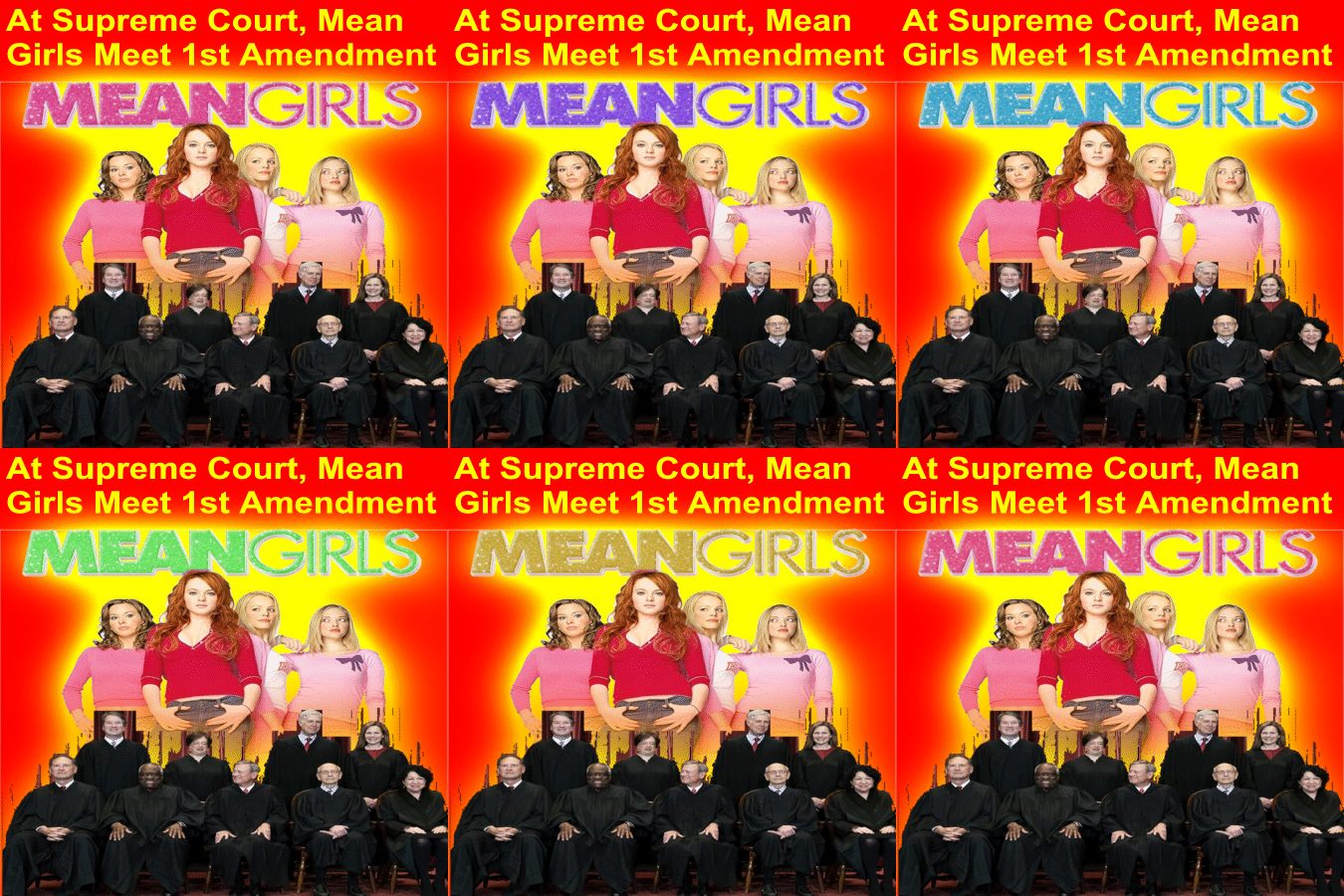
At Supreme Court, Mean Girls Meet 1st Amendment : NPR

At Supreme Court, Mean Girls Meet 1st Amendment : NPR
At Supreme Court, Mean Girls Meet 1st Amendment


Even Supreme Court advocates can look at a case before the court with their own teenage years in mind. And lawyer Gregory Garre sums up Wednesday's case this way: "Mean girls meet the First Amendment."

More than a half-century ago, the court, in a 7-to-2 vote, ruled that students do have free speech rights at school, unless the speech is disruptive. Now, the justices are being asked to clarify whether, in the internet age, schools can punish students for off-campus speech.

The case was brought by a 14-year-old high school cheerleader, Brandi Levy. A freshman on the junior varsity cheerleading team, Brandi failed to win a spot as a varsity cheerleader for the following year, and she failed to get the position she wanted on the softball team too. So that weekend, frustrated and upset — and off campus — Brandi took a photo of herself and a friend flipping the bird to the camera. She then typed the words at the center of this dispute: "F*** school f*** softball f*** cheer f*** everything."

"I posted it on my Snapchat, so I was expecting everyone to see it," she says. Still, she CONTINUE READING: At Supreme Court, Mean Girls Meet 1st Amendment : NPR

Friday, March 19, 2021

Flast v. Cohen (1968) - Part Four: Oh No I've Said Too Much... | Blue Cereal Education

Flast v. Cohen (1968) - Part Four: Oh No I've Said Too Much... | Blue Cereal Education
Flast v. Cohen (1968) - Part Four: Oh No I've Said Too Much...


Issue of StandingI’ve been posting some of my rough drafts for a book I hope will be out this summer, tentatively titled “Have To” History: It Followed Her To School One Day… and with a subtitle longer than several of the actual chapters in my effort to clarify what it’s about right there on the cover while still being saucy. What started off as a one-pager for the case of Flast v. Cohen (1968) became a rambling summary of “standing” issues in church-state cases related to public education, which I’ve been sharing here as it develops.

Flast was and is still important, as is the handling of “standing” over the past century in these “wall of education” cases. I will, however, definitely be breaking down this information differently than what you’re seeing here. This is driven by (a) my belief in clarity and easy reference, and (b) a burning desire to sell more than four copies.

Standing UpIn the meantime, here’s the rest of my initial mess and then it’s time to move on. You know what they say: nothing Flast forever.

Yeah, that’s not going in the book either…

In case you’re just now joining the party, you might as well start with Part OnePart Two, and Part Three.

“School Choice” and Taxpayer Standing

The numerous “school choice” cases best typified by Zelman v. Simmons-Harris CONTINUE READING: Flast v. Cohen (1968) - Part Four: Oh No I've Said Too Much... | Blue Cereal Education

Saturday, March 13, 2021

Flast v. Cohen (1968) - Part Three: Consider This The Hint Of The Century | Blue Cereal Education

Flast v. Cohen (1968) - Part Three: Consider This The Hint Of The Century | Blue Cereal Education
Flast v. Cohen (1968) - Part Three: Consider This The Hint Of The Century


Recap of Part One:

Tax TimeThe Supreme Court explained in Commonwealth of Massachusetts v. Mellon (1923) that simply being a taxpayer didn’t give one the right to protest government actions – even potentially unconstitutional ones – in the courts. There were simply too many “what ifs” between the individual taxpayer sending in their $20 and any one specific expenditure.

In the 1960s, the Court began framing the Establishment Clause as something fundamentally different than the other protections in the Bill of Rights. As a result, arguments that this particular clause was being violated were sometimes handled with a different set of rules than other types of claims.

Recap of Part Two:

In Flast v. Cohen (1968), a group of taxpayers objected to the use of public funds to provide secular textbooks for sectarian schools. With any other issue, being taxpayers wouldn’t be sufficient to establish standing. When it came to Establishment Clause issues, however… maybe it kinda was?

The Supreme Court determined that there was nothing in the Constitution barring federal taxpayers from challenging taxing and spending they believed to be unconstitutional when they could demonstrate their fundamental constitutional rights were being violated in the process. In practice, this turned out to apply only when the Establishment Clause was involved. Establishment violations can also occur for non-taxpayers based on “unwanted exposure” to government-promoted religious messages.

The “Lemon Test” informally established in Lemon v. Kurtzman (1971) set up a three-part checklist for determining whether or not a government action was constitutional: it must have a valid, secular legislative purpose, it’s principal effect can neither inhibit nor advance religion, and it must not create an “excessive government entanglement” CONTINUE READING: Flast v. Cohen (1968) - Part Three: Consider This The Hint Of The Century | Blue Cereal Education

Tuesday, March 9, 2021

Flast v. Cohen (1968) – Part Two: That’s Me In The Courtroom | Blue Cereal Education

Flast v. Cohen (1968) – Part Two: That’s Me In The Courtroom | Blue Cereal Education
Flast v. Cohen (1968) – Part Two: That’s Me In The Courtroom


Recap of Part One:

Losing My ReligionThe Supreme Court explained in Commonwealth of Massachusetts v. Mellon (1923) that simply being a taxpayer didn’t give one the right to protest government actions – even potentially unconstitutional ones – in the courts. There were simply too many “what ifs” between the individual taxpayer sending in their $20 and any one specific expenditure.

Nevertheless, plaintiffs – at least in Establishment cases – tended to reference the fact that they were taxpayers in their complaints against government actions over the next several decades, even if they were also parents of students being impacted. It was rarely the focus on the Court’s decisions, but it kinda kept coming up.

In the 1960s, the Court began framing the Establishment Clause as something fundamentally different than the other protections in the Bill of Rights. As a result, arguments that this particular clause was being violated might have to operate according to a slightly different set of rules than the rest.

Finally, in 1968, the Court did its best to explain exactly what that might look like, at CONTINUE READING: Flast v. Cohen (1968) – Part Two: That’s Me In The Courtroom | Blue Cereal Education

Thursday, February 25, 2021

David Berliner: Why Religious Schools Should Never Receive a Dollar of Public Funding | Diane Ravitch's blog

David Berliner: Why Religious Schools Should Never Receive a Dollar of Public Funding | Diane Ravitch's blog
David Berliner: Why Religious Schools Should Never Receive a Dollar of Public Funding


Since the 2020 election, when Republicans won many seats in state legislatures, there has been an explosion of proposed voucher laws, to allow people to get public money to pay for religious schools. David Berliner, one of our nation’s most distinguished researchers of education, explains why funding religious schools with public money is a terrible idea.

Why Religious Schools Should Never Receive a Dollar of Public Funding

David C. Berliner Regents’ Professor Emeritus

Mary Lou Fulton Teachers College Arizona State University

I believe in separation of church and state. I think it has done the United States a lot of good to honor Jefferson’s metaphoric and aspirational “wall” between the two. I also believe that money corrupts too many people and too many institutions. Holding those two beliefs simultaneously means 1.) I never want to see any local, state, or federal money used to aide any religious group, and 2.) I don’t want to see any religious group, or affiliated religious organizations, donating to the campaigns of public officials. The latter may be impossible to stop in an era of “dark money.” But the former—government support of religious institutions– is almost always done in public view and is worth stopping CONTINUE READING: David Berliner: Why Religious Schools Should Never Receive a Dollar of Public Funding | Diane Ravitch's blog

Sunday, February 14, 2021

What's In A Blaine? | Blue Cereal Education

What's In A Blaine? | Blue Cereal Education
What's In A Blaine?


I've written about the Blaine Amendment before in the context of Oklahoma GOP shenanigans a few years back. This time around, I'm looking to go a bit 'bigger picture' and give it a brief chapter in "It Followed Her To School One Day," which might actually be finished before summer. Below is the first draft of that chapter.

The final product will be tighter (this one's too long) and less ranty-ravee about things.While I'm not going for detached and boring in the book, I will shoot for something a bit more balanced and accessible to the average reader. This is not an ethical decision so much as capitalistic lust. I mean, let's be honest - conservative dollars spend the same as liberal dollars, and they have WAY more of them, so no sense alientating them right out of the gate. Keep it subtle, so they can be offended and horrified after it's too late to return it.

Here with you, however, my Eleven Faithful Followers, I can share my unfiltered wisdom with spices and color intact. 

What's In A Blaine?

Blaine GatorsWhile it was not always mentioned by name, several major decisions of the Court in the early 21st century very much involved the history and potential future of the “Blaine Amendment.” Blaine is a general label applied to various provisions in 37 different state CONTINUE READING: What's In A Blaine? | Blue Cereal Education

Tuesday, January 19, 2021

School choice lawsuit surge pushes possible high court fight

School choice lawsuit surge pushes possible high court fight


Vermont is facing at least its second lawsuit in four months over a voucher program that allows students in communities that don't have schools or are not part of supervisory unions to attend schools of their choice, including approved private institutions.

The Vermont system in which certain towns pay tuition for students to attend other schools is unconstitutional because it's not available to all students in the state, according to the Liberty Justice Center, a Chicago-based national nonprofit law firm that fights for school choice. If the lawsuit succeeds, officials at the nonprofit say they will file legal challenges in other states with similar school choice programs. But critics say the lawsuit is a veiled attempt to get a case to the U.S. Supreme Court, where conservative judges hold six of nine seats, to get more public funding into private education, including religious schools.

The Vermont suit comes six months after a divided U.S. Supreme Court ruled in a Montana case that states can't cut religious schools out of programs that send public money to private education. Following that decision, three Vermont families filed a lawsuit in September in federal court, saying that denying them the state tuition benefit to send their children to religious schools is unconstitutional.


A similar lawsuit challenging Maine’s exclusion of religious schools from a high school tuition voucher program was denied by the 1st U.S. Circuit Court of Appeals and the parents challenging the law and their attorneys have vowed to appeal the decision to the U.S. Supreme Court. Another lawsuit was filed in New Hampshire.

Maine and New Hampshire have similar programs for students who live in communities without schools to attend public or non-religious private schools of their choice.

In light of the U.S. Supreme Court decision in the Montana case, the federal appeals court granted an injunction on Friday to stop Vermont from excluding a high school student who attends a religious school from taking college classes under the state’s dual enrollment CONTINUE READING: School choice lawsuit surge pushes possible high court fight

Friday, November 20, 2020

Derek Black: State Courts Turn Back Voucher Cases | Diane Ravitch's blog

Derek Black: State Courts Turn Back Voucher Cases | Diane Ravitch's blog
Derek Black: State Courts Turn Back Voucher Cases


Derek W. Black is a professor of constitutional law who specializes in civil rights issues at the University of South Carolina. His recent book Schoolhouse Burning: Public Education and the Assault on American Democracy is a must-read.

Black writes here in an essay written for this blog about recent voucher cases in state courts:

This summer in Espinoza v. Montana Department of Revenue, the US Supreme Court struck down the provision in the Montana state constitution that prohibited aid to religious schools as a violation of free exercise of religion.  Some public education advocates understandably feared the sky was falling. Voucher advocates hailed Espinoza as a “major win” and began strategizing how they might expand the decision and leverage it in other contexts.  Most notably, the plan they envisioned would use Espinoza to force states to allow religious institutions to operate charter schools.  If they achieved that, public education might not only be privatized, it might become religious.

Far less attention has been paid to the string of state constitutional victories striking down voucher programs and respecting states’ decision to limits on the use of CONTINUE READING: Derek Black: State Courts Turn Back Voucher Cases | Diane Ravitch's blog

Saturday, November 14, 2020

Board of Education of Kiryas Joel Village School District v. Grumet (1994) – Part Three | Blue Cereal Education

Board of Education of Kiryas Joel Village School District v. Grumet (1994) – Part Three | Blue Cereal Education
Board of Education of Kiryas Joel Village School District v. Grumet (1994) – Part Three


I’m discovering as I continue to draft a follow-up to “Have To” History: Landmark Supreme Court Cases that it’s more and more difficult to keep things succinct as subject matter nears the 21st century. I’m sharing a few rough drafts along the way partly in hopes a few of you, my Eleven Faithful Followers, might find them interesting, and partly because nothing highlights the problems in a text like posting it live for all the world to see.

Some version of this Talmudic Tale will likely be in the upcoming book. Chances are good, however, that the final results will be considerably more succinct.

Recap of Parts One & Two:  Kiryas Joel was (and is) a community of particularly insular Hasidic Jews (the Satmars) in New York. Most of their children attended private religious schools, but they asked the state for assistance providing care and education for their special needs children. Initial efforts to serve these particular children rand into conflict with recent Supreme Court rulings which struck down several public school efforts to serve high needs kids in religious institutions. New York responded by allowing the Satmars to create their own neighborhood and later a publicly funded neighborhood school tailored to their precise boundaries. The Supreme Court struck CONTINUE READING: Board of Education of Kiryas Joel Village School District v. Grumet (1994) – Part Three | Blue Cereal Education

Thursday, November 12, 2020

Board of Education of Kiryas Joel Village School District v. Grumet (1994) – Part Two | Blue Cereal Education

Board of Education of Kiryas Joel Village School District v. Grumet (1994) – Part Two | Blue Cereal Education
Board of Education of Kiryas Joel Village School District v. Grumet (1994) – Part Two


I’m discovering as I continue to draft a follow-up to “Have To” History: Landmark Supreme Court Cases that it’s more and more difficult to keep things succinct as subject matter nears the 21st century. I’m sharing a few rough drafts along the way partly in hopes a few of you, my Eleven Faithful Followers, might find them interesting, and partly because nothing highlights the problems in a text like posting it live for all the world to see.

Some version of this Talmudic Tale will likely be in the upcoming book. Chances are good, however, that the final results will be considerably more succinct – which is both necessary and a tiny bit sad.

Recap of Part One:  Kiryas Joel was (and is) a community of particularly insular Hasidic Jews (the Satmars) in New York. Most of their children attended private religious schools, but they asked the state for assistance providing care and education for their special needs children. Initial efforts to serve these particular children ran into conflict with recent Supreme Court rulings which struck down several public school efforts to serve high needs kids in religious institutions. New York responded by allowing the Satmars to create their own neighborhood and later a publicly funded neighborhood school tailored to their precise boundaries.  

As a practical matter, it certainly solved the problem. Constitutionally, on the other hand...

Kiryas Joel Students

Larkin v. Grendel’s Den (1982)

Just a decade before, the Supreme Court had ruled on a case having absolutely nothing to do with religious enclaves or public education, but which would nevertheless complicate the lives of the Satmars just as things were looking up for their special- CONTINUE READING: Board of Education of Kiryas Joel Village School District v. Grumet (1994) – Part Two | Blue Cereal Education

Tuesday, November 10, 2020

Board of Education of Kiryas Joel Village School District v. Grumet (1994) – Part One | Blue Cereal Education

Board of Education of Kiryas Joel Village School District v. Grumet (1994) – Part One | Blue Cereal Education
Board of Education of Kiryas Joel Village School District v. Grumet (1994) – Part One


I’m discovering as I continue to draft a follow-up to “Have To” History: Landmark Supreme Court Cases that it’s more and more difficult to keep things succinct as subject matter nears the 21st century. There’s so much relevant context for each case and potential applications are far more immediate… it’s difficult at times to know what’s essential and what’s not. 

I’m sharing a few rough drafts along the way partly in hopes a few of you, my Eleven Faithful Followers, might find them interesting, and partly because nothing highlights the problems in a text like posting it live for all the world to see. Some version of this material will likely be in the upcoming book. Chances are good, however, that the final results will be considerably more succinct – which is both necessary and a tiny bit sad. 

Getting Hasidic With It

Three Big Things:

1. In an effort to accommodate a particularly insular community of Hasidic Jews (the Satmars), the State of New York created a neighborhood and later a publicly funded neighborhood school tailored to their precise boundaries. Most children attended CONTINUE READING: Board of Education of Kiryas Joel Village School District v. Grumet (1994) – Part One | Blue Cereal Education

Saturday, October 17, 2020

Indiana: ACB Served on the Board of a School That Discriminated Against Gays | Diane Ravitch's blog

Indiana: ACB Served on the Board of a School That Discriminated Against Gays | Diane Ravitch's blog

Indiana: ACB Served on the Board of a School That Discriminated Against Gays


Steve Hinnefeld, a regular commentator on education in Indiana, regrets that Amy Coney Barrett was not asked about vouchers during her hearings.
He notes that she served on the board of a Catholic school in Indiana that received state voucher funds and that openly discriminated against same-sex families.
Barrett served from 2015-17 on the board of Trinity School at Greenlawn, a South Bend Catholic school, the New York Times reported. Trinity had a policy during Barrett’s time on the board that effectively prohibited same-sex couples from enrolling their children in the school, according to the Times.
That would seem to cast doubt on Barrett’s claim in her confirmation hearing that she had “never discriminated on the basis of sexual preference” and would not do so. It also raises policy questions about whether publicly funded institutions should practice discrimination. READ MORE: Indiana: ACB Served on the Board of a School That Discriminated Against Gays | Diane Ravitch's blog

An Originalist Reading of Public Schools | gadflyonthewallblog

An Originalist Reading of Public Schools | gadflyonthewallblog

An Originalist Reading of Public Schools


Let’s say you went to a restaurant and ordered a big ol’ meat sandwich only to find nothing but straw between two pieces of bread.
“Waiter!” You say, calling over a server.
“What’s wrong, Sir?”
“There’s no meat in my sandwich.”
“Oh, Sir?” He says smiling, examining your plate. “Here at Scalia’s Bar and Grill we adhere to a strict originalist interpretation of language.”
“What does that have to do with my sandwich?”
“Well, Sir, in Old English ‘meat’ meant any solid food, anything other than drink. As in ‘A Journey to the Western Islands of Scotland’ (1775), Samuel Johnson noted, ‘Our guides told us, that the horses could not travel all day without rest or meat.’”
“But that’s not what I ordered!”
“Oh yes it is, Sir. You ordered CONTINUE READING: An Originalist Reading of Public Schools | gadflyonthewallblog

Friday, October 16, 2020

For Defining the Right to Public Education, Constitutional Originalism Doesn’t Work | janresseger

For Defining the Right to Public Education, Constitutional Originalism Doesn’t Work | janresseger

For Defining the Right to Public Education, Constitutional Originalism Doesn’t Work


For a couple of weeks now, since the publication of Derek Black’s history of the constitutional basis for American public education, this blog has been reflecting on the meaning of constitutional principles in our nation’s founding documents and the 50 state constitutions for defining the role and meaning of our nation’s system of public schools.  (See herehere, and here.)
This blog will take a one week break.  Look for a new post on Monday, October 26, 2020
.
But this week, Judge Amy Coney Barrett, who defines herself as a constitutional originalist, went through hours of Senate confirmation hearings leading to a Senate vote on her confirmation in the next week or two as President Trump’s latest appointment to the U.S. Supreme Court. All week we have been considering what it means for our society today when members of the U.S. Supreme Court define themselves as originalists who are bound to interpret the constitutionality of today’s laws according to the precise wording of the U.S. Constitution of 1787.
The other day when Chicago Mayor Lori Lightfoot, trained in the law and formerly a federal prosecutor, was asked whether she is an originalist, Mayor Lightfood replied: “You ask a gay, black woman if she is an originalist? No, ma’am, I am not. The Constitution didn’t consider me a person… because I’m a woman, because I’m black, because I’m gay.  I am not an originalist. I believe in the Constitution. I believe that it is a document that the founders intended to evolve and what they did was set the framework for how our country was going to be different from any other. But originalists say that, ‘Let’s go back to 1776 and whatever was there in the original language, that’s it.’ That language excluded, now, over 50 percent of the country. So, no I’m not an originalist.”
Like Mayor Lightfoot, many people today worry about originalist legal interpretation.  In CONTINUE READING: For Defining the Right to Public Education, Constitutional Originalism Doesn’t Work | janresseger

Thursday, October 8, 2020

Five reasons the Supreme Court matters for educators and public schools - Education Votes

Five reasons the Supreme Court matters for educators and public schools - Education Votes

Five reasons the Supreme Court matters for educators and public schools


By Amanda Meanas
Instead of waiting until the American people have had their say and the next president is inaugurated, President Donald Trump and the GOP-led Senate are determined to rush through Trump’s Supreme Court nominee. Those efforts led to a COVID-19 “super spreader” event at the White House. More than 20 people, including the president, tested positive soon after the event.
Voters should decide who fills Justice Ginsburg’s seat. But Senate Republicans are attempting to rush through President Trump’s nominee, Amy Coney Barrett, even though they have dragged their feet and failed to pass coronavirus relief legislation that would help so many Americans and public school systems across the country.
“Judge Amy Coney Barrett has sided with the powerful and well-connected throughout her career. … She has sided with the powerful against workers, allowed racially segregated workplaces, ruled in favor of Trump policies harming immigrants, and against those seeking to protect women from sexual assault,” said former science teacher and NEA President Becky Pringle.
The Supreme Court is a critical institution in our federal government for protecting the rights of those who might otherwise not have a voice in our institutions. That means the next justice absolutely must not be beholden to partisan or corporate interests.
Here are five reasons the Supreme Court and the nomination of Amy Coney Barrett matter for educators:

1. Judge Barrett wants to repeal the Affordable Care Act

In her short three years as a federal judge, Barrett’s record was alarming, and she has promised to continue to side with corporations over working people. While Americans continue to struggle through the global coronavirus pandemic, access to healthcare is at the forefront of conversation.If Barrett is confirmed, she is poised to strike down the Affordable Care Act, throwing millions off their insurance and ending protections for those with preexisting conditions. In fact, for the 7 million Americans who have battled COVID-19, those side effects could now be considered preexisting conditions.

2. The Supreme Court will vote on workers’ rights to join and form unions<

Educators could face increased difficulty in holding their employers accountable for illegal discrimination and unfair employment practices if Barrett is confirmed. During her time in the lower court, Judge Barrett limited workers’ tools to fight against racial discrimination in the workplace, wrote in favor of age discrimination when applying to jobs, and worked to set dangerous precedent that would hurt gig workers. The Court already weakened the rights of educators to collectively bargain in 2018, and the nomination of Barrett means unions will face CONTINUE READING: Five reasons the Supreme Court matters for educators and public schools - Education Votes