Transcript of Video Critiquing Edunomics Graphs
-
“Make it stop! Please!” — Video debunking of Edunomics intentionally
deceitful school funding/outcome graphs Source: School Finance 101 (Bruce
Baker), publ...
MORNING NEWS UPDATE: AUGUST 29, 2026
-
*MORNING NEWS UPDATE: AUGUST 29, 2026REMEMBER IN NOVEMBER*
*Top news stories for August 29, 2026 (Saturday), drawn from major outlets
including AP, Re...
Seattle Schools and The Next Budget
-
I have not one, not two, but three budget analyses about SPS' budget.
Finance is not my forte so I am very grateful for this in the weeds,
in-depth work....
THE HUMANITIES
-
Get tickets for THE HUMANITIES at Victory Gardens Theater: The Humanities
is a provocative play by Zayd Ayers Dohrn in which faculty and students at
an eli...
The Light She Left Behind
-
“Those we love don’t go away, they sit beside us every day.” — Liane
Moriarty, Big Little Lies Forgive us if we are a little sad here in
Tennessee. We lost...
Band Kids. They’re the Best.
-
I can’t add anything to the outpouring of love and respect for Dolly
Parton. She was phenomenal, in dozens of ways. As a musician, I appreciate
her melodic...
"The Truth Will Make Me Free"
-
*Man is nothing else, but what he makes of himself.* ~Jean-Paul Sartre
Among the founding principles of our American democracy is the ideal that
we eac...
When ‘Parental Rights’ Means Letting a Child Die
-
In a new investigative report, ProPublica has identified at least 15 babies
and children in Idaho who died between 2015 and 2025 from conditions
doctors sa...
The Great and Irreplaceable Dolly Parton
-
If the state of the world has you down, here’s a reprieve, two interviews
with the great Dolly Parton. The first is my extended interview with her,
13 yea...
Who Wants a Raise?
-
Everyone. And if you are a UFTer (and not a retiree), you are getting one.
But get this. A new paraprofessional is getting a raise of $803/year. Man,
do th...
Nashville Public Schools Hall of Fame
-
The Nashville Public Education Foundation (NPEF) will hold an event on
Thursday, August 27th to honor this year’s inductees into the Public
Schools Hall of...
Research Studies Of The Week
-
I often write about research studies from various fields and how they can
be applied to the classroom. I write individual posts about ones that I
think a...
AI Bogus EdTech Scheme
-
By Thomas Ultican 8/24/2026 Big technology oligarchs are pushing their
dangerous not-ready-for-prime-time artificial intelligence (AI) products
into Americ...
What Is the Far Left ?
-
What is the Far Left ?
The growing visibility of Democratic Socialists of America (DSA) and
victories by some DSA-backed candidates has triggered an upsu...
SQ 844: How is this better?
-
In plain terms, the new language gives the Legislature the authority to
establish both the amount and methodology for distributing ad valorem
reimbursement...
-
It's time to Revise Louisiana's
School Curriculum
Present standards do not allow for individual differences and life goals
For the last 15 years Louisiana'...
Time to change our Nation’s Diaper
-
It’s time to change our nation’s diaper. Our national identity now reeks
due to our inability to clean out the mess caused by the Orange Turd.
Corruption i...
GLP-1 Meds for Kids? Some Info.
-
Like many consumers of television and social media, I have been bombarded
with ads for GLP-1s (short for glucagon-like peptide-1). The ads are
everywhere. ...
By One Dishonest Measure
-
A loaded question that education reformers like to ponder is: Exactly how
many students in the boroughs of New York City are trapped in failing
schools? In...
1776
-
__________
“The fate of unborn millions will now depend, under God, on the courage and
conduct of this army…. We have, therefore, resolved to conquer...
May’s Parent Engagement Resources
-
San Diego Unified Created a System to ‘Empower’ Parents. It Unraveled is
from The Voice of San Diego. Why Those Disengaged Parents in Your School
Deserve a...
Reflections on America, the world, and life
-
I acknowledge that I rarely post here anymore. Folks should remember that I
am approaching my 80th birthday in less than 9 weeks, I am still teaching
ful...
Shutting Down The Site
-
Ten years ago, I ran for a seat on the LAUSD School Board of Education with
the goal to *Change the LAUSD*.
I am proud of the campaign we ran. We achieve...
Blogoversary #19 — Time to Move on
-
Times have changed. I had a nice long run here, but let’s face it, it ended
a while ago. So I’ve moved. I’m not writing much any more, but when I do it
wil...
Il Papa è Morto
-
Francis brought a distinct pastoral outlook to his papacy. A simple man, he
lived in a small apartment in the guesthouse. He sought to make the church
acce...
Mike Shulman the ARISE UFT Judenrat
-
I was surprised to learn that Mike Shulman has aligned himself with ARISE.
I previously supported him, advocating that the Castle Doctrine could have
bee...
AIN’T IT AWFUL
-
As the terrible feelings of dread and angst spread across the world the
great majority of the American people feel powerless before the onslaught
of those ...
Vote NO on the UFT Contract. Here is Why:
-
The best reason to vote no on this contract is this: UFT Unity* lied* to us
in 2018. They misrepresented that contract. It was predicated on deals we
wer...
Testimony to the CPS Truancy Task Force
-
I prepared testimony for one of two public hearings held by the Chicago
Public Schools Truancy Task Force, a body mandated by state legislation.
The meetin...
There Is A Teacher Shortage.Not.
-
THERE IS A TEACHER SHORTAGE. And just to be sure you understand, it’s not
that teachers don’t want to teach. It’s not that there aren’t enough
teachers cer...
Book Banning Turns to Dick and Jane
-
Breaking News: Dateline February 4, 2022 - Parents in Dimwitty, Alabama
have asked the Dimwitty Board of Education to ban the children's primer *Fun
with...
Have You Heard Has a New Website
-
TweetHave You Heard has a new website. Visit us at
www.haveyouheardpodcast.com to find our latest episodes and our entire
archive. And be sure to check out...
Follow me at Substack
-
I've moved. Follow me at Substack
I'm now posting regularly at Substack. You can subscribe for free to my new
Edu/Pol blog at michaelklonsky.substack.com
...
I’ve moved.
-
I’m on Substack now. You can continue to receive periodic posts for free.
Or you can read every post and comment for $5 a month, $60 a year.
fredklonsky.su...
Aspiring Teachers Get New Help Paying For College
-
[image: colorful classroom pattern]
*; Credit: shuoshu/Getty Images*
Cory Turner | NPR
New rules kick in today that will help aspiring teachers pay for c...
Tips Akses Situs Judi Qq Tanpa Perlu Takut Nawala
-
Kegiatan berjudi slot melalui situs judi qq online, sekarang sudah
dilakukan oleh banyak penjudi Indonesia. Tentu, Kamu yang sedang membaca
artikel ini a...
The Threat of Integration
-
I have lived in the same house in the Miracle Mile section of Los Angeles
for over 30 years, where up until now I have had little or no interaction
with th...
We fight for a democracy worthy of us all!
-
The nation stands at a crossroads, said NEA President Lily Eskelsen García
in her final keynote address to the 2020 NEA Representative Assembly and
it’s up...
The Passing Of Chaz 1951-2020 Age 69
-
I am the son of Chaz and like to inform you that he passed away this
afternoon from the COVID virus. My father passed in peace beside his loved
ones. We ar...
The Fight For Our Children
-
*The number of suicides among people ages 10 to 24 nationally increased by
56 percent between 2007 and 2017, according to a new federal report showing
the ...
Read to Self: Just a Kid and a Book.
-
Date: Monday, January 5, 2020 Place: My classroom Student: Mrs.Mims, could
we start doing Read to Self again because I got this great book for
Christmas an...
Reminiscences
-
I just finished dumping the rest of my lesson plans. I guess I held on to
the calculus ones for so long because I spent so much time working on them
an...
Just Asking for some Teachers I know.
-
Recently Wisconsin Governor Tony Evers stated, We must … recognize that
part of supporting our kids in the classroom means supporting the educators
who t...
Cara Menang Bermain Judi Bola Online
-
Bermain judi bola online tentu saja memiliki kesenangannya tersendiri baik
itu mendapatkan keuntungan maupun ketika menantikan hasil skor pada sebuah
perta...
A Critique of Standards-Based Grading
-
It first happened to me about ten years ago. I was beginning my third year
of teaching in a new school in Washington, DC. Social studies teachers were
si...
Reduced time for testing? Not so fast.
-
NYSED and Commish Elia continue to say that the NYS Assessments are of
reasonable length, I completely disagree.
Here is what NYSED states are average expe...
The World According to Michelle Rhee
-
The men behind the curtain fashioning the brave new world of corporate run
education in America! Michelle Rhee is the founder of StudentsFirst, The
New T...
Whose Opinions Matter in Education World?
-
It's hard to identify education heroes and sheroes. And perhaps even harder
to pinpoint just whose work is slanted, paid-for and dishonest.
New Local Businesses in Sacramento
-
Starting a new local business in Sacramento is a monumental task, but can
be accomplished with footwork, perseverance and knowledge. One must learn
the loc...
Lesson Plan: Rhyme and Rhythm in Poetry
-
I’ve started a recent unit on poetry with my class. I’m not a poet, and I’m
not a poetry fan (I don’t hate it, but I’m a prose gal), so this makes it
harde...
The Apotheosis of Betsy DeVos
-
Betsy Devos has drawn few headlines in recent months, and that is a good
thing for the Secretary of Education. Her tenure began with Vice President
Mike P...
Education Is a Civic Question
-
In their final post to end Bridging Differences' decade-long run, Deborah
Meier and Harry Boyte urge readers to put the energy, talents, wisdom, and
hard w...
Site News: New Home for Education News & Commentary
-
Quick! Get over there! The daily education news roundup and education
commentaries that you're probably looking for are now being published over
at The Gra...
Should We Be Grateful?
-
In an odd turn of events, and with little explanation, Michigan Governor
Rick Snyder has decided to return the state’s School Reform Office back to
the Dep...
An Open Letter to NC Lawmakers
-
An Open Letter to NC State Lawmakers and NC State Superintendent Mark
Johnson: I am a NC native, voter, and public school teacher. I am
addressing you all ...
The Secret to Fixing Schools (My Next Bestseller)
-
The Secret to Fixing Schools (My next bestseller) Prologue I just finished
watching a fascinating documentary on Netflix entitled, “The Secret”. The
film p...
Farewell, Sleep
-
Today is the official last day of my spring break. I've done a scientific
survey: My natural bedtime is 2 AM, and my natural wake up time is 9:41
AM. Tom...
REPORT: States With the Best and Worst Schools
-
States With the Best (and Worst)Schools
By *Evan Comen, Michael B. Sauter, Samuel Stebbins and Thomas C. Frohlich*
January 20, 2017- http://247wallst.com
...
Test Refusal = People Power
-
In recent months, social media has been ablaze with talk of regular folk
taking action to resist the Trump agenda. Protests are a daily occurrence,
and ev...
Random Musings and Observations. . . .
-
I’ve been gone a while from the blogging scene. Some of my more regular
readers no doubt noticed but did not hassle me about it. Thank you for
that. Sinc...
AB 934: A LEGISLATIVE FIX FOR VERGARA?
-
By Michael Stratford | in the Politco Morning Education Report | via email
05/24/2016 10:00 AM EDT :: Two national education groups are backing a
Califor...
MY NEW BLOG
-
My new blog will consist of fictitious headlines, meant to be a blend of
humor and satire. I apologize ahead of time if any other satirical site has
simila...
Thank you
-
Dear Readers,
Thank you for visiting *The Perimeter Primate*. This blog is being retired
for the time being. Although I no longer post here, I do still s...
I am Retiring
-
I have some news: I am retiring from the PBS NewsHour and Learning Matters.
[[ This is a content summary only. Visit my website for full links, other
conte...
New Beginnings: Kickstarter and EdWeek Teacher
-
Greetings to InterACT readers one and all! If you’ve been following posts
here recently you might recall that I’m moving my blogging activity to
other loca...
Adelaide L. Sanford Charter School
-
*“With Adelaide L. Sanford Charter School closing, Newark families must
move on.”* The Star-Ledger (NJ), 6/25/2013
NEWARK — Bobby and Troy Shanks saw the...
Laura Chapman: When Bankers Lead Education “Reform”
Our brilliant reader Laura Chapman, retired educator, decided to dig deep into the politics of education reform in Minnesota in response to a post about a dubious constitutional amendment sponsored by the Federal Reserve Bank.
Chapman, who lives in Ohio, writes:
I am not from Minnesota, but this post sent me deep into some policies there. The idea is to frame education as a fundamental right to “quality schools” as “measured against uniform achievement standards set forth by the state.”
No. This law is written as if the standard-setting process is a business-as usual-review of existing standards and benchmarks for learning, with periodic revisions. It is not.
Joe Biden’s Golden Opportunity to Strengthen Public Education
In picking Connecticut Commissioner of Education Miguel Cardona to be his nominee for U.S. secretary of education, President-elect Joe Biden appears to have made a Goldilocks choice that pleases just about everyone. People who rarely agree on education policy have praised the decision, including Jeanne Allen, CEO of the Center for Education Reform, a nonprofit group that advocates for charter schools and school choice, who called Cardona “good news,” and education historian Diane Ravitch, who also called the pick “good news” because he does not seem to be aligned with advocates for charter schools and vouchers. Sara Sneed, president and CEO of the NEA Foundation, a public charity founded by educators, called Cardona an “ideal candidate,” in an email, and hailed him for “his emphasis on the need to end structural racism in education and for his push for greater educational equity and opportunity through public schools.”
But as Biden and Cardona—should he be approved, as most expect—begin to address the array of critical issues that confront the nation’s schools, there’s bound to be more of a pushback. Or maybe not?
After years of federal policy malpractice, the nation is eager for a fresh agenda for public schools.
After decades of federal legislation that emphasized mandating standardized testing and tying school and teacher evaluations to the scores; imposing financial austerity on public institutions; incentivizing various forms of privatization; and undermining teachers’ professionalism and labor rights, there is a keen appetite for a new direction for school policy.
Today, our featured Black Educator is Dr. Inez Beverly Prosser.
Dr. Inez Beverly Prosser is a testimony of striving for excellence while dedicating one’s self to the education and empowerment of others.
Prosser was born in 1897 in Texas; one of eleven children. She graduated from the Yoakum Colored High School and the Prairie View Normal College; she was valedictorian at both schools. After graduation, Prosser began a teaching career, first in Yoakum’s segregated schools and then in Austin.
But, Prosser almost didn’t make it to college. Her parents thought they would only be able to afford to send one of their eleven children to college. They CONTINUE READING:
Elizabeth Thorn Scott Flood was an eduactivist who made her own way for her own children and the Black children of her community. Born in 1828 in New York, Flood was educated in New Bedford, Massachusetts. Flood and her first husband moved to California during the gold rush. The couple settled in Sacramento with their young son, before her husband died suddenly.
When Flood tried to enroll her son in the public schools, she was refused and met many other Black and Brown parents whose children had also been turned away from “public” schools. Therefore, Flood decided to open her own school for her son and the sizable Black population in the city. She opened the school in her home and eventually opened the school to Indigenous and Asian American students. Flood served as a teacher and principal of the school. Within three months, she needed to move to a larger space and found it in the basement of St. Andrew’s Church. Her students’ ages ranged from four year olds to twenty-nine year olds. As always, Black people recognized CONTINUE READING: ELIZABETH THORN SCOTT FLOOD, BLACK EDUCATOR HALL OF FAME
The House Budget Committee has pulled together committee-approved components of President Biden’s COVID-19 package, creating a single bill that will come to the House floor this week; action could continue through the weekend. The Senate plans to take up the House-passed bill the week of March 1. Democrats are pushing to enact the legislation before March 14, when unemployment benefits for more than 11 million workers begin to expire.
The current House bill includes NEA’s top priorities: $170 billion in dedicated education funding to help advance the process of safely returning to in-person instruction at K-12 public school buildings, college campuses and universities; $350 billion in state and local aid to avoid further layoffs of educators and other essential public servants; and $7 billion to address an aspect of the digital divide known as the homework gap—the inability to do schoolwork at home due to lack of internet access—via the E-Rate program administered by the Federal Communications Commission (FCC).
NEA is also pushing to require all employers to provide paid sick leave for the duration of the pandemic. Sixty percent of U.S. workers do not have access to paid sick leave through their employers, including many education support professionals. TAKE ACTION
New immigration bill provides pathways to citizenship
President Biden’s promise “to restore humanity and American values to our immigration system” is the basis for the U.S. Citizenship Act introduced Feb. 18 in both the Senate and the House. The bill would provide legal status and pathways to citizenship for Dreamers—people brought to the United States as minors who know no other country as home—and others allowed to remain here for humanitarian reasons.
“The introduction of the U.S. Citizenship Act of 2021 is a necessary and good step towards transforming America’s inhumane immigration system into one that is more humane, functional, and centered in racial justice, and respects all people, regardless of race, religion, or birthplace,” said NEA President Becky Pringle. She noted that those who would benefit include “an estimated 15,000 educators who have continued to provide and sustain student learning during the pandemic.”
For participants in Deferred Action for Childhood Arrivals (DACA) and Temporary Status Holders (TPS) since Jan. 1, 2017, the pathway to citizenship would be three years. For undocumented individuals in the United States since Jan. 1, 2021, the pathway to citizenship would be eight years—temporary status for five years, then Lawful Permanent Resident (LPR) or green card status for three years. The bill would also eliminate restrictions on family-based immigration and expand visas for foreign workers. TAKE ACTION
House to vote on Equality Act this week
The House is scheduled to vote this week on the Equality Act (H.R. 5) to give LGBTQ Americans explicit protection from discrimination in key areas of life: employment, housing, credit, education, public spaces and services, federally funded programs, and jury service. The bill would amend the Civil Rights Act of 1964, the Fair Housing Act, and other federal laws to include sexual orientation and gender identity as protected characteristics.
The current patchwork of laws—most states lack non-discrimination policies that include sexual orientation and gender identity—leaves many students and educators vulnerable to discrimination and sends the message LGBTQ Americans are second-class citizens. The Equality Act would help cultivate nurturing and supportive school environments for LGBTQ students while safeguarding LGBTQ educators, often key sources of support and encouragement for LGBTQ students. TAKE ACTION
Cheers and Jeers
Sens. Marco Rubio (R-FL) and Elizabeth Warren (D-MA) introduced the JOBS Act (S. 210) to help to ensure borrowers are not inhibited from working solely because they fell behind on their federal student loan payments.
Sen. Chris Van Hollen (D-MD) reintroduced the Keep Our PACT Act (S. 72), which would put Congress on a fiscally-responsible path to meet its obligation to fully fund Title I and the Individuals with Disabilities Education Act (IDEA) on a mandatory basis over the next 10 years.
Reps. Jerry Nadler (D-NY), John Katko (R-NY), Bobby Scott (D-VA), Jaime Herrera Beutler (R-WA), and Lucy McBath (D-GA) reintroduced the Pregnant Workers Fairness Act (H.R. 1065) to ensure workers are no longer forced to choose between their jobs and the health of their pregnancies.
Education International released a report last summer. Written by Ben Williamson (University of Edinburgh, U.K.) and Anna Hogan (University of Queensland, Australia), "Commercialisation and privatisation in/of education in the context of Covid-19" is sixty-some pages of thorough research and depressing news for fans of public education. The attempt to "map the powerful network of commercial edtech players and coalitions" who are trying to shape the world's edu-response to the pandemic via disaster capitalism (a term the report uses) is not uplifting reading.
I've read this, but I'm not going to attempt my usual speedy explainer because there are several large, critical points made in the report and I don't want them to get lost in the explaining and dot connecting. For those who spend a lot of time down the education rabbit hole, there are bits of this that reach out and knock you right between the eyes. I'll probably return to some of this at greater length in the future, but I want to lay out the highlights now.
Ed Tech Solutionism
"A 'global education industry' of private has played a significant role in education provision during the Covid-19 crisis, working at local, national and international scales to insert ed tech into educational systems and practices. It has often set the agenda, offered technical solutions for government departments of education to follow, and is actively pursuing long-term reforms whereby private technology companies would be embedded in public education systems during the CONTINUE READING: CURMUDGUCATION: Report: Global Ed Privatization Under Covid-19
Full Interview Teacher Union Pres.: 'There's no perfect solution' to reopening schools
In an exclusive interview with Meet the Press, Randi Weingarten, President, American Federation of Teachers, talks about polling that shows teachers want to return to classrooms, but are concerned about their safety.
Entire School Board Resigns After Trash-Talking Parents In Hot Mic
Moment
The four members of the Oakley Union Elementary School District Board
in California didn’t realize their meeting was being broadcast to the
public.
OAKLEY, Calif. (AP) — All members of a San Francisco Bay Area school
board resigned days after they were heard making disparaging comments
about parents at a virtual board meeting they didn’t realize was being
broadcast to the public.
The four members of Oakley Union Elementary School District Board had
stepped down by Friday amid growing outrage that began with the board’s
Wednesday meeting. Before the meeting officially began and unaware the
public could see and hear them, they used profanity and made jokes about
parents just wanting a babysitter or to smoke pot in their home.
The incident garnered national attention and widespread
condemnation.
The district’s superintendent, Greg Hetrick, announced the resignation
in a letter Friday and said that Contra Costa County education board
members will replace them in an interim capacity, the Mercury News reported.
“We deeply regret the earlier comments that were made in the meeting of
the Board of Education earlier this week,” a joint statement by now
ex-board members Kim Beede, Erica Ippolito and Richie Masadas says. “As
trustees, we realize it is our responsibility to model the conduct that
we expect of our students and staff, and it is our obligation to build
confidence in district leadership; our comments failed you in both
regards, and for this we offer our sincerest apology.”
Beede, Ippolito and Masadas join board President Lisa Brizendine, who
announced her resignation Thursday.
Trustees were awaiting the start of the meeting when they began
discussing parents’ letters and social media posts about reopening
schools.
Beede defended herself against a parent who chided her on social media
for going to a party during the coronavirus pandemic after declaring it
wasn’t safe to return to school.
“I wasn’t doing anything bad — I honestly don’t care about that part —
but are we alone?” she asked the other trustees. “B—-, ..If you call me
out, I’m going to f—you up.”
More teachers are asked to double up, instructing kids at school and at home
simultaneously
With third grade back in the building, Meghan Foster was teaching math
one recent morning to two classes at once: 14 students who filled her
classroom on Maryland’s Eastern Shore and another six children logging
in from laptops at home.
To make it work, the veteran teacher from Caroline County used a
desktop computer, a laptop and a document camera, adjusting for
glitches as she went along. She strove to meld the in-person with the
virtual, to strike a balance between children who are near and far.
During a pandemic school year when nothing in education has been
perfect, the kind of double duty needed forsimultaneous
instruction is its own kind of lesson, Foster says.
“Sometimes, I want to teach them how to multiply, but I end up
teaching them how to persevere when things get tough or how to problem
solve,” said Foster, 41, who called it the greatest challenge she has
faced in 20 years of teaching.
Simultaneous teaching — also called simulcast or concurrent — is
what many districts across the country have settled on in
an attempt to solve the logistical jigsaw puzzle involved in bringing
back some students for in-person instruction while others continue
learning from home.
And it’s about to get ramped up in dramatic fashion. Under pressure
from President Biden and governors, and facing mounting evidence
that schools can reopen if safety measures are followed, districts
in the Washington region and nationwide are embarking on the
difficult mission of returning hundreds of thousands of children to
classrooms that have been shuttered for nearly a year. CONTINUE READING: More teachers are asked to double up, instructing kids at school and at home simultaneously - The Washington Post
Exclusive: Patrik Williams Threatens Smyrna Teachers Union
Smyrna School District Superintendent Patrik Williams found himself in the hot seat yet again. This time it was with the Delaware Public Employment Relations Board.
In a case filed by the Smyrna Educators Association (SEA) against the Smyrna School District Board of Education concerning payment for part-time custodians during the Covid shutdown in Spring of 2020, the Relations Board ultimately ruled in the district’s favor but not without completely blasting Williams communications to the SEA. It appears Williams’ obnoxious and arrogant way of communicating in any situation knows no bounds. Not only does he lambasted the union over the situation but he doesn’t hide a direct threat to them either. As quoted from the final decision, rendered 2/15//2021:
The tenor of the Superintendent’s emails to the union representatives was unusually caustic.
The grim toll of the coronavirus pandemic has many measures: Twenty-eight million infections and 500,000 lives lost. Eight million more people enduring poverty, many of them children. Family businesses shuttered, weddings without guests, and epidemics of depression and isolation. The shocking one-year decline in life expectancy in the first half of 2020 alone. It’s tempting to tick through “what-ifs.” What if the last administration’s response had been competent, not chaotic? What if officials had prioritized reopening schools over bars and gyms, and used the time schools were closed to prepare them to safely reopen? But we must shift from “what if?” to “what now?”
My union has been working to safely reopen schools for nearly a year, and we welcome the sea change the new Biden administration brings. Yet some critics, in a cynical attempt to exploit families’ legitimate frustrations, spread the myth that teachers and their unions don’t want to return to in-person teaching and learning. Educators know that in-person learning is essential for children to thrive; they are asking to be safe in the midst of a once-in-a-century pandemic. With commonsense safety protocols, COVID-19 testing and vaccines, our public schools can reopen for in-person learning and can do so with the overwhelming support of teachers and support personnel.
The AFT recently polled educators, who have been working harder than ever to help our kids in this pandemic. Eighty-five percent of AFT teachers and school staff support a return to in-person learning with the science and health and safety guardrails that the AFT laid out — safeguards like masks, physical distancing, sanitizing, ventilation upgrades, testing and contact tracing. Educators also strongly approve of the Biden administration’s plan to reopen schools.
This is not to suggest that educators are not afraid of this deadly virus that spreads asymptomatically and invisibly. Our poll found that 64 percent worry they might get infected with COVID-19 at work and 71 percent fear they could infect someone in their family. Yet the vast majority are willing to return to their schools with the necessary safeguards, including priority access to the vaccine, given the essential work they do.
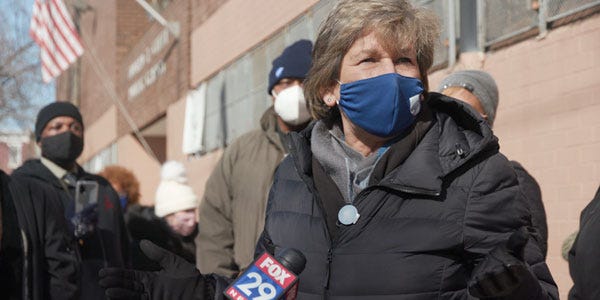
AFT President Randi Weingarten outside Edward T. Steel School in Philadelphia on Feb. 8, calling for health and safety upgrades to make schools safe.
Educators’ overwhelming support for a safe return to in-school learning raises the question of whether, if the federal government early in the pandemic had provided a plan to reopen schools similar to the Biden administration’s, with the resources to fund it, millions more students would be learning in person now, instead of remotely. It’s time to work with teachers and their unions to reopen schools safely for in-person instruction, instead of blaming them for the continuation of a pandemic made incalculably worse by the last administration.
The Centers for Disease Control and Prevention recently issued new guidelines for reopening schools. The guidelines reinforce the need for mitigation strategies to prevent the spread of the coronavirus, testing to detect asymptomatic transmission, vaccine prioritization for teachers and school staff, and accommodations for educators with pre-existing conditions and those taking care of others at risk.
Teachers unions have negotiated such health guardrails in Boston, Chicago, New York City, San Francisco, Washington, D.C., and elsewhere — playing a critical role in enabling in-person learning to resume that other school districts could emulate.
But countless places lack the resources to implement the necessary safety provisions, because the pandemic and resulting recession have drained state and local coffers. The Biden administration’s $1.9 trillion American Rescue Plan would fund vaccinations, direct relief to families bearing the brunt of the COVID-19 crisis, and provide crucial local and state aid — including $170 billion to help schools, colleges and universities reopen and operate safely.
This funding is needed immediately to safely reopen schools for in-person teaching and learning for the remainder of this semester, and to allow schools to prepare for this summer, which can and should be a voluntary “second, second semester.” Wealthy parents have an array of summer programs for their children. All students, particularly from under-resourced communities, should have access to programs this summer for reconnection, recreation, enrichment, social and emotional support, and academic growth.
Even as we deal with the challenges at hand, we must reimagine learning beyond COVID-19 and create the conditions to help all children thrive. Rather than the traditional spring state testing, we should assess and respond to students’ wide-ranging needs; support our most vulnerable students; focus on educators’ professional learning and growth to meet these unprecedented challenges; and promote equity and excellence in all of our public schools.
As we approach one year since the first school closures to prevent the spread of the coronavirus, students, families and educators are understandably frustrated. But we all want the same thing — to be together in school, with the conditions and support not only to recover from what has been lost but to thrive and grow. People are recognizing anew how important our public schools are. Let’s do what is needed to make them safe for students and staff to return.
NYCDOE Sabbatical Applications Open – Take One if You Can
On a full year study sabbatical you get 70% of your pay while taking 16 credits. You come refreshed, rejuvenated, and, frankly, a better teacher.
Learning: it is very different being a student than being a teacher. The new perspective is valuable.
Content: you can learn more in your content area, or explore something related.
Money: July 2021 is at full pay. August is at 70% – until the next July 2022 which is still at 70%. Finally August 2022 would be 100% – so that’s 12 months at 70%, 2 months at 100%. Also, the tax taken go down considerably.
Rights: This is an amazing contractual right. People should use it.
Me: I took a sabbatical 2013-2014.
I learned stuff that I applied to the classroom. I learned stuff that was fun. I was reminded what it was like to be a student. And I still correspond with two of my professors.
I made my schedule Tuesday/Thursday – which left me with long weekends for short trips, and college breaks for long trips. I spent more time with friends, with family. I went to Pittsburgh, CONTINUE READING:
Do you ever get the feeling DPS is just making stuff up as they go along? That there is little rhyme or reason? Well, today's version features the cancelation of scholar bowl while sports chug along.
So our schools are too dangerous for scholar bowl but not for the classes the scholars are taking? Not for sports? Also if any activity screams can be done over teams, it is scholar bowl.
Education Matters: DCPS's insidious effort to get more kids back in school - https://jaxkidsmatter.blogspot.com/2021/02/dcpss-insidious-effort-to-get-more-kids.html?utm_source=feedburner&utm_medium=feed&utm_campaign=Feed:+blogspot/iYxgC+(Education+Matters)
Mayoral Candidates Need To Speak Out on New Round of Charter School Expansion
An Open Letter From PCAPS Leaders
6a00e54f8c25c988340133f4bf18a4970b-500wi
With charter school advocates pressing for a new round of expansion there is a need for those who would lead Philadelphia to address what this will mean for public education in our city.
We believe the following points need to be recognized:
1). Charter expansion comes at a cost. This year, charter schools will cost the district $750 million—one third of the district’s school budget. Charter schools represent huge stranded costs and make it nearly impossible for the school district to plan and assess the savings that an economy of scale brings. This is occurring at a time when the District is facing an ongoing deficit and school budgets are going without adequate staff, classroom supplies and academic offerings to give our children a high quality education. Fraud, lack of transparency and mismanagement are serious problems in the charter sector because of a lack of regulation. Thirty million dollars have been lost as a result and this is surely the tip of a large iceberg. No further expansion should be allowed until a serious regulatory regime is established.
2). There is no compelling evidence that the growth of charter school sector has produced a school system that has better outcomes for students. Given that traditional public schools have been starved of resources, it is not surprising that many parents have opted for charter schools. However, like regular public schools, charter performance varies considerably with poverty being the single greatest CONTINUE READING: Mayoral Candidates Need To Speak Out on New Round of Charter School Expansion – wearepcaps.org


 The House Budget Committee has pulled together committee-approved components of President Biden’s COVID-19 package, creating a single bill that will come to the House floor this week; action could continue through the weekend. The Senate plans to take up the House-passed bill the week of March 1. Democrats are pushing to enact the legislation before March 14, when unemployment benefits for more than 11 million workers begin to expire.
 President Biden’s promise “to restore humanity and American values to our immigration system” is the basis for the U.S. Citizenship Act introduced Feb. 18 in both the Senate and the House. The bill would provide legal status and pathways to citizenship for Dreamers—people brought to the United States as minors who know no other country as home—and others allowed to remain here for humanitarian reasons.
 The House is scheduled to vote this week on the Equality Act (H.R. 5) to give LGBTQ Americans explicit protection from discrimination in key areas of life: employment, housing, credit, education, public spaces and services, federally funded programs, and jury service. The bill would amend the Civil Rights Act of 1964, the Fair Housing Act, and other federal laws to include sexual orientation and gender identity as protected characteristics.
 Sens. Marco Rubio (R-FL) and Elizabeth Warren (D-MA)