Latest News and Comment from Education

Saturday, March 23, 2019

Post & Courier: Education reform is deja vu all over again | radical eyes for equity

Post & Courier: Education reform is deja vu all over again | radical eyes for equity

Post & Courier: Education reform is deja vu all over again


[with hyperlinks below]
I have taught in South Carolina since 1983, 18 years as an English teacher and coach followed by 17 years as a teacher educator and first-year writing professor. Over that career, I have felt exasperated by education reform that has proven to be déjà vu all over again.

A few years ago, I advocated against the misguided Read to Succeed Act, policy as flawed as I predicted since it failed to identify the evidence-based problems with reading in SC and then promoted new policy that does not address those problems while creating new and even worse consequences.
Read to Succeed also foreshadowed this newest round of wholesale education reform facing the state.
Since the 1980s, politicians in SC have insisted that our public schools are failing. Their responses, however, have meant that the only consistency in our schools is we are in a constant state of education reform repackaged over and over again.
State standards, state high-stakes testing, school choice, charter schools—these policies have been reframed repeatedly, and all we have to show for that is the same complaints about failing schools and decades of research revealing it’s policies that have failed.
Instead of misguided education reform beneath misleading political rhetoric, SC should take a different path, one shifting not only policies but also ideologies.
First, SC must clearly identify what problems exist in our schools and then carefully distinguish between which of those problems are caused by out-of-school factors and which are the consequences of in-school practices and policies.
For example, SC’s struggles with literacy are driven by generational CONTINUE READING: Post & Courier: Education reform is deja vu all over again | radical eyes for equity

CURMUDGUCATION: Stop Talking About Student Achievement

CURMUDGUCATION: Stop Talking About Student Achievement

Stop Talking About Student Achievement

If I told you that my student had achieved great things in school this year, what would you imagine I meant?
Maybe she started reading longer books with heavier vocabulary and deeper themes. Maybe she not only read them, but spent time thinking about the ideas they contained. Maybe she improved her technical facility and musicality when playing her flute. Maybe she conducted an impressively complex and ambitious physics experiment. Maybe she created a beautiful and useful website. Maybe she progressed to more complex problems in algebra. Maybe she completed some impressive in-depth research on a particular historical period. Maybe she passed welding certification tests. Or maybe she packed away some chunks of learning that won't really come to life for her until years from now.
But we have a problem in current education policy discussions; when we say "student achievement," we usually don't mean any of those things.
One of the great central challenges of education in general and teaching in particular is that we cannot read minds. We cannot see inside a student's head and see what has taken root and what has taken flight.
So part of the gentle art of teaching involves the creation and deployment of performance tasks designed to get us at least a peek inside the student brain to see if they have in fact mastered what we tried to get them to master. It is an ever-evolving challenge, made complex by the many types of students and the many levels of learning, further complicated by the fact that the best assessment is never as accurate as it was the first time you used it (unless you believe that students never talk to each other).
Some pieces of learning are easy to measure (does the student know her times table) and some are  CONTINUE READING: CURMUDGUCATION: Stop Talking About Student Achievement

Betsy DeVos' Actions Speak Volumes - Education Votes

Betsy DeVos' Actions Speak Volumes - Education Votes

Betsy DeVos’
No Good, Very Bad Record on Public Education

HERE'S WHAT SHE'S DONE


Betsy DeVos’ Actions Speak Volumes

As President Donald Trump’s secretary of education, Betsy DeVos has worked to subvert public education. She has promoted the privatization of public schools through vouchers, called for deep cuts to federal funding, rolled back protections for vulnerable children, and shilled for the for-profit college industry that has defrauded countless students.
Scroll down through this timeline to see what Betsy DeVos has done as education secretary. Each moment shows how she’s been a disastrous choice, just as public school supporters knew she would be.

1990s-2000s

(AP Photo/Carlos Osorio)
Betsy DeVos and her family spend millionspromoting education privatization schemes.Long before she is Secretary of Education, Betsy DeVos uses her family’s wealth to privatize public schools. She funds politicians who support voucher schemes. She chairs the pro-voucher American Federation for Children. In her home state of Michigan, DeVos is “one of the architects of Detroit’s charter school system,” one that downplays regulation and accountability while draining resources from public schools. Even some privatization advocates have described it as “one of the biggest school reform disasters in the country.”

November 2016

Educators denounce Trump’s nomination of Betsy DeVos. Elementary teacher and NEA president Lily Eskelsen García says DeVos will be “the first secretary of education with zero experience with public schools. She has never worked in a public school. She has never been a teacher, a school administrator, nor served on any public board of education. She didn’t even attend public schools or send her children to public schools. She is out of her league when it comes to knowing and doing what works for public school students.”

CONTINUE READING: Betsy DeVos' Actions Speak Volumes - Education Votes


Betsy DeVos’ war on Obama’s legacy is losing badly because of her 'inability to follow basic laws'

Betsy DeVos’ war on Obama’s legacy is losing badly because of her 'inability to follow basic laws'

Betsy DeVos’ war on Obama’s legacy is losing badly because of her ‘inability to follow basic laws’


Education Secretary Betsy DeVos keeps running into roadblocks in her efforts to rollback Obama-era education policies, according to a report from Politico.
DeVos is trying to rescind policies regarding student loan forgiveness, arbitration agreements, and racial disparities.
“The latest legal blow came earlier this month when a federal judge ruled DeVos illegally postponed a regulation requiring states to identify school districts where there are significant racial disparities among the students placed in special education programs,” the report said. “And last week, Education Department officials began implementing a sweeping package of Obama-era student loan policies after DeVos lost a lawsuit over delaying them last fall.”
DeVos argues that student loan forgiveness policies cost taxpayers too much money. A judge ruled that DeVos did not have substantial reasoning for wanting to undo the policies.
“Judges in the cases decided so far have said the Trump administration ran afoul of the Administrative Procedures Act, ruling that the department’s efforts to delay policies were arbitrary or lacked a reasoned basis,” the report said.
Toby Merrill, who directs the Harvard Law School’s Project on Predatory Student CONTINUE READING: Betsy DeVos’ war on Obama’s legacy is losing badly because of her 'inability to follow basic laws'

Atlanta’s Public School Board Voted for Privatization | tultican

Atlanta’s Public School Board Voted for Privatization | tultican

Atlanta’s Public School Board Voted for Privatization


On March 4, the Atlanta Public School (APS) board voted 5 to 3 to begin adopting the “System of Excellent Schools.” That is Atlanta’s euphemistic name for the portfolio district model which systematically ends democratic governance of public schools. The portfolio model was a response to John Chubb’s and Terry Moe’s 1990 book, Politics, Markets, and America’s Schools, which claimed that poor academic performance was “one of the prices Americans pay for choosing to exercise direct democratic control over their schools.”
A Rand Corporation researcher named Paul Hill who founded the Center on Reinventing Public Education (CRPE) began working out the mechanics of ending democratic control of public education. His solution to ending demon democracy – which is extremely unpopular with many billionaires – was the portfolio model of school governance.
The portfolio model of school governance directs closing schools that score in the bottom 5% on standardized testing and reopening them as charter schools or Innovation schools. In either case, the local community loses their right to hold elected leaders accountable, because the schools are removed from the school boards portfolio. It is a plan that guarantees school churn in poor neighborhoods, venerates disruption and dismisses the value of stability and community history.

Atlanta’s Comprador Regime

Atlanta resident Ed Johnson compared what is happening in APS to a “comprador regime” serving today’s neocolonialists. In the 19th century, a comprador was a native servant doing the bidding of his European masters; the new compradors are doing the bidding of billionaires privatizing public education.
Chalkbeat reported that Atlanta is one of seven US cities The City Fund has targeted for implementation of the portfolio district governance model. The city fund was founded in 2018 by two billionaires, John Arnold the former Enron executive who did not go to prison and Reed Hastings the founder and CEO of Netflix. Neerav Kingsland, Executive Director of The City Fund, stated, “Along with the Hastings Fund and the Arnold Foundation, we’ve also received funds from the Dell Foundation, the Gates Foundation, the Walton Family Foundation, and the Ballmer Group.”
City Fund has designated RedefinED as their representative in Atlanta. Ed  CONTINUE READING: Atlanta’s Public School Board Voted for Privatization | tultican


“Successful” Schools? Looking at MetWest High School and Social Justice Humanitas Academy | Larry Cuban on School Reform and Classroom Practice

“Successful” Schools? Looking at MetWest High School and Social Justice Humanitas Academy | Larry Cuban on School Reform and Classroom Practice

“Successful” Schools? Looking at MetWest High School and Social Justice Humanitas Academy


For the past two years I have been researching and writing about definitions of “success” and “failure” in U.S. education. As I have done with all of my book projects, I draft posts for this blog to clarify my thinking and learn from reader comments. Then I revise what I have written and those revisions become part of the book I am writing.
A year and a half ago, I posted a series on “success” and “failure” in schools (see herehere, and here). Since then I have written a few chapters for this forthcoming book that answer questions driving this study.
  1. How have “success” and “failure” been defined and applied to reforming schools and judging programs past and present?
  2. From where do these ideas of “success” and “failure” come?
  3. How were these ideas transmitted to Americans then and now?
  4. Who decides (and how) whether schools “succeed” and “fail?”
  5. What does “success”and “failure” look like in contemporary classrooms, schools and districts?
  6. So what?
Now I have four chapters that tentatively answer the first four questions. Last month I began research on the fifth question by looking at two schools deemed “successful” by current metrics but have gone beyond traditional definitions of “success” to carve out a larger, expansive view of what student, teacher, and school “success” look like.
Both California schools are non-special, that is, neither a charter nor magnet in their districts. MetWest High School* with about 160 students is in the Oakland Unified School District. It is a Big Picture school launched in 2002 that combines CONTINUE READING: “Successful” Schools? Looking at MetWest High School and Social Justice Humanitas Academy | Larry Cuban on School Reform and Classroom Practice

Feds Cite New York State for Decades of Depriving Special Education Students of Services: Will/Can the State Comply? | Ed In The Apple

Feds Cite New York State for Decades of Depriving Special Education Students of Services: Will/Can the State Comply? | Ed In The Apple

Feds Cite New York State for Decades of Depriving Special Education Students of Services: Will/Can the State Comply?


The Individuals with Disabilities Education Act (1975) for the first time recognized that disabled children required a special educational setting.  The law required that each state establish mechanisms for the identification and placement of children with disabilities in “appropriate” educational settings, the creation of an Individual Education Plan (IEP), with educational goals, and by appropriate the law means appropriate to their disability. The law also requires that parents are involved in every step of the process and have the right to appeal decisions of the school district.
In New York State parents or teachers can refer children for testing, to the Committee on Special Education (CSE), and, within strict time frames evaluate and place the student in the setting appropriate to their disability. The settings range from integrated settings, classes made up of general education and children with IEP’s, with two teachers, a content area teacher and a certified special education teacher to self-contained classrooms with lower class size and a paraprofessional to separate schools with a wide range of services. The IEP is reviewed annually and the CSE, with the involvement of the parent, can alter the placement of the student.
In New York City before mayoral control every district had a District Administrator Special Education, the “DASE,” who acted essentially as the deputy to the superintendent for special education. As the district union rep I worked closely with the DASE. Any questions or complaints from staff were resolved expeditiously. The Department of Education provided each district with dollars for professional development for special education staff, called QUIPP, with a central director of the program. We constructed an “interest inventory,” (better name than “needs assessment”) asking staff to identify topics for CONTINUE READING: Feds Cite New York State for Decades of Depriving Special Education Students of Services: Will/Can the State Comply? | Ed In The Apple

CURMUDGUCATION: Foolish Canadian Grit

CURMUDGUCATION: Foolish Canadian Grit

Foolish Canadian Grit


Proving that dumb knows no national boundaries, Ontario's Education Minister Lisa Thompson this week defended the plan to increase class size by making this observation:

This woman.
"When students are currently preparing to go off to post-secondary education, we're hearing from professors and employers alike that they're lacking coping skills and they're lacking resiliency," Thompson told CBC Radio's Metro Morning on Wednesday.

"By increasing class sizes in high school, we're preparing them for the reality of post-secondary as well as the world of work."

Yessireebob-- what we need to do to toughen students up and give 'em some grit is just c ram more of them into classrooms. Why would the government even want to do such a thing? That answer is also recognizable down here to the south-- it will let them cut a bunch of jobs. About 1,000, by some estimates.

In all fairness to our neighbors to the North, their idea of increasing class sizes is pretty bush league-- high schools would go from an average of 22 students per class to an average of 28. I know. There are plenty of US schools where it would be a huge relief to get only 28 students in a class.

But the reasoning. Thompson is a longtime politician, though in her civilian life she was the manager of a goat cooperative, which seems like fine preparation for running an education system.

In the meantime, if she's really keen on this real world preparation through toughening approach CONTINUE READING: 
CURMUDGUCATION: Foolish Canadian Grit

Friday, March 22, 2019

California's public school chief says education no place for competition | CALmatters

California's public school chief says education no place for competition | CALmatters

California’s public school chief says education no place for competition


The state’s public schools superintendent didn’t hold back in a wide-ranging discussion Thursday night: He raised doubts about the value of charter schools, criticized school districts for the state’s wave of teacher strikes, questioned the severity of public pension debt and insisted the state must spend more to educate its students.
Two months into the new job, Tony Thurmond seems to be exactly the man that his most loyal backers hoped (and his opponents feared) he would be.
In a conversation with CALmatters’ education reporter Ricardo Cano at San Francisco’s Commonwealth Club, Thurmond talked about how his mother, an immigrant from Panama, died when he was 6, leaving him to be raised by a cousin he never met. He says his family benefited from many government programs to get by, but that “a great public education” was the most vital.
“If it were not for the education, my cousin who took me in, countless mentors, I would easily have ended up in California state prison instead of serving as California’s superintendent of public instruction,” he said. “We owe this to all the students in our state.”
That philosophy, he said, informs his fairly dim view of charter schools, which he characterized as benefiting certain students as the possible expense of others.
“I think there’s a role for all schools,” Thurmond said, including charters—publicly funded but privately managed schools that supporters say offer valuable educational alternatives to children, but which critics say undermine traditional public education. “But I do not believe that the state should ever open new schools without providing CONTINUE READING: California's public school chief says education no place for competition | CALmatters


Opinion: Teachers shouldn’t have to beg in über-rich California – East Bay Times #Unite4SACKids #WeAreSCTA #WeAreCTA #strikeready #REDFORED #SCTA #CTA #UTLA

Opinion: Teachers shouldn’t have to beg in über-rich California – East Bay Times

Opinion: Teachers shouldn’t have to beg in über-rich California
Educators are striking because the state starves schools and 6 million children of resources needed to succeed


John Affeldt 

Teachers in Sacramento, west Fresno County and Dublin may soon go on strike over the same bread and butter issues that were fought over in Oakland: low teacher pay, large class sizes, and few counselors and nurses.
If you didn’t know better, you might mistake California for a declining Rust Belt state. But it’s not. California is über-rich. The shameful truth behind all this discord is that California is fabulously wealthy; yet for decades, it has starved its public schools and 6 million children of the resources necessary to succeed.
With a GDP of $2.7 trillion, California is the world’s 5th largest economy—surpassed only by behemoths like China, Japan, Germany and the United States itself. Tech giants like Apple, Facebook, Netflix, and Google are synonymous with California. So are Fortune 500 companies like Chevron, Wells Fargo, Disney, Gap and Visa. Home to Hollywood, Napa Valley, Palm Springs, Disneyland and Lake Tahoe, tourists pump almost $132 billion into the economy every year. It’s the largest manufacturing state in the country, and this year, the Golden State will be home to thousands of new millionaires as tech companies rush to go public.
Yet, as Gov. Gavin Newsom has noted, California ranks 41st in per pupil spending nationwide. As a consequence, in our high-cost state, we have fewer adults—teachers, counselors, nurses, librarians, administrators—per student than all but two states and struggle to pay a living wage to those who serve.
In a state with such vast wealth, we actually can afford to meet the school funding shortfall—which one recent study concluded to be some $25 billion annually. Without that investment, we are doomed to repeat the same battles over paying teachers a fair wage vs. providing basic resources vs. supporting high-need students—battles that end with short-term unsustainable bargains and underperforming students.
We’re already seeing cash-strapped districts tap into money set aside for English learners, foster youth and low-income students to pay for across-the-board raises and class-size reductions. In the case of the Los Angeles district, financial reserves are covering the CONTINUE READING: Opinion: Teachers shouldn’t have to beg in über-rich California – East Bay Times

John Affeldt is a managing attorney at Public Advocates in San Francisco, where he focuses on educational equity issues through litigation, policy advocacy and partnerships with grassroots organizations.


New York City public schools like Stuyvesant show why standardized testing is broken - Vox

New York City public schools like Stuyvesant show why standardized testing is broken - Vox

The New York City school controversy shows why standardized testing is broken
New York City’s Specialized High School Admission Test is a tool of structural racism.


When news broke this week that only seven black students were accepted into New York City’s Stuyvesant High School, an elite public school that supposedly only takes the most advanced students in the city, I wasn’t surprised. In my 14-year career as a middle school math teacher in Manhattan with majority black or Latinx students, I’ve had thousands of kids who were rejected from magnet public schools like Stuyvesant. It breaks my heart every time.
Every year, sometime in March, thousands of New York City adolescents receive a letter that tells them which high school selected them. That school day is always a tough one. Some students run up and down the halls, excitedly telling their friends about where they will be spending the next four years. Others, disappointed in their placement, sit solemnly or find a comforting shoulder to lean on.

I’ve had to console far too many brilliant students who didn’t get chosen for the high school they wanted to go to. They checked off all the proverbial boxes: great attendance, high grades, strong work ethic, and had positive relationships with adults and peers. They studied hard for the Specialized High School Admission Test — an assessment given to eighth or ninth graders for entry into eight of the elite magnet public schools in New York City — for months. Because a student’s score on that test is the only criterion for high school admissions, the stressful three hours spent taking this exam could determine a student’s future.
As a teacher, I try to assure my students that they will be fine regardless of which school they attend. But I often wonder if we educators are doing a disservice — and perpetuating the lie of meritocracy — by continuing to tell kids that if they work hard and excel then they can get what they want in life.

School segregation in New York City is reaching emergency levels

Make no mistake: New York City is burning. But unlike the literal and metaphorical burning of the Bronx in the 1970s, the latest fire is happening in our education system as schools continue to segregate at alarming rates. Only 190 of the 4,798 slots, or 3 percent, in the eight major CONTINUE READING: New York City public schools like Stuyvesant show why standardized testing is broken - Vox


New Yorkers Protest Millions Proposed for School Safety Budget, Saying Money Fuels School-to-Prison Pipeline

New Yorkers Protest Millions Proposed for School Safety Budget, Saying Money Fuels School-to-Prison Pipeline

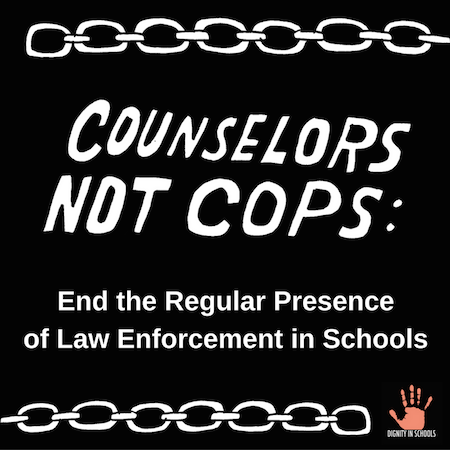
Counselors, Not Cops: New Yorkers Protest Millions Proposed for School Safety Budget, Saying Money Fuels School-to-Prison Pipeline


Guided by a coalition of 40 New York City social justice organizations, dozens of students, parents and advocates converged on New York’s City Hall Wednesday to protest Mayor Bill de Blasio’s proposed increase to the NYPD’s School Safety Division budget, saying those millions would be better used on student social supports and services.

In an attempt to stem the tide of the school-to-prison pipeline, the Dignity in Schools Campaign-NY brought together a team outfitted in bright green “Counselors Not Cops” T-shirts in opposition to de Blasio’s 2020 fiscal year preliminary budget, which increases the NYPD’s School Safety Division by more than $27 million, bringing its total budget to at least $314 million and perhaps as high as $431 million—the largest proposed budget for the division in its history.
Additionally, the School Construction Authority is proposing to double school security spending to reach $200 million for policing instruments such as video surveillance and metal detection equipment, which, for many, is simply more fuel for the school to prison pipeline.
“Time and time again, our young people talk about whenever they walk into school, it feels like walking into a prison … they’re going through metal detectors, they’re being hand wanded, there are school safety agents roaming the halls,” Kate McDonough, Director of the Dignity in Schools Campaign told The Root. “That already makes them feel as if they’re in jail. Young people who are just being young people are having interaction with law enforcement when they shouldn’t be.”
What these advocates and their supporters want instead are funds CONTINUE READING: New Yorkers Protest Millions Proposed for School Safety Budget, Saying Money Fuels School-to-Prison Pipeline


Emboldened House Dems to question DeVos on Trump education cuts ⋆ Michigan Advance

Emboldened House Dems to question DeVos on Trump education cuts ⋆ Michigan Advance

Emboldened House Dems to question DeVos on Trump education cuts


WASHINGTON — U.S. Education Secretary Betsy DeVos is slated to testify in the U.S. House next week for the first time since Democrats took control of the chamber earlier this year.

DeVos — a West Michigan billionaire and one of the most polarizing President Donald Trump administration officials — is scheduled to testify Tuesday before a U.S. House Appropriations subcommittee that oversees education spending.
Her visit is certain to be dramatic.
She’s been called to Capitol Hill to defend Trump’s fiscal 2020 budget, which again seeks to boost voucher programs.
Vouchers have long been an issue close to DeVos’ heart. In 2000, the DeVoses pushed a constitutional amendment in Michigan creating a voucher program. That failed, despite a $13 million investment from the family, which routinely spends the most of any clan on elections in Michigan.
House Democrats will seize the opportunity to deride the administration’s controversial education policies.
U.S. Rep. Rosa DeLauro (D-Conn.), one of DeVos’ most outspoken critics on Capitol Hill, now holds the gavel of the House subcommittee with jurisdiction over federal education spending.


Rosa DeLauro

DeLauro and DeVos have gotten into heated exchangesbefore — including a fight during a hearing last year in which an exasperated DeLauro shouted at a clearly flustered DeVos about the Trump administration’s student loan policies.
DeLauro said earlier this year that she would use her subcommittee post to “hold Secretary DeVos accountable for her agency’s failure to uphold federal protections for our students.”
The Connecticut Democrat pointed specifically to DeVos’ CONTINUE READING: Emboldened House Dems to question DeVos on Trump education cuts ⋆ Michigan Advance