Latest News and Comment from Education

Showing posts with label READING WARS. Show all posts

Monday, May 17, 2021

Russ on Reading: Defeating the Science of Reading Narrative, Part 3: Building Bridges with Colleagues

Russ on Reading: Defeating the Science of Reading Narrative, Part 3: Building Bridges with Colleagues
Defeating the Science of Reading Narrative, Part 3: Building Bridges with Colleagues


Over the past month I have been exploring the Science of Reading (SOR) narrative that has dominated discussion about reading instruction for the last few years in posts here, here, and here. What I have argued is that the SOR narrative is far too narrow a conceptualization of reading instruction and that making it the dominant mode of instruction is dangerous. The prior posts back up that argument with relevant and recent research. Some readers, while sympathetic to my overall message, have complained that my language in these blogs is confrontational and likely to cut off conversation rather than build bridges. 

I admit that I have used words like "defeat", "fight", "overturn", and "combat", in discussing how we must respond to the SOR narrative. That is because this narrative is being foist upon school leaders, teachers, and children through lobbying groups, state legislatures, and school boards that have bought into this narrow view of reading instruction. My language is CONTINUE READING: Russ on Reading: Defeating the Science of Reading Narrative, Part 3: Building Bridges with Colleagues

Monday, February 22, 2021

NANCY BAILEY: Time for a NEW National Reading Panel to Study Reading Instruction

Time for a NEW National Reading Panel to Study Reading Instruction


Reading. It’s one of the most important and controversial topics in education. Reading is the foundational skill required of children to learn. With a new President and educators Dr. Miguel Cardona and Cindy Marten, the time is right to convene a new, inclusive National Reading Panel (NRP).

Here’s why this is important, along with some brainstorming as to what it could involve. Please share your ideas.

National Reading Panel

The last NRP convened in 1997, submitting its report to Congress in February 1999, almost 25 years ago. Much has changed.

The NRP is mired in controversy. In his recent book, education scholar P.L. Thomas states:

A central component of No Child Left Behind was the NRP; however, as a key member of the panel has detailed, that report was neither a comprehensive and valid overview of the then-current state of research on teaching reading nor a foundational tool for guiding reading practices or policy. Yet, media coverage routinely references the NRP CONTINUE READING: Time for a NEW National Reading Panel to Study Reading Instruction

Thursday, February 4, 2021

The “Science of Reading”: A Movement Anchored in the Past – radical eyes for equity

The “Science of Reading”: A Movement Anchored in the Past – radical eyes for equity
The “Science of Reading”: A Movement Anchored in the Past


One of the defining moments of my first-year writing seminar is my reading aloud the first few paragraphs from A Report from Occupied Territory by James Baldwin.

This essay in The Nation from July 11, 1966, offers students dozens of powerful examples of compelling and purposeful writing, Baldwin at his best. But the circumstances of the essay are what first strike my students.

“There was a great commotion in the streets, which, especially since it was a spring day, involved many people, including running, frightened, little boys,” Baldwin writes. “They were running from the police.”

We note that Baldwin uses “police[men]” five times in the first paragraph, which focuses on people in the Harlem “in terror of the police” because “two of the policemen were beating up a kid.”

Students immediately noted that Baldwin was addressing exactly the same racism grounded in policing that has been the source of social unrest in the CONTINUE READING: The “Science of Reading”: A Movement Anchored in the Past – radical eyes for equity

Saturday, January 30, 2021

Greenville News (SC): SC should not “jump on bandwagon” of “science of reading” movement – radical eyes for equity

Greenville News (SC): SC should not “jump on bandwagon” of “science of reading” movement – radical eyes for equity
Greenville News (SC): SC should not “jump on bandwagon” of “science of reading” movement


SC should not “jump on bandwagon” of “science of reading” movement (link coming; original with hyperlinks below)

South Carolina is poised with Bill 3613 to continue the historical failures of addressing reading in South Carolina through micromanaging legislation that has not resulted in improving home, community, individual equity or learning outcomes for students living in poverty, Black students, Emergent Bilinguals, or students with special needs.

Currently, I am in year 37 of teaching in SC, serving as a high school English teacher at Woodruff High for 18 years before moving to teacher education at Furman University for the past 19 years. I entered education in SC in 1984, the first days of the accountability movement in our state.

Despite political leaders changing standards and high-stakes testing multiple times over the past four decades, political and public perception remains convinced our schools are failing, and that our students are, specifically, failing to learn to read.

Read To Succeed, which Bill 3613 seeks to amend, was a serious mistake at its inception since it misreads both how students learn to read and how best to teach reading. Reading growth is not simple, and test scores are a stronger CONTINUE READING: Greenville News (SC): SC should not “jump on bandwagon” of “science of reading” movement – radical eyes for equity

Wednesday, October 21, 2020

The Reading Wars Are Over! Lucy Calkins Endorses Phonics | Diane Ravitch's blog

The Reading Wars Are Over! Lucy Calkins Endorses Phonics | Diane Ravitch's blog
The Reading Wars Are Over! Lucy Calkins Endorses Phonics


Lucy Calkins is one of the most influential reading researchers In the nation. She created the Teachers College Reading and Writing Project, whose teaching materials have been widely adopted and is a proponent of “balanced literacy.” BL prominently opposed the “phonics first” approach.

In my book Left Back: A Century of Battles Over School Reform,” I described in detail the long-standing debates about teaching reading, which dates back to the mid-nineteenth century. The phonetic approach was the conventional method until the advent of the very popular “Dick and Jane” reading books in the late 1920s. Those readers relied on the “whole word” method, in which children learned to recognize short words (“Run, Dick, run.” “See Sally run.”) and to use them in context rather than sound them out phonetically. In the 1950s, the debate came to a raging boil after publication of Rudolf Flesch’s “Why Johnny Can’t Read,” which attacked the CONTINUE READING: The Reading Wars Are Over! Lucy Calkins Endorses Phonics | Diane Ravitch's blog

Thursday, October 8, 2020

WILL BETSY DEVOS AND THE USDOE ALLOW THE SCHWINIGANS TO CONTINUE UNABATED? – Dad Gone Wild

WILL BETSY DEVOS AND THE USDOE ALLOW THE SCHWINIGANS TO CONTINUE UNABATED? – Dad Gone Wild

WILL BETSY DEVOS AND THE USDOE ALLOW THE SCHWINIGANS TO CONTINUE UNABATED?


“Our deeds determine us, as much as we determine our deeds.”
― George Eliot, Adam Bede
The hits from 2020 keep right on coming. Last week it was the legendary St. Lous Cardinals pitcher Bob Gibson. This week, it’s guitar hero Eddie Van Halen.
Any of you who grew up in the ’70s and ’80s can attest to the power of Van Halen and what it felt like the first time you heard those ferocious guitar licks. Dance the Night Away, off of the second album, will always epitomize the band for me – technical genius that brought forth joy when you heard it. Eddie’s impish grin is forever etched in my mind when a Van Halen tune came on the radio. A decided departure from the pained grimace employed by previous guitar gods. Eddie seemed to be having as much delivering the sound as we did receive it.
As sad as the passing of Van Halen is, there is some solace in that his death brought us all together, if just for a moment. Right, and Left was forgotten, as lasting memories were shared. For just a brief respite, it was refreshing to be able to leave behind the constant political wrangling, and realize that in some things we are more similar than different.
AND THE SCHWINIGANS CONTINUE
If you’ll remember, back in the Spring the Governor and his handmaiden concocted this fantastic – that’s sarcasm in case you missed it – idea to transform literacy in Tennessee. It called for employing only one method of teaching reading the Science of Reading. It increased testing by mandating that all LEA’s utilize a state chosen benchmark test administered 3x a year. It included mandates for teacher prep programs in Tennessee to change how they taught reading instruction. It would serve to rob LEA’s of local control. At its core was promised payday for the preferred textbook CONTINUE READING: WILL BETSY DEVOS AND THE USDOE ALLOW THE SCHWINIGANS TO CONTINUE UNABATED? – Dad Gone Wild

Tuesday, September 29, 2020

Russ on Reading: When Best Practice Meets Questionable Methods in Literacy Instruction

Russ on Reading: When Best Practice Meets Questionable Methods in Literacy Instruction

When Best Practice Meets Questionable Methods in Literacy Instruction


All of us try to provide best practice instruction to our students. Sometimes, though, in our enthusiasm to provide the children the instruction they need, we end up using some instructional methods that work against our goals. Here are a few things we know work in literacy instruction, some ways we can turn those good practices into unproductive ones, and then some things we can do instead.


Best Practice: Regular Reading - Kids who read a lot tend to get better at reading, so it is a good idea to get kids to read as much as possible.

Questionable Method: Reading Logs - Research has long shown us that external controls have a negative impact on intrinsic motivation. Reading logs, rigidly employed, can turn the pleasurable act of reading into a chore. Other extrinsic motivators like pizza parties and other non-reading related awards should also be avoided.

What to do instead: Trust in the power of books and focus on student engagement in those books. If we want children to read we need to have many books readily available (classroom library), to provide the opportunity to read them (independent reading), to give children some choice in what they read, and to make sure they are able to read them (just right book). We CONTINUE READING: Russ on Reading: When Best Practice Meets Questionable Methods in Literacy Instruction

Tuesday, September 22, 2020

Russ on Reading: Picture Books for Older Children? Of Course

Russ on Reading: Picture Books for Older Children? Of Course

Picture Books for Older Children? Of Course


One of the ways that teachers are meeting the challenge of online instruction is through picture books and the read aloud. This is a good idea in many ways, but are picture books appropriate for older students, say fifth grade and up? The answer is YES, OF COURSE. The reasons are many, but I wish to highlight just one of those reasons today. Picture books make a great introduction to many, many complex ideas. They can help to build needed background knowledge for new topics, introduce content specific vocabulary with illustrations to assist the learning, and may serve to engage students in a topic of study that they may not have even known they were interested in prior to the picture book read aloud.

Year ago I noticed my colleague, Peggy Burke, had a copy of a comic book titled, Your Brain and You on her desk. I asked her why she had a comic on her desk and she told me that she was reading it because she had signed up for a seminar titled something like, New Discoveries about the Functions of the Brain for Educators, at Harvard University. Peggy said she really didn't have much current background knowledge on the brain, so before attending the seminar she thought that this picture book could give her some the of the basic anatomy and vocabulary related to the topic. 

And so it is with many picture books, they provide outstanding introductions to a wide variety of topics. I have found Gail Gibbons books particularly effective for just this purpose. Her book, The Monarch CONTINUE READING: Russ on Reading: Picture Books for Older Children? Of Course

Monday, September 21, 2020

NANCY BAILEY: 3rd Grade Reading Laws Are Harmful

3rd Grade Reading Laws Are Harmful

3rd Grade Reading Laws Are Harmful


By Stefanie Rysdahl Fuhr
Many states insist that students read by third grade. If students have difficulties they might be retained. Students might master reading later. They should not be punished if they aren’t reading perfectly in third grade.
Last spring I sent this letter to my state legislators.  Feel free to use it as a template for your legislators.
____________
Dear Senator XXXXX OR Representative XXXXX,
As a constituent, I urge you to repeal Read Well by 3rd Grade legislation. This law is forcing children to read in kindergarten and to be tested on some arbitrary level using inappropriate and even false reading assessments. This is hurting the children who are our future leaders. Everyone can recognize the absurdity of expecting all children to crawl at a certain age. Likewise, experts tell us that labeling children as deficient before they are developmentally ready to read is extremely harmful. Experts tell us that the average age a child learns to read is 7. Some read earlier and some read later. Please look at this research.
In Finland, where teens score at the top of international reading tests, children don’t start school until age 7 because lawmakers, drawing on the wisdom of experts, understand that many younger kids have not reached the developmental maturity for the more focused structure that we in Minnesota are imposing on younger and younger children. Forcing our children to read before they are developmentally ready is causing them to be falsely labeled as deficient.
Finland also knows that education is local. They respect the expertise and knowledge of local teachers.
National Education Policy Center and Education Deans for Justice recently posted this policy statement, “The Science of Reading,” which provides legislators with proven policies:
I ask you to look to such proven policies instead of legislation that promotes a narrowed CONTINUE READING: 3rd Grade Reading Laws Are Harmful

Friday, September 18, 2020

The Ends Do Not Justify the Means in the Lives and Education of Children – radical eyes for equity

The Ends Do Not Justify the Means in the Lives and Education of Children – radical eyes for equity

The Ends Do Not Justify the Means in the Lives and Education of Children


17 September 2020 turned out to be a day of disinformation about education in the U.S. The White House launched another assault on education (not a surprise), and the International Literacy Association offered (for a fee) “Making Sense of the Science of Reading.”
The latter is disappointing from a powerful and influential professional organization because the “sense” made appears to be quite different than the intent.
Ultimately, as this event revealed, the “science of reading” (SoR) advocacy fails for several key reasons:
  1. The movement is driven by parent advocacy (specifically around dyslexia) and media advocacy. That grounding lacks historical context and expertise in reading, literacy, and special needs.
  2. SoR promotes a simple view of reading and seeks to mandate systematic intensive phonics for all students (regardless of student need).
  3. SoR embraces a simplistic and distorted view of “science” as “settled.”
  4. SoR links reading to policies and practices that lack scientific support and cross ethical lines of allowing the ends to justify the means (for example, nonsense literacy and grade retention linked to high-stakes testing).
Here, I want to focus on how SoR crosses ethical lines in order to justify and misrepresent the very “science” those advocates embrace.

Tuesday, September 1, 2020

Russ on Reading: Vocabulary Instruction: Try Word Riffs

Russ on Reading: Vocabulary Instruction: Try Word Riffs

Vocabulary Instruction: Try Word Riffs


Many young readers hit a wall when their reading demands that they decode longer and longer words. Research has shown that instruction in morphology (roots and affixes) can help readers make this transition. Some excellent resources are available for teaching morphological understanding. One that I particularly like is the Word Ladder approach of  Dr. Tim Rasinski. Word Ladder books for various grade levels are readily available from Scholastic, but lately Tim has been posting Word Ladders on his Twitter feed. You can follow him @TimRasinski1 to get his latest freebies. 

I have had success with a variation on the Word Ladder, adding an element of the Think Aloud, in my own teaching. I call it, for lack of a better term, the Word Riff. The idea of the Word Riff is to help students use morphology in decoding, expand student vocabulary, and turn students on to the richness and logic in the English language. 

The Word Riff grows out of each students' Vocabulary Self-Collection Notebook. As a part of the student's interactive notebook they keep for my class (a place for reflections, reading responses, notes, etc.) I ask the students to collect new, unknown and interesting words they run across in their reading. The student is asked to identify the word, the context (sentence) the word was found in, a best guess definition of the word, and a dictionary definition of the word. If you would like to read more about the CONTINUE READING: Russ on Reading: Vocabulary Instruction: Try Word Riffs

Monday, August 17, 2020

The Problems with “Show Me the Research” in Teaching Reading – radical eyes for equity

The Problems with “Show Me the Research” in Teaching Reading – radical eyes for equity

The Problems with “Show Me the Research” in Teaching Reading


I was born in 1961 and entered first grade in 1967, already able to read independently and play sophisticated card and board games.
My mother had taped index cards with words identifying objects all around our house. She had attended one year of junior college, but had no training in how to teach.
None the less, from the first day of school, I excelled in literacy, scoring in the 99th percentile on standardized tests. My learning to read has two important elements; I was of the generation taught by the Dick and Jane basal readers (whole-word focus over discrete phonics), and my learning to read overlapped with one of the most aggressive reading crisis moments in the U.S., spurred by Rudolf Flesch’s Why Johnny Can’t Read, first published in 1955.
To whom and what should we attribute my high-achieving literacy skills? How could research tease out any causal inferences about my reading achievement? I was certainly not a Johnny who couldn’t read even as I had almost no direct phonics instruction, and I am sure the basal readers and my teachers’ instructional methods had only minimal impact on my literacy development (other than that I loved Ms. Landford, my first grade teacher, and wanted desperately to please her).
Many years later, I was a high school English teacher in the rural high school I had attended. One year, a wonderful student whose mother was also an English teacher in the school scored a perfect 800 on the verbal section of the SAT.
People throughout the school and town often congratulated me and praised my role in her perfect score. For many, that student’s success was proof I was CONTINUE READING: The Problems with “Show Me the Research” in Teaching Reading – radical eyes for equity

Wednesday, June 10, 2020

“Science of Reading” Advocacy Stumbles, Falls – radical eyes for equity

“Science of Reading” Advocacy Stumbles, Falls – radical eyes for equity

“Science of Reading” Advocacy Stumbles, Falls


First, the stumble.
Yet another education journalist (also identified as a novelist and historian), Natalie Wexler, has weighed in on the “science of reading” (SoR). Wexler isn’t an educator, and she seems to suffer from the Columbus Syndrome far too common among journalists covering education.
I am not linking to the article, but it has already been updated since Wexler has received strong challenges to her tactics in this over-stated and misleading article
Accompanying the standard misrepresentations about teaching reading in the U.S., Wexler attempts to cast an accusatory shadow—invoking racism—over teaching reading by joining the “science of reading” propaganda movement.
However, Zaretta Hammond set the record straight on Twitter. In brief, Hammond challenges Wexler’s jumbled attempts at calling out racism and misguided references to recent racist police violence as well as implicating CONTINUE READING: “Science of Reading” Advocacy Stumbles, Falls – radical eyes for equity

Monday, May 25, 2020

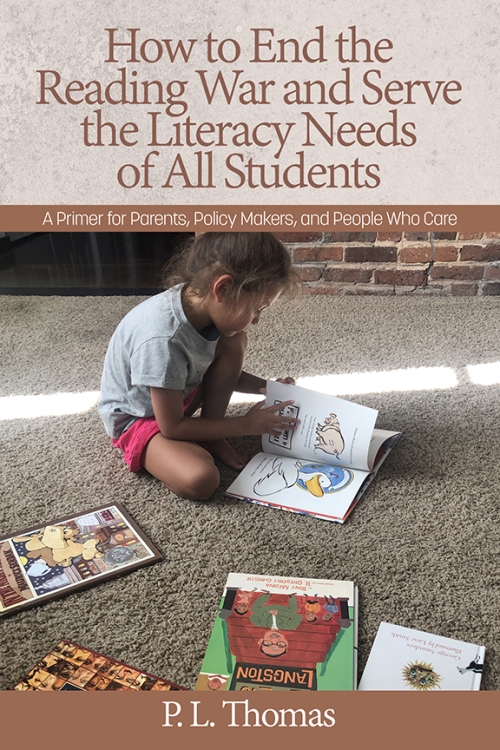
In Press: How to End the Reading War and Serve the Literacy Needs of All Students: A Primer for Parents, Policy Makers, and People Who Care (IAP) – radical eyes for equity

In Press: How to End the Reading War and Serve the Literacy Needs of All Students: A Primer for Parents, Policy Makers, and People Who Care (IAP) – radical eyes for equity

In Press: How to End the Reading War and Serve the Literacy Needs of All Students: A Primer for Parents, Policy Makers, and People Who Care (IAP)


[excerpt from Introduction]
How to End the Reading War and Serve the Literacy Needs of All Students: An Overview
The chapters that follow are not intended to document how we should or can teach reading. In fact, there is abundant work that has existed since the early twentieth century to document the many and varied ways we know we should help foster students as readers from the first days of school to the last. As well, this entire book is working well outside being a how-to on teaching reading or a storehouse of research—even as I am advocating that test-driven reading policy and instruction are asking way too little of students and their teachers.
ThomasCase2
Instead, this is an informative work, focusing on the historical and current Reading War, that builds to a framework for moving beyond that war, and as the subtitle states, serving the literacy needs of all students.
Chapter 1 (A Historical Perspective of the Reading War: 1940s and 1990s Editions) offers a historical overview of crisis responses to reading, focusing on the 1940s (WWII literacy rates of soldiers) and a 1990s report spurred by NAEP. This historical perspective is often missing from media coverage of reading and reading policy debates and decisions made at the federal and state levels.
In Chapter 2 (The Twenty-First Century Reading War: “The Science of Reading,” Dyslexia, and Misguided Reading Policy), I examine the current “science of reading” phenomenon in mainstream media driven by mainstream media, Emily Hanford and Education Week as key examples, but also fueled by dyslexia advocacy, all of which has manifested themselves in education policy such as adopting grade retention based on 3rd-grade test scores and training teachers in the “science of reading.”
Chapter 3 (Misreading Reading: The Good, the Bad, and the Ugly) addresses key concepts and topics that are misunderstood but central to the media coverage of the recent Reading War, such as the following: The National Reading Panel (NRP), reading programs, balanced literacy (BL), whole language (WL), phonics, scientific research, grade retention, teacher education, and teacher autonomy.
Finally, in Chapter 4 (How to End the Reading War and Serve the Literacy Needs of All Students: Shifting Our Deficit Gaze, Asking Different Questions about Literacy), the following reforms needed to end the Reading war will be explored:
  • Social policy must be implemented to address inequity and the homes, communities, and lives of children; these socioeconomic reforms must be viewed as central to reading policy.
  • The mainstream media must abandon Christopher Columbus and both-sides journalism that addresses education/reading.
  • Reading policy must abandon ineffective and hurtful commitments that include standards, high-stakes testing, grade retention, etc.
  • Classroom and school practices must abandon reading programs and silver-bullet approaches to literacy; and teaching must be far more individualized and patient.
  • Evidence-based teaching of reading must expand the meaning of “scientific” and evidence.
In the Conclusion (The Science of Literacy: A 36-Year Journey and Counting), I challenge a narrow view of “science,” especially in terms of education and literacy.
As you read the following chapters, I want you to keep some big-picture concerns in mind: What do we ultimately mean when we talk about teaching children to read? And what does it mean for a student to be able to read?
I want you to consider this story from a high school ELA class discussion on capital punishment. As the teacher led a discussion on the death penalty, a student interjected that Texas currently uses decapitation for the death penalty. The teacher paused, and then suggested that this wasn’t true. The student hurriedly explained it was true, and that he had proof.
The student took out his smartphone, pulling up an article to show the teacher. The article was from The Onion.
Patiently, the teacher informed the student that The Onion is satire, to which the student replied, “No, it isn’t.” Keep in mind that this high school student can pronounce the words in the article; he had read the entire piece.
Are our reading standards, sacred high-stakes tests, and reading programs fostering the sort of students who are critical readers, capable of navigating a complex world better than the student above? Is this Reading War in any way addressing that problem?