Latest News and Comment from Education

Showing posts with label LEARNING. Show all posts

Wednesday, April 28, 2021

Teacher Tom: Learning is for Each Child a Unique and Personal Experience (and why not acknowledging that is so stressful)

Teacher Tom: Learning is for Each Child a Unique and Personal Experience (and why not acknowledging that is so stressful)
Learning is for Each Child a Unique and Personal Experience (and why not acknowledging that is so stressful)


I've been married to my wife Jennifer since 1986, that's 35 years, and during that time we've shared a lot of experiences, side-by-side, the difference in our relative perspectives only a matter of degrees, yet we still regularly find ourself disagreeing about what we saw, heard, touched, tasted, or smelled. Often, it's a simple matter of whether someone was wearing a red or green shirt, but other times our memories differ about matters of great moment. Indeed, there are some things that I remember with clarity, moments in which something significant happened, that she hardly remembers at all, and vice versa.

The older I've gotten, the less certain I've become about the objective accuracy of my memories. Or rather, I find myself questioning the concept of object accuracy altogether. Yes, something in the past happened, but it only exists for me as the form it imprints upon my brain. But not even that. Researchers have discovered that we are constantly making and re-making our memories. Each time we recall something, they tell us, it becomes altered in some way. The more we recall something, the more we tend to change it until our memories very often only have a passing resemblance to what actually, objectively, happened.

Tuesday, April 13, 2021

Teacher Tom: I Don't Know What They Are Learning . . . And Neither Do You

Teacher Tom: I Don't Know What They Are Learning . . . And Neither Do You
I Don't Know What They Are Learning . . . And Neither Do You


I was recently asked how I go about explaining to skeptical parents what their child is learning as she plays. It's a common enough question, one I don't need to address very often in my day-to-day life as a teacher, largely because the Woodland Park Cooperative School's reputation as a play-based school precedes it, mostly only attracting families who are seeking what we have to offer -- the opportunity for their children to play with other kids in a safe enough, loving, interesting environment, -- so I don't often have to deal with skeptics. The families of the children I teach tend to view play as a pure good, like love, one that needs no other supporting evidence.
When I see children on the floor, say, building with blocks, I know they are learning, because that's what play is: it's children setting about asking and answering their own questions. Can I stack this block atop that one? Can I make it even higher? Add a roof? Create a room? A zoo? Can I persuade this other person to join me in my vision? Can I join them in theirs? They aren't saying these things aloud or even in their heads, but it's quite clear that when humans play, when we freely choose an activity, that is what we are doing, testing the world, performing experiments, seeking answers CONTINUE READING: 
Teacher Tom: I Don't Know What They Are Learning . . . And Neither Do You

Tuesday, March 30, 2021

Unlearning to Write – radical eyes for equity

Unlearning to Write – radical eyes for equity
Unlearning to Write


In my foundations of education course, we discussed the role of evidence and research in education, highlighting the problem with experimental/quasi-experimental research and its use in the so-called real world of day-to-day teaching. I always use medicine as an analogy—such as the recently development of the Covid-19 vaccine.

What I hope to accomplish is to offer students a more nuanced understanding of evidence and research. I stress that based on my nearly 40 years of teaching, gold-standard research matters, but it rarely matters in teaching (versus medicine) the way that many people think.

Teaching and learning, I explain, are extremely complicated.

In the article we examined, Seven ‘great’ teaching methods not backed up by evidence, one of the “popular” teaching practices Higgins and Coe claim there is “no evidence for” is discovery learning.

As someone who has spent four decades grounded in discovery learning and using workshop structures when teaching literacy, specifically writing, I find such claims to be condescending and off-base because they are overly simplistic.

In the listing of educational practices there is “no evidence for,” I ask students to consider how research in education often defines “works” or “doesn’t work” CONTINUE READING: Unlearning to Write – radical eyes for equity

Friday, March 26, 2021

Whatever Happened To the Dalton Plan? | Larry Cuban on School Reform and Classroom Practice

Whatever Happened To the Dalton Plan? | Larry Cuban on School Reform and Classroom Practice
Whatever Happened To the Dalton Plan?


When, where, and why did the Dalton Plan arise?

Begin with Helen Parkhurst. A 20th century educator much taken with the Progressive approach to schooling, she designed the Dalton Plan after World War I as a way of organizing instruction consistent with Maria Montessori’s and John Dewey’s ideas of individualizing all academic work and building school community. The core of the Plan was students making contracts with their teachers to study and learn content and skills.

Deeply concerned by the grouping and lock-step movement of children and youth in American schools, Parkhurst sought to reorganize classroom work so that teachers would be able to convert traditional age-graded schools and classrooms where whole-group teaching, 55-minute periods, textbooks, and tests prevailed into laboratories where individual students contracted with their teachers to work on topics that interested them. Students then would have to make decisions on what to study when, finishing assignments, and meeting the terms of the contract to complete the teacher designed work (see below for description of Dalton Plan).

Parkhurst named the Plan after the public high school in Dalton, Massachusetts where it was first put into practice in 1920. She also was the founder of a New York City private school named after the Plan where it was the primary means of CONTINUE READING: Whatever Happened To the Dalton Plan? | Larry Cuban on School Reform and Classroom Practice

Monday, March 22, 2021

Teacher Tom: Embodied Learning

Teacher Tom: Embodied Learning
Embodied Learning


I wasn't exposed to the works of William Shakespeare until I was 17-years-old. I can't even remember what play we had to read. It was probably one of the best known ones like Hamlet or A Midsummer Night's Dream, but I barely understood a word. I blamed the material, of course. It couldn't be me: I was a good reader, something I'd been told since first grade when I was placed in "Reading Group 1" by my teacher Mrs. McCutcheon. This archaic crap might have been a best seller back in the 16th century, but today, in the modern world of 1979, it had clearly lost its relevance. Forcing us to endure it was an example of academic hazing or something.

I wasn't the only one who struggled, so our teacher had the idea of reading parts aloud to us so we could "hear the poetry." Aside from making it feel a bit like we'd been transported back to kindergarten, she was right, it did help. Shakespeare's meaning was more clear and I began to make some of my first approaches toward something like CONTINUE READING: Teacher Tom: Embodied Learning

Wednesday, March 17, 2021

Teacher Tom: Thinking, Learning, and the Having of Wonderful Ideas

Teacher Tom: Thinking, Learning, and the Having of Wonderful Ideas
Thinking, Learning, and the Having of Wonderful Ideas


The word "education" has two Latin roots: educare and educereEducare means to train or mold someone and specifically refers to a processes of passing along knowledge from one generation to the next, with the goal of shaping youth in the image of their parents through rote learning and future employment in the economy. Educere, in contrast, means to "lead out," in the sense that we are preparing youth for an unknown future, which calls for thinking, questioning, and creating. The modern word "education" didn't appear in the English language until the tail end of the Middle Ages and was used primarily in the sense of educare, and was largely applied, often brutally, to making peasant youth into compliant workers. By the Enlightenment, however, the word had taken on a meaning more in keeping with educere. And here we are today, arguing over what we want from education.

The lazy answer is to say we want to find a balance, but from where I sit there is no way to balance concepts that cancel one another out. To be well-trained means to be obedient and compliant, which requires the suppression thinking, questioning, and creating. Thinking, questioning, and creating, in turn, leads to individuals inclined to upset the status quo, which stands in direct opposition to the goal of CONTINUE READING: Teacher Tom: Thinking, Learning, and the Having of Wonderful Ideas

Monday, March 15, 2021

NANCY BAILEY: Questions About The AFT and NEA’s “Learning After Covid Vision”

Questions About The AFT and NEA’s “Learning After Covid Vision”


Teachers are the most important individuals in a child’s schooling, and during the pandemic, they have gone above and beyond to reach out to students.

AFT President Randi Weingarten and NEA’s Becky Pringle are to be commended for speaking out about Covid-19 in support of student and teacher safety. The teachers’ unions have been criticized unfairly for trying to do what’s right for the safety of students and teachers.

But why does their new post-Covid-19 guide tip a hat towards nonprofits and groups that are not friendly to teachers and public education?

How exactly will schools change after Covid-19? Are teachers aware of the union connections and what they mean by words like restructuring schools? Is it about online learning? How involved will teachers be in that restructuring process and is it for the betterment of students?

Learning Beyond Covid: A Vision for Thriving in Public Education at first glance might seem positive and it makes some good points. But many of the links raise CONTINUE READING: Questions About The AFT and NEA’s “Learning After Covid Vision”

Monday, March 8, 2021

Teacher Tom: Experience and Freedom Matter

Teacher Tom: Experience and Freedom Matter
Experience and Freedom Matter


I'm suspicious of most research performed on children. For instance, there have been several studies released over the last couple decades that conclude that we can't expect children, and especially teens, to make good decisions. (Here's an article that links to a few of these studies.) The leading theory is that humans are simply designed that way, that our frontal lobes, the part of our brain scientists think is associated with executive function, isn't fully formed until well into our 20's. So, you know, the kids really need us to help them make decisions well into young adulthood.

I trust and respect the scientific process and these results have, more or less, been replicated. The essential findings are that the older kids get, the better they get at making decisions, which makes sense to me, because experience matters, but I have my doubts about how much it has to do with the development of the frontal lobe. Oh, I'm convinced that something goes on in our frontal lobes as we make decisions. We can measure the electrical and chemical activity. That's the evidence we have that our brains do the thinking: we can either determine what part of the brain is CONTINUE READING: Teacher Tom: Experience and Freedom Matter

Sunday, March 7, 2021

A Half-Dozen Things You (Could Have) Learned in School: Lessons from a Pandemic | Teacher in a strange land

A Half-Dozen Things You (Could Have) Learned in School: Lessons from a Pandemic | Teacher in a strange land
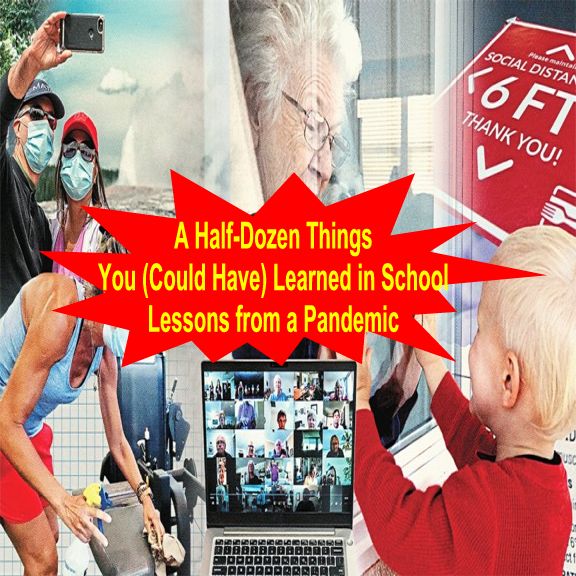
A Half-Dozen Things You (Could Have) Learned in School: Lessons from a Pandemic


If you’re old and loyal to NPR, like me, you may have listened to Whad’ya Know? on the radio, out running errands on Saturdays, a decade ago. A gently sardonic quiz show, hosted by Michael Feldman, my favorite category of question was Things You Should Have Learned in School (Had You Been Paying Attention).

I was always interested in what people think is, you know, core knowledge–stuff that everyone should have mastered, in the place where I worked for more than 30 years. Mostly, it was prosaic things—the isosceles triangle or the gerund—that you likely haven’t thought of in years.

It begs the question: What do we really want—or need– kids to learn in school? Besides basic literacy and numeracy, you’d think our next highest priorities would be good citizenship, and an appreciation for the benefits of modern science, helping us make progress on the issues that have plagued mankind for centuries. But—thinking about the Governor of Texas here—evidently not.

A year ago, as it was just beginning to dawn on us that this thing was coming our way, I wrote a ridiculously sunny blog about things we could learn from being in quarantine. NaĆÆve things. A new appreciation for teachers was one of them, as well as an up close and personal understanding of both the uses and limitations of remote CONTINUE READING: 
A Half-Dozen Things You (Could Have) Learned in School: Lessons from a Pandemic | Teacher in a strange land

Tuesday, February 16, 2021

Teacher Tom: "Actual Life"

Teacher Tom: "Actual Life"
"Actual Life"


Alfred North Whitehead spent the 1890's writing his Treatise on Universal Algebra, and the next decade collaborating with this former student Bertrand Russell writing Principia Mathematica, generally considered to be one of the most important works on mathematics, or any topic for that matter, of the 20th century. I share this only to point out that this guy was no slouch. A supremely well-educated man, who taught at places like Harvard, and who aged into the sort of old, white man upon whom the entire idea of Western Society has been built. Putting mathematics largely behind him, in his later years he turned increasingly to philosophy. In 1929, in an essay entitled, The Aims of Education, this dusty academic, from deep within the established order, wrote:

There is only one subject-matter for education, and that is Life in all its manifestations. Instead of this single unity, we offer children -- Algebra, from which nothing follows; Geometry, from which nothing follows; Science, from which nothing follows; History, from which nothing follows; a Couple of Languages, never mastered; and lastly, most dreary of all, Literature, represented by plays of Shakespeare, with philological notes and short analyses of plot and character to be in substance committed to memory. Can such a list be said to represent Life, as it is known in the midst of the living of it? The best that can be said of it is, that it is a rapid table of contents which a deity might run over in his mind while he was thinking of creating a world, and has not yet determined how to put it together. 

This could be written today by any one of us who have spent CONTINUE READING: Teacher Tom: "Actual Life"

Monday, February 15, 2021

NYC Educator: If We Can't Learn from Crisis, School Doesn't Matter

NYC Educator: If We Can't Learn from Crisis, School Doesn't Matter
If We Can't Learn from Crisis, School Doesn't Matter


Well, according to the NY Times, most pediatricians, all of whom had access to the vaccination well before we did, don't think we need it in order to return to work. I'm not surprised. Ever since the plague hit, I've been reading in the Times about how awful it is that schools were closed. The fact that schools are, in fact, not closed, and that they have not been closed is neither here nor there. And hey, why err on the side of caution when we can just hope things like this don't happen?

It's vital that we get those buildings open, and that we get those kids in there to study algebra, or whatever it is on their programs. Otherwise, how will Western Civilization continue its great march ahead? Obviously, living through a pandemic is not an educational experience. There is absolutely nothing to be learned from it.

One thing, for example, that cannot be learned is preserving the environment. Who cares if we've destroyed a whole lot of rain forest, and that animals out of their element bring us diseases that come from theirs? Who cares if we keep interacting with bats, and that they carry resistance to a whole lot of deadly diseases that we don't? As long as we have someone solving for X, let's forget about the earth, our home, altogether. That algebra cannot be allowed to simply go by the wayside.

Another thing we can't be bothered learning is it is not, in fact, a good idea to elect a self-serving, self-important, solipsistic serial liar to the Presidency of the United States. Why should kids bother learning things like that? That's cancel culture. We have an absolute right to select politicians who don't give a golly gosh darn about the environment (not to mention working people). If politicians choose not to take precautions in public, and if they get COVID and infect others with it, well, that's their right as Americans. Every time they breathe virus into one of our faces they're doing their sacred duty of owning the libs. 

So let's get those kids into physical classrooms, for goodness sake, and never mind if, in fact, it's only a distinct minority of children who actually attend. Never mind if the people themselves, by a margin of two or three to one, don't trust the NY Times or the pediatricians in the survey. Never mind a consistent history of medical mistreatment that leaves minorities (majorities in our area) wary of doctors and even the NY Times reporters who preach to us.

Who cares if the few students who make it into buildings are kept separated and masked? The important thing is to keep them doing that algebra, or whatever it is we happen to be offering them that day. It doesn't matter if we invite them into rooms and preclude social interaction. It's good for kids to sit masked and far apart from one another, and it's healthy that most of them don't come in, evidently. But NY Times reporter have yet other brilliant insights to share with us:

Yeah, it's an absolute disgrace we keep closing down schools so that CONTINUE READING: NYC Educator: If We Can't Learn from Crisis, School Doesn't Matter

Thursday, December 31, 2020

Teacher Tom: An Education That Emerges From Those Things That Most Affect Us

Teacher Tom: An Education That Emerges From Those Things That Most Affect Us
An Education That Emerges From Those Things That Most Affect Us


In 1675, French rationalist philosopher Nicholas Malebranche wrote, "The mind does not pay equal attention to everything it perceives. For it applies itself infinitely more to those things that affect it, that modify it, and that penetrate it, than to those that are present to it but do not affect it."

I don't know if this insight was groundbreaking at the time, but for most of us today it seems self-evident. I know that this is true of my own mind and from what I've read, modern scientists concur. It makes sense that our minds would have evolved like this. Or rather, it's rational to conclude, at least, that our senses have evolved to filter out the "noise" in our environment in order to focus on those things that have the greatest impact on our fitness. In a world of plant life, for instance, we're more likely to notice the ones that provide nutrition or the potential for shelter, but if a tiger prowls onto the scene, the plants fall to the background as our minds CONTINUE READING: Teacher Tom: An Education That Emerges From Those Things That Most Affect Us

Wednesday, December 30, 2020

glen brown: When Children Return to School by Teresa Thayer Snyder

glen brown: When Children Return to School by Teresa Thayer Snyder
When Children Return to School by Teresa Thayer Snyder


Dear Friends and Colleagues:

 I am writing today about the children of this pandemic. After a lifetime of working among the young, I feel compelled to address the concerns that are being expressed by so many of my peers about the deficits the children will demonstrate when they finally return to school.

 My goodness, what a disconcerting thing to be concerned about in the face of a pandemic which is affecting millions of people around the country and the world. It speaks to one of my biggest fears for the children when they return. In our determination to “catch them up,” I fear that we will lose who they are and what they have learned during this unprecedented era.

 What on earth are we trying to catch them up on? The models no longer apply, the benchmarks are no longer valid, the trend analyses have been interrupted. We must not forget that those arbitrary measures were established by people, not ordained by God. We can make those invalid measures as obsolete as a crank up telephone! They simply do not apply.

When the children return to school, they will have returned with a new history that we will need to help them identify and make sense of. When the children return to school, we will need to listen to them. Let their stories be told. They have endured a year that has no parallel in modern times. There is no assessment that applies to who they are or what they have learned.

Remember, their brains did not go into hibernation during this year. Their brains may not have been focused on traditional school material, but they did not stop either. Their brains may have been focused on where their next meal is coming from, or how to care for a younger sibling, or how to deal CONTINUE READING: glen brown: When Children Return to School by Teresa Thayer Snyder

Saturday, December 12, 2020

NYC Educator: School Leaders Who Never Learn Believe Students Can't Either

NYC Educator: School Leaders Who Never Learn Believe Students Can't Either
School Leaders Who Never Learn Believe Students Can't Either


It's hard to overstate the lack of vision and foresight of Mayor Bill de Blasio and Chancellor Richard Carranza, but they continue to trip all over themselves day after day. The mayor just finished announcing that the one-third of students who signed up for in person learning, at least those in lower grades, might be able to attend five days a week. Evidently, that's the only way that students can catch up with Whatever It Is they need to catch up with.

Don't worry about the fact that it's likely impossible. The impossible is no barrier to Carranza or de Blasio. The important thing is to open the schools no matter what, as de Blasio tries to salvage his reputation as someone who is not simply a hapless and bumbling hack. We watched him stumble through a humiliating campaign for the Presidential nomination, one in which he won no more delegates than my dog did. (In fairness, my dog is much cuter than de Blasio will ever be.)

De Blasio spent the early part of this school year dithering with ridiculous, unworkable plans, Now that they've crashed and burned, he's finally opening slots for the virtual content specialists that will likely not be needed at all. He's reopened schools up to grade five in the face of an exploding pandemic. His principled stand to close schools when the city hit 3% positivity now lies trashed with every other principle he's abandoned. The question is no longer whether these buildings will close again, but when. I only hope it's soon.

Meanwhile, he and the chancellor have other genius ideas to tinker with. In Tweed World, no one learns anything from actual events. Take this pandemic, for example. It doesn't actually mean anything, and students will acquire CONTINUE READING: NYC Educator: School Leaders Who Never Learn Believe Students Can't Either


Friday, December 11, 2020

Grades Tarnish Teaching as well as Learning – radical eyes for equity

Grades Tarnish Teaching as well as Learning – radical eyes for equity
Grades Tarnish Teaching as well as Learning


Recently on social media, a professor asked if others used rubrics with graduate students. Since rejecting rubrics has been a central component of my career-long efforts to de-grade and de-test teaching and learning, I chimed in.

My posts in the comments explaining why I don’t use rubrics were significant outliers because the thread of comments was overwhelmingly endorsing rubrics, almost entirely in terms of making grading easier or more transparent as well as providing teachers/professors protection against (hypothetical) students challenging their grades.

One immediate response to my comments is also worth highlighting since a person who doesn’t know me made fairly nasty assumptions about me being like the professors they had in grad school, the “gotcha” professors who use grades to ambush and punish students.

While most of my public (see here and here, for example) and scholarly work rejecting the use of rubrics—especially when teaching writing—has focused on their negative impact, along with grades, on students and learning (see this example), the recent social media thread highlights that grades also tarnish CONTINUE READING: Grades Tarnish Teaching as well as Learning – radical eyes for equity


Thursday, December 10, 2020

THE GLASS JUST MIGHT BE HALF FULL – Dad Gone Wild

THE GLASS JUST MIGHT BE HALF FULL – Dad Gone Wild
THE GLASS JUST MIGHT BE HALF FULL


“There are two ways to be fooled One to believe what isn’t true The other is to refuse to believe what is true.” Soren Kierkegaard

The battle between those who believe that school buildings should be open and those who believe they are unsafe under current circumstances shows no sign of abatement. In fact just the opposite, as opposing sides cling tighter to their positions.

Personally, my focus isn’t on either option, but rather encouraging policymakers to find means to ensure that students are getting what they need, be it in school buildings, rec centers, churches, or individual homes. Obviously, the benefits of in-school learning are well known, but we are still discovering the potential of remote learning. Yes, it is difficult, inconvenient, and the jury is out on its effectiveness. But in its defense, it is still in its infancy, so potential in addressing long standing issues with in-person instruction remains untapped.

Because remote learning is so new, and we don’t have reliable data on which to draw from, there is a concern with so-called learning loss. Policymakers and administrators are leaping to use that supposition as a weapon against schools. Whether the belief is backed by evidence, or not, is immaterial.

On a recent, Zoom call with Nashville’s PROPEL, State Education Commissioner Penny Schwinn went so far as to proclaim that when children are not in classrooms, learning can’t take place. In her words, “Learning does not happen through osmosis.” Yeah…that’s not exactly right. I would CONTINUE READING: THE GLASS JUST MIGHT BE HALF FULL – Dad Gone Wild

Monday, December 7, 2020

Teacher Tom: Learning Rules Vs. Intellectual Development and Understanding

Teacher Tom: Learning Rules Vs. Intellectual Development and Understanding
Learning Rules Vs. Intellectual Development and Understanding


I've had the opportunity, through this blog and in person, to talk to hundreds of thousands of educators and parents about how our version of progressive, play-based preschool education works. I've shared about creating interesting, safe-enough environments in which children are free to follow their own curiosity, to ask and answer their own questions, while engaging with the people they find there. Among the most frequent follow-up question from friend and skeptic alike is something along the lines of: "That all sounds well and good, but how do the children do once they find themselves in public school?"


My answer has changed over the years because public schools have changed. Two decades ago, my honest answer was, "They do just fine," because kindergarten was still at least somewhat play-based and the kids naturally adapted even as their freedom over what and how they would learn would be gradually throttled during the course of the next 13 years. I wouldn't necessarily tell parents the second part CONTINUE READING: Teacher Tom: Learning Rules Vs. Intellectual Development and Understanding

Who Is Doing the Work in the Teaching/Learning Dynamic? – radical eyes for equity

Who Is Doing the Work in the Teaching/Learning Dynamic? – radical eyes for equity
Who Is Doing the Work in the Teaching/Learning Dynamic?


The end of a course often challenges my fundamental beliefs as a teacher.

Once again, in the final days of my courses when students are allowed and encouraged to revise their major essays as often as possible, I have returned several without responding because the resubmitted essays are mostly the same as the last draft I marked or the student is merely dutifully addressing only what I have marked.

Many years ago when I was teaching high school English, my classroom was directly across the courtyard from a math teacher. We could see each other’s desks through our windows.

Part joking and part shade, that math teacher occasionally prodded me with “I wish I could teach while sitting at my desk.”

Some of the tension here is the essential nature of teaching math versus teaching writing as an English teacher, but there is also the more pronounced tension of what it means to teach. [1]

This math teacher ran a very quiet classroom with students focused on the CONTINUE READING: Who Is Doing the Work in the Teaching/Learning Dynamic? – radical eyes for equity

Saturday, December 5, 2020

What I Learned from a High School Student | Larry Cuban on School Reform and Classroom Practice

What I Learned from a High School Student | Larry Cuban on School Reform and Classroom Practice
What I Learned from a High School Student


Individuals writing about what they learned from former teachers is common. It is uncommon, however, for teachers to write about what they learned from former students. I do not mean those many instances when tech-savvy students helped teachers solve hardware and software problems. I mean the kinds of learning that doesn’t come from only books but from the questions students ask and the thoughts they express in and out of class.

I learned from Carol Schneider, a 16 year-old junior in my U.S. history class at Glenville High School in Cleveland. The year was 1958. I was a 23 year old teacher beginning my third year of teaching at Glenville. I relished teaching six classes of U.S. history a day in this largely black high school. By the end of the day, I was bone-tired (yeah, I shudder to think what teaching four straight classes, a break for lunch, then two more in the afternoon would do to my body and mind now). I went to Western Reserve University (soon to become Case Western Reserve) two evenings a week to get my Masters degree in history and had begun to prepare classroom lessons in what was then called Negro history. I  created readings to supplement the history textbook that said little about slavery, Reconstruction, and Jim Crowism. Of my six classes, three responded very well to the readings (do any readers remember the purple-stained hands that came from using the school’s “spirit master” or ditto machine?). The other three classes, well, they were much less enthused. Carol was in one of those responsive classes.

Carol who came from a working class family steeped in left-wing political CONTINUE READING: What I Learned from a High School Student | Larry Cuban on School Reform and Classroom Practice

Wednesday, December 2, 2020

Teacher Tom: This is What Real Learning Looks Like

Teacher Tom: This is What Real Learning Looks Like
This is What Real Learning Looks Like


This is the problem with letting dilettantes, even well-intended dilettantes, lead when it comes to education policy. They don't have the experience to recognize what real learning looks like, and since they tend to come from the world of business, they don't trust mere "employees" (teachers), especially if they belong to a union, so they come up with arbitrary data points that carry with them a hint of education-ness, then subject children to their amateur hour. I don't think that most of them want to be cruel to children and their parents, but in their ignorance they believe they know better because they've managed to make money off selling software or hardware or something, so they conjure up education-ish sounding ideas and, because they can, they impose them, despite the objections of those of us who do have the experience to know what real learning looks like.

Anyone who has spent any time in a classroom knows that real learning does not look like children slumped in chairs staring at iPads. Real learning looks like stepping in a puddle you've made with your friends, then sinking in until the water tops your boots.


Real learning looks like pouring water through systems of CONTINUE READING:  Teacher Tom: This is What Real Learning Looks Like