Tuesday, March 9, 2021

Missing the Mark – Tennessee Education Report

Missing the Mark – Tennessee Education Report
MISSING THE MARK


Superintendents in Shelby County are raising concerns about recently-passed legislation that would make retention the default option for a significant number of third grade students. One Superintendent even noted the effort “misses the mark” of its intent and instead of being helpful, will actually have a harmful effect on students.

The Daily Memphian has more:

“I have never seen anything that will hurt students as bad as what they are proposing,” Germantown Municipal School District Superintendent Jason Manuel told the suburb’s Board of Education in a recent meeting.

The response from Manuel comes as his district sent a letter to Gov. Bill Lee and local lawmakers raising concerns about this issue and the insistence on in-person TNReady testing this year.

Meanwhile, it has been pointed out that TNReady is NOT a literacy test and using it for this purpose is ill-advised.

“The legislation is attempting to address third graders who can’t read at grade level, but the TCAP test doesn’t test to see if students can read at grade level,” Lakeland Superintendent Ted Horrell said.

Unsurprisingly, the leadership over at SCORE suggests this idea is a really good one – even though actual educators stand in strong opposition to it. Here’s SCORE CEO CONTINUE READING : Missing the Mark – Tennessee Education Report

Biden executive order is first step to reverse Betsy DeVos’s sexual assault rules - Vox

Biden executive order is first step to reverse Betsy DeVos’s sexual assault rules - Vox
Betsy DeVos’s sexual assault rules have already hurt survivors
Biden just took the first step to reverse them


Last fall, as students around the country were adjusting to the beginning of a school year in the midst of a pandemic, something else changed too: the rules for K-12 schools, colleges, and universities handling reports of sexual harassment and assault.

A new Trump administration regulation that went into effect last August raised the bar for what constitutes sexual harassment, allowed students who report harassment or assault to be directly cross-examined, and allowed schools to use a standard of evidence that many saw as more favorable to the accused. At the time, survivors and their advocates were deeply concerned that the new rules would discourage survivors from reporting and make it easier for schools to let harassment and assault slide.

Now President Biden has taken his first step toward reversing the rule, signing an executive order on Monday directing the Department of Education to review the issue. “It is the policy of my Administration that all students should be guaranteed an educational environment free from discrimination on the basis of sex, including discrimination in the form of sexual harassment, which encompasses sexual violence,” the order, signed on International Women’s Day, states.

But reviewing and reversing the Trump administration rule could take months or even years. And in the meantime, advocates say the rule has already harmed survivors at schools across the country. For example, many are now barred from filing a formal complaint because they experienced harassment off campus, because their harasser has graduated, or because what they experienced does not meet the new, stricter standards set forth by the Trump CONTINUE READING: Biden executive order is first step to reverse Betsy DeVos’s sexual assault rules - Vox

AFT & NEA Issue Joint Statement on Actions Needed After the Pandemic to Benefit All Students | Diane Ravitch's blog

AFT & NEA Issue Joint Statement on Actions Needed After the Pandemic to Benefit All Students | Diane Ravitch's blog
AFT & NEA Issue Joint Statement on Actions Needed After the Pandemic to Benefit All Students


The nation’s two teachers’ unions joined together to issue an unusual joint statement that advises federal, state, and local leaders what must be done not only to revive education after the pandemic but to restart it with a fresh vision that focuses on the needs of children, not assumptions about their “learning loss” or “COVID slide.”

They introduce the document and its visionary proposals with these words:

Nation’s educators release shared agenda to ensure all students succeed Organizations offer proven ways to help students overcome Covid-19 opportunity gaps and meet students’ academic, social, and emotional needs

WASHINGTON, DC – Today the National Education Association (NEA) and American Federation of Teachers (AFT), the nation’s two largest educators’ unions, released a bold, shared agenda to ensure that all students receive the supports and resources they need to thrive now and in the future.  

Over the course of the last month, AFT and NEA have come together to define the essential elements needed to effectively understand and address the ways in which the COVID-19 pandemic has disrupted students’ academic, social, and developmental experiences. “We have an unprecedented opportunity to create the public schools all our students deserve,” said NEA President Becky Pringle. “It is our mission to demand stronger public schools and more opportunities for all students- Black and white, Native and newcomer, Hispanic and Asian alike. And we must support the whole learner through social, emotional and academic development. The ideas presented in this roadmap will lay the groundwork to build a better future for all of our students.” 

“COVID-19 has laid bare this country’s deep fissures and inequities and our children, our educators and our communities have endured an unprecedented year of frustration, pain and loss,” said AFT President Randi Weingarten. “As vaccine access and effectiveness suggest the end is in sight, it is incumbent on us to not only plan our recovery, but to reimagine public schooling so our children, families and educators can thrive.  

“The crises gripping our country are weighing heavily on young people, who are the future of our communities. That’s why our schools must, at a minimum, be supported and well-resourced to address our students their trauma, social-emotional, developmental and academic needs. This framework is an invaluable tool to help us get there,” Weingarten added. 

Shared with Sec. of Education Cardona last week, Learning Beyond Covid-19, A Vision for Thriving in Public Education offers the organizations’ ideas on ways our education systems can meet students where they are academically, socially, and emotionally.  The framework outlines five priorities that can serve as a guide for nurturing students’ learning now and beyond COVID-19 including learning, enrichment and reconnection for this summer and beyond; diagnosing student well-being and academic success; meeting the needs of our most underserved students; professional excellence for learning and growth; and an education system that centers equity and excellence. 

The full document can be found here. 

Flast v. Cohen (1968) – Part Two: That’s Me In The Courtroom | Blue Cereal Education

Flast v. Cohen (1968) – Part Two: That’s Me In The Courtroom | Blue Cereal Education
Flast v. Cohen (1968) – Part Two: That’s Me In The Courtroom


Recap of Part One:

Losing My ReligionThe Supreme Court explained in Commonwealth of Massachusetts v. Mellon (1923) that simply being a taxpayer didn’t give one the right to protest government actions – even potentially unconstitutional ones – in the courts. There were simply too many “what ifs” between the individual taxpayer sending in their $20 and any one specific expenditure.

Nevertheless, plaintiffs – at least in Establishment cases – tended to reference the fact that they were taxpayers in their complaints against government actions over the next several decades, even if they were also parents of students being impacted. It was rarely the focus on the Court’s decisions, but it kinda kept coming up.

In the 1960s, the Court began framing the Establishment Clause as something fundamentally different than the other protections in the Bill of Rights. As a result, arguments that this particular clause was being violated might have to operate according to a slightly different set of rules than the rest.

Finally, in 1968, the Court did its best to explain exactly what that might look like, at CONTINUE READING: Flast v. Cohen (1968) – Part Two: That’s Me In The Courtroom | Blue Cereal Education

Letter to the Editor: Tennessee Poised to Fail Students – radical eyes for equity

Letter to the Editor: Tennessee Poised to Fail Students – radical eyes for equity
Letter to the Editor: Tennessee Poised to Fail Students


In response to Third grade retention law causing suburban superintendents angst, I submitted the following letter to the editor:

While it is increasingly popular across the US to pass third-grade retention laws as part of larger reading policies, often under the guise of the “science of reading,” there are decades of research showing that grade retention is extremely harmful to children, especially minoritized students and students living in poverty.

The National Council of Teachers of English (NCTE), the largest organization of English teachers in the US, “oppose[s] legislation mandating that children, in any grade level, who do not meet criteria in reading be retained” and “oppose[s] the use of high-stakes test performance in reading as the criterion for student retention.”

As well, the National Education Policy Center (Boulder, CO) has issued a policy brief warning that states “[s]hould not adopt ‘ends justify the means’ policies aimed at raising reading test scores in the short term that have longer-term harms (for example, third-grade retention policies).” Further, states “[s]hould not prescribe a narrow definition of ‘scientific’ or ‘evidence-based’ that CONTINUE READING: Letter to the Editor: Tennessee Poised to Fail Students – radical eyes for equity

New York Times: Readers Respond to Charter Debate | Diane Ravitch's blog

New York Times: Readers Respond to Charter Debate | Diane Ravitch's blog
New York Times: Readers Respond to Charter Debate 


You may recall that sociologist and author Eve Ewing wrote an opinion piece in the New York Times that said it was time to end the debate about charter schools and celebrate all good schools, whatever they are called. This is one of the talking points of the charter industry, which prefers the public not to notice how many charter schools close every year, how many are low-performing, and how many are run by non-educators who turn a handsome profit.

My response was here.

The New York Times published letters to the editor about the Ewing article. Only one was favorable, written by Jeanne Allen, who runs a charter advocacy organization called the “Center for Education Reform,” funded by rightwing billionaires and Wall Street financiers. CER promotes all kinds of school choice and is hostile to public schools.

The first letter was written by Denis Smith of Ohio, who has appeared on this blog:

To the Editor:

Re “End the Fight Over Charter Schools,” by Eve L. Ewing (Op-Ed, Feb. 23):

Why do we allow two separate but seemingly parallel systems of education, using scarce public funds that are taken from traditional public schools to fund charters, a seeming experiment gone awry? Why do we allow one entity that is accountable and has governance conveyed from the voters in each community and allow the other to CONTINE READING: New York Times: Readers Respond to Charter Debate | Diane Ravitch's blog

Teacher Tom: A Curriculum of All-Bugs-All-The-Time vs. Hubris and Habit

Teacher Tom: A Curriculum of All-Bugs-All-The-Time vs. Hubris and Habit
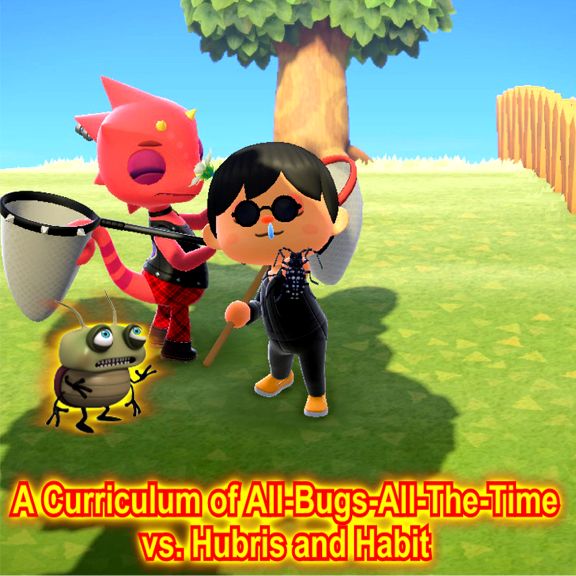
A Curriculum of All-Bugs-All-The-Time vs. Hubris and Habit


I once taught a boy named Rico who had a passion for insects. He came to me that way as a three-year-old and was still hunting for bugs as a five-year-old. He didn't care at all for the tub of plastic insects we had inside the preschool, even the super-sized scorpion that every kid wanted, left him shrugging. Instead, he peered into the dark places -- under and behind furniture, for instance, or into the thin cracks between the baseboards and walls. -- because that, he knew, was where the bugs wanted to be. He included spiders in his studies, as well as snails and worms, even as he knew they were arachnids and mollusks, and for a time allowed himself to be fascinated with crabs and lobsters after the visiting "Bug Man" told us that they were, in fact, a type of insect. But his main interest were the bugs that live among us on a daily basis, the creatures he found in his garden, under his house, while on walks, and, of course, on the playground.


He would occasionally play with the other children, and often lure some of them to join him in his hunts, but he spent a great deal of time on his own, on his hands-and-knees, peering under leaves, turning over rocks, and investigating the damp, dark corners of the yard. When he found something interesting, he would begin to call out to others, CONTINUE READING: Teacher Tom: A Curriculum of All-Bugs-All-The-Time vs. Hubris and Habit


Teachers I Respect and Admire–Carmen Wilkinson | Larry Cuban on School Reform and Classroom Practice

Teachers I Respect and Admire–Carmen Wilkinson | Larry Cuban on School Reform and Classroom Practice
Teachers I Respect and Admire–Carmen Wilkinson


I was stunned when I walked into the classroom of Carmen Wilkinson at Jamestown Elementary School in 1975 (all names are actual people and places). In my first year as Arlington (VA) school superintendent, I had already seen hundreds of elementary classrooms. This was the only one I had seen that had mixed ages (grades 1 through 4) and learning stations in which 50 students spent most of the day working independently and moving freely about the room; they worked in small groups and individually while Wilkinson–a 27-year veteran of teaching–moved about the room asking and answering question, giving advice, and listening to students. Called “The Palace” by parents, children, and staff, the class used two adjacent rooms. Wilkinson teamed with another teacher and, at the time, two student teachers. She orchestrated scores of tasks in a quiet, low-key fashion. Wilkinson’s informal classroom was unusual at Jamestown–I did discover a few more in other schools–in the 500 other elementary classrooms in the Arlington public schools.

Wilkinson began teaching in Arlington in 1950 and came to Jamestown in 1957. She taught first through third grades. She was one of the first teachers in the County schools to try and then embrace “open classrooms” in the late-1960s. Parents vied to get their children into “The Palace.” Local colleges sent their CONTINUE READING: Teachers I Respect and Admire–Carmen Wilkinson | Larry Cuban on School Reform and Classroom Practice

School Openings: Political Gamesmanship Collides with Sound Educational Policy. | Ed In The Apple

School Openings: Political Gamesmanship Collides with Sound Educational Policy. | Ed In The Apple
School Openings: Political Gamesmanship Collides with Sound Educational Policy


President Biden set a target of school re-openings within his first hundred days in office; however, the decision to open schools is local; the 14,000 school districts across the nation have the authority to open and close schools. The national teacher unions (NEA, AFT) do not have the authority either; the local unions within school districts “negotiate” school openings.

The American Federation of Teachers (AFT) produced a “Roadmap to Safely Open Schools” (Read here)

Randi Weingarten, the AFT President favors reopenings, with safeguards..

Education Next, a widely read website was prescient, Schools will remain closed for the rest of the 2019–20 academic year but will reopen in the 2020–21 academic year (albeit with the potential of localized, rolling closures for 14–28 days triggered by additional waves of infection,

The Los Angeles School District has been closed since the pandemic hit in March, COVID positive rates in Los Angeles remain high as well as hospitalizations and deaths. The teacher union (UTLA) has been adamant, has threatened a strike and only in the last few days agreed to a phased reopening plan.

The conservative media has pummeled teacher unions.

The New York City teacher union (UFT) threatened a “safety strike” in August, CONTINUE READING: School Openings: Political Gamesmanship Collides with Sound Educational Policy. | Ed In The Apple

Jersey Jazzman: Lakewood, NJ: Where Public Schools Are Left To Wither, Part I

Jersey Jazzman: Lakewood, NJ: Where Public Schools Are Left To Wither, Part I
Lakewood, NJ: Where Public Schools Are Left To Wither, Part I


If you follow K12 policy, you've probably noticed that the school privatization crowd has recently become reenergized. The folks from right-wing think tanks and the professional school "choice" promoters have been pushing the idea of school vouchers hard, certain that the pandemic has created widespread dissatisfaction with our current system of public school districts.

Many times I've seen these people make the argument that private schools are fully open, and the only reason public schools are not is the intransigence of teachers unions and fecklessness of school boards. Of course, it's hardly that simple: consider that many "no excuses" charter schools -- free of both unions and BOEs -- remain closed. We also really don't know how many private schools are open, or to what extent, or with what consequences.

Nonetheless, the privatizers see an opening. And considering the number of wingnuts out there who think COVID isn't a serious threat that requires extraordinary actions to secure schools, they may be right. School privatization was, to my mind, always a secondary part of the overall conservative agenda, but that may have changed, if only in the short term.

Given the renewed focus on vouchers, I think we're justified in taking some time to really CONTINUE READING: Jersey Jazzman: Lakewood, NJ: Where Public Schools Are Left To Wither, Part I

ARGUING OVER MARKETING TERMS – Dad Gone Wild

ARGUING OVER MARKETING TERMS – Dad Gone Wild
ARGUING OVER MARKETING TERMS


“If I were going to tell one of my sons how to possess the world, I would simply bring him into my house, show him that solid wall of books, and say to him: ‘the secret is in there somewhere, and even if you never find out what it is, you will still have come closer.”
― James Dickey


Some of you may notice the Spotify header. From here on out, you can listen to Dad Gone Wild as a podcast or read it traditionally. The podcast is obviously in its beginning stages, so it’s going to be a little rough for a while, but the option is available for those who so chose.

I’ve also started distributing posts via Substack. Substack allows you to sign up to receive posts via email. Currently, subscriptions are free, but there is an opportunity to help support my work as well. It’s my hope that Substack provides a means to decrease my social media footprint. As much as I once loved Twitter and found it to be an irreplaceable source of information, over the years its toxicity has only grown and it continually regresses into something that strangely brings forth recollections of high school.

People have retreated to their individual tribes and honest discourse seems to occur with increasing infrequency. Rare is the Tweet that says, “Hmmm…I never considered that. You’ve given me more to think about”, or, “I concede your point and I appreciate the thoughtful argument.” Instead, it’s personal attacks when someone voices an opinion that runs counter, disparaging terms, like “boomer” and “Karen”, are tossed around as if they aren’t the latest tool to dismiss and marginalize people.

The only thing that does hold me to social media is old friends and the positive voices of people like Hume-Fogge librarian Amanda Smithfield, Cresswell Middle Arts, and Matt Taibbi. There are others, but today these 3 people standout, for always keeping the bar high, even when I don’t agree with CONTINUE READING: ARGUING OVER MARKETING TERMS – Dad Gone Wild

NewBlackMan (in Exile) TODAY #BLM #BLACKLIVESMATTER

 NewBlackMan (in Exile)


NewBlackMan (in Exile) TODAY


Big Education Ape: THIS WEEK WITH NEWBLACKMAN (IN EXILE) - http://bigeducationape.blogspot.com/2021/03/this-week-with-newblackman-in-exile-blm.html


Music Education In The Pandemic And Beyond
"Teaching orchestra, choir or band virtually in a pandemic presents some unique challenges. Even with schools reopening, it's difficult to hold in-person band practice in a way that's safe and socially distant. How has music education changed during the pandemic? And what does its future in U.S. education look like?" -- 1A
Actor Daniel Kaluuya’s Road to Revolutionary
"Actor Daniel Kaluuya -- known for his roles in Get Out and Queen & Slim -- portrays Fred Hampton in the new film, Judas and the Black Messiah , which follows Hampton’s meteoric rise through the party, a multiracial class movement and the series of betrayals that led to his untimely fall. Weeks before he won the Golden Globe award for “ Best Performance by an Actor in a Supporting Role in a Motio
Leroy Moore, Krip Hop Nation and the Politics of the Paralympics
"On this episode of Edge of Sports , host Dave Zirin speaks with Leroy Moore , one of the founders of the hip hop organization, Krip Hop Nation about the Paralympics. Edge of Sports also talks to Moore about his love of Hip-Hop, his favorite artists, and growing up in New York City during the birth of the music genre." Edge of Sports ·
The Quarantine Tapes 165: Sanford Biggers
"On episode 165 of The Quarantine Tapes , guest host Imani Perry is joined by Sanford Biggers . Sanford is an artist working across a wide range of disciplines. He talks with Imani about some of his recent work with quilting, describing how he came to that medium and talking about the cultural and historical elements of that work. Imani asks Sanford about his beginnings in art and about the range
The Voice And Spirit Of Bobi Cรฉspedes
"Considered the musical madrina of the Bay Area's Afro-Cuban community, Bobi Cรฉspedes has been practicing her art there in a number of bands and performance settings for over 40 years. Cรฉspedes' recent album, Mujer y Cantante, was recorded with a small group that includes top notch instrumentalists, some of whom are young enough to be her sons. It gives her voice and her spirit a boost of youthfu
The Quarantine Tapes 163: Alicia Hall Moran
"On episode 163 of The Quarantine Tapes , guest host Imani Perry is joined by Alicia Hall Moran for a two-part episode. Imani and Alicia have a fascinating and wide-reaching conversation about Alicia’s work as an artist and vocalist. Alicia pulls on varied threads of history and music in their

 NewBlackMan (in Exile)