Creative and Just Curriculum, Pt II: Six Ideas about Teaching Music During a Pandemic
Facebook post, shared by a colleague: Started band camp last Sunday, two rehearsals per day. No more than 25 students in a group. They wore masks while moving between stations, and after the second rehearsal, two students went home because of low grade fevers. One tested positive. We were forced to shut down for a minimum of two weeks. There was no precaution we didn’t take.
Welcome to 2020, music educators.
About six weeks ago, Texas band directors (a fierce and highly competitive bunch) started posting summer band-camp photos, on a band directors’ site I follow. Flute players with facial shields. Trumpets and mellophones with their bells bagged. Masked percussionists, labeling their mallets, so they’re touched by only one person. They were fired up. Creativity and safety would win the day!
The page today is really tough reading: Shut-down camps. Lost jobs. Will there be a marching band next year if there’s none this year? Pictures of band rooms where precisely 13 students can play while social-distancing. Deep, philosophical chats about the value of music in kids’ lives. And this—how the hell am I supposed to have a band online?
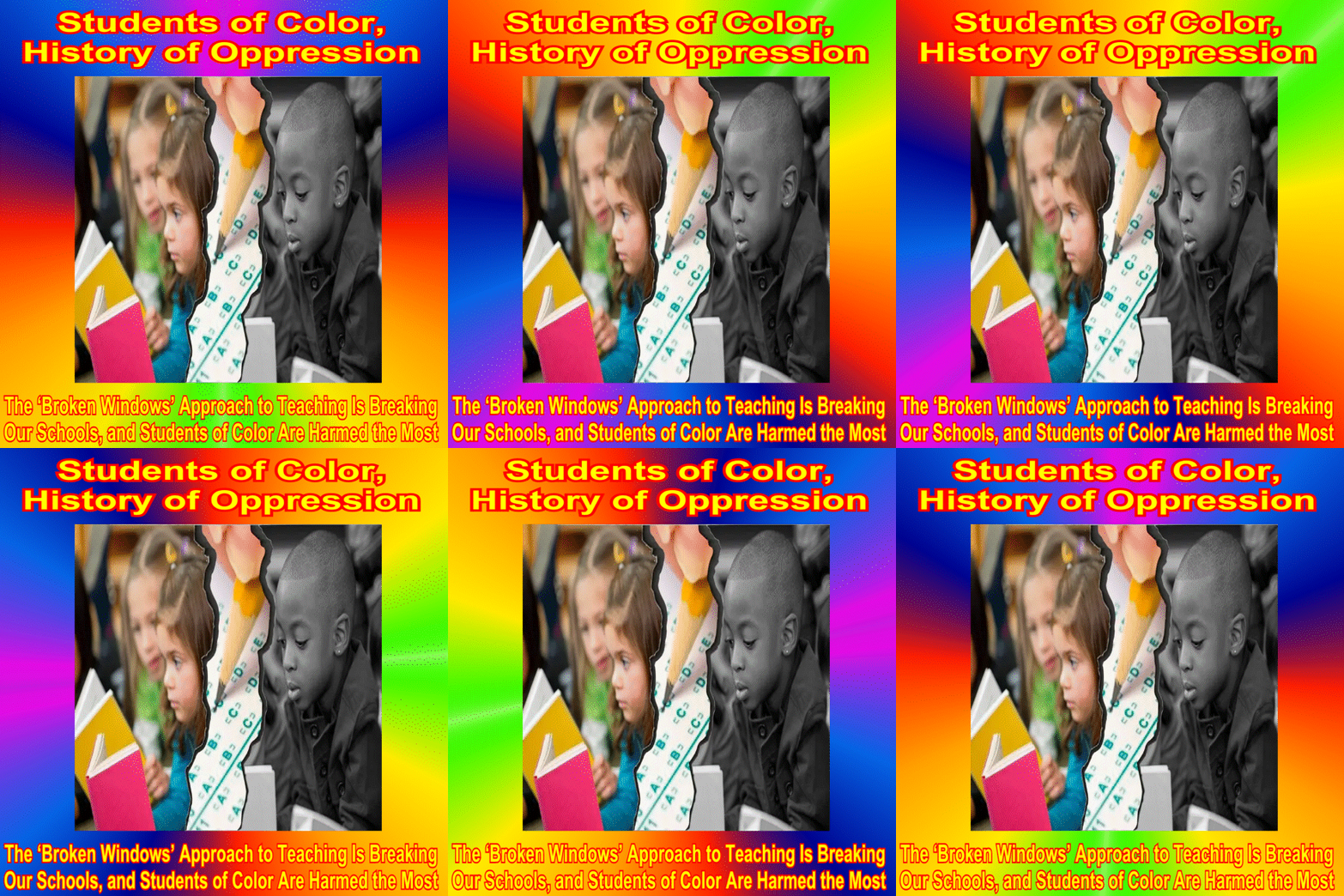
In the fight for racial justice, teachers have a heavy job, for schools are both microcosms of, and preparation for, society. Because teachers serve as significant adult figures in children’s lives, their interactions with students can shape students’ sense of self and the world around them, as well as their engagement in school, personal efficacy, and academic achievement. Complex and difficult racial dynamics impact these relationships, and as calls for justice grow, it’s time to recognize this.
We cannot continue to promote the same unjust and oppressive educational structures that have endured for centuries. Rather, we must reimagine education and recruit a racially diverse teaching force.
Systemic racism is sometimes blatant in our schools. For example, it is hard to deny that segregation persists, and that schools serving students of color receive less funding than mostly white schools. In my home state of Arizona, for example, schools serving mostly white students receive an average of $7,600 more per pupil than schools serving students of color, a discrepancy that increases to nearly $11,000 when controlling for neighborhood income. Research also repeatedly reveals that Black students in particular are more likely to be subjected to disciplinary action, much of which removes them from classrooms and schools. Sometimes this even leads students directly into interactions with law enforcement, hence the moniker school-to-prison pipeline. But there is a subtler form of racism at play in many classrooms, one that expresses itself in the way teachers (82 percent of whom are white nationwide) form relationships with their students.
BREAKING NEWS: THE NEW UK AND NAACP EDUCATION AND CIVIL RIGHTS INITIATIVE
This is a blog I’ve been looking forward to writing for more than a year.
I can finally share with you that the College of Education has entered into a groundbreaking, history-making collaboration with the NAACP, the nation’s largest and most preeminent civil rights organization.
Housed in the Department of Educational Policy Studies and Evaluation, this education and research initiative will focus on educational equity, civil rights and social justice. As NAACP President and CEO Derrick Johnson pointed out, this is the first time the NAACP has partnered with university-based scholars in the education field to help address the racial inequities that continue to plague our education system.
Since the summer of 2019, we have turned ideas into action, laying the foundation for this work. We welcomed Gregory Vincent, an acclaimed civil rights attorney and university professor, as director of this initiative; Sarah LaCour, arriving from the University of Colorado Boulder to serve as an assistant director; Mariama Lockington, a celebrated author and voice for equity and inclusion, who will help support the work of the initiative; and Cheryl Matias, a nationally-recognized scholar who studies culturally responsive education practices, who will contribute to the initiative as well as serve as a professor in the Department of Curriculum and Instruction. They are among a number of new faces who will add to the breadth of expertise and energy in the College of Education
But it doesn’t stop there.
Danelle Stevens-Watkins, who is also director of graduate studies in the Department of Educational, School, and Counseling Psychology, has been named Assistant Vice President for Research in Diversity and Inclusion. She has agreed to chair the UNITed in racial Equity (UNITE) research priority area.
And today, UK President Eli Capilouto announced that senior administrators will undergo anti-racist training as a first step in UK’s campus-wide initiative to change our culture as a community united against systemic racism. The training will be led by Candice Hargons, Ph.D., an assistant professor in theDepartment of Educational, School, and Counseling Psychology. Hargons is a counseling psychologist with a national reputation in the field of anti-racism training.
The world is taking notice. We’re hearing from news media and colleagues from far and wide. One example is the Washington Post article from Thursday, Aug. 6.
You can read more about our work at the links below:
There is much more work to do, and no doubt, there will be more challenges ahead, but I am convinced that we will refuse to allow adversity to stop us from pressing forward and making an unmistakable and lasting impact.
Please Facebook Like, Tweet, etc below and/or reblog to share this discussion with others.
I was not aware of Sears’ collection and organizing of Trumpian verbiage into blank verse. Searching for the poetry of Trump by Sears on Amazon, I discovered that he also wrote a book titled: “Vladimir Putin: Life Coach.”
Here are one of Glen Brown’s Trump poems:
“I’m One of the Smartest People in the World” by Donald J. Trump
Wanting Approval from Those Who You Must Judge: A Dilemma of Leadership
In the second week of my superintendency in the mid-1970s–I came from outside the district, had no entourage, and knew no one in Arlington (VA) save the school board members who had unanimously appointed me–the head of the principals group (there were 35 schools in the district), met me in the stairwell of the Administration building and we chatted a few moments about the weather and the beginning of the school year. He leaned toward me and in a near whisper asked if I would like to join a Friday night poker game with a small group of veteran principals. He added that my predecessor and key district office administrators had played weekly for years. I paused and said: “let me think about it.”
After dinner when the kids had gone upstairs to do their homework, I told Barbara about the invitation and we discussed it thoroughly. My wife pointed out that the invitation was a very important gesture on the part of veteran administrators who had been clearly unenthusiastic when the School Board appointed me. I was an outsider and first-time superintendent who had worked across the river in the largely Black D.C. schools for nearly a decade as a high school teacher and district administrator. She pointed out that it was a splendid opportunity for me to satisfy a strong personal need that we had discussed prior to taking the post. That is, I wanted to secure the respect and approval–and eventually trust–of those who report to me. We had talked about the tension between seeking approval of subordinates who I depended upon while at the same time being in a position where I would have to judge their performance annually. She and I chewed on that dilemma for a long time.
Can Geppetto and Pinocchio Open New York City Schools Safely? or, Are There More Sensible Options?
After weeks and weeks of speculation Governor Cuomo made his anticipated announcement,
Schools across New York can reopen for in-person instruction this fall, Gov. Andrew M. Cuomo said Friday. … Just a few months after New York became a global epicenter of the pandemic, the governor opened the door for millions of students across the state to return to classrooms, even as most public school students in the country will start the school year remotely.
But Mr. Cuomo’s announcement does not guarantee that school buildings in the state’s roughly 700 local districts will actually reopen in the coming weeks. It is now up to local politicians and superintendents to decide whether to reopen, and how to do so. Their in-person reopening plans must also be approved by the state’s education and health departments in the coming weeks.
In other words the governor is punting to the next level, leaving the district by district and school by school decisions to local school boards and local government.
Will de Blasio go along with governor and re-open schools? Will he be able to satisfy the unions, actually the union memberships, the teachers and principals?
There Are No Writing Prodigies: What That Means For Writing Instruction
Mozart was composing and performing at the age of 4. Shirley Temple made her first film appearance at age 3, and within two years was a film star. Pascal wrote a treatise on vibrating bodies at age 9. Trombone Shorty was leading his own band at age 6.
But there are no child prodigies in writing. No classic novels composed by a six year old. No world-altering essays written by some young person in second grade.
That means that every writer starts out at the same level of skill and quality—somewhere between very low and none. Every author you have ever admired, enjoyed, or been inspired by started out as a not-very-good writer.
And that means that the path of a writer is always one of continuous growth, an unending journey that takes each individual across a variety of landscapes. Each path is a little different, featuring different obstacles and rewards. Each path varies in length, not because everyone is born with a pre-determined destination, but because so many people say, “That’s it. I’m done trying to go down this path.” Some people are better equipped to make the journey than others, but you’d be hard pressed to find a great writer who says, “Yes, I stopped working on growing as a writer because I figured I simply had no room for improvement.” Nobody arrives at the top of the mountain because they somehow had the gift of magically transporting there.
Screaming into a pillow, Florida, Covid-19 edition
the revelation that Governor DeSantis said on one hand schools could close at the direction of their health departments and on the other told those health departments not to help, I spent more than a few minutes screaming into a pillow. His politicization of health is unacceptable and should be an impeachable offense, but it also should be a jailable one as well.
From the Palm Beach Post,
“It’s not up to the health department to say a yes or a no,” the governor said.
As Gov. Ron DeSantis pushed this summer for schools to reopen, state leaders told school boards they would need Health Department approval if they wanted to keep classrooms closed.
Then they instructed health directors not to give it.
Is She Focused on Grizzlies Again? DeVos Fails to See the Covid-19 Danger to ALL Schools!
Sidestepping Covid-19 to focus on school choice is like DeVos skipping over gun safety concerns about schools to focus on the threat of grizzly bears. I’m of course referring to comments made during her confirmation hearing.
Once again, she fails to focus on the real risk. Covid-19 is not going to discriminate between schools. It doesn’t care if students attend the most expensive private school, the holiest parochial school, the poorest charter school, or a wealthy segregated public school in Georgia!
President Trump and Education Secretary Betsy DeVos are an example of poor leadership during the coronavirus. They want all public schools to open and never discuss how to address the problems school officials face during a pandemic.
DeVos has turned the virus into a school choice issue, blaming the mean teachers and their unions for keeping some public schools running remotely. She shows no sympathy or understanding for the confusion and fear this virus creates for everyone. Instead, she capitalizes on this terrible time to attack public education and teachers, pushing her CONTINUE READING: Is She Focused on Grizzlies Again? DeVos Fails to See the Covid-19 Danger to ALL Schools!
“The era of procrastination, of half-measures, of soothing and baffling expedients, of delays is coming to its close. In its place we are entering a period of consequences.” ― Winston S. Churchill
“A Native American elder once described his own inner struggles in this manner: Inside of me there are two dogs. One of the dogs is mean and evil. The other dog is good. The mean dog fights the good dog all the time. When asked which dog wins, he reflected for a moment and replied, The one I feed the most.” ― George Bernard Shaw
This week marks my 13th opening of school week as the spouse of a classroom teacher. It marks my 7th as an author of a weekly education blog. It marks my 7th as a parent of school-age children. This week I find myself wrestling with a plethora of challenging issues. Like many involved in the public education world – parents, teachers, principals, administrators – I’m struggling to process it all.
I started this blog 7 years ago after watching the struggles my wife went through in order to pursue a passion that called to her. I watched her first several years unfold, filled with a sense of pride and amazement. Being a classroom teacher is hard work. That seems like an understatement, but there is no way to adequately describe the sweat, tears, and elbow grease that goes into educating children. It’s never a 40 hour week, and it’s a job that’s never completed. There is never enough time – never enough resources.
I’ve seen the tears of frustration shed late at night while trying to pull together the final strings of a PBL project that nobody wanted to undertake but has now fully engaged a classroom of 5th graders. I’ve seen the tears of tragedy when a former student, one filled with so much promise meets an untimely end due to the constraints imposed on them by an uncompromising society. I’ve seen the tears of joy after running into and being excitedly greeted by a former student who is now working at Kroger and putting themselves through college – an affirmation that past lessons had taken root. It case you haven’t caught on by now, there are a lot of tears involved in being a teacher.
The first week of school, by my observation, has always been difficult. New students to meet. New policies to implement. New colleagues to integrate with. In the early years of her career, the school year would end and the planning for next year would begin. The first week of June was a time to meet with teammates and map out the coming year while the successes and failures of the CONTINUE READING: RUNAWAY TRUCK AHEAD – Dad Gone Wild
Report: Are Charter Schools A Big Risk For Families?
In a new report, the Network for Public Education shows how big a gamble it can be to enroll your child in a charter school. And the odds are not in parents’ favor.
“Broken Promises: An Analysis of Charter School Closures From 1999-2017” is a deep dive into the data surrounding patterns of charter closure and the number of students affected by those closures, especially those in high poverty areas. NPE is a advocacy group co-founded by Diane Ravitch, the Bush-era Assistant Secretary of Education who has since become an outspoken critic of education reform. The organization's executive director is Carol Burris, a former award-winning New York principal; Burris co-wrote the report with Ryan Pfleger, an education policy researcher.
The researchers worked primarily from the U.S. Department of Education’s Common Core of Data (CCD) and broke charter schools into 17 cohorts based on the year that they opened. The findings serve as a warning for parents considering the charter option.
Within the first three years, 18% of charters had closed, with many of those closures occurring within the first year. By the end of five years, CONTINUE READING: Report: Are Charter Schools A Big Risk For Families?
6 in 10 with Kids at Home are not Confident that Schools Can Safely Reopen
I get commercial pieces in my in-box. I usually don’t reprint them (maybe I never have?) but this one is from a fairly reliable source – Consumer Reports – and it is highly relevant.
Pay close attention to the section on the “racial divide” – the New York Times would have you believe that getting Black and Brown children back into school is a civil rights issue – the Times, that great self-appointed voice for justice. Actually, Black and Hispanic families with children are most OPPOSED to sending kids in today.
Majority of Americans “Very Concerned” About Spread of Virus in Their Communities
YONKERS, NY — The dawn of the new school year finds Americans sharply divided on how K-12 schools should best reopen, according to a new nationally representative survey from Consumer Reports, the nonprofit consumer research, testing, and advocacy organization. A majority of Americans with school-aged children in their homes (62 percent) say they are “not too confident” (30 percent) or “not confident at all” (32 percent) that schools can prevent the spread of COVID-19 among students, teachers, and staff if they reopen for in-person classes.
The CR American Experiences Survey was fielded between July 9 and 20, following the surge in cases being reported across the nation. It included questions on the pandemic’s impact on consumers’ attitudes, behaviors, and finances. In broad terms, respondents are growing increasingly concerned CONTINUE READING: 6 in 10 with Kids at Home are not Confident that Schools Can Safely Reopen | JD2718
The CDE NSD is pleased to announce that USDA TN has released several new CACFP resources, including interactive worksheets (in both English and Spanish) and the new Crediting Handbook for the CACFP.
In response to COVID-19 and the unforeseen changes in food usage and inventory, the CDE, FDP, is amending its annual Processor Inventory Reconciliation process for School Year 2019–20 carryover year.
This posting notifies CACFP centers that Program Year 2020–21 will open on today, July 31st, 2020. Agencies must update and submit their application in the CNIPS prior to August 31, 2020.




 “The era of procrastination, of half-measures, of soothing and baffling expedients, of delays is coming to its close. In its place we are entering a period of consequences.”


