Saturday, October 6, 2018

Lift Us Up: Meet the Activists on the Front Lines of the Battle for Educational Justice in America | Schott Foundation for Public Education

Lift Us Up: Meet the Activists on the Front Lines of the Battle for Educational Justice in America | Schott Foundation for Public Education

Lift Us Up: Meet the Activists on the Front Lines of the Battle for Educational Justice in America


Democracy Now! recently looked at the criminalization of Black and brown students that has led to what is known as the school-to-prison pipeline. They spoke with a roundtable of community activists — including members of Schott grantee partners Journey for Justice Alliance and the Dignity in Schools Campaign — engaged in the fight to save schools and push for alternatives to punishment and privatization.
Their voices are highlighted in a new book titled “Lift Us Up, Don’t Push Us Out! Voices from the Front Lines of the Educational Justice Movement.” In Chicago, they spoke with 
Jitu Brown, the national director of the Journey for Justice. In Washington, D.C., they spoke with Zakiya Sankara-Jabar, the co-founder of Racial Justice NOW! and field organizer for the Dignity in Schools Campaign. And in New York City, they spoke with high school teacher and restorative justice coordinator E.M. Eisen-Markowitz and Mark Warren, co-author of “Lift Us Up, Don’t Push Us Out!”
Jitu Brown underlined the clear link between school discipline policies, school underfunding, and larger structures of white supremacy in American society today: "I would just say that we don’t have a policy problem in public education. We have a values problem. There’s a belief system, that is rooted in the hatred of Black and brown children, that fuels education policy."
Zakiya Sankara-Jabar, who co-founded Racial Justice NOW! in Ohio, told her story of how she moved from a concerned parent of a young public school student into a community organizer. The long, difficult and largely unsung organizing work she and others have committed themselves to for many years has bore fruit. As she told Amy Goodman, "because of the work of working-class poor and working-class Black parents in the city of Dayton, Ohio just recently passed a law, House Bill 318, to ban most out-of-school pre-K-through-third-grade suspensions across the entire state."

Like what you've read?

Then don't miss a thing. Join the thousands of students, parents, educators, and activists who already receive our latest updates and resources!
Lift Us Up: Meet the Activists on the Front Lines of the Battle for Educational Justice in America | Schott Foundation for Public Education


Ballot measures that can make or break public education this November - Education Votes

Ballot measures that can make or break public education this November - Education Votes

Ballot measures that can make or break public education this November


As voters head to the polls on Nov. 6, educators in Florida are going to be particularly eager to bring the Rick Scott era to a close. As governor, Scott kept the state’s education funding to crippling lows and never came across a school privatization scheme – or a tax break for the state’s wealthiest citizens – he didn’t wholeheartedly champion.
Electing public education champions is critical. But in 2018 that victory by itself may not be enough. Further down on the November ballot voters will also find a proposed state amendment that could potentially straightjacket any new plans to reinvest in public education.
It’s called Amendment 5. If approved, it will require any new revenues for any purpose be approved by at least a 2/3 majority of legislators in each house. (Currently, the legislature needs a simple majority to pass any new taxes or fees or to increase existing ones). This supermajority threshold essentially empowers a small number of legislators to block budget proposals that invest in key public services, locking into place Rick Scott’s legacy of austerity for public schools and tax breaks for corporations for decades to come. (Needless to say, Amendment 5 does not extend to efforts to further cut taxes for the wealthy.)
Amendment 5 would likely force even deeper education cuts in a state that already ranks low on many education funding and performance measures. According to an analysis by the Florida Policy Institute (FPI) Florida ranks 47th in attracting and retaining effective teachers, 44th in high school graduation rates, and 42nd in spending per K-12 student.
The FPI report warns those rankings could dip even further in an economic downturn:
“The rising cost of competing priorities could shift support away from education. If a two-thirds majority cannot be reached, then local lawmakers would be forced to choose between raising local taxes or reducing support for schools and other local priorities.”
As in Florida, the underfunding of public schools has taken center stage across the nation this campaign season. Educators are out in force, leading a #RedforEd movement to sweep pro-education candidates into office (there are 554 educators on the ballot this fall) and push an aggressive legislative agenda to reinvest in their students.
Elections aren’t just about candidates. In many states, voters in 2018 may be determining the future of public school funding. State ballot initiatives – the good, the bad and the ugly – have risen the stakes.

‘Schools Cemented Into a Permanent Recession’

Florida isn’t the only state where powerful interests are using ballot measures to choke off revenue streams for public services and secure tax breaks for the wealthy. A similar scheme is underway in North Carolina, another state another still reeling from decade of deep cuts to education.
Senate Bill 75 would cap the state income tax rate at 7% (a decrease from the current constitutionally-mandated 10%). Supporters like to call the proposal merely a way to protect taxpayers. What it is, says Mark Jewell, president of the North Carolina Association of Educators, is “a permanent tax cut for corporations and millionaires that will leave our schools starving.”
According to estimates, an income tax cap would drain $3.5 million annually from the state’s coffers, damaging any effort to make significant investments in public schools and students. Jewell says it would also force lawmakers to increase other taxes, such as property and sales taxes, which disproportionately burden working families.
A flexible income tax helped keep the state afloat in the previous two recessions. According to the North Carolina Policy Justice Center, “state policymakers enacted temporary top brackets on high-income taxpayers to raise revenue that minimized cuts to public schools, public health, and other investments that were important to the long-term well-being and economic success of the state.”
If a cap is implemented, the state’s public education system will face dire consequences. Progress NC Action called SB75 the “sound of North Carolina’s public schools cemented into a permanent recession.”
Public education activists in North Carolina and Florida believe the experience of other states serve as cautionary tales.
Since 1992, Colorado’s schools have been under the thumb of the so-called “Taxpayers Bill of Rights” (TABOR), a voter-approved referendum that drastically limited the amount of revenue governments could collect and spend. Although lawmakers have loosened its restrictions, Colorado spends $2,000 less per student on average, compared with other states. Teacher pay is well below the national average, and schools are constantly struggling to fill their classrooms Continue reading: Ballot measures that can make or break public education this November - Education Votes


Fraud can scuttle nonprofits, but the bigger and older ones fare better | Salon.com

Fraud can scuttle nonprofits, but the bigger and older ones fare better | Salon.com

Fraud can scuttle nonprofits, but the bigger and older ones fare better
Fraud has organizational consequences and can doom an NPO


After a director of the Fairmont-Marion County Food Pantry embezzled more than US$50,000, it had to close for two months in 2009 — leaving 1,200 West Virginians who depended on it in a temporary lurch.

The effects of this kind of malfeasance may appear straightforward. Charities caught committing fraud become untrustworthy in their donors’ eyes. Without money, they no longer can serve the public.
That food pantry overcame that crisis and reopened. But as scholars who research nonprofit fraud, we wanted to discover what long-term consequences befall organizations that are supposed to do good things when some of their staff are caught doing bad things.

The frequency of fraud
First, we identified charities that had committed a publicized act of fraud. Then we scoured public filings, news stories and social media for evidence of life after the fraud.
We found that 1 in 4 of these nonprofits closed down for good within three years. That is significantly higher than the overall 4 to 16 percent rate at which nonprofits became defunct during the same time period — the years 2000 to 2012.
Once we saw the big picture, we investigated the factors driving this outcome. We wanted to know if it had to do with the structure of the organizations, the people who commit fraud or the type of fraud Continue reading: Fraud can scuttle nonprofits, but the bigger and older ones fare better | Salon.com


Editorial Advocates Destroy Public Education Operative to Lead California’s Schools | tultican

Editorial Advocates Destroy Public Education Operative to Lead California’s Schools | tultican

Editorial Advocates Destroy Public Education Operative to Lead California’s Schools


A recent editorial in the San Diego Union called for electing a former banker and charter school chief as Secretary of Public Instruction (SPI). Following a familiar destroy public education (DPE) script; the editor creates a false crisis as the predicate for an urgent need to elect charter school executive, Marshall Tuck, over California State Assemblyman, Tony Thurmond.
Another Phony Baloney Education Crisis

The piece opens by stating,
“The 21st century has been a transformative time in public education. While most educators were disappointed with the mixed results of the 2002 federal law that linked aid to improving test scores — the No Child Left Behind Act — some states have seen dramatic progress. In union strongholds like Massachusetts and New Jersey, and in nonunion states like Florida and Texas, reforms that emphasize accountability from students, parents, teachers and administrators alike — and that use evidence-based best practices to standardize and improve teaching tactics — have boosted student achievement. These four states’ 2017 scores in the massive National Assessment of Educational Progress confirm this success.”
Stunningly a group that cheered on the federal take-over of public education by the No Child Left Behind ACT (NCLB) admits the results were “mixed.”  “Mixed” is a soft way of characterizing the abject and destructive failure that was NCLB. The editor implies that NCLB theory actually worked when citing the use of “evidence-based best practices to standardize and improve teaching tactics” as the reason for improved scores by the good schools on National Assessment of Educational Progress (NAEP) testing.
The writer informs us that California, instead of following the example of these four exemplary states instituted the mistaken Local Control Funding Formula Continue reading: Editorial Advocates Destroy Public Education Operative to Lead California’s Schools | tultican


Betsy DeVos Visits 2 New Orleans Charters Preferred by NOLA’s White Population | deutsch29

Betsy DeVos Visits 2 New Orleans Charters Preferred by NOLA’s White Population | deutsch29

Betsy DeVos Visits 2 New Orleans Charters Preferred by NOLA’s White Population


When it comes to almost-all-charter New Orleans, if a school has a notable white population, it also tends to have a higher school grade.
I wrote about this reality in this July 22, 2018, post, in which I include the following chart I created to show where New Orleans’ white students overwhelmingly choose to attend:
School
Total students
Black
White
% at-risk
2017 grade
New Orleans Center for Creative Arts
228
60
123
17.98%
A
Bricolage Academy
443
191
207
41.33%
B
New Orleans Military & Maritime Academy
763
341
224
64.35%
A
Morris Jeff Community School
826
449
235
58.35%
C
Audubon Charter School
797
362
312
41.41%
A
International School of Louisiana
1,389
571
345
57.31%
A
Edward Hynes Charter School
691
225
363
48.64%
A
Benjamin Franklin High School
970
293
368
24.54%
A
Lycee Francais de la Nouvelle-Orleans
765
129
449
35.69%
B
Lusher Charter School
1,761
460
997
16.98%
A
The one exception is Warren Easton High School, which in 2017 had a school grade of A and enrolled 958 black students, 24 Hispanic students, and 2 white students. Furthermore, only one D-graded school could be added to this list: Homer Plessy Community School, which enrolled 73 white students out of 251 (29 percent).
The remaining 33 out of 85 D-F-graded schools all have majority black populations Continue reading: Betsy DeVos Visits 2 New Orleans Charters Preferred by NOLA’s White Population | deutsch29


Friday, October 5, 2018

Teacher Strike Wave: By the Numbers | Labor Notes

Teacher Strike Wave: By the Numbers | Labor Notes
Teacher Strike Wave: By the Numbers


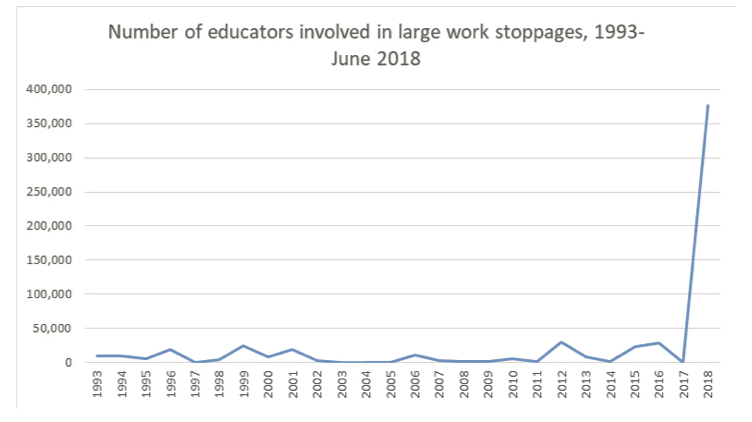
Five percent of all U.S. workers in K-12 public education walked out on strike this spring. It’s by far the biggest spike in teacher strikes in a quarter-century.


The strike wave this spring was by far the biggest spike in teacher strikes in a quarter-century.
The strikers included educators from North Carolina (123,000), Arizona (81,000), Colorado (63,000), Oklahoma (45,000), West Virginia (35,000), Kentucky (26,000), and Jersey City (3,600).
These figures come from the Bureau of Labor Statistics, which tracks “work stoppages” (strikes and lockouts) involving 1,000 or more workers and lasting one or more shifts. The agency gathers its data from public news sources, such as newspapers and the Internet.
The data for January to June of this year show that 376,800 K-12 public educators participated in big strikes. We didn’t include a higher-education strike by 53,000 AFSCME members at the University of California. Continue reading: Teacher Strike Wave: By the Numbers | Labor Notes


The truth about money in public education politics

Opinion: The truth about money in public education politics

The truth about money in public education politics
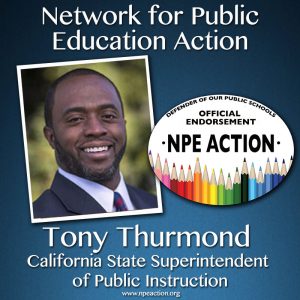
Thurmond will fight back against the billionaires and their pro-charter school industry agenda


There is a little watched election that is projected to be the most expensive race in California this fall.  More money will be spent on the race for California State Superintendent of Public Instruction – the person who oversees over 10,000 public and charter schools – than in any congressional race, and perhaps even the race for governor.
Why will so much money be spent on this race?  The reason lies with a small group of billionaires who have no education experience but because of their outsized pocketbooks wield huge influence in education politics across the nation.  Billionaires like the Waltons (of Walmart fortune), Eli Broad, and President Trump’s Education Secretary Betsy DeVos have made it their priority to fight for the charter school industry, school vouchers, and high-stakes testing.
The billionaires are supporting candidate Marshall Tuck, a former charter schools executive with a mixed record of success and reputation for fighting not fixing – because they know they can count on him to support the charter school industry.

His opponent is Democratic state legislator and public school parent Tony Thurmond.  Tony is a social worker by training who has spent 20 years working inside and outside of schools with some of the most high-need children in California.
Tony’s passion for education stems from his own life experience.
Like many California students, Tony Thurmond comes from humble beginnings.  Tony’s mother emigrated from Panama to San Jose to become a teacher.  His father was a Vietnam veteran who, suffering from PTSD, did not return to the family.  When Tony was 6, his mother lost her battle to cancer.  He and his brother were sent to live with a distant cousin.
Tony grew up on public assistance and college was never a sure thing – but he succeeded because he was able to attend a great public school where his teachers encouraged him to apply.  At Temple University in Philadelphia, Tony became student body president.
After graduation, Tony became a social worker to give back, serving foster youth, children with incarcerated parents, folks with disabilities, immigrants, first-generation college students, and families living in deep poverty.  He went on to lead nonprofits and run school-based mental health programs.  Tony has taught civics, life skills, and career training courses.
Tony Thurmond believes, as I do, that public education can save lives.  For me, it’s a belief that stems from 50 years working in education, first as a teacher and counselor in the Continue reading: Opinion: The truth about money in public education politics
Image result for Tony Thurmond as Superintendent of Public Instruction

A Plan to Improve California's Public Schools

Tony Thurmond for State Superintendent of Public Instruction -https://www.tonythurmond.com/