Friday, December 16, 2016

CURMUDGUCATION: Do Poor Students Get the Worst Teachers?

CURMUDGUCATION: Do Poor Students Get the Worst Teachers?:

Do Poor Students Get the Worst Teachers?


This has been open to debate forever, but the debate has gotten more spirited ever since the Obama administration made it a matter of policy that poverty just doesn't matter if you have an awesome teacher in the room. There are three real answers to this question. Let's consider each one.

No, They Don't

A recently-released report from the Institute of Education Sciences (part of the USED) has been touted as proof that all socio-economic levels of students have similar supplies of swell teachers. And there is also an argument to be made that since teachers in high-poverty schools are doing more heavy lifting against a greater weight of outside issues, they are actually tougher for it. I have no doubt that some of the greatest, mightiest, teacheriest teachers in the country are working in poverty-wracked schools.


This is not a new idea. The teacher program that I graduated from was run by a small-town upper-mid-class college, but it required student teachers to work in Cleveland (i.e. poor urban) schools. Their reasoning was that if you could handle that environment, you could handle any teaching environment.


Yes, They Do

There are plenty of reasons to suspect this might be so. Many policy choices have made recruitment a challenge.

In some states, test results (which are reliably lower in poorer schools) are tied to teacher evaluation, which means that taking a job at a poor school can damage a teacher's career, even end it in states that have removed tenure and made "low performance" grounds for dismissal. Who wants 
CURMUDGUCATION: Do Poor Students Get the Worst Teachers?:


Torlakson Appoints New Personnel Services Director - Year 2016 (CA Dept of Education)

Torlakson Appoints New Personnel Services Director - Year 2016 (CA Dept of Education):

State Schools Superintendent Tom Torlakson Appoints
Valarie Bliss as Director of Personnel Services Division
Image result for State Schools Superintendent Tom Torlakson


SACRAMENTO—State Superintendent of Public Instruction Tom Torlakson announced today the appointment of Valarie Bliss as the new Personnel Services Division Director at the California Department of Education (CDE).
“Valarie has dedicated her professional career to serving the Department of Education and guiding our employees,” Torlakson said. “I am thrilled that she will bring her extensive knowledge of the Department and expertise in state personnel processes to the position.”
Bliss will supervise eight offices that comprise the Personnel Services Division, including Labor Relations, Training, and Facilities Management. Personnel Services oversees more than 2,400 CDE employees statewide.
A CDE veteran, Bliss brings nine years of experience as a Staff Services Manager III in the Personnel Services Division. She has been with CDE for nearly 25 years, working in the Special Education Division, the School Improvement Division, the Curriculum and Instructional Leadership Branch, and the Curriculum Frameworks and Instructional Resources Office.
Bliss replaces former Division Director Sharon Taylor, who retired.
A native of Broderick (now West Sacramento), Bliss and her husband of 30 years have four children and eight grandchildren.

# # # #
Tom Torlakson — State Superintendent of Public Instruction
Communications Division, Room 5206, 916-319-0818, Fax 916-319-0100
Last Reviewed: Friday, December 16, 2016


Empowering Trans Students with Super Powers | Schott Foundation for Public Education

Empowering Trans Students with Super Powers | Schott Foundation for Public Education:

Empowering Trans Students with Super Powers

Over the past few years, in partnership with the Arcus Foundation, Schott has supported the work of Massachusetts grantee BAGLY, the Boston Alliance of Gay Lesbian Bisexual and Transgender Youth, to elevate the voice of trans students in Boston Public Schools. BAGLY youth leaders have identified several key ways that students, educators, and schools can help make our public education system more safe and supportive of trans students — it’s time to support the super powers of trans youth!


 Helmet of Knowledge: Students need to first be aware of their rights as afforded to them by Massachusetts’ Department of Elementary and Secondary Education (DESE) guidelines of inclusion and diversity.

Advocacy Shield: When a student is denied treatment according to MA law and DESE guidelines, they should know what resources to contact in order to obtain the support they need to push back against unfair/unequal treatment (BAGLY can connect students to other resources like lawyers, case management, therapy, etc.).
Cape of Protection: Culturally competent mentors should be available in schools (LGBTQ-identified, trans-identified, etc.).
Power Bolt of Systemic Change: Audit school curricula to include LGBTQ-specific issues and social justice history.
Peer Support Rocket Boots: Increase awareness in the student body — hold assemblies focusing on diversity, including sexual orientation, gender identity, and gender expression.

Resources

Connect with these organizations for support, programming, and policy advocacy:

Massachusetts

National

Understanding Public-Sector Privatization Strategies in the Age Of Trumpism

Coalition for Public Education/Coalición por la Educación Pública: Understanding Public-Sector Privatization Strategies in the Age Of Trumpism:

Understanding Public-Sector Privatization Strategies in the Age Of Trumpism


"The Cartel has created a vast array of
think tanks and advocacy organizations
to distribute questionable and deeply flawed
research studies to confirm that corporate
and virtual charters, vouchers, and non-certified
teachers are the best approaches to
educating low-income students of color."


BlackCommentator.com Columnist, Dr. Walter C. Farrell, Jr., PhD, MSPH, is a Fellow of the National Education Policy Center (NEPC) at the University of Colorado-Boulder and has written widely on vouchers, charter schools, and public school privatization. He has served as Professor of Social Work at the University of North Carolina at Chapel Hill and as Professor of Educational Policy and Community Studies at the University of Wisconsin-Milwaukee. Contact Dr. Farrell. 

 Public sector stakeholders (teachers, unions, and ordinary citizens) are on the precipice of a public education Armageddon. On January 20, 2017, the nation’s system of public education is likely to begin descending into a public education free zone. President-Elect Donald J. Trump has stated that he will ramp up and facilitate the efforts of the corporate education reform Cartel to privatize public schools. To underscore his commitment to this endeavor, he has placed one of the Cartel’s most prominent and aggressive members, billionaire Betsy DeVos, at the helm of the U.S. Department of Education (USDOE).


She and the Cartel have also established and funded an interlocking network of majority and minority civic leaders, grassroots groups, corporate executives, professional athletes, entertainers, former and current school board members, superintendents, political bosses, governors, state and federal legislators, and every U.S. president since Ronald Reagan. DeVos’s approach has been bipartisan with deep tentacles among both Democrats and Republicans.


This reality is at the core of public education supporters’ conflicts as to how to combat this assault on K-12 public education. As noted in previous columns, they cannot decide whether cooperation or opposition is the best option to save public education and the public sector. As a result, teachers, unions, elected officials, and others have been unable to come up with a coherent and focused set of initiatives to win the battle for K-12 public schools.


While these difference of opinion persist among public education stakeholders, the corporate education reform Cartel has systematically employed a military-style offensive on the foundations of private- and public-sector unions: co-opting and/or developing Democratic legislators and leaders who traditionally sustained and advanced the public sector; legislative redistricting which facilitated Republican takeovers of state legislatures and the U.S. Congress; writing and passing state and federal legislation promoting public school privatization; dismantling collective bargaining agreements (CBAs); and forming sixty-five Cartel think tanks, from coast to coast, that produce a steady stream of questionable and exaggerated research findings to affirm the success of public school privatization.


Starting in the 1980s, the Cartel identified minority and majority politicians, clergy, and local leaders and contributed to their campaigns and 501c3 non-profits. Included in this group are former Baltimore Mayor Kurt Schmoke; South Carolina legislator, U.S. Congressman, and now U.S. Sen. Tim Scott; former Illinois state senator, U.S. Senator, and now two-term Coalition for Public Education/Coalición por la Educación Pública: Understanding Public-Sector Privatization Strategies in the Age Of Trumpism:

Capo Unified sends critical audit on Oxford charter schools to D.A. - The Orange County Register

Capo Unified sends critical audit on Oxford charter schools to D.A. - The Orange County Register:

Capo Unified sends critical audit on Oxford charter schools to D.A.

critical audit that alleges fraud at Oxford Preparatory Academy, which has two campuses in south Orange County, is being referred to the Orange County District Attorney’s Office.
Board members with the Capistrano Unified School District, which oversees the Oxford’s public charter in Mission Viejo, on Wednesday night referred to District Attorney Tony Rackauckas an audit that accuses the school’s founder of “laundering” campus funds through for-profit entities run by friends and family members.
“The public has a right of protection of public funds,” Capistrano Unified Trustee James Reardon said Thursday. “CUSD is not a policing agency, so we have to rely on the district attorney to investigate wrongdoing. ... We can easily conclude from that report that something bad happened.”
The Fiscal Crisis & Management Assistance Team, created by legislators in 1992 to help California school districts comply with fiscal accountability standards, released the 45-page audit last month accusing Oxford founder Sue Roche of setting up a system that diverted public school funds to her and her associates.
Roche’s attorney, Marc Greenberg, has denied wrongdoing and accused those who created the report of misinterpreting facts.
Oxford has schools in Chino, Lake Forest and Mission Viejo. While the K-8 Capo Unified sends critical audit on Oxford charter schools to D.A. - The Orange County Register:


Pastors for Texas Children Become a Rising Voice Against School Vouchers

The Gilmer Mirror - Pastors for Texas Children Become a Rising Voice Against School Vouchers:

Pastors for Texas Children Become a Rising Voice Against School Vouchers

feature_img_1826
Rev. Charles Foster Johnson, the executive director of Pastors for Texas Children, a multi-denominational network of about 2,000 church leaders around the state who work to support public schools, speaks to Baptist pastors in Waco this November. John Savage/Reporting Texas


“We’ve got a God-given responsibility to maintain and keep this public trust, to protect public schools,” Rev. Charles Foster Johnson bellowed at several dozen pastors, snapping them to attention as they ate breakfast.
Johnson, 59, is the Fort Worth-based executive director of Pastors for Texas Children, a network of about 2,000 church leaders around the state who work to support public schools.
Johnson and his group have emerged as chief adversaries of Lt. Gov. Dan Patrick. Patrick champions a breed of education reform forged around vouchers — which steer money from public schools to parents to pay private school tuition.
“The lieutenant governor said, a couple of weeks ago, he’ll keep bringing it up until it passes,” Foster told the pastors, who were gathered for a meeting of Texas Baptists Committed in Waco. “It’s up to us to stop him.”
In his baritone southern drawl, Johnson told the pastors that vouchers siphon funds from schools in low-income neighborhoods and violate the separation of church and state enshrined in the First Amendment. School vouchers contradict God’s law of religious liberty, he said, by providing government support for religion.
The organization’s mission is twofold: To advocate for public education with state lawmakers and to mobilize individual churches to support public schools by providing services such as student mentoring and teacher appreciation events.
Members have linked dozens of churches with public schools, met with more than 100 lawmakers since the organization’s inception in 2013, and published dozens of anti-school voucher editorials in newspapers across Texas.
The group is getting national attention: In recent months, it has been mentioned in Politico, the Washington Post and the widely read blog of Diane Ravitch, a former assistant secretary of education under President George W. Bush and a leader of the grassroots movement against school privatization.
In an October blog post, Ravitch called Pastors for Texas Children “one of the strongest, most consistent defenders of public schools.”
Pastors for Texas Children does not fit neatly into the predictable camps in the voucher debate, with liberal groups and public school teachers in opposition and with conservative and religious groups in support.
Michael Barba, associate director of public policy at the Texas Catholic Conference of Bishops, supports Patrick’s school-choice legislation and is hopeful about its prospects in 2017.
“Like the lieutenant governor, we want more flexibility in the system for students to go to the school of their choice — public, private, charter, intradistrict transfers or otherwise,” Barba said.
For more than two decades in the Legislature, an alliance of Democrats and rural Republicans has defeated voucher bills. But Johnson said Patrick’s unwavering support and the election of Donald Trump have emboldened voucher advocates. Trump has called public schools a “government-run education monopoly” and promised to use the “pulpit of the presidency” to fight for school vouchers across the country. He has nominated Betsy DeVos, a voucher-supporting billionaire with no public education experience, as secretary of education.
Patrick’s office did not reply to emails requesting comment, but he has painted a dire portrait of hundreds of “failing” public schools and Read more:The Gilmer Mirror - Pastors for Texas Children Become a Rising Voice Against School Vouchers


Visit your senator: Vote "no" for DeVos - Network For Public Education

Visit your senator: Vote "no" for DeVos - Network For Public Education:

Visit your senator: Vote “no” for DeVos

toolkit-3


Toolkit 3
The link to the Senator’s website will give you the address of their home offices in your state.  Schedule a visit, or, drop by and hand deliver a letter. We supply a model below that you can copy and paste, or you can download an editable Word document by clicking the graphic above or here.
[Date]

Dear Senator [name]:
I strongly urge you to vote against the nomination of Betsy DeVos to be Secretary of Education. Never has someone so uniquely unqualified been selected to this post. Ms. DeVos never attended a public school, never sent her children to one, and never has served in any educational or governmental capacity. Her only qualification seems to be her wealth, which she has used to promote a radical agenda of school privatization and vouchers.
More than 90% of all American children attend public schools; public schools are the bedrock of our democracy and one of the few unifying forces in our nation. Diverting taxpayer funds to private and religious schools will not only severely weaken our public schools, but will sow more discord, division, and degrade the quality of education that our children receive.
Moreover, in 2008, Ms. DeVos’ PAC violated Ohio’s campaign finance laws, and was fined $5.3 million. Her PAC ignored a state advisory ruling that its action would be illegal and yet went ahead anyway. The fine remains unpaid.[1] Such disregard for the laws should not be rewarded with a cabinet position.
Because of Ms. DeVos efforts, nearly $1 billion of public education dollars have been drained each year from Michigan public schools into mostly for-profit charter schools of poor quality. According to the New York Times, “divisive politics and educational ideology … have combined to produce a public education fiasco that is perhaps unparalleled in the United States.” [2] The attempt of Michigan’s Republican Governor Rick Snyder to insert some accountability, quality control, and oversight to prevent corruption and wasted taxpayer dollars was defeated primarily because of Ms. DeVos advocacy.
The Phi Delta Kappa/Gallup poll reveals that only 31 percent of Americans favor allowing students to attend private schools at public expense. [3] Since 1972, all attempts to create state voucher programs through referendum have failed, generally by two-to-one margins. [4] Recent research has concluded that public school students who receive vouchers to attend private schools score much lower on both reading and math tests than similar students who remain in the public schools. [5]
Contrary to Ms. DeVos rhetoric, the first choice of the most American parents is a good neighborhood public school, and want our nation’s public schools to be supported and strengthened rather than dismantled. As Mark Twain said, “We believe that out of the public school grows the greatness of a nation.”
The appointment of Ms. DeVos could set back the progress of our nation’s public schools so severely that they might never recover.  I would appreciate if you would let me know how you intend to vote on her nomination.
Yours sincerely,
Name, address, phone
 Visit your senator: Vote "no" for DeVos - Network For Public Education:


Teachers Why Don't You Just MAKE Them? | Blue Cereal Education

Why Don't You Just MAKE Them? | Blue Cereal Education:

Why Don't You Just MAKE Them?

Mean Teacher Snape


"Why don't you just make them ______?"
The most adorable befuddlement comes over non-educators when the subject of student learning or behavior is brought up.  
It’s completely understandable. Many of them have rose-damaged memories of their own school years – teachers wielding yardsticks, parents spanking and grounding, and a pervasive respect/terror of any and all authority figures. It's a wonder we haven't raised an entire generation of serial killers if even half these recollections are true. 
Mean Teacher Math
Then again, it would explain a great deal about Trump’s rise to power. A wider tie and some day-old stubble and he's everyone’s caricature of “terrifying-but-largely-incoherent principal.” Generally avoided at all cost, he was just what you needed when schoolyard bullies were about to pummel you. It restored order to your universe to see his furies periodically directed at your oppressors... however similar his tactics were to theirs in retrospect. 
Nowadays, though, it seems educators and pedagogical trend-setters are more interested in wooing impressionable young squirrels to daintily learn-out-of-their-hands, instead of putting on their big-teacher panties and really educating those little turds - right up a tree if need be! My god, no wonder we have a nation of wimps – we used to learn reading, writing, and arithmetic; now we just share our feelings, learn about evolution and why everyone should be gay, then go back to talking about our feelings again. 
Restorative justice, expanded support services, all manner of training over different learning styles and emotional needs – it must seem ridiculous compared to hazy constructs of our own past. 
Whatever the reality of your own “dear old Golden Rule days,” brute force is not merely an ethically questionable classroom strategy in the 21st century – it simply doesn’t work. We can debate it on principle, but realistically… it’s just not realistic. 
Mean Teacher Old Man
Consider the things you think you found motivating as a child. Were you afraid of what your parents would say if your grades dropped or you got in trouble at school? That’s certainly a factor for some students today, but not all of them. Not always even most of them. I’ll spare you the sob stories – they tend to be outliers anyway – but life is complicated enough that “wait until your parents find out” simply isn’t a Top Five Concern for many kids. Thus, it’s not a big motivator.  
So bust their little butts at school, right? Detention? In-School Suspension? Trapped in a small room with a handful of other offenders, working in dead Why Don't You Just MAKE Them? | Blue Cereal Education:


What Comes Between Fake News and Students? Educators

What Comes Between Fake News and Students? Educators:

What Comes Between Fake News and Students? Educators

fake news students


Every week, David Stuart hands out a current news article to his world history students so they can digest and evaluate the credibility of the sources.  One day this fall, Stuart, now in his tenth year at Cedar Springs High School in Michigan, distributed a couple of stories about the 2016 presidential candidates.
In the middle of a uniquely controversial and divisive campaign, it was perhaps inevitable that during the discussion some students would dredge up information that didn’t appear in the articles their teacher had provided. It was quickly apparent, says Stuart, that much of it was untrue and probably gleaned from dubious sources – or peddlers of what has now famously been dubbed “fake news.”
There’s nothing new about teenagers (or adults for that matter) finding unreliable or just plain false information on the Internet, but fake news –  bogus or exaggerated information disguised as reliable “journalism” and funneled primarily through Facebook – went viral in a big way in 2016. An analysis by Buzzfeed revealed that from August to November, the height of the presidential campaign, the level of engagement (likes, shares, etc.) for posts categorized as “fake news” outpaced that of stories from mainstream news outlets.
Source: Buzzfeed News
Because it was generated by the hyperpartisan climate of the 2016 election, addressing fake news in the classroom specifically could be dicey for educators if it is perceived that the purpose is to knock down or dismiss political opinions and candidates.
The conversation in David Stuart’s class, however, was focused more on  larger questions of how students as news consumers reach conclusions and how they can and should use evidence to support these conclusions.
“I don’t think my students are intentionally looking for conspiracy web sites or blatantly misleading information,” Stuart explains. “So I would just redirect the discussion to questions about credibility without passing judgement. Is this source valid? Where is the evidence? The conversations were respectful and the kids handled it really well. Let them do the thinking.”

When Information Becomes Polluted

Taking on “fake news” still comes down to media and digital literacy, which is taught in many schools but certainly not at the level needed to help neutralize the effects of false information that went viral.  Writing on his blog, Bill Ferriter, a teacher in North Carolina, believes focusing on the “new literacy” in the classroom will do more to curb the problem than waiting on Mark Zuckerberg to overhaul Facebook’s fact-checking procedures:
“We don’t need new policies and tools from tech companies to identify sketchy What Comes Between Fake News and Students? Educators:


Educate Louisiana | Barriers to learning for children in poverty.

Educate Louisiana | Barriers to learning for children in poverty.:

BARRIERS TO LEARNING FOR CHILDREN IN POVERTY.


These days, the average person can spend a minimum amount of time in a classroom and recognize the effects that poverty has on children. Education reformers like to claim that accepting this fact is the same as saying that poor children can’t learn. Of course, poor children can learn. All children can learn and these claims are an injustice to the people who teach children who live in poverty.
Ed reform’s unwillingness to accept this is further illustrated in the “teacher prep” programs that are being promoted to fill the teaching positions that have been vacated because of their invalid policies. These programs have omitted even introductory level courses related to child psychology, theory of learning and cognitive development. I suppose the idea is that by not educating future teachers on these topics, they can essentially remove the claims that poverty affects a child’s performance in the classroom. They completely discount a century of research that serves as the foundation of education.

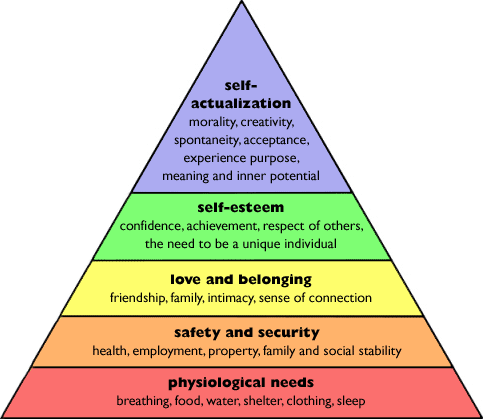
Maslow’s Hierarchy of Needs.
It is an undeniable fact that children living in poverty experience barriers to learning. The inability to drive your car across a river without a bridge doesn’t mean that you are unable to drive a car anymore than being poor means that you cannot learn. It simply means you need a bridge.
In 1943, psychologist Abraham Maslow published “A Theory of Human Motivation” which included his revolutionary “Hierarchy of Needs.” From the lowest level to the highest, the hierarchy is as follows.
  1. Physiological Needs: These include food, water, clothing, sleep, etc. This covers all of the basic physical needs for normal human function.
  2. Safety Needs: This includes protection from danger,  health and well being, financial security and a safety net for personal setbacks.
  3. Love/Belonging: Things such as a stable family life, a circle of friends, developing last relationship, etc.
  4. Esteem: This is the general feeling of being respected. Developing a hobby and the feeling that your efforts make a contribution.
  5. Self-Actualization: Recognizing one’s abilities and developing them to their fullest potential.
Maslow asserts that once the five levels of needs are filled, human beings become contributors to a functional society. In addition, he states that the fourth and fifth Educate Louisiana | Barriers to learning for children in poverty.:

Debacle: How a Charter School Failed – Capital & Main

Debacle: How a Promising Charter School Failed – Capital & Main:

Debacle: How a Promising Charter School Failed

Student Empowerment Academy's first and last home. (Photo by Svgperson)
In 2014, when teachers at Los Angeles’ Jefferson High School opened their own charter school, the Student Empowerment Academy, they hoped to bring the larger world into their classrooms. They wanted to show kids opportunities outside of their neighborhood, where academics often took a back seat to economic survival. Kids would learn science, math and social studies by solving real-world problems in teams, just as they would in the work-force, while teachers would have autonomy and genuine decision-making authority.

See Documents Related to This Story

But faculty members soon found themselves facing one real-world problem they hadn’t bargained on — a tug of war for power with administrators and board members. Conflicts reached a boiling point in 2015, with staff leaving en masse – either fired, pushed out or stressed beyond their limits. The school also ran afoul of the Los Angeles Unified School District, which oversees the city’s charter schools, for financial mismanagement and other shortcomings. With enrollment dwindling, Jefferson announced that SEA would have to move to another facility for the 2017-18 academic year. If these obstacles weren’t enough, in its last year the fledgling charter school was led by a former professional football player with no teaching background and little administrative experience, and who, along with the academy’s board of directors, would throw the academy and students under the school bus once the going got tough.
SEA’s story highlights the precarious nature of small independent charter schools, and brings to light the fact that charter boards of directors are largely independent and don’t always have to account to parents, teachers and communities for decisions that affect students. In the end, the academy’s board of directors concluded that SEA faced problems that were so intractable that the only solution was to shut it down, and last June, two weeks after classes ended for summer break, the directors voted for permanent closure.
Teachers and parents were left reeling. Parents demanded to know what happened to the public funds that created the school, and where their kids would attend classes the next year. Teachers argued that more could have been done to save the school.
Jefferson High sits in a South L.A. neighborhood where corner stores, modest homes and ramshackle apartments huddle cheek by jowl with small factories, all in the shadow of downtown’s skyline. Alumni include diplomat Ralph Bunche, the first African American Nobel laureate, choreographer Alvin Ailey, jazz saxophonist Dexter Gordon and singer Etta James. About a decade ago Jefferson became notorious for massive brawls that erupted on campus. Television news reports blamed racial tensions, but more-in-depth accounts noted that nearly 4,000 kids were crammed into a school built for a third that many.
Six years ago in response, the school created small learning communities to break down the anonymity of the giant high school. One of those initiatives was the New Tech High School for Student Empowerment Academy, a sort of school within a school. When, in 2013, administrators announced staff cuts and larger class sizes, faculty member Linda Rahardjo was one of several teachers who designed the 300-student independent charter version of SEA to carry on the work they had begun.
Rahardjo told Capital & Main the decision to go charter was an ultimately futile attempt to preserve what the faculty had originally built. The teachers who formed SEA were a closely-knit group who came to school early and stayed late to create a safe place where students could learn to study and think. “Being able to pass their classes became the in-thing,” she noted, adding that the students had begun to put brains above brawn, especially where disputes were involved. “They’d step back [from a fight] and say, ‘That’s not what we do here.’” It was a cultural shift at Jefferson.
SEA’s troubles began in earnest with a perfect storm of problems that included its coming expulsion from the Jefferson High Debacle: How a Promising Charter School Failed – Capital & Main:

Fake News For Astro Turf SFER | Richmond Confidential

Student canvassers helped elect charter friendly school board | Richmond Confidential:

Student canvassers helped elect charter friendly school board

If you’re a Richmond resident and a registered voter, chances are a Students for Education Reform Action Network (SFER AN) canvasser knocked on your door in the months leading up to the Nov. 8 elections. The group of high school and college students reached more than 30,000 residences in the city campaigning for two school board candidates, Tom Panas and Miriam Stephanie Sequeira.
SFER AN and its parent organization, Students for Education Reform (SFER), present themselves as student-run, grassroots groups that advocate for change and improvement in local public education systems. But leaders in both organizations have charter school connections that appear to influence the groups’ activities, from educating eligible voters to endorsing candidates.
In fact, this election cycle, SFER AN-endorsed candidate Panas won a seat on the West Contra Costa Unified School District (WCCUSD) Board of Education, adding a third charter-linked board member to the five-seat board—thereby giving charter-supported members a majority on the board.
SFER and SFER AN executive director Alexis Morin said the student canvassers who campaigned for Panas and Sequeira “[wore] through their shoes…they are incredibly hardworking.”
Morin, who also cofounded SFER, said she founded the organization after becoming interested in disparities in the quality of public education while she was a student at Princeton.
“I knew that the quality of education that my friends and I received was not equal,” Morin said. “It seemed to me that the quality of our schools ha[s] so much bearing on whether a young person can follow their dreams.”
Morin started SFER as a Princeton student group in 2009, to raise awareness about inequality in public education and empower people to make a difference, she said.
In its first year, the group hosted movie screenings and study breaks, and student members visited high-performing charter schools in underserved areas in New Jersey, New York, Pennsylvania and Washington, D.C.—including schools that were part of the Uncommon Schools and the Knowledge is Power Program (KIPP) public charter school networks.
The organization’s membership grew quickly, and in 2011, Morin and cofounder Catharine Bellinger, a fellow Princeton student, launched SFER as a nonprofit organization. In 2013, the two founded SFER AN, the 501(c)(4) political arm of SFER.
“We definitely recognized that your ability to change a policy is affected by the leaders in charge of the system,” said Morin. The 501(c)(4) organization allowed SFER’s work to expand into the realm of politics and campaigns through SFER AN.
Morin said both organizations adhere to a common set of principles, including setting high standards for students and providing support to meet those standards; supporting quality teachers; creating schools that serve the needs of every student; ensuring justice in schools; and providing access to a variety of school choices for parents and students.
But SFER’s main objective, said Morin, is “to identify and train student leaders to be effective community organizers who can then go and fight for educational justice in their own communities.”
In the months leading up to this year’s election, SFER AN operated five local chapters in four states: California, Colorado, Minnesota and North Carolina.
Many of the students involved in Richmond’s SFER AN chapter and chapters at nearby colleges, including UC Berkeley and UC Davis, grew up in or near Richmond and graduated from WCCUSD traditional public schools and public charter schools.
This fall, SFER “fellows,” as they are called, spent several hours each evening canvassing in Richmond and delivering leaflets for the Panas and Sequeira campaigns. SFER AN considers students’ participation a “fellowship,” and students in the fellowship, which begins over summer, received stipends ranging from $3,760 to $4,680, depending on the hours they worked.
Providing a stipend is necessary, Morin said, because some students must choose between a job and joining SFER AN.
Panas and Sequeira were the only two candidates to receive support from charter-linked organizations in the seven-candidate school board race. Both received backing from the local Education Matters PAC and the Parent Teacher Alliance Sponsored by the California Charter Student canvassers helped elect charter friendly school board | Richmond Confidential: