Latest News and Comment from Education

Wednesday, August 26, 2015

You'd Be On C-SPAN Getting Mic'd Up Too [Video] | The Jose Vilson

You'd Be On C-SPAN Getting Mic'd Up Too [Video] | The Jose Vilson:

Screen Shot 2015-08-26 at 4.36.11 PM

You’d Be On C-SPAN Getting Mic’d Up Too [Video]

 JOSE VILSON VIDEO LEAVE A COMMENT

Given how little I advertised this, I’m glad so many of you got to watch this interview of me via C-SPAN’s Wasington Journal with Pedro Echevarria (shout-outs to their team):
A few things to note:
  1. I was hoping a student would call in, and that’s exactly what happened. The student who called in wrote to me later. I hope to share her e-mail later on this week.
  2. A few of my friends have commented that I handled the phone questions with calm and cojones. After some of the nonsense I dealt within 24 hours of interview, the phone interviewers were a piece of cake.
  3. My three-year-old got to see me on TV, and told me as much when I got back home. My heart is warm.
If you escaped what I escaped, you’d be on C-SPAN getting mic’d up too. Teach so hard.
Let me know what you think below.

About Jose Vilson

José Luis Vilson is a math educator, blogger, speaker, and activist. For more of my writing, buy my book This Is Not A Test: A New Narrative on Race, Class, and Education, on sale now.

With A Brooklyn Accent: "Opt Out- Stop the Abuse" Message from an Educator in Upstate New York

With A Brooklyn Accent: "Opt Out- Stop the Abuse" Message from an Educator in Upstate New York:

"Opt Out- Stop the Abuse" Message from an Educator in Upstate New York


The New York State Education Department released the student test data to the school districts on Friday, August 21, 2015.  I have spent two entire days entering student test data into the computer.  That is, I entered a 1, 2, 3,or 4 for specific students.  In many cases, only one student took the test.  What this means is that one student will determine a teacher’s growth score.  One student will be the deciding factor if a teacher is rated: developing, effective, highly effective, or ineffective.  One student.  Is this statistically sound?    Most would call this inhumane or even insane.  Is this ethical?

A teacher who may be a single working mom supporting her family stands to lose her income if deemed ineffective two years in a row.  We are fortunate to have some local assessments in place that may save her job----maybe.  It’s hard to plan for a family’s future when your job and entire livelihood lies in the balance.  This is an unnecessary amount of pressure.  Most would call this inhumane or even insane. Is this ethical?

So, what most people do not know is that these state tests DO NOT truly measure a student’s reading skills or math skills.  These tests Do Not measure a teacher’s effectiveness.  The tests have been purposely designed to reduce the public school teaching staff exponentially.  Most would call this inhumane or even insane.  Is this ethical?

I pride myself in knowing the students in my school.  I know their families.  I know their day-to-day performance in the classroom.  In many cases, I have known these children since Kindergarten.  I know their joys and their sorrows.  I know the teachers in my building.  I know their joys, their struggles, and their hardships.   I cannot help but think about all of this as I proceed with the mind-numbing task of entering a 1, 2, 3, or 4 into the computer system.  A numbers game with human beings, that I am being manipulated to participate in, coerced if you will.   This I know is wrong with ever fiber of my being, my heart and my soul.  I saw 2’s for students who should have gotten a 4.  They would have gotten a 4 if the test was written on their grade level, and if there were no trick questions with extremely close choices for answers.  I saw 2’s for students who read above their grade level.  That tells me that they are not test takers and/or the answers were so close that they may have picked the wrong one, or they may simply have run out of time due to the length of the reading passages.  I cannot analyze this, because, I do not have the test questions  nor do I have the answer sheets.  I cannot have a conference with parents and show them where their child needs assistance.  Most would call this inhumane or even insane.  Is this ethical?

How can I trust the validity of any of this?  How can I trust what the new Commissioner of Education dictates?   She is new to her position.  She has not yet earned the trust of New Yorkers.  I understand she has concerns about ethics. 

I think about the student who vomited on her test.  We followed protocol, and put her test in a zip lock bag.  She was escorted to the Nurse’s office, and needless to say, she did not finish her test.  I don’t have a test score to enter for her. These tests put several stakeholders under undue pressure.  Is this ethical?

I wake at 2:00 am and see the computer screen right before my eyes.  I can see all of the data, but what I really see before my eyes is unethical practices of the New York State Education Department. 

I consider the Commissioner’s comments that I am an extension, or an arm , if you With A Brooklyn Accent: "Opt Out- Stop the Abuse" Message from an Educator in Upstate New York:


Al Jazeera includes silenced ed reform perspectives @AJStream  | Cloaking Inequity

Al Jazeera includes silenced ed reform perspectives @AJStream  | Cloaking Inequity:
Al Jazeera includes silenced ed reform perspectives @AJStream 

Screen Shot 2015-08-25 at 10.58.57 PM
I was previously impressed that Al Jazeera took on Teach For America. Now they are taking on education “reformers” again in NOLA— by including silenced perspectives community perspectives on education reform on their show AJ Stream— especially from folks of color.
@AJStream is a really interesting mix of studio, Twitter, video clips, and online distance guests. It’s a great format, very engaging. I think MSNBC, CNN etc. should give it a go. Al Jazeera reached out yesterday and asked me to film a 30 second clip for the innovative program.


I was honored to make the cameo appearance with Dr. Raynard SandersKaren Harper Royal et al. to discussDeconstructing New Orleans’ reconstruction”
My comment focused on  and the facade that is the Recovery School District “success.” See my short YouTube clip cued up below.
Also watch the entire program below. I think the varied format and critical content is more interesting than 97% of what’s on NBC, CBS, ABC, CNN, MSNBC (I won’t even mention FoxNews) these days.
The mainstream media is clearly not covering the counter narrative discussed. The recent New York Times piece Opinion: The Myth of the New Orleans School Makeover caused a bunch of ruckus because the education reformers and TFA get VERY FRIENDLY treatment in the media.
Not such friendly treatment on Al Jazeera. Bravo!!

D.C. schools attracted record amounts of philanthropy in recent years - The Washington Post

D.C. schools attracted record amounts of philanthropy in recent years - The Washington Post:

D.C. schools attracted record amounts of philanthropy in recent years


Washington, D.C., became a magnet for philanthropy after 2007, when former mayor Adrian Fenty took control over the schools and appointed Michelle Rhee as chancellor.
In 2010, the District brought in more than $31 million from national foundations, according to an analysis by two professors at Michigan State University of grants by the 15 largest philanthropies funding kindergarten through 12th grade education that year.  The total represented an extra $705 per student — far more than any other school district in the country.
More than two-thirds of the funds raised went to the D.C. Public Education Fund, which was created in 2007 to support reform efforts in the public school system. At least $ 7 million went to specific charter schools or to organizations, including the New Schools Venture Fund, that support charter schools.
The report, which has not yet been published, found that grantmaking from the largest funders increased from $486.6 million to $843.7 million between 2000 and 2010. The researchers found a growing preference among funders to invest in cities with reform-oriented policies and environments.  Cities that had a Teach for America site or laws that encourage the growth of charter schools, for example, were more likely to receive foundation funding.
Sarah Reckhow, a professor of political science at Michigan State who coauthored the report, said more philanthropists are thinking nationally about policy priorities when they make funding decisions, and many are interested in growing charter schools and challenging traditional methods for evaluating and rewarding teachers.
In 2010, D.C. public schools rolled out a new teacher contract, including teacher evaluations that could lead to termination or significant bonuses. The increased costs associated were funded at first by a three-year, $64.5 million grant from a group of national philanthropists, including the Walton Family Foundation and the Eli and Edythe Broad Foundation.
That expense was eventually absorbed by the local budget, and District education officials said philanthropic investments in the schools have fallen since 2010. The D.C. Education Fund raised $5.7 million  in fiscal 2014, down from more than $17 million in fiscal 2012 and $24 million in 2010.
Fundraising has picked up again, with about $11 million raised so far this D.C. schools attracted record amounts of philanthropy in recent years - The Washington Post:

CURMUDGUCATION: TN: We've Found the Unicorn Farm

CURMUDGUCATION: TN: We've Found the Unicorn Farm:

TN: We've Found the Unicorn Farm


Tennessee officials are cheerfully announcing the advent of awesome new assessments that will be "not a test you can game." The tests will be delivered at the end of the year by winged unicorns pooping rainbows while playing a Brahms lullabye on the spoons.

“We’re moving into a better test that will provide us better information about how well our students are prepared for post-secondary,” Tennessee Education Commissioner Candice McQueen told reporters recently during sneak peek at some of the questions.

Fans of the new standardized tests continue to be impressed at how these tests solve the problems of education in the 1970's. Assistant state commissioner of data and research Nokia Townes says that the tests will require "more than rote memorization," which puts them on a par with the tests I started giving my students thirty-five years ago. But that statement also indicates that officials still don't understand what "gaming the test" means.

Standardized tests are, by their nature, games. Where you have multiple choice questions, you have one correct answer and several other answers designed to trick and trap students who might make a particular mistake, so by their nature, they are not simply trying to capture a particular correct behavior, but are also testing for several incorrect ones.

But Tennessee officials are distracted themselves, focusing on unimportant test features. The 
CURMUDGUCATION: TN: We've Found the Unicorn Farm:

This Week In Education: Thompson: Ta-Nehisi Coates & School Reform

This Week In Education: Thompson: Ta-Nehisi Coates & School Reform:

Thompson: Ta-Nehisi Coates & School Reform

image from ecx.images-amazon.com


Toni Morrison rightly compares Ta-Nehisi Coates to James Baldwin. I hope teachers and education policy makers will read CoatesBetween the World and Me, and consider its obvious implications for school improvement. I do not want to drag his beautiful book, a touching letter to his son, into our vicious school reform wars. Instead, I will review some of the key parts of Coates’s wisdom that can inform our practice and education policy, and mostly leave our education civil war to another day.
I would think that teachers would be thrilled to have a politically conscious student like Coates. Surely most of us would welcome the creative insubordination of a high school student who would quote Nas and challenge us with the idea “schools where I learned they should be burned, it is poison.”  After all, teachers and education policy-makers should all wrestle with Coates’s indictment of schools for “drugging us with false morality.”
At times, however, class discussions involving Coates could easily become uncomfortable. He “was made for the library, not the classroom. The classroom was a jail of other people’s interests.” Moreover, “if the streets shackled my right leg, the schools shackled my left. Fail to comprehend the streets and you gave up on your body now. But fail to comprehend the schools and you gave up your body later.” If that doesn’t hit too close to home, Coates adds that he resented school more than the streets.
Schools are supposed to be a “means of escape from death and penal warehousing.” But, too often, educators don’t understand what it takes for poor children of color to avail themselves of that escape hatch. For instance, he recalls that “each day, fully one-third of my brain was concerned with who I was walking to school with, our precise number, the manner of our walk, the number of times I smiled, who or what I smiled at, who offered a pound and who did not.”
Coates knew he was being robbed of that third of his consciousness, and that education should enrich his entire mind.  But, he felt that school “had no time for the childhoods of black boys and girls.” Coates found himself “unfit for the schools, and in good measure wanting to be unfit for them.”


One scene in Between the World and Me that has gained attention is its account of Coates’s insubordination with his 9th grade teacher and his father’s response. Reaching for his belt, his father said, “I can beat him, or the police.” (This scene becomes especially valuable when read in context with Jorja Leap’s Project Fatherhood.)   Coates says of the punishment, “Maybe that saved me. Maybe it didn’t.”  He then explains how this dynamic pervades so much of the ghetto. “All I know is, the This Week In Education: Thompson: Ta-Nehisi Coates & School Reform:

Knock Knock, Teacher's Here: The Power Of Home Visits : NPR Ed : NPR

Knock Knock, Teacher's Here: The Power Of Home Visits : NPR Ed : NPR:

Knock Knock, Teacher's Here: The Power Of Home Visits

Door-knocking.


Ninety percent of students at Hobgood Elementary in Murfreesboro, Tenn., come from low-income households. Most of the school's teachers don't. And that's a challenge, says principal Tammy Garrett.
"If you only know middle-class families, you may not understand at times why they don't have their homework or why they're tired," Garrett says.
When she became principal four years ago, Garrett decided to get her teachers out of their classrooms — and comfort zones — for an afternoon. Once a year, just before school starts, they board a pair of yellow buses and head for the neighborhoods and apartment complexes where Hobgood students live.
En route, the bus driver describes over the intercom how he picks up 50 children at one complex each morning. The teachers pump themselves up with a chant. After all, they're doing something most people don't enjoy: knocking on doors unannounced.
When the caravan arrives at a cluster of apartments, the teachers fan out and start knocking on doors of known Hobgood families. Some encounters don't get beyond awkward pleasantries and handing over fliers about first-of-the-year festivities. Others yield brief but substantive conversations with parents who might be strangers around school.
Jennifer Mathis has one child still at Hobgood and says she appreciates that the school came to her — since she has a hard time getting to school.
"I don't have a car. I can't drive because my back got broken in two places," she tells a trio of teachers standing in her doorway. "I'm a mom. I can't be there with all of them all the time."
Giving Home Visits A Try
There was a time when a teacher showing up on a student's doorstep meant something bad. But increasingly, home visits have become a tool to spark parental involvement. The National Education Association has encouraged more schools to try it out, and there's this national effort.

New Website Shares #KatrinaTruth | National Opportunity to Learn Campaign | Education Reform for Equity and Opportunity

New Website Shares #KatrinaTruth | National Opportunity to Learn Campaign | Education Reform for Equity and Opportunity:

New Website Shares #KatrinaTruth

Posted on: Monday August 24th, 2015

Ten years ago, Hurricane Katrina devastated New Orleans and displaced hundreds of thousands of its residents. Now, a new site by the Advancement Project and the group Families and Friends of Louisiana's Incarcerated Children (FFLIC), called KatrinaTruth, has shown that although the city may be rebuilt, its recovery has not been an equitable one. In fact, they demonstrate how post-Katrina policies worked to push out Black families and communities from their homes, their schools, and their government.
The site provides nine different "Reality Checks" addressing major areas in which post-Katrina policies have failed New Orleans: education, housing, economic inequality, Black leadership, criminal justice, environmental justice, queer and trans people of color, and health and wellness. These reality checks disrupt the falsely-positive narratives of policies like school "reform" system, which the site argues is really a school to prison pipeline. While test scores may have improved in New Orleans, they have come at the cost of children being pushed out of schools, harsh disciplinary practices, no accountability, and failures to accommodate students with disabilities or English language learners. As the site says, this isn't "progress," it's inequality and injustice.
Changes in education also played a role in the dismantling of Black leadership in New Orleans. After hurricane Katrina, the 7,000 teachers fired (most of whom were black) were replaced by mostly white education reformers, such as those leading charter schools. This kept Black educators out of their schools but it also deprived the large Black community of their leadership and advocacy. Their removal also contributed to economic inequality, as Black teachers were a key part of New Orleans' middle class.
Each of the Reality Checks includes "key recovery data" for a highlighted look at some of the most important numbers, and links to other resources. The site has also generated considerable discussion on twitter, under #KatrinaTruthCheck it out today!New Website Shares #KatrinaTruth | National Opportunity to Learn Campaign | Education Reform for Equity and Opportunity:

In Chicago, hunger strikers fight for a high school - The Washington Post #FightForDyett

In Chicago, hunger strikers fight for a high school - The Washington Post:

In Chicago, hunger strikers fight for a high school


Demonstrators hold placards during a Chicago Teachers Union protest in Chicago in March 2013 over a controversial proposal to close 54 schools in the country's third-largest public school district. (John Gress/Reuters)


A dozen parents and activists in Chicago entered their 10th day of a hunger strike Wednesday, part of a fight with city officials over the fate of a high school in their South Side neighborhood.
So far, two hunger strikers have been sent to the hospital this week and one of the organizers had a dizzy spell Wednesday, but the protesters say they will keep going without food.
“This is really about the privatization of education, it’s about having sustainable community schools in every neighborhood,” said Monique Smith, 32, a resident who has lost seven pounds since she stopped eating Aug. 17. “This is a much larger struggle.”
Walter H. Dyett High School was closed by Chicago Public Schools in June after years of poor performance and dwindling enrollment. Last year, the senior class had 13 students.
But after protests by the community, the Chicago Public Schools said it would consider proposals from private organizations to operate the school on behalf of the district for a fee.
Community organizers say they want to keep the school publicly operated, and have proposed that Dyett be reopened as a “leadership and green technology school.” They want to develop a science-based curriculum that would take advantage of the school’s location near a park. The group also wants to renovate the building into a LEED certified green facility.
Chicago Public Schools officials were supposed to make a decision about the school’s fate last month but they postponed action and said they would hold a hearing on the competing plans Sept. 15.
That’s unacceptable to activists, who say they want the school system to make a decision about the school.
“We’ve had plenty of community hearings — we want the decision,” said Smith, who teaches history in a Chicago public middle school. “There is no other meeting we care to have. What is the hold up? They’ve had our proposal for more than a couple of months. That’s the reason for the hunger strike. We want to bring attention to this constant postponement, this constant sabotage.”
A spokesman for Chicago Public Schools could not be reached for comment. The school system closed nearly 50 schools in 2013, displacing more than 12,000 students.
It is unclear how long the strikers will keep up their action. They spend the days camped out in front of Dyett and then the evenings a few blocks away at the headquarters of the Rainbow PUSH Coalition, the nonprofit formed by the Rev. Jesse Jackson.
Randi Weingarten, president of the American Federation of Teachers, joined state and city union leaders at a rally in Chicago in support of the hunger strikers.
Activists in other communities around the country have been participating in a one-day fast in support of the Dyett strikers. Hundreds in different cities 

The Union Advantage for Women - Women in the StatesWomen in the States

The Union Advantage for Women - Women in the StatesWomen in the States:


The Union Advantage for Women

This briefing paper presents an analysis of women’s union membership and the union wage and benefit advantage for women by state and by race/ethnicity. It is based on an analysis of the Current Population Survey. Wage and benefit data are for all workers covered by a union contract, irrespective of their membership in a union.
Download the bSWS Union Advantage thumbriefing paper, The Union Advantage for Women.
Read the press release, “Unionized Women Earn More than Nonunionized Women in Every U.S. State.”


National Opinion Poll on Testing and Test-Based Teacher Accountability | VAMboozled!

National Opinion Poll on Testing and Test-Based Teacher Accountability | VAMboozled!:

National Opinion Poll on Testing and Test-Based Teacher Accountability


VAMboozled!


In an article titled “Testing Doesn’t Measure up for Americans,” just released by Phi Delta Kappa (PDK) International in partnership with the flagship professional polling organizationGallup, you can read the results of the annual public poll that PDK/Gallup conduct every year regarding the public’s thoughts on America’s public education system. Pollers polled a nationally representative samples of 3,499 Americans over 18 via the web and 1,001 Americans over 18 via phone. As most pertinent to our purposes here, here are the key findings with which you all might be most interested.
“Americans agree that there is too much testing in schools, but few parents report that their children are complaining about excessive testing. Most Americans believe parents should have the right to opt out of standardized testing, but few said they
would exercise that option themselves.”
  • 55% of Americans and 61% of public school parents oppose including student
    scores on standardized tests as part of teacher evaluations.
  • To measure the effectiveness of the public schools, using tests came in last as a measure of effectiveness with just 14% of public school parents valuing test scores as very important for such measurements.
  • 64% of Americans and a similar proportion of public school parents said there is too much emphasis on standardized testing in the public schools in their community with just 7% believing there’s not enough.
  • When asked what ideas were most important for improving public schoolsNational Opinion Poll on Testing and Test-Based Teacher Accountability | VAMboozled!:

edTPA. The Gates and NCTQ plan, a long time in the works. | Fred Klonsky

edTPA. The Gates and NCTQ plan, a long time in the works. | Fred Klonsky:

edTPA. The Gates and NCTQ plan, a long time in the works.


au-1


Graphic: Rethinking Schools


edTPA is not new.

I have been posting about it now because the implementation of edTPA in Illinois, mandated by the Democratic Party controlled state legislature as the path to teacher certification, is moving at full steam.

If you go back to the summer of 2013 Rethinking Schools has an article by Wayne Au which places edTPA right in the center of the debate over corporate school reform, the Gates Foundation and the corporate National Council on Teacher Quality (NCTQ).

Incidentally, I wrote about the cozy relationship between the Illinois Education Association’s Executive Director Audrey Soglin and NCTQ back in April of 2013.

But this is part of what Wayne Au wrote for Rethinking Schools two years ago:

Conservatives have been developing an infrastructure to attack teacher education at least since 2000, when the Thomas B. Fordham Institute created the National Council on Teacher Quality (NCTQ). As former Fordham Institute board member Diane Ravitch recalls: “Conservatives, and I was one, did not like teacher training institutions. . . . [The Fordham Institute] established NCTQ as a new entity to promote alternative certification and to break the power of the hated ed schools.”

With $5 million from then-Secretary of Education Rod Paige and the Bush administration, the NCTQ founded the American Board for Certification of Teacher Excellence (ABCTE), which would grant edTPA. The Gates and NCTQ plan, a long time in the works. | Fred Klonsky:

Mapping the Displacement of Katrina Survivors - The Atlantic

Mapping the Displacement of Katrina Survivors - The Atlantic:

Hurricane Katrina's Uncharted Diaspora

The storm displaced hundreds of thousands from their homes, and there is still no comprehensive picture of where they ended up.


Hurricane Katrina made landfall in the city of New Orleans on the morning of August 29, 2005, swept in by winds traveling at 127 mph. But the true damage came after the levees broke, when about 80 percent of the city flooded. At least400,000 residents, nearly the entire city, were displaced—some for a few days, some forever.


Ten years later, there is still no single, comprehensive source of information on what happened to displaced New Orleans residents—on where they went, or why. Beyond FEMA and U.S. Census data collected a year or less after the disaster, neither the local nor federal government had systems in place to systematically track Katrina’s castaways.

What we do have are a handful of individual studies, lists, and mapping efforts, that, taken all together, paint a portrait of a decade of dramatic upheaval.


The New Orleans ‘Diaspora’

The New York Times

In the hours before, during, and after the storm, New Orleanians evacuated to cities and towns all over the country. Sometimes they chose a destination in order to be with family or friends. Other times, FEMA sent them off to places unknown. “We have residents who were loaded onto buses bound for Memphis or Salt Lake City and only found out once they got there,” says Michelle Whetten, vice president of the affordable housing and community development nonprofitEnterprise Community Partners, Inc.


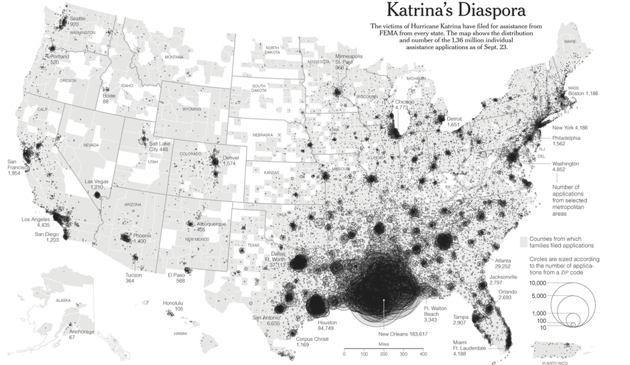
By September 23, 2005, 1.36 million applications had been submitted to FEMA by former Gulf Coast residents for Katrina-related disaster assistance. As The New York Times’ 2005 “diaspora” map above shows, applications came in from every state and, according to one researcher, almost half of all ZIP codes.

But FEMA captured just a snapshot of the displacement, and in the broadest stokes. Narayan Sastry, a scholar of population studies at the University of Michigan and a social scientist at the RAND Corporation, has been developingsurvey-based methods of tracking displaced New Orleanians since 2009. In a2014 paper, Sastry used a sample of individual responses from the Census Bureau’s American Community Survey (ACS) to examine where New Orleans residents wound up in the year after the hurricane, and what factors had influenced their moves.

By one year out, about 53 percent of displaced adult New Orleanians in Sastry’s sample were back again, with less than a third at the home they’d lived in prior to Katrina. Of those who remained displaced, 12 percent were living elsewhere in Louisiana (particularly Baton Rouge), and 40 percent were in Texas (particularly Dallas and Houston, the latter receiving more evacuees than anywhere else). Most of the rest were scattered throughout the South, or New York, Ohio, and California.

“Most of the displaced adults likely faced considerable economic and Mapping the Displacement of Katrina Survivors - The Atlantic:


CURMUDGUCATION: Content-Free Curriculum

CURMUDGUCATION: Content-Free Curriculum:

Content-Free Curriculum


Coming back to school (first student day yesterday, thanks) reminds me once again of the huge hole in the heart of current Core curriculum. The lack of content. The sad fact that there is no there there.

Yes, someone is going to pop up to say that the Core (both in its original incarnation and all the old wine in new skins versions that have promulgated throughout states where "OMGZ NOES! We has no Common Core!" versions of the Core still roam free) is NOT a curriculum, which is part of the trick. Because the Core really isn't a curriculum in a classic sense; the ELA standards are a sort of anti-curriculum in which teachers are forbidden to care about the content, and must only worry about teaching students to perform certain actions, certain tricks, on a test.

Content exists, and teachers a free to select what they will. Teach Romeo and Juliet or  Heart of Darkness or Green Eggs and Ham-- we don't care because it doesn't matter because the literature, the content, has no purpose beyond a playing field on which to practice certain plays. I've accused the Core of treating literature like a bucket in which we carry the important part, the "skills" that the Core demands, but it's more accurate to call literature the paper cup-- disposable and replaceable. We just want you to be able to "find support" or "draw conclusions." About what just doesn't matter.

Back in the early days, we had folks arguing that CCSS called for rich content instruction, that it absolutely demanded a classroom filled with the classic canon. At the time I thought those folks were simply hallucinating, since CCSS  makes no content demands at all (the closest it comes is the infamous appendix suggested readings list). But I've come to believe that those folks were reacting to the gap that they saw-- "Without rich content, this set of standards is crap, so apparently, by implication and necessity, this must call for rich content. Because otherwise it's crap."

I think the absence of content is also the origin of the "new kind of non-bubble non-memorizing test" talking point. The old school test their thinking of is the kind that asks you to pick the year the 

Chicago Tribune: Teacher compensation is a perk. | Fred Klonsky

Chicago Tribune: Teacher compensation is a perk. | Fred Klonsky:

Chicago Tribune: Teacher compensation is a perk.


6b09619b832af39de8433346d84278bf
It has been just a few days since the Chicago Tribune embarrassed itself by publishing the ghoulish op-ed by Kristen McQueary which called for a devastating natural disaster like Katrina to hit Chicago.
Only “water gushing through manhole covers” could bring school reform to our city wrote McQueary, praising the privatization of New Orleans schools that followed Hurricane Katrina.
This morning they publish another one of their patented bull poop articles on teacher pensions, claiming a district’s pension pick-up is a “perk.”
They write that this perk is “little noticed.”
That’s because to most observers of collective bargaining agreements between labor and management it is not normally considered a perk to receive compensation for your work.
A point about the contract language: If someone were to read the collective bargaining agreement (CBA) between the Park Ridge board of education and the Park Ridge Education Association (of which I was a member for 30 years) it says, “the Board shall pick-up the teacher’s required contribution to the Illinois Teachers Retirement System (TRS).”
What does this mean?
It means that the board will take the 9.4% our of our check  and send it to TRS. We paid the entire amount but the board transferred the money. That is all that they did. It was nothing more than an electronic transfer of our money so that we didn’t have to mail in a check to TRS ourselves.
Yet someone might read that and think the board paid our contribution. They Chicago Tribune: Teacher compensation is a perk. | Fred Klonsky:

Mike Klonsky's SmallTalk Blog: Big day for Dyett hunger strikers

Mike Klonsky's SmallTalk Blog: Big day for Dyett hunger strikers:

Big day for Dyett hunger strikers


Important day for the Dyett hunger strikers.
AFT Pres. Randi Weingarten is coming to Chicago today to speak in support of the strikers. Maybe that will push some other unions to do the same and get some decent media coverage.
Our thoughts are with hunger striking Grandmother Irene Robinson who was hospitalized yesterday. She.tells hospital staffers,  "I'm still hungry for Dyett!"
International Business Times picked it up...
The hunger strike has caught the attention of the Rev. Jesse Jackson, who briefly joined last week, and the advocacy group Alliance to Reclaim Our Schools, which encouraged residents across the U.S. to join in solidarity Tuesday. Randi Weingarten, president of the American Federation of Teachers labor union, also announced plans to speak before a group of Dyett demonstrators Wednesday.
The Daily Caller reports:
 Strikers say the decision to shutter the school reflects Emanuel’s utter Mike Klonsky's SmallTalk Blog: Big day for Dyett hunger strikers: