Wednesday, December 30, 2015

Why Philanthropy Hurts Rather Than Helps Some of the World's Worst Problems | The Progressive

Why Philanthropy Hurts Rather Than Helps Some of the World's Worst Problems | The Progressive:

Why Philanthropy Hurts Rather Than Helps Some of the World's Worst Problems


In America today, big time philanthropists are often lauded for helping to even the playing field for those less fortunate. Every week, millionaires flock from TED conferences to "idea festivals" sharing viral new presentations on how to solve the world's biggest problems (give village children computers, think positive thoughts etc.). But this acceptance of the philanthropic order was not always the case. In the era of Carnegie and Rockefeller, for instance, many distrusted these philanthropic barons, arguing they had no right to horde would-be tax dollars for their own pet causes, especially since these "donations" came from the toil of the workers beneath them.
In her new book No Such Thing As A Free Gift: The Gates Foundation and the Price of Philanthropy Linsey McGoey reasserts this challenge to the legitimacy of philanthropy in today's new  era of philanthropic superstars. McGoey’s book investigates the Gates Foundation’s interventions in US K-12 education and global health, raising serious concerns about the extent to which the massive philanthropic sector depletes funding for traditional social services and prioritizes the agendas of unelected foundation leaders.
As institutions like the Gates Foundation take increasingly leading roles in policymaking and governance, McGoey argues, the line between traditional notions of charity and top-down consolidation of power becomes unclear; and with this largely unchecked influence, philanthro-capitalists, like Bill Gates, have pushed countries across the world to accept market based solutions for crises like education inequity and disease proliferation—despite evidence that these problems are often rooted in actions taken by those philanthro-capitalists themselves.
No Such Thing As A Free Gift asks, what is the place of such philanthropy in a democratic society? The answer seems to be “none at all.”
You start the book by putting the rise of today's "philanthrocapitalists," like Bill Gates, into historical context. Could you explain what philanthrocapitalism is and what is actually new about it? How do the Bill Gateses of today compare to the Carnegies and Rockefellers of old?
The term philanthrocapitalism was coined by Matthew Bishop, an editor at the Economist and expanded in a 2008 book co-written with Michael Green. They define the term in two key ways: First, they argue that philanthropy is becoming more business-like Why Philanthropy Hurts Rather Than Helps Some of the World's Worst Problems | The Progressive:

Exploring Cross-State Variations in Resources, Outcomes and Gaps | School Finance 101

Exploring Cross-State Variations in Resources, Outcomes and Gaps | School Finance 101:

Exploring Cross-State Variations in Resources, Outcomes and Gaps

For the past several years now, the Education Law Center of New Jersey and I have been producing a roughly annual report on the state of school finance systems. As that report has evolved, we have taken advantage of publicly available data to construct more and more indicators. Over the next several months, we will be releasing an update of the funding fairness report and a report in collaboration with Educational Testing Services which will explore in greater depth the relationships among the various indicators across states. I also expect in the near future to be releasing, with support of Shanker Institute, an update of my 2012 report exploring what we know about the relationship between school spending, schooling resources and student outcomes – in other words, the “does money matter” question.
In my last post, I explored national average trends in school spending and schooling resources, and discussed some of the recent literature on the topic. Here, I provide some snapshots of cross-state variations in financial effort, financial inputs, real resource inputs and student outcomes across states.
I begin with a relatively simple model of how effort and funding translates to resources, and how those resources ultimately provide the enabling conditions for the classroom conditions and practices that lead to better student outcomes. Despite the assertions of some, the schooling equation remains relatively simple – Schooling remains a human resource intensive endeavor, requiring competitive wages to recruit quality teachers and other school staff, and requiring sufficient capital outlay as well to provide the setting for schooling. The search for the holy grail of alternative technologies (broadly speaking, any substantive changes to educational organization/practices) that would substantially reduce the costs of achieving the same outcomes, has not, as of yet panned out. I have discussed this issue generally (as well as methods for studying it), and with specific reference to teacher compensation, as well as “chartering” [where the most aggressive technological substitutions in particular have been massive failures thus far].

REALLY SIMPLE MODEL

Building on the findings and justifications provided by Baker (2012 – Update coming soon!!!), we offer Figure 1 as a simple model of the relationship of schooling resources to children’s measurable school achievement outcomes. First, the fiscal capacity of states – their wealth and income – does affect their ability to finance public education systems. But, as we have shown in related research, on which we expand herein, the effort put forth in state and local tax policy plays an equal role (Baker, Farrie & Sciarra, 2010).
The amount of state and local revenue raised drives the majority of current spending of local public school districts, because federal aid constitutes such a relatively small share. Further, the amount of money a district is able spend on current operations determines the staffing ratios, class sizes and wages a local public school district is able to pay. Indeed, there are tradeoffs to be made between staffing ratios and wage levels. Finally, a sizable body of research illustrates the connection between staffing qualities and quantities and student outcomes (see Baker, 2012).
Figure 1
Slide1
The connections laid out in this model seem rather obvious. How much you raise dictates how much you can spend. How much you spend in a labor intensive industry dictates how many individuals you can Exploring Cross-State Variations in Resources, Outcomes and Gaps | School Finance 101:

Teaching for Justice & Rebellion | @ THE CHALKFACE

Teaching for Justice & Rebellion | @ THE CHALKFACE:

Teaching for Justice & Rebellion

Let me just say that I agree with most of my more progressive colleagues out there in their calls for teaching with a bend towards social justice, activism, and rebellion.
To wit:
Why waste precious class time doing a close read of a technical manual from a Pearson reader when we can read local newspapers and community blogs? Why should students learn docile obedience in class when the times call for us to civilly disobey and march in the streets? What does “College and Career Ready” matter when the bodies of students of color are being obliterated?
That’s fine exposition. But Mr. Barrett, to whom are you speaking?
Inspirational calls for justice and activism in the classroom all exist within a particular context. Very few educators in the avant garde of education activism would disagree with passionate pleas for justice. And I certainly would like to see more examples of actual teaching for justice being implemented. Concrete examples would all help us to better achieve our goals.
In Washington, DC, where similar degrees of oppression from leadership exist, I think it would be fair to say that we lack the same degree of passion when compared to activist groups in, say, Chicago. Teachers in DC definitely don’t possess the same amount of solidarity and cover that is provided to members of the Chicago Teachers’ Union (Try being a building’s union rep and you’ll see real quick).
But let me ask again: Mr. Barrett, to whom are you speaking? I work with a lot of teachers who would love to actualize Mr. Barrett’s calls to justice. I could certainly recommend this article, and a host of others, to our teachers. Yet, I think Mr. Barrett and others should direct some of their ire and calls to action to administrators, who largely control the what and how of teaching in the classroom.
By the powers invested in teacher evaluation, and through a pervasive culture of fear that envelops us all, Teaching for Justice & Rebellion | @ THE CHALKFACE:

Looking back over 2015. | Fred Klonsky

Looking back over 2015. | Fred Klonsky:

Looking back over 2015.


 Some posts from the past year:

Before the Illinois Supreme Court ruled in our favor, I started 2015 out by saying if we want to win our pensions we must also fight for peace and justice.
The IEA might lose 600 adjunct members from Columbia College. And they did.
I was an early supporter of the Progressive Caucus in the Chicago City Council. And I still am.
gridlock
With Bruce Rauner pushing Right to Work, my friend Lee Tally explained why unions were important.
2015 would be the last year I would be a delegate to an IEA or NEA Representative Assembly. The IEA was helpful for bargaining a contract, but they are not standing up for retirees.
I shaved my beard and kept my moustache for Chuy. That raised $500 for the Chuy campaign, half coming from CTU President Karen Lewis.
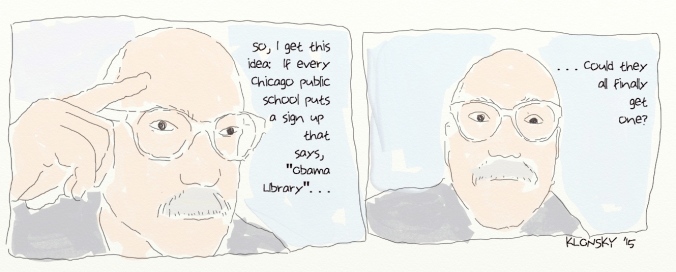
obama-library
There was a lot going on out in Hinsdale with the crazy Tea Party members of the board of education.
With school corruption occurring at the highest levels, in Atlanta it was African Looking back over 2015. | Fred Klonsky:

CURMUDGUCATION: Why Do the Feds Heart Testing?

CURMUDGUCATION: Why Do the Feds Heart Testing?:

Why Do the Feds Heart Testing?


It has been a fact of educational life for so long, that we don't take the question out and ask it much any more, but really--

Why is there a federal requirement to give students a standardized test?

Why has that provision, that requirement, that burden been given the weight of federal regulation? Even as ESSA tore down and ripped up many pieces of federal oversight and regulation, that provision was never in doubt. At best, for a while, there was hope that the testing requirement would be reduced, but nobody ever thought that the federal requirement to make give students a standardized test would go away. And it didn't.

But why? Why does the federal government believe that an important national interest is served by testing every American school student, year after year?

There's no federal requirement that every automobile be inspected year after year. There's no federal requirement to even register firearms, let alone make sure they're still working properly. Federal requirements for food are loose and getting looser, with the FDA limited in how much inspecting they can get done and what they can do about the results. There's no annual federal testing requirement for soldiers and armaments, no federal requirement for annual testing of road surfaces, no federal requirement for annual testing of judges or legislators-- you get the idea. There's a big long list of things that are important for the welfare and safety of the country, a long list of things that taxpayers spend big money on, and yet do not operate under a federal demand for constant testing.

On top of that, once the federally required tests have been given-- what will the feds do with the 


FL: Stamping Out Science?

Florida remains an important reminder that as much as I love the idea of local control, it can a powerful instrument for educational malpractice.

Yes, the state has managed to fumble everything from their Big Standardized Test crash-and-burn to making Florida a petri dish for growing some of the most odious reformster groups around (and all of that educational baloney just to help launch Jeb! into the biggest national campaign fizzle since New Coke). They let Bill Gates play with (and crash) a whole school district. But Florida has also allowed local school boards the freedom to make baldly racist assaults on their own school system.Pinellas County schools resegregated their elementary schools and cut off proper funding and support to the poor black ones.

Now some right-wing Common Core opponents are backing proposed laws that would give local taxpayers a tactical nuke to use on their school districts.

House Bill 899 and Senate Bill 1018 are aimed at the book-buying procedure in Florida. Florida Citizens' Alliance is one of the groups backing this measure; on their web page you can find a call to action for both these actions (billed as anti-Common Core legislation) and open carry and campus carry bills.

They would like to see a change in how textbooks are selected. The bill calls for a committee chosen by the local school board, containing at least one third parents, following public meeting 
FL: Stamping Out Science?

6 Reasons Your Kid Could Have Less Standardized Testing in 2016 - Yahoo News

6 Reasons Your Kid Could Have Less Standardized Testing in 2016 - Yahoo News:

6 Reasons Your Kid Could Have Less Standardized Testing in 2016

It’s been a rough year for standardized testing—the timed, fill-in-the-bubble-with-a-No. 2-pencil mental gauntlets feared by students, loathed by teachers, and loved by education policy makers, perhaps because they no longer have to take them. Testing started in earnest decades ago as a measure of academic skills and intensified in 2002 as education policy specialists suggested it could help students in the United States catch up with their global peers and measure how well public schoolteachers are doing their jobs.
But over the course of 2015, there were major disturbances in the testing universe. Students, with their parents’ blessing, chose not to take them; a growing number of colleges questioned their usefulness; and arguably the biggest official proponent of testing decided to leave his post. Here are the top six moments of 2015 that will influence what happens in classrooms next year.
6. Computer Problems With Standardized Test Scoring
The partial list reads like a random roll call of the states: Illinois, Virginia, Montana, North Dakota. Yet, that’s only a handful of the dozen or so states where computer glitches either ruined or didn’t deliver results of high-stakes assessment tests, according to information compiled by the Center for Fair and Open Testing, also known as FairTest. States pushed back, withholding payments to testing firms—in Nevada, where only 30 percent of students completed the test, authorities reached a $1.3 million settlement. In Indiana, testing giant CTB McGraw Hill did nothing to correcta problem that fouled up thousands of scores on the Hoosier State’s assessment test.
5. ACT, SAT, OUT: More Colleges Dropping Tests as Admission Requirement
As K–12 standardized assessments fell by the wayside, 2015 saw an increasing number of colleges and universities either scaling back use of the ACT and SAT tests—or ditching them altogether—as an admission requirement. The factors leading them in that direction are familiar to any college-bound teenager anxiously awaiting the oversize, computerized envelope containing their scores, and, essentially, their future: heightened student stress before, during, and after the test; the temptation to cheat; and the test's inability to objectively determine if a top scorer is a knowledgeable student or just a great test taker.
4. Atlanta Cheating Scandal Concludes
In a cautionary tale for the nation, 11 Atlanta educators were convicted in April of altering, inflating, or fabricating test scores on student achievement tests in struggling schools, bringing to a close the most massive cheating scandal in the nation’s history. Authorities said the scandal dated back to 2001, when scores on statewide aptitude tests shot up unexpectedly; more than 30 educators were indicted in 2013, and most took plea deals. The educators—ranging from classroom teachers to school administrators in on the conspiracy—were sentenced to a mix of prison time, home detention, probation, and fines.
3. Explosion of the Opt-Out Anti-Test Movement
In arguably the biggest blow to the bureaucratic education reform movement, an estimated 500,000 students in seven states, from New York to Oregon, chose not to take federally mandated assessment tests in the spring, with the blessing of their parents, according to FairTest. (The U.S. Department of Education won’t have official opt-out numbers until later this month.) Testing advocates say the tests hold teachers accountable and measure student 6 Reasons Your Kid Could Have Less Standardized Testing in 2016 - Yahoo News:

Too few students taking state exams; Washington could face sanctions | The Seattle Times

Too few students taking state exams; Washington could face sanctions | The Seattle Times:

Too few students taking state exams; Washington could face sanctions

A dozen states were asked to address test-participation rates that dipped lower than the required 95 percent.


Washington is one of 12 states that could face sanctions if it fails to get more students to take state exams next spring.
The U.S. Department of Education has sent warning letters to Washington and the 11 other states where participation rates on state reading and math tests fell below the required 95 percent.
Washington’s participation rate was about 91 percent, according to the state’s Office of Superintendent of Public Instruction, with many high-school juniors refusing to take the exams.
If states do little or nothing to raise participation rates, the federal agency  could place them on high-risk status, issue a cease-and-desist order and/or withhold a portion of the state’s federal education funding, according to the letter, which Education Week posted last week.
In a response sent Dec. 2, Washington state’s education office wrote that schools and districts here with lower-than-required participation will have to come up with a plan to increase their rates next spring. The office will provide additional information for schools and school districts to share with their communities about what the federal government requires and how test results are used.
“The plan must address the causes of the low participation rate and the actions the district and/or schools will take in response to the low participation rate,” Assistant Superintendent Gayle Pauley wrote.
Washington schools had no problem meeting the required participation rate in grades three through eight. Participation rates were also high for high-school sophomores, who have to pass the state’s English language-arts test to graduate.
The numbers were much lower for juniors, who weren’t required to take the tests for graduation. About 30 percent of juniors across the state were confirmed refusals for both the English/language arts and math tests, according to state test data.
One of the districts with a high refusal rate was Seattle Public Schools, where 43 percent of juniors opted out of the English-language arts test, and 44 percent opted out of the math test. Other nearby districts had even higher rates: Preliminary data showed more than three-quarters of juniors in the Bainbridge Island, Issaquah, Enumclaw and Snoqualmie Valley school districts refused to take the tests.
The other states that received warning letters are: California, Colorado, Connecticut, Delaware, Idaho, Maine, New York, North Carolina, Oregon, Rhode Island and Wisconsin, according to Education Week.
Even though the federal government recently passed a new education law, Too few students taking state exams; Washington could face sanctions | The Seattle Times:

How Congress Left Behind Public-School Choice - WSJ

How Congress Left Behind Public-School Choice - WSJ:

How Congress Left Behind Public-School Choice
Obama calls the new law a ‘miracle.’ Tell that to students no longer able to transfer from bad schools.


 When President Obama signed the Every Student Succeeds Act earlier this month, he celebrated the bipartisan support for the legislation—which replaced the No Child Left Behind Act—as a “Christmas miracle.” Miracle or not, the new law ended the largest school-choice program in the country.

“Public School Choice,” was the simple name for the program, and it was built into No Child Left Behind. Under the law, any school failing to meet performance benchmarks in reading or math for two consecutive years was identified as “in need of improvement.” Families whose children attended one of these schools had to be offered the option to transfer to any other district school that was not so identified.
The program had some obvious flaws. Some districts were so small that they had only one school in a grade level; and all of the schools in some districts were in need of improvement.
Also, the program was run by state and local bureaucrats who had little incentive to make it work well. Not because it cost taxpayers any extra money; public funds flowed with the student to his new school, along with the federal funds to transport him. Still, the program forced school choice on districts that might have preferred their traditional assignment systems—and districts had to send letters to parents notifying them of their options.
As a result, the actual offer letters to parents tended to bury the most important information—a choice to enroll their children in a better school, along with free busing—in obscurely worded form letters. Consequently, the takeup rate was never high. Not even 3% of eligible families transferred their children to another school, which is probably why the end of the program attracted so little attention.
On the other hand, state bureaucrats, under pressure from local school districts, couldn’t wait to end the program. The Obama administration gave them that chance starting in 2012, when it began granting waivers for states to avoid the most onerous aspects of No Child Left Behind. Without any federal pressure, nearly all of the states with waivers dropped the school-choice provision and another provision offering families free after-school tutoring. Enrollment rates began falling. Congress killed both provisions when it reauthorized the federal education law.
And yet this program, despite its flaws, was a big deal. About 48,000 students transferred to a better school when the option became available in the 2004-05 school year. Eventually the number of students who transferred rose to more than 165,000 in the 2009-10 school year. As more schools were identified for improvement the number of students transferring started falling, and it fell even more as more states got waivers. But even in 2013-14, the last year for which data is available, 27,126 children switched schools.
To put this in perspective, the Public School Choice program was, at its peak, more than twice as large as the largest provider of charter schools, the Knowledge Is Power 

National Association of Charter School Authorizers (NACSA) Group: 
1 in 5 charter schools not doing well enough to stay open
A group that oversees more than half of the nation's 5,600 charter schools said as many as 
one in five U.S. charter schools should be shut down because of poor academic performance. 
http://seattletimes.com/html/nationworld/2019784379_charterschools29.html


New California Law Limits Use of Student Data - US News

New California Law Limits Use of Student Data - US News:

New California Law Limits Use of Student Data

The statute bars companies from using student data for advertising.


For technology companies in California, ringing in the New Year will mean adjusting to a new privacy law that limits how they can collect and use student data.
The data privacy legislation was originally signed into law by Gov. Jerry Brown in 2014 and goes into effect Jan. 1. It prohibits the operators of education websites, online services and apps from using any student's personal information for targeted advertising or creating a commercial profile, as well as the selling of any student's information.
The law also requires education technology companies to maintain reasonable security procedures for students' personal data and to delete information at a school's request.
While the law is hardly the first – more than 20 states currently have some type of student data privacy law on the books – it is unique in that it applies to all education websites, online services and apps, regardless of whether they have a contract with states and schools.
Laws in other states specifically regulate education technology contracts.
"This is the most aggressive legislative effort to protect the privacy of student data," says Craig Cheslog, vice president for California policy at Common Sense Kids Action, a nonprofit advocacy organization that helped craft the law. "It puts the responsibility directly on industry and not on teachers, parents or families."
Notably, more than 200 technology companies in Silicon Valley and around the country, including Apple and Google, have already pledged to safeguard student privacy. 
Advocates for stronger student privacy laws have welcomed the California legislation, saying it provides rules of the road for technology companies at a time when K-12 schools are increasingly integrating laptops, tablets and other digital devices and software into the classroom.
Those providers have been known to collect massive amounts of data about students – everything from contact information, performance records and online search history to health information, behavior and disciplinary records, and even whether students ride the bus to school. Google, for example, stopped scanning student email messages for advertising purposes last year.
Advocates argue that there haven't been clear limits on the use of student data and that many education technology companies fail to adequately encrypt students' personal information and secure it from potential misuse. The law, they say, will ensure that information stays out of the wrong hands.
"The truth is in every generation, perhaps now more like every five to 10 years, a new revolution in technology forces us to contend with new questions about how to keep our kids safe," U.S. Secretary of Education Arne Duncan said at an education technology summit just months before the California legislation was signed into law last year. "Privacy rules may well be the seat belt of this generation."
Over the last few years, Duncan has conceded that current federal laws haven't kept pace in a field New California Law Limits Use of Student Data - US News:

States’ Pension Woes Split Democrats and Union Allies - WSJ

States’ Pension Woes Split Democrats and Union Allies - WSJ:

States’ Pension Woes Split Democrats and Union Allies

Left-leaning politicians are increasingly supporting more aggressive revamps of retirement benefits despite opposition from labor officials


 A $1 trillion U.S. pension gap is dividing two longtime allies: Democrats and unions.

Left-leaning politicians from Rhode Island to California are increasingly supporting more aggressive overhauls of government pension benefits despite opposition from labor officials, traditionally one of the Democratic Party’s biggest policy and electoral supporters.
The erosion of Democratic backing for conventional retirement benefits prized by teachers, firefighters and police officers is a sign of how strained government budgets are as obligations for 24 million public workers and retirees continue to mount.
The latest clash is unfolding in Pennsylvania, where Democratic Gov. Tom Wolf has been seeking to end a six-month budget impasse with a Republican-controlled Legislature by agreeing to approve retirement cuts for new state hires and current workers. The Keystone State has $50 billion in unfunded pension obligations, one of the deepest retirement holes in the country.
“I know you’re not going to be happy,” Mr. Wolf told union leaders in private phone calls during recent weeks, those labor officials said. Union officials said the cuts aimed at current workers violate state laws.
A spokesman for Mr. Wolf said the governor understands that some people would be upset with the pension cuts, but his priority has been boosting education spending. “The governor absolutely wants to make sure state workers have a secure retirement, but this was a compromise budget and he’s dealing with an overwhelmingly Republican-led Legislature,” the spokesman said.
Since 2009, 25 out of 34 states that had Democratic governors in office have rolled back retirement benefits for public workers, a result that is proportionally in line with states run by Republicans, according to a Wall Street Journal analysis of National Association of State Retirement Administrators data. Most of those governors also have survived attempts by union interests to remove them from office. At present, 17 states have Democratic governors.
Pension-cutting Democrats can come off as the lesser of two evils for union officials, because they have curtailed some benefits in an effort to make retirement plans more sustainable. Republicans often pursue more drastic steps such as ditching traditional pensions altogether in favor of the 401(k)-like plans common in the private sector.
The amount states and local governments are paying each year to fund retirement systems has risen to 4% of annual spending, up from 2.3% in 2002, according to U.S. Census data. Meanwhile, large retirement systems now have just three-quarters of the assets they need to fund future obligations, according to consultant Milliman Inc., leaving a gap of $1 trillion.
Democrats rarely tried to roll back pensions before 2008, according to politicians and pension officials. But as deficits surged because of deep investment losses in the wake of the financial crisis and chronic underfunding of retirement plans, Democrats said they had little choice but to revamp benefits, leading to conflicts with what has usually been a large and loyal bloc of voters.
ENLARGE
In West Virginia, Democratic Gov. Earl Ray Tomblin this year backed pension cuts that raise mandatory worker contributions for new hires and block those workers from retiring as young as 55.
In California, Democratic Gov. Jerry Brown traded jabs with the state’s largest retirement system when he said a proposal to lower investment targets was irresponsible because it didn’t go far enough and would likely reduce the expected rate of return over a longer period, in effect papering over looming deficits. The California Public Employees’ States’ Pension Woes Split Democrats and Union Allies - WSJ:

Know Who's Psyched for Hillary? Teachers Unions. – InsideSources

Know Who's Psyched for Hillary? Teachers Unions. – InsideSources:

Know Who’s Psyched for Hillary? Teachers Unions.

Lily Eskelsen Garcรญa is feeling good these days.
As president of the country’s largest labor union, the National Education Association, she was overjoyed by this month’s passage of the Every Student Succeeds Act — legislation President Barack Obama signed to end President George W. Bush’s much-maligned school reform policy, No Child Left Behind.
The new law shifts significant controls over public education to the states, reducing requirements for the use of standardized testing in evaluating students, teachers and schools. It’s music to the ears of Eskelsen Garcรญa, who has long argued against what she calls the “test and punish” model of assessment.
The union chief was still euphoric about ESSA when she appeared on C-SPAN’s “Newsmakers” program Sunday. She said she was in “happy shock that things are going to be really, really, really better for 52 million public school children.”
Here’s what’s certainly true: things are about to be better for the NEA, especially if its Democratic primary candidate — former Secretary of State Hillary Clinton — wins the White House next year.
  NEA’s Lily Eskelsen Garcรญa gushes over Democratic presidential candidate Hillary Clinton.
For all teachers unions have done to support Obama, Clinton has always been closer to them than the president, whose education policies created a rocky relationship with what’s traditionally a core progressive constituency. As Politico put it in “Obama vs. teachers unions: It’s still on,” education is the issue where the president has “veered farthest from his liberal base,” except perhaps for trade:
It’s historically a local issue, but Obama and [Education Secretary Arne Duncan], his pickup basketball pal from Chicago, have reshaped the national landscape, using carrots (like the Race to the Top competition for stimulus dollars) and sticks (like the threat of sanctions under the No Child Left Behind Law) to nudge states into adopting reforms that unions hate.
By choosing [Deputy Education Secretary John] King to succeed Duncan, the president is signaling that he cares more about continuing those fights—for higher standards, for charter schools, for standardized testing—than healing wounds or papering over differences within his party before the 2016 election.
King is set to take over after Duncan gives a farewell address in the Windy City Wednesday, but a new secretary could be on the job along with a new president in January 2017. And if it’s Clinton’s in the White House, significant changes to education policy may be in store. Vox flagged a November American Federation of Teachers forum where the Democratic front-runner voiced opposition to evaluating educators on test scores and skepticism about expanding charter schools, contrasting herself with Obama.
She has also spoken out against Republican presidential candidates who use anti-teacher-union rhetoric, Know Who's Psyched for Hillary? Teachers Unions. – InsideSources: