Latest News and Comment from Education

Wednesday, February 26, 2020

It's Larry Ferlazzo's Websites of the Day... A VERY BUSY DAY | The latest news and resources in education since 2007

Larry Ferlazzo's Websites of the Day... | The latest news and resources in education since 2007


It's Larry Ferlazzo's  Websites of the Day... A VERY BUSY DAY 
The latest news and resources in education since 2007

A Look Back: Surprise, Surprise: Study Finds That Relationships Promote Perseverance & Cash Bonuses Do Not

I thought that new – and veteran – readers might find it interesting if I began sharing my best posts from over the years. You can see the entire collection here . I wrote this post in 2013. You might also be interested in The Best Resources On The Value & Practice Of Having Older Students Mentoring Younger Ones . That post includes my latest related post, Here Are The Instructions I Give Mentors
How Can We Make Our Lessons More Culturally Responsive?

The next question-of-the-week at my Ed Week column is: What are specific ways to make lessons more culturally responsive and culturally sustaining? Please leave responses on Twitter or in the comments section.
Smithsonian Releases 2.8 MILLION Images Into Public Domain

Program from the March on Washington for Jobs and Freedom at the Lincoln Memorial. The program is a single page folded in half to create a booklet. The top of the front page has the march title and date in large black letters underlined by a black decorative border. It reads “MARCH ON WASHINGTON/ FOR JOBS AND FREEDOM/ AUGUST 28, 1963.” The Smithsonian announced today that they were making 2.8 mil
“Connecting Reading & Writing ‘Is a High-Leverage Move'”

Connecting Reading & Writing ‘Is a High-Leverage Move’ is the headline of my latest Education Week Teacher column. Five educators recommend strategies for using reading instruction as a tool to improve students’ writing skills, including through the use of informal writing and sections of reading texts students can use as models for their writing. Here are some excerpts:
What Are Your Suggestions For Online Learning If Schools Are Closed In U.S. Because Of The Coronavirus?

I don’t want to be overly-alarmist, but two things happened today to get me wondering what would happen here in the U.S. if the coronavirus resulted in U.S. schools closing for a period of time. First, the CDC announced today that it 


Larry Ferlazzo's Websites of the Day... | The latest news and resources in education since 2007

Songs of Innocence, Songs of Experience – radical eyes for equity

Songs of Innocence, Songs of Experience – radical eyes for equity

Songs of Innocence, Songs of Experience


I am deeply indebted to the academic and personal kindness and mentoring afforded me during my undergraduate education by one of my English professors, Dr. Nancy Moore.
Dr. Moore combined an admirable ability to challenge students academically while also being sincerely supportive and encouraging. I probably did not need or even deserve her praise, but Dr. Moore always made me feel like a successful student, budding scholar, and most of all, credible writer.
She was one of the first people to treat me as a poet, inviting me to read and share my work in various settings.
But I also recall that she regularly chided me about my literary affections, warning me that I would grow out of some of my favorite authors. Part of that rested on one of my proclivities for authors who dwelled on innocence, such as J.D. Salinger and e.e. cummings.
While my literary tastes have in fact changed and even matured (in the sense that my critical sensibilities are sharper as I have aged), as I am staring down the barrel of turning 60, I remain deeply drawn still to the poetry of cummings, even as my discomfort with him as a person has grown with each biography I read.
This blog post title refers directly to William Blake’s major poetry collection that remains also a favorite of mine since it captures why these works still resonate with me; the tension between innocence/youth and CONTINUE READING: Songs of Innocence, Songs of Experience – radical eyes for equity

AFT Prez Weingarten Signals Support for Sanders over Moderates as Field Narrows – Payday Report

AFT Prez Weingarten Signals Support for Sanders over Moderates as Field Narrows – Payday Report

AFT Prez Weingarten Signals Support for Sanders over Moderates as Field Narrows

Last week, the American Federation of Teachers President Randi Weingarten signaled that their union would likely support Senator Sanders if the primary field were to narrow if Warren or Biden dropped out due to poor showing.
On Thursday, last week, the union voted to encourage its members to vote for either Vice President Joe Biden, Senator Elizabeth Warren (D-MA), or Senator Bernie Sanders (D-VT).
“The resolution signals to members and leaders that support for any of those three candidates is welcome at this stage of the process before the union makes a national endorsement,” the union said in a statement last week.
In their broad joint endorsement, the union signaled that they were opposed to the upstart moderate candidacies of former New York Mayor Michael Bloomberg, Minnesota Senator Amy Klobuchar, and former South Bend Mayor Pete Buttigieg; all of whom have been criticized for their support of charter schools.
“It was clear that the time to take this action was now before all the delegates are chosen and before all of the primaries are over so that AFT members and leaders can help shape the race and the narrative, ensure our voices are heard, and ensure one of these three candidates emerges as the nominee,” Weingarten said in explaining the union decisions to do a joint endorsement of Biden, Warren, and Sanders.
With Warren’s and Biden’s campaign sagging, the positioning by AFT opens the door for the union endorsing Sanders.
An endorsement from the political popular teachers’ union and its president Randi Weingarten would CONTINUE READING: AFT Prez Weingarten Signals Support for Sanders over Moderates as Field Narrows – Payday Report

Ohio: Who Is Writing Education Policy? Not Educators. | Diane Ravitch's blog

Ohio: Who Is Writing Education Policy? Not Educators. | Diane Ravitch's blog

Ohio: Who Is Writing Education Policy? Not Educators.


Joel Malin and Kathleen Knight-Abowitz of Miami University in Oxford, Ohio, write here about the forces determining education policy in Ohio. 
Ohio education policy is a train wreck. It is not benefiting students or teachers or society. So who is it benefiting?
In our view, it pays to start asking larger questions about EdChoice to understand how education policy is made in Ohio. Why, for instance, did this dramatic increase in voucher eligibility occur? Why would lawmakers experiment with such an expensive initiative, when studies of such voucher programs – including a rigorous study of EdChoice – have most often revealed large, negative impacts on student learning? And, in what universe does it make sense that schools would be judged, and voucher eligibility triggered, by students’ scores in 2013 and 2014 (but not 2015-2017)?
The great uproar around EdChoice should have us asking about how policy is made: specifically, whose voices are being elevated, and whose are being diminished, when Ohio education policy is being created?
Taking a step back, we can see that the policies adopted CONTINUE READING: Ohio: Who Is Writing Education Policy? Not Educators. | Diane Ravitch's blog

Is the NYC School System Idling in Neutral? | Ed In The Apple

Is the NYC School System Idling in Neutral? | Ed In The Apple

Is the NYC School System Idling in Neutral?


Have you ever coached a kid sports team? a dance group? a band or orchestra?  Kids vary widely in talent and the effort they put into getting better. As a coach, you try and hone your coaching skills; maybe you use the camera on your phone to show the kids their footwork or instrument fingering.  You may take a coaching course; what are the most effective exercises for the kids to practice?   I coached soccer and took a US Soccer Federation Coaching License course; each session was 1.5 hours in the classroom with film and 1.5 hours in the gym or on a field, it was rigorous; and only for the “D” license.
We played in the Metropolitan Soccer League; we were the only “American” team, the only non-ethnic team. We probably got cursed at in many, many different languages; our kids played hard, they were pretty good. Some kids went on to play in high school and college, for most it was just fun, and, our parents weren’t as passionate as the GottcheeGreek AmericansGjoa or the Brooklyn Italian parents.
God, in her wisdom didn’t distribute talent equally, to kids, or, coaches.
Some kids weren’t the most gifted but they made up for it in effort; conversely other kids with “natural” talent never responded to coaching.
On the other hand I didn’t go beyond the “D” license, I’d like to think my CONTINUE READING: Is the NYC School System Idling in Neutral? | Ed In The Apple

Michael Bloomberg’s Disastrous Public Education Legacy | The Indypendent

Michael Bloomberg’s Disastrous Public Education Legacy | The Indypendent

Michael Bloomberg’s Disastrous Public Education Legacy


As of mid-February, Michael Bloomberg has spent over $400 million on his presidential campaign, including blanketing the air waves with ads and is on track to spend more than a billion dollars. As a result, he has risen sharply in the polls, and in turn, begun to receive critical attention regarding his record on certain issues, such as racial profiling and his stop-and-frisk policies.
However, Bloomberg’s record on education has been glossed over. When it is mentioned at all, he has been vaguely praised, as in a recent Thomas Friedman column, for championing  “virtually every progressive cause” including “education reform for predominantly minority schools.”
But the reality is that Bloomberg’s education record is far from progressive. In fact, when I heard that he was running for president, it felt like the return of a bad dream that for many of us had begun to fade away long years ago.
Aggressive Free-Market Ideology
For voters who do not live in New York City or never sent their children to public school here,  you might not be aware that Bloomberg embodied an aggressive free-market ideology with policies that were contrary to research and hugely disruptive — in the worst sense of the word. Far from the benevolent, pragmatic centrist his campaign likes to portray,  Bloomberg and his chancellors reigned over NYC public schools for 12 years with an iron fist, autocratically imposing destructive reforms with little concern for how they upended the lives of communities, students and teachers.
In many respects, his policies contradicted his campaign promises. When he first ran for Mayor in 2002, he didn’t mention the wrecking-ball he later deployed on the school system, but instead pledged to implement a proven reform: to lower class sizes in all schools to 20 students or less in grades K-3. Class-size reduction has been shown to benefit all kids but especially students of color, who make up the majority of kids in New York City schools.
Instead of following through on this promise, subsequent audits from the state and city comptrollers showed, his administration misused hundreds of millions of state dollars meant for class-size reduction. As a result, class sizes stagnated and then rose sharply in his second term.  
 In 2011, at a speech at the Massachusetts Institute of Technology, Bloomberg announced that if he had his way, he would double class sizes by firing half the teachers. He would “weed out all the bad ones” and pay the rest more. It would be “good deal for the students,” he insisted. What he didn’t mention, of course, is that his own daughters attended a private school where class sizes averaged 14-18 student CONTINUE READING: Michael Bloomberg’s Disastrous Public Education Legacy | The Indypendent

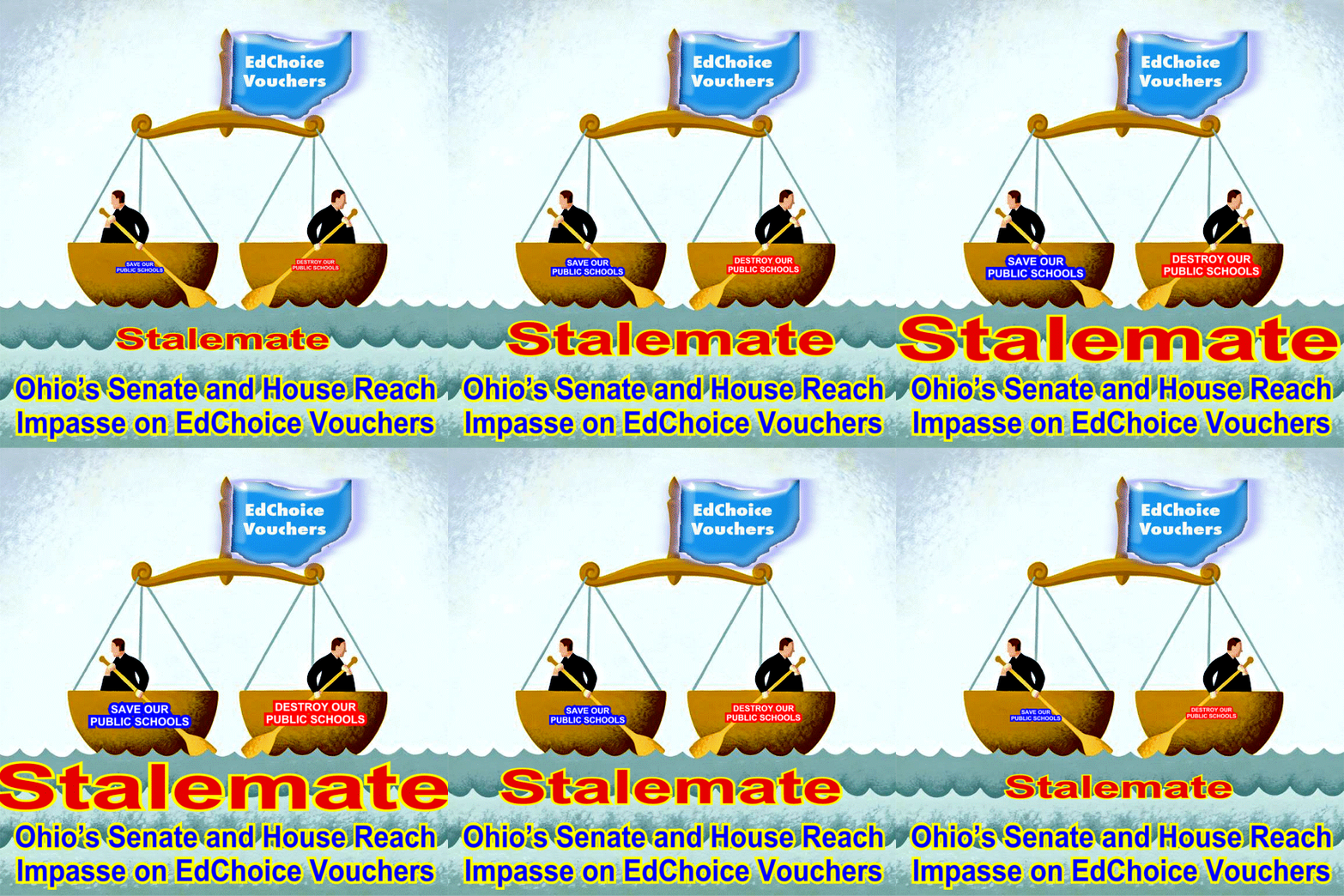
Stalemate: Ohio’s Senate and House Reach Impasse on EdChoice Vouchers | janresseger

Stalemate: Ohio’s Senate and House Reach Impasse on EdChoice Vouchers | janresseger

Stalemate: Ohio’s Senate and House Reach Impasse on EdChoice Vouchers


According to what is logical, what is constitutional, and what is moral, you would think members of Ohio’s legislature could come together to resolve Ohio’s voucher crisis and provide some relief for school districts going broke because that same legislature (in the final hours of the budget conference committee last summer) surreptitiously and explosively expanded EdChoice Vouchers paid for out of local school districts’ budgets.  But you would be wrong, because in the Ohio Senate, ideology trumps logic, constitutional protection of school funding, and basic morality.
Ohio’s EdChoice Voucher program has created a crisis for Ohio school districts. Here’s why:
  • EdChoice Vouchers are awarded to students in so-called “failing” schools.  The school ratings are based on what everyone—Republican and Democratic legislators alike—agrees are flawed algorithms in the state report card.  Schools are rated in six categories, and if a school scores D or F for two years running in any one of the categories, it becomes an EdChoice Designated School, where students can qualify for a voucher paid for by a local school district budget deduction. The number of EdChoice Designated public schools increased from 255 last school year (2018-2019) to 517 this year (2019-2020), and that number is due to explode to over 1,200 schools for next school year (2020-2021). Two-thirds of all the state’s school districts will have at least one EdChoice Designated school next school year.
  • Each EdChoice voucher is based on a school district deduction—$4,650 for K-8 students and $6,000 for each high school student.  A student is counted as enrolled in the local school district, and the district receives state basic aid for that student, but for many districts, the voucher extracts more than the state’s basic aid per-pupil.  And in an added twist this school year, the state froze basic formula aid for all public schools at last year’s amount.  There is no extra money coming into the school district to pay for any additional vouchers this school year.
  • While previously a student had to have been enrolled in a public school in order to carry a voucher out of that school, in the state budget bill, the Legislature changed that requirement.  This year, any high school student living in the zone of a Designated EdChoice high school qualifies for a voucher even if that student has never attended a public school in the district.
All this means that during this 2019-2020 school year, thousands of students previously CONTINUE READING: Stalemate: Ohio’s Senate and House Reach Impasse on EdChoice Vouchers | janresseger

State Level Educational Outcomes of Foster Youth

State Level Educational Outcomes of Foster Youth


Students in foster care represent one of the most vulnerable and academically at-risk student groups enrolled in California schools. The California Department of Education (CDE) monitors the educational outcomes for foster youth and partners with multiple state agencies and non-profit organizations to ensure these students receive the supports and services they need. This web page provides information and resources on the educational outcomes for foster youth. Select one of the tabs below to access information on the educational rights of foster youth among other resources and documents to learn more about the needs of these students and some of the different ways CDE is working to support counties, school districts, and schools to meet these needs..

State Level Educational Outcomes of Foster Youth

The outcomes for foster students, outlined below, are published annually. These outcomes and more can be accessed on DataQuest. DataQuest is the California Department of Education’s online, public reporting system that provides reports about California’s schools and school districts. To find out how to access reports specifically for foster youth on DataQuest, view these Instructions on Accessing Data(DOCX).
2018-2019 Percent of Students Chronically Absent
The graph below displays the 2018-2019 school year chronic absence rates for foster and non-foster students. Chronic absence rate is calculated as the percent of students who miss ten percent or more of the days they are expected to attend.
Bar chart showing chronic absence rate for foster as 28% and for non-foster as 12%.
2018-2019 Suspension Rate
The graph below displays the 2018-2019 school year suspension rates for foster and non-foster students. Suspension rate is calculated as the percent of all students who were suspended one or more times during the school year for an in-school or out-of-school suspension.
Bar chart showing suspension rate for foster as 15% and for non-foster as 3%.
Percent of Students Meeting or Exceeding Standards - 2018-2019 Smarter Balanced Assessment in English Language Arts
The graph below displays the 2018-2019 school year percent of students meeting or exceeding standards on the Smarter Balanced Assessment in English Language Arts for foster and non-foster students.
Bar chart showing percent of foster meeting or exceeding standards in English Language Arts as 24% and 51% for non-foster.
Percent of Students Meeting or Exceeding Standards - 2018-2019 Smarter Balanced Assessment in Mathematics
The graph below displays the 2018-2019 school year percent of students meeting or exceeding standards on the Smarter Balanced Assessment in Mathematics for foster and non-foster students.
Bar chart showing percent of foster meeting or exceeding standards in Mathematics as 15% and 40% for non-foster.
2018-2019 Four- Year Cohort Graduation Rate
The graph below displays the 2018-2019 school year four-year cohort graduation rates for foster and non-foster students. The four-year cohort graduation rate is calculated as the percent of students who graduate high school within four years from the time they enter ninth grade with a traditional high school diploma.
Bar chart showing graduation rate for foster as 56% and for non-foster as 85%.
Questions:  


State Level Educational Outcomes of Foster Youth

Unannounced Active Shooter Drills Scaring Students Without Making Them Safer

Unannounced Active Shooter Drills Scaring Students Without Making Them Safer

Unannounced Active Shooter Drills Scaring Students Without Making Them Safer

Although they account for only 0.2 percent of the approximately 36,000 annual gun deaths in the United States, school shootings have traumatized the nation and driven much of the gun violence debate. While the public has demanded action from lawmakers to protect students, school districts have too often resorted to measures that offer the appearance of decisiveness, but do little to increase safety.  In fact, they may be doing considerable harm.
Soon after the shooting at Columbine High School in April 1999, schools began implementing active shooter drills. Soon, districts across the country followed suit. By the 2005-06 school year, 40 percent of public schools drilled students on lockdown procedures. By the 2015-16 school year – three years after the Sandy Hook shooting – that number had skyrocketed to 95 percent. In the 2017-18 school year, more than 4.1 million students endured at least one lockdown.
Comprehensive safety plans are of obviously of paramount importance to every school, but the proliferation of these drills – many of which are unannounced or actually simulate gun violence – has prompted concerns from educators, parents and mental health professionals.
According to a new report by Everytown for Gun Safety, the National Education Association (NEA) and the American Federation of Teachers, unannounced active shooter drills are a detrimental and unproven school safety tactic.
“Everywhere I travel, I hear from parents and educators about active shooter drills CONTINUE READING: Unannounced Active Shooter Drills Scaring Students Without Making Them Safer