Latest News and Comment from Education

Friday, September 20, 2019

Symposium: Stripping church-state separation to the bone? The Supreme Court considers mandatory government funding of religious education - SCOTUSblog

Symposium: Stripping church-state separation to the bone? The Supreme Court considers mandatory government funding of religious education - SCOTUSblog

Symposium: Stripping church-state separation to the bone? The Supreme Court considers mandatory government funding of religious education
Daniel Mach is Director of the ACLU Program on Freedom of Religion and Belief.


In Espinoza v. Montana Department of Revenue, the Supreme Court will address a question that would have been unthinkable even to ask until quite recently: Can a state be forced to underwrite religious education with taxpayer dollars? Although the court has previously allowed the government to adopt school-voucher programs that provide indirect government aid to religious schools, it has never suggested that the U.S. Constitution somehow requires doing so ― and certainly not in the face of state constitutional rules barring taxpayer funding of religious education. Yet that is essentially what the petitioners are seeking in Espinoza, the latest in a disturbing line of cases attacking the very foundations of the separation of church and state.
At issue in Espinoza is a voucher-type program in Montana designed to divert millions in government dollars to private schools, the overwhelming majority of which are religiously affiliated. The program, enacted in 2015, allows taxpayers to receive dollar-for-dollar tax credits for donations to Student Scholarship Organizations, which then award scholarships to students attending private elementary and secondary schools. In other words, if a taxpayer owes the state, say, $100 in taxes, she can decide instead to send that money directly to an SSO, which will then spend it on private-school scholarships. In practice, the tax-credit program has served its unmistakable goal of funneling government dollars to religious education: The only SSO operating in the state supports 13 private schools, 12 of which are religiously affiliated, and over 94 percent of program scholarships have gone to finance religious education.
Such religious funding, even though indirect, violates the Montana constitution, which includes heightened protections against government-funded religion. The state constitution’s “no-aid provision,” adopted to promote the separation of church and state and to ensure continued taxpayer support for public schools in Montana, expressly prohibits the government from providing “direct or indirect” aid for religious education. In light of the no-aid provision, the Montana Department of CONTINUE READING: Symposium: Stripping church-state separation to the bone? The Supreme Court considers mandatory government funding of religious education - SCOTUSblog

Why Teachers Need to Incorporate More Physical Activity Into Their Lesson Plans - Teacher Habits

Why Teachers Need to Incorporate More Physical Activity Into Their Lesson Plans - Teacher Habits

Why Teachers Need to Incorporate More Physical Activity Into Their Lesson Plans

Finding a balance in the classroom can be difficult. Incorporating time for grammar, nutrition, mathematics, science, technology, and a plethora of other subjects is already hard all on its own. As if that wasn’t challenging enough, though, covering so many subjects without turning your class into a horde of zombie-children in the process can feel impossible. The lack of focus and increased levels of pent up energy that come with hours of trying to sit still and listen can be difficult to contain.
That’s where good old physical activity comes into play. It may be a simple concept, but the idea of incorporating exercise into the classroom is a critical ingredient for education success. 

Why Physical Activity Matters

Physical activity is a necessary part of life. The act of moving around, stretching your legs and getting your heart pumping faster should be intimately integrated into a long day in the classroom. 
We live in an era where the general lack of physical health isn’t just a concern, it’s an epidemic. Over a third of American adults are obese at CONTINUE READING: Why Teachers Need to Incorporate More Physical Activity Into Their Lesson Plans - Teacher Habits


No more waiting - Sacramento News & Review

Sacramento News & Review - No more waiting - News - Local Stories - September 19, 2019

No more waiting
More than two years after an independent audit raised alarm bells about special-ed classes, youth advocacy groups don’t see change coming without legal action

“How much data do you need to take action?” the frustrated parent of an autistic student asked in January, after the Sacramento City Unified School District had spent 19 months mulling over a damning independent report on its handling of students with disabilities, while failing to act on most of its recommendations.

Eight months later, it’s not just parents exasperated by the lack of action: A coalition of nonprofits and youth advocacy groups just filed a federal lawsuit against the district, one that seeks to force fundamental change in its special education program.

Some parents had long suspected the district has potentially illegal polices for educating disabled students, though their concerns became impossible to ignore after May 2017. That’s when the independent audit by Council of the Great City Schools determined disabled students at SCUSD had abnormally low graduation rates, weren’t getting adequate mental health services and were experiencing alarmingly high suspension rates. The audit singled out the district’s handling of African-American students, many of whom suffered from emotional disturbances and had nearly twice the suspension rate as non-disabled students. The analysis was soon bolstered by another independent study, this one by San Diego State University. It found that black male students with disabilities in the district were the group with the highest suspension rates.

A year after the audit’s release, all 11 members of the district’s Community Advisory Committee for Special Education resigned in protest, specifically because SCUSD officials had failed to implement recommendations from both them and the audit.

On Sept. 6, Disability Rights California, Equal Justice Society, Western Center on Law & Poverty, the National Center for Youth Law and the Black Parallel School Board jointly filed suit against the district and school board in federal district court.

“Sacramento City Unified School District has created and perpetuates an unlawful school system that results in modern-day segregation and mistreatment of students with disabilities, particularly Black CONTINUE READING: Sacramento News & Review - No more waiting - News - Local Stories - September 19, 2019

Sacramento teacher shortage means students taught by substitutes | The Sacramento Bee

Sacramento teacher shortage means students taught by substitutes | The Sacramento Bee

Sacramento City Unified teacher vacancies mean hundreds of students are taught by substitutes

More than three weeks into the school year, several hundred Sacramento City Unified School District students are being taught by substitutes as school officials continue to look for teachers to staff classrooms.
The district estimates that about 46 classrooms have teaching vacancies, which officials said is normal for this time of year. But the Sacramento City Teachers Association said that there are about 100 certificated vacancies, including counselors and nurses. More than 1,000 students are being affected, sometimes being taught electives and required courses by substitutes who are not experienced in subjects like Spanish and art.


Math, science and special education positions are the hardest to fill, according to the district, both in Sacramento and statewide. Sacramento City Unified vacancies include six math teachers and five science teachers. Special Education has 14 vacancies.
Some Sacramento schools are seeing a high concentration of teacher vacancies, amid a nationwide teacher shortage.
Rosa Parks Elementary School held the highest concentration of vacancies. Six positions were still open in science, social science, and English classrooms.
C.K. McClatchy High School had three vacancies in English, biology and social science classrooms.
The Sacramento City Teachers Association estimated hundreds of students at McClatchy High are affected by the teacher shortage, and will be instructed by at least one substitute during their school day.
Lori Jablonski, a government teacher at McClatchy High, surveyed one class of 32 students during the first week of school.
“I asked [students] how many subs they had for three periods a day; 16 raised their hands. I asked how many had subs for four periods a day; four raised their hands,” she said. “Because these classes did not start with permanent teachers, no one at the school site has been leaving lesson plans either, as a permanent teacher would do when calling a sub.”
Since then, the high school has filled three math positions and an art class position. Jablonski said several Spanish classes are being taught by a substitute, but the position is not posted as a vacancy.
Substitutes take positions for a maximum of 30 days, and if a teacher isn’t hired, a new substitute is CONTINUE READING: Sacramento teacher shortage means students taught by substitutes | The Sacramento Bee

CURMUDGUCATION: Why Directing Community Theater Is Like Teaching

CURMUDGUCATION: Why Directing Community Theater Is Like Teaching

Why Directing Community Theater Is Like Teaching


Readers of this blog generally get a dose of whatever is on my mind, and what's on my mind at the moment is theater. I'm coming down to the wire on one more community theater production; The Music Man opens one week from tomorrow (by all means, feel free to stop by). I've been doing this and school theater for thirty-some years, and yes, it's an awful lot like teaching. Let me count the ways.

You Work With What You Get

Big time Broadway directors have it easy. If you decide you want to cast someone who's  5'3" with blue eyes and blond hair with a cleft chin and a baritone voice, plus juggling and tap skills-- for the  chorus--  you can have your pick of twenty such guys. In the community theater world, you tend to get what you get, and your challenge is to figure out how you  make a show out of that. Not that I don't get plenty of great performers, and not that I haven't had the opportunity to pick and choose from several prospects for a part. But there's a tricky line to tread; on the one hand, you have to have a vision going into auditions, but on the other hand, you cant hold so tightly to it that you can't get the show cast at all.


It's like a classroom. You can curse your fate every day that you don't have a room full of enthusiastic readers with a good grasp of writing basics, or you can just accept that your students are who they are. You may have your favorite Ron Swanson quote, and at my house, we do, too. There's an episode  in which Ron is telling a story about a getting shot in the foot with a nail gun. Leslie's exclaims, "You only have nine toes?!" And Ron replies, "I have the toes I have." That's pretty much it.

Adaptability Is Not Only Necessary But Rewarding

Broadways shows are mostly written for lots of men. Community (and high school) theater tends to CONTINUE READING: 
CURMUDGUCATION: Why Directing Community Theater Is Like Teaching


New Reports Confirm Persistent Child Poverty While Policymakers Blame Educators and Fail to Address Core Problem | janresseger

New Reports Confirm Persistent Child Poverty While Policymakers Blame Educators and Fail to Address Core Problem | janresseger

New Reports Confirm Persistent Child Poverty While Policymakers Blame Educators and Fail to Address Core Problem

On Tuesday, the Cleveland Plain Dealer published a stunning analysis, by the newspaper’s data analyst Rich Exner, of the school district grades awarded by the state of Ohio on the state report cards released last week.  The new report cards are based on data from the 2018-2019 school year.  I encourage you to follow the link to look at Exner’s series of bar graphs, which, like this one, present a series of almost perfect downward staircases, with “A” grades for school districts in communities with high median income and “F” grades for the school districts in Ohio’s poorest communities.
The correlation of academic achievement with family income has been demonstrated now for half a century, but policymakers, like those in the Ohio legislature who are debating punitive school district takeovers, prefer to blame public school teachers and administrators instead of using the resources of government to assist struggling families who need better access to healthcare, quality childcare, better jobs, and food assistance.
Ohio’s school district grades arrived this week. At the same time, and with less fanfare, arrived a series of reports on the level of federal spending on children, reports documenting that, as Education Week‘s Andrew Uifusa explains: “The share of the federal budget that goes toward children, including education spending, dipped to just below 2 percent of the nation’s gross domestic product in 2018—the lowest level in the decade.”


How My Thinking about School Reform Has Changed Over the Decades (Part 2) | Larry Cuban on School Reform and Classroom Practice

How My Thinking about School Reform Has Changed Over the Decades (Part 2) | Larry Cuban on School Reform and Classroom Practice

How My Thinking about School Reform Has Changed Over the Decades (Part 2)

A few years ago, Richard Elmore asked me to write a piece about how my ideas have changed over the years. Daily experience in schools as a teacher, administrator, and researcher (and the reflections and writing that I did about those experiences)  altered key ideas I had about the nature of reform and how reform worked its way into districts, schools, and classrooms. He included my piece in a book called I Used to Think… And Now I Think (Harvard Education Press, 2011).  Both posts appeared originally in 2013. There is light editing in Part 2. Part 1 appeared a few days ago.
I used to think that structural reforms (e.g., creating non-graded schools; new district and school site governance structures; novel technologies; small high schools with block schedules, advisories, and student learning communities) would lead to better classroom instruction. And now I think that, at best, such structural reforms may be necessary first steps toward improving instruction but are (and have been) seldom sufficient to alter traditional teaching practices.
In teaching nearly 15 years, I had concluded that policies creating new structures (see above examples) would alter common teaching practices which, in turn, would get students to learn more, faster, and better.
I revised that conclusion, albeit in slow motion, as I looked around at how my fellow teachers taught and began to examine my own classroom practices. I reconsidered the supposed power of structures in changing teaching practices CONTINUE READING: How My Thinking about School Reform Has Changed Over the Decades (Part 2) | Larry Cuban on School Reform and Classroom Practice

Louisiana’s “Education PAC”: A Bit About Nancy Landry, Eddie Rispone, and Lane Grigsby, and More. | deutsch29

Louisiana’s “Education PAC”: A Bit About Nancy Landry, Eddie Rispone, and Lane Grigsby, and More. | deutsch29

Louisiana’s “Education PAC”: A Bit About Nancy Landry, Eddie Rispone, and Lane Grigsby, and More.


n my perusal of Louisiana campaign finance reports, I discovered the PAC featured in this post.
On January 31, 2017, Louisiana lawyer and former La. House rep Nancy Landry started a Louisiana PAC called the Education PAC.
Investigating the political connections among ed-reform associates is very much spider-webby-entangling. I will purposely keep this one brief.
Landry was the House education chair who publicly demeaned Louisiana teachers in 2012; Landry proposed a motion (which passed) requiring teachers who came before the House ed committee to state what kind of leave they took to be present to speak during a school day.
nancy landry 2
Nancy Landry
The first donors to Landry’s Education PAC were Louisiana businessmen Lane Grigsby and Edward Rispone. Each donated $25,000 in 2016.
Both Grigsby and Rispone are associated with Lousiana Business and Industry (LABI), which is a major promoter of education reform in Lousiana. LABI loves Nancy Landry.
Grigsby’s own Empower Louisiana PAC was a funnel for six out-of-state billionaires from four families to contribute a combined $3M to influence the outcome of Louisiana’s 2015 Board of Elementary and Secondary Education CONTINUE READING: Louisiana’s “Education PAC”: A Bit About Nancy Landry, Eddie Rispone, and Lane Grigsby, and More. | deutsch29

Charter School’s Two Dads – How a Hatred for Public School Gave Us School Privatization | gadflyonthewallblog

Charter School’s Two Dads – How a Hatred for Public School Gave Us School Privatization | gadflyonthewallblog

Charter School’s Two Dads – How a Hatred for Public School Gave Us School Privatization
If bad ideas can be said to have fathers, then charter schools have two.
And I’m not talking about greed and racism.
No, I mean two flesh and blood men who did more than any others to give this terrible idea life – Minnesota ideologues Ted Kolderie, 89, and Joe Nathan, 71.
In my article “Charter Schools Were Never a Good Idea. They Were a Corporate Plot All Along,” I wrote about Kolderie’s role but neglected to mention Nathan’s.
And of the two men, Nathan has actually commented on this blog.
He flamed on your humble narrator when I dared to say that charter schools and voucher schools are virtually identical.
I guess he didn’t like me connecting “liberal” charters with “conservative” vouchers. CONTINUE READING: Charter School’s Two Dads – How a Hatred for Public School Gave Us School Privatization | gadflyonthewallblog

Thursday, September 19, 2019

The California city where students with disabilities are 'segregated' | US news | The Guardian

The California city where students with disabilities are 'segregated' | US news | The Guardian

The California city where students with disabilities are 'segregated'


Stephen’s teachers started sending him to the separate room when he was in first grade.
Now 10, Stephen has been diagnosed with autism and anxiety. His mom said that when he got frustrated and behaved in ways teachers found disruptive – breaking pencils, blurting out or crumpling paper – educators swiftly removed him from the classroom, sending him to a room where he would sit the rest of the day without access to school work.
Sometimes the school simply sent him home for the day – it happened more than 80 times by the time Stephen reached fifth grade, his mom said. Eventually, school staff started urging his mom to agree to place Stephen in a separate classes exclusively for students with disabilities where they said he’d be “happier”. His mom believes Stephen’s race makes him a target. Students called him CONTINUE READING: The California city where students with disabilities are 'segregated' | US news | The Guardian

Petition · Investigate Nick Melvoin · Change.org

Petition · Investigate Nick Melvoin · Change.org

 Investigate Nick Melvoin
A California Public Records Act (CPRA) request of past emails shows that in February 2018, Los Angeles Unified School District (LAUSD ) Board Member Nick Melvoin attended a meeting identified as 'Facilities Proposal Meeting' with the California Charter Schools Association (CCSA). At that meeting, emails indicate that Nick Melvoin shared confidential legal information pertaining to the LAUSD school board with the opposing party suing the district—the California Charter Schools Association (CCSA). As an elected official of our LAUSD School Board, Mr. Melvoin took an oath to represent the interests of all of the students in his district (LAUSD District 4)‚ not just the students attending charter schools.
Due to this serious breach, we the undersigned parents, teachers and members of the public demand the following actions:
1 -- a full investigation into Nick Melvoin’s communication with CCSA, which we believe is unethical and potentially illegal;
2 -- that Mr. Melvoin not act as a voting member of the board until this investigation is resolved;
3 -- that all measures put forward by Nick Melvoin be tabled until the conclusion of this investigation, to insure that he was acting in good faith;
4 -- pending investigation, the school board should not adopt any measure that Nick Melvoin has introduced unless he has been cleared of any wrongdoing.

Nick Melvoin’s unprofessional and potentially unethical behavior is the sort of thing that erodes public and parent trust in our LAUSD Board. After the Deasy scandal, the secret backroom deal to hire Beutner, and the delayed resignation of indicted and convicted felon Ref Rodriguez, The LAUSD Board of Education cannot afford any more corruption. We will be reporting Mr. Melvoin to the City Attorney and the State Bar Association.
The Board must act now.

Keeping Public Education Public: New Strategies Against School Voucher Programs | Schott Foundation for Public Education

Keeping Public Education Public: New Strategies Against School Voucher Programs | Schott Foundation for Public Education

Keeping Public Education Public: New Strategies Against School Voucher Programs
Quality public education for all is a centerpiece of the American promise and an aspiration to which generations have worked to fulfill. During Reconstruction in the 1860s and 1870s, one of the very first things Black policymakers in the South did once elected was to institute universal, compulsory public education for all children, regardless of race or wealth. The subsequent campaigns of terror that undid much of Reconstruction's achievements and inaugurated Jim Crow across the South segregated those schools, creating two separate and unequal systems of education.
In many states during the 1960s, school vouchers were used as a way to get around Supreme Court decisions like Brown v. Board of Education and perpetuate that segregated system by allowing white parents to send their children to segregated private schools at taxpayer expense.
Regardless of intent, the effect of private school vouchers is the redirection of public funds to private educational uses, diverting critical resources away from public schools, depriving students of important civil rights protections, and harming communities.
This webinar introduced Public Funds Public Schools, a joint campaign of Education Law Center and Southern Poverty Law Center that seeks to ensure public funds for education are used to maintain and support public schools. We will discuss the history and varied forms of private school vouchers and the strategies we are using—including litigation, advocacy, and research—to halt and roll back voucher programs. We also shared specific examples of our work and the many ways that public education stakeholders can support efforts to keep public funds in public schools that are open to all students.
Speakers included:
  • Bacardi Jackson, Senior Supervising Attorney for Children’s Rights for the State of Florida, Managing Attorney of the Miami Office for the Southern Poverty Law Center
  • Jessica Levin, Senior Attorney for the Education Law Center (ELC)
  • Dr. John H. Jackson (moderator), President & CEO, Schott Foundation for Public Education

Betsy DeVos: The Musical! – Have You Heard

Betsy DeVos: The Musical! – Have You Heard

Betsy DeVos: The Musical!

Theater teacher Quinn Strassel has seen first hand the impact that Betsy DeVos has had on Michigan’s public schools. And so he decided to fight back, by writing a musical. Strassel grew up and attended schools in Ypsilanti, MI, where he was schooled in the theatrical arts by teacher Diane Hill. Ypsilanti’s acclaimed theater program no longer exists—under Michigan’s “schools of choice” policy, the subject of episode #68, school districts compete against each other for students and the funding that comes with them, and working class districts like Ypsilanti have not fared well. But enough with the bleak back story! Diane Hill, now an award-winning actress, plays the part of Betsy DeVos in Quinn’s musical. Jennifer was lucky enough to get to be in the audience when Quinn staged a reading. In the latest episode of Have You Heard, you get to listen in on Betsy DeVos!: the Musical! and hear Quinn talk about his effort to make a serious point by getting us all laughing, Note: Quinn is currently raising funds to stage a professional, fully realized production next summer leading into the 2020 election. If you want to support his efforts, click here.  
Complete transcript available here.


Betsy DeVos: The Musical! – Have You Heard

2019 Medley #19 | Live Long and Prosper

2019 Medley #19 | Live Long and Prosper

2019 Medley #19


ET TU CANADA?
Since 2012 Grant Frost has been writing about the GERM (the Global Education Reform Movement) infection of Canada. Sadly, the story is similar to what’s been happening here in the US. Outside factors affect school achievement, yet solutions to societal problems seem to fall to the schools.
In 2011, Texas Superintendent John Kuhn asked,
Why do we not demand that our leaders make “Adequate Yearly Progress”? We have data about poverty, health care, crime, and drug abuse in every legislative district. We know that those factors directly impact our ability to teach kids. Why have we not established annual targets for our legislators to meet?
Schools can’t do it alone…and schools can’t solve the problems caused by, in the case of the US, decades of neglect, racism, and economic inequity. State (and Provincial) governments must accept their share of responsibility…not by punishing high need schools with school takeovers and inadequate funding, but with real programs aimed at healing the problems of poverty and systemic racism.
To paraphrase Frost, “The reality of our situation in Indiana is not that our schools are failing our kids; our government is.”
What struck me so soundly as I read through the report, beyond my obvious alarm, was the way in which so many of these issues, or more particularly, the finding of solutions for them, has so often been downloaded by CONTINUE READING: 2019 Medley #19 | Live Long and Prosper

The 'Greta Effect' On Student Activism and Climate Change - NEA Today

The 'Greta Effect' On Student Activism and Climate Change - NEA Today

The ‘Greta Effect’ On Student Activism and Climate Change

Once upon a time a courageous 16-year-old girl set out to save her planet from imminent doom from powers seemingly beyond her control. With the support of millions of other young people determined to help their planet survive, the girl sailed across an ocean on a vessel powered by the sun to take on her greatest foe…
It sounds like something out of the Hunger Games or another dystopian YA novel, but It’s the true story of Greta Thunberg, the teen climate activist from Sweden who is holding world leaders accountable for their lack of action on the climate crisis.
On Friday, Thunberg will lead worldwide international climate strikes where legions of students will walk out of their classrooms across the United States, Africa, Asia, Australia, Europe and South America. In New York City, where Thunberg will march, and in many other areas, districts are allowing students to take part without penalizing them for missing school, but either way, educators can find ways to support their students’ interest in climate change throughout the year.
“We should work hard to ensure that we’re teaching about all the ways we can take action to mitigate the effects of climate change,” says modified language arts educator Jennifer Hall, the Earth Club advisor for West Seattle High School, who will join the student climate strike in Washington, D.C. on Friday. “Help students plant trees, start school-based compost programs and partner with your city or town to collect the food waste to make the compost and expand composting facilities.”
School gardens, Hall says, are more important than ever in mitigating climate CONTINUE READING: The 'Greta Effect' On Student Activism and Climate Change - NEA Today

Nevada: Vouchers and the Definition of Insanity | Diane Ravitch's blog

Nevada: Vouchers and the Definition of Insanity | Diane Ravitch's blog

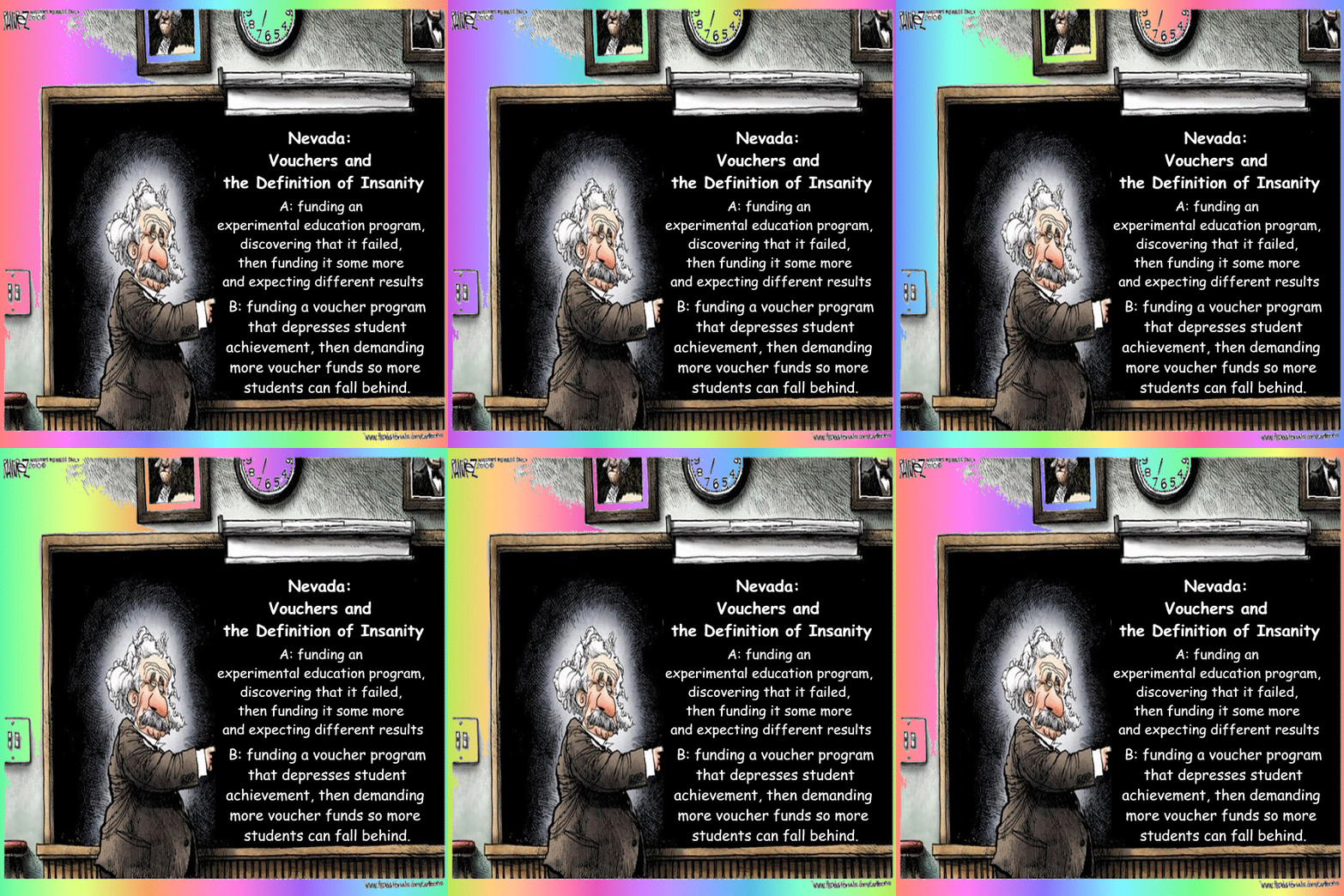
Nevada: Vouchers and the Definition of Insanity

The definition of insanity: funding an experimental education program, discovering that it failed, then funding it some more and expecting different results.
Another definition of insanity: funding a voucher program that depresses student achievement, then demanding more voucher funds so more students can fall behind.
Why fund failure?

Despite Poor Academic Results Groups Sue to Grow Private School Voucher Program

A few weeks ago a pro-school privatization organization, Institute for Justice, announced a lawsuit against the State of Nevada over the impact of AB 458 to private school vouchers recipients, scholarship granting organizations and businesses receiving tax incentives.
Though pro-voucher advocates are framing the suit as “saving vouchers,” in reality, the voucher program did not lose funding. The controversy over some students losing their scholarships is actually the result of a single scholarship granting organization interpreting a law passed this legislative session (AB 458) differently than all other scholarship organizations. Certain families who went through this organization for their voucher funds were the only ones whose funds were not renewed, leaving those students in limbo as the law’s purpose is clarified by the State.
To be clear, AB 458 did NOT cancel funding for the voucher program but only ended the requirement that funding for the controversial program grow by 10% each year. Given that growth in public education funding often struggles just  to keep up with inflation (approximately 2%), automatically growing a voucher program with scant accountability and poor results just doesn’t make sense.
Businesses are also suing on the claim that they would not be able to increase their contributions to vouchers because there is no increase in tax incentives. However ,they could choose to continue supporting private school tuition CONTINUE READING: Nevada: Vouchers and the Definition of Insanity | Diane Ravitch's blog


Take a walk with me | Cloaking Inequity

Take a walk with me | Cloaking Inequity

Take a walk with me 

It’s a great day to take a walk with me! Watch and get to know what’s ahead for deaning in a community-engaged, community-relevant fashion.
Please Facebook Like, Tweet, etc below and/or reblog to share this discussion with others.
Check out and follow my YouTube channel here.
Twitter: @ProfessorJVH
Click here for Vitae.
Take a walk with me | Cloaking Inequity


Aaron Wright: Caught in the Middle: Whatever Happened to the Individuals With Disabilities Act? NANCY BAILEY'S EDUCATION WEBSITE

Caught in the Middle: Whatever Happened to the Individuals With Disabilities Act?

Caught in the Middle: Whatever Happened to the Individuals With Disabilities Act?

No child wants to feel like a failure. No educator wants to feel like they have failed a child. Most children in special education are identified as having a specific learning disability or language impairment. Yet nationally only 67% of children with disabilities will graduate from high school and almost one and five will drop out.
In 1975 Gerald Ford signed into law what would become the Individuals with Disability Education Act (IDEA). Previously there was no guarantee that a child with disabilities would be provided an education, let alone be allowed into a public school. But even as Ford signed the legislation he lamented its shortcomings, “[T]he funding levels proposed in this bill will simply not be possible…” Those ripple effects continue to this day.
In 1990, the addition of the IDEA’s central principles of a Free Appropriate Public Education (FAPE), Appropriate Evaluation, Individualized Education Plan (IEP), Least Restrictive Environment, Parent Participation, and Procedural Safeguards granted the families of disabled children a formal and standardized means advocacy and redress.
Parents are driven to advocacy by instinct and science. A growing body of data has illuminated the dire consequences of a failed education. Up to 85 percent of youth in juvenile detention have disabilities that made them eligible for special education services, yet only 37 percent had received services while in school. Adding to CONTINUE READING: Caught in the Middle: Whatever Happened to the Individuals With Disabilities Act?