Latest News and Comment from Education

Thursday, March 7, 2019

Proposed amendments to the NYS charter law | Class Size Matters

Proposed amendments to the NYS charter law | Class Size Matters Proposed amendments to the NYS charter law | A clearinghouse for information on class size & the proven benefits of smaller classes

Proposed amendments to the NYS charter law


This fact sheet as a pdf is also available here.

 Enrollment and retention of high-needs students

  • Each year, charter schools and school districts shall report on their enrollment, suspension, and attrition rates of students overall as well as in the following high needs categories: students with disabilities, English language learners, and students who are eligible applicants for the free and reduced price lunch program.

  • Suspension rates, including out-of-school suspensions and in-school suspensions, should be reported and counted by frequency of suspensions as well as how many individual students are suspended each year.

  • Each year the State Education Department shall report on these rates for each charter schools as compared to the surrounding school districts, in NYC meaning the Community school district.

  • At least every two years, the NYC Comptroller should audit these figures for charter schools in NYC; and the State Comptroller should audit these figures for the charter schools outside the city.

Authorization:

  • Charter authorizers shall take these figures of enrollment, suspension and attrition rates, both overall and in the high needs categories into account for when charter schools apply for renewals or replication. If any charter school does not have rates within 5 percent rates in these categories compared to the surrounding district, their charter shall not be re-authorized or allowed to replicate. In NYC, the rates should be compared to the Community School District in which the charter school is located. Differential rates in any of these categories shall also be grounds for revoking a charter before renewal.

  • All charter school applications, renewals and replications must be approved by the local board of education in the district where the school is to be located before they are submitted to a chartering entity.

  • In NYC, charter applications, renewals and replications must be approved by the Community Education Council of the district in which the charter school is or will be located.

Disciplinary policies and practices

  • Charter schools shall be bound by all the requirements of compulsory education as set forth in  part one of  article Sixty-five of this chapter including but not limited to §3214 and its regulations. These shall also be  incorporated in their proposed charters, including policies on suspensions and expulsions, before being approved, renewed or replicated. Charter schools that refuse to do so should have their authorization revoked.

  • Charter schools shall also provide full-time alternative instruction for the time period that the student is suspended.

  • Charter schools shall also be required to post their disciplinary policies online, and make them available to parents at the beginning of the school year, along with contact information and description of how to file complaints and/or appeal suspensions

Transparency

  • The state comptroller shall have the authority to audit all charter schools in the state, and perform both financial and performance audits.

  • The city comptroller shall have the authority to audit all charter schools in NYC, and perform both financial and performance audits.

  • Open meetings law: The board meetings of charter schools, their networks, and their charter management organizations shall be subject to open meetings law and publicly post in a prominent place on their websites the time and location of meetings at least 72 hours in advance. They shall also retain a mailing list of those who request notification of their meetings, and send this information to them at least 72 hours in advance.

  • All charter schools and their boards shall also keep a public archive of all such announcements. Board meeting minutes shall be posted online and available upon request. Repeated non-compliance with Open Meetings law requirements shall be grounds for the denial of a charter school’s replication, renewal or revocation of its charter.

  • All NYC charter schools shall include in their authorization, replication and renewal requests what specific community school district they intend to locate within, and whether they will request co-located or private space. If approved, they shall locate in that district and not in another.

  • Testing oversight: All charter schools shall have to use same methods as used by the surrounding district to ensure blind scoring of the mandated state exams, including in NYC, cooperative grading sites  They shall also be subject to what other methods the state or district may use to ensure integrity of results, including independent monitors and erasure analysis.

  • All charter schools shall post their charters online, including their discipline policies, and make them available by request to parents free of charge within 5 days.

  • When charter schools close, an independent receiver should be appointed to perform financial audits so that taxpayer assets are protected and returned to the district.

Space, facilities and renovation funding

  • No new, existing or expanding charter school shall receive priority for space over a new, existing, or expanding public schools.

  • No charter school shall be provided space in an existing public school if this will currently or over the lifetime of the charter school at full grade levels put the building over 100% utilization.

  • No charter school shall be provided space in an existing public schools if this will preclude providing space now or in the future that could be used for reducing class size to the original C4E levels in the city’s class size reduction plan of no more than 20 students per class in grades K-3, 23 in grades 4-8 and 25 in high schools.

  • If charter schools in NYC or elsewhere are provided funding for private space, either leased directly by the school or provided with a per student subsidy for space, these funds shall be paid for by the state, with no obligation of the district to cover these costs.

  • Matching funds for renovations: Every dollar a co-located charter school spends on renovations or other capital expenses shall require the charter school to provide matching funds to the other schools in the building. These amounts shall be publicly reported each year by Dec. 31 by the charter school to the city and the state, and shall be available upon request by any individual or organization with 30 days of such request.

Parent voice


  • Within three years, all charter school boards shall be composed of half parents, elected directly by the parents at their schools.

  • Each charter school shall outline a clear, simple process for parents to file complaints and appeals on its website, including how they can send them via email, with a schedule of deadlines to ensure timely responses by the charter school, the board, and the authorizer.

  • Each charter school authorizer shall appoint an ombudsperson whose responsibilities will be to support and advise parents who have specific issues and complaints, to investigate and resolve these complaints. These ombudsperson shall also regularly report to their boards, whether it be the Board of Regents and/or SUNY, as to the number of complaints received, the type of complaint, and if and how they were resolved.

Proposed amendments to the NYS charter law | Class Size Matters Proposed amendments to the NYS charter law | A clearinghouse for information on class size & the proven benefits of smaller classes

Wednesday, March 6, 2019

“I Was Just Following Orders” | The Merrow Report

“I Was Just Following Orders” | The Merrow Report

“I Was Just Following Orders”


Three questions: Who makes the rules for classroom behavior?  How much should 5-, 6-, 7-, and 8-year-olds get to decide, or should the teacher just lay down the rules? And does it make any difference in the long run?
In my 41 years of reporting, I must have visited thousands of elementary school classrooms, and I would be willing to bet that virtually every one of them displayed–usually near the door–a poster listing the rules for student behavior.
Often the posters were store-bought, glossy and laminated, and perhaps distributed by the school district.  No editing possible, and no thought required. Just follow orders!  Here’s an example: CONTINUE READING: “I Was Just Following Orders” | The Merrow Report


Why Does Oklahoma Lead the World in Incarceration? - Living in Dialogue

Why Does Oklahoma Lead the World in Incarceration? - Living in Dialogue

Why Does Oklahoma Lead the World in Incarceration? 

Image result for Why Does Oklahoma Lead the World in Incarceration?
By John Thompson.
Former President Barack Obama recently recommended his short 2019 Black History Month reading list: It included classics by and about James Baldwin, Martin Luther King, and Frederick Douglass; and Bryan Stevenson’s Just Mercy: A Story of Justice and Redemption.  The overflow crowd at Oklahoma Christian University’s Complex Dialogues with Bryan Stevenson would wholeheartedly agree with the recommendation. The bipartisan crowd left in awe, wrestling both with the reasons why Oklahoma is #1 in the world in locking up our fellow citizens, and what that says about us.
This first post will focus on what Stevenson said on February 18 at Oklahoma Christian University about our criminal justice system. A second post will discuss the role of the forum’s local advocates, liberals and conservatives from secular and religious backgrounds, who are committed to undoing the damage of mass incarceration.
Oklahoma and America have always had plenty of problems, with poverty being the origin of many of the most intransigent ones. Moreover, as late as 2010, the incarceration rate for black Oklahomans was nearly five times higher than for white Oklahomans. But Stevenson notes, “The opposite of poverty isn’t wealth. The opposite of poverty is justice.” And he warns us, “Until we reckon with the trauma our society has caused to people of color and people in poverty, we cannot embrace the truth and heal.”
Our state and nation have long had a political and economic system which proves the maxim that “power corrupts” and our district attorney system shows how “absolute power corrupts absolutely.” Across the U.S., Stevenson said, “We have a system of justice that treats you much better if you’re rich and guilty than if you’re poor and innocent.” And the prison pipeline vividly illustrates the truth that, “Wealth, not culpability, shapes outcomes.”
Years of litigation and research have taught Stevenson that “the closer we get to mass incarceration and extreme levels of punishment, the more I believe it’s necessary to recognize that we all need mercy, we all need justice, and – perhaps – we all need some measure of unmerited grace.”
It is hard for this Oklahoman to acknowledge that we are a case study of how “fear and anger can make us vindictive and abusive, unjust and unfair, until we all suffer from the absence of mercy and we condemn CONTINUE READING: Why Does Oklahoma Lead the World in Incarceration? - Living in Dialogue

The Voters Have Spoken. Is the LAUSD Listening? – Carl J. Petersen – Medium

The Voters Have Spoken. Is the LAUSD Listening? – Carl J. Petersen – Medium

The Voters Have Spoken. Is the LAUSD Listening?

I believe there should be an election. I’ve been consistent for 12 years.
- LAUSD Board Member Dr. Richard Vladovic
 
Jackie Goldberg faces the felon she seeks to succeed

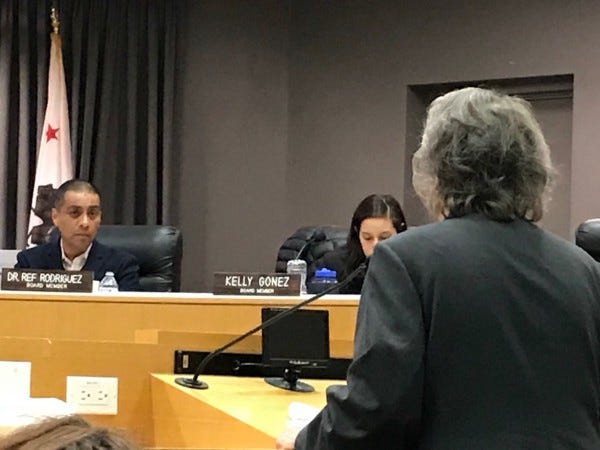
The students in the Los Angeles Unified School District’s (LAUSD) Board District 5 have been unrepresented since Ref Rodriguez was forced from office on July 23, 2018. Considering the fact that the charter school founder pleaded guilty to crimes related to his election, these constituents have not been represented fairly since the day he took office. Board Member Scott Schmerelson offered a resolution that would have given them representation by appointing Jackie Goldberg to the seat until an election could be held. However, after a meeting poisoned by bigotry, the Charter Industry supported Board Members sided with Dr. Vladovic to leave one-seventh of the District’s stakeholders unrepresented.
While Goldberg had promised not to run in the special election if she had been appointed at the August Board Meeting, the Board’s “No” vote meant she was free to declare her candidacy. In the primary that was held yesterday, the former LAUSD Board Member, LA City Councilperson and State Assemblymember won 48.26%of the vote in preliminary results. Her closest competitor, Graciela “Grace” Ortiz, was far behind with a vote totaling 13.3%. Since no candidate took over 50% of the vote, a run-off will have to be held on May 14. The students of Board District 5 should not have to wait that long to be represented.


In order to win in May, Ortiz would have to secure the near-unanimous support of those who voted for all of the other candidates in order to win. This unlikely scenario is made even more improbable by the fact that Rocio Rivas released a statement before the election urging her supporters to vote for Goldberg. With the two opponents coming from different sides of the CONTINUE READING: The Voters Have Spoken. Is the LAUSD Listening? – Carl J. Petersen – Medium


California law requires charter schools to end secrecy about how they operate - The Washington Post

California law requires charter schools to end secrecy about how they operate - The Washington Post

California law requires charter schools to end secrecy about how they operate


California Gov. Gavin Newsom (D) did something on Tuesday that his Democratic predecessor, Jerry Brown, had refused to do: sign into law a bill that requires charter schools, which are publicly funded but privately operated, to be as transparent to the public about how they operate as are traditional public school districts.
The change has long been sought by critics of the charter school movement in California, which has more charter schools and charter school students than any other state. California has allowed charters to expand with little oversight amid growing controversy over financial scandals and other issues.
The law follows a nonbinding December opinion by California Attorney General Xavier Becerra, who said charter school governing boards should be required to comply with the same transparency laws as public school districts.

The move marks a shift in the state government’s attitude about charter schools — and more change may be coming. Last week, Assemblyman Patrick O’Donnell (D), chairman of the Education Committee in the Assembly, along with some colleagues, introduced legislation that would significantly restrict the growth of charter schools in the state in several important ways. There are more than 1,300 charters in California.
While it is not clear what will happen with the four new bills — Newsom has not taken a position — a charter moratorium has new support in unlikely places.
The Los Angeles Board of Education passed a resolution urging the legislature to place a moratorium on new charters in the Los Angeles Unified School District as one concession to end a teachers’ strike in the largest school district in California. That was a big shift for the pro-charter board. The same thing just happened in Oakland, where a pro-charter school board agreed to support a halt on new charters to end a teachers’ strike CONTINUE READING: California law requires charter schools to end secrecy about how they operate - The Washington Post

Denver Rising: A Loving School System agenda aims to reverse racial inequity | Schott Foundation for Public Education

Denver Rising: A Loving School System agenda aims to reverse racial inequity | Schott Foundation for Public Education

Denver Rising: A Loving School System agenda aims to reverse racial inequity

This weekend, Our Voices Our Schools coalition is gathering a group of community practitioners and activists to come together at Denver University and align around a comprehensive agenda for education justice in Denver. The goal of the event: to move from talk to action by creating a comprehensive Loving School System agenda that highlights the systemic changes and investments needed to truly provide Black children in Denver their right to free, high-quality public education.
Many working in the education field in Denver acknowledge that there has been a great deal of talk about racial equity in Denver over the past several years, but not a lot of action and public investment. The facts are indisputable: even after years of “improvement plans” to address inequitable academic outcomes, Black students in Denver do not have the same opportunity to succeed on state math and literacy tests and graduate on time, and they are being suspended at higher rates than their White peers.
The Bailey Report produced by former school board member Sharon Bailey nearly three years ago highlighted the cultural racism experienced by Black teachers and students in Denver Public Schools. The report led to the formation of a task force that proposed 11 recommendations for ways to improve culture and conditions, including offering signing bonuses to help attract more black teachers, making student discipline data count toward school ratings, and requiring each school to create a plan “designed to strengthen relationships between African-Americans and schools.” While school board and Denver Public School district officials continue to create space to talk about racial equity, little has been done to implement these recommendations or make other investments in schools serving predominantly Black populations.
Beyond the cultural and inter-personal racism that the Bailey Report highlights, other recent reports put data points to the broader structural racism and inequity in public school systems across Colorado and the nation.
According to an edbuild report23 billion less public dollars go to nonwhite schools districts compared to districts serving predominantly White students. In Colorado, predominantly White school districts, whether they are serving low-poverty or high-poverty populations, have on average 16% more funding than nonwhite districts. This is because White school districts tend to close themselves off, and draw lines around them in ways that keep them very small and very wealthy, and in a way that closes wealth off from communities of color.
The Loving School Systems agenda that will begin to take shape through this convening will include a focus on inequity in public and private funding and strategies to “decolonize wealth”, with Edgar Villanueva from the Schott Foundation speaking to the group about strategies to address the massive gaps in funding for education justice work. The convening will be grounded in the Loving Cities Index framework created by the Schott Foundation to highlight how inequitable access to resources and supports across education, workforce development, health, housing, and other related sectors impact education justice and as a result student academic success. The convening will be capped off with a community gathering in the evening, to learn about "Decolonizing Wealth" and screen and discuss the documentary Backpack Full of Cash
The Loving School Systems convening will lift up public education justice and the fight for a high-quality public education as the human rights and civil rights issue of our time. This will be a chance for practitioners to align around the systems changes, policies, and programs that are needed and the resources that must be mobilized for the survival of poor Black, Brown, marginalized White communities by meeting the promise of high-quality public education for all.
Big Education Ape: Local Leaders Play Critical Role to Drive U.S. Toward More Loving and Just Society | Schott Foundation for Public Education - http://bigeducationape.blogspot.com/2019/03/local-leaders-play-critical-role-to.html

CURMUDGUCATION: Teacher Merit Pay Is A Bad Idea

CURMUDGUCATION: Teacher Merit Pay Is A Bad Idea

Teacher Merit Pay Is A Bad Idea

Florida's governor is planning to boost the state bonus program for teachers, even as Denver teachers walked off the job over their district's version of an incentive program. So it's worth taking a moment to step back and remember why teacher merit pay and bonus systems are just a bad idea.
First, they can't work like a private sector bonus system. In the business world, bonuses and incentives are based on a clear idea of success. Whether the definition of success at Widgetcorps this year is "We made a bunch more money" or "We increased the value of Widgetcorps stock this year" or even "We managed to strip a pile of dollars out of Widgetcorps this year," the end result is a pile of "extra" money (the end result, depending on the definition of success, may be a less healthy company, but let's set that aside for now). The bonus deal between Widgetcorps and its bonus-eligible employees is simple--if there's a pile of extra money here at the end of the year, you get to have some of it.
Public schools, on the other hand, don't make money, and school district success is hugely hard to define. More high school graduates? The football team won a championship? The school musical was really good this year? More students really got into Shakespeare? Larger number of students earned welding certification? The school's culture and atmosphere was so healthy that students really love attending? All of these might count as success, but none of them result in a school district ending the year with "extra" money to be split up for bonuses.
Instead, the pile of bonus money has to be pre-budgeted, and then teachers get to compete with each other for a share of a fixed pie. This may not establish the kind of in-house atmosphere you want for your school ("No, colleague, you may not see my materials for how I teach fractions--my CONTINUE READING: CURMUDGUCATION: Teacher Merit Pay Is A Bad Idea

Jackie Goldberg Wins School Board Election, Again ~ Will Face Runoff ~ L.A. TACO

Jackie Goldberg Wins School Board Election, Again ~ Will Face Runoff ~ L.A. TACO

JACKIE GOLDBERG WINS SCHOOL BOARD ELECTION, AGAIN ~ WILL FACE RUNOFF


With 100 percent of of precincts reporting, Jackie Goldberg was the big winner of Tuesday’s special election to represent L.A. Unified’s 5th District on the Board of Education.
With 48.26 percent of the votes, she fell less than two percent shy of the threshold to avoid a runoff in May with the second place finisher. That appears to be Graciela “Grace” Ortiz (13.3 percent) who is narrowly ahead of Heather Repenning (13.09 percent).
That election is scheduled for May 14. Goldberg’s showing in Tuesday’s elections puts her on the path for her second tenure as a member of the school board.


Goldberg is a former teacher, L.A.City Council member, and California State Representative. She was an LAUSD member and president in the 1980s, when she spearheaded district wide bilingual education initiatives. Goldberg has been a powerful force in local left and progressive politics, especially in the northeastern part of the city, where half of LAUSD’s 5th district lies.
Goldberg is a champion of afterschool programs, authoring state bonds to increase funding for public education, and striking a tone of undaunting support for public education and the UTLA teachers union. She has also signaled a flexibility to work with both local charter school administrators and LAUSD superintendent Austin Beutner.  She racked up support from State Superintendent of Public Instruction Tony Thurmond, Dolores Huerta from the United Farm Workers, the local chapter of the Democratic Socialists of America, and United Teachers Los Angeles.
“Our local charter school administrators, they do believe they are doing a good job, my problem isn’t with them.” Goldberg told L.A. Taco, “The problem is legislation in Sacramento that means that charter and public schools can’t co-exist. The system unintentionally economically undermines schools with parents who keep kids in public schools” by tying public dollars to enrollment, meaning policy at the state level takes money out of public schools when parents enroll their kids in charter schools.  
Goldberg reiterated to L.A. Taco that she didn’t want to close charters. She does want them to be more regulated by the district and the state. She also wants charter schools to submit budgets to the district, a stop to co-location of charter schools inside of LAUSD buildings, and a moratorium on the building of new charter schools until a district wide study is done to assess their impact on public education in the city. CONTINUE READING: Jackie Goldberg Wins School Board Election, Again ~ Will Face Runoff ~ L.A. TACO

Let’s Stop Ignoring the Truths of Puberty. We’re Making It Even More Awkward. - The New York Times

Let’s Stop Ignoring the Truths of Puberty. We’re Making It Even More Awkward. - The New York Times

Let’s Stop Ignoring the Truths of Puberty. We’re Making It Even More Awkward.
Sex education in U.S. schools is lacking, but new efforts to broaden its scope are bubbling up.


It’s Women’s History Month! You’re reading In Her Words, where women rule the headlines. Sign up here to get it delivered to your inbox. Let me know what you think at dearmaya@nytimes.com.

“I’d rather they just don’t teach anything if they can’t be honest.”
— Susan Lontine, a Colorado state representative who introduced a bill that would mandate teachings about safe sex, consent and sexual orientation in the state’s public schools

By the time I was 15, most of my knowledge about puberty was gleaned from one-dimensional tales on TV and in movies. I learned what it meant when a pubescent boy carried a book in front of his body (cue laugh track) and that when girls develop breasts, boys (and men) “can’t help but” ogle them. That’s about it.
In the last year or so, TV and film have made strides in representing pubescent girls as complex and awkward beings who also happen to be sex-obsessed (a trait normally reserved for adolescent boys), my colleague Amanda Hess pointed out in a recent piece about the shows “PEN15” and “Big Mouth” and the movie “Eighth Grade.”


“The lustful adolescent girl is having her moment,” wrote Hess, a Times culture critic. “It is not, to be clear, an altogether glorious time,” she said, adding that “girls’ feelings matter, too. And these girls feel so much.”
Such nuances and acknowledgments of female sexuality are largely missing from sex education in U.S. schools, where curriculum is lacking over all.
The majority of states don’t mandate sex ed at all, and just 13 require that the material be medically accurate. Abstinence education remainsa pillar of most programs. And that is saying nothing of more complex issues like consent, sexual orientation and gender identity. (In seven states, laws prohibit educators from portraying same-sex relationships positively.)
Simultaneously, the influence of pornography is growing. “Easy-to-access online porn fills the vacuum, making porn the de facto sex CONTINUE READING: Let’s Stop Ignoring the Truths of Puberty. We’re Making It Even More Awkward. - The New York Times

Stand for Children and the Democratic Party regulars. Some history. – Fred Klonsky

Stand for Children and the Democratic Party regulars. Some history. – Fred Klonsky

Stand for Children and the Democratic Party regulars. Some history.


Stand for Children would oppose a puppy if the puppy was supported by the Chicago Teachers Union.
Since Stand for Children first came to Illinois it has had a close relationship with the leaders of the Democratic Party.
A poll showing Lori Lightfoot with an overwhelming lead over Toni Preckwinkle has put Stand for Children back in the news. SFC paid for the poll.
TeamToni has trashed the poll results because of what it shows, convinced that it is irrefutable evidence that Stand for Children, a viciously anti-teachers union group, backs Lightfoot.
However, Lightfoot is running a pro-union, pro-public education, anti-charter  campaign.
There is nothing to suggest that Stand for Children has anything to do with Lightfoot’s campaign or has anything in common with Lightfoot when it comes to education policy.
There is plenty to suggest that Stand For Children is trying to stir things up because the Chicago Teachers Union decided early on to back Toni Preckwinkle, current Cook County Board President and Chair of the Cook County Democratic Party.
Stand for Children hates the Chicago Teachers Union.
SFC has had a long friendly relationship with the state and Cook County Democratic Party that Preckwinkle heads. It has thrown tons of money at key members of CONTINUE READING: Stand for Children and the Democratic Party regulars. Some history. – Fred Klonsky

Louisiana Educator: A National Study Confirms Our Worst Fears About Our School Standards and Tests

Louisiana Educator: A National Study Confirms Our Worst Fears About Our School Standards and Tests

A National Study Confirms Our Worst Fears About Our School Standards and Tests

In my opinion, the Common Core based tests such as the Louisiana LEAP tests and our high school end of course tests (EOC) are just not valid for any purpose, and I now have data to back that up. Right now the LEAP and EOC test are used for measuring the achievement levels of our students, the effectiveness of our teachers and the ratings of our schools. The evidence is building that our tests are not good for any of those purposes.

My most recent post on this blog describes how the State Department of Education has lowered the standard for passing LEAP and EOC to appallingly low levels. This was done primarily to show false progress in improving student achievement in ELA and math. My post showed that this so called progress is contradicted by the NAEP tests. But it was also done because the tests are much too difficult for our students. Now a study just released by NEPE (The National Education Policy Center) provides more than adequate cause why these tests should be trashed before they do more damage.

The NEPE study titled "A Consumer’s Guide to Testing under the Every Student Succeeds Act (ESSA): What Can the Common Core and Other ESSA Assessments Tell Us?" is a long technical report that would be extremely difficult for any lay person to comprehend. In addition, it was obviously written in such a way as to avoid offending the powers that keep our school systems chained to the Common Core standards. But buried in the report are some shocking findings, if you look hard enough to find them.

The most shocking finding of the NEPE report is not to be found in the summary of the findings even though it should have been included as one of the most significant concerns. This finding is about the validity of the PARCC tests upon which at least 90% of our Louisiana tests are based and it is just casually mentioned on page 44 of the 60 page report. It reads as follows:


2. Currently, PARCC’s Items are Prohibitively Difficult
Item analysis results from the first operational testing of PARCC  CONTINUE READING: 
Louisiana Educator: A National Study Confirms Our Worst Fears About Our School Standards and Tests

Education Research Report: Trends in Education Philanthropy

Education Research Report: Trends in Education Philanthropy

Trends in Education Philanthropy


Grantmakers for Education’s Trendsin Education Philanthropy: Benchmarking 2018-19 report offers insights on the current and evolving priorities of the education funding community. It can help funders to understand their role in supporting education innovation and identify future priorities that hold the greatest promise for benefiting America’s learners.

This latest report in Grantmakers for Education’s series of benchmarking studies identifies what’s now and what’s next for education philanthropy. Findings are drawn from the survey responses of Grantmakers for Education members and other education funders and presented in the context of the 10-year anniversary of the bench-marking report.

Big Picture: Trends in Education Philanthropy

This new benchmarking study comes at a time of seemingly rapid evolution in the priorities of education funders. Three trends stand out based on the speed with which they have come to the fore, their crosscutting focus and the scale of their current or potential impact on education philanthropy. Based on survey responses:

•Education funders have markedly increased their focus on the learning stages before and after K-12 education.While elementary and secondary education has long dominated U.S. education funding priorities and continues to do so, some of the largest gains in shares of funders and biggest anticipated increases in support reported by respondents were for early learning, postsecondary education and preparation for career and workforce. Among factors driving the growth for early learning are a growing understanding of the critical importance of preparing young learners for success prior to beginning kindergarten, as well as increased public interest and investment in early learning. For postsec- ondary education and workforce and career readiness, a central factor has been a belief in the critical importance of postsecondary education in preparing learners for a rapidly changing labor market.
•Education funders have ramped up support for strategies embracing the whole learner, while moving away from the academic areas of focus that characterized the prior decade of education reform.A growing body of research on the impact of social and emotional intelligence and family and community supports on learners’ academic and life success has fueled funder interest in advancing strategies that support learners’ holistic development. Respondents cited social and emotional learning as the factor or trend they think has the greatest potential for a positive impact on education over the next five years.
•Education funders have lost confidence in federal government leadership on and funding for education reform. Survey findings suggest that many funders have stepped away from direct engagement in the large-scale, academic-focused, national efforts to reform the education system and have migrated back to focusing on local communities. In fact, when asked to identify the factors they think will have the greatest potential negative impact on education in coming years, the single largest share of respondents cited current federal education leadership.

Education Research Report: Trends in Education Philanthropy


Ohio Charter Schools Ruin District Finances: Steal State and Local Taxes, Leave Behind Stranded Costs | janresseger

Ohio Charter Schools Ruin District Finances: Steal State and Local Taxes, Leave Behind Stranded Costs | janresseger

Ohio Charter Schools Ruin District Finances: Steal State and Local Taxes, Leave Behind Stranded Costs


When we evaluate charter schools, I wonder why we rarely consider their fiscal impact on the public schools among which they are nested? I have never heard anybody in Ohio consider the overall impact of charter school expansion on access to education for the entire population of students across a particular community or across the state. Today in Ohio, people are talking about the value of charter schools because charter operators and sponsors—claiming the schools are broke—are asking for an extra $2,000 per pupil.
Usually arguments about the quality of public investment in charters are about whether charters do a good job as measured by test scores.  Proponents of charter schools typically want the public to evaluate charter schools and traditional public schools by comparing their test scores—despite considerable research over the years demonstrating that the results are, at best, relatively comparable.  Steve Dyer uses the test score yardstick in a recent blog post: “Not only have Ohio charter schools not gotten appreciably better on the report card since… 2015, but since the 2012-2013 school year, charter schools overall have received more Fs than all other grades combined on state report cards.” Dyer doesn’t think these schools are performing well enough to deserve additional tax support.
Then there are the arguments about about whether charters mismanage the tax dollars they receive.  In a recent article about Ohio charter schools, three prominent professors of education policy and law examine self-dealing by charter management companies which lease buildings owned by the very same companies back to the Ohio charter schools they are hired to manage—at exorbitant, above-market rents.  The authors of this critique report that, “just a few weeks ago, the National Alliance for Charter Schools was back in Ohio asking the state to increase funding for charter school facilities.”
Here is an example—this time from Sunday’s Cleveland Plain Dealer—of how reporting on charter school accountability and funding often goes.   As he describes the request for more money from the legislature, reporter Patrick O’Donnell considers the academic record of Ohio  CONTINUE READING: Ohio Charter Schools Ruin District Finances: Steal State and Local Taxes, Leave Behind Stranded Costs | janresseger