Latest News and Comment from Education

Friday, March 1, 2019

Guess which state spends the most public funds on private and religious school education. (Hint: Betsy DeVos has a house there.) - The Washington Post

Guess which state spends the most public funds on private and religious school education. (Hint: Betsy DeVos has a house there.) - The Washington Post

Guess which state spends the most public funds on private and religious school education. (Hint: Betsy DeVos has a house there.)


Education Secretary Betsy DeVos just announced she is backing Senate legislation that would create the first federally funded school tax credit, so it seems like a good time to see which states spend public money to send kids to private and religious schools — and how much.
To be clear, the new legislation has virtually no chance of passing Congress; Democrats now control the House and most of them wouldn’t support it. A similar idea couldn’t muster enough enthusiasm a few years ago when Republicans controlled the House and the Senate.
And it is worth noting that DeVos opposes federal involvement in education — she once said “government sucks” — and she believes that choice programs, like all education, are best at the state and local level. She couldn’t, of course, oppose a federal choice program. But she isn’t likely to appreciate federal restrictions that would necessarily be attached to the money.
Tax credits are just one of the programs that fall under the branch of the “school choice” movement that seeks to use public money to send children to private and religious schools — even when those schools can legally discriminate against LBGTQ students and other groups of students. There are, however, differences in how the programs work throughout the country, structured according to the laws of each state.
The issue is central to the national education debate. Supporters say families should have options for their children. Opponents say it is unconstitutional to use public funds for religious education and that these programs drain resources from public school districts that educate most of America’s children. The Supreme Court is expected to soon get a case that addresses the constitutionality of voucher programs.
Under tax credit scholarship programs, donors take tax deductions for contributions they make to a state-sanctioned entity that distributes those contributions to qualified students who then use the money for private and religious schools.
There are, according to the pro-choice nonprofit group EdChoice, 23 tax-credit scholarship programs in 18 states: Alabama, Arizona (4), Florida (2), Georgia, Illinois, Indiana, Iowa, Kansas, Louisiana, Montana, New Hampshire, Nevada, Oklahoma, Pennsylvania (2), Rhode Island, South Carolina, South Dakota and Virginia.
EdChoice is an Indiana-based nonprofit with a mission to privatize the public education system through a universal voucher system. (You can learn about its philosophy in this 1995 op-ed written for The Washington Post by Milton Friedman, who funded the predecessor organization that is now EdChoice. The headline: “Public Schools: Make Them Private.”) CONTINUE READING: Guess which state spends the most public funds on private and religious school education. (Hint: Betsy DeVos has a house there.) - The Washington Post


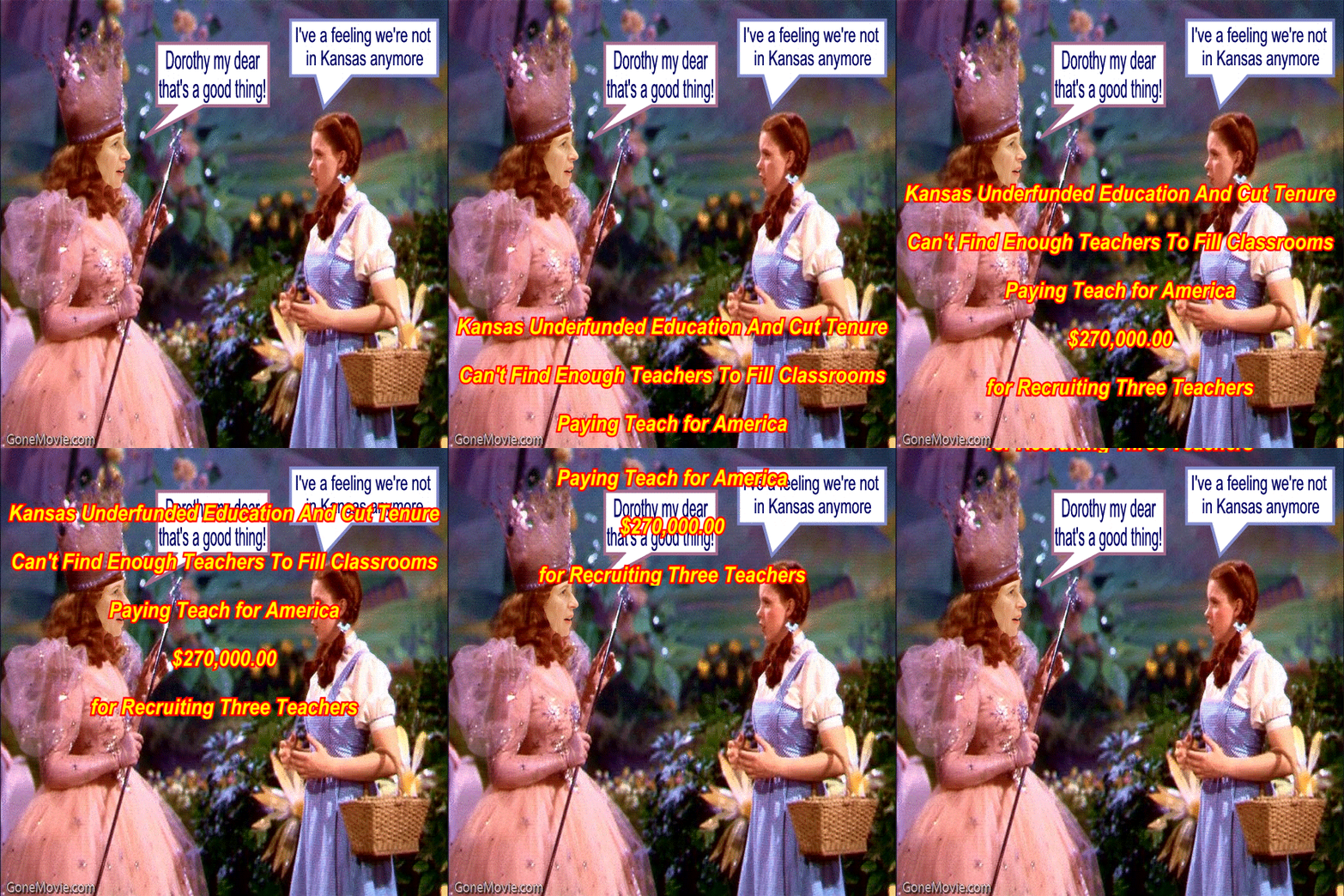
Louisiana’s Teach for America Contracts: Not As Lucrative as They Used to Be, But Still There. | deutsch29

Louisiana’s Teach for America Contracts: Not As Lucrative as They Used to Be, But Still There. | deutsch29

Louisiana’s Teach for America Contracts: Not As Lucrative as They Used to Be, But Still There.


On February 22, 2019, I submitted a public records request for “all contracts between the Louisiana Department of Education (LDOE) and Teach for America (TFA) from 2016 to date.”
The result yielded four contracts between LDOE and TFA:
The objectives of these continuously-issued TFA contracts includes “sustaining a TFA presence across Louisiana.” From the 2015-16 contract:
Objectives:
  1. To place approximately 380 Teach for America corps members in high needs public schools serving low-income populations in Southen Louisiana and the Louisiana Delta, within the following Parishes: Ascension, Avoyelles, Concordia, East Baton Rouge, East Carroll, East Feliciana, Iberville, Jefferson, Madison, Orleans, Pointe Coupee, St. Bernard, St. Helena, and Tensas.
  2. To support these corps members, through ongoing professional development and support, to achieve ambitious and measurable results with students.
  3. To work with the Louisiana Department of Education to sustain Teach for America’s teacher and alumni presence across Louisiana.
In 2016-17, the same 14 parishes were listed, but the number of TFA recruits dropped to 285. However, in both 2015-16 and 2016-17, the contract amount CONTINUE READING: Louisiana’s Teach for America Contracts: Not As Lucrative as They Used to Be, But Still There. | deutsch29


NYC Public School Parents: The reality vs the hype of Teach to One

NYC Public School Parents: The reality vs the hype of Teach to One

The reality vs the hype of Teach to One


On February 28, Digital Learning day.
Last week, two different studies came out about the results of the well-known blended learning program originally called “School of One” and now called “Teach to One”, created and sold to schools by an organization named New Classrooms.  If you want to cut to the chase, you can read about the contrasting analyses in Education WeekChalkbeat or the Hechinger Report.  If you want to know about the history of this much-hyped program that was first developed for use in NYC public schools and uses software programs and algorithms to deliver instruction, read on here. It provides lessons in how insistent the promoters of online learning have hyped programs with little or no evidence behind them, how negative evaluations have been suppressed or discounted and how conflicts of interest have been ignored – all in the service of convincing schools to adopt these programs far and wide.

According to his Linked-in profile, Joel Rose was a Teach for America corps member for three years, until he was hired to work at the headquarters of Edison charter schools in New York City, a national for-profit chain of charters headquartered in NYC.  By 2003, he was running a division of Edison called Newton Learning that provided tutoring to students through the supplementary services program (SES) that was included in No Child Left Behind.  NCLB required public schools with low test scores to pay for their students to receive tutoring services from private companies.  In 2003 alone, Newton Learning was paid more than $5 million by the NYC Department of Education for its tutoring services. 
According to NCLB, parents of students at these schools were supposed to be provided with the choice of tutoring companies. Yet in 2005, the NY Post found that in some NYC schools, principals and parent coordinators were incentivized to recruit students for Newton.  In one Bronx school, as a result, the school distributed flyers to parents saying “Newton Learning is your best SES choice. The Newton Learning Adventure offers FUN and EXCITING activity-based lessons.”  Some parents were told by their schools that the only choice was for them to enroll their children in Newton Learning, or they would receive no tutoring at all.

In March 2006, the NYC  Special Investigator of Schools Richard Condon released a report, revealing how several SES providers, including Newton Learning, had engaged in a number of “questionable business practices” in their dealings with DOE officials, parents and students.  These companies had been involved in the “misappropriation and misuse of confidential student information and the offering of self- serving incentive programs”, and Newton staff had been improperly allowed entry into schools to directly solicit students.  In one case, a principal permitted Newton reps to perform skits in front of students during class time to promote their services. 

Newton staff had also improperly obtained student contact information from school staff and had offered financial incentives to principals and teachers if their students signed up.  They had promised gifts to students in exchange for enrolling, including CD players and $100 gift cards.  This sort of chicanery continued even after DOE told Newton to stop these practices, according to Condon’s report. Newton also had failed to carry out required fingerprinting and background checks for the staff they hired as tutors.

According to the DOE rules, Newton and other tutoring companies could use classroom space in the public schools free of charge, if granted a “permit” by the school’s principal.  Yet in return, any company was also supposed to give students a 9% reduction in fees.  Yet every company which had asked for a waiver from this discount was granted one by David Ross, the head of DOE’s Division of Contracts and Services. (Remember that name, David Ross; it will come up later.) Here’s an article  in the NY Times, with more about the special investigator’s findings. 

Condon’s report and news articles about his findings were apparently ignored by DOE, as shown by the fact that a few months later, in December 2006, Joel Klein hired Chris Cerf, to be his Deputy CONTINUE READING: NYC Public School Parents: The reality vs the hype of Teach to One

Big Education Ape: CA schools freed from costly after-school tutoring mandate | 89.3 KPCC - https://bigeducationape.blogspot.com/2016/02/ca-schools-freed-from-costly-after.html

Big Education Ape: Feds: New $1.3M tutoring scam uncovered at Detroit schools - https://bigeducationape.blogspot.com/2016/05/feds-new-13m-tutoring-scam-uncovered-at.html

Big Education Ape: Where is Education Secretary Duncan’s Head? - https://bigeducationape.blogspot.com/2014/04/where-is-education-secretary-duncans.html

Thursday, February 28, 2019

Are Your Students Watching History? | Teacher in a strange land

Are Your Students Watching History? | Teacher in a strange land

Are Your Students Watching History?


One of the more intriguing aspects of Wednesday’s fascinating, glued-to-the-tube Congressional train wreck was the backchannel Twitter conversation among teachers. Specifically: How do we talk to our students about this? Are we watching this with our seniors in government class? It’s history in the making, all right. How do teachers deal?
If you’ve taught as long as I have, you (and your students) have witnessed several crises happening in the world, including politically and socially sensitive events. Anyone who thinks that a teacher can avoid talking about a public tragedy, a politically contentious election outcome or the death of an iconic American is a fool. School is where kids collect, every day. School is where they talk about stuff. Adults can’t and shouldn’t suppress this, but they can provide context.
Even small children talk about big events, often confusing fact and fiction. When Pope John Paul died, in 2005, I was teaching younger children. The funeral took up a lot of time on mainstream TV, and my littles talked about it endlessly. I eventually figured out that some of them didn’t know who the Pope was, why he was important. A couple of my students thought he was ‘old fashioned Santa Claus’ (St. Nicholas) because of his red robes and tall hat. They were bereft.
That’s kind of sweet and chuckle-y. But the morning Kurt Cobain died, there was genuine grief among some of my 8th graders. A mixture of emotions, in fact—confusion, fear, horror and faux detachment. The wanted to present as chill and aloof, but the idea of someone so tuned into their self-image taking his own life was CONTINUE READING: Are Your Students Watching History? | Teacher in a strange land

I Used to be a Reporter. Now I’m a Teacher. I’ve Become What I Used to Observe | gadflyonthewallblog

I Used to be a Reporter. Now I’m a Teacher. I’ve Become What I Used to Observe | gadflyonthewallblog

I Used to be a Reporter. Now I’m a Teacher. I’ve Become What I Used to Observe

A long time ago, in a newsroom far, far away; your humble narrator was a respected journalist.
Today I am a beloved school teacher in a suburban middle school.
Okay. That may be laying it on a bit thick.
Like any human being whose job it is to get children to do their best and learn something, I’m beloved by some and beloathed by others. And if I’m honest, when I was a reporter, I was never all that respected. But I did win several state journalism awards.
The point I’m trying to make is that like a caterpillar into a butterfly or a tadpole into a frog, I made a startling transformation in career paths that flies somewhat in the face of popular wisdom.
F. Scott Fitzgerald wrote, “There are no second acts in American Lives.” Well, I’m on my third or fourth act and nowhere near ready for the curtain to come down yet.
It’s shocking how far I’ve come, though there’s a surprising amount of overlap between my two professions. In fact, the biggest difference is one of orientation.
I used to get up at 4 a.m., weave into the newsroom and type away for a few hours about the previous night’s school board or city council meeting before my deadline came down, the presses rolled and the morning edition went on sale.
Now I get up at 5 a.m., hobble into the classroom and go to meetings, grade papers or otherwise get ready for a 7-hour invasion by 12- and 13-year-olds, followed by more meetings and papers and planning.
I used to go into the classroom to interview teachers and students about special lessons, state and federal programs or standardized tests.
Now I’m in the classroom questioning myself about my students and what works best to help them learn, trying to navigate the state and federal programs so they get the CONTINUE READING: I Used to be a Reporter. Now I’m a Teacher. I’ve Become What I Used to Observe | gadflyonthewallblog

Newsom fast-tracks legislation to hold charter schools to same standards as public schools - Los Angeles Times

Newsom fast-tracks legislation to hold charter schools to same standards as public schools - Los Angeles Times

Newsom fast-tracks legislation to hold charter schools to same standards as public schools
BREAKING NEWS! SB 126 has passed both houses of the legislature and is now headed to Governor Newsom’s desk! Thank you to all our supporters for your phone calls and advocacy to bring accountability & transparency to charter schools.
A proposal championed by Gov. Gavin Newsom to require new transparency standards for charter schools across California was passed by state legislators Thursday, an effort that would align the campuses with guidelines followed by traditional public schools.
The legislation marks a symbolic shift in the long proxy war between teachers unions and charter-school backers over education policy, after back-to-back election cycles in which the two sides spent tens of millions of dollars on rival candidates in California’s top statewide races.
A proposal championed by Gov. Gavin Newsom to require new transparency standards for charter schools across California was passed by state legislators Thursday, an effort that would align the campuses with guidelines followed by traditional public schools.
The legislation marks a symbolic shift in the long proxy war between teachers unions and charter-school backers over education policy, after back-to-back election cycles in which the two sides spent tens of millions of dollars on rival candidates in California’s top statewide races. CONTINUE READING: Newsom fast-tracks legislation to hold charter schools to same standards as public schools - Los Angeles Times


Sign a Petition to Change the Charter Law in California | Diane Ravitch's blog

Sign a Petition to Change the Charter Law in California | Diane Ravitch's blog

Sign a Petition to Change the Charter Law in California


Allies who met at the Oakland conference of the Network for Public Educare are petitioning to regulate charter schools so they don’t harm public schools.

Dear Friend of Public Education:
On behalf of Educators for Democratic Schools, and Wellstone Democratic Club Education Committee (both active in Oakland) we are writing again to those who participated in the California Caucus of the NPE conference and others interested in Charter School reform to enlist your support for reform of the Charter School Act. We are about to launch a statewide petition for the following specific changes to the Act:
  1. Add adverse fiscal impact as a basis on which districts may reject charter applications.
  1. Give locally elected school boards the sole authority to approve and renew charter school petitions.
  1. Require charter schools to enroll students with disabilities, including those with the most severe disabilities, English Language Learners, and newcomers, in equal proportion to the enrollment of these groups of students in the district in which the charter operates.
  1. Apply to charter school board members the same prohibition of conflicts of interest as apply to public school boards.
  1. Require charter schools to be more accountable and transparent and not force school districts to have to cede control of their facilities to charter schools.
You can sign the petition today by going to CharterLawReform.com.
We also created a suggested cover email for you here but if you want to create your own personal cover even better: Open in Docs
We are hoping that tomorrow each of you will join each of us and many other organizers throughout the state to send the petition out to all your friends, families, networks and organizations and ask them to sign as well.  Once someone signs and inserts their address it will automatically be directed to their state Senator and Assembly member as well as every member of the Education Committees of both bodies and the Governor.
Thank you in advance for your help and support!
David Weintraub, on behalf of Educators for Democratic Schools
Wellstone Democratic Club Education Committee
Sign a Petition to Change the Charter Law in California | Diane Ravitch's blog


Oakland parents lead ‘strike schools’ in homes as negotiations continue - SFGate #Unite4OaklandKids #WeAreOEA #WeAreCTA #strikeready #REDFORED

Oakland parents lead ‘strike schools’ in homes as negotiations continue - SFGate

Oakland parents lead ‘strike schools’ in homes as negotiations continue


Inside Alicia Johnson’s Berkeley home Wednesday, a handful of kindergartners finished their morning math activity at the dining table and dashed downstairs to a playroom filled with a meandering train track, a rubber T. rex, costumes and a toy kitchen.
A few older kids played on a Nintendo Wii upstairs after finishing their own morning lesson. There were 13 children in all.
It’s the new norm at Johnson’s “strike school,” a safe haven nestled in the Hiller Highlands neighborhood where parents drop their kids off before heading to work, unwilling to cross the picket line of educators that has all but shut down Oakland schools for one week.
Johnson, 38, is in a group of parents across the Oakland Unified School District who have stepped up as impromptu caretakers and teachers during the strike, opening up their homes to other school kids as a show of solidarity to teachers asking for better wages and more resources.
The district upped its offer Wednesday to an 8 percent raise plus a 2 percent bonus. Teachers are seeking a 12-percent raise, among other demands, and the Oakland Education Association did not comment immediately on the new proposal.
“It helps put parents’ mind at ease,” said Johnson, whose two kids attend Kaiser Elementary School. “They don’t have to stress, they don’t have to worry about missing work, not being paid. And I know they would do it for me if I had an emergency and needed help, too.”
Many of these at-home schools— dubbed “solidarity schools” by organizers and parents — have popped up across the district, though numbers weren’t available districtwide. Parents have established more than 40 solidarity schools at Melrose Leadership Academy alone, according to the organization Bay Rising, which has helped coordinate many of the schools.
Parents, high school students and young kids held a solidarity school protest in downtown Oakland Wednesday, calling on state representatives to support the teachers’ union.
Oakland schools have remained open during the labor action, with substitute teachers and administrators on duty. But school CONTINUE READING: Oakland parents lead ‘strike schools’ in homes as negotiations continue - SFGate


Highlights from Projections of Education Statistics to 2027

Highlights from Projections of Education Statistics to 2027

HIGHLIGHTS FROM PROJECTIONS OF EDUCATION STATISTICS TO 2027

Projections of Education Statistics to 2027 is the 46th in a series of publications initiated in 1964. This report provides national-level data on enrollment, teachers, high school graduates, and expenditures at the elementary and secondary level, and enrollment and degrees at the postsecondary level for the past 15 years and projections to the year 2027. For each of the 50 states and the District of Columbia, the tables, figures, and text contain data on projections of public elementary and secondary enrollment and public high school graduates to the year 2027. The methodology section describes models and assumptions used to develop the national- and state-level projections.


Figure 1. Actual and projected numbers for enrollment in elementary and secondary schools, by grade level: Fall 2002 through fall 2027
Click the figure to expandFigure 1. Actual and projected numbers for enrollment in elementary and secondary schools, by grade level: Fall 2002 through fall 2027
NOTE: PreK = prekindergarten. Enrollment numbers for prekindergarten through 12th grade and prekindergarten through 8th grade include private nursery and prekindergarten enrollment in schools that offer kindergarten or higher grades. Since the biennial Private School Universe Survey (PSS) is collected in the fall of odd-numbered years, private school numbers for alternate years are estimated based on data from the PSS. Some data have been revised from previously published figures. Mean absolute percentage errors of selected education statistics can be found in table A-2, appendix A.
SOURCE: U.S. Department of Education, National Center for Education Statistics, Common Core of Data (CCD), “State Nonfiscal Survey of Public Elementary/Secondary Education,” 2002–03 through 2015–16; Private School Universe Survey (PSS), selected years 2003–04 through 2015–16; and National Elementary and Secondary Enrollment Projection Model, 1972 through 2027. (This figure was prepared April 2018.)

Total elementary and secondary enrollment
  • increased 3 percent between 2002 and 2015 (54.4 million versus 56.2 million); and
  • is projected to increase 4 percent between 2015 and 2027 to 58.2 million.
Enrollment in prekindergarten through grade 8
  • was 2 percent higher in 2015 (39.7 million versus 39.0 million) than in 2002; and
  • is projected to increase 4 percent between 2015 and 2027 to 41.2 million.
Enrollment in grades 9–12
  • increased 7 percent between 2002 and 2015 (15.4 million versus 16.5 million); and
  • is projected to increase 3 percent between 2015 and 2027 to 17.0 million.


Figure 3. Projected percentage change in enrollment in public elementary and secondary schools, by state: Fall 2015 and fall 2027
Click the figure to expandFigure 3. Projected percentage change in enrollment in public elementary and secondary schools, by state: Fall 2015 and fall 2027
NOTE: Mean absolute percentage errors of enrollment in public elementary and secondary schools by state and region can be found in table A-7, appendix A. Although rounded numbers are displayed, the figures are based on unrounded numbers.
SOURCE: U.S. Department of Education, National Center for Education Statistics, Common Core of Data (CCD), “State Nonfiscal Survey of Public Elementary/Secondary Education,” 2015–16; and State Public Elementary and Secondary Enrollment Projection Model, 1980 through 2027. (This figure was prepared April 2018.)


The expected 3 percent national increase in public school enrollment between 2015 and 2027 plays out differently among the states.
  • Enrollments are projected to be higher in 2027 than in 2015 for 33 states and the District of Columbia, with projected enrollments
  • 5 percent or more higher in 24 states and the District of Columbia; and
  • less than 5 percent higher in 9 states.
  • Enrollments are projected to be lower in 2027 than in 2015 for 17 states, with projected enrollments
  • 5 percent or more lower in 10 states; and
  • less than 5 percent lower in 7 states.


Figure 9. Actual and projected numbers for high school graduates, by control of school: School years 2002–03 through 2027–28
Click the figure to expandFigure 9. Actual and projected numbers for high school graduates, by control of school: School years 2002–03 through 2027–28
NOTE: The private school data for 2014–15 is an actual number. Since the biennial Private School Universe Survey (PSS) is collected in the fall of odd-numbered years and the numbers collected for high school graduates are for the preceding year, private school numbers for odd years are estimated based on data from the PSS. Includes graduates of regular day school programs. Excludes graduates of other programs, when separately reported, and recipients of high school equivalency certificates. Some data have been revised from previously published figures. Mean absolute percentage errors of selected education statistics can be found in table A-2, appendix A.
SOURCE: U.S. Department of Education, National Center for Education Statistics, Common Core of Data (CCD), “State Nonfiscal Survey of Public Elementary/Secondary Education,” 2003–04 through 2009–10; “State Dropout and Completion Data File,” 2010–11 through 2012–13; Private School Universe Survey (PSS), selected years, 2003–04 through 2015–16; and National High School Graduates Projection Model, 1972–73 through 2027–28. (This figure was prepared April 2018.)

The total number of high school graduates
  • increased 15 percent between 2002–03 and 2012–13 (3.0 million versus 3.5 million), a period of 10 years; and
  • is projected to increase 5 percent between 2012–13 and 2027–28 to 3.7 million.
The number of public high school graduates
  • increased 17 percent between 2002–03 and 2012–13 (2.7 million versus 3.2 million); and
  • is projected to increase 5 percent between 2012–13 and 2027–28 to 3.3 million.
The number of private high school graduates
  • increased 4 percent between 2002–03 and 2012–13 (296,000 versus 309,000); and
  • is projected to be not measurably different in 2027–28 (314,000) than in 2012–13.


Figure 16. Actual and projected numbers for total enrollment in all degree-granting postsecondary institutions: Fall 2002 through fall 2027
Click the figure to expandFigure 16. Actual and projected numbers for total enrollment in all degree-granting postsecondary institutions: Fall 2002 through fall 2027
NOTE: Degree-granting institutions grant associate’s or higher degrees and participate in Title IV federal financial aid programs. Some data have been revised from previously published figures.
SOURCE: U.S. Department of Education, National Center for Education Statistics, Integrated Postsecondary Education Data System (IPEDS) Spring 2003 through Spring 2017, Fall Enrollment component; and Enrollment in Degree-Granting Institutions Projection Model, 2000 through 2027. (This figure was prepared April 2018.)


Total enrollment in degree-granting postsecondary institutions
  • increased 19 percent from 2002 to 2016 (16.6 million versus 19.8 million), a period of 14 years; and
  • is projected to increase 3 percent, to 20.5 million, from 2016 to 2027, a period of 11 years.

To view the full report, please visit https://nces.ed.gov/ pubsearch/pubsinfo.asp?pubid=2019001


AUTHORS

William J. Hussar
National Center for Education Statistics Tabitha M. Bailey
IHS Global Inc.

This report was prepared in part under Contract No. ED-IES-14-O-5005 with IHS Global Inc. Mention of trade names, commercial products, or organizations does not imply endorsement by the U.S. Government.


Highlights from Projections of Education Statistics to 2027

LA City Council Says California Needs to Increase Education Spending - NBC Southern California

LA City Council Says California Needs to Increase Education Spending - NBC Southern California

LA City Council Says California Needs to Increase Education Spending

A little over a month removed from a strike by the Los Angeles teachers union, the City Council Tuesday approved a resolution calling for California public schools to be funded at the national average or higher by the year 2020, and at a level that is equal to or above the average of the top 10 states nationally by 2025.
The resolution approved on a 12-0 vote puts the council on record as officially supporting any legislative or administrative action at the state level that would help achieve the goal.
According to the resolution, California ranks 45th nationally in the percentage of taxable income spent on education, 41st in per-pupil funding, 45th in pupil-teacher ratios and 48th in pupil-staff ratios.
California funds schools at roughly $1,961 per student less than the national average, which translates to $3,462 per student when adjusted for California being a high-cost state, and California trails the average of the top 10 states by almost $7,000 in per-pupil funding, the resolution says.
In January, members of United Teachers Los Angeles went on strike for six school days, calling for smaller class sizes and the hiring of more support staff, such as nurses, counselors and librarians, along with a pay raise. The strike ended after a marathon negotiating session led by Mayor Eric Garcetti that resulted in a labor agreement.


LA City Council Says California Needs to Increase Education Spending - NBC Southern California

The Rise of the *Portfolio* Model for Schools – Have You Heard

The Rise of the *Portfolio* Model for Schools – Have You Heard

The Rise of the *Portfolio* Model for Schools


The portfolio model of school district management—it sounds technocratic, even a little bit weedy and yet it’s arguably one of the hottest button topics in our great education debate today. You may have heard the ‘p’ word mentioned in the context of recent teachers strikes in LA and Denver, and if you haven’t, well, you’ll likely be hearing it soon. That’s because there’s big money lining up to bring the portfolio model to a school district near you. A new organization backed by two billionaires—that would be Reed Hastings of Netflix fame and hedge funder John Arnold—will be pushing aggressively and expensively to expand the portfolio model across the country. But what is it exactly? In the latest episode of Have You Heard, Jennifer and Jack are joined by Katrina Bulkley, author of Between Public and Private: Politics, Governance and the New Portfolio Models for Urban Education Reform. Bulkley walks us through the central tenets of portfolio-ism and also sheds some lights on why districts that have embraced the portfolio push seem to be, well, on fire.
You can read a full transcript of the episode here. And if you’re a fan of Have You Heard, please consider becoming a supporter on Patreon.

The Rise of the *Portfolio* Model for Schools – Have You Heard


Linda Darling-Hammond at AASA: Testing Is Not Reform | Diane Ravitch's blog

Linda Darling-Hammond at AASA: Testing Is Not Reform | Diane Ravitch's blog

Linda Darling-Hammond at AASA: Testing Is Not Reform


The newly appointed chair of the California State Board of Education Linda Darling-Hammond spoke to the national conference of the American Association of School Administrators (the School Superintendents Association) and denounced the American reliance on high-stakes testing as a reform strategy.
If America wants to be the world leader in education, then it should look to other countries as a model for success, says Linda Darling-Hammond, a leading educational researcher, in her Thought Leader session Thursday at the AASA national conference.
Countries such as Finland and Singapore have been among the highest-scoring countries in international comparisons. Unlike the United States, these countries provide broad support for children’s welfare, said Darling-Hammond, president and CEO of the Learning Policy Institute in Palo Alto, Calif.
“They take care of children. Health care is usually universal. There is income security and (state-paid) preschool,” she told a room full of superintendents, education advocates and business leaders at the AASA conference. In effect, those countries educate “the whole child,” she said.
Darling-Hammond was the keynote speaker for the AASA Sobol Lecture, named for the late New York education leader Thomas Sobol, a vehement supporter of equity in education and for involving parents and teachers in policymaking decisions affecting classrooms. Sobol passed away in 2015.
With more than 25 books and research articles on education, Darling-Hammond is influential in CONTINUE READING: Linda Darling-Hammond at AASA: Testing Is Not Reform | Diane Ravitch's blog