Latest News and Comment from Education

Tuesday, January 29, 2019

Here’s how to check your student’s school-issued GSuite account. | Parent Coalition for Student Privacy

Here’s how to check your student’s school-issued GSuite account. | Parent Coalition for Student Privacy

HERE’S HOW TO CHECK YOUR STUDENT’S SCHOOL-ISSUED GSUITE ACCOUNT.


Google defends Gmail data sharing, gives few details on violations-Reuters

With mounting concerns about school safety, screen addiction,  screen time’s known health and brain effects, increase in internet crimes against children, along with hyper focused national attention on data misuselocation trackingbreachesGmail data sharing, and data privacy–what about schoolchildren?
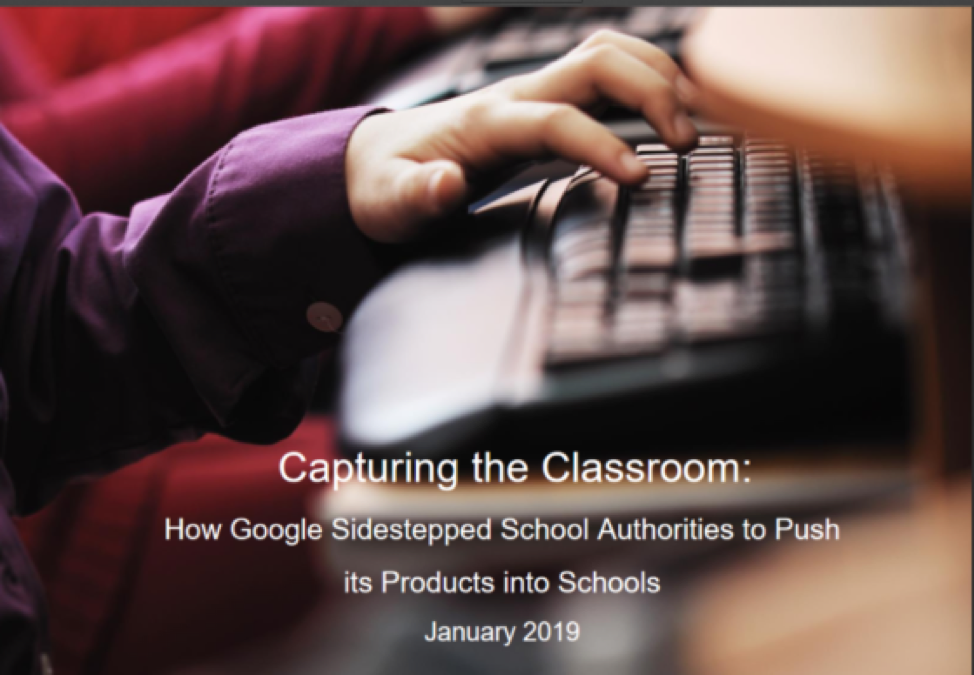
As this Google Transparency Project explains, Google is promoting itself via GSuite products and Apps into many classrooms across America (and the globe).  What is Google doing with student data?  Why is Google allowed to track Location, Voice Activity, Web & App Activity, Device Information, YouTube videos Searched and Watched of K-12 school children? How are these data being used and shared?
What data are being collected and stored (and shared?) via your child’s school issued Google GSuite account? We’ll show you how to start checking.
In August of 2018 Missouri Education Watchdog wrote this articledetailing how one Springfield, Missouri family, discovered that their school district’s Google’s GSuite platform was collecting and storing surprising amounts of personal data about students and, apparently even storing information from parents’ and family members’ personal accounts (family members’ passwords to banking, work, shopping, bills).  Others reported on this issue here and here.
Missouri Education Watchdog recently followed up with a story highlighting a group of parents and educators asking to stop online advertisements to students.  The blog documents many pop ads(some very inappropriate) that students are receiving when logged into their school accounts, including recommendations from CONTINUE READING: Here’s how to check your student’s school-issued GSuite account. | Parent Coalition for Student Privacy


Seattle Schools Community Forum: City IS Going to Give K-12 Education Dollars to Charter Schools

Seattle Schools Community Forum: City IS Going to Give K-12 Education Dollars to Charter Schools

Seattle Schools Community Forum: City IS Going to Give K-12 Education Dollars to Charter Schools 


I will be writing more about this in the coming days but for now, I told you so.

I attended the press conference about the Mayor signing the City Council's resolution of support for the SPS levies.  I asked the Mayor directly whether the City's oversight committee for its education levy had voted to share levy dollars with charter schools.  She waved the question off and said we could talk "offline."

I had asked Dwane Chappelle before the press conference and he told me we could talk afterwards.

Both of them exited the room before I could talk to either of them.  Here's what I was later told in an email:

Dwane Chappelle, Director of the Department of Education and Early Learning. 


“The Families, Education, Preschool, and Promise plan invests to close the opportunity gap across our City.  The Department of Education and Early Learning will allow all public schools and all public school students to apply for levy funds. This decision includes public charter schools in Seattle, which represent approximately 800 students at public charter schools,  and the more than 54,000 students at Seattle Public Schools. This decision was made after consulting with the City’s lawyers and is consistent with past precedent which allowed a preschool organization affiliated with the public charter school to apply for Levy funding and ultimately receive funds. We look forward to continuing our critical work through a strong partnership with the City and District’s to advance our shared vision and values.”
On background for your other questions. This decision is part of the of the Implementation and Evaluation Plan for the Families, Education, Preschool and Promise Levy which will be transmitted to Council for approval in the coming weeks.
So my thought for now is to write the City Council and say no to this.  Council@seattle.gov.
Some of them are running for office again - maybe it should be pointed out to  CONTINUE READING: 
Seattle Schools Community Forum: City IS Going to Give K-12 Education Dollars to Charter Schools

CURMUDGUCATION: The Truth About Davos, AI, and Firing All the Humans

CURMUDGUCATION: The Truth About Davos, AI, and Firing All the Humans

The Truth About Davos, AI, and Firing All the Humans


This article ran last week, and it made my ICYMI list Sunday, but you really, really need to see this.

Kevin Roos went to Davos for the New York Times to see what the masters of the universe are up to, and his most striking discoveries was "The Hidden Automation Agenda of the Davos Elite."

The short version is simple. In public, they are going to talk about how much Artificial Intelligence will improve the workplace. In private, they talk about how AI will let them slash the human workforce to the bone. From the article:

All over the world, executives are spending billions of dollars to transform their businesses into lean, digitized, highly automated operations. They crave the fat profit margins automation can deliver, and they see A.I. as a golden ticket to savings, perhaps by letting them whittle departments with thousands of workers down to just a few dozen.

“People are looking to achieve very big numbers,” said Mohit Joshi, the president of Infosys, a technology and consulting firm that helps other businesses automate their operations. “Earlier they had incremental, 5 to 10 percent goals in reducing their work force. Now they’re saying, ‘Why can’t we do it with 1 percent of the people we have?’”


Is there any reason to think the advent of AI in education is different? Of course not-- education is a field where the single greatest expense is personnel. If your goal is to bust free some of that sweet sweet public education money, getting rid of live, trained teachers and replace them with a couple of cheap mentors.

Look at it this way. Since the beginning of the modern ed reform era, the dream has been to cut staff costs.

We were going to "teacher proof" classrooms with instruction in a box, complete with scripts, so CONTINUE READING: 
CURMUDGUCATION: The Truth About Davos, AI, and Firing All the Humans


Linda Darling-Hammond Disappoints in Cleveland City Club Address | janresseger

Linda Darling-Hammond Disappoints in Cleveland City Club Address | janresseger

Linda Darling-Hammond Disappoints in Cleveland City Club Address


Linda Darling-Hammond is a national figure in the field of education policy.  She is the President and CEO of the Learning Policy Institute at Stanford University, where she is an emeritus professor of education, and she headed up President Obama’s transition team for education. She is the author of several books including The Flat World and Education, in which she declares: “One wonders what we might accomplish as a nation if we could finally set aside what appears to be our de facto commitment to inequality so profoundly at odds with our rhetoric of equity, and put the millions of dollars spent continually arguing and litigating into building a high quality education system for all children.” (p. 164)
Last Friday, Darling-Hammond delivered the weekly address at the Cleveland City Club.  I was disappointed.
Darling-Hammond declared that “we have left No Child Left Behind (NCLB) behind” and implied that its 2015 replacement, the federal Every Student Succeeds Act, has erased the punitive philosophy of its NCLB predecessor.  Darling-Hammond then devoted most of her prepared remarks to Ohio’s adoption of one of her own research priorities—social-emotional learning—into the state’s new five-year strategic plan for education.  Darling-Hammond chaired the Aspen Institute’s National Commission on Social, Emotional, and Academic Development, which on January 15, 2019 published its final report, From a Nation at Risk to a Nation at Hope.
Of course one cannot blame an academic for focusing a major policy address on her own particular research interest. But I was disappointed nonetheless, because Darling-Hammond’s remarks so completely neglected what I and many others believe are alarming realities today CONTINUE READING: Linda Darling-Hammond Disappoints in Cleveland City Club Address | janresseger


Monday, January 28, 2019

ERIC BLANC: Never Trust a Billionaire’s Antiracism

Never Trust a Billionaire’s Antiracism

Never Trust a Billionaire’s Antiracism
The Los Angeles strike wasn’t just a teachers’ victory. It was also a tale of two competing antiracist visions — one upheld by privatizing billionaires and another pushed by working people.


Mass strikes don’t happen very often in the US. But when they do, such strikes can reveal important truths about society. By walking out for the schools students deserve, Los Angeles teachers exposed the deepening contradiction between a privatizing billionaire class and the preservation of public education in the city and around the country.
But the victorious strike also demonstrated the existence of two competing, and contradictory, proposals to fight racial injustice in Los Angeles and across the United States. The conflict in LA was a story of two antiracisms.
On the one hand, privatizers and their political lackeys like LA school board president Monica Garcia pushed charter schools as “the civil rights issue of our time.” Ending racial inequality in American schools and throughout American society, in their view, is impossible through regular public schools. Those schools have to be dismantled.

On the other hand, unionized teachers and their supporters showed that the defunding and dismantling of LA public schools was disproportionately hurting black and brown students. To fight racism in the city’s schools, they turned to their union and mass strike action. And they won big.
The conflict in LA has demonstrated that these two visions are irreconcilable — and how a fighting working class can advance an uncompromising antiracist vision that exposes the bankruptcy of education privatizers’ racial justice rhetoric.

Working-Class Antiracism

By building a vibrant, multiracial mass movement for both economic and social justice, UTLA has put the lie to the constant equation of organized labor, and working-class politics, with old white guys in hard hats. That pundits continue to make this assumption says more about their own class location than it does about the actual gender and racial diversity of the labor movement.
UTLA’s approach was straightforward: combine specific antiracist initiatives with a strategic focus on uniting workers of all backgrounds around their common interests. Upon taking office in 2014, the new UTLA leadership’s first major initiative was to win a 10 percent pay increase for its mostly female, nonwhite membership. “Winning that raise was a necessary initial step towards restoring [our] members’ confidence in the union,” notes UTLA’s Arlene Inouye.
Union leaders subsequently pivoted to a broader fight for more school funding, lower classes, better public schools, and an end to privatization. Significantly, UTLA has raised demands not only for its members, but for working people generally — an approach known as “bargaining for the common good.” And since working-class problems such as school underfunding, low wages, and privatization are especially acute for communities of color, these broad demands are fundamentally antiracist, as writers like Briahna Joy Gray have shown.
The disparities between California’s school districts are some of the worst in the nation, rivaling CONTINUE READING: Never Trust a Billionaire’s Antiracism


Henry A. Giroux: Teachers Are Rising Up to Resist Neoliberal Attacks on Education

Teachers Are Rising Up to Resist Neoliberal Attacks on Education

Teachers Are Rising Up to Resist Neoliberal Attacks on Education
Teachers in LA are rejecting forms of pedagogical terrorism that aim to remove students from politics.


Hannah Arendt once argued that, “Thinking itself is dangerous to all creeds, convictions, and opinions.” In the current political climate, the institutions that nurture critical thinking are similarly seen as dangerous and threatening to our increasingly authoritarian social order. These institutions include public and higher education along with almost any form of progressive media.
As a result, purveyors of neoliberal ideology and policy have been working relentlessly to undermine public education in order to define it in strictly economic terms. Taking an instrumentalist approach obsessed with measurement and quantification, they have aggressively attempted to turn education into a business, faculty into devalued clerks and students into consumers.
Fortunately, teachers and students are refusing to participate in the destruction of US education. The historic strike initiated on January 14 by 33,000 teachers in Los Angeles — the nation’s second-largest school district — is the latest evidence of a nationwide trend in which public school teachers and students have increasingly gone on strike and engaged in walkouts.

A Wave of Resistance Against Neoliberal Approaches to Education

This wave of resistance has emerged to counter the neoliberal market-driven approach to education, which historically has cut across mainstream party lines. Market-driven reforms have been supported since the Reagan administration by every president and by every established political faction since the 1970s.
Refusing to promote the relationship between education and democracy,  CONTINUE READING: Teachers Are Rising Up to Resist Neoliberal Attacks on Education

The latest front in Russian infiltration: America’s right-wing homeschooling movement – ThinkProgress

The latest front in Russian infiltration: America’s right-wing homeschooling movement – ThinkProgress

The latest front in Russian infiltration: America’s right-wing homeschooling movement
This is the latest connection between Russia and the American religious right.


The group and its origins sound innocuous enough. But the Home School Legal Defense Association (HSLDA) — a right-wing group founded 36 years ago — has deepened connections between America’s religious right and Russians even as the latter have been sanctioned by the United States, according to a ThinkProgress investigation.
By networking with Russians, the HSLDA — now America’s largest right-wing homeschooling association — has provided the Kremlin with a new avenue of influence over some of the most conservative organizations in the United States.
And while investigations by Special Counsel Robert Mueller, intelligence organizations, and congressional committees have focused on Russia’s efforts to influence U.S. elections, Russian ties to groups like the HSLDA demonstrate the Kremlin’s broader attempts to hold sway over American policies.
Other ties between sanctioned Russians and the American far-right are well documented. From Christian fundamentalists to white supremacists to secession movements to fascists in the so-called “alt-right,” the links are as diffuse as they are damning. Not only have these networks brought Russian agents into close contact with higher-ups in the Republican party, but they’ve presented some of the primary threads of the Kremlin’s efforts at upending and unwinding American democracy.
But at the same time that details — and criticism — of these links between Russia and American right-wing groups were emerging, the HSLDA co-sponsored a formal homeschooling conference in Moscow and St. Petersburg, ThinkProgress found. One of the conference’s other sponsors was a foundation run by sanctioned Russian oligarch CONTINUE READING: The latest front in Russian infiltration: America’s right-wing homeschooling movement – ThinkProgress


Where else teachers are primed to strike in 2019 — and why - The Washington Post

Where else teachers are primed to strike in 2019 — and why - The Washington Post

Where else teachers are primed to strike in 2019 — and why


The first major teachers strike of 2019 is over. The union in Los Angeles reached a deal this month with the second-largest school district in the country that calls for higher pay, smaller class sizes and more support for students.
Don’t expect it to be the last teacher job action of the year. In Oakland, Calif., and Denver, teachers are likely to strike, and in Virginia, teachers are marching Monday in the state capital to demand higher pay and more money for public schools.
Educator unrest may not stop there.
This could become the second year in a row when teachers across the country go on strike, demanding higher pay and more resources for their schools. And they may do that even in states where it is illegal for public employees to do so.
The wave of strikes in 2018 started in West Virginia and became known as the Red for Ed movement, because most of the labor actions were in Republican-led states. Los Angeles, of course, is “about as blue as you can get,” as United Teachers Los Angeles union leader Alex Caputo-Pearl said. It shows that low teacher pay and inadequate school resources are a bipartisan problem.
“There is something pretty profound about that,” he said in an interview. Caputo-Pearl said the Los Angeles teachers strike was the first major labor action since the 2018 Supreme Court ruling in the Janus v. AFSCME Council 31 case, which declared it unconstitutional for public-sector unions to collect membership dues from nonunion members, even though those members benefit from collective bargaining agreements.
After that ruling, labor leaders warned that instead of union activism waning, it could increase as teachers unions move to re-create themselves and take new stands. Caputo-Pearl pointed to the strike in Los Angeles as proof.
“There is a real gravity to it in terms of what kinds of actions the labor movement is going to need to take to show that we are fighting, to show that we are willing to be bold, to show that we are willing to work with CONTINUE READING: Where else teachers are primed to strike in 2019 — and why - The Washington Post


Charter School Teachers Return To Classrooms Today After Reaching Tentative Contract Agreement – CBS Los Angeles

Charter School Teachers Return To Classrooms Today After Reaching Tentative Contract Agreement – CBS Los Angeles

Charter School Teachers Return To Classrooms Today After Reaching Tentative Contract Agreement


LOS ANGELES (CBSLA) — The first charter school strike in California is over now that teachers are returning to the classroom after making a tentative agreement with The Accelerated Schools network.
An agreement to end the eight-day strike was reached Sunday. The Accelerated Schools teachers are expected to vote on the agreement Monday afternoon.
“We are happy to announce that teachers will be returning to their classrooms on Monday with the official end of their strike pending ratification of the agreement,” said Ed Gutierrez of United Teachers Los Angeles.
Gutierrez said the tentative deal “makes significant progress toward satisfying our members’ core demands for increased job security and that will allow teachers at The Accelerated Schools to effectively address the problem of high teacher turnover that has plagued the schools for too long and hindered student learning.”
Union leaders will discuss the deal at a Monday morning news conference. Negotiations between teachers and The Accelerated Schools began 20 months ago.
The three-year contract includes an increase in both salary and health benefits and also mandates the creation of a joint committee to develop criteria for future employment contracts and teacher evaluations.
The job action was the first strike by charter school teachers in California, with the educators calling for increased pay and health benefits to reduce the high teacher turnover rate at the school.
Two LAUSD teachers founded TAS in 1994 with 50 K-4 students. It has grown to three schools covering Transitional Kindergarten through 12th grade with 1,850 students, a TAS statement said.


Charter School Teachers Return To Classrooms Today After Reaching Tentative Contract Agreement – CBS Los Angeles

Granada Hills Charter High School and the Case for a Moratorium

Granada Hills Charter High School and the Case for a Moratorium

Granada Hills Charter High School and the Case for a Moratorium
Image result for CHARTER SCHOOL Moratorium


– Proposed LAUSD Resolution
Granada Hills Charter High School is the poster child of why a moratorium on new charter schools is needed in the Los Angeles Unified School District (LAUSD). This single school is currently larger than 86% of all school districts nationwide and under its recently approved expansion, it will add another 1,425 students. Lacking the manpower, funding, and willpower to provide adequate oversight, the District stands by while this publicly funded private school underserves the special-needs community, pushes students into an independent learning program against their will, constructs projects that endanger the health and safety of students and staff, and spends public money without adequate controls.


With a charter that has already been approved by the District, Granada will be unaffected by a proposal that would look into “a plan to pursue laws intended to authorize a moratorium on newcharter schools within the boundaries of the District”. Still, they are using public education funds to coordinate a rally in front of LAUSD Board Member Scott Schmerelson’s Valley office to oppose the measure, misleadingly telling parents that it will “ban the opening of charter schools in Los Angeles.” The California Charter School Association (CCSA) is planning additional protests when the full LAUSD Board considers the motion on Tuesday.
The charter industry’s opposition to the Board resolution provides yet another example of how these privately run schools want to avoid any accountability for the public funding that they receive. While they CONTINUE READING: Granada Hills Charter High School and the Case for a Moratorium


Image result for CHARTER SCHOOL Moratorium

What’s A Moratorium? – redqueeninla

What’s A Moratorium? – redqueeninla

What’s A Moratorium?


It’s a “TEMPORARY prohibition of an activity”, according to Webster’s. It’s not a ban, it’s not as its root sounds, to kill or die.  The root relates, in fact, to “delay”. And it’s a word we none of us use very much.
Which is why the call for many years now in addressing problems with the Charter School system has been to call for a “CAP” on charter authorizations.  Not on charters. On the imposition of NEW charters, if it should be determined, for example, that the petitioning charter is unnecessary or in any other way wanting.  Currently LAUSD approval of a charter school is all but mandatory.
Therefore the charter authorization procedure is called into question. Not currently chartered schools.  Not charters as a notion.
The fancy, confusing word “moratorium” has been twisted by the Charter School Industry to mean something it does not. The parent front-group for the Charter industry lobby, “SpeakUp”, opposes a “backroom charter ban”. Which is nothing that has been called for anywhere.  It is a disingenuous fantasy, invoked as a false dog-whistle to call out their uniformed supporters.
The resolution forwarded by LAUSD board member Dick Vladovic (the southerly District 7), is pretty tepid.  It requests: (1) that the Superintendent study the legality of a cap on new charter approvals. Direct approval from voters via initiative may be required; (2) that the State study charter authorization reform, and perhaps charter policy as well; (3) requests that only while awaiting results of the study, the State temporarily cap new charter authorizations.
The resolution does not suggest or request the necessity of a cap on new charters, much less CONTINUE READING: What’s A Moratorium? – redqueeninla


NYC Educator: Denver--The Teachers vs. the Morally Bankrupt

NYC Educator: Denver--The Teachers vs. the Morally Bankrupt

Denver--The Teachers vs. the Morally Bankrupt


Denver teachers were set to strike today, but it looks like they may be delayed for a while. But don't worry. The people who staff the schools are gonna take care of everything. They plan to  fill schools up, evidently, with just about anyone they can get to sub.

It's very tough to be a sub, as far as I'm concerned. One of my least favorite things is getting called each semester for my freebie. I don't know any of the kids, and I likely as not don't know the subject either. There are a whole lot of subjects I'm not good at, and I've subbed in each and every one of them. Sometimes kids are reasonable and cooperative. Other times they aren't.

I have things I use in my classes to make things go better. They work because the students know me and I know them. Sometimes we respect each other. Sometimes they know that I'll call their homes, report them to their coach, go to a teacher they really respect, or find some other way to make behavior inconvenient. When I sub, it's different. I just call the dean and get a kid or two removed. Hopefully that looks inconvenient enough to the rest of the class, and they will be reasonable.


You never know, though. Now I'm certain there are subs who are better than I am, because I'm really not good at all. So on that basis alone, I have to respect people who come in and do this on a regular basis, or even an irregular basis.

Still, I'm not sure the best sub on God's green earth could do what they're asking out in Denver. Let's just imagine you're a sub, walking into a school with not one teacher who's usually there, and having to deal with kids who know all their teachers are outside walking a picket line. I'm supposing their best hope would be that the students cut en masse.

But it's scab ahoy over at DPS recruitment:


DPS officials have said that, in the event of a strike, they will pay regular substitutes double the daily rate, or $212 a day, and “super subs” — retired teachers — $250 a day.

DPS is full of fine people. In fact, they even apologized after they threatened striking teachers with deportation. What more could anyone ask in terms of role models? As for budget, they're certainly focused on saving money, what with instigating a strike that will preclude paying any full-time teachers. I sure wouldn't want to be one of those "super subs," crossing a picket line consisting of my brother and sister teachers. Some people need the money.


Douglas County resident Tom Shor saw substitute teaching as a way to supplement his income as the owner of a hot dog stand during the offseason. Shor said he used to substitute teach years ago, noting that the district was “offering a decent salary.”

I don't know how much money you make selling hot dogs in Denver, but I guess when the dogs aren't moving, you stab unionists in the back and save the money to invest in CONTINUE READING: 
NYC Educator: Denver--The Teachers vs. the Morally Bankrupt


All Things Education: Which 2019 Virginia House of Delegates candidates support #Red4EdVA?

All Things Education: Which 2019 Virginia House of Delegates candidates support #Red4EdVA?

Which 2019 Virginia House of Delegates candidates support #Red4EdVA?


One of my recent posts was about the RedForEd movement in Virginia. I encouraged people to attend the March & Rally on Monday, January 28th (it starts at 11am Monroe Park in Richmond, Virginia, and ends at the Virginia State Capitol--all details can be found here).


One reason I supported Ralph Northam for Governor so publicly and so early is because he un-apologetically supported public schools, something that too many other even Democratic politicians have failed to do in recent years.

In Virginia, ALL of our House of Delegates (100 seats) and State Senate (40 seats) are up for re-election in November 2019.  As with then Lt. Governor, I have been thrilled with how many candidates for the Virginia General Assembly have been without hesitation supportive of public schools and of #Red4EdVA. In this post, as a way of thanking them, I am gong to list those candidates for the Virginia House of Delegates that I know of--I already posted this for the Virginia State Senate. (And they can't just say they support public schools; they have to have receipts.) If you are reading this and someone is missing, please let me know (with evidence) and I will update the post. (You can tweet at me or message me on All Things Education facebook page). Here goes:
------THESE VIRGINIA HOUSE OF DELEGATES CANDIDATES SUPPORT RED4EDVA!------
Please thank them and remember this in November.
SEE Which 2019 Virginia House of Delegates candidates support #Red4EdVA CLICK HERE: All Things Education: Which 2019 Virginia House of Delegates candidates support #Red4EdVA?

Which 2019 Virginia State Senate candidates support #Red4EdVA?


46368215_182191792720694_545588154147117


My last post was about the RedForEd movement in Virginia. I encouraged people to attend the March & Rally on Monday, January 28th (it starts at 11am at Monroe Park in Richmond, Virginia, and ends at the Virginia State Capitol--all details can be found here).

One reason I supported Ralph Northam for Governor so publicly and so early is because he un-apologetically supported public schools, something that too many other even Democratic politicians have failed to do in recent years.

In Virginia, ALL of our House of Delegates (100 seats) and State Senate (40 seats) are up for re-election in November 2019.  As with then Lt. Governor, I have been thrilled with how many candidates for the Virginia General Assembly have been without hesitation supportive of public schools and of #Red4EdVA. In this post, as a way of thanking them, I am gong to list those candidates for the Virginia State Senate that I know of--the next post will be the Virginia House of Delegates. (And they can't just say they support public schools; they have to have receipts.) If you are reading this and someone is missing, please let me know (with evidence) and I will update the post. (You can tweet at me or message me on All Things Education facebook page). Here goes:
----------THESE VIRGINIA STATE SENATE CANDIDATES SUPPORT RED4EDVA!----------
Please thank them and remember this in November.


Badass Teachers Association: The Trauma of Bad Education Policy by Renegade Teacher

Badass Teachers Association: The Trauma of Bad Education Policy by Renegade Teacher

The Trauma of Bad Education Policy by Renegade Teacher
Related image

Originally posted at: https://renegadeteacher.blog/2019/01/25/the-trauma-of-bad-education-policy/?fbclid=IwAR1B26NM64eMQY1EJYbm5ZmhYZJFjUEmwLkCHCKBpAjFuyzqJYCEivDexUM


In America, “teachers and other public education employees, such as community-college faculty, school psychologists and janitors, are quitting their jobs at the fastest rate on record, government data shows,” the Wall Street Journal proclaimed last month.
The WSJ article continued to cite Labor Department statistics and reference “a tight labor market.” Phrases appeared such as “voluntary departures,” “unemployment rate,” and “public education budgets.” Quoted experts included a labor economist from ZipRecruiter and the executive of Teach Plus (a hedge fund and Gates-funded group).
There seemed to be a perspective missing from this article: what it feels like to be part of that reality. While national labor statistics and teacher shortages in states such as Michigan paint a certain ‘speaks-for-itself’ picture, I want to shed light on the visceral experience that accompanies a sinking education landscape in America. Again, numbers alone do not tell the story of what it feels like to be a beneficiary of America’s bad education policies; and we need to humanize the trauma felt in order to carve a path forward.

A Different Perspective

Eve Ewing’s book “Ghosts in the Schoolyard” is incredible for many reasons, but one thing she does really well is to juxtapose the cold, technocratic process of identifying which schools to close in Chicago CONTINUE READING: Badass Teachers Association: The Trauma of Bad Education Policy by Renegade Teacher