Latest News and Comment from Education

Thursday, January 14, 2016

How Much Do We Hate Our Children?

1/14/2016 – How Much De We Hate Our Children?:

1/14/2016 – How Much Do We Hate Our Children?

THIS WEEK: Fixing Urban Schools … Computers Widen Achievement Gap … Closing Schools Hurts Students … College Degree Gap Grows … Why We Need Unions

TOP STORY

How Much Do We Hate Our Children?

By Jeff Bryant

“Conversations with Americans still elicit lots of sentiment for the well-being of kids. But it’s increasingly harder to see that sentiment reflected in policy … Big numbers don’t tell the whole story … Anecdotal evidence of our, not just neglect, but abject militancy toward the needs of children is even more disturbing. But there are recent examples of adults taking actions to change policies and practices to address the needs of children, and those examples are growing and spreading.”
Read more …

NEWS AND VIEWS

How To Fix the Country’s Failing Schools. And How Not To.

The New York Times

Public policy professor David Kirp writes, “A quarter-century ago, Newark and nearby Union City epitomized the failure of American urban school systems … Today Union City, which opted for homegrown gradualism, is regarded as a poster child for good urban education. Newark, despite huge infusions of money and outside talent, has struggled … Newark’s big mistake was not so much that the school officials embraced one solution or another but that they placed their faith in the idea of disruptive change and charismatic leaders. Union City adopted the opposite approach, embracing the idea of gradual change and working within existing structure.”
Read more …

Using Computers Widens The Achievement Gap In Writing, A Federal Study Finds

The Hechinger Report

“Last year, more than half of U.S. states gave computer-based writing tests to children as young as third-graders … The majority used a computer … High-performing students did substantially better on the computer than with pencil and paper. But the opposite was true for average and low-performing students. They crafted better sentences using pencil and paper than they did using the computer. Low-income and black and Hispanic students tended to be in this latter category … [Children] do better writing by hand if they’re less experienced [with computers]. And if they’re more experienced, then there may actually be an advantage toward writing on the computer.”
Read more …

Students Attending Closing Schools Graduated With Less Rigorous Diplomas

Education Week

“What happens to the students who are still attending low-performing high schools while those schools are being phased out? A new look at such students … found that those students … were less likely to graduate college-ready when compared to peers at demographically similar low-performing schools that had not been targeted for closure. In addition, students … were less likely to graduate on time when compared to students at low-performing schools that were not scheduled to close … School closures and their impacts on students are fraught with controversy as schools officials and policymakers continue to wrestle with the best ways to turn around low-performing schools.”
Read more …

College Degree Gap Grows Wider Between Whites, Blacks And Latinos

The Hechinger Report

“The racial gap in who’s graduating from college has widened since 2007 … Companies that have benefited from the loan program range from debt servicer While more blacks and Latinos are graduating from college now, the percentage of whites graduating has grown even faster … At the same time, states have cut the funding they provide to public colleges, per student, by 21% since the economic collapse in 2008, and have raised tuition by 28%. As public colleges become more costly, it’s harder for low-income students to finish a degree. In many states, those students are disproportionately black and Latino … The widely accepted prediction is that 65% of jobs by 2020 will require education beyond high school. So state economies and the wellbeing of states’ residents could suffer if these trends continue.”
Read more …

Strong Unions, Strong Democracy

The New York Times

Richard Kahlenberg of the Century Foundation writes, “In Friedrichs v. California Teachers Association … the ruling bloc of conservative justices appears ready to render a decision later this year that would significantly weaken public sector labor unions. By stripping these unions of key financial resources – their fair share of fees provided by nonmembers – the court would upend a longstanding precedent. A decision in favor of the plaintiff would effectively slam the door on an era in which some conservatives joined liberals in recognizing that vibrant unions help make our democracy work. This is radicalism, not conservatism … Because today’s conservatives are typically hostile to unions, it’s easy to forget that they were not always opposed to unionism or fair share fees … Teachers unions are strong champions of American public schooling, which undergirds our democracy … Unions aren’t faultless, but they are a crucial source of stability and strength for our democracy.”
Read more …1/14/2016 – How Much De We Hate Our Children?:

CURMUDGUCATION: ESSA Accountability: Part II (P.S. Mike)

CURMUDGUCATION: ESSA Accountability: Part II (P.S. Mike):

ESSA Accountability: Part II (P.S. Mike)


Almost as soon as my head hit the pillow, I realized that I had left out an important part of my accountability plan. You can read the first part of this wonkery here-- now for the addendum (hey-- I've already shown that I'm a scofflaw, so why not blow through the 2,000 word limit for submissions)

I don't know where this fits, but for accountability we need full and open school audits.

Visits from a team that includes folks from the state capital and working educators. They will visit the school, have free rein to walk in and out of any classroom, to examine records, curriculum, watch teachers in action, interview students and faculty and parents.

I fully agree that "Just take our word for it" is not an accountability system. Neither is "Prove yourself with paperwork." You want to see if somebody is doing their job-- go look.

The audit team visits for a week and makes an evaluation of the school's strength and weaknesses, creating a full description of the school's impact on children and the state of the children it is serving. Look at all the items mentioned in the first part of the proposal, including student health and well-being, breadth and depth of programs, effectiveness of the staff, degree to which school is meeting the needs of the children and community.

Response to First Replies

Imagine my delight to wake up this morning and find my plan had already been looked at. I can 
CURMUDGUCATION: ESSA Accountability: Part II (P.S. Mike):


Ca’s accountability plan may prove a model to the nation :: SI&A Cabinet Report :: The Essential Resource for Superintendents and the Cabinet

Ca’s accountability plan may prove a model to the nation :: SI&A Cabinet Report :: The Essential Resource for Superintendents and the Cabinet:

Ca’s accountability plan may prove a model to the nation


(Calif.) Even in the absence of detailed guidance on how schools and states will transition to the newly reauthorized Every Student Succeeds Act, the California State Board of Education continued Wednesday to advance its new school accountability system with an eye toward making any forthcoming federal mandates fit its needs rather than the other way around.
Pointing out that federal education funding for California schools amounts to about $7 billion – roughly 10 percent of the $71 billion provided by the state, board member Sue Burr reminded her colleagues that they know best the needs of their public schools and must keep that ideal front and center as they continue the transition to a new era of accountability.
“While it’s fantastic that they have reauthorized this federal law – and in many ways it’s remarkably congruent with what we’ve already been doing the last two-and-a-half years and gives us a wonderful opportunity to align our two systems – I want to keep that in context because we’re responsible for our children in California,” said Burr, a former top education advisor to Gov. Jerry Brown.
“I really want us to think about how we create accountability with the state being the leader in the conversation, and in proportion to our [financial] contribution and our [Constitutional] responsibility,” she said.
Having taken its own path toward developing a new school accountability system at a time when most states chose to pursue a federal waiver program, California may well emerge a national leader in terms of creating a state performance model that will also meet requirements under the country’s newest education law.
In 2011, with the nation’s schools heading toward academic failure under the unrealistic requirements of No Child Left Behind – and with bi-partisan gridlock dashing any hope that Congress would take action to avert the disaster – the Obama administration began granting waivers from Ca’s accountability plan may prove a model to the nation :: SI&A Cabinet Report :: The Essential Resource for Superintendents and the Cabinet:

Randi Weingarten: What's Next for Public Unions? | WBEZ 91.5 Chicago

What's Next for Public Unions? | WBEZ 91.5 Chicago:

What's Next for Public Unions?


 Union leaders representing some 10 million state government workers like police officers and teachers are no doubt a bit nervous these days with the U.S. Supreme Court likely to rule against public unions in a case brought by California teachers.

At issue is whether state government workers who choose not to join a union can nonetheless be required to pay a share of union dues to cover the cost of negotiating contracts.
So if the high court does rule in favor of the plaintiff, what will this mean going forward for those unions? President of American Federation of Teachers, Randi Weingarten joins us shares her thoughts.

See how LAUSD has wavered between picking leaders from the outside and within - LA Times

See how LAUSD has wavered between picking leaders from the outside and within - LA Times:

See how LAUSD has wavered between picking leaders from the outside and within


King
LOCAL  Education LAUSD 
See how LAUSD has wavered between picking leaders from the outside and within
KingMichelle King is the first African American woman to lead L.A. Unified. (Mel Melcon / Los Angeles Times)
One of the most salient headlines about the hiring of Michelle King as the superintendent of the Los Angeles Unified School District is that she’s an insider -- a district stalwart who worked her way up the LAUSD ladder over a span of 30 years -- and not someone with a glitzy national name, such as a vice admiral in the Navy or a former governor.
The history of L.A. Unified’s leadership provides context to King’s appointment: The district is constantly revising its view on whether it needs an insider to stabilize the schools, or an outsider to shake them up. And history hasn’t settled the question of whether being an insider is a help, or a hindrance.
Over 45 years, the margin of insiders to outsiders leading the district was eight to five. Here is a timeline of the superintendents in recent history, how the board chose them, and how they fared:

1971-1981

William J. Johnston - INSIDER


Supt. William J. Johnston, 1971-1981 (L.A. Times file photo)
Johnston was promoted from within the ranks of L.A. Unified. Before his appointment, he served as assistant superintendent for adult education, the focus of his graduate education. Observers saw his “young, energetic” personality as an asset to promoting renewal within the schools. He started in L.A. Unified as a math teacher and junior varsity baseball coach at Gardena High School.
His insider ties extended beyond his own LAUSD career. His dad, Ogden “Johnny” Johnston, had been warmly remembered as a wood shop teacher for nearly 40 years at Roosevelt High in East Los Angeles. 
During his tenure as superintendent, he established the All-District Honors Band. As superintendent, Johnston also encouraged LAUSD schools to participate in what was then the new state academic decathlon competition.
Johnston still corresponds, by formal letter, with district leaders, offering his opinions and guidance.

1981-1987 

Harry Handler - INSIDER


Harry Handler was superintendent from 1981-1987 (L.A. Times file photo)
Handler had been serving as Johnston’s chief deputy when he was appointed superintendent. He joined LAUSD in 1952 as a substitute junior high math teacher, and later served as supervisor of guidance and counseling for junior and senior high schools. In 1968, Handler was named to the district's newly created post of director of research and development. He later became associate superintendent for instruction.
As The Times reported upon his appointment, “His selection is expected to please top district officials, whowanted to see the practice of promoting from within the ranks continued.” 
Discord over desegregation was still brewing when he took office. The board Handler inherited was polarized, consumed with bitter busing fights and the aftermath of white flight by students and teachers. However, “Handler's most enduring legacy,”  The Times wrote in an editorial the day he left office, “may be a school board that works in harmony.”  

1987-1990

Leonard M. Britton - OUTSIDER


Leonard Britton, superintendent of LAUSD from 1987 to 1990. (L.A. Times file photo)
Britton had the distinction of being the first outsider appointed as LAUSD superintendent in nearly 40 years. He uprooted himself from a successful legacy as head of the Miami-Dade County public schools. In his seven years in Miami, Britton developed well-regarded specialty schools, including one for pregnant teens. He strengthened relations with the teachers union, developed a group of effective administrators and experimented with school-based management. It was that reputation and record that prompted his appointment in Los Angeles.
However, the complex political landscape of LAUSD was riddled with tough issues, making for a steep See how LAUSD has wavered between picking leaders from the outside and within - LA Times:

Opt-Out Activists Aim to Build on Momentum in States - Education Week

Opt-Out Activists Aim to Build on Momentum in States - Education Week:

Testing Skeptics Aim to Build Support for Opt-Out Strategy

Riding what they see as a wave of anti-testing sentiment among parents, opponents of high-stakes assessments believe a strategy known as opt-out-having parents refuse to let their children take state-mandated tests-could force policymakers to take note of their cause.

Once considered a rarity, the opt-out push has prompted high-profile boycott efforts and meetings in large districts such as Chicago and led more parents nationwide to join forces with anti-testing advocates in arguing that the assessments are unnecessary, excessive, and, in some cases, even harmful to students.

Such efforts come at a time when states across the country are preparing to field-test assessments aligned with the Common Core State Standards, and when controversy over the common core in many statehouses has reignited the debate over testing overload.

In Chicago, where students started taking the Illinois Standards Achievement Test last week, teachers at two schools will likely face disciplinary action for refusing to administer the assessment. Parent advocates last week were asserting that up to 2,000 students in grades 3-8 opted out, though a Chicago school district official disputed that tally, estimating the number to be fewer than 1,000.

Rallies and meetings promoting parents' rights to refuse student testing are planned in a wide range of communities, from Denver to Port Jefferson Station, N.Y. And a new national coalition called the Testing Resistance & Reform Spring, which officially launched in February, hopes to coordinate such local efforts to start a more substantial assault on reforming and scaling back high-stakes testing.

"Opting out is one powerful tactic to make policymakers aware that parents are fed up with testing overkill," said Robert A. Schaeffer, public education director for FairTest, based in Jamaica Plain, Mass., which is part of that new coalition. "Opting out, at its core, is a form of civil disobedience."

But opting out can be a murky and messy process in most states because few specific guidelines exist outlining what rights parents have to refuse testing on behalf of their children.

Michelle Exstrom, the director of the education program at the National Conference of State Legislatures, said state laws generally require districts to administer the assessments, but students are not required to take the tests. Federal law, she said, is largely silent on the issue of opting out.

Variations Seen

While some state legislation allows the parents of students with disabilities to opt out of testing, Ms. Exstrom characterized opt-out policies as "vague."

In California, the education code explicitly grants parents permission to refuse the test on behalf of a student. In Illinois and New York, the student, not the parent, must refuse the test. (Parent advocates say forcing students, some as young as 9, to refuse the test is unconscionable-in New York, some parents are being advised by advocates to pin "I refuse" notes on their children's shirts, instead.)

Meanwhile, the U.S. Department of Education advises that while parents may have the right to opt out of state tests, such a decision could end up hurting Opt-Out Activists Aim to Build on Momentum in States - Education Week:


Hey, NJ and the nation–the feds say you can’t handle the truth about Christie and the bridge | Bob Braun's Ledger

Hey, NJ and the nation–the feds say you can’t handle the truth about Christie and the bridge | Bob Braun's Ledger:

Hey, NJ and the nation–the feds say you can’t handle the truth about Christie and the bridge

In a few weeks, voters in Iowa and New Hampshire—in contests with portentous consequences for the nation—will be deciding who they want to be president of the United States. One of those candidates could very well be an unindicted co-conspirator in a federal criminal case. His name is Chris Christie and he is the governor of New Jersey, but the feds won’t tell us whether he is on the secret list of co-conspirators .
Paul Fishman, who succeeded Christie as the state’s chief federal prosecutor, seems determined to shield his predecessor from the consequences of involvement in closing down the busiest interstate crossing in the nation  for political reasons. Fishman has argued he won’t release the names of co-conspirators because of the “sensitive nature” of the disclosure.
Sensitive? It is difficult to imagine anything more sensitive than the unwitting, possible election to the nation’s highest political office of someone who may have been involved in a federal crime.
In March of 1974, a federal grand jury investigating the break-in at the Watergate building in Washington, DC, named Richard Nixon, then nothing less than the sitting president of the United States, as an unindicted co-conspirator. The republic survived that—as it did subsequent disclosures that Nixon was so deeply involved in Watergate that calling him an unindicted co-conspirator was about the mildest Hey, NJ and the nation–the feds say you can’t handle the truth about Christie and the bridge | Bob Braun's Ledger:

Emergency Managers Burden Detroit Public Schools with Staggering Deficit | janresseger

Emergency Managers Burden Detroit Public Schools with Staggering Deficit | janresseger:

Emergency Managers Burden Detroit Public Schools with Staggering Deficit


What is happening most notably in Detroit but also in Philadelphia and Chicago would not be possible in your public schools if you live in a prosperous community or a middle income suburb, or a small city or town with a mix of rich and middle income and poor families.  The plight of the public schools and their teachers and their students in these big cities and others scattered across the states is the result of structural poverty and powerlessness and the unwillingness of local and state officials to find a way fairly to serve the children.  As is happening right now in Detroit and Chicago, everybody is blaming the teachers’ pension funds and by extension blaming the teachers.
Here is what has actually been happening.  In Chicago the school district pays into the state teachers’ pension when required to do so, but then the school district borrows the money right back out.  In Detroit, the school district has pretty often over the years failed to pay in what is required.  It has not only withheld its own contributions, but according to a recent report from the Citizens Research Council of Michigan, it has sometimes missed contributing each teacher’s own share—the part withheld from each teacher’s paycheck. The financial morass is so convoluted and arcane that nobody can really understand the details.  The fact is that these school districts—and in Detroit the state emergency managers who were supposedly appointed to deal with the district’s financial crisis—have put the school districts so far in debt that nobody knows how to dig them out.
This week Detroit’s teachers have been staging a sick-out to bring attention to the problems in the schools where they work.  The Associated Press reports that on Tuesday the mayor of Detroit (whose city, by Michigan law, is a separate jurisdiction from the school district) visited some of the schools across the city.  He found a dead mouse in one school; in others he found Emergency Managers Burden Detroit Public Schools with Staggering Deficit | janresseger:

King: the right jewel for LAUSD’s crown – redqueeninla

King: the right jewel for LAUSD’s crown – redqueeninla:

King: the right jewel for LAUSD’s crown


Wednesday morning dawned a superlative sunrise here in LA ~ roseate clouds fronting exhilaratingly blue sky, a morning-after display suffused with color worthy of our news.
Not Obama’s Tuesday night swan song, nor Mayor Butts’ hyperbolic certituderegarding Inglewood’s free municipal lunch (at 5:10), but the naming of a successor for LAUSD’s hundreds of thousands of stakeholders, its children, its parents, its administrators and educators, its operatives and critics, disciples, roadies and acolytes, visionaries and venture capitalists.
Home town girl all growed up, weatherer of successive activist administrations through a battened down, pragmatic work ethic: Michelle King has surfaced to assume America’s most volatile and politically electrified superintendency – our LAUSD’s.
I’ve heard it remarked this is LA’s Hope moment, but I do not think so. King’s promise is not of suppressed anticipatory excitement, but of commonplace relief. None of us actively engaged in public education actually wants the drama of ideology, we want schools that work, institutions anchored to our communities, giving and taking in equal measure, part and parcel of our society’s bedrock. We don’t want to be utilized as part of neoliberal capitalism where education is a sector exploited for its privatization potential. Our kid’s education is not a King: the right jewel for LAUSD’s crown – redqueeninla:

Campaign on child poverty mocks tourism ads, drawing ire of state officials - The Santa Fe New Mexican: Local News

Campaign on child poverty mocks tourism ads, drawing ire of state officials - The Santa Fe New Mexican: Local News:

Campaign on child poverty mocks tourism ads, drawing ire of state officials

  • An image posted on newmexicotruth.org spoofs the state’s ‘New Mexico True’ campaign, which is designed to attract tourists. St. Joseph’s Children’s ‘New Mexico Truth’ campaign is designed to shine a light on childhood poverty in New Mexico.
  • An image posted on newmexicotruth.org spoofs the state’s ‘New Mexico True’ campaign, which is designed to attract tourists. St. Joseph’s Children’s ‘New Mexico Truth’ campaign is designed to shine a light on childhood poverty in New Mexico.
An Albuquerque-based Catholic group that has advocated for the state to invest more funding in early education programs is mimicking the state’s tourism campaign in a new ad venture spotlighting childhood poverty in New Mexico — drawing complaints that it’s infringing on trademark rights.
St. Joseph’s Children, a nonprofit affiliated with Catholic Health Initiatives, launched a $200,000 advertising campaign this week that takes a satirical swipe at the state Department of Tourism’s “New Mexico True” campaign with a more sobering venture called “New Mexico Truth.”
The Department of Tourism responded with a charge that St. Joseph’s is infringing on trademark rights, and officials are demanding the group discontinue the campaign under threat of legal action.
Using statistics from the U.S. Census Bureau and a recent Annie E. Casey Foundation report that ranks New Mexico 49th in the nation when it comes to child well-being, a website for the St. Joseph’s campaign says, “The year of El Niño,” and lists several dim child statistics: “New Mexico has the highest rate of children living in poverty in the nation”; “62% of our 3 and 4 year olds are not enrolled in pre-school”; “79% of our children are not proficient in reading by the 4th grade.”
The site, newmexicotruth.org, includes several videos parodying some of the “New Mexico True” ads. One video showcases the state’s beauty as the soothing voice of a female narrator intones, “This is New Mexico, where the cold mountain air is an invitation to adventure. Where we wait all day just to see the sunset. Where our spirits soar far beyond the horizon and our children are left behind.”
The narrator then says that 31 percent of the state’s children live in poverty and thousands go hungry every day. She concludes, “In New Mexico, there are endless opportunities for discovery, yet few opportunities for our children. New Mexico Truth.”
The Martinez administration is not amused. Mike Lonergan, a spokesman for Gov. Susana Martinez, said the ad campaign is “nothing more than a petty, cynical attempt to hijack an ad campaign that showcases the beauty, diversity and wonders of New Mexico — one that is bringing tourists and revenue to communities large and small — in order to score cheap political points.”
Heather Briganti, a spokeswoman for the New Mexico Department of Tourism, said in a statement Wednesday, “We’re disappointed that anyone would attempt to smear something that is doing so much good for the people of New Mexico. We question the character of an organization that takes aim at a campaign that has Campaign on child poverty mocks tourism ads, drawing ire of state officials - The Santa Fe New Mexican: Local News:


Campaign on child poverty mocks tourism ads, drawing ire of state officials - The Santa Fe New Mexican: Local News:

What If the Wealthy Donated to Fixing Public School Buildings?

What If the Wealthy Donated to Fixing Public School Buildings?:

What If the Wealthy Donated to Fixing Public School Buildings?

photodune-603256-decoration-of-old-buildings-old-school-statues-and-barelief-xs
According to a 2014 PBS report, more than half of the nation’s public school buildings are in bad shape, and it will take $197 billion to fix or rebuild them. Where will all the money come from to do this?
I checked, and most of the Presidential candidates on both sides have said that they will fix the country’s infrastructure including schools. Sen. Bernie Sanders talks about it the most.
But, before he took office, President Obama spoke about fixing school facilities too, and those promises were lost once he became President and Congress didn’t agree.
What if the wealthy helped fix and maintain real public school buildings?
Wealthy CEOs tend to perseverate on two general messages that fail to consider other serious factors.
  1. Public schools fail the poor.
  2. Teachers fail to teach poor children well.
They use these claims to pour their so-called philanthropy into charter schools, Teach for America, etc., to destroy democratic public schooling, disregarding the many What If the Wealthy Donated to Fixing Public School Buildings?:

Parents: Who is (mis)Labeling Your Children? – Missouri Education Watchdog

Parents: Who is (mis)Labeling Your Children? – Missouri Education Watchdog:

Parents: Who is (mis)Labeling Your Children?

label children
Labels are good on soup cans, on prescription bottles, but on children? …not so much.
Here’s a newsflash for the data driven educrats:  Children change, develop at different rates, aren’t easily or accurately quantified. Data can bebiased and data can be wrong.
Take, for example, a 7 year old child who was labeled as profoundly developmentally disabled. One specialist told the parent that his child would likely need assistance getting on and off a school bus, and would be in a “classroom of her peers, would not play sports, and likely not attend college.” Turns out, the specialist, who prepared this report for a school disability meeting, was wrong. The specialist couldn’t accurately predict this child’s future, which in itself is great news. (The little girl, now 10 years old, plays soccer and is hoping to be a pro-athlete or scientist when she grows up.) The bad news: the inaccurate report remains in her education record, and has been digitally shared outside of the school. The report was uploaded to the state’s education data records system, SLDS, which collects, stores records on every child beginning in preschool. (For more on this longitudinal data system in every state, see here.) Once data is entered into the state’s SLDS data system, a parent doesn’t know who outside the school has had access to their child’s records, because the information in a child’s education record and SLDS can be shared without parental consent, to anyone the school or state authorizes (vendors, researchers, government agencies like Dept. of Labor, Dept. of Corrections, etc.) Parents often do not know that Health Insurance Portability and Accountability Act (HIPAA) does not apply to schools and that FERPA privacy law was relaxed, (despite many protests) to allow sharing of a child’s personal information, no parental consent required.
Many parents do not know that the information in their child’s education record, (photos, even medical information, disability status, IEPs, mental health, discipline records, etc.) can be shared outside of school.Parents: Who is (mis)Labeling Your Children? – Missouri Education Watchdog:


Dignity and Respect in Public Schools - Bridging Differences - Education Week

Dignity and Respect in Public Schools - Bridging Differences - Education Week:

Dignity and Respect in Public Schools

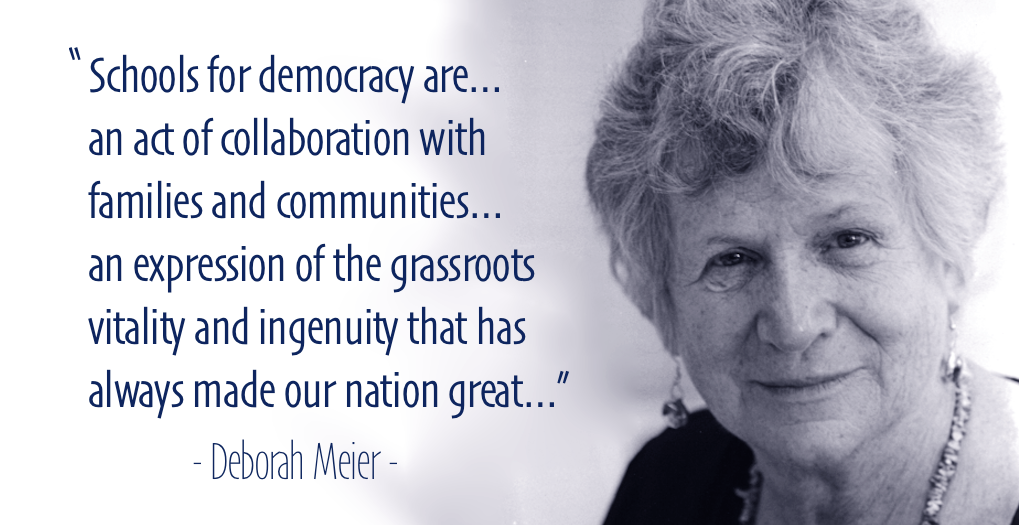
Deborah Meier continues her conversation with Harry Boyte. To read their full exchange, please visit here.
Dear Harry and friends,
I've spent the last five days trying to get my new fancy iPhone 6 Plus to work. Hours on the phone and a visit back to the Apple store Genius and ... it still is misbehaving. It gives me a slight delight. Even the experts can't always save us. Why does that please me? I'm not sure. Since teachers were never considered experts, perhaps it's a kind of revenge fantasy. For years when I spoke I shared the stage with someone who was called "the expert" while I was "the practitioner." For a while, after I got the MacArthur "Genius" Award I was treated somewhat better. But it wears off.
Thanks for filling me in a bit more on what you were doing before we met—down South.
Someday I'll make you sit down and tell me the whole story.
Meanwhile. I like the Oliver Harvey story. I was stuck by his use of the word "dignity," which has not been in fashion of late. It was the loss of dignity that I was most struck with when I entered teaching in Chicago. I had never been treated as disrespectfully—even as a child—and wasn't sure how to respond. It turned out to be an advantage since it soon became clear to others that I wouldn't "tolerate" it. But then I became a teacher when I was in my 30s, and I was white. One of the effects of the schooling that the least advantaged get during their years and years of schooling is a kind of outward numbness to institutional disrespect. Among their peers, being treated with dignity becomes even more important perhaps for this very reason.
It became clear to me, Harry, that boys—particularly if they were Black—got the worst of it above all from white teaches. During one of our perennial "hat policy" disputes I came to this conclusion: Dignity and Respect in Public Schools - Bridging Differences - Education Week:


Giving Every Child in America a Fair Shot at a Great Education | U.S. Department of Education

Giving Every Child in America a Fair Shot at a Great Education | U.S. Department of Education:

Giving Every Child in America a Fair Shot at a Great Education


 In the days immediately following the State of the Union, Cabinet officials are embarking on the “State of the Union: Cabinet In Your Community” road tour to engage Americans in small towns, big cities and Indian country about the advancements the Administration has made on the most important issues facing the American people, as well as the opportunities and challenges that lie ahead. The President made clear in his State of the Union address that the true test is not the challenges we face, but how we approach those challenges. That’s why he and his Cabinet will keep their feet on the gas in this final stretch to continue driving toward solutions that will move this country forward for generations to come, while highlighting the progress that has been made over the past seven years.

***
Giving Every Child in America a Fair Shot at a Great Education
Today in El Paso, Texas, Acting U.S. Education Secretary John King will kick off his “Opportunity Across America” tour to discuss how the Every Student Succeeds Act (ESSA) will build on progress made in education since the beginning of the Obama Administration to ensure that every student —regardless of disability, race, zip code, or family income—is prepared to succeed in school and in life.
Signed by President Obama, the new law helps ensure educational opportunity for all students by:
  • Holding all students to high academic standards that prepare them for success in college and careers.
  • Providing more children access to high-quality preschool.
  • Reducing the often onerous burden of testing on students and teachers, making sure that tests don't crowd out teaching and learning, without sacrificing clear, annual information parents and educators need to make sure our children are learning.
  • Empowering state and local decision-makers to develop their own strong systems for school improvement.
  • Promoting competitive programs that will build on the Administration’s efforts to spur reform, expand opportunity, and drive better outcomes for America’s students.
And, in recognition of the Elementary and Secondary Education Act’s legacy as a civil rights law, ESSA upholds critical protections for America’s disadvantaged students, including vulnerable children. The new law ensures that states and school districts will hold schools accountable for the progress of all students. To help accomplish this goal, it prescribes meaningful reforms to remedy underperformance, ensuring that steps are taken to help students who fall behind and their schools; especially the very lowest-performing schools, high schools with high dropout rates, and schools where certain groups of students are not achieving to their fullest potential.
In order to fully realize these critical protections contained in the law and to support state and local leaders, the Department is moving quickly to provide important support and guidance to states during the transition. In order to ensure that states and school districts meet new requirements and take advantage of new opportunities in the law, while ensuring equity for all students, the Department will need to provide regulations, guidance and technical assistance on key provisions of the law. To that end, the Department:
  • Issued a Dear Colleague Letter to states to clarify some initial steps as states, districts and schools transition to the new law and signal the Department’s commitment to facilitating a smooth transition to the new law—with minimal disruption to students, families, teachers, and schools.
  • Launched the rulemaking process by publishing in the Federal Register a Request for Information to solicit advice and recommendations from about the implementation of the new law, and specifically whether there are areas for which regulations may be helpful. 
  • Will hold a second regional meeting this month to gather input on possible areas for regulation and guidance under the new law. It will be held on Tuesday, Jan. 19, from 9 a.m. to 5 p.m. PT, at UCLA in Los Angeles.
The new law builds on key areas of progress accomplished in recent years through the efforts of educators, communities, parents, and students from across the country, as the President highlighted in his State of the Union address. Those accomplishments include:
  • More preschoolers with access to high-quality early learning programs. The Administration invested billions of dollars in early childhood education, and is building and expanding high-quality preschool in over 200 high-need communities across 18 states that span the geographic and political spectrum.
  • The highest high school graduation rate. The nation’s high school graduation rate hit 82 percent in 2013-14, the highest level since states adopted a new uniform way of calculating graduation rates five years ago. The greatest progress has been among students of color. The dropout rate among Hispanics is half of what it was in 2000, and rates for African-American and low-income youths have been cut by more than a third.
  • Greater college opportunity. The Administration has dramatically increased investments in the Pell grant program, supporting 2 million more students to attend college each year than in 2008. And more students of color are attending college than ever before. Enrollment for African-American and Hispanic students has risen by more than 1 million since 2008.
Over the past seven years, the Obama Administration has laid the groundwork for generational change in America’s education system. The new law extends many of the key reforms the Administration has encouraged states and districts to adopt in exchange for relief from the more onerous provisions of No Child Left Behind, and as a part of the Administration’s competitive grant programs. The nation has seen tremendous efforts to improve education from cradle to career, with substantial progress made—thanks to the hard work of students, educators, and state and local education officials. The Administration’s efforts include:
  • Spurring Comprehensive Change. President Obama’s Race to the Top initiative offered strong incentives to states willing to enact systemic changes that would improve teaching and learning in America’s schools, including adopting higher standards, turning around the lowest performing schools, building strong data systems, and recruiting, developing, rewarding, and retaining effective teachers and principals.
  • Investments in Innovation. The 15 new experimental sites launched during the Administration, including the Dual Enrollment program and Second Chance Pell, and the Investing in Innovation (i3) program, have helped develop a culture of evidence-based decision-making that accelerates student achievement in pre-K-12 and postsecondary education.
  • Creation of Promise Neighborhoods. Since 2010, the Administration’s Promise Neighborhoods program has sought to break the cycle of intergenerational poverty by investing $270 million in more than 50 of our nation’s most distressed communities, representing more than 700 schools.
  • A campaign to prepare 100,000 excellent science, technology, engineering and math (STEM) teachers: In his 2011 State of the Union address, the President called for a new effort to prepare 100,000 STEM teachers over the next decade with strong teaching skills and deep content knowledge. The President’s Educate to Innovate campaign has resulted in more than $1 billion in direct and in-kind support for STEM education.
  • Expanded access to technology students need to succeed. Since President Obama launched his ConnectED initiative in 2013, 20 million more students have access to high-speed Internet. Today, 77 percent of school districts meet minimum standards for high-speed broadband, compared to 30 percent in 2013.
Making college more affordable: Our historic investments in student aid for college, a far simpler Free Application for Federal Student Aid (FAFSA), and the new College Scorecard are helping to give all students the opportunity to go to college by providing them with more scholarship support and the cleared information possible to make informed college choices. We’ve increased the maximum Pell Grant by more than $1,000, expanded education tax credits, kept student loan interest rates low, and helped more than 4 million borrowers manage their debt through plans like the President’s “Pay as You Earn” plan, which caps payments at 10 percent of monthly income. 
In Texas, King will hear from local students, educators, and community leaders about the unique challenges and opportunities faced by border communities. The Obama Administration is committed to expanding opportunity for all students, including English learners and immigrant students. The Administration’s efforts in this area include providing:
  • Guidance to ensure equal access for all children to public schools, regardless of immigration status. The guidance is intended to help schools understand their responsibilities under the Supreme Court's decision in Plyler v. Doe and federal civil rights laws to provide all children with equal access to an education regardless of their or their parents' immigration status.
  • An English Learner Tool Kit prepared by the Office of English Language Acquisition for states, school districts and school administrations to help them meet their legal obligations to English learner students and to provide students with the support needed to attain English language proficiency while meeting college- and career-ready standards. The tools and resources in the kit are free, available in multiple languages, and accessible on the Department of Education’s website.
  • A Resource Guide: Supporting Undocumented Youth to help schools, colleges, teachers, and other personnel seeking to support the college and career success of undocumented youth in secondary and postsecondary institutions, including information about requesting consideration for Deferred Action for Childhood Arrivals (DACA) announced in 2012. The Department is currently in the process of developing a separate Resource Guide on early learning and elementary education that includes promising practices for serving undocumented children and children of undocumented parents.
  • Dear Colleague Letter to school districts, colleges, and universities on promoting and maintaining safe, respectful and nondiscriminatory learning environments for all students by protecting students against discrimination or harassment based on their actual or perceived race, religion, or national origin. The letter urges schools to ensure that systems for reporting and responding to bullying and harassment are understood by all students and staff and ensure that the well-being of students and their ability to learn is not negatively affected. It includes several links to federal resources on issues like student harassment, discrimination on the basis of religion or national origin, and refugee and asylee students.
  • More than $118 million to states on the southwest border (Arizona, California, New Mexico and Texas) to turn around chronically low-performing schools which have demonstrated the greatest need and the strongest commitment to implementing rigorous reforms to raise student achievement.
For more information, please visit whitehouse.gov/sotu.