Latest News and Comment from Education

Wednesday, December 9, 2015

How the Every Student Succeeds Act Will Really Change No Child Left Behind-Era Schools - The Atlantic

How the Every Student Succeeds Act Will Really Change No Child Left Behind-Era Schools - The Atlantic:
The Bloated Rhetoric of No Child Left Behind’s Demise
What replacing the despised law actually means for America’s schools


How does the Every Student Succeeds Act reverse the course of K-12 education in the United States? The headlines say it all: It “Restores Local Education Control.” It “continues a long federal retreat from American classrooms.” It “shifts power to states.” According to a Wall Street Journal editorial, it represents “the largest devolution of federal control to the states in a quarter-century.” The Every Student Succeeds Act, according to The New York Times, represents “the end of an era in which the federal government aggressively policed public school performance, and returning control to states and local districts.” But for all the breathless hype, the legislation seems unlikely to produce many changes that are actually visible on the ground.
The Senate on Wednesday approved the Every Student Succeeds Act, the bill that will reauthorize the nation’s 50-year-old omnibus education law and make the “pretty-much-universally despised” No Child Left Behind obsolete. The legislation, which has already gotten the Obama administration’s tacit approval, is being touted by observers and policymakers from both the right and left as a product of rare bipartisan compromise. “I think this has turned out to be a textbook example of how to deal with a difficult subject,” Republican Senator Lamar Alexander, who co-wrote the legislation, told Politico. “When we come to a bipartisan consensus like this, I think the country accepts it a lot better.” Democratic Senator Patty Murray, another architect of the act, tweeted: “It’s not the bill I would have written on my own, it’s not the bill Republicans would have written. That’s compromise.”  
The most conspicuous manifestation of that bipartisan give-and-take is what’s being highlighted by news outlets and pundits across the country: Schools will still be held accountable for student performance, but states can determine the nuances of how that will take place. They’ll have to use “college-and-career ready” standards and intervene when those expectations aren’t met, but states will get to design their own standards and intervention protocol. They’ll still be required to administer annual testing in certain grades, ensure at least 95 percent of students participate, and disaggregate data based on students’ race, income, and disability status, but they can use other factors on top of testing to assess student performance, and the details of how the testing happens and how the scores are interpreted are up to states.
The overthrow of No Child Left Behind, which has been up for reauthorization for years, is certainly cause for excitement. The George W. Bush-era law required schools to administer annual tests in certain grades in an effort to identify and elevate the achievement of underperforming youth. It was also loathed for its one-size-fits-all approach to education reform, its promotion of teaching-to-the-test, and its harsh system of sanctions. Republicans grew to despise it for how much it allowed the Department of Education to micromanage states and school districts (especially when Obama rose into office). And given how little power the Every Student Succeeds Act gives to the federal government, it may feel, particularly among those on the right, as if the nation’s schools are about to experience a major makeover—as if the next era of public education will mark a How the Every Student Succeeds Act Will Really Change No Child Left Behind-Era Schools - The Atlantic:

CURMUDGUCATION: ESSA: All New Baloney!

CURMUDGUCATION: ESSA: All New Baloney!:
ESSA: All New Baloney!


ESSA has just cleared Congress, and the Department of Education is already giving us a look at the freshly sliced baloney that they will be serving at the Ed Reform Buffet. From Twitter, just now:


Let's count all the ways this is wrong, because it helps us understand just how USED's vision is messed up.

Holds all students to high academic standards?

The federal government cannot hold all students to a high academic standard. The mind boggles at even attempting to imagine how that would work. John White, Acting Pretend Secretary of ED, will stop by my classroom and go over my students' work with them? He'll engage in spirited motivational speeches to get my students to try extra hard.

The federal government is a dozen layers of management removed from interacting with students. They cannot "hold them" to anything. The most they can do is to try to force those of us who actually deal with students to prove, somehow, that we're holding the students to high standards, and then either carrot or stick us for what they think they know.

But the feds don't have any idea how to do that, just as they don't have any idea what "high 
CURMUDGUCATION: ESSA: All New Baloney!:

While Team Malloy says full steam ahead on the Common Core and Common Core Testing Mania… - Wait What?

While Team Malloy says full steam ahead on the Common Core and Common Core Testing Mania… - Wait What?:

While Team Malloy says full steam ahead on the Common Core and Common Core Testing Mania…


Veteran Connecticut educator Ann P. Cronin says that in this new post No Child Behind Act  (NCLB)Environment, “CT Must Reject The Common Core.”
Educator, public education advocate and education blogger Ann P. Cronin posts her writing on her blog, Real Learning CT
Her latest piece entitled, Post NCLB: CT Must Reject The Common Core, cuts through all the “education reform” rhetoric and lays out the harsh truth.  The Common Core and Common Cores testing frenzy is undermining public education in Connecticut and across the country.
The time has come to dump and replace it with a system of standards designed to provide ALL students with the knowledge and skills they need to live fulfilling lives.  Such a set of standards must be developed by educators and those who understand childhood development, not by those who seek to profit off of our children and the resources we taxpayers devote to public education.
Ann P. Cronin writes;
With the end of No Child Left Behind, states will have the flexibility to continue with the controversial Common Core State Standards or not. This is Connecticut’s opportunity to put a good education in place for our students by rejecting the Common Core. However, Alan Taylor, the Chair of the 
While Team Malloy says full steam ahead on the Common Core and Common Core Testing Mania… - Wait What?:

Why it’s worth re-reading George W. Bush’s 2002 No Child Left Behind speech - The Washington Post

Why it’s worth re-reading George W. Bush’s 2002 No Child Left Behind speech - The Washington Post:

Why it’s worth re-reading George W. Bush’s 2002 No Child Left Behind speech


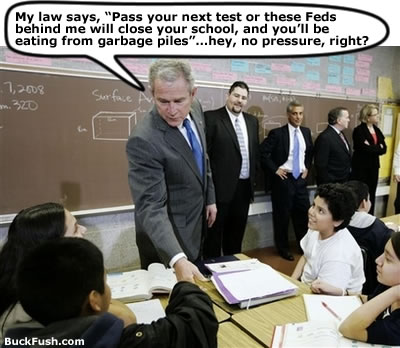
It was on Jan. 8, 2002 that then president George W. Bush signed No Child Left Behind into law, promising a new start for students in low-achieving schools. It was a “historic” moment, he said, and America’s public schools would be all the better for it.
The reality of NCLB never matched Bush’s hopes, in part because the law mandated the impossible goal that all children would be proficient on reading and math tests by 2014, and because President Obama came into office in 2009 and actually took the already identified problems with NCLB — high-stakes tests — and made the situation worse. Now we are at the point where NCLB is almost dead; the Senate passed its successor, the Every Student Succeeds Act, on Wednesday, following last week’s approval by the House. Obama said he will sign the bill, which as my colleague Lyndsey Laytonreports here, will send significant education policy-making power back to states and local districts while maintaining limited federal oversight of education.
But it’s worth taking a look back at that moment when NCLB became law — when Bush put pen to paper at Hamilton High School in Ohio and spelled out his vision for the initiative that he hoped would enshrine him as the “education president” — and the marked similarities to what happened then, and what is happening now.
NCLB was a bipartisan bill that Bush and his Republican supporters in Congress crafted with none other than Sen. Ted Kennedy of Massachusetts, the Democrat that the GOP loved to hate. Later, Kennedy got angry because NCLB was never fully funded, but without him, there might have been no NCLB.
ESSA is a bipartisan effort that would not have succeeded without the collaboration of Republican Sen. Lamar Alexander of Tennessee, the head of the Senate education committee, and Democratic Sen. Patty Murray of Washington, the panel’s ranking member.
NCLB was hailed by Bush as a civil rights achievement because it was designed to force schools to pay attention to slighted populations of students. Current Education Secretary Arne Duncan, who in fact did not get everything he wanted in this bill, still called it a civil rights win for the same reasons. (Critics would argue that neither were.)
NCLB was passed by Congress in December 2001 — just a few months after the Sept. 11 terrorist attacks on the World Trade Center and the Pentagon — and Bush made mention of terrorism in his NCLB speech. The ESSA passed Congress amid a national debate about terrorism.
When NCLB passed, it was hard to find a critical comment, with effusive praise coming from legislators of both parties and various education groups (though there were a few). The praise for ESSA is just as effusive from various constituencies. It is not hard to project that in hindsight, some folks will be sorry they hadn’t paid more attention to ESSA when it was being created, as was true with NCLB.
Here’s Bush’s speech. Read it and see what the hope was vs. today’s reality, in which achievement gaps have not measurably narrowed, school choice has spread but with highly mixed results, and teachers feel as if they have spent years under siege from reformers.

THE PRESIDENT: Thank you all very much.
AUDIENCE: U-S-A! U-S-A!
THE PRESIDENT: Okay. I know you all are anxious to get back to class. (Laughter.) So please be seated. (Laughter.) Thank you for such a warm welcome. It’s great to be in the home of the Big Blue. (Applause.) Hamilton High School. I want to thank you all for coming. I particularly want to thank my friend, the Governor of the great state of Ohio, Governor Taft, for being here. (Applause.)
I want to thank Tracy Miller for being so hospitable. (Applause.) I want to thank all who have come to witness this historic moment. For those of you who have studied the history of our government, you know most bills are signed at the White House. But I decided to sign this bill in one of the most important places in America — a public school. (Applause.)
We’ve got large challenges here in America. There’s no greater challenge than to make sure that every child — and all of us on this stage mean every child, not just a few children — (applause) — every single child, regardless of where they live, how they’re raised, the income level of their family, every child receive a first-class education in America. (Applause.)
And as you know, we’ve got another challenge, and that’s to protect America from evil ones. And I want to assure the seniors and juniors and sophomores here at Hamilton High School that the effort that this great country is engaged in, the effort to defend freedom and to defend our people, the effort to rout out terror 
Why it’s worth re-reading George W. Bush’s 2002 No Child Left Behind speech - The Washington Post:

AFT: Every Student Succeeds Act Opens New Chapter for Education | American Federation of Teachers

AFT: Every Student Succeeds Act Opens New Chapter for Education | American Federation of Teachers:

AFT: Every Student Succeeds Act Opens New Chapter for Education


WASHINGTON—Statement by American Federation of Teachers President Randi Weingarten on Senate—and final congressional—approval of the Every Student Succeeds Act:
"Today's Senate vote of 85-12 on the Every Student Succeeds Act represents a significant course correction acknowledging that more than a decade's worth of education reforms based on test-and-sanction policies was a failure. The new law will give us the chance to press the reset button so public schools can be places where teachers want to teach, parents want to send their kids and students are engaged.
"Congress maintained the best of the original intent of the Elementary and Secondary Education Act—funding for poor kids—while slamming the door on federally prescribed high-stakes consequences of testing. While the new bill doesn't solve all problems, it opens the way for districts across America to give teachers the latitude to teach so their kids can reach their God-given potential.
"For years, educators, parents and members of our broader communities were the canaries in the coal mine, crying out that hypertesting was hurting students, demoralizing teachers and frustrating parents. We will continue to be vigilant as work shifts to the states to fix accountability systems and develop teacher evaluation systems that are fair and aimed at improving and supporting good instruction. This new bill promises the creation of better accountability and support systems, and our students, their parents and their educators deserve nothing less.
"The bipartisan leadership and true partnership of Sens. Lamar Alexander (R-Tenn.) and Patty Murray (D-Wash.) were instrumental in getting us to today's vote."
# # # #
The AFT represents 1.6 million pre-K through 12th-grade teachers; paraprofessionals and other school-related personnel; higher education faculty and professional staff; federal, state and local government employees; nurses and healthcare workers; and early childhood educators.
- See more at: http://www.aft.org/press-release/aft-every-student-succeeds-act-opens-new-chapter-education#sthash.8VxZNM7z.KPTUhBW9.dpuf


Just the Facts, Ma’am | EduShyster

Just the Facts, Ma’am | EduShyster:

Just the Facts, Ma’am

Bump
STATE AUDITOR SUZANNE BUMP PERFORMS AN AUDIT OF HER AUDIT


I sit down with Massachusetts State Auditor Suzanne Bump (which is a lot more exciting than it sounds…)

EduShysterFirst of all, allow me to congratulate you. You took the top spot in a category that I like to call *most read audit by people who have never read an audit before.* I’m talking, of course, about youraudit of the Massachusetts Department of Elementary and Secondary Education (DESE), specifically, their oversight of the state’s charter schools. What did you find?
Suzanne BumpWhat we found was that DESE was using subjective standards, that there wasn’t an even application of standards when they were, say, renewing the charters of schools. We looked to try and determine whether the data they were putting out relative to student demographics was accurate, whether waitlists were accurate. This is information that guides DESE’s policy making and we found it to be unreliable because the state never verifies it. Data reliability testing is the first thing you do in auditing. You can’t reach proper conclusions if we can’t rely upon the data and we found that we couldn’t rely upon the data. That’s a warning to DESE that they shouldn’t be either. 
EduShyster: I think I can explain what happened. Charter schools are laboratories of innovation, as unique as snowflakes, so of course it wouldn’t make sense to apply a uniform standard to them. Am I onto something here?
auditBumpIf they’re failing to meet certain standards, then the penalties should be the same no matter what the institution is. Or there should at least be explanations as to why that’s not the case. The schools should all be treated the same way and they’re not, and there’s no explanation given. Different schools would be given a pass on certain deficiencies. Other schools would be directed to take specific actions. There would be conditions attached to some charters that you would think would be applied to others that had committed the same transgressions.
EduShysterI want to ask you specifically about the charter school waiting list, as it figures prominently in your audit and is the centerpiece of a campaign to lift the state’s cap on charter schools. In fact, if I’m not mistaken, the waiting list has been Just the Facts, Ma’am | EduShyster:

A Premature Celebration in DC | The Merrow Report

A Premature Celebration in DC | The Merrow Report:

A Premature Celebration in DC


Why Is Washington Celebrating Kaya Henderson’s Five Year Anniversary?
Last month Kaya Henderson celebrated her fifth anniversary as Chancellor of the public schools in Washington, DC.  Five years at the helm of an urban district is a milestone that few big city superintendents achieve, and she has been praised for hanging in and for calming down the storm created by Michelle Rhee, whose 3+ year reign was marked by numerous controversies, included the massive scandal sometimes called “Erasergate,” when USA Today investigative reporters found that thousands of student answers were changed–and almost always from ‘wrong’ to ‘right.’
The Washington Post, a consistent cheerleader for Henderson and her controversial predecessor, celebrated Henderson’s anniversary with a largely laudatory article that included praise from two members of Washington’s education establishment, US Secretary of Education Arne Duncan and the long time Executive Director of the Great City Schools, Michael Casserly.  The latter called Henderson “one of the most effective and popular school leaders any place in the country.”  As the Post put it, “Unlike her predecessor, whose turbulent style and top-down approach made A Premature Celebration in DC | The Merrow Report:

Want to know why CTU members will vote to strike? Here’s why. | Fred Klonsky

Want to know why CTU members will vote to strike? Here’s why. | Fred Klonsky:

Want to know why CTU members will vote to strike? Here’s why.


Members of the Chicago Teachers Union will be voting on strike authorization over the next three days.
Many have taken to social media to explain their reasons for voting yes.
CTU members are invited to send me their video to my comment section and I will add them to this post.


Illinois Budget Crisis Threatens to Slash $480 Million from Chicago Schools Mid-Year | janresseger

Illinois Budget Crisis Threatens to Slash $480 Million from Chicago Schools Mid-Year | janresseger:

Illinois Budget Crisis Threatens to Slash $480 Million from Chicago Schools Mid-Year


Chicago teachers are voting this week to authorize a strike, though it wouldn’t occur any time prior to March 2016. Catalyst Chicago quotes Karen Lewis, President of the Chicago Teachers Union, explaining, “We don’t want a strike; we’d like to have a settled contract.” But the contract negotiations have dragged on and on and have been complicated by the budget crisis in Illinois, one of two states that, by mid-December, lacks a state budget.
Valerie Strauss in the Washington Post reports: “The union’s contract with the city expired last summer, and talks have been deadlocked.”  Here is how Catalyst describes some of the impasse: “The district says the CTU is asking for an additional $1.3 billion in spending it can’t afford.”  “Among the union’s contract proposals: enforceable lower class sizes; full-day free preschool for low-income 3-and 4-year-olds; more community schools; fewer standardized tests; an end to school closings and charter expansions; and a minimum $15 hourly salary for all CPS employees.”
The Chicago Tribune presents the demands from the school district’s point of view: “According to the district, CTU wants more than 1,000 new school nurses, psychologists and social workers; hundreds of counselors and case managers; a 3 percent salary increase; and pay for snow days.  The district also asserts it would have to hire more than 5,000 teachers to accommodate a union demand to shrink classroom sizes.”  Jesse Sharkey, vice president of the Chicago Teachers Union responds that the board of education, “has rejected every demand to improve conditions in our schools and asked for a contract that amounts to $653 million in cuts, not counting the staff cuts.”
This is not merely a teachers’ contract dispute. Underneath the financial problems in 


Mike Klonsky's SmallTalk Blog: Feds are in town to save Rahm, not to bury him

Mike Klonsky's SmallTalk Blog: Feds are in town to save Rahm, not to bury him:

Feds are in town to save Rahm, not to bury him


Asked specifically if the probe will be expanded to examine City Hall or the Cook County State's Attorney's office, Lynch said the investigation will focus on misconduct "within the police department."

"The Department of Justice is coming in," Emanuel said. "We welcome it, accept it and need it. It's in our self-interests as a city." -- Tribune

Boy, that was easy. Three days earlier, Rahm had made clear that he didn't didn'twant no stink'n feds sticking their noses into his business. Now he's breathing a sigh of relief that Lynch has promised "not focus on individuals" but rather to "improve the system."

Rahm had no choice but to face reality after a come-to-Jesus meeting with party and White House heavies. His approval rating is now at an all-time low of 18%. To put that in perspective, that's lower than the 20% Gov. Rauner, the most hated pol in Chicago, polled last fall. As I recall, Mayor Daley was down to 31% in 2010, when he declared his intention not to seek a seventh term, clearing the way for Emanuel to take over.

Yes, Obama's cavalry is coming in to supposedly clean-up Rahm's racist and corrupt police department. The FBI has already been in town for months, trying to clean-up Rahm's no-bid-contract scandal at CPS. When is the last time you heard Mike Klonsky's SmallTalk Blog: Feds are in town to save Rahm, not to bury him:


Final reauthorization bill leaves out ‘readiness’ goals :: SI&A Cabinet Report

Final reauthorization bill leaves out ‘readiness’ goals :: SI&A Cabinet Report :: The Essential Resource for Superintendents and the Cabinet:

Final reauthorization bill leaves out ‘readiness’ goals


(District of Columbia) In what may prove the single largest showing of bipartisanship during the entire two terms of the Obama administration, Congress is poised to approve a sweeping rewrite of the Elementary and Secondary Education Act.
In a procedural move to cut off further debate, the U.S. Senate overwhelmingly agreed to bring the Every Student Succeeds Act back for a final vote today.
If so, President Barack Obama has signaled that he will sign it perhaps before the end of the week.
Although both Obama and his Education Secretary Arne Duncan are cheering the bill’s passage, there are number of key elements in the legislation that run counter to long-held presidential policies.
One significant departure is its lack of focus on creating students who are “college and career ready,” a term closely associated with the Obama administration and the architects of the Common Core State Standards.
The term itself isn’t even in the final version, David DeSchryver, senior vice president and co-director of Whiteboard Advisors, a D.C.-based education consulting firm, noted in an analysis released last week.
“Rather, this bill asks states and districts to take a holistic approach to student learning,” DeSchryver said.
For example, he explained, under the new bill school districts will be required to explain how they are implementing “a well-rounded program of instruction,” how they are targeting at-risk students and how they are planning to improve the overall academic status of a school.
“This is a big departure from the current No Child Left Behind Act,” DeSchryver said. “NCLB asked states and districts to focus their efforts on interventions for students in Title I schools that were failing or at risk of failing the state's academic achievement standards, as measured by annual assessments.
“This bill, in contrast, seeks to ensure that all children receive a high-quality education and that schools close student achievement gaps,”’ he said. “There is a broader concept of student learning at play here, and that means that there will be a broader meaning of what costs are allowable under the program.”
The concept of college and career readiness has been a key goal of virtually every education initiative sponsored by Obama’s White House – including Race to the Top, the NCLB waivers as well as Investing in Innovation and School Improvement Grants.
Although the administration was not involved in the development of Common Core, Obama and Duncan were big supporters and attempted to encourage states to adopt the nationalized curriculum standards and make college and career readiness conditions for getting federal support for some programs.
An early version of the compromise legislation retained the readiness goals and it is unclear why Final reauthorization bill leaves out ‘readiness’ goals :: SI&A Cabinet Report :: The Essential Resource for Superintendents and the Cabinet:

Schools Matter: The Compelling Research on Diversity

Schools Matter: The Compelling Research on Diversity:

The Compelling Research on Diversity


SCOTUS is about to hear the Fisher v. University of Texas appeal, and the American Educational Research Association has just released a press kit to help the public understand the issues involved in supporting policy to assure diversity in schools, whether college or kindergarten.

Fisher v. University of Texas at Austin II
Research Supporting the Compelling Interest in Diversity
 
Angelo Ancheta, J.D., M.P.A. 

One of the key questions that the U.S. Supreme Court may address in Fisher v. University of Texas is whether the University’s interest in promoting student body diversity is a compelling governmental interest. In Grutter v. Bollinger(2003), the Court held that the interest in student body diversity is indeed compelling, and cited multiple sources, including scientific research findings, to support its ruling. The Court reaffirmed Grutter’s holding in the first Fisher v. University of Texas appealbut the plaintiff has continued to argue that the University’s interest is not compelling. In particular, the plaintiff has proposed that promoting diversity among minority students (e.g., admitting African American students from different socioeconomic backgrounds) is unconstitutional. Nonetheless, research on the benefits of diversity remains strongly supportive of the University’s diversity interest, including promoting “intra-racial diversity.” To support the compelling interest in diversity, the AERA et al. amicus brief focuses on multiple lines of research, highlighting literature that has been published since the first Fisher litigation: 

1. EDUCATIONAL BENEFITS OF DIVERSITY 
Research continues to show that student body diversity leads to important educational benefits. Among these benefits are: 
  •   Improvements in Intergroup Contact and Increased Cross-Racial Interaction 
    •   Racially diverse educational settings are effective in reducing prejudice by 
      promoting greater intergroup contactboth informally and in classroom settingsas well as encouraging friendship across group lines (e.g., Chang et al., 2006; Denson & Chang, 2015; Pettigrew & Tropp, 2006). 
    •   Meta-analyses (studies compiling and summarizing findings from several previous studies) show that positive intergroup contact reduces prejudice and that greater intergroup contact is associated with lower levels of prejudice (e.g., Pettigrew & Tropp, 2006; Pettigrew & Tropp, 2008). 
  •   Improvements in Cognitive Abilities, Critical Thinking Skills, and Self-Confidence 
 Student body diversity promotes improvements in students’ cognitive skills, such as critical thinking and problem solving, because students’ exposure to 
individuals different from themselves (as well as to novel ideas and situations arising from exposure) challenges their thinking and leads to cognitive growth (e.g., Antonio et al., 2004; Hurtado, 2005; Luo & Jamieson-Drake, 2009; Bowman, 2010).
 Greater Civic Engagement Diverse learning experiences also promote improvements in civic engagement, 
including civic attitudes toward democratic participation, civic behaviors such as participating in community activities, and intentions to participate in civic activities (e.g., Bowman, 2011). 
 Gains in Pluralistic Orientation Diversity leads to gains in “pluralistic orientation,” a metric tied to capacities for 
thinking and social interaction that enable students to engage in cooperative behavior, to manage controversial issues, and to develop a high regard for others’ beliefs and backgrounds (Engberg & Hurtado, 2011). 

 Improved Classroom Environments Classroom learning is improved in diverse environments. For example, a survey 
of over 500 students from the University of Michigan revealed that most respondents were engaged in positive interactions with students from different racial backgrounds, and that (a) greater diversity in the student body leads to increased classroom diversity and improved learning; (b) classroom diversity results in open minds and engaging classroom conversations; and (c) more structural diversity leads to greater participation by minority students and less tokenism (Deo, 2011). 

 Improved Intergroup Dialogues Recent research has also documented the necessity of diverse environments in 
promoting intergroup dialogues in designated classes. One nationwide study of over 1,400 students found gains in students’ insights into how members of other groups perceived the world and increases in thoughtfulness about the underpinnings of 
Schools Matter: The Compelling Research on Diversity:

Nearly 1,000 North Side high schoolers skip school lunch | WBEZ 91.5 Chicago

Nearly 1,000 North Side high schoolers skip school lunch | WBEZ 91.5 Chicago:

High Schoolers Get CPS’ Attention with Website and Lunch Boycott

More than 80 percent of Roosevelt High School students boycotted school lunch Monday to protest school food. Many ate granola, yogurt and fruit donated by supporters.

(WBEZ/Monica Eng)
Monday morning Roosevelt High School students and their teacher Tim Meegan unloaded thousands of bags of granola donated to support their lunch boycott.


Nearly a thousand students skipped school lunch at Roosevelt High School on the North Side Monday.
It was part of their larger project (which includes a petition and website) to change food in Chicago Public Schools-- food they consider unhealthy and unappetizing.
Their civics teacher Tim Meegan said that 143 boycotted on Thursday and 437 (more than a third of students) boycotted on Friday, according to lunch staff counts. Monday that number blew up to 952 (or more than 80 percent of students), Meegan said late Monday afternoon.
It was harder for the teacher to check progress Monday morning when I visited the school. That’s because he was outside with students unloading 10,000 bags of puffed rice granola donated by health group Mercola.com.
It joined a shipment of organic fruit and yogurt from Chicago’s Dill Pickle Co-Op.
“This way we’re well-stocked in case the kids need to continue the boycott,” Meegan said, carrying boxes from a massive white truck.
The boxes were going into the school to be handed out to boycotting students.  
Meegan said that, in addition to the food donations, “We’ve gotten messages of support from teachers, students and administrators at different school districts, [and]  food justice groups from all over the country.”
But the teacher and his students have also gotten push back. Last week CPS Nutrition Services head, Leslie Fowler, wrote to them asking for a meeting, but also implying that their boycott could cost the Roosevelt lunch staff pay.
"Lunchroom staff are paid on a sliding scale based on meals served,” confirmed CPS spokesperson Emily Bittner in an email to WBEZ, “and their pay will be reduced for the next school year if a large number of meals are lost.”
Louise Babbs who’s a lunch worker and organizer for the CPS lunch workers union, Unite Local One, however, sent this statement:
"CPS lunch ladies are paid by the hour, and our members will faithfully report to work regardless because the kids come first. We've been fighting for good fresh food for years, and we support any efforts on the part of students to do the same."
WBEZ is continuing to investigate the question of commissions for lunch workers based on the number of meals taken.
Meegan accused the district’s food service company Aramark  of trying undermine the boycott Nearly 1,000 North Side high schoolers skip school lunch | WBEZ 91.5 Chicago: