Wednesday, August 26, 2015

Knock Knock, Teacher's Here: The Power Of Home Visits : NPR Ed : NPR

Knock Knock, Teacher's Here: The Power Of Home Visits : NPR Ed : NPR:

Knock Knock, Teacher's Here: The Power Of Home Visits

Door-knocking.


Ninety percent of students at Hobgood Elementary in Murfreesboro, Tenn., come from low-income households. Most of the school's teachers don't. And that's a challenge, says principal Tammy Garrett.
"If you only know middle-class families, you may not understand at times why they don't have their homework or why they're tired," Garrett says.
When she became principal four years ago, Garrett decided to get her teachers out of their classrooms — and comfort zones — for an afternoon. Once a year, just before school starts, they board a pair of yellow buses and head for the neighborhoods and apartment complexes where Hobgood students live.
En route, the bus driver describes over the intercom how he picks up 50 children at one complex each morning. The teachers pump themselves up with a chant. After all, they're doing something most people don't enjoy: knocking on doors unannounced.
When the caravan arrives at a cluster of apartments, the teachers fan out and start knocking on doors of known Hobgood families. Some encounters don't get beyond awkward pleasantries and handing over fliers about first-of-the-year festivities. Others yield brief but substantive conversations with parents who might be strangers around school.
Jennifer Mathis has one child still at Hobgood and says she appreciates that the school came to her — since she has a hard time getting to school.
"I don't have a car. I can't drive because my back got broken in two places," she tells a trio of teachers standing in her doorway. "I'm a mom. I can't be there with all of them all the time."
Giving Home Visits A Try
There was a time when a teacher showing up on a student's doorstep meant something bad. But increasingly, home visits have become a tool to spark parental involvement. The National Education Association has encouraged more schools to try it out, and there's this national effort.

New Website Shares #KatrinaTruth | National Opportunity to Learn Campaign | Education Reform for Equity and Opportunity

New Website Shares #KatrinaTruth | National Opportunity to Learn Campaign | Education Reform for Equity and Opportunity:

New Website Shares #KatrinaTruth

Posted on: Monday August 24th, 2015

Ten years ago, Hurricane Katrina devastated New Orleans and displaced hundreds of thousands of its residents. Now, a new site by the Advancement Project and the group Families and Friends of Louisiana's Incarcerated Children (FFLIC), called KatrinaTruth, has shown that although the city may be rebuilt, its recovery has not been an equitable one. In fact, they demonstrate how post-Katrina policies worked to push out Black families and communities from their homes, their schools, and their government.
The site provides nine different "Reality Checks" addressing major areas in which post-Katrina policies have failed New Orleans: education, housing, economic inequality, Black leadership, criminal justice, environmental justice, queer and trans people of color, and health and wellness. These reality checks disrupt the falsely-positive narratives of policies like school "reform" system, which the site argues is really a school to prison pipeline. While test scores may have improved in New Orleans, they have come at the cost of children being pushed out of schools, harsh disciplinary practices, no accountability, and failures to accommodate students with disabilities or English language learners. As the site says, this isn't "progress," it's inequality and injustice.
Changes in education also played a role in the dismantling of Black leadership in New Orleans. After hurricane Katrina, the 7,000 teachers fired (most of whom were black) were replaced by mostly white education reformers, such as those leading charter schools. This kept Black educators out of their schools but it also deprived the large Black community of their leadership and advocacy. Their removal also contributed to economic inequality, as Black teachers were a key part of New Orleans' middle class.
Each of the Reality Checks includes "key recovery data" for a highlighted look at some of the most important numbers, and links to other resources. The site has also generated considerable discussion on twitter, under #KatrinaTruthCheck it out today!New Website Shares #KatrinaTruth | National Opportunity to Learn Campaign | Education Reform for Equity and Opportunity:

In Chicago, hunger strikers fight for a high school - The Washington Post #FightForDyett

In Chicago, hunger strikers fight for a high school - The Washington Post:

In Chicago, hunger strikers fight for a high school


Demonstrators hold placards during a Chicago Teachers Union protest in Chicago in March 2013 over a controversial proposal to close 54 schools in the country's third-largest public school district. (John Gress/Reuters)


A dozen parents and activists in Chicago entered their 10th day of a hunger strike Wednesday, part of a fight with city officials over the fate of a high school in their South Side neighborhood.
So far, two hunger strikers have been sent to the hospital this week and one of the organizers had a dizzy spell Wednesday, but the protesters say they will keep going without food.
“This is really about the privatization of education, it’s about having sustainable community schools in every neighborhood,” said Monique Smith, 32, a resident who has lost seven pounds since she stopped eating Aug. 17. “This is a much larger struggle.”
Walter H. Dyett High School was closed by Chicago Public Schools in June after years of poor performance and dwindling enrollment. Last year, the senior class had 13 students.
But after protests by the community, the Chicago Public Schools said it would consider proposals from private organizations to operate the school on behalf of the district for a fee.
Community organizers say they want to keep the school publicly operated, and have proposed that Dyett be reopened as a “leadership and green technology school.” They want to develop a science-based curriculum that would take advantage of the school’s location near a park. The group also wants to renovate the building into a LEED certified green facility.
Chicago Public Schools officials were supposed to make a decision about the school’s fate last month but they postponed action and said they would hold a hearing on the competing plans Sept. 15.
That’s unacceptable to activists, who say they want the school system to make a decision about the school.
“We’ve had plenty of community hearings — we want the decision,” said Smith, who teaches history in a Chicago public middle school. “There is no other meeting we care to have. What is the hold up? They’ve had our proposal for more than a couple of months. That’s the reason for the hunger strike. We want to bring attention to this constant postponement, this constant sabotage.”
A spokesman for Chicago Public Schools could not be reached for comment. The school system closed nearly 50 schools in 2013, displacing more than 12,000 students.
It is unclear how long the strikers will keep up their action. They spend the days camped out in front of Dyett and then the evenings a few blocks away at the headquarters of the Rainbow PUSH Coalition, the nonprofit formed by the Rev. Jesse Jackson.
Randi Weingarten, president of the American Federation of Teachers, joined state and city union leaders at a rally in Chicago in support of the hunger strikers.
Activists in other communities around the country have been participating in a one-day fast in support of the Dyett strikers. Hundreds in different cities 

The Union Advantage for Women - Women in the StatesWomen in the States

The Union Advantage for Women - Women in the StatesWomen in the States:


The Union Advantage for Women

This briefing paper presents an analysis of women’s union membership and the union wage and benefit advantage for women by state and by race/ethnicity. It is based on an analysis of the Current Population Survey. Wage and benefit data are for all workers covered by a union contract, irrespective of their membership in a union.
Download the bSWS Union Advantage thumbriefing paper, The Union Advantage for Women.
Read the press release, “Unionized Women Earn More than Nonunionized Women in Every U.S. State.”


National Opinion Poll on Testing and Test-Based Teacher Accountability | VAMboozled!

National Opinion Poll on Testing and Test-Based Teacher Accountability | VAMboozled!:

National Opinion Poll on Testing and Test-Based Teacher Accountability


VAMboozled!


In an article titled “Testing Doesn’t Measure up for Americans,” just released by Phi Delta Kappa (PDK) International in partnership with the flagship professional polling organizationGallup, you can read the results of the annual public poll that PDK/Gallup conduct every year regarding the public’s thoughts on America’s public education system. Pollers polled a nationally representative samples of 3,499 Americans over 18 via the web and 1,001 Americans over 18 via phone. As most pertinent to our purposes here, here are the key findings with which you all might be most interested.
“Americans agree that there is too much testing in schools, but few parents report that their children are complaining about excessive testing. Most Americans believe parents should have the right to opt out of standardized testing, but few said they
would exercise that option themselves.”
  • 55% of Americans and 61% of public school parents oppose including student
    scores on standardized tests as part of teacher evaluations.
  • To measure the effectiveness of the public schools, using tests came in last as a measure of effectiveness with just 14% of public school parents valuing test scores as very important for such measurements.
  • 64% of Americans and a similar proportion of public school parents said there is too much emphasis on standardized testing in the public schools in their community with just 7% believing there’s not enough.
  • When asked what ideas were most important for improving public schoolsNational Opinion Poll on Testing and Test-Based Teacher Accountability | VAMboozled!:

edTPA. The Gates and NCTQ plan, a long time in the works. | Fred Klonsky

edTPA. The Gates and NCTQ plan, a long time in the works. | Fred Klonsky:

edTPA. The Gates and NCTQ plan, a long time in the works.


au-1


Graphic: Rethinking Schools


edTPA is not new.

I have been posting about it now because the implementation of edTPA in Illinois, mandated by the Democratic Party controlled state legislature as the path to teacher certification, is moving at full steam.

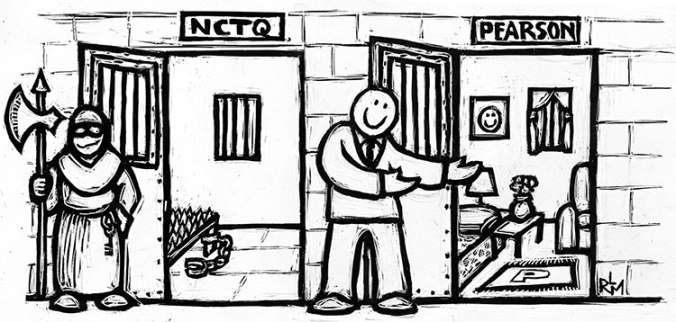
If you go back to the summer of 2013 Rethinking Schools has an article by Wayne Au which places edTPA right in the center of the debate over corporate school reform, the Gates Foundation and the corporate National Council on Teacher Quality (NCTQ).

Incidentally, I wrote about the cozy relationship between the Illinois Education Association’s Executive Director Audrey Soglin and NCTQ back in April of 2013.

But this is part of what Wayne Au wrote for Rethinking Schools two years ago:

Conservatives have been developing an infrastructure to attack teacher education at least since 2000, when the Thomas B. Fordham Institute created the National Council on Teacher Quality (NCTQ). As former Fordham Institute board member Diane Ravitch recalls: “Conservatives, and I was one, did not like teacher training institutions. . . . [The Fordham Institute] established NCTQ as a new entity to promote alternative certification and to break the power of the hated ed schools.”

With $5 million from then-Secretary of Education Rod Paige and the Bush administration, the NCTQ founded the American Board for Certification of Teacher Excellence (ABCTE), which would grant edTPA. The Gates and NCTQ plan, a long time in the works. | Fred Klonsky:

Mapping the Displacement of Katrina Survivors - The Atlantic

Mapping the Displacement of Katrina Survivors - The Atlantic:

Hurricane Katrina's Uncharted Diaspora

The storm displaced hundreds of thousands from their homes, and there is still no comprehensive picture of where they ended up.


Hurricane Katrina made landfall in the city of New Orleans on the morning of August 29, 2005, swept in by winds traveling at 127 mph. But the true damage came after the levees broke, when about 80 percent of the city flooded. At least400,000 residents, nearly the entire city, were displaced—some for a few days, some forever.


Ten years later, there is still no single, comprehensive source of information on what happened to displaced New Orleans residents—on where they went, or why. Beyond FEMA and U.S. Census data collected a year or less after the disaster, neither the local nor federal government had systems in place to systematically track Katrina’s castaways.

What we do have are a handful of individual studies, lists, and mapping efforts, that, taken all together, paint a portrait of a decade of dramatic upheaval.


The New Orleans ‘Diaspora’

The New York Times

In the hours before, during, and after the storm, New Orleanians evacuated to cities and towns all over the country. Sometimes they chose a destination in order to be with family or friends. Other times, FEMA sent them off to places unknown. “We have residents who were loaded onto buses bound for Memphis or Salt Lake City and only found out once they got there,” says Michelle Whetten, vice president of the affordable housing and community development nonprofitEnterprise Community Partners, Inc.


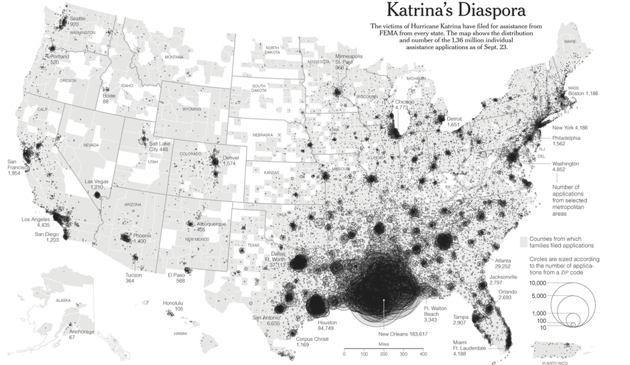
By September 23, 2005, 1.36 million applications had been submitted to FEMA by former Gulf Coast residents for Katrina-related disaster assistance. As The New York Times’ 2005 “diaspora” map above shows, applications came in from every state and, according to one researcher, almost half of all ZIP codes.

But FEMA captured just a snapshot of the displacement, and in the broadest stokes. Narayan Sastry, a scholar of population studies at the University of Michigan and a social scientist at the RAND Corporation, has been developingsurvey-based methods of tracking displaced New Orleanians since 2009. In a2014 paper, Sastry used a sample of individual responses from the Census Bureau’s American Community Survey (ACS) to examine where New Orleans residents wound up in the year after the hurricane, and what factors had influenced their moves.

By one year out, about 53 percent of displaced adult New Orleanians in Sastry’s sample were back again, with less than a third at the home they’d lived in prior to Katrina. Of those who remained displaced, 12 percent were living elsewhere in Louisiana (particularly Baton Rouge), and 40 percent were in Texas (particularly Dallas and Houston, the latter receiving more evacuees than anywhere else). Most of the rest were scattered throughout the South, or New York, Ohio, and California.

“Most of the displaced adults likely faced considerable economic and Mapping the Displacement of Katrina Survivors - The Atlantic:


CURMUDGUCATION: Content-Free Curriculum

CURMUDGUCATION: Content-Free Curriculum:

Content-Free Curriculum


Coming back to school (first student day yesterday, thanks) reminds me once again of the huge hole in the heart of current Core curriculum. The lack of content. The sad fact that there is no there there.

Yes, someone is going to pop up to say that the Core (both in its original incarnation and all the old wine in new skins versions that have promulgated throughout states where "OMGZ NOES! We has no Common Core!" versions of the Core still roam free) is NOT a curriculum, which is part of the trick. Because the Core really isn't a curriculum in a classic sense; the ELA standards are a sort of anti-curriculum in which teachers are forbidden to care about the content, and must only worry about teaching students to perform certain actions, certain tricks, on a test.

Content exists, and teachers a free to select what they will. Teach Romeo and Juliet or  Heart of Darkness or Green Eggs and Ham-- we don't care because it doesn't matter because the literature, the content, has no purpose beyond a playing field on which to practice certain plays. I've accused the Core of treating literature like a bucket in which we carry the important part, the "skills" that the Core demands, but it's more accurate to call literature the paper cup-- disposable and replaceable. We just want you to be able to "find support" or "draw conclusions." About what just doesn't matter.

Back in the early days, we had folks arguing that CCSS called for rich content instruction, that it absolutely demanded a classroom filled with the classic canon. At the time I thought those folks were simply hallucinating, since CCSS  makes no content demands at all (the closest it comes is the infamous appendix suggested readings list). But I've come to believe that those folks were reacting to the gap that they saw-- "Without rich content, this set of standards is crap, so apparently, by implication and necessity, this must call for rich content. Because otherwise it's crap."

I think the absence of content is also the origin of the "new kind of non-bubble non-memorizing test" talking point. The old school test their thinking of is the kind that asks you to pick the year the 

Chicago Tribune: Teacher compensation is a perk. | Fred Klonsky

Chicago Tribune: Teacher compensation is a perk. | Fred Klonsky:

Chicago Tribune: Teacher compensation is a perk.


6b09619b832af39de8433346d84278bf
It has been just a few days since the Chicago Tribune embarrassed itself by publishing the ghoulish op-ed by Kristen McQueary which called for a devastating natural disaster like Katrina to hit Chicago.
Only “water gushing through manhole covers” could bring school reform to our city wrote McQueary, praising the privatization of New Orleans schools that followed Hurricane Katrina.
This morning they publish another one of their patented bull poop articles on teacher pensions, claiming a district’s pension pick-up is a “perk.”
They write that this perk is “little noticed.”
That’s because to most observers of collective bargaining agreements between labor and management it is not normally considered a perk to receive compensation for your work.
A point about the contract language: If someone were to read the collective bargaining agreement (CBA) between the Park Ridge board of education and the Park Ridge Education Association (of which I was a member for 30 years) it says, “the Board shall pick-up the teacher’s required contribution to the Illinois Teachers Retirement System (TRS).”
What does this mean?
It means that the board will take the 9.4% our of our check  and send it to TRS. We paid the entire amount but the board transferred the money. That is all that they did. It was nothing more than an electronic transfer of our money so that we didn’t have to mail in a check to TRS ourselves.
Yet someone might read that and think the board paid our contribution. They Chicago Tribune: Teacher compensation is a perk. | Fred Klonsky:

Mike Klonsky's SmallTalk Blog: Big day for Dyett hunger strikers

Mike Klonsky's SmallTalk Blog: Big day for Dyett hunger strikers:

Big day for Dyett hunger strikers


Important day for the Dyett hunger strikers.
AFT Pres. Randi Weingarten is coming to Chicago today to speak in support of the strikers. Maybe that will push some other unions to do the same and get some decent media coverage.
Our thoughts are with hunger striking Grandmother Irene Robinson who was hospitalized yesterday. She.tells hospital staffers,  "I'm still hungry for Dyett!"
International Business Times picked it up...
The hunger strike has caught the attention of the Rev. Jesse Jackson, who briefly joined last week, and the advocacy group Alliance to Reclaim Our Schools, which encouraged residents across the U.S. to join in solidarity Tuesday. Randi Weingarten, president of the American Federation of Teachers labor union, also announced plans to speak before a group of Dyett demonstrators Wednesday.
The Daily Caller reports:
 Strikers say the decision to shutter the school reflects Emanuel’s utter Mike Klonsky's SmallTalk Blog: Big day for Dyett hunger strikers:

This could change everything about school — for kids, teachers and everybody else - The Washington Post

This could change everything about school — for kids, teachers and everybody else - The Washington Post:

This could change everything about school — for kids, teachers and everybody else


For years, veteran educator Marion Brady has argued on this blog that no matter the level of a learner’s ability, much higher levels of academic performance are possible.  The means to that end, he says, is learners’ understanding and deliberate use of their “master mental organizer”—the information organizer we all begin developing at birth and routinely use (except in schoolwork) to make sense and communicate.
Acknowledging and accommodating institutional resistance to the idea, he and his brother have written, for middle or high school students, three illustrative, ready-to-use, year-long courses. The first helps learners understand the sense-making process; the other two use world history and American history as vehicles for exercising and elaborating the sense-making process. To encourage examination, criticism, use, and collaboration in their improvement, the three courses are and will remain free for the downloading.  Links are at the end of the post.
By Marion and Howard Brady
Learning is challenging. Kids need to accept that life is a test and grit is essential to success. Competition builds character. A quiet school is a good school. Recess and leisurely lunchtimes are poor uses of valuable instructional time. Kindergarten should be the new first grade. Poverty is no excuse for poor performance. Retention in grade for under-performing kids just makes good sense. The root cause of academic decline is teachers’ low expectations. Rigor is the key to winning the Race to the Top.
So goes the conventional wisdom. Saying that learning is natural, that stress is counterproductive, that free play and the so-called “frill” subjects teach in powerful ways, that standardized tests are counterproductive, invites heated argument. To say that present corporately driven education policies have been a monumental waste of time, money, and talent invites being dismissed by those setting education policy as too out of touch with reality to deserve continued reading.
But hear us out. That first paragraph reflects a Puritanical view of human nature that, historically, Americans have tended to favor. No surprise then that those leading the “reform” effort believe the “test and punish, standards-This could change everything about school — for kids, teachers and everybody else - The Washington Post:

Amid Widespread Racial Biases in School Suspensions, Teachers Say No to Federal Ban on ‘Disparate Impact’ Discipline - The Atlantic

Amid Widespread Racial Biases in School Suspensions, Teachers Say No to Federal Ban on ‘Disparate Impact’ Discipline - The Atlantic:

When Schools Are Forced to Practice Race-Based Discipline

Students of color are expelled and suspended at disproportionate rates. Educators say policies banning “disparate-impact” discipline are not the answer.


The Obama administration might be disappointed to find out there’s not much support for one of its key school-discipline reform initiatives—at least not from teachers or members of the general public.

A growing body of evidence has long revealed discriminatory tendencies in the ways school districts dole out discipline. Black and Latino students are much more likely to be disciplined and suffer greater rates of in- and out-of-school suspensions. Of the 49 million students enrolled in public schools in the 2011-12 school year, close to 7 million were suspended, about half of them out of school. According to the U.S. Department of Education’s Civil Rights Data Collection,black students were suspended and expelled at a rate three times greater than were white students.


Taken as a whole, white students in the U.S. account for the largest share of one-time suspensions and expulsions. Still, discrepancies emerge when considering how the numbers compare to enrollment. While black students represented 16 percent of the U.S. student population, they accounted for 32 percent of the students suspended and 42 percent of those expelled. Black students also experience the highest rate of multiple suspensions, the DOE data shows.


The discrepancies are particularly egregious in certain parts of the country. AsThe New York Times reported on Tuesday, a new analysis of the federal data finds that black students in 13 Southern states are suspended or expelled “at rates overwhelmingly higher than white children.” In 132 of the districts analyzed, for example, black students were suspended at rates at least five times greater than their representation in the student population.

In an effort to combat disciplinary bias, the federal government has warned every school district in the country that they face legal action if their discipline policies have a “disparate impact”—“a disproportionate and unjustified effect”—on students of a particular race.

Still, despite widespread concern about the “discipline gap,” the recommendation has sparked a good deal of backlash, including from pundits who’ve speculated that children of color will actually be the ones most harmed. The administration’s guidelines “will encourage schools to tolerate disruptive and dangerous behavior lest they have too many students of one race being punished,” wrote the education-law expert Joshua Dunn in a Fordham Institute blog post last year. “The effect will be to punish students who behave and want to learn since their education will be sabotaged by troublemakers. And the disruptive will certainly learn, and learn quickly, that their schools are now tolerating even more disruptive behavior.”


A recent Education Next poll of nearly 4,000 respondents (including oversamples of teachers, African Americans, and Hispanics) suggests that few people think the disparate-impact approach—which some have argued leads to racial quotas—is the best solution. Some of the strongest opposition seems to be from teachers, fewer than a fourth of whom support such policies, as well as those who identify as white. Thirty-five percent of teachers and 36 percent of white respondents answered that they “completely oppose” policies that prevent minorities from being expelled at higher rates, according to the poll, which surveyed Americans on education-policy issues.


The researchers administered the poll after President Obama made it a priority Amid Widespread Racial Biases in School Suspensions, Teachers Say No to Federal Ban on ‘Disparate Impact’ Discipline - The Atlantic:


Left Behind: The unintended consequences of school choice | The Post and Courier

Left behind | The Post and Courier:

Left Behind: The unintended consequences of school choice

Kids with toughest hurdles stuck in gutted schools


The first bell rings in 10 minutes, but no cars line the road outside to drop off students. While other schools clog major thoroughfares with traffic, a lone car pulls up to North Charleston High every few minutes for a drowsy teen to roll out. Two park in the entire student lot.

The rest ride school buses or walk. Several arrive on public CARTA buses. They don’t have cars. Most of their families don’t either. Virtually all qualify for the free and reduced-price breakfast being cooked inside, with its aroma of warm eggs wafting from the cafeteria doors, a homey hello.

Anthony Ludwig’s door swings shut for first-period psychology class. It’s just past the winter break and into the chilly slog toward spring. A young guy from Philly, Ludwig grabs a thermos of coffee to begin laps around the perimeter of the classroom, bullhorn voice explaining life’s stages.

“Memory and intelligence are affected by age. That’s why you’re in school right now!” Ludwig booms. Unless they fry their brains with weed, booze or crack, he adds, those mental faculties should remain just as strong until their 60s.

A dozen teens, each embodying what this school now faces, sit rapt. Or asleep.

Up front, senior Noah Johnson pens precise notes. He used to transfer out to West Ashley High under No Child Left Behind, a federal law that let students flee “failing” schools. But when that busing ended a few years ago, his single mom had no car to drive him. So he came here, not wanting to.

Romulus Townes sits in the middle. A 6-foot, 3-inch sophomore, his future hangs on a bitter custody battle involving his mother, father, grandmother and the state Department of Social Services. He could be sent away from here at any time.

Senior Chenelle Perry doodles in back. Her best friend died in a drive-by shooting. Another friend was riding with the shooter. The first anniversary approaches.

Off to one side, freshman Maurice Williams takes notes, empty backpack on, a fresh 3-inch incision in his skull hinting at his own near death a few weeks ago. He just moved in with a half-sister barely out of high school with two kids of her own.

Ludwig talks about assessing one’s life before death. A girl raises her hand.

“So what’s PTSD?” she says, out of nowhere.

Post-traumatic stress disorder, Ludwig explains. People who experience traumas, violent ones, are most at risk.

Students ‘left behind’

Many students at North Charleston High have faced near homelessness, street violence, severe family instability or other major upheavals in their young lives.

Although the campus sits right off Park Circle, one of the region’s trendiest spots, Spruill Avenue has become the main street for many left here. It’s a high-crime stretch beyond the reach of gentrification where windows hide behind boards and bars, porches sag and generations live mired in minimum-wage poverty.


That’s because the school, which should house a diverse group of 1,141 students from across its attendance zone, instead enrolled just 450 this year — and shrinkingNearly 90 percent of its students are black in an area that’s more than a quarter white, and virtually all left are poor.


Casey Trauger sees their struggles daily. She’s the longest-serving special-education teacher in what has become the school’s biggest department.Left behind | The Post and Courier:

Ed Notes Online: The Racist History of the Charter School Movement

Ed Notes Online: The Racist History of the Charter School Movement:

The Racist History of the Charter School Movement

  • states and localities [in the south in the 60s] enacted “freedom of choice” plans that typically allowed white students to transfer out of desegregated schools, but forced black students to clear numerous administrative hurdles and, not infrequently, withstand harassment from teachers and students if they entered formerly all-white schools. When some segregationists began to acknowledge that separate black and white schools were no longer viable legally, they sought other means to eliminate "undesirables."
  • Charter school operators (like health insurers who exclude potentially costly applicants) have developed methods to screen out applicants who are likely to depress overall test scores.... 
.....Alternet
A billboard in the south
Commentary: 
Charters have been sold to the black community as a solution. And we have had push back from people in communities whose only option is a weak public school - sometimes this is perception rather than reality. Choice has been the selling point and we point out that the end game will be the disappearance of the public school option altogether except for the kids the charters don't want  - see the re-examination of New Orleans "total charter and no public schools" to pear into the future.

In essence, the south after "desegregation" ended up with the same dual school system we will see played out here --

But note this point in the article:

In the West and some areas of the South, it appears that charter schools “serve as havens for white flight from public schools,” according to the Civil Rights Project.  
They should include the current Eva Moskowitz Success Academy model in this scenario as she is placing schools in gentrifying areas to attract white and middle class black parents.

There have been a bunch of articles on this topic. This is a good one:
Truthout: Racism and the Charter School Movement: Unveiling the Myths

Another is the article below on the racist history of charters. It has been lurking on my desktop since January. Let's revisit as we come to the end of the dog days of August.

The Racist History of the Charter School Movement - Alternet
Touted as the cure for what ails public education, charter schools have historical roots that are rarely discussed.
http://www.alternet.org/education/racist-history-charter-school-movement

As a parent I find it easy to understand the appeal of charter schools, especially for parents and students who feel that traditional public schools have failed them. As a historical sociologist who studies race and politics, however, I am disturbed both by the significant challenges that plague the contemporary charter school movement, and by the ugly history of segregationist tactics that link past educational practices to the troubling present.
The now-popular idea of offering public education dollars to private entrepreneurs has historical roots in white 
Ed Notes Online: The Racist History of the Charter School Movement:


New Policy Brief Released: "Significant Changes in the New Orleans Teacher Workforce" · News · Education Research Alliance for New Orleans

New Policy Brief Released: "Significant Changes in the New Orleans Teacher Workforce" · News · Education Research Alliance for New Orleans:

Significant Changes in the New Orleans Teacher Workforce


New Orleans' Teaching Force Today: Whiter, Less Experienced, Higher Turnover - Teacher Beat - Education Week http://bit.ly/1JvZYDb
Education Research Alliance for New Orleans releases policy brief on changes in the New Orleans Teacher Workforce post-Katrina
While there is much debate about the success of school reform, there is one thing almost everyone, on all sides of the debate, agrees on—teachers are the most important school resource. This may seem obvious, especially to educators themselves, since schools are groups of teachers working together to help students learn. But there is growing evidence that teachers affect students’ long-term life outcomes and that performance varies considerably across teachers. There is also considerable variation in teacher performance within schools.
A policy brief by Nathan Barrett and Douglas Harris
Technical Report Cover
Significant Changes in the New Orleans Teacher Workforce
Published 
While there is much debate about the success of school reform, there is one thing almost everyone, on all sides of the debate, agrees on—teachers are the most important school resource. This may seem obvious, especially to educators themselves, since schools are groups of teachers working together to help students learn. But there is growing evidence that teachers affect students’ long-term life outcomes and that performance varies considerably across teachers. There is also considerable variation in teacher performance within schools.New Policy Brief Released: "Significant Changes in the New Orleans Teacher Workforce" · News · Education Research Alliance for New Orleans:

Teacher ranks shrink, skew white and less experienced in report

Teacher ranks shrink, skew white and less experienced in report:

Teacher ranks shrink, skew white and less experienced in report


Over a five-year period that included the near-elimination of collective bargaining in Wisconsin's public schools, the teacher workforce in metro Milwaukee is smaller, less experienced and still largely white, according to a new report.
The metro region also lost 700 teachers during that time, but that trend was most pronounced in Milwaukee Public Schools, which lost a total of 730, the report said.
Those are the key takeaways of a teacher workforce analysis to be published Wednesday by the Public Policy Forum. The report surveys key characteristics of public school teachers in the 53 school districts within Milwaukee, Waukesha, Ozaukee and Washington counties, between the years of 2009-'10 and 2013-'14, the most recent year available.
"This is giving us a valuable pre-Act 10 and post-Act 10 snapshot," said Rob Henken, president of the Public Policy Forum.
Act 10 was the controversial legislation signed by Gov. Scott Walker in 2011 that all but eliminated collective bargaining for most public workers and sparked widespread protests.
But some predicted consequences of the law — like widespread teacher mobility — did not materialize in the data.
The report shows that only about 7% of teachers in the metro region moved to a different district over the years studied, despite anecdotes from district administrators that suggest otherwise.
It became easier for teachers to move between districts after Act 10, because new employee handbooks did not offer the same incentives as collective bargaining agreements to stay with one district until retirement.
"We didn't see widespread evidence of districts poaching teachers" from other districts, said Joe Yeado, senior researcher of the new study. "Even when we looked at (teachers in hard-to-staff subjects), there wasn't an outsize impact of teachers jumping from one field to another."
The analysis showed no real change in the average age of the region's public school teachers over the past five years. But teacher experience declined in the region.
"That suggests that districts are hiring teachers who are not necessarily younger, but are less experienced," Yeado said. "They're not necessarily hiring new college graduates to fill these vacancies, but older teachers with less teaching experience."
That drop in experience did not occur among MPS teachers, where the average years of experience remained Teacher ranks shrink, skew white and less experienced in report: