Latest News and Comment from Education

Showing posts with label CLASSROOM. Show all posts

Wednesday, May 12, 2021

Alfie Kohn: The Progressive Teacher’s Role in the Classroom: What Active Adult Involvement Does and Doesn’t Entail | National Education Policy Center

Alfie Kohn: The Progressive Teacher’s Role in the Classroom: What Active Adult Involvement Does and Doesn’t Entail | National Education Policy Center
Alfie Kohn: The Progressive Teacher’s Role in the Classroom: What Active Adult Involvement Does and Doesn’t Entail


According to Michael Harrington and many other scholars, a careful reading of Marx’s work makes it clear that he “regarded democracy as the essence of socialism.” Soviet-style Communism, by contrast, corrupted socialism “by equating it with a totalitarian denial of freedom.”1 But, as Noam Chomsky has often pointed out, it served the interests of both the U.S.S.R. and the United States to pretend otherwise — that is, to equate the Soviet system with socialism, as if it represented the very apotheosis of Marx’s vision rather than a cynical misuse of it. The Soviets wanted to bask in the glory of Marx’s vision of bottom-up control and liberation from oppression, while the Americans wanted to make capitalism seem more appealing by linking the alternative of socialism to the tyranny of Lenin and Stalin.

I was fascinated by this paradox when I first encountered it — the idea that two diametrically opposed belief systems might embrace the same (faulty) conclusion for entirely different reasons. And I recognized it again years later when I saw something similar playing out in the field of education.

Traditionalists believe that teachers should have absolute control over a classroom: Adults know more than children do and therefore ought to make all the important decisions — setting and enforcing the rules, managing students’ behavior, planning the curriculum, dispensing knowledge, and so on. Groovy alternative educators, meanwhile, believe that children can be trusted to learn and grow and solve their problems essentially on their own, without outside interference.

Their prescriptions are utterly opposed. But both sides — direct-instruction behaviorists and Our Lady of the Fiercely Snapping Ruler, on the one hand; unschoolers and proponents of “free” CONTINUE READING: Alfie Kohn: The Progressive Teacher’s Role in the Classroom: What Active Adult Involvement Does and Doesn’t Entail | National Education Policy Center

Monday, May 10, 2021

Life in Classrooms and Philip Jackson | Larry Cuban on School Reform and Classroom Practice

Life in Classrooms and Philip Jackson | Larry Cuban on School Reform and Classroom Practice
Life in Classrooms and Philip Jackson


In searching for my next project, I surrounded myself with books on teaching, teachers, and classroom life. Many of these books I had read more than once and each time in the re-reading, I learned something new. I re-learned not because I was dense the first time I read the book but simply because I had accumulated experiences since the first time I picked up the book. And that is what happened in re-reading Philip Jackson’s Life in Classrooms (1968). Rethinking my experiences over decades in classrooms pushed me again to learn anew as I read those gracefully written chapters–beginning with the “Daily Grind”–into further reflection.

Like myself, Stanford University professor, Elliot Eisner, former student and colleague of Jackson at the University of Chicago said about that initial chapter: “Who can forget ‘the daily grind’? Who can forget the importance of students learning how to delay gratification? Who can forget the aroma, or should I say odor, of a place that smells of stale milk and that leaves chalk dust on your sleeves?”* I certainly have not.

In just 177 pages of text, Jackson took what he had seen in a handful of elementary schools and blazed a trail for subsequent generations of school and CONTINUE READING: Life in Classrooms and Philip Jackson | Larry Cuban on School Reform and Classroom Practice

Tuesday, May 4, 2021

The Classroom as a “Gritty” Place for Engineers and Plumbers (Matthew Evans) | Larry Cuban on School Reform and Classroom Practice

The Classroom as a “Gritty” Place for Engineers and Plumbers (Matthew Evans) | Larry Cuban on School Reform and Classroom Practice
The Classroom as a “Gritty” Place for Engineers and Plumbers (Matthew Evans)


Matthews Evans is headteacher of a Gloucestershire secondary school in southwest England and author of Leaders with Substance: An Antidote to Leadership. The issue of researchers–engineers who study and design projects to solve schooling problems–having a difficult time in getting practitioners–plumbers who get in and around pipes and drains–to put their findings into daily practice has been a perennial issue in the U.S. Many U.S. policymakers call it an “implementation” problem. According to Evans it is more complicated than just “implementation” as he describes the divide between teachers and researchers in the United Kingdom.

This post comes from his blog, theeducontrarian. It appeared April 25, 2021. I have lightly edited Evans’ post For the full text and references please go to the above link.

I’m going to go out on a limb here and say that cognitive science has, and will continue to have, a fairly limited impact on educational standards.

It is not that I reject the findings of this branch of psychology (although many of the studies, we are beginning to realise, may fail to replicate), or that I think we should turn our backs on the discipline. On the contrary: we should glean all we can from this, and other disciplines, which offer something to our understanding of education. My concern is that the implementation of cognitive science – or indeed any research in social psychology – is problematic.

There are many reasons why the application of knowledge from research, or theory, to the classroom is difficult. I will explore just one of these reasons here, which is the problem of the particular.

Access to water

The economist Esther Deflo tells the story of the effort to bring clean water to homes in Tangier in 2007. The firm responsible for this effort spent considerable amounts of money building a large network of pipes and installing taps and CONTINUE READING: The Classroom as a “Gritty” Place for Engineers and Plumbers (Matthew Evans) | Larry Cuban on School Reform and Classroom Practice

Monday, April 26, 2021

CURMUDGUCATION: ID: Lt. Governor Forms Indoctrination Task Force

CURMUDGUCATION: ID: Lt. Governor Forms Indoctrination Task Force
ID: Lt. Governor Forms Indoctrination Task Force


I am not making this up.

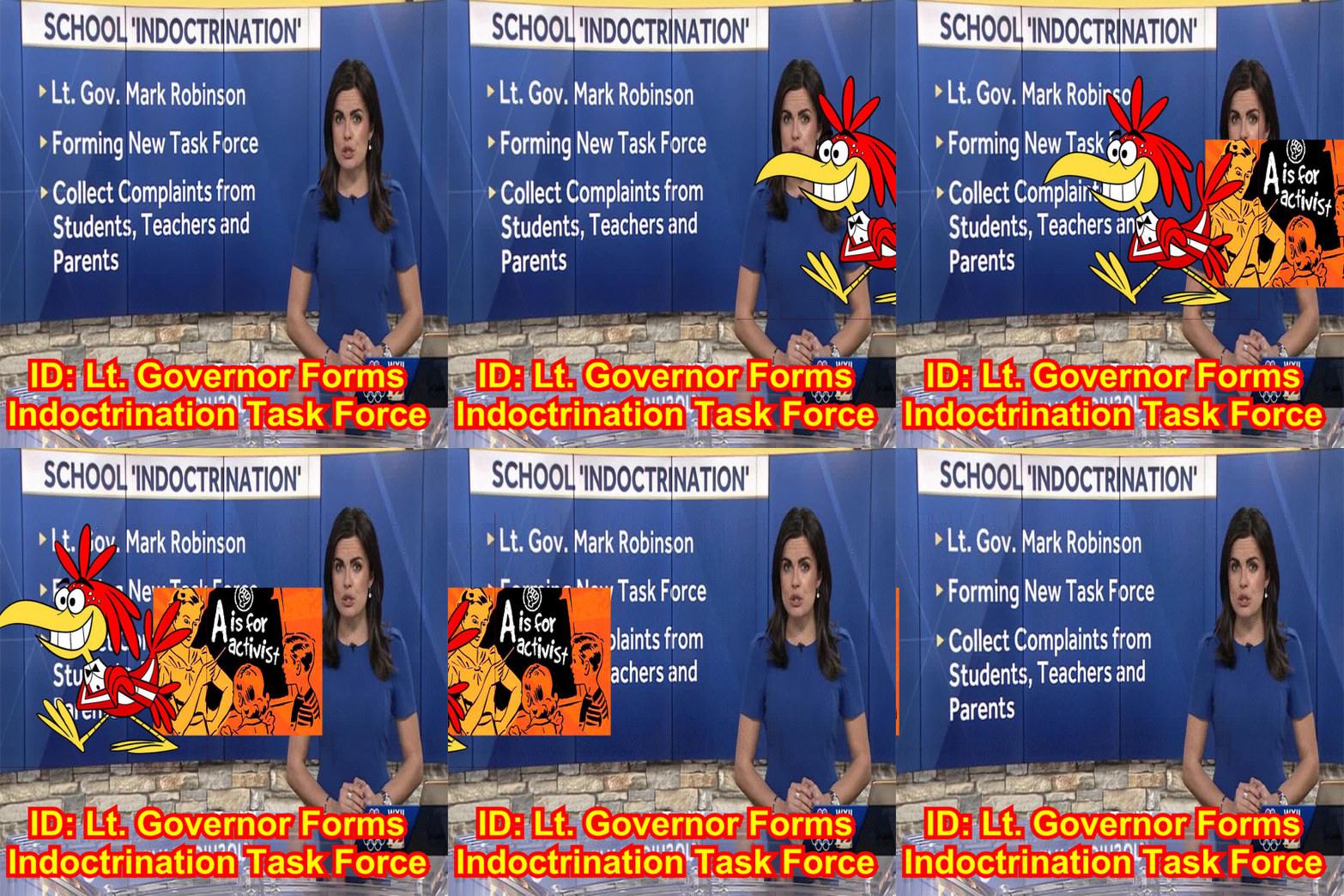
Idaho Lt. Governor Janice McGeachin has announced the formation of a Task Force to Examine Indoctrination in Idaho Education. 

You can go to an honest to God state website page where you can turn in an educator who is doing Naughty Indoctrination Things. 

“One of our primary goals with this task force is to give concerned citizens a voice regarding education in Idaho,” said Lt. Gov. McGeachin. “If you, your child, or someone close to you has information regarding problematic teachings on social justice, critical race theory, socialism, communism, or Marxism, please provide us with as much information as you are comfortable sharing.”

So if a teacher you know, or know of, or have heard about through the grapevine, or on a Facebook group, has been involved in "problematic teachings on social justice, critical race theory, socialism, communism, or Marxism," you can turn that teacher in to the state. And while the form calls for your name, McGeachin is quick to reassure the public that they can turn teachers in anonymously.

Again, I feel it necessary to point out once again that I am not making this up or exaggerating for effect (as I occasionally am wont to do). This is the official headline of the official press release from the official Lt. Governor's official office.

Idaho Lt. Governor Assembling Task Force to Examine Indoctrination in Idaho Education Based on Critical Race Theory, Socialism, Communism, and Marxism


In that release, the Lt. Governor notes “As I have traveled CONTINUE READING: CURMUDGUCATION: ID: Lt. Governor Forms Indoctrination Task Force

Friday, April 16, 2021

EdCo to Host “Antiracist Classroom” Event – Tennessee Education Report

EdCo to Host “Antiracist Classroom” Event – Tennessee Education Report
EDCO TO HOST “ANTIRACIST CLASSROOM” EVENT


April 24 at 11:30 AM (CT) The Educators’ Cooperative (EdCo) will  host a virtual conversation titled “Antiracist Teaching, Learning, and Leading from the Classroom:  Addressing the legacies of segregation and white supremacy in our schools, and adjusting our lenses with  Critical Race Theory in education.” The teachers of EdCo are dedicated to facilitating this essential antiracist  work cross-sector, for the benefit of all students. Registration for the event, which is offered to educators at  no cost, is now open at educatorscooperative.org. Non-educators may purchase a ticket for $75.  

The event will feature three expert panelists: 

Dr. Gloria Ladson Billings is a Teacher, Author, Professor, and Researcher whose work is fundamental in  the application of Critical Race Theory in education; she coined the terminology “Culturally Relevant  Pedagogy.” Her books include The Dreamkeepers: Successful Teachers of African American Children and  Crossing Over to Canaan: The Journey of New Teachers in Diverse Classrooms.  

Dr. Roni Ellington, Assistant Professor in Mathematics Education at Morgan State University, founded  the Transforming STEM Network to promote diversity and inclusion in STEM education. She is the  principal investigator on a National Science Foundation grant focused on incorporating culturally  responsive teaching into university mathematics classrooms.  

Ashford Hughes is the Executive Officer for Diversity, Equity & Inclusion for Metro Nashville Public  Schools, where he designs and implements initiatives that address academic and social-emotional  learning needs of the district’s diverse populations. He is Co-chairman of the Nashville My Brother’s  Keeper Network – a coalition that works to improve life outcomes for boys and young men of color  through internal agency policy review, education, and employment opportunities.  

EdCo Executive Director Greg O’Loughlin is “excited about this unique opportunity for teachers to learn  together from a leading scholar in the field and the researchers and community leaders who do the  work every day.” The no-cost tickets for educators are provided through the generosity of The  Community Foundation of Middle Tennessee. 

Wednesday, April 14, 2021

Whatever Happened To Current Events Lessons? | Larry Cuban on School Reform and Classroom Practice

Whatever Happened To Current Events Lessons? | Larry Cuban on School Reform and Classroom Practice
Whatever Happened To Current Events Lessons?


Nearly all social studies lessons that I taught between the 1950s and 1970s contained at least one weekly lesson on “current events.” In these lessons, I tried to connect contemporary happenings to past events I was covering in my U.S. history and world history classes. Moreover, for at least five years, I used cut outs from Time magazine covers portraying world leaders in the 1950s–China’s Mao, Ghana’s Nkrumah, France’s De Gaulle–positioned on a wall ledge to link a particular event that occurred that week to those faces on Time covers.

By the mid-1960s, I had learned to incorporate national events (e.g., civil rights movement and protests against the Vietnam War) into U.S. historical topics such as slavery and Reconstruction and anti-war activism during the Mexican and Civil Wars. Even with those linkages, I still would set aside at least one weekly lesson to connect the past to the present by focusing on “current events” through newspaper articles, political cartoons, and local events in the city. And throughout those years, most other social studies teachers maintained a current events lesson (see here and here)

Looks like those kind of lessons, however, are waning. Except for those instances where national attention is riveted such as the Minneapolis police officer who killed George Floyd, or sexual harassment allegations against men in powerful positions as New York Governor Andrew Cuomo, current events (data are scant on social studies and other subject matter teachers teaching such lessons) appear fleetingly in classrooms except in traditional Civics and Government courses required for high school graduation.

When did current events lessons begin in social studies classrooms and why?

The Progressive school reforms of the early 20th century including the teaching CONTINUE READING: Whatever Happened To Current Events Lessons? | Larry Cuban on School Reform and Classroom Practice

Thursday, April 8, 2021

Teacher Tom: Are Uncluttered Classrooms Really Best for Young Leaners?

Teacher Tom: Are Uncluttered Classrooms Really Best for Young Leaners?
Are Uncluttered Classrooms Really Best for Young Leaners?


The conventional wisdom is that an uncluttered classroom is best for young learners. I regularly see photos labeled as "classroom don'ts" with scads of posters and other art on the walls, things dangling from the ceilings, and materials stuffed willy-nilly on shelves. These busy, messy spaces, we're told, are full of distractions, making it difficult to concentrate. They are visually over-stimulating, whereas a cleaner, tidier space, with it's bare walls and organized shelves, calms children, which is, according to this theory, the proper mindset for learning. Indeed, research indicates that a tidy space may promote such desirable traits as healthy eating and generosity. People in tidy spaces are, likewise, more likely to follow rules, adhere to expectations, and to make "conventional" choices, which would, I presume, make them better at, say, passing a test.
"If a cluttered desk is a sign of a cluttered mind, of what, then, is an empty desk a sign?" ~Albert Einstein
Research also indicates that a messy space promotes creative thinking and stimulates new ideas. "Disorderly environments seem to inspire breaking free of tradition, which can produce fresh insights," according Kathleen Vohs, the University of CONTINUE READING: Teacher Tom: Are Uncluttered Classrooms Really Best for Young Leaners?

Big Education Ape: Teacher Tom: Let's Turn The World Around: Teacher Tom's Play Summit - https://bigeducationape.blogspot.com/2021/04/teacher-tom-lets-turn-world-around.html


Sunday, March 28, 2021

My Pandemic Classroom | deutsch29: Mercedes Schneider's Blog

My Pandemic Classroom | deutsch29: Mercedes Schneider's Blog
My Pandemic Classroom


Due to the complications associated with living life during this pandemic, my blogging frequency has taken quite the plunge this past year. Our school district has been in session full time, in person, since September. Faculty reported to school late August. In order to adjust for a delayed school year, our district cut many of our holidays even as the school day itself became longer to keep students from congregating. Desk cleaning happens with each change of class, and conveniences such as wooden hall passes cannot be used, so that means writing a pass on paper every time a student needs the restroom. For quarantined students, there’s Google Meet happening simultaneously as class meets in person. More than once I have had my class at a standstill because a quarantined student needed extra assistance via the bumbling that can easily happen when people are trying to work out an issue without the simplicity of being together in the same physical space.

In short, I am tired. Long-term tired. However, I have also accomplished a major goal: To date, and by God’s grace, I have not missed a single day of school. My only premature exit was two hours early one Monday to bring my mother to the dentist. As of this writing, my seniors have only three weeks to go (which is both a relief and pressure to get our work done and graded).

In my classroom, I have masked; I have distanced; I have cleaned; I have made careful decisions with my personal time so that I minimized the likelihood of CONTINUE READING: My Pandemic Classroom | deutsch29: Mercedes Schneider's Blog

DIARY OF A PUBLIC SCHOOL TEACHER!: Head, Shoulders, No Knees and Toes. Teaching Virtually.

DIARY OF A PUBLIC SCHOOL TEACHER!: Head, Shoulders, No Knees and Toes. Teaching Virtually.
Head, Shoulders, No Knees and Toes. Teaching Virtually.


I miss my class. :( 

I miss being with my class. 

I see them every day, cameras, on, cameras off. A glimpse here, a glimpse there.

I saw them once, some of them, when they met me at the school to pick up their "gifts" I got from DonorsChoose. 

We saw each other in "real life!" So exciting!

I miss getting up and going out the door, fighting traffic, road raging at those who wish to make me late.

I miss rushing to get ready because I am not the teacher who is there an hour before school starts.

I miss chatting with my colleagues.

I miss high-fiving my students and teaching them that saying "Good Morning" when someone says it to you is normal.

I miss my planning time that moves at twice the speed of light.

I miss small group at the kidney table. Small group in class vs. Breakout rooms? Small CONTINUE READING: DIARY OF A PUBLIC SCHOOL TEACHER!: Head, Shoulders, No Knees and Toes. Teaching Virtually.

Tuesday, February 2, 2021

The Whole Truth about Kids, Schools, and Covid-19 (Derek Thompson) | Larry Cuban on School Reform and Classroom Practice

The Whole Truth about Kids, Schools, and Covid-19 (Derek Thompson) | Larry Cuban on School Reform and Classroom Practice
The Whole Truth about Kids, Schools, and Covid-19 (Derek Thompson)


The following article comes from The Atlantic, January 2021. “Derek Thompson is a staff writer at The Atlantic, where he writes about economics, technology, and the media. He is the author of Hit Makers and the host of the podcast Crazy/Genius.”

Those school boards and superintendents who continue to keep schools closed in light of this evidence have the duty of explaining to their patrons why district schools have not re-opened. Perhaps the rates of infection among adults in the geographical area are very high and they are waiting for rates to come down. Or maybe there are insufficient funds to prepare buildings to meet Center for Disease Control guidelines. Or there are too many teachers refusing to enter schools because of underlying medical condition. Or there is a lack of phase-in plans for younger children and then older ones attending.

Whatever the reasons are, district policymakers need to explain clearly and coherently why their schools have not re-opened in light of the preponderance of evidence for opening classrooms to in-person instruction. That is task number one.

Federal health officials at the CDC this week called for children to return to American classrooms as soon as possible. In an essay in the Journal of the CONTINUE READING; The Whole Truth about Kids, Schools, and Covid-19 (Derek Thompson) | Larry Cuban on School Reform and Classroom Practice

Saturday, January 9, 2021

The Politics of Calling for No Politics: 2021 – radical eyes for equity

The Politics of Calling for No Politics: 2021 – radical eyes for equity
The Politics of Calling for No Politics: 2021


As a part of the education community, I noticed two immediate responses to the insurrection of the U.S. Capitol by domestic terrorists seeking to disrupt the confirmation of the next President of the U.S.

One response anticipated that (once again) teachers would be on the front line of addressing trauma by suggesting ways that examining the riot in DC could be (should be) incorporated into the classroom—notably for those teachers dealing with history.

Another response, however, was the both-sides warning calling for no politics in the classroom.

Some educators received the identical email shared after the November elections, essentially telling teachers not to take political sides in the classroom.

We stand in the first weeks of 2021 once again needing to clarify language and confronting just what being “political” means.

First, to remain neutral or to use the “both sides” approach (or to remain silent) is a form of politics—often imposed by those with power onto those who CONTINUE READING: The Politics of Calling for No Politics: 2021 – radical eyes for equity


Thursday, December 24, 2020

You don’t know what you’ve got till it’s gone… | Live Long and Prosper

You don’t know what you’ve got till it’s gone… | Live Long and Prosper
You don’t know what you’ve got till it’s gone…


GOT KIDS? GOT GRANDKIDS?

Have you tried schooling them at home during the pandemic? For most people, it hasn’t been as easy as they thought it would be. Never mind the fact that the only people who are helping their kids at home are those who can afford to stay home, or who can work from home, or who have been laid off so they’re home anyway. Many parents and caregivers have found that a well-trained teacher, who understands curriculum and child development is a luxury that we didn’t know we needed till it was gone.

Don’t it always seem to go that you don’t know what you’ve got till it’s gone.

And it’s going to get worse no matter who the next U.S. Secretary of Education is because Indiana’s public school policy is determined by the Indiana legislature along with the Indiana State Board of Education…

The pandemic is causing teachers to flee the profession

Our public education system may be on the verge of collapse. Indeed, most families with children enrolled in public school find patchwork systems of in-person and virtual instruction underwhelming at best. Teachers are overwhelmed and unable to keep stitching it together. Something has to CONTINUE READING: 

You don’t know what you’ve got till it’s gone… | Live Long and Prosper

Tuesday, December 15, 2020

Classrooms of the Future? | Larry Cuban on School Reform and Classroom Practice

Classrooms of the Future? | Larry Cuban on School Reform and Classroom Practice
Classrooms of the Future?


Technological fantasies of the future school have been around for decades. Here’s one from 1910. Note all of the information going into students’ heads comes from textbooks fed into a wood chipper.

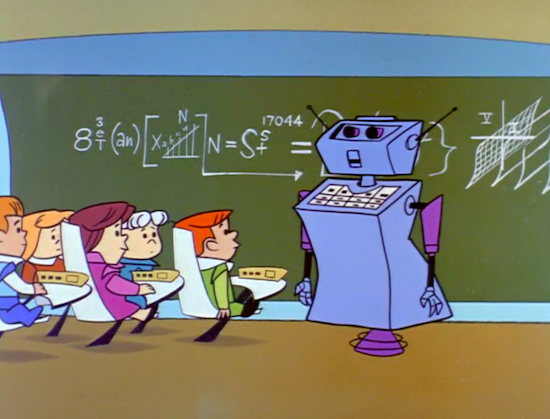
  Or another from 1963 cartoon called “The Jetsons.”

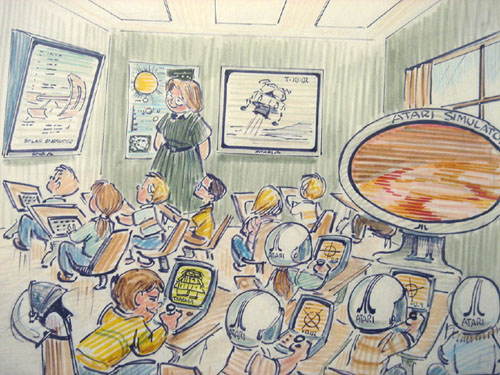
 Or this one in 1982 predicting that the future school will be monopolized by the then dominant company Atari.

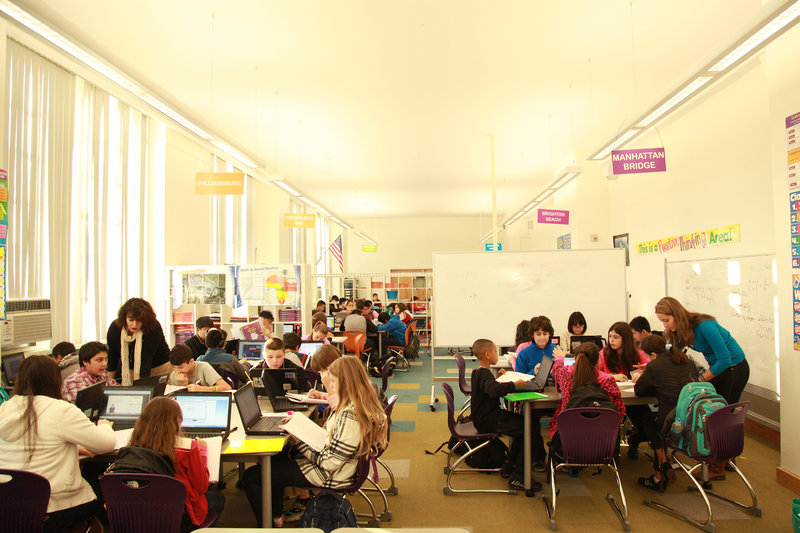
And then “Meet The Classroom of the Future” in 2015 at David Boody Intermediate School (IS 228) in New York City.

 Modeled after the School of One, an  innovative program that began in New York City a few years ago, sixth-to-eighth grade students work at their individual skill levels based on data collected from state and  school tests, diagnostic assessments, and past performance. From this data bank, software installed on laptops presents individual lessons tailored for each student to work through on the screen daily. These individual lessons become the day-to-day “playlist” for each student in various subjects. Teachers monitor, adapt, and enrich  lessons for each student.  The blended learning program at IS 228 touts “personalized instruction” for  over 800 students (2012) who apply to its varied magnet programs.

The journalist who described his visit to IS 228 began the article by saying: “The classroom of the future probably won’t be led by a robot with arms and legs, but it may be guided by a digital brain.” Describing a sixth grade math class at David Boody Intermediate School,  the classroom of the future  “may look like this: one room, about the size of a basketball court; more than 100 students, all plugged CONTINUE READING: Classrooms of the Future? | Larry Cuban on School Reform and Classroom Practice

Saturday, December 5, 2020

UCL Institute of Education: Does Class Size Matter? We’ll Get a Better Answer If We Rethink the Debate | National Education Policy Center

UCL Institute of Education: Does Class Size Matter? We’ll Get a Better Answer If We Rethink the Debate | National Education Policy Center
UCL Institute of Education: Does Class Size Matter? We’ll Get a Better Answer If We Rethink the Debate


For many teachers, large classes present problems which adversely affect their practice and their pupils’ learning. This is what our surveys show. But researchers and commentators often have a different view. For them the class size debate can be summed up with the question: does class size affect pupil attainment?

As we show in our new open access book, ‘Rethinking Class Size: The Complex Story of Impact on Teaching and Learning’, published by UCL Press this week, researchers (contrary to a practitioner view) commonly find that the statistical association between class size and attainment is not marked and so conclude that class size does not matter much. This has led some to even suggest that we could raise class sizes, and instead invest savings in professional development for teachers. Currently, in the wake of the Covid pandemic and teacher absences, there are reports of some schools being forced to create supersized classes of 60 pupils.

The view that class size is not important is probably the predominant view among researchers and policy makers, and so they may be relatively relaxed about increases in class size. We therefore need – more than ever – good quality evidence on class size effects, but in our view much research is limited and leads to misleading conclusions.

We identify three problems. One issue is that the exclusive concern with the association between class size and academic attainment in first language and mathematics is limited.  It may be that teachers in large classes prioritise these subjects (and this might help account for the relatively small difference in pupil academic outcomes, compared to smaller classes) but this raises a question about the possible way large classes affect other pupil ‘outcomes’, e.g., creativity, independent and critical thinking and motivation to learn. There is very little research that addresses this question.

Second, class size is not an ‘intervention’ like the distinct pedagogical approaches with which it CONTINUE READING: UCL Institute of Education: Does Class Size Matter? We’ll Get a Better Answer If We Rethink the Debate | National Education Policy Center
Tuesday, October 13, 2020

ANDRE PERRY: The first presidential debate showed our leaders are not acting that way

The first presidential debate showed our leaders are not acting that way

‘Stand by.’ ‘Shut up.’ Is this really what we want to teach our children?
Our leaders must also be teachers, but they’re not acting that way


Frustrated by interruptions from President Donald Trump at the first presidential debate, an exasperated former Vice President Joe Biden blurted, “Would you shut up, man?” Biden sounded like a bad substitute teacher who was being overrun by a belligerent child.
During that exchange, I turned to my 9-year-old son, who was sitting next to me, and asked him to leave the room. I’d hoped by watching the candidates discuss government, leadership and the most important issues facing our world, he would learn something positive. But it was no teaching moment. Instead, bad teaching was on full display.
Our elected officials may not see themselves as teaching professionals, but that is exactly what they are. They model behavior with their words, deeds and policies. When they promote laws and regulations based on science, whether it’s following public health recommendations about masks or pushing for legislation that would take climate change seriously and shrink our carbon footprint, children memorizing their periodic tables understand that what they’re learning matters. When our officials promote free and fair elections and demonstrate how power is passed on peacefully in a democracy, children witness the pages of their social studies textbooks come to life. And when they act out our country’s core values of equality and unity by ensuring every American is treated with fairness and justice, CONTINUE READING: The first presidential debate showed our leaders are not acting that way

Monday, August 3, 2020

The COVID Classroom: Anything But Normal | deutsch29

The COVID Classroom: Anything But Normal | deutsch29

The COVID Classroom: Anything But Normal


Last week, I went to my classroom to begin preparing it for teaching COVID-style.
I was fortunate enough to be able to pack up my classroom once our governor declared in April 2020 that students would not be returning in person to school for the remainder of the 2020-21 school year. So, in some respects, preparing my room for pandemic teaching was rather easy since my personal possessions will remain packed away.
My desk is bare except for my roll book, my plexiglass clipboard (which may prove useful as a barrier) and my hand sanitizer.
No Kleenex on the desk since an open box of tissue could become contaminated by COVID-19.
No classroom set of books, either, so I dissembled the bookshelf to make room for socially-distanced student desks.
No need for my podium for student presentations, so I moved that further back and put my reading stool behind it. (To leave my stool in its usual place at the front of the room would have me too close to my students, who will also not be allowed to move to front of room to take turns leading the class. Too much movement; not enough space.)
The podium and stool are crowded at front of room near my projector cart and CONTINUE READING: The COVID Classroom: Anything But Normal | deutsch29