Latest News and Comment from Education

Saturday, December 26, 2020

Megan Prather: The year in Oklahoma education - NONDOC

The year in Oklahoma education


What a long, strange year it’s been.

We collectively coped with adjusting to COVID-19, an election and a massive power outage all in the span of 365 days. For that, I think we all deserve an air high-five.

But before we plunge into a new year, take a moment to stroll down Oklahoma education memory lane with this collection of notable NonDoc stories from the unforgettable year of 2020.

School’s out for now: ‘This is a dynamic situation’

In March, the Oklahoma State Board of Education ordered all public, charter and virtual schools closed until April 6 to help curb the spread of the novel coronavirus.

“This is a dynamic situation. It’s very fluid,” State Superintendent of Public Instruction Joy Hofmeister said during an emergency State Board of Education meeting March 16.

The Board of Education was confronted with other COVID-related issues throughout the year, including failed calls for a statewide school mask mandate as well as cancelling school report cards for the 2020/2021 school year.

Stitt announces $10 million in PPE for schools CONTINUE READING: The year in Oklahoma education

Kwanzaa 2020: Celebrating Beautiful and Resilient Blackness

Kwanzaa 2020: Celebrating Beautiful and Resilient Blackness
Habari Gani? This Kwanzaa, We’re Celebrating All the Beautiful and Resilient Blackness We Saw in 2020


Kwanzaa is a Black holiday that takes place between December 26 and January 1 each year, during which Black people are encouraged to celebrate their community, culture, and kinship including by reflecting on the Seven Principles, or Nguzo Saba, that characterize some of our shared values as a people.

Illustration for article titled Habari Gani? This Kwanzaa, We’re Celebrating All the Beautiful and Resilient Blackness We Saw in 2020
Kwanzaa 101 for the Uninitiated, Self-Conscious, or Confused

Y’all, Kwanzaa is LIT. Seriously. What other uniquely African-American holiday invites you to spend

Read more

Umoja

Umoja—striving for unity in the family, community, nation, and race—is celebrated on the first day of Kwanzaa and is the holiday’s most foundational principle. But when the COVID-19 pandemic barreled into our lives about nine months ago and forced us into isolation and quarantine, it felt like we were being condemned to experience the exact opposite of unity. Then came Black people and music. First out of the gate was DJ D-Nice, with his “Club Quarantine” series on Instagram Live. The veteran deejay told The Root in March that the cancellation of nightlife events caused by the pandemic, plus his well-honed knowledge of music’s ability to bring people together, prompted him to spin tunes while streaming himself live in order to “help lift spirits.” With sets that ran as long as nine hours, D-Nice made space for the definition of unity by gathering more than 100,000 viewers who came to jam out together—including people like Barack Obama, Quincy Jones, and Oprah.

Timbaland and Swizz Beatz then kept the online party going by launching the Verzuz series of musical battles on Instagram Live. With match-ups between big names like Babyface and Teddy Riley (a two part battle which birthed a CONTINUE READING: Kwanzaa 2020: Celebrating Beautiful and Resilient Blackness

How Beliefs in School Reform Evolve Over Time | Larry Cuban on School Reform and Classroom Practice

How Beliefs in School Reform Evolve Over Time | Larry Cuban on School Reform and Classroom Practice
How Beliefs in School Reform Evolve Over Time


School reform is steady work. As a teacher, administrator, superintendent, and university researcher for over six decades in working to reform classrooms, schools, and districts, it should come as no surprise to readers that what I thought about reform in the mid-1950s as a teacher, what I believed school reform was when I ran a district in the 1970s and 1980s, and how I conceptualize reform today as a retired professor has changed. Looking back at my strongly held beliefs on reforming schools then and how, I can see how they have morphed into quite different views about school reform today.

There may be wisdom in this “confession” about evolving beliefs about school reform. And even if some readers were to think so, I am well aware that wisdom cannot be told to others because reflecting on one’s direct experience more often than not trumps others’ advice. So I offer these reflections on how one educator’s beliefs about reform changed over time to get readers to ponder what their beliefs once were and are now about teaching, learning, and, yes, of course–reforming schools.

Changes in reform beliefs over time is surely common especially as educators accumulate different experiences over time. What may be uncommon is to document those changes and then reflect on those changes in beliefs.

And that is what I have done in the final chapter of my next book. What I present below is a draft–not a final version so I am open to CONTINUE READING: How Beliefs in School Reform Evolve Over Time | Larry Cuban on School Reform and Classroom Practice

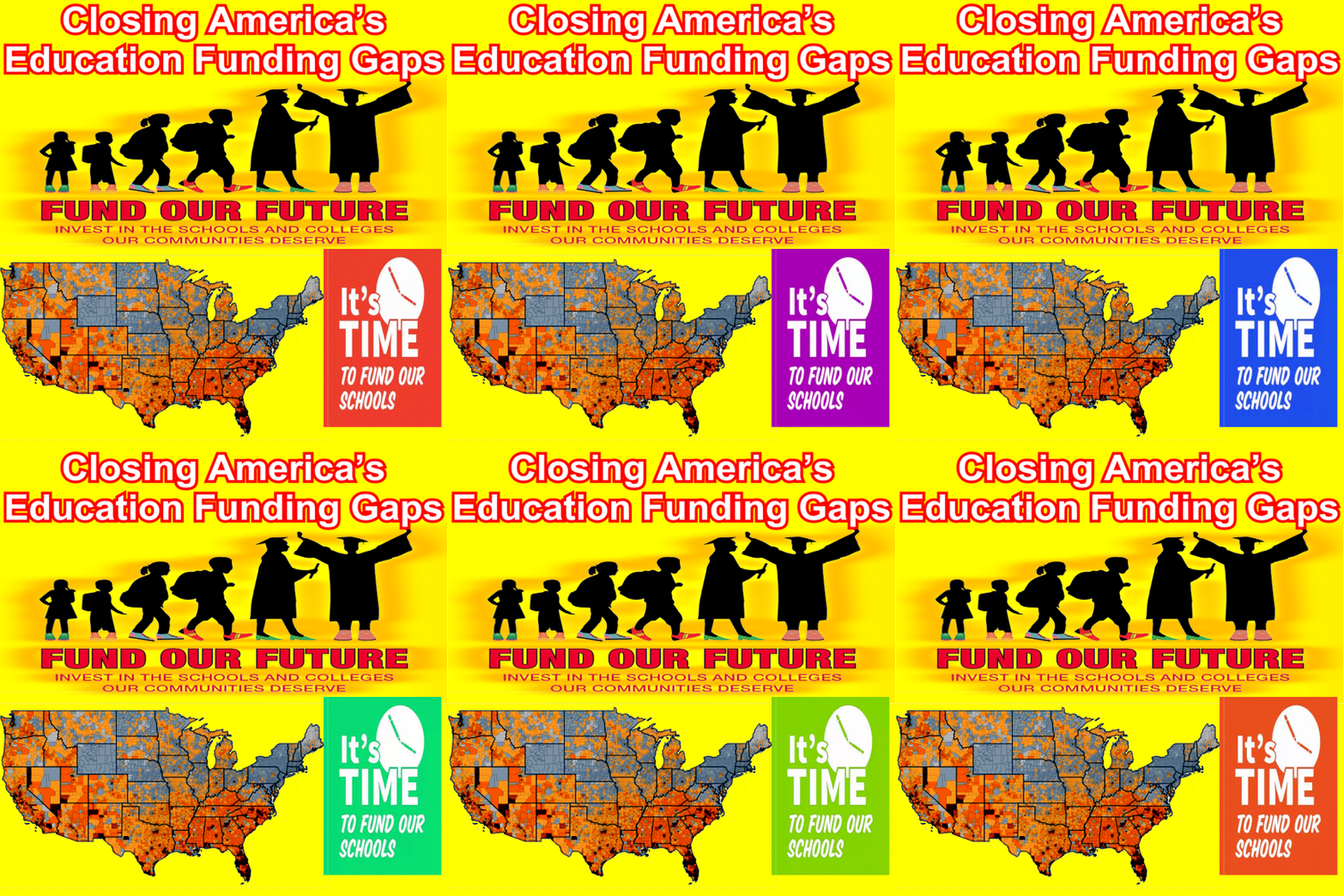
REPORT: Closing America’s Education Funding Gaps - THE CENTURY FOUNDATION

Closing America’s Education Funding Gaps


Key Findings

Our cost model and interactive map identify every district in the country with a funding gap—that is, where current spending is below the amount that our model estimates is necessary to achieve average outcomes, based on that district’s unique geography and student demographics. The result is that broad swaths of the country, including much of the south, southwest, and west United States, show sizable funding gaps.

Similarly, many of the nation’s large cities, which have more diverse school districts, have significantly larger funding gaps. As the COVID-19 pandemic constrains state and local budgets further, additional cuts to public education spending may exacerbate these gaps.

District-Level Findings

  • Districts with high concentrations of students living in poverty are more likely to have funding gaps, and these students experience significantly larger funding gaps, than wealthier districts.
  • Low-income school districts are more than twice as likely to have a funding gap as higher income districts.
  • Districts with the highest concentrations of poverty—those in the highest 20 percent of districts by Census poverty rate—are 2.6 times more likely to have a funding gap.
  • The average gap in these districts is more than $6,700 per pupil.
  • Districts with high concentrations of Latinx and Black students have much larger funding gaps, and are more likely to have funding gaps to begin with, than majority white districts.
  • Districts that have more than 50 percent Black or Latinx enrollment are nearly twice (1.95 times) as likely to have a funding gap than districts with minority enrollment less than 50 percent.
  • Nationally, districts with over 50 percent Black and/or Latinx students face a funding gap of more than $5,000 per pupil on average (see Figure 1).


Founded as the Co-operative League in 1919 by the progressive business leader Edward Filene, and later renamed to the Twentieth Century Fund, TCF is one of the oldest public policy research institutes in the country. As we left behind the twentieth century, we entered into the early 2000s with the same mission but a new name: The Century Foundation.

Over our long history, we have been at the forefront of positive change in some of the most critical areas of domestic and foreign policy. Today, TCF continues this legacy by researching issues that range from pursuing fairness and opportunity in education; protecting workers and further strengthening the social safety net; encouraging democracy and ensuring personal rights in the tech age; and promoting stability and prosperity abroad.

Our experts come from academia, journalism, and public service—all with a shared commitment to advancing progressive ideas that benefit the public good. Through our evidence-based research and policy analysis, we seek to inform citizens, guide policymakers, and reshape what government does for the better.

Click here for our 2020 annual report.

SURVEY: BRUCE LESLEY WANTS TO KNOW What's your priority for children for 2021? - First Focus Campaign for Children

Children's Action Network - First Focus Campaign for Children
SURVEY: BRUCE LESLEY WANTS TO KNOW
What's your priority for children for 2021?


Ensuring all children have health coverage

Increasing access to quality child care and early childhood programs

Designating a White House Office of Children to oversee children’s issues

Ending the school-to-prison pipeline and placing more counselors in schools

Providing greater budget transparency on children’s issues

Cutting child poverty rates in half within the decade

Ensuring racial equity for children’s outcomes

Prioritizing well-being and legal protections for immigrant youth


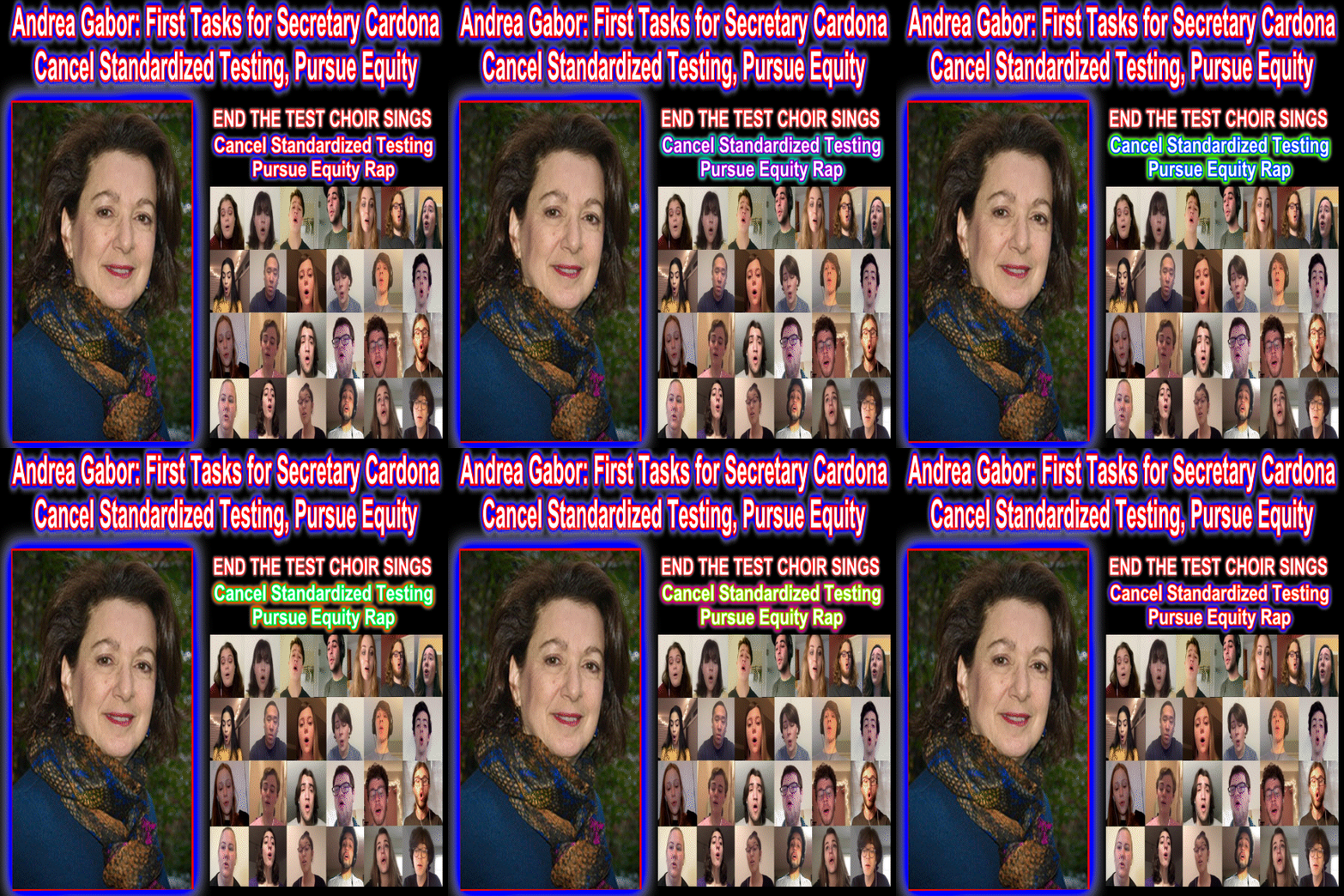
Andrea Gabor: First Tasks for Secretary Cardona: Cancel Standardized Testing, Pursue Equity | Diane Ravitch's blog

Andrea Gabor: First Tasks for Secretary Cardona: Cancel Standardized Testing, Pursue Equity | Diane Ravitch's blog
Andrea Gabor: First Tasks for Secretary Cardona: Cancel Standardized Testing, Pursue Equity


Andrea Gabor has some good ideas about what the new Secretary of Education must do.

President-elect Joe Biden’s nominee for education secretary, Miguel Cardona, will face a host of pandemic-related challenges that have disproportionately affected the nation’s neediest students. In addition to learning setbacks, the prolonged isolation has caused social and emotional trauma. 

The challenges will continue to mount once the Covid-19 crisis is over.

Government resources will be strained at all levels, and continued Republican control of the Senate would likely limit extra funding available for K-12 education. 

In the absence of significant support for state and local governments, beyond the money included in any year-end stimulus package, Cardona, who has been Connecticut’s education commissioner, will need to concentrate on closing funding inequities between poor and affluent school districts in order to avoid the kind of educational setbacks that followed the 2008 recession. 

Although recent data indicate that the learning losses this CONTINUE READING: Andrea Gabor: First Tasks for Secretary Cardona: Cancel Standardized Testing, Pursue Equity | Diane Ravitch's blog

CURMUDGUCATION: No Test In 2021 (A BS Test Reader)

CURMUDGUCATION: No Test In 2021 (A BS Test Reader)
No Test In 2021 (A BS Test Reader)


Among the many things that the new secretary of education really needs to do upon taking office, a big simple one is this--cancel the Big Standardized Test for 2021. I've been banging the "Get Rid of the BS Test" for years, but all the reasons it's a lousy, toxic, destructive-and-not-even-useful force in education are amplified a hundred-fold by our current pandemess. 

Many wise folks have pointed this out, like Andrea Gabor at Bloomberg and the indispensable Mercedes Schneider at her own blog. And I've been pointing it out, too, both here at the Institute and over at Forbes. So rather than whipping up a new skin for old wine, I'm going to offer this selection of my pieces from the past that all work to make the argument. Read, peruse, and most of all, share so that the tiny who-like chorus can pierce the beltway. Because waiving 2021's test would take the New Secretary five minutes and be hugely beneficial to students and schools in the US.

Is the Big Standardized Test a Big Standardized Flop?

A couple of years ago, some members of the education disruptors club, especially Jay Greene, started to admit that the BS Test wasn't actually connected to real world results.

Six Arguments For Giving the Test in 2021 (And Why Biden's Ed Secretary Should Ignore Them)

At Forbes, my most recent rebuttals to the standard "we have to CONTINUE READING: CURMUDGUCATION: No Test In 2021 (A BS Test Reader)

THIS WEEK'S WILDNESS Dad Gone Wild Nobody reads it, everybody quotes it. + TENNESSEE EDUCATION REPORT

 Dad Gone Wild – Nobody reads it, everybody quotes it.


THIS WEEK'S WILDNESS 
Dad Gone Wild 
Nobody reads it, everybody quotes it.


DEC 24

A MELDING OF HOLIDAY CLASSICS
“War is fought in mystery. The truth can take days to travel, and ahead of truth flies rumor, and it is ever hard to know what is really happening, and the art of it is to pluck the clean bone of fact from the rotting flesh of fear and lies.” ― Bernard Cornwell, The Last Kingdom ‘Twas the night before Christmas, when all through the house. Not a creature was stirring, not even a mouse; The stocki

DEC 21

BACK ROOM QUESTIONS
“Success is stumbling from failure to failure with no loss of enthusiasm.” ― Winston S. Churchill Things are bad in Tennessee in relation to COVID-19. Case rates are the highest in the country, and open hospital beds are becoming scarce. As Christmas approaches, fears are ratcheting up for another after the holiday explosion. Especially as many schools are scheduled to re-open for in-person learn

DEC 18

A FEAR OF LOOKING FORWARD
“don’t write out of what I know; I write out of what I wonder. I think most artists create art in order to explore, not to give the answers. Poetry and art are not about answers to me; they are about questions.” ― Lucille Clifton As the first 

Dad Gone Wild – Nobody reads it, everybody quotes it.

TENNESSEE EDUCATION REPORT

EDUCATION POLITICS AND POLICY IN THE VOLUNTEER STATE


Just Kidding
Apparently, Gov. Bill Lee doesn’t really believe the COVID-19 pandemic is all that serious. Despite a prime time address Sunday in which he “strongly urged” and made some suggestions, there’s been very little real action. What action there has been reflects a Governor who is not actually all that concerned about the safety and well-being of those in schools. WPLN’s Alexis Marshall has more : But
Thoughts on Dr. Miguel Cardona
Carol Burris from the Network for Public Education shares some thoughts on President-elect Joe Biden’s choice for Education Secretary. Additionally, she includes some notes from Diane Ravitch. Here they are: The Biden Administration selected Dr. Miguel Cardona, the State Superintendent of Connecticut, as his Secretary of Education. We congratulate Dr. Cardona who has dedicated his life to public
Turkey Farmer
Nashville education blogger TC Weber offers some insightful commentary on Gov. Bill Lee’s speech on the state’s ongoing COVID-19 crisis . Here are some highlights: What you missed remains unclear because the Governor managed to address a crisis without offering any clear direction. There were a lot of suggestions, and a few warnings, but no mandates. In essence, a request was entered, that if Ten
Lack of Action
Tonight, Gov. Bill Lee addressed the State of Tennessee in response to a growing crisis as Tennessee is a national and world leader in COVID cases per capita and in the rate of spread of the disease. Lee insisted that masks work and then refused to issue a mask mandate. He did issue an Executive Order that says very little. It limits indoor social gatherings to 10 or less people but allows high s
Kelsey Sends Grinchy Voucher Christmas Card
Tennessee’s “Mr. Voucher” State Senator Brian Kelsey sent Christmas greeting cards with a grinchy message about his non-stop work to privatize Tennessee’s public schools. Apparently, even the “Season of Giving” is one