Tuesday, February 11, 2020

Education Reform De-professionalizes Women Educators – radical eyes for equity

Education Reform De-professionalizes Women Educators – radical eyes for equity

Education Reform De-professionalizes Women Educators

Who were your teachers?
In elementary school, nearly 9 of 10 teachers are women; by high school, about 6 of 10 are women. And nearly all of your teachers, 80%, were white (see NCES data).
As a student and a teacher, then, I have spent a great deal of my life in spaces where women are the overwhelmingly majority; often I am the only man in the room.
Recently, while I was presenting at two education conferences (South Carolina Council of Teachers of English and Wisconsin State Reading Association), I had several important experiences with recognizing teaching as a profession constituted by mostly women.
At SCCTE, I attended a session led by SC for Ed, making eye contact with one of the organization’s leaders at one point in recognition that I was the only man in the room. This session was on teacher activism and the need to inform state legislators about education while the state considers a major education bill.
As the discussion focused on many of the state representatives being condescending, I offered to the group that many of the problems faced in CONTINUE READING: Education Reform De-professionalizes Women Educators – radical eyes for equity

CURMUDGUCATION: Trump and DeVos Abandon Charter Schools

CURMUDGUCATION: Trump and DeVos Abandon Charter Schools

Trump and DeVos Abandon Charter Schools


Surprise! Never mind Sanders or Warren. Just like that, the charter supporters have found themselves abandoned by the Trump administration.

The Trump budget axes federal support for charter schools, rolling the federal money for charters into a big fat all-purpose block grant, a big chunk of money retrieved from various programs that have been deemed redundant and ineffective. States will now get a big pile of money that they can spend on a loosely defined bunch of Education Stuff.


If they want to spend some of that on charter schools, they can. But by combining the various program moneys, the feds have now put charters in the position of having to compete on the state level against other programs for things like education for homeless children (you can see more of the details here in the department's budget summary).

Charter folks are not happy. National Review gave Nina Rees (President and CEO of the National Alliance for Public [sic] Charter Schools) a bunch of space to count all the ways she doesn't like this, from leaving families with fewer options to it would give too much power to folks who are against charters to, well, this fairly honest statement from Twitter


Pity those poor entrepreneurs.

This doesn't come out of nowhere. DeVos has always been pretty clear that she's interested in CONTINUE READING: 
CURMUDGUCATION: Trump and DeVos Abandon Charter Schools

2 Big Teachers Unions Call For Rethinking Student Involvement In Lockdown Drills | 89.3 KPCC

2 Big Teachers Unions Call For Rethinking Student Involvement In Lockdown Drills | 89.3 KPCC

2 Big Teachers Unions Call For Rethinking Student Involvement In Lockdown Drills


Ryan Pascal, a 17-year-old student at Palos Verdes High School near Los Angeles, says when her school holds active shooter drills, it's "chaos." The first time it happened, not long after the shooting at Marjory Stoneman Douglas High School in Parkland, Fla., in 2018, rumors started flying over Snapchat and text that the school was really under attack.
"We had some students trying to stack up desks to blockade the door. We had some students sort of joking around because they weren't sure how to handle this. There are other students who are very, very afraid."
On top of all the other stresses of high school, she says, some students are now on constant alert: "When the little bell before an announcement happens, or when the fire alarm goes off, you can see this fear in students' faces as they wonder, is this going to be a lockdown? Is this a drill? What's happening? There's so much anxiety just by a little trigger like that."
Ninety-five percent of American public schools conduct some form of regular active shooter safety drill — sometimes called a lockdown or active threat drill — according to the National Center for Education Statistics. But concerns are growing that these drills have not been proven effective in preventing violence and that they may even traumatize some students.
Now the advocacy group Everytown For Gun Safety is joining with the American Federation of Teachers and the National Education Association — the nation's largest education unions, with several million members — in calling for schools to reassess the use of lockdown drills.
In a white paper out Tuesday, the groups say they do not recommend active shooter training for students. And if schools do choose to do these drills with students, they CONTINUE READING: 2 Big Teachers Unions Call For Rethinking Student Involvement In Lockdown Drills | 89.3 KPCC


School Reforms That Are Persistent and Admired But Marginal (Part 1) | Larry Cuban on School Reform and Classroom Practice

School Reforms That Are Persistent and Admired But Marginal (Part 1) | Larry Cuban on School Reform and Classroom Practice

School Reforms That Are Persistent and Admired But Marginal (Part 1)


A head-scratching puzzle of school reform over the past century is the innovation that arrives in tinsel and enters tax-supported public schools. Often districts adopt such glittering new programs and they settle into protected niches. But, and here is the puzzle, praised and admired as they are, they cannot break out of that nook. They stick around at the edges of the system remaining isolated, failing to spread throughout the district.
Early 20th century Progressives had their Project Method and the Dalton Plan. Both were adopted in many public schools because they seemingly solved organizational, curricular, and instructional problems. And they had internal constituencies of teachers and administrators yet they remained on the periphery of school systems. They did not become standard practices across classrooms.
Mid-century curricular reformers had their New Math. Late-20th century insurgents rallied around Coalition of Essential Schools and Core Knowledge programs. And early 21st century reformers have their problem-based learning and International Baccalaureate programs still awaiting that magic moment when the “system” adopts the innovation district wide completely altering how teachers teach and students learn. All had supporters either inside or outside districts (or both) but failed to move from the margins to become regular programs across districts.
To many reformers, the difficulty of getting adopted into public schools appears CONTINUE READING: School Reforms That Are Persistent and Admired But Marginal (Part 1) | Larry Cuban on School Reform and Classroom Practice

All Things Education: Love Grow Your Own (but not without the actual growth part)

All Things Education: Love Grow Your Own (but not without the actual growth part)

Love Grow Your Own (but not without the actual growth part)


The Governor of Virginia, Ralph Northam, recently announced a grow-your-own type of program for teachers. According to this piece:


On Monday, Governor Ralph Northam unveiled what he called a potential new solution to Virginia’s teacher shortage problem. Northam announced a proposed $1 million investment toward attracting STEM teachers from historically black colleges and universities (HBCUs).  
It's called UTeach and it gives secondary teaching certificates to students who graduate university with degrees in things like biology or chemistry.
So, I am all for "Grow your Own," state-sponsored, and fully funded alternative teacher credentialing programs, and this one certainly will address three problems at once: low rates of teacher recruitment and retention, low numbers of teachers qualified to teach STEM subjects, and an insufficient number of Black teachers in our public schools. Furthermore, it won't cost the teacher candidates. And, we need more people of African descent in higher-level STEM positions, so having more Black STEM teachers should help with that.

That being said, I really hope the plan is not to just hand off teaching licenses to college graduates without giving them CONTINUE READING: 
All Things Education: Love Grow Your Own (but not without the actual growth part)


Download the new Screens in Schools Action Kit! | Parents Across America

Download the new Screens in Schools Action Kit! | Parents Across America

Download the new Screens in Schools Action Kit! 


From our friends at the Children’s Screen Time Action Network, a project of Campaign for a Commercial-Free Childhood, comes the Screens in Schools Action Kit, released just today. In 2016, Parents Across America did a deep dive into the edtech movement. Since then, classroom digital device use by students has skyrocketed and increasingly, parents, students, and educators alike are voicing their concerns about the use, over-use, and misuse of these devices.
Please download, read, and share the Screens in Schools Action Kit! It includes a wealth of current information and research in addition to helpful advocacy tools. Parents Across America is proud to have been a collaborative partner in the creation of the Screens in Schools Action Kit and we’re grateful for all of the work that’s gone into creating it. It’s a fantastic resource and we’re certain it will be a popular and essential go-to guide for those who care about the education and well-being of children.
From the Children’s Screen Time Action Network:
“A groundbreaking resource has been created “by teachers and parents, for teachers and parent” to address widespread overuse of edtech, which is creating adverse impacts on children’s learning, health, and privacy. The Screens in Schools Action Kit from the Children’s Screen Time Action Network, a project of Campaign for a Commercial-Free Childhood, walks you through the process of advocating for reduced classroom screen time.  Download it now for free!
Inside, you’ll find:
●       a clear articulation of the problems posed by edtech;
●       thoroughly-researched information on the negative effects of edtech on children’s physical and mental health, learning, and privacy;
●       an extensive library of resources for parents, including templates for petition and letter writing campaigns, legal strategies, and much more;
●       a comprehensive library of resources for educators, including resources for teachers’ unions, based on successful advocacy campaigns;
●       a curated bibliography of books that outline the problems with children’s screen use, as well as workable and proven solutions for families and schools.
Every child has a right to an education shaped by teachers, not devices and edtech companies – and we hope you’ll download, use, and share the Screens in Schools Action Kit to ensure that they get it.”
Download the new Screens in Schools Action Kit! | Parents Across America

Monday, February 10, 2020

Clarifications: Greenville desegregation: Academic achievement gap slowly closing, but inequities persist – radical eyes for equity

Clarifications: Greenville desegregation: Academic achievement gap slowly closing, but inequities persist – radical eyes for equity

Clarifications: Greenville desegregation: Academic achievement gap slowly closing, but inequities persist


Ariel Gilreath offers a strong overview in her Greenville desegregation: Academic achievement gap slowly closing, but inequities persist. A key point in this look at desegregation confronts the disturbing consequences of South Carolina’s libertarian streak:
The public school district in Greenville County became the last major district in South Carolina to integrate in 1970. South Carolina was the second-to-last state in the nation. On Feb. 17, Greenville schools will mark 50 years since the district was integrated.
In those 50 years, though policies and tests have changed, the academic achievement gap has persisted, and so has inequity.
Desegregation of schools in SC spurred the growth of private schools (white racists fleeing public schools) and provided the foundation for what would become known as the Corridor of Shame, a label that captures the historical political negligence in the state that has failed black, brown, and poor students in weak economic communities across the state.
Academic achievement, usually test scores, is strongly correlated with socioeconomic statuses of students homes and communities as well as with race (as the article notes, so-called racial minorities tend to be over-represented in poverty, and poverty is a key marker of low test scores).
Three aspects of the article deserve a bit of clarification and resources for CONTINUE READING: Clarifications: Greenville desegregation: Academic achievement gap slowly closing, but inequities persist – radical eyes for equity

PETER GREENE: Six Things To Know About The Trump-DeVos-Cruz ‘Education Freedom’ Plan

Six Things To Know About The Trump-DeVos-Cruz ‘Education Freedom’ Plan

Six Things To Know About The Trump-DeVos-Cruz ‘Education Freedom’ Plan

The early buzz says that Donald Trump will use a chunk of his State of the Union Address to plug a voucher-style program that Secretary of Education Betsy DeVos has been pushing for months under the name “Education Freedom.” The Houston Chronicle reports that Ted Cruz pitched the plan to Trump; Cruz has taken the lead on trying to turn DeVos’s dream into actual legislation.
If you haven’t been following DeVos’s school choice initiative, here are a few basic takeaways to help follow what Trump is talking about.
How Does It Work?
It’s a tax credit scholarship plan, and many states already have one.* Here’s how they work. Corporations or individuals can contribute to the plan instead of paying their taxes. They hand their money to a scholarship organization, which in turn issues scholarships to students. The money can be used to pay for transportation, remedial programs, homeschooling materials, or, most commonly, private school tuition.

* Pennsylvania is one of those states. An unsuccessful attempt to expand the program was referenced by Trump in his speech. CONTINUE READING: Six Things To Know About The Trump-DeVos-Cruz ‘Education Freedom’ Plan
Big Education Ape: CATCH UP WITH CURMUDGUCATION + ICYMI- Ice Edition (2/9) - http://bigeducationape.blogspot.com/2020/02/curmudgucation-icymi-ice-edition-29.html 

Girl chosen by Trump to symbolize failing schools attends a popular charter program - The Washington Post

Girl chosen by Trump to symbolize failing schools attends a popular charter program - The Washington Post

Girl chosen by Trump to symbolize failing schools attends a popular charter program


The Philadelphia fourth-grader whom President Trump singled out during his State of the Union address as one of thousands of students “trapped in failing government schools” actually attends a sought-after charter school.
Janiyah Davis and her mother, Stephanie Davis, were seated in the House chamber for the president’s prime-time address last week. Trump said Janiyah was one of thousands of students on a waiting list for private school scholarships, and he urged Congress to pass a federal tax break that would reward donations to these scholarship programs.


In one of several made-for-TV moments, Trump then surprised Janiyah and her mother by announcing that a scholarship had become available. “Your long wait is over,” he said. “You will soon be headed to the school of your choice.”
The next day, officials said the scholarship was being personally funded by Education Secretary Betsy DeVos, a strong backer of what she and other Republicans call “school choice.” But administration officials would not answer any questions about where Janiyah attends school or where she hoped to go.
As it turns out, she attends the popular Math, Science and Technology Community Charter School III, known as MaST III, according to John F. Swoyer III, chief executive of the network that runs the school. The information was first reported in an account Stephanie Davis gave to the Philadelphia Inquirer.
Charter schools are taxpayer funded but independently run and are one of the options that school-choice proponents typically tout. MaST III received 6,500 applications for 100 spots next year, with slots distributed via lottery, Swoyer said. The school enrolls about 900 students.
For grades first through third, Janiyah attended Olney Christian School, which charges $5,200 a year in tuition, the Inquirer reported. Janiyah received a partial scholarship, but it was still a financial struggle CONTINUE READING: Girl chosen by Trump to symbolize failing schools attends a popular charter program - The Washington Post

OPINION: Education Freedom Scholarships ignore kids with disabilities

OPINION: Education Freedom Scholarships ignore kids with disabilities

OPINION: President Trump’s school choice proposal leaves students with disabilities behind

An expert on special education in charter schools weighs in on the proposed Education Freedom Scholarships and Opportunity Act
In his 2020 State of the Union address, President Donald J. Trump promoted the Education Freedom Scholarships and Opportunity Act as a means to “rescue” students “trapped in failing government schools.” His proposal, however, runs the risk of infringing on the civil liberties of students with disabilities.
Under the federal Individuals with Disabilities Education Act (IDEA), all public schools — traditional and charter — are required to provide a free and appropriate education to students with disabilities in the least restrictive environment. Private and religious schools, on the other hand, have no such obligation. They can, and do, simply turn away prospective students with disabilities.
The proposed Education Freedom Scholarships and Opportunity Act, which would create a $5 billion annual federal tax credit for businesses and individuals who donate to state scholarship-granting organizations, claims to expand educational options by granting students money that can be used to attend a school of their family’s choice, including private and religious schools.
The “choice,” provided by tax credit voucher programs, however, often does not exist for students with disabilities. As the National Council on Disability (NCD) has pointed out, many existing state voucher programs actually require families to give up their rights CONTINUE READING: OPINION: Education Freedom Scholarships ignore kids with disabilities

City Council Candidate Seeks A Working Relationship with School District

City Council Candidate Seeks A Working Relationship with School District

City Council Candidate Seeks A Working Relationship with School District

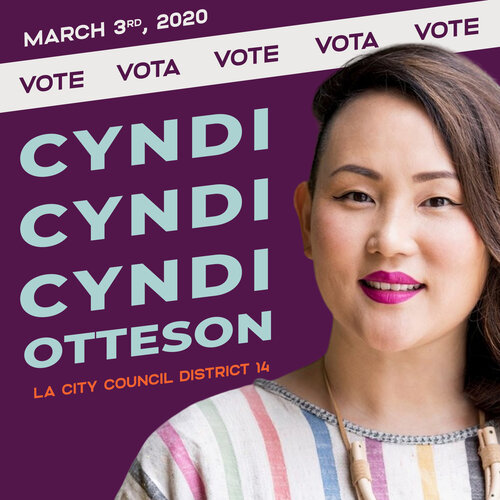
Image result for Cyndi Otteson

“I am the only major candidate in this race who has pledged to never take donations from the corporations, developers, and charter school investors that have controlled the City Council for decades.”- Cyndi Otteson
The FBI dropped a bomb onto CD14’s power base on November 7, 2018, when it raided the offices and home of long-time city councilman Josรฉ Huizar. A week later, the Council President removed Huizar from his committee assignments, depriving him of both influence and access to fundraising. He became an “invisible man” and was a no-show at community events. In the weeks following the raids he was “absent for all or part of 60% of [city council] meetings.”
With Huizar’s fall from grace, his wife’s plans also disintegrated. Just two months before the raid, she had launched her campaign to take his place, and “was the instant overwhelming favorite” to win. However, that effort ended within weeks of the FBI’s visit to her home. The impending Huizar dynasty was over before it began. There is no shortage of candidates looking to take advantage of the power vacuum.
Of the 23 people who filed their intention to run, five collected enough signatures to appear on the ballot. With his campaign coffers flush with cash from real estate developers, it appears that Kevin De Leรณn is the candidate to beat in this race. Fresh off his loss to Dianne Feinstein he needs someplace to wait out the two years left until the mayor’s office becomes vacant. Huizar’s protege, Monica Garcia is two years away from being termed out as an LAUSD Board Member and could use the city council seat as a way to continue collecting a public salary. Cyndi Otteson has served as the vice-president of the Eagle Rock Neighborhood Council and is “running [a] grassroots campaign” for the seat. The field is rounded out by John Jimenez and Raquel Zomora.
In an effort to find out about their views on educational issues, all five CONTINUE READING:  City Council Candidate Seeks A Working Relationship with School District


How the media image of the ‘great’ teacher hurts the real-life good teacher - The Washington Post

How the media image of the ‘great’ teacher hurts the real-life good teacher - The Washington Post

How the media image of the ‘great’ teacher hurts the real-life good teacher


This is the first of a five-part series on The Answer Sheet this week about the stories we tell about teaching. All of them will be written by Roxanna Elden, who combines 11 years of experience as a public-school teacher with a decade of speaking about education-related topics.
Her first book, the nonfiction “See Me After Class: Advice for Teachers by Teachers,” is widely used for teacher training. Her debut novel, “Adequate Yearly Progress,” about a diverse group of educators in an urban high school, is on store shelves in wide distribution beginning this week.

By Roxanna Elden

Public debates about teaching often raise some version of this question: How do we figure out what great teachers do differently and then get other teachers to do it?
The why-can’t-every-teacher-be-more-like-this refrain has long been popular. Media stories about the Next Big Edu-Thing begin by presenting the educator who embodies the new trend, whose rapt students lean forward in their seats, or chatter with purpose in self-directed, project-based learning groups, or interact glitchlessly with their school’s new blended-lesson tech tools. Focusing on great teachers seems to be a win for everyone — certainly, it’s less fraught than having to debate what makes a bad teacher.
As someone who spent more than a decade at the front of a classroom, though, these stories didn’t exactly inspire me to new heights in my own pedagogy. In fact, on a bad day, stories starring super-teachers made me feel worse than tales trashing bad ones.
After all, I knew I didn’t fit the media stereotypes of terrible teachers: feet up on the desk, newspaper obscuring my face, tequila bottle hidden in a drawer. But why, I couldn’t help asking myself, was the real-life classroom in front of my tired eyes so much less . . . great than the ones in all those news stories?
When teachers start asking themselves this question, it’s often on a day that began at 5 a.m., while CONTINUE READING: How the media image of the ‘great’ teacher hurts the real-life good teacher - The Washington Post