Latest News and Comment from Education

Tuesday, September 17, 2019

On Teachers & Teacher Bashing – School Finance 101

On Teachers & Teacher Bashing – School Finance 101

On Teachers & Teacher Bashing


Over a year after the teacher uprisings, with the start of this school year, we are finally seeing some new national news coverage of the teacher workforce:
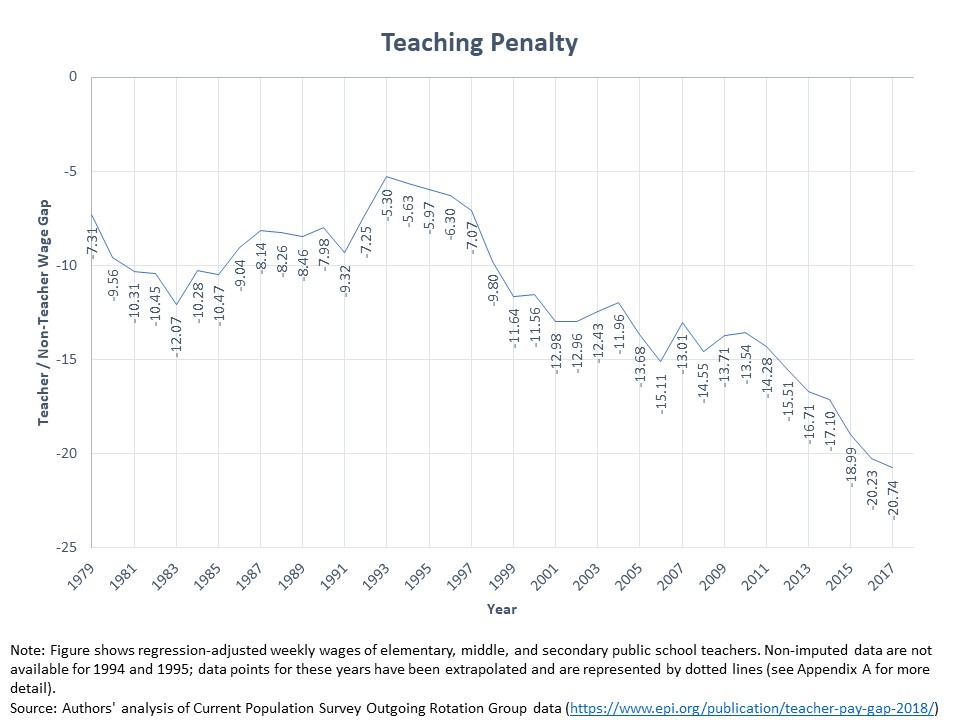
Certainly, lagging compensation is a major issue. Teacher wages have plummeted over time with respect to similarly educated (weekly) non-teacher wages.


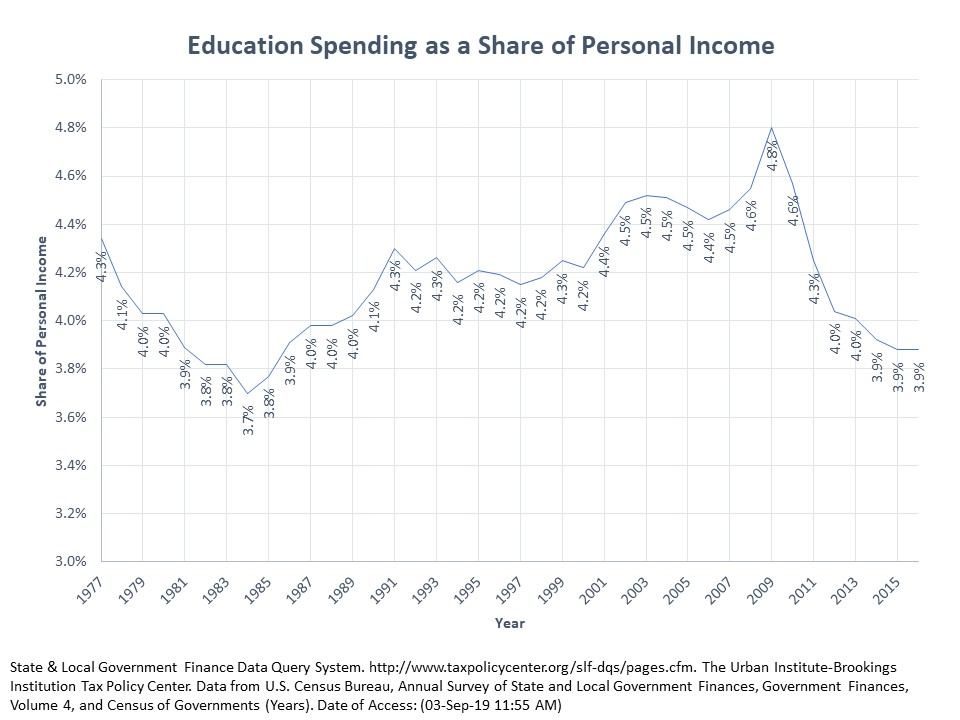
The share of economic capacity spent on K12 schooling over time has dropped:


And NO! spending hasn’t increased dramatically, nor have staffing ratios:


At least not for nearly 20 years! This, despite increased demands on schools!
Further, states that put up the least effort, tend to have the crappiest wages:


Then there’s this other issue of the rhetoric about “bad teachers,” and their evil “unions.” That’s actually softened in recent years. But this rhetoric has likely also had some influence on young people’s desire to enter the teaching profession. I mean seriously, you’ve got popular international outlets like The Economist calling teachers and their unions the greatest impediment to closing income gaps ever and anywhere (more than any Wall Street financier) and Wall Street financiers taking that ball and running with it, comparing teachers and their unions to the KKK and Governor George Wallace.
Then, you have more subtly manipulative efforts to pit young, incoming teachers against their elders, to distract teachers and the general public from the problems so evident in the graphs above. Below is a short section I removed from my book due largely to space constraints:
Who is to Blame?
If our schools really are so bad and if we really spend so much to achieve such deplorable CONTINUE READING: On Teachers & Teacher Bashing – School Finance 101


Monday, September 16, 2019

Maureen Downey: Does anyone care about the social and emotional needs of teachers?

Does anyone care about the social and emotional needs of teachers?

Is anyone considering the social and emotional needs of teachers?

Teachers face increasing stresses in system that treats them as technicians


This is a good piece on something that seldom gets any real consideration – the rise in teacher stress.

Yes, we all talk about how teaching has become harder and how so much more is being asked of schools, from policing children’s social media to keeping them safe from an active shooter.Yet, we continue to pile responsibilities on teachers, including the social and emotional well-being of their students. We are now asking teachers to go beyond teaching multiplication tables to delivering the critical life skills that kids must have to thrive in the world. 

In a guest column, University of Georgia education professor Peter Smagorinsky and Stacia L. Long, a UGA doctoral student in language and literacy education, assert we should be offering social and emotional support to teachers to help them cope with an increasingly demanding job. We also should learn what the job entails to understand why teachers are so stressed.By Stacia L. Long & Peter Smagorinsky

The social and emotional needs of students have gotten a lot of attention in the press and among researchers in recent years. The Social and Emotional Learning or SEL movement addresses the ability of students to manage their emotional lives so that their social behavior allows them to function well, and perhaps thrive, as learners CONTINUE READING: Does anyone care about the social and emotional needs of teachers?


Public Funds Public Schools|New Campaign to Fight Vouchers, Protect Public Education

Public Funds Public Schools|New Campaign to Fight Vouchers, Protect Public Education

New Campaign to Fight Vouchers, Protect Public Education

Education Law Center (ELC), the Southern Poverty Law Center (SPLC), and the SPLC Action Fund have joined forces on a nationwide campaign to fight private school vouchers and ensure public funds are dedicated to educating the millions of students in public schools across the country.
The new campaign – Public Funds Public Schools (PFPS) – will deploy multiple strategies to combat the diversion of taxpayer dollars to private schools. These strategies include filing and supporting lawsuits; disseminating research on the impact and outcomes of voucher programs; and supporting parents, students, educators, and concerned communities advocating to keep taxpayer dollars in their public schools.
PFPS will build on ELC’s and SPLC’s decades of legal and advocacy expertise to respond to proposals for new or expanded private school voucher programs on the state and federal levels. Munger, Tolles & Olson, a premier national law firm, is also a PFPS partner, drawing on its success in a lawsuit striking down Nevada’s unlimited voucher law.
A crucial backdrop for the PFPS campaign is the severe and chronic underfunding of the nation’s public schools. Nearly half of states are investing less in public education than before the 2008 recession, and wide funding gaps persist between schools in wealthy communities and those in low-income communities and communities of color. That’s why taking public dollars from public schools poses a grave and growing threat to the opportunity for every child in the United States to attend a thriving public school.
Vouchers now come in many forms, including “traditional” vouchers to pay for private school tuition, so-called voucher “scholarships” funded by tax credits to individuals and corporations, and private education “savings accounts” created with taxpayer dollars. All of these voucher programs have one thing in common: they reduce the resources available to educate the vast majority of the nation’s children who rely on our public schools.
“Every tax dollar used for a voucher is money desperately needed to meet states’ responsibility to provide a quality public education to all children,” said Bacardi Jackson, SPLC managing attorney. “Voucher schools also lack accountability for civil rights protections: voucher-recipient schools can and do discriminate based on, among other things, students’ and families’ disabilities, LGBTQ status, religion, immigration status, and language proficiency.”
In addition to filing and participating in lawsuits challenging voucher laws, PFPS will closely monitor legislative proposals in the states to start new voucher programs or expand existing ones. Recognizing that advocates across the country are organizing to fight for public schools, PFPS aims to support and supplement those efforts.
Visitors to the campaign’s new website will be able to access information about voucher proposals in their states during legislative sessions. Up-to-date voucher research and news about advocacy campaigns is also available on the website, along with information about previous and current lawsuits.
“The spread of vouchers is a serious threat to education equity and the future of our public schools. PFPS is a powerful initiative ready to fight against vouchers and, by doing so, keep public funding where it belongs: in public schools for public schoolchildren,” said David Sciarra, ELC Executive Director. “We encourage supporters of public education across the country to join us.”
Press Contacts:
Jessica Levin
Education Law Center
jlevin@edlawcenter.org
973-494-5657
Ashley Levett
Southern Poverty Law Center
Ashley.Levett@splcenter.org
334-296-0084
Public Funds Public Schools|New Campaign to Fight Vouchers, Protect Public Education

R.I. education commissioner denies bid by parents, students for role in Providence takeover - News - providencejournal.com - Providence, RI

R.I. education commissioner denies bid by parents, students for role in Providence takeover - News - providencejournal.com - Providence, RI

R.I. education commissioner denies bid by parents, students for role in Providence takeover
But Angélica Infante-Green says the community’s input with be important in creating a plan.

PROVIDENCE — State Education Commissioner Angélica Infante-Green announced on Friday that she would not give parents, students and community groups a formal say in the order to intervene in the Providence Public Schools, but she assured that they would have official roles in the creation of a turnaround plan for the district.
After hearing four hours of testimony from various community representatives, Infante-Green ruled that the Crowley Act, the state law that gives an education commissioner authority to assume control of a local school district, does not give a “small subset” of students and parents legal standing to intervene in the order. Infante-Green released a draft order last month that builds a case for the state takeover and will issue a final order within three weeks.
She said that Friday’s show-cause hearing was a legal proceeding that, by law, only four parties — the Providence School Board, the City Council, the superintendent and the mayor — were able to participate in, but once she issues the final order and assumes control of the district, community members will be given a seat at the table.
“You will see that when the plan is developed, because they will be part of developing that plan,” she said. “I can’t develop a plan, I don’t even have control of the district. Legally, I cannot do that. So I think that there’s a lot of angst, there’s a lot of worry, and I don’t blame people. People have been let down. I feel the pain.”
In the hearing — on a motion filed last week with the Rhode Island Department of Education by students, parents and community organizations — representatives from those groups expressed their desire to be given a role in the CONTINUE READING: R.I. education commissioner denies bid by parents, students for role in Providence takeover - News - providencejournal.com - Providence, RI

Stopping Homophobic Violence in Schools - LA Progressive

Stopping Homophobic Violence in Schools - LA Progressive

Stopping Homophobic Violence in Schools

Homophobia in schools assaults LGBTQ+ students’ right to exist. Schools must act now to stop it and improve campus climates. It is California law.

Last week at the Kern High School District Board meeting, students recounted homophobic experiences and decried the lack of policies and actions to create inclusive schools.  They advocated for the creation of a districtwide student-led committee to address discrimination and bullying of LGBTQ+ students on campus. This call came a week after students from the Future Farmers of America (FFA) in Bakersfield were reported to have confronted classmates at a Gay-Straight Alliance meeting with MAGA flags and homophobic taunts about which types of relationships are so-called right.

Blatant bullying fuels a toxic campus climate and contributes to gender violence in our schools and society.

The Kern High School district characterized these assaults as “varying viewpoints and opinions.” District officials wrote that their schools aim “to teach students how to communicate respectfully.” This framing minimizes the severity of the issues, and it assumes that all viewpoints are equal, even those that attack people for who they are and how they express themselves. Blatant bullying fuels a toxic campus climate and contributes to gender violence in our schools and society. California law requires schools to “provide all students with a safe, supportive and inclusive learning environment, free from discrimination, harassment, and bullying.” Schools are in violation of this law when this does not occur.
Reports of what is happening in Bakersfield are the latest example of attacks on LGBTQ+ community members to make the headlines. Thankfully, the affected students and their parents have called out these actions. However, everyday LGBTQ+ students, staff and educators CONTINUE READING: Stopping Homophobic Violence in Schools - LA Progressive

When Black Parents Were the Ones to Go On Strike Against A School District - A Tactic Black Parents Should Exercise Again. - Philly's 7th Ward

When Black Parents Were the Ones to Go On Strike Against A School District - A Tactic Black Parents Should Exercise Again. - Philly's 7th Ward

WHEN BLACK PARENTS WERE THE ONES TO GO ON STRIKE AGAINST A SCHOOL DISTRICT – A TACTIC BLACK PARENTS SHOULD EXERCISE AGAIN

There is always much talk about integration, segregation, and desegregation. There is less talk of the power Black families hold and a blueprint Black parents can use to make demands that create seismic shifts for what they believe their children need.  
Outside of Philadelphia, two decades before the U.S. Supreme Court’s landmark decision in the Brown vs Board of Education’s case, the integrated school districts of Tredyffrin and Easttown townships, enrolled all students – regardless of race. Black and white students attended the same schools. People in the townships were excited about the two new schools being built. Things weren’t perfect, but there was a sense of hope for Black parents with children enrolled in these integrated schools.
But, racism knows no bounds, even when there are elementary children involved. Unbeknownst to the Black community, the winds were changing. No one knew about the school districts’ plan to use the two new school buildings as an opportunity to design a race-based school enrollment plan until the local newspaper’s headline screamed, “Townships Will Provide Exclusive Colored School.” 
The plan was that all “colored” students from both Tredyffrin and Easttown CONTINUE READING: When Black Parents Were the Ones to Go On Strike Against A School District - A Tactic Black Parents Should Exercise Again. - Philly's 7th Ward

After Months-Long Battle, California Finally Enacts Modest Oversight of Charter School Sector | janresseger

After Months-Long Battle, California Finally Enacts Modest Oversight of Charter School Sector | janresseger

After Months-Long Battle, California Finally Enacts Modest Oversight of Charter School Sector

There’s an old cliche that almost perfectly describes the struggle to regulate an out-of-control charter school sector from state to state:  You can’t put the toothpaste back in the tube.
In late August, in a presentation at the Columbus Metropolitan Club, former Ohio Governor Bob Taft named lack of effective regulations in the Ohio laws that enabled charter schools as one of the things he regrets about his tenure as Ohio governor.  Taft, a Republican, served for two terms as governor, from 1999-2007. In his remarks last week Taft explained that during his term, “We were not as observant as we should have been with regard to the early development of charter schools. We didn’t have the quality control we should have had, and as a result, we have a lot of low-quality charter schools. We should have done a better job—making sure operators were good; quality was high.”  (You can listen to Taft’s comments here—at minute 53 in the broadcast.)
This year, the enormous difficulty of regulating charter schools in the public interest has centered in California. California’s original charter school enabling legislation, like the Ohio charter school legislation which Bob Taft now regrets, emphasized innovation and launched a new experiment. But it neglected strict oversight.  Los Angeles Times reporter Taryn Luna explains: “Charter schools in California are publicly funded and independently operated. Originally authorized in 1992 legislation to promote educational innovation, charter schools have evolved from an experiment to a system that enrolls more than 600,000 students across the state.  California ties education funding to enrollment, and charters have often been pitted against traditional neighborhood schools in a competition for students.”
Capital & Main‘s Bill Raden is more blunt.  He sees this year’s battle to regulate California’s CONTINUE READING: After Months-Long Battle, California Finally Enacts Modest Oversight of Charter School Sector | janresseger

NEA’s Read Across America Rebrands With New Mission #ReadAcrossAmerica

NEA’s Read Across America Rebrands With New Mission

NEA’s Read Across America Rebrands With New Mission
A new focus on books that tell children of color or of different gender identities that they belong in the world and the world belongs to them.

Linda Estrada grew up in Donna, Texas, the border town where she now works as a campus secretary at Runn Elementary School. Fifteen miles from the Mexican border, she worked alongside her parents and three siblings as a migrant farm worker until she started kindergarten.
“My parents didn’t want us to fall behind in our studies like they did growing up as migrant workers, spending more time in the fields than in the classroom,” says Estrada.
By the time she was 10 years old, her mother was the only one working and the family subsisted on $60.00 a week she earned cleaning a local hotel.
“Not much with four children to support and in those times, no government assistance either,” says Estrada.
“But my mom was a miracle worker. Aside from paying bills, buying groceries, and clothing us, she made sure we were surrounded by books.”
Estrada says she never realized that they were poor.
In a home filled with love and books, her world was enriched beyond material things. She became an avid reader and recalls devouring the Little House on the Prairie books and Nancy Drew mysteries, even World Book Encyclopedias. But in school, there were few books about her own heritage and culture. It wasn’t CONTINUE READING: NEA’s Read Across America Rebrands With New Mission

Seattle Schools Community Forum: Amplify Lawsuit Updates

Seattle Schools Community Forum: Amplify Lawsuit Updates

Amplify Lawsuit Updates


Amplify updates (from various sources):

- There is currently only one appellant, parent Emily Cherkin.  She's the only appellant with standing for the court. The other filed appellants, former SPS teacher Robert Femiano and former Board director Sally Soriano have stepped off but still support the appeal.  Makes sense.

GoFundMe for this lawsuit.  Honestly, if you believe how this situation played out is wrong, chip in something.  I'm going to do so soon.


- Apparently there is a District-mandated calendar for teaching Amplify this year, that appears to be very strict with no teacher input. There are also pre- and post-assessments for each unit until, for a single 8th grade class, it adds up to a minimum of 18 assessments over the course of one school year.

- Recent statements from former SPS science teachers:


"The science curriculum revisions shamed this school district in both substance and process. Established rules, procedures, accounting practices and the school board itself were blatantly disregarded. In the school setting, scheduling, budgeting, enrollments, college admissions concerns, as well as the deep professional experience of science teachers was equally CONTINUE READING: Seattle Schools Community Forum: Amplify Lawsuit Updates

Join us FB live tomorrow night on privacy, and WBAI on Wed. on diversity and gifted programs | Class Size Matters

Join us FB live tomorrow night on privacy, and WBAI on Wed. on diversity and gifted programs | Class Size Matters 

Join us FB live tomorrow night on privacy, and WBAI on Wed. on diversity and gifted programs

1.Just a short note to let you know that I’ll be talking about student privacy on Facebook Live tomorrow night, Tuesday Sept. 10 at 6:30 on the Long Island Opt Out FB page. I’ll be speaking with Jeanette Deutermann of LI Opt out about the widespread Pearson breach of student data and NY State Education Department’s attempt to weaken the state student privacy law by allowing College Board, ACT and other vendors to sell personal student information and use it for marketing purposes. More on this here.
In connection with this issue, please remember to send a message to NYSED not to weaken the state law in this way; just click here.
2. On Wed., from 10-11 AM, we’ll be launching our new WBAI radio show, Talk out of School, co-hosted with Carol Burris, and guests Shino Tanikawa of the School Diversity Advisory Group and Alex Rodriguez of Teens Take Charge. We’ll be discussing the recommendations of the SDAG to eliminate gifted programs in elementary schools and screened middle schools. Please join us at 99.5 FM or at wbai.org online, and call in!
Thanks, Leonie
Join us FB live tomorrow night on privacy, and WBAI on Wed. on diversity and gifted programs | Class Size Matters 

Finally, Democratic candidates talk about education in a debate. But nobody raised this key issue. - The Washington Post

Finally, Democratic candidates talk about education in a debate. But nobody raised this key issue. - The Washington Post

Finally, Democratic candidates talk about education in a debate. But nobody raised this key issue.
Read the entire discussion on schools


Finally, after three debates among Democratic presidential candidates with scarcely a question about education, a moderator, Linsey Davis of ABC News, raised the issue Thursday night. She asked some good questions — even if some candidates tried to skirt them or stated as fact things that may not, in fact, be true.

It wasn’t a particularly revelatory discussion, with candidates generally sticking to their talking points. But it did touch on some key subjects, including school segregation, charter schools, teacher pay, student debt and universal pre-K.
Some important issues were briefly raised, such as when Julián Castro, the former housing and urban development secretary in the Obama administration, said that improving schools cannot be divorced from housing, health care and social policy: “Our schools are segregated because our neighborhoods are segregated.”
Sen. Bernie Sanders (I-Vt.) raised another key issue when he noted that the United States has one of the world’s highest child poverty rates, which is a factor in academic achievement.
But the one thing that nobody discussed onstage is what many public education activists see as the root of public education’s problems: the funding system, which relies heavily, though not exclusively, on property taxes. The obvious result is that poorer neighborhoods have fewer funds and more cash-strapped schools. Federal money intended to help close the gap hasn’t come close.
According to the Learning Policy Institute, a California nonprofit think tank founded by Linda Darling-Hammond, a highly respected educator and researcher who is chairwoman of the California Board of Education: “The highest-spending districts in the United States spend nearly 10 times more than the lowest-spending, with large differentials both across and within states.” In most states, it says, children who live in low-income neighborhoods attend the schools most deprived of resources.
On average, school districts serving the largest concentrations of students of color receive approximately $1,800 less per student in state and local funding than those serving the fewest students of color, and the differentials are even greater within states. For example, in Illinois, per-pupil funding ranged from $8,500 to $32,000 in 2016, with suburban districts in Cook County outspending nearby Chicago by more than $10,000 per pupil.
The great divide in funding comes largely from reliance on local property taxes. Districts with higher property values bring in more property tax revenues and provide correspondingly higher funding for schools than poorer districts do. States typically offset these disparities to some extent, but rarely provide an equitable system that can respond to student needs. Funding CONTINUE READING: Finally, Democratic candidates talk about education in a debate. But nobody raised this key issue. - The Washington Post

Indiana: West Lafayette Public Schools Sues the State for Taking Their Property and Giving It to Charter Industry for $1 | Diane Ravitch's blog

Indiana: West Lafayette Public Schools Sues the State for Taking Their Property and Giving It to Charter Industry for $1 | Diane Ravitch's blog

Indiana: West Lafayette Public Schools Sues the State for Taking Their Property and Giving It to Charter Industry for $1

Rocky Killion, superintendent of the West Lafayette, Indiana, public school district, is a fighter for public schools. A few years ago, he helped to launch an outstanding film about the extremist assault on the public schools by privatizers; it is called Rise Above the Mark, and it showcases the good work done in Indiana’s public schools.
Now Rocky Killion is suing the state of Indiana for permitting an “unconstitutional land grab.” The legislature passed a law in 2011 declaring that any unused schools must be sold to charter operators for $1. Rocky Killion says this is wrong. The schools were paid for by the taxpayers, and they belong to the district, not to charter operators.
WEST LAFAYETTE – West Lafayette schools, defending against any effort to takeover the former Happy Hollow Elementary, filed a lawsuit Thursday, is challenging the constitutionality of a 2011 state law that says public school districts must lease unused classroom space to charter schools for $1.
Rocky Killion, West Lafayette Community School Corp. superintendent, said no charter schools or anyone else has approached the district about Happy Hollow, built at 1200 N. Salisbury St. in the 1950s, since the building CONTINUE READING: Indiana: West Lafayette Public Schools Sues the State for Taking Their Property and Giving It to Charter Industry for $1 | Diane Ravitch's blog

Don’t Believe the Sacramento Charter School Compromise is a Bad Deal?

Don’t Believe the Sacramento Charter School Compromise is a Bad Deal?

Don’t Believe the Sacramento Charter School Compromise is a Bad Deal?
This seems like a feel-good bill for the teachers [sic] union but charters can still do what they want and still get approved if the county Board of Education is an option
– Mike Trujillo
The Los Angeles Times describes Mike Trujillo as a “political strategist.” Usually, these types of operatives prefer to do their work behind the scenes, but Trujillo seems to have an affinity towards seeing his own name in print. This is bad for the clients that he represents but is instructive for those outside the charter industry’s inner circle who get to see what is going on behind the curtain.
In May 2018, Nick Melvoin’s school privatization advocacy group, Speak Up, attacked Jackie Goldberg’s ethnicity in a bid to block her appointment to the board seat left vacant by Ref Rodriguez’ felony conviction. Trujillo was front and center in their propaganda efforts. Ignoring the words of Martin Luther King Jr., he claimed that “Appointing a non-Latino candidate like Goldberg to the seat, even temporarily, is definitely not in the spirit of the law.” In the end, voters ignored Speak Up’s call for bigotry and overwhelmingly elected Goldberg to the seat. Unfortunately, the refusal to make a temporary appointment meant that the stakeholders of the district were unrepresented for almost a year.
In the aftermath of Governor Newsom’s compromise with the charter industry, Trujillo has found another opportunity to get his name in print. While the smart political move would have been to keep quiet as the CONTINUE READING: Don’t Believe the Sacramento Charter School Compromise is a Bad Deal?


Black Teachers as Reparations: My Remarks at the Congressional Black Caucus | The Jose Vilson

Black Teachers as Reparations: My Remarks at the Congressional Black Caucus | The Jose Vilson

BLACK TEACHERS AS REPARATIONS: MY REMARKS AT THE CONGRESSIONAL BLACK CAUCUS

The Center for American Progress in collaboration with Education Reform Now invited me and a host of other citizens with opinions on education to speak about education and racial equityI’m honored and thankful they asked me to represent current classroom teachers as so few of us – if any – get opportunities to inform policy and practice on a regular basis. Below are notes that turned into my opening remarks for the panel. The conference’s theme this year centered on the 400th anniversary of the first person enslaved arriving in the colony of Jamestown, VA.
Good morning, class. My name is Jose Luis Vilson, math teacher in Washington Heights, New York City, and this is my fifteenth year teaching students math at IS 52. In addition to writing extensively on these issues extensively, including the book This Is Not A Test: A New Narrative on Race, Class, and Education, executive director and co-founder of EduColor, I’m also a father to a second grader who also attends public schools.
For me, this is a conversation about truth, reconciliation, and reparations. Black teachers are more likely to see students as talented and gifted, push students towards visions of college, and inspire students towards effort and resilience. Informally, I’ll also say they are more likely to build better relationships first, shift narratives from the dominant culture to an inclusive story, and pave the way for every other marginalized group to see their work realized, too.
This also comes with important caveats because none of this is perfect. Those of us who are Black educators need an orientation towards justice. We don’t “leave;” we’re more often forced out through any number of policies. Some like to use the “death by 1000 cuts,” but in this case, I like to call it death by 1000 mandates.
Really, Black teachers are a key part to re-envisioning the collective aspirations of what we call CONTINUE READING: Black Teachers as Reparations: My Remarks at the Congressional Black Caucus | The Jose Vilson


Sunday, September 15, 2019

MVP Math Chooses to Sue NC Parent, Apparently Expects to Recover Reputation | deutsch29

MVP Math Chooses to Sue NC Parent, Apparently Expects to Recover Reputation | deutsch29

MVP Math Chooses to Sue NC Parent, Apparently Expects to Recover Reputation

When I read the term, MVP, my first thought is “most valuable player.”
Well, this MVP might want to be that most valuable player, but this MVP (which stands for Mathematics Vision Project, LLC, a Utah limited liability company “active as of 03/17/2016”, has apparently suffered enough at the hands of a single North Carolina parent enough to sue the parent, Blaine Dillard.
Dillard is displeased with MVP and has a blog, a website, and a Facebook group focused on criticizing MVP as the Wake County, NC, math program.
Apparently, Dillard is so powerful that he is affecting profits to such a degree that MVP apparently felt compelled to sue. From MVP’s July 25, 2019, suit against Dillard, “an individual”:
The publication and/or public speaking of [Dillard’s aforementioned] statements harmed MVP. Part of MVP’s business involves submitting proposals for education-related contracts with private schools, public schools, school districts, government entities, and other entities. Dillard’s statements harmed MVP’s reputation as well as perceptions of the efficacy of the products and services that MVP provides. Upon information and belief, MVP has been unable to enter into contracts, and/or has not been invited to make proposals for contracts, and/or has been forced to enter contracts on compromised terms, and/or has been denied extensions on contracts, and/or has been forced to accept contract extensions on compromised terms, and/or has been unable to attract employees and/or consultants, and/or has been forced to invest more resources than otherwise would have been necessary to consummate a contract, and/or has otherwise been harmed.
It would be quite the challenge for MVP to document an irrefutable, direct connection between “not being invited to make proposals” and “being forced to enter contracts on compromised terms” and one man, Blaine Dillard.
Then there is the layer of ridiculousness to be overcome before a jury as an LLC CONTINUE READING: MVP Math Chooses to Sue NC Parent, Apparently Expects to Recover Reputation | deutsch29

enrique baloyra: Greta comes to NYC - YouTube #FridaysForFuture.#ClimateEmergency.

Greta comes to NYC - YouTube

Greta comes to NYC


enrique baloyra


Why does it take a child to point out the emperor has no clothes?
Like after an angry, young man shot up their school, it took a group of kids from Parkland, FL, to start a nationwide campaign to pass meaningful, common sense gun reform.
The same kids, in turn, inspired Swedish teenager Greta Thunberg to start her own worldwide phenomenon,
#FridaysForFuture. Every Friday for the past year, Greta has been protesting the I’ll-be-dead-by-then attitude most adults are taking towards our #ClimateEmergency.
Since then, she’s appeared before the European Union, British Parliament; she has her own TED talk, and has even been nominated for the Nobel Peace Prize.
In January she scolded foremost economic and political leaders at the World Economic Summit in Davos, Switzerland, saying, “I want you to act as if the house is on fire. Because it is.”
Greta recently crossed the Atlantic in a sailboat to address the United Nations Climate Action Summit next Monday.
She seems astounded by our debate over whether we believe in climate change.
“Where I’m from,” she says, “it’s a fact.”
It appears her message is catching on, and, predictably, rightwing talking heads have been mocking the sixteen-year-old girl, calling her "mentally unstable.” FYI, Greta has Asperger’s.
So, these people are actually making her point for her when she asks, where are the adults?
"You are not mature enough to tell it like it is. Even that burden to leave to us children.”
https://twitter.com/Avaaz/status/1073...
Kids have a right to be outraged when we say we love them, yet allow the destruction of their future.
Greta asks, what’s the point in learning facts at school when those facts mean nothing to politicians and our society?
As teachers and parents, we have a moral responsibility to show our kids that facts matter; that our actions matter. We must do whatever it takes to save their world from certain environmental collapse, regardless of the cost.
After all, in the words of a little girl, “If we can save the banks, we can save the planet.”
This Friday, September 20, millions of children, workers and our unions will join climate activists around the world in demanding an end to fossil fuels. To find an action near you, or create your own, you can visit globalclimatestrike.net.


Greta comes to NYC - YouTube