Latest News and Comment from Education

Friday, May 24, 2019

States’ Math and Reading Performance After the Implementation of School A-F Letter Grade Policies | VAMboozled!

States’ Math and Reading Performance After the Implementation of School A-F Letter Grade Policies | VAMboozled!

States’ Math and Reading Performance After the Implementation of School A-F Letter Grade Policies

It’s been a while! Thanks to the passage of the Every Student Succeeds Act (ESSA; see prior posts about ESSA herehere, and here), the chaos surrounding states’ teacher evaluation systems has exponentially declined. Hence, my posts have declined in effect. As I have written prior, this is good news!
However, there seems to be a new form of test-based accountability on the rise. Some states are now being pressed to move forward with school letter grade policies, also known as A-F policies that help states define and then label school quality, in order to better hold schools and school districts accountable for their students’ test scores. These reform-based policies are being pushed by what was formerly known as the Foundation for Excellence in Education, that was launched while Jeb Bush was Florida’s governor, and what has since been rebranded as ExcelinEd. With Jeb Bush still in ExcelinEd’s Presidential seat, the organization describes itself as a “501(c)(3) nonprofit organization focused on state education reform” that operates on approximately $12 million per year of donations from the Bill & Melinda Gates Foundation, Michael Bloomberg Philanthropies, the Walton Family Foundation, and the Pearson, McGraw-Hill, Northwest Evaluation Association, ACT, College Board, and Educational Testing Service (ETS) testing corporations, among others.
I happened to be on a technical advisory committee for the state of Arizona, advising the state board of education on its A-F policies, when I came to really understand all that was at play, including the politics at play. Because of this role, though, I decided to examine, with two PhD students — Tray Geiger and Kevin Winn — what was just put out via an American Educational Research Association (AERA) press release. Our study, titled “States’ Performance on NAEP Mathematics and Reading Exams After the Implementation of School Letter Grades” is currently under review for publication, but CONTINUE READING: States’ Math and Reading Performance After the Implementation of School A-F Letter Grade Policies | VAMboozled!


CURMUDGUCATION: OH: Union Reps Fired By Turnaround CEO

CURMUDGUCATION: OH: Union Reps Fired By Turnaround CEO

OH: Union Reps Fired By Turnaround CEO


Lorain City Schools is one of the three Ohio districts that has been subjected to HB 70, a takeover law that replaces both the school board and the superintendent with a single all-powerful CEO. You can get the background of Lorain's troubles here, and see what has been happening in the fight against HB 70 here.

The short form for Lorain is this: HB 70 is a terrible piece of law, calling for a CEO who is knowledgeable and competent in every single aspect of school management, from teacher assignment to bus schedules, and this super-competent person has to be able to run every aspect of the district while building relationships with all the local folks who are still smarting from having the state strip all of their local power.


Location of my first teaching job
So let's start by accepting that nobody is going to be able to do this job well. But Lorain won some sort of reverse lottery, and got CEO David Hardy, Jr., who is especially not good at this job. Hardy's background is Teach for America and charter schools. I've reached out to someone who worked with him previously, and they suggest that he doesn't take criticism well, nor does he much care for teachers. That's just one person-- but nothing about his history in Lorain suggests otherwise. He has refused to move his family to Lorain, has refused to meet with the elected school board, and has not established positive working relationships with any CONTINUE READING: CURMUDGUCATION: OH: Union Reps Fired By Turnaround CEO


Learning from Our Teachers: The Education Strikes of 2018 - Los Angeles Review of Books

Learning from Our Teachers: The Education Strikes of 2018 - Los Angeles Review of Books

Learning from Our Teachers: The Education Strikes of 2018

Red State Revolt By Eric BlancThe Teachers’ Strike Wave and Working-Class PoliticsPublished 04.23.2019Verso224 Pages


IN SPRING OF 2018, tens of thousands of K–12 educators and support staff in West Virginia, Oklahoma, and Arizona went on strike, demanding livable salaries and other concessions from the state. Where did these uprisings in Trump country come from? How were they able to win in states where public sector strikes are illegal and other anti-labor laws prevail? In Red State Revolt: The Teachers’ Strike Wave and Working-Class Politics, Eric Blanc sets out to answer these questions.
The saga began in West Virginia. Teacher salaries were stagnant as state legislators continued to defund public education. At the same time, these politicians granted enormous tax breaks to corporations. They also took a pair of scissors to any document that resembled a pro-labor bill. Although anger among educators had brewed for decades, resignation was the norm. When another premium increase for employee health insurance was announced at the end of 2017, few people had any reason to suspect that there would be resistance in West Virginia.
But there was. After two months of protests and strikes, not only did these employees stop the proposed premium increase, they also forced the state to drop its pro–charter school and anti-labor legislation. In the process, they secured a five percent raise for all state employees. Inspired by the victories in West Virginia, teachers and support staff followed suit in Oklahoma and in Arizona, again forcing the hands of their Tea Party–influenced governments. They achieved more in two months than they had in the past two decades.
What propelled the shift from resignation to resistance? Blanc went to these states to get some answers. Through numerous interviews and a discerning attention to broader issues of labor and politics in the United States, he paints a clear portrait of the forces at work in this historic moment. Of note, he traces the influence of Bernie Sanders’s 2016 presidential campaign that popularized an alternative to the status quo. His influence was most felt in West Virginia, where he won every county in the Democratic primary. At the level of action, the Sanders campaign pushed people to get involved in grassroots politics. By the time the health-care premium increases in West Virginia were announced, there were a number of self-identified “democratic socialists” with radical ideas and organizing experience.
In the words of West Virginia teacher Emily Comer:
The role of the Bernie campaign of 2016 on organizing in West  CONTINUE READING: Learning from Our Teachers: The Education Strikes of 2018 - Los Angeles Review of Books

Seattle Schools Community Forum: The Entire Board Must Vote No on the Science Adoption

Seattle Schools Community Forum: The Entire Board Must Vote No on the Science Adoption

The Entire Board Must Vote No on the Science Adoption


You'll note the use of the word "must" in the headline for this post.  I have gone from "should" to "must" based on new information I received today via public disclosure documents from the district.

I had put in a request weeks ago and received a message that there were over 900 emails between the head of Science, Mary Margaret Welch, and Amplify.   I'm not surprised that there were some but that is quite a volume for less than two years.

However, there were 25 other emails between Welch and several other people that I asked the good folks in the Public Disclosure area to send as soon as they could.  They were kind enough to get them to me yesterday.

They reveal that Welch entered into an agreement in early August 2017 with Lawrence Hall at UC Berkeley (who had a grant from IES - a federal agency, Institute of Education Sciences) and SRI International (who is the entity carrying out the research for the grant).  The grant was to study the efficacy of Amplify Science for first graders around literacy and science.  


If funded, districts would receive the full curriculum package along with teacher professional development and support over the two years of implementation at no cost to the participating districts.  Districts also receive a stipend to partner with us to CONTINUE READING: Seattle Schools Community Forum: The Entire Board Must Vote No on the Science Adoption

LAUSD’s Measure EE Highlights the Need For Charter School Oversight

LAUSD’s Measure EE Highlights the Need For Charter School Oversight

LAUSD’s Measure EE Highlights the Need For Charter School Oversight
This is a compromise, but we owe that to our children and the way that we can model compromise as a Board and as a community. Let’s not forget that the disenfranchised here are our students…If you don’t compromise it leads to this retrenchment and cynicism that then goes to this downward spiral and even more resentment and cynicism and disappointment, and that is never the source of progress.
– LAUSD Board Member Nick Melvoin


Last July, the Los Angeles Unified School District (LAUSD) Board had the opportunity to put a parcel tax on the regularly scheduled November ballot. Unfortunately, the California Charter School Association (CCSA) opposed the resolution by George McKenna and Scott Schmerelson, falsely claiming that “the proposal [excluded] 110,000 charter public [sic] school students.” Therefore, Ref Rodriguez (in one of his last actions before pleading guilty to felonious acts related to his campaign), Nick Melvoin and Monica Garcia voted against asking the voters for funding that was desperately needed by the students of the district.
Less than nine months later, Melvoin and Garcia had a change of heart. Perhaps they read the writing on the wall and realized that Jackie Goldberg’s impending election meant that the parcel tax was going to pass without their support. Or maybe it was the fact that Melvoin’s expectations for a quick victory in the January strikecrumbled when parents and the community supported the demands made by the teachers. In any case, they finally joined McKenna and CONTINUE READING: LAUSD’s Measure EE Highlights the Need For Charter School Oversight

Thursday, May 23, 2019

Louisiana’s VAM: Quantitative Bungling on Display | deutsch29

Louisiana’s VAM: Quantitative Bungling on Display | deutsch29

Louisiana’s VAM: Quantitative Bungling on Display

This post is about value-added assessment (VAA), also called value-added modeling (VAM). I saw that Louisiana’s “father of VAM,” LSU psychology professor, George Noell, and others, had recently published a VAM reflection related to VAM usage on Louisiana’s teacher preparation programs (TPPs), entitled, “Linking Student Achievement to Teacher Preparation: Emergent Challenges of in Implementing Value Added Assessment,” and I just had to write about it.
(You can read the article for free by signing up for a 14-day trial here; meanwhile, I have contacted the publisher for permission to link to full article. Stay tuned.)
Notice that Noell’s et al. title includes the carefully-selected term, “linking,” because it is a tricky game to establish that VAM proves causation and not just correlation. However, the big buzz about VAM usage in education is that VAM is often reverently consulted in decisions about the professional fates of teachers, schools, and TPPs.
VAM is used to judge, and in those judgments, the judges assume that the teacher, or the school, or the teacher prep program “caused” some associated VAM score. If the VAM score is deemed pleasing, then good for you, teacher, school, or TPP.
If not, well, you better fix whatever needs fixing (though VAM is not precise enough to inform on this point) or you could be *correlated* right out of professional existence.
The first piece I wrote as a public education advocate was this 2012 “VAM Explanation for Legislators.” I did so at the behest of a fellow Louisiana teacher and advocate, who asked if I would write something that our Louisiana legislators could understand, “on the eighth-grade level.”
Not sure if I hit the appropriate grade-level readability, but I did rip the erratic CONTINUE READING: Louisiana’s VAM: Quantitative Bungling on Display | deutsch29

Education Research Report: Flaws in High-Profile “Gold Standard” Study Used to Market Teach for America

Education Research Report: Flaws in High-Profile “Gold Standard” Study Used to Market Teach for America

Flaws in High-Profile “Gold Standard” Study Used to Market Teach for America


Andrew Brantlinger is a former public school math teacher who is now an associate professor at the University of Maryland’s Department of Teaching and Learning, Policy and Leadership. Earlier in his academic career, he worked with data concerning the New York City Teaching Fellows alternative certification program. So Brantlinger was intrigued when, six years ago, the federal Institute of Education (IES) Sciences published a report entitled, The effectiveness of secondary math teachers from Teach For America and the Teaching Fellows programs, finding that Teach for America corps members significantly out-performed other teachers at their high-poverty schools. This IES-funded high-profile study, which was authored by researchers at Mathematica, a non-partisan, research organization, is prominently featured in TFA promotional material.
TFA selects high-achieving college graduates and places them in these high-poverty schools after several weeks of preparation. Although the TFA corps members start off uncertified, the placement is followed by ongoing, on-the-job support, and many do eventually gain standard certification.
Brantlinger was eventually able to obtain the data used in the IES/Mathematica study and, along with co-author and University of Maryland doctoral candidate Matthew Griffin, he was able to perform a secondary analysis of the study data. 
In a Review Worth Sharing published today by the National Education Policy Center, Brantlinger and Griffin explain that the original analysis was flawed in three primary ways:
  • First-year Teach for America teachers were under-represented in the study (while second-year corps members were over-represented). This matters because teachers typically make considerable professional growth in their initial years on the job.
  • Poorly qualified teachers were over-represented in the comparison group. For example, nationwide, 80 percent of 8thgrade math teachers at high-poverty schools are fully certified. Yet just 40 percent of the comparison group were fully certified, while 58 percent of the TFA teachers in the study were fully certified. Keep in mind that alternative-certification programs, by definition, generally place teachers in schools before they are certified—making the situation studied here difficult to generalize. This may limit the study’s applicability to other schools and also bias the results in TFA’s favor.
  • TFA teachers were likely trained to teach to the exams used as study outcomes, since such an approach is part of the program. The study did not account for this likely alignment between the outcome measure and the TFA focus.
Despite assertions to the contrary on TFA’s website and promotional materials and by the authors of the Mathematica report, the effect size identified by the study was small—certainly small enough to be explained by these three flaws in data and methods.
The Mathematica study was designed as an experiment, with students randomly assigned to matched pairs of TFA and comparison teachers. Randomization studies are sometimes described as the “gold standard” for research because they reduce the odds that treatment and control groups are not comparable. However, as Brantlinger and Griffin’s analysis highlights, the on-the-ground reality of experimental studies does not CONTINUE READING: Education Research Report: Flaws in High-Profile “Gold Standard” Study Used to Market Teach for America

John Thompson: Holding Diane Ravitch and Corporate School Reformers Accountable - Living in Dialogue

Holding Diane Ravitch and Corporate School Reformers Accountable - Living in Dialogue

Holding Diane Ravitch and Corporate School Reformers Accountable
A Review of The Wisdom and Wit of Diane Ravitch: Part 1

By John Thompson.
As we wait for Diane Ravitch’s next, comprehensive masterpieceSlaying Goliath, a new anthology, The Wisdom and Wit of Diane Ravitch, offers a unique opportunity to assess the quality and accuracy of both Ravitch’s and the corporate school reformers’ analyses of school improvement. Of course, Ravitch’s experience in education research and politics gave her advantages in understanding policy complexities over the non-educators who imposed test-driven, accountability-driven policies on the nation’s schools. On the other hand, it was the edu-philanthropists’ untested opinions that became the laws of almost all of the states, so they should have been just as rigorous as Ravitch in studying the facts of life in our nation’s diverse schools.
Ravitch came to the school reform wars with a reputation as a thorough, balanced scholar, with close ties to conservative reformers. She had been an Assistant U.S. Secretary of Education, and a member of the National Assessment of Educational Progress Board (NAEP), and worked with policy analysts with the Fordham Institute, the Brookings Institution, and other think tanks.  Ravitch also had a long career as an education historian.  In contrast to corporate reformers who demanded schools and systems where “everyone is on the same page,” Ravitch believed, “Historians understand that debate and dissent are part of the work of understanding history.”
Ravitch explained, “There is not one truth, but on the other hand, you can’t just make up facts and narratives, hire a fancy PR firm, and rewrite history to suit yourself.”   She said, “One of the things that a historian tries to do is to correct the record.” So, it is not surprising that an accountability audit of Ravitch’s positions during CONTINUE READING: Holding Diane Ravitch and Corporate School Reformers Accountable - Living in Dialogue

California teachers, students, officials rally for school funding | The Sacramento Bee

California teachers, students, officials rally for school funding | The Sacramento Bee

‘Starvation diet’ for schools protested by California teachers, officials, students at Capitol


More than 1,000 California teachers, students and school district administrators marched in downtown Sacramento and rallied at the state Capitol on Wednesday afternoon, adding their voices to a statewide advocacy day for school funding.
The event, part of the national “Red for Ed” movement, brought together union members and school administrators who have sometimes been at odds, with teacher strikes unfolding this year in Sacramento, Los Angeles and Oakland. The groups put aside their differences Wednesday to push for legislation directing more money to public education


“For too long, we have been on a starvation diet for our schools,” said California Teachers Association President Eric Heins.
Some teachers and staffers from the Sacramento City Unified School District shared concerns about out-of-date textbooks, a shortage of physical education teachers and librarians, and worn-out portable buildings.
“I am at nine schools and I take care of about 3,700 students,” said Noh Le-Hinds, a school nurse and union representative in Sacramento City Unified. “We think healthy students learn better.”
Katie Carr, a special education teacher, said her elementary school doesn’t provide reading intervention for its most vulnerable students.
“These are kids that are already struggling with academics,” she said. “Books are a basic right, and kids deserve better. “
“It’s difficult to make ends meet as a teacher,” said Sacramento City Teachers Association President David Fisher. “We are in a crisis of losing teachers, because it costs a lot to become one. Paying your mortgage or rent are extremely difficult. ”
Many at the rally said they are concerned that charter schools are undermining the public school system.
“Charter schools laws are basically destroying public education, and we don’t think a dime of public funds should go to corporate charter organizations,” said California Teachers Association Vice President David Goldberg. “Every school should serve the needs of the community.”
A package of bills backed by teachers unions and currently under consideration in the Legislature CONTINUE READING: California teachers, students, officials rally for school funding | The Sacramento Bee


Charter school curbs pass Assembly, but drama foretells compromise | CALmatters

Charter school curbs pass Assembly, but drama foretells compromise | CALmatters

Charter school curbs pass Assembly, but drama foretells compromise


Legislation that would give local school districts more control over charter-school authorizations narrowly passed the California State Assembly Wednesday in a dramatic vote that served as an initial litmus test for a package of consequential, union-backed charter regulation bills.
For nearly an hour, Assembly Bill 1505 stood just shy of a handful of the 41 votes required to advance to the Senate, in part because of concerns the bill went too far in limiting the ability of charter schools to appeal authorization denials from local school districts to county and state education boards.
Moderate Democrats in particular were reluctant to support the measure. When the bill finally passed 42-19, it was with an assurance from  Assemblyman Patrick O’Donnell, the bill’s author, that the bill would be amended to include a “fair” appeal process.
“We knew this was going to be a fight because this is a heavily political matter,” O’Donnell said following the floor vote. “Charter schools have a lot of resources that public schools don’t on the political front, and they employ them in the state Capitol, and we saw that today.”
AB 15051506 and 1507 and Senate Bill 756, put forth as a charter regulation package, have pitted teachers unions and supporters of traditional public schools against advocates of charter schools, which are public but mostly non-union. The two education interests are among Sacramento’s most powerful, and until this past election, when union candidates triumphed in races for governor and statewide schools chief, they have largely fought to a draw.
If passed, the package of proposals would make the most significant changes in a generation to the state’s 27-year-old charter school laws. They would give local school boards more power over authorizations, enact a statewide cap on CONTINUE READING: Charter school curbs pass Assembly, but drama foretells compromise | CALmatters


Measure EE Works Like The Corporate Program To “Match Gifts” – redqueeninla

Measure EE Works Like The Corporate Program To “Match Gifts” – redqueeninla

Measure EE Works Like The Corporate Program To “Match Gifts”


On June 4, 2019 at the polls, we’ll approve fairly funded Public Education for all by voting YES ON EE. It’s a gift to democracy from the body politic. See here.  https://tinyurl.com/howcorporatematchingworks
In the meantime large corporations and industrial landowners have launched a stunning reveal of Big Business As Scrooge.  They’re sabotaging the rest of us, fueling a deluge of anxiety on social media. Guess what? The questions evoked have straightforward answers:
(1)  WHAT about the lottery?
Experts say:  “Perhaps the biggest misunderstanding about California’s lottery comes down to the false impression people have about its role in funding our schools. … [Because it turns out,]… Well, the lottery doesn’t provide very much to K-12 schools.”
About 20 cents on the dollar goes to K-12 schools for a total of $1 billion dollars a year — actually a drop in the bucket of CA education funding.  The vast majority goes into the pockets of the businesses that sell the tickets and maintain the machines and the lotto system — and the tickets are mostly bought by residents of low-income neighborhoods.  Since a change in the law in 2010, ticket sales have gone up and returns for schools have gone down.  More here:  laist lottery big money small returns.  https://laist.com/2018/06/19/lottery.php
It’s smarter not to send Education dollars to Sacramento but to keep it right here locally, under our own citizen’s watchful eyes (see #7 below).
(2)  Didn’t we already increase our taxes for education?
Temporarily — yes.  In the wake of the Great Recession, we saved our schools with Prop 30 which raised taxes from 2012-2018 on individuals making over $250K (joint filers making over $500K).  A 0.25% sales tax increase ended in 2016.  An extension of the income tax on the wealthy was passed in 2016 (Prop 55) and will last through 2030.  With that assistance, California’s spending on education rose a little but remains in the bottom 20% of all states in the union.
Remember when local business leaders “supported” Prop 30? Remember when CONTINUE READING: Measure EE Works Like The Corporate Program To “Match Gifts” – redqueeninla

Los Angeles: At First Meeting, Jackie Goldberg Changes Board Dynamics by Challenging Co-Location of Charters | Diane Ravitch's blog

Los Angeles: At First Meeting, Jackie Goldberg Changes Board Dynamics by Challenging Co-Location of Charters | Diane Ravitch's blog

Los Angeles: At First Meeting, Jackie Goldberg Changes Board Dynamics by Challenging Co-Location of Charters

Jackie Goldberg was sworn in to her new office as representative for District 5 on the Los Angeles school board, and she hit the ground running. 
She criticized co-locations, when charters take space in an existing public school, especially when charters are given preferential treatment.
Goldberg’s concerns arose minutes after the board began moving through its agenda. The item was $16 million to prepare space for charters operating on up to 79 district campuses. In all, about 11% of campuses host charters, according to the California Charter Schools Assn. Charters enroll nearly one in five district students.
Goldberg noticed that some of the money would pay for computers and wanted to know if the host school would have comparable technology.
“I have a school that lost its computer lab and the charter school went in there and put in a computer lab,” which it used to recruit students, Goldberg said during the meeting. “That’s crazy.”
Goldberg declined to name the school.
Another board member, George McKenna, raised similar points. And board member Richard Vladovic asserted CONTINUE READING: Los Angeles: At First Meeting, Jackie Goldberg Changes Board Dynamics by Challenging Co-Location of Charters | Diane Ravitch's blog

If colleges want a diverse campus they need to amend admissions policies

If colleges want a diverse campus they need to amend admissions policies

In higher education, the wand chooses the wizard
It’s not Hufflepuff and Slytherin, it’s Harvard and Stanford

For those who seek higher education, access to a college is no longer an insurmountable problem. With more than 5,000 colleges and universities dotted across the United States, and the availability of online and distance learning, more students can find their way into a college classroom than ever before.
Yet close inspection reveals that there is a big assumption in our everyday thinking about higher education that is riddled with faults: the idea that individuals choose the colleges they attend. Yes, individuals must fill out an application and enroll in an institution. But true choice can be out of reach. Students’ college options can multiply based on the family they were born into, the neighborhood they live in and the schools they attended — and none of these factors are in their control.
new report was released today by the Pell Institute, an education think tank that conducts research on first-generation college students, and PennAhead, a University of Pennsylvania research group. It found that among the 2009 cohort of ninth graders — who graduated from high school as seniors in 2013 — students from the highest socioeconomic quintiles were eight times as likely to attend a “most” or “highly” selective college as those from the lower economic quintile (33 percent versus 4 percent). Moreover, students who attended four‐year institutions were more likely to graduate, giving them more opportunities than their peers who attended two-year colleges.
While most students can get into some form of postsecondary institution, low-income students don’t have the same options as their wealthier peers. In JK Rowling’s famous novels, when Harry Potter goes to buy a wand, the shop’s proprietor, Mr. Ollivander, tells him, “The wand chooses the wizard, Mr. Potter.” In the Potterverse, this wasn’t a bad thing. But what if you were a wizard who desperately wanted a wand that didn’t want you back? Substitute colleges for wands, and you have our higher education system.
College admissions leaders talk about creating a diverse campus, but their decisions don’t back up their words. The numbers in this new report don’t lie. In the 2009 cohort, a shocking 73 percent of rich CONTINUE READING: If colleges want a diverse campus they need to amend admissions policies

The Public Good? Betsy DeVos Doesn’t Get It. | janresseger

The Public Good? Betsy DeVos Doesn’t Get It. | janresseger

The Public Good? Betsy DeVos Doesn’t Get It.


When she spoke recently at the Education Writers Association, Betsy DeVos, the U.S. Secretary of Education, swallowed whatever humility she has and presumed to redefine the role public education in our society.  Betsy loves freedom from government (even though she works for the government), and she can’t seem to discern any difference between what is good for the individual and what is good for us all together.
Here is what she told the nation’s education journalists: “I entered public life to promote policies that empower all families. Notice that I said ‘families,’ not government… I am a common-sense conservative with a healthy distrust of centralized government. Instead, I trust the American people to live their own lives and to decide their own destinies… Margaret Thatcher said that government ‘has no source of money other than the money people earn themselves.’ There is no such thing as ‘public money.’ The Iron Lady was right! … Let’s stop and rethink the definition of public education. Today, it’s often defined as one-type of school, funded by taxpayers, controlled by government. But if every student is part of ‘the public,’ then every way and every place a student learns is ultimately of benefit to ‘the public.’ That should be the new definition of public education.” So Betsy defines public schools and charter schools and private schools funded with vouchers and tuition tax credits and education savings accounts, and home schooling and maybe even Girl Scouts and piano lessons as public education.  It is pretty hard to see where she would draw the line.
In a recent Washington Post column, Adam Laats, a professor of education at the State University of New York in Binghamton, refutes DeVos’s new definition of public education as entirely impractical.  Laats looks back at education in the United States very early in the nineteenth century, when we basically had a public-private model, and shows why we replaced that old model with something that worked better—universal, publicly funded education:
“DeVos’s ‘new definition’ is exactly how American elites thought about public education in the first half of the 19th century… (T)he first generation of education leaders begged and borrowed from governments and private philanthropists to create schools for all, believing their project was of benefit to the American public. Back then, a public school was simply one that served the public; the funding usually came from a blend of public and private sources, and the schools themselves were usually run by churches and private charitable CONTINUE READING: The Public Good? Betsy DeVos Doesn’t Get It. | janresseger

Cartoons on Technology at Work, Home, and School | Larry Cuban on School Reform and Classroom Practice

Cartoons on Technology at Work, Home, and School | Larry Cuban on School Reform and Classroom Practice

Cartoons on Technology at Work, Home, and School


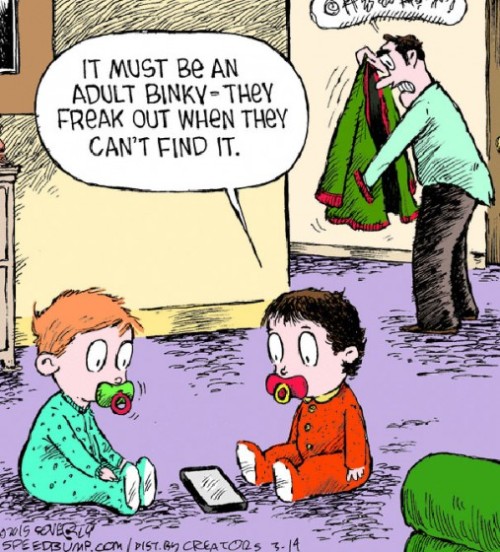
For this month, I have collected a melange of cartoons about technology use in different venues. Enjoy!

0c58a9bd3e30cc591f6c291292e34f59.gif

27682.jpg

these-30-cartoons-illustrate-how-smartphones-are-the-death-of-conversation24-507x560.jpg

bizcom26.gif

14ff34bc81aafaff085b045ea6a3a628.gif

5ec029b579686979327a12e94bb71113.gif