Latest News and Comment from Education

Saturday, May 4, 2019

IT’S ECONOMICS, NOT POLITICS. | DCGEducator: Doing The Right Thing

IT’S ECONOMICS, NOT POLITICS. | DCGEducator: Doing The Right Thing

IT’S ECONOMICS, NOT POLITICS.


New analyses that examine the political campaign contributions from those most active in “education reform”, find the movement populated by individuals who support Democratic candidates for public office. (Education Reform’s Deep Blue Hue Are school reformers right-wingers or centrists — or neither?(3/11/19 Education Next)
0*rFX1Hb-DPfovb_ED
DEMOCRATIC, YES. PROGRESSIVE? NO. 
“True to their findings, the leading participants in the school-reform “wars” are mostly engaged in an intramural brawl, one between union teacher-allied Democrats and a strand of so called“progressive” Democrats more intent on changing school systems through TFA, Charter School, Common Core, and Standardized data driven testing.”See my corrections in bold.
To call that latter group of Democrats progressive is an insult to Progressives who firmly believe in the sanctity of Public Schools and the creative powers of public school teachers, not top down instructional techniques or curricula. It shows the ignorance of these researchers because they looked at political contributions, not education as a core issue.
Why the authors say “school reform is routinely portrayed as a right-wing enterprise” is beyond me.  They say the “education-reform” community defends itself as bipartisan, school reformers are decidedly left-leaning, with 87 percent or more of the political contributions by staff at “school-reform” organizations going to Democratic candidates and causes.
THIS JUST MAKES THEM DEMOCRAT LEANING…NOT PROGRESSIVE.
However, when you begin to throw in the issues surrounding Common Core, the Republican side of these issues comes out loud and clear because of the fear of “liberal brainwashing” through Common Core Curricula. I have been witness to CONTINUE READING: IT’S ECONOMICS, NOT POLITICS. | DCGEducator: Doing The Right Thing

Jersey Jazzman: How NOT To Evaluate Education Policy: A Newark Example

Jersey Jazzman: How NOT To Evaluate Education Policy: A Newark Example

How NOT To Evaluate Education Policy: A Newark Example


One thing I've learned from years of writing on education policy: the more convoluted the talking point, the more likely it's twisting the facts.


For example [all emphases below are mine]:
Today, African-American students in Newark are four times more likely to go to a quality school than they were in 2006. 
That's from a piece by Kyle Rosenkrans, who is launching something called the New Jersey Children's Foundation (because what we really need around here is another education "advocacy" group...).

I've seen variations of this talking point in other places:

“There is not a city in America that has experienced a greater expansion of educational opportunity than Newark over the last decade,” said Ryan Hill, CEO of KIPP New Jersey charter schools. He points to test score results showing African American kids in Newark are now four times as likely to enroll in a school where students outperform the state average than they were in 2006.
At least Hill is specific, unlike Rosenkrans's use of the watery term "quality school." But where did this data nugget come from? I can't trace the source of the "four times" claim, but the same methodology was used back in 2015, when Andrew Martin, who also worked for KIPP-NJ, wrote a piece in The 74:

The percentage of black Newark students attending a school that beat the CONTINUE READING: Jersey Jazzman: How NOT To Evaluate Education Policy: A Newark Example

LAUSD Watchdogs Outrun Misconduct, Live to Offend Again - LA Progressive

LAUSD Watchdogs Outrun Misconduct, Live to Offend Again - LA Progressive

LAUSD Watchdogs Outrun Misconduct, Live to Offend Again


he Los Angeles Unified School District (LAUSD), Office of the Inspector General in 2018 was roiled by controversy. This office was responsible for investigation fraud, waste and abuse as well as the District’s internal workings.
Imagine than if you will, on March 9, 2018, Frank Cabibi, Deputy Inspector, Investigations, was forced to resign in lieu of termination amid allegations of having made racially and sexually tinged comments and shortly thereafter, he lands a job at Amtrak as an investigator.
Then, just a few short months later, in June 2018, Inspector General Kenneth Bramlett’s contract isn’t renewed amid allegations of failed leadership and fostering a hostile work environment. Bramlett wiggles his way over to Albuquerque, New Mexico where he became their Inspector General in January 2019.

How is it that these two very powerfully placed, former law enforcement officers could be accused of serious misconduct, forced out of their respective positions and come out unscathed?

How is it that these two very powerfully placed, former law enforcement officers could be accused of serious misconduct, forced out of their respective positions and come out unscathed?
There was certainly plenty of documented evidence, available on the internet, that should give a perspective employer pause.
Here are the reported claims according to Laist/Kyle Stokes
  • “Two OIG employees’ complaints alleged Cabibi — their direct boss, and the organization’s second-in-command — made discriminatory remarks about Latinos and gays.
  • Two complaints alleged that Cabibi told an OIG employee she “needed to get laid” to “knock the cobwebs out of there.”
Image result for LAUSD Watchdogs

First on new California state superintendent’s long agenda: getting more men of color in the classroom | EdSource

First on new California state superintendent’s long agenda: getting more men of color in the classroom | EdSource

First on new California state superintendent’s long agenda: getting more men of color in the classroom
Tony Thurmond reaches out for ideas on 13 education challenges


our months into his first term, State Superintendent of Public Instruction Tony Thurmond is creating 13 work groups that he expects will recommend strategies for addressing some of the state’s thorniest education challenges. The issues include the need for an extensive student data system, college affordability, special education, teacher development, student health and safety, the teacher shortage and the issue he ran on but has little direct power to effect — more funding for schools.


In an interview this week at EdSource, Thurmond identified one priority he’s ready to push high on the to-do list: enticing more minority men to become teachers, particularly in the elementary grades, and fostering the conditions to keep them in the classroom. “We’ve landed on a strategy that we’re going to get in place hopefully by next year. It’s tangible. It’s concrete and we know it’s impactful,” Thurmond said. “The data shows when kids see a teacher who looks like them it makes a huge difference.”
Only 1 percent of teachers in California are male African-Americansand 5 percent are Latino, while 6 percent of the state’s students are African-American and 54 percent are Latino. A half-dozen of the 23 campuses in the California State University system, which trains the bulk of the state’s teachers, have had initiatives to recruit minority men. But they need more funding for programs like year-long teacher residencies, which mentor young teachers in districts where they will work, Thurmond said.
Ryan Smith, whom Thurmond has named to chair the work group on closing the CONTINUE READING: First on new California state superintendent’s long agenda: getting more men of color in the classroom | EdSource

Sacramento City Unified Teachers Gets Win In Salary Dispute; Strike Still An Option – CBS Sacramento

Sacramento City Unified Teachers Gets Win In Salary Dispute; Strike Still An Option – CBS Sacramento

Sacramento City Unified Teachers Gets Win In Salary Dispute; Strike Still An Option

WE STAND WITH SACRAMENTO TEACHERS


SACRAMENTO (CBS13) — Sacramento City Unified teachers got a win in their salary dispute with the district Thursday, but it may not be enough to avoid a planned strike.
An arbitrator ruled in favor of the teacher’s union over a salary increase for mid-career teachers.
David Fisher with the Teachers Association said the educators are pleased with the arbitrator’s ruling.
“We look forward to working with the District to implement the arbitrator’s award immediately and hope that this decision encourages the District to honor our contract going forward,” Fisher said.
The district said it was disappointed in the decision as it struggles with a $35 million budget gap and a possible takeover by the state. The district said the decision will cost them more than the 3.5% maximum increase they had agreed to in their budget.
“It will have negative implications on our budget situation and we are now carefully reviewing the details of his decision to assess how much our financial obligation will increase by and the impact of this decision on our current financial challenges,” the district said in a statement.
Despite the ruling, the teachers may still stage a one-day strike on May 22. The union said the district still is not honoring another agreement to reduce class sizes and hire more counselors.

Sacramento City Unified Teachers Gets Win In Salary Dispute; Strike Still An Option – CBS Sacramento


Teachers Unions Begin Vetting Democratic Presidential Contenders | Education News | US News

Teachers Unions Begin Vetting Democratic Presidential Contenders | Education News | US News

Teachers Unions Begin Vetting 2020 Dems
The unions are planning to play a key role in selecting a Democratic candidate who can defeat President Donald Trump.


THE TWO NATIONAL teachers unions are beginning the vetting process for the large field of Democratic president contenders.
"Educators plan to be front and center in this conversation," NEA President Lily Eskelsen García said in a call with reporters Thursday during which she outlined the union's endorsement process. "We will make our presence felt in this election and will play a major role in choosing the next president of the United States."
The 3.5 million-member teachers union and the 1.7 million-member American Federation of Teachers are primed to flex their political muscle and open their purses this election cycle in order to oust President Donald Trump, whose signature education policy agenda – school choice – and proposals to slash K-12 spending are anathema to their goals.
Combined, the NEA and the AFT made $64 million in contributions to candidates, political parties, 527 committees and outside spending groups during the 2016 election cycle, according to Open Secrets, a nonprofit tracker of money in politics.
In order to win the endorsement of the NEA, candidates must complete and return a questionnaire and participate in a video interview with Eskelsen García. After that, the union's political action committee council – comprised of representatives from every state and its executive committee – makes a recommendation to the union's board of directors.
NEA recently launched a website to keep members informed about where the candidates stand on key issues, share election events, submit questions for the candidates, watch videos of the candidates and provide news from the campaign trail.
On a call with reporters, Eskelsen García called the timing of the endorsement "very, very fluid."
The AFT process differs slightly, requiring presidential candidates to engage directly its union members in a live event, which could include, the union's regulations state, meeting members at the workplace, participating in candidate forums or joining Facebook live forums.
Weingarten has said that, given the extensive field of 2020 Democratic hopefuls, she doesn't expect making an endorsement until next spring. CONTINUE READING: Teachers Unions Begin Vetting Democratic Presidential Contenders | Education News | US News

Charter School Fatigue | Dissident Voice

Charter School Fatigue | Dissident Voice

Charter School Fatigue


Charter schools have always attracted criticism due to the serious problems inherent to them, but it is no secret that in recent months charter schools have been taking it on the chin a little more than usual.
This is not unexpected.
More detailed reports, articles, and investigations are exposing with greater regularity the multi-faceted corruption and endless Jerry Springer-style scandals long plaguing nonprofit and for-profit charter schools, especially so-called “no-excuses” charter schools, virtual charter schools, and “miracle” charter schools.
Bizarre student enrollment management practices, coupled with poor transparency, shady real estate deals, inflated administrator pay, inaccurate waiting lists, high teacher turnover rates, almost no teacher unions, frequent arrests, numerous investigations, sloppy charter school applications, the siphoning of billions of dollars from public schools, the colonizing of physical facilities that rightfully belong to public schools, a severe obsession with unsound tests, and a refusal to analyze real conditions in education and society, all feel like a bit much.
People do not want any more deregulated, segregated, non-transparent “schools” that cherry-pick students, close regularly, and drain public money from over-tested, under-funded, and constantly-shamed public schools that accept all students all the time.
Just as “innovation” fatigue has started to settle in, so too has charter school fatigue. It is perhaps not ironic that charter schools have long been heralded as an “innovation.” But wherever it was applied, “innovation” ended up solving no problems; it just created new ones, namely embroiling people in more neoliberal schemes, policies, strategies, and initiatives that destroy the natural and social environment. “Innovation,” like so many other neoliberal buzzwords, proved to not serve the public interest. “Innovation” was always anti-evidence and an ideological device to block people from seeing what the CONTINUE READING: Charter School Fatigue | Dissident Voice

Beutner's changes to ballot language spark debate over parcel tax for L.A. schools - Los Angeles Times

Beutner's changes to ballot language spark debate over parcel tax for L.A. schools - Los Angeles Times

Beutner's changes to ballot language spark debate over parcel tax for L.A. schools

A dispute is roiling over a change to the ballot language of Measure EE, which would raise an estimated $500 million a year for Los Angeles public schools if approved by voters next month.
The funding infusion would provide major relief to the financially challenged L.A. Unified School District, but it would come at the cost of a substantial new obligation for local property owners.
The ballot language is the latest battlefront between business interests that oppose the tax and those who favor it, including school district officials, labor groups and others.
The proceeds of Measure EE would help both traditional public schools and privately operated charter schools in L.A. Unified. It will go before voters who live within the boundaries of the school system on June 4 and must win two-thirds approval. It is called a “parcel tax,” because the tax is applied in a uniform way per parcel and not based on the value of the property. Each eligible square foot of a parcel would be taxed at 16 cents a year for 12 years.
The school board voted unanimously on Feb. 28 to put the measure on the ballot. And district staff assured board members at the time that there would be no changes to wording, with the exception of correcting a misspelling or an error in grammar or syntax. To do otherwise would be illegal, board members were told.
But then in a March 11 letter to a county election official, L.A. schools Supt. Austin Beutner requested a change to the description of what would be taxed.
This description is crucial because it affects how much revenue the school system collects and how much money each property owner must pay for “improved building square footage.”
If this revision amounts to a change in the district’s taxing authority, the measure could face a legal challenge, based on the district’s own earlier legal analysis.
The original language, as approved by the Board of Education, defines what can be taxed as “habitable main square footage as measured by the Los Angeles County Assessor and as maintained in the Assessor’s electronic reports.”
But it is the revised definition submitted by Beutner that appears on the ballot: “the square  CONTINUE READING: Beutner's changes to ballot language spark debate over parcel tax for L.A. schools - Los Angeles Times

Sketchy Epic Cyber Charter Has Gone National | tultican

Sketchy Epic Cyber Charter Has Gone National | tultican

Sketchy Epic Cyber Charter Has Gone National


By T. Ultican 5/4/2019
Epic is the business name for Oklahoma’s indigenous and fastest growing virtual charter school chain. In 2015, they moved beyond Oklahoma opening a business in Orange County, California and are currently in contract talks with Pulaski County, Arkansas to provide online education. EPIC’s fast growth has been accompanied by continuous legal problems, charges of political improprieties and claims of unethical aggressive marketing.
The Founders
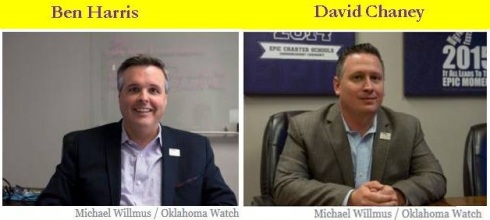
Ben Harris and David Chaney, two long time friends from Oklahoma City, founded Epic.
Harris and Chaney
The Founders of EPIC Virtual Charter Schools
In 1999, One year after Harris was awarded a Master of Public Administration from Syracuse University, he and Chaney founded Advanced Academics Inc.Today Pearson Corporation the large British testing and publishing company owns Advanced Academics which sells credit recovery courses and software for virtual classes.
Both Harris and Chaney went to work for Jeb Bush in 2003 at the Florida Department of Children and Families. Harris was soon made the Deputy Secretary in charge of technology. He worked under Secretary Jerry Regier who had previously run health and human services in Oklahoma. It was here that Harris made a name for himself by privatizing the child welfare system. However, all was not well.
Megan Rolland of the Tulsa World reported,
“In July 2004, a whistle-blower investigation revealed that Harris had accepted trips, dinners and other favors from companies looking to contract with the social services agency.
“Harris resigned and a full criminal investigation conducted by the Florida Department of Law Enforcement began. No charges were filed.
“The investigation did find that both Harris and Chaney were involved in CONTINUE READING: Sketchy Epic Cyber Charter Has Gone National | tultican

Revealing Podcast About Success Academy — Part VII | Gary Rubinstein's Blog

Revealing Podcast About Success Academy — Part VII | Gary Rubinstein's Blog

Revealing Podcast About Success Academy — Part VII


The seventh, and final, part of Startup’s podcast series about Success Academy (available here) is titled ‘High School.’
The podcast describes the chaos in their first high school which eventually led to a student revolt.  Students were sick of the overly strict rules, the extreme punishments — like getting held back a grade for being late to school too often, the culturally insensitivity of rules like the one not allowing non-religious head scarves, and an epidemic of student depression stemming from all this.  They have several interviews with Moskowitz that reveal how tone-deaf she is to these sorts of issues.  Still, this section has a happy ending — the school compromised to the student’s demands.  Still, most of the staff at the high school quit at the end of the school year.
A big segment of the podcast is about the first graduating class, the colleges they got into, and their graduation ceremony.  In the second episode, it mentions that there were 73 students in the first group of Success Academy students when it opened.  So when at around the 7:30 mark in this podcast they say “She had only 16 kids in this first senior class,16 to get into college” this would certainly have been a good time to inform the listeners who either haven’t listened to the earlier episode — or who just forgot what didn’t seem like an important detail in episode 2 — that this was 16 out of 73.
Describing the graduation:
The ceremony was held in an elegant concert hall at Lincoln Center. Eva is standing on stage wearing a bright floral dress and black patent leather stilettos. The 16 graduating seniors have blue caps and gowns, with orange tassels, the school colors. School leaders, including the outgoing high school principal Andy Malone, sit on the stage behind her, beaming. The crowd is going wild.
And in the last minute, one of the final things said in the seven part podcast
For these 16 graduating seniors, they’ve beaten the odds, and will be entering a world filled with opportunities that they likely wouldn’t have had without Success Academy.
So there was ample opportunity as, again and again, she talked about these 16 students, for the host to mention that this was 16 out of 73 yet she doesn’t and this is surely a CONTINUE READING: 


Audio: Summit Prep charter school closes doors a month early and won't reopen | 89.3 KPCC

Audio: Summit Prep charter school closes doors a month early and won't reopen | 89.3 KPCC

Summit Prep charter school closes doors a month early and won't reopen


Summit Preparatory Charter School in South L.A. has taken the unusual step of closing its doors a month early after the L.A. Unified School Board voted not to renew its charter. Summit Prep leaders could have appealed the April 2 vote, but the LAUSD decision jeopardized a short-term loan the school was counting on and administrators said it could not afford to stay open through June.
The school shut down permanently on May 3. Despite the early closure, Summit Prep students have already clocked in a complete school year — they’ve met a state minimum for instructional time.
Audio: Summit Prep charter school closes doors a month early and won't reopen | 89.3 KPCC

This South L.A. Charter School Closed a Month Early — And Won't Reopen: LAist - https://laist.com/2019/05/03/why_this_la_charter_school_closed_a_month_early_--_and_wont_reopen.php on @laist

THIS WEEK Education Research Report

Education Research Report


THIS WEEK 

Education Research Report


Science News from research organizations Finnish school students outperform US students on 'fake news' digital literacy tasks
A recent study revealed students at an international school in Finland significantly outperformed U.S. students on tasks which measure digital literacy in social media and online news. The researchers suggest this may be due to the Finnish and International Baccalaureate curricula's different way of facilitating students' critical thinking skills compared to the US system and curriculum. The resu

MAY 02

What happens when schools go solar?
Stanford's School of Earth, Energy & Environmental Sciences Sunshine splashing onto school rooftops and campuses across the country is an undertapped resource that could help shrink electricity bills, new research suggests. The study , published in the April issue of the peer-reviewed journal Environmental Research Letters , shows taking advantage of all viable space for solar panels could allow
Gallup Poll: 54% Say Teachers Unprepared to Handle Discipline
Less than half of U.S. adults (43%) believe teachers are "very prepared" or "prepared" to handle discipline issues in the classroom -- while a slight majority, 54%, say they are "unprepared" or "very unprepared." When asked about six possible solutions to address discipline issues in schools, six in 10 Americans, the most for any solution suggested, say greater access to mental health services fo
Schools in high-poverty areas, which children of color disproportionately attend, most need the repairs that correlate with improved academic achievement
Summer is often a time to repair and improve school buildings or finish building new ones, but the nation’s K-12 schools — especially in low-income neighborhoods — have been neglected for years. The coming onset of summer provides a timely reminder that states should move more forcefully to help address the need. State cuts to K-12 education over the past decade have affected more than school ope
A Weak Defense of a Useless Report
In April, the National Education Policy Center published a review of a Mackinac Center for Public Policy report entitled The Michigan Context and Performance Report Card: High Schools 2018 . The report is the fourth in a series ranking Michigan high schools based on their test scores while controlling for the percentage of students eligible for free school lunches. These Mackinac reports have bee

MAY 01

Young children who are exposed to large amounts of adult speech tend to have better cognitive skills
Researchers have found that young children who are exposed to large amounts of adult speech tend to have better cognitive skills. The major new study, led by researchers at the University of York, identified a link between kids who heard high quantities of adult speech and their nonverbal abilities such as reasoning, numeracy and shape awareness. The researchers gained unprecedented insight into
Are Public School Teachers Adequately Compensated? xx
It is difficult to definitively answer the question of whether public school teachers are adequately compensated. To provide context for understanding the research on the adequacy of teacher compensation, this Center on Education Policy brie f describes how the public K-12 education system is funded (including how events how the Great Recession impact teacher compensation) and highlights recent a
How States are Responding to ESSA’s Evidence Requirements for School Improvement
This report, based on interviews with officials from seven state departments of education, explores state efforts to assist local educators with selecting evidence-based interventions to improve low-performing schools. The report also contains some recommendations for making research more accessible to educators. Several themes emerged across multiple state interviews that could be informative fo
Personalized Learning: The Promise and the Reality
Personalized learning programs are proliferating in schools across the United States, fueled by philanthropic dollars, tech industry lobbying, marketing by third-party vendors, and a policy environment that provides little guidance and few constraints. In Personalized Learning and the Digital Privatization of Curriculum and Teaching , Faith Boninger, Alex Molnar, and Christopher M. Saldaña, of th

APR 30

The impact of Take Stock in Children's® (TSIC's®) FLIGHT program
The What Works Clearinghouse (WWC) recently reviewed research that examined the impact of Take Stock in Children's ® ( TSIC's ® ) FLIGHT program on students’ college access and enrollment, general academic achievement (high school), and attendance (high school). The results are summarized in an intervention report released by the Institute of Education Sciences today . FLIGHT provides eligible st
Student Outcomes and Parent Teacher Home Visits
Parent Teacher Home Visits (PTHV) is a strategy for engaging educators and families as a team to support student achievement. The PTHV model developed from an understanding that family engagement is critical to student success. This study addresses the following research questions : 1 . To what extent does schools’ implementation of PTHV predict school - level outcomes? 2 . To what extent does st
Trial of the MindOut Program for Disadvantaged Post-Primary School Students
School-based social and emotional learning programs aim to provide students with the skills they need to deal with life challenges, thereby enhancing their social and emotional wellbeing, academic outcomes, and reducing their risk of mental health difficulties. While there is a robust evidence base on the effectiveness of these programs originating from the US, there is a relative paucity of rese
Research on Programs For Struggling Readers in Elementary Schools
This article reviews research on the outcomes of diverse reading approaches on the achievement of struggling readers in elementary schools. 61 studies of 48 different programs met rigorous standards. 84% were randomized experiments and 16% quasi-experiments. Outcomes were positive for one-to-one tutoring and were positive but not as large for one-to-small group tutoring. There were no differences
Effects of College-and Career-Ready Standards on Student Achievement: Significant negative effects for grade 4 reading; Negative effects were also observed for grade 8 reading, grade 4 math, and grade 8 math
Full report Since the release of the report A Nation at Risk, standards-based reforms have been a crucial part of federal and state efforts to improve education. College- and career-ready (CCR) standards--the focus of the current wave of standards-based reform—differ from states’ previous standards in importantways.Most notably,the new CCR standards were explicitly designed around thegoal of ensu
English Language Learners in America’s Great City Schools
In 2013, the Council of the Great City Schools (CGCS) published the first-ever report on English language learners (ELLs) enrolled in member districts, reporting on a range of indicators in addition to ELL enrollment and languages spoken by such students. This report updates most of the data presented in the 2013 Council ELL report, shedding light once again on ELL enrollment, student performance
Higher Education Trends
For 17 years, the New Media Consortium convened panels of experts from higher education and posed three key questions for them to discuss: What is on the five-year horizon for higher education institutions? Which trends and technology developments will drive educational change? What are the critical challenges and how can we strategize solutions? The resulting Horizon Report series charts the fiv
2018 National Assessment of Educational Progress (NAEP)
In 2018, the National Assessment of Educational Progress (NAEP) administered the digitally based Technology and Engineering Literacy (TEL) assessment to better understand what U.S. students know and can do in the areas of technology and engineering. Eighth-grade students were presented with real-world technology and engineering challenges. They were asked to respond to questions aimed at assessin

APR 29

Education may be key to a healthier, wealthier US
According to the United States Department of Education, the U.S. high school graduation rate will reach an all-time high this year, which is good news for both our economy and health. Policy makers often use education policy to strengthen the workforce and boost earnings, productivity and employment. But earning a diploma may also lead to a longer, healthier life. A new study from the University
Being a car commuter with obesity linked to a 32% increased death risk
New research presented at this year's European Congress on Obesity in Glasgow, Scotland (28 April - 1 May) shows that individuals with obesity who commute by car have a 32% higher risk of death, from any cause, compared with those individuals with a normal weight and commute via cycling and walking. The study is by Edward Toke-Bjolgerud, University of Glasgow, UK, and colleagues. Previous work, u
'Pedigree is not destiny' when it comes to scholarly success
Santa Fe Institute IMAGE: For pairs of computer science faculty matched by (A,B) work environment prestige or (C,D) training environment prestige, (A) publication and (B) citation counts are statistically independent of differences in doctoral prestige... view more Credit: Samuel F. Way What matters more to a scientist's career success: where they currently work, or where they got their Ph.D.? It
Quality Rating Systems for Early Learning Programs
In several publications released today (April 29 th ), the Institute of Education Sciences describes the progress that Race to the Top—Early Learning Challenge (RTT-ELC) grantee states made in implementing rating systems to document and improve early learning program quality. The RTT-ELC grant program aimed to improve the school readiness of children, particularly those with high needs. A key pri

APR 26

State pre-K provision for 3-year-olds lags far behind
April 26, 2019 Infants and toddlers, preschoolers, and early elementary-aged children encompass the field of early childhood education, giving the impression that all children from birth through age 8, fit neatly into one of three categories. But state policies suggest something quite different for 3-year-old children as they often are neglected when state preschool programs are designed and fund
Special Ed: Varied State Criteria May Contribute to Differences in Percentages of Children Served
About 13 percent of children aged 3 through 21 enrolled in public schools received special education services in school year 2015-16, and about 3 percent of children from birth through age 2 received special education services.The percentage of the population served under IDEA varies across states. For example, in fall 2016, the percentages of the population aged 6 through 21 served in individual

APR 25

Severe Teacher Shortage Shows States Should Better Fund Schools
The country’s severe shortage of qualified public elementary and secondary school teachers, which a new Economic Policy Institute (EPI) report details, demonstrates states’ need to raise adequate revenue not only to boost teacher pay but also to provide the resources that high-quality schools require. While teacher protests over the last year helped encourage states to boost teacher pay, some sta
English Learners, One Study, and the Dangers of Translating Research into Practice
It hit the news with a bang : Immigrants learned English in half the time when they were held back in third grade, proclaimed one headline about the National Bureau of Economic Research working paper by David Figlio of Northwestern University and Umut Özek of the American Institutes for Research. Repeating 3rd Grade Could Help Struggling English-Learners, blared another. The findings , while clea
50-State Comparison: Postsecondary Campus Safety
When it comes to safety and students, a lot of public interest and media attention centers on K-12 schools. But college campuses face safety concerns, too, and state policies play an important role in setting standards and guidance for postsecondary institutions. This new 50-State Comparison captures state policies — pertaining to (1) guns on campus and (2) sexual assault involving students on or
Large negative effects of voucher usage after four years, especially in math.
The Louisiana Scholarship Program (LSP) offers publicly-funded vouchers to students in low-performing schools with family income no greater than 250 percent of the poverty line, allowing them to enroll in participating private schools. Established in 2008 as a pilot program in New Orleans, the LSP 


Education Research Report