Latest News and Comment from Education

Monday, July 10, 2017

Portland woman sues Betsy DeVos for delaying rules targeting for-profit schools | OregonLive.com

Portland woman sues Betsy DeVos for delaying rules targeting for-profit schools | OregonLive.com:

Portland woman sues Betsy DeVos for delaying rules targeting for-profit schools

Niesha Wright, 40, completed an associate's degree program at ITT Tech but soon discovered that the degree and the school's credits were not respected or transferable.


Niesha Wright, 40, completed an associate's degree program at ITT Tech but soon discovered that the degree and the school's credits were not respected or transferable. (Courtesy of Niesha Wright)


Niesha Wright completed an associate's degree program at ITT Tech last summer, weeks before the for-profit giant began to crumble under increasing regulatory pressure from the Obama-era Department of Education.
She didn't leave the program as a proud graduate. The 40-year-old Portland resident had more than $25,000 in federal student loans and few useful skills to show for her two years at ITT Tech, according to her attorney. Wright hoped to obtain relief, along with tens of thousands of other jilted ITT students, through a federal student loan forgiveness program geared toward students who experienced misleading or predatory treatment at the hands of largely for-profit colleges.
But on June 14, U.S. Secretary of Education Betsy DeVos said she would delay the Obama administration's proposed rules governing the loan forgiveness program. The Obama rules, set to take effect July 1, were designed to streamline the application process for students like Wright.
On Monday, Wright sued DeVos in federal court.
The lawsuit comes on the heels of a separate lawsuit from Oregon Attorney General Ellen Rosenblum and 18 of her colleagues last week challenging DeVos' legal authority to unilaterally delay the borrower defense rules without public process. "Had this rule gone into effect on July 1, as intended," Rosenblum said last week in a statement provided to The Oregonian/OregonLIve, "it would have provided important protections for borrowers who have been victimized by Portland woman sues Betsy DeVos for delaying rules targeting for-profit schools | OregonLive.com:

Beyond Testing | Deborah Meier on Education

Beyond Testing | Deborah Meier on Education:

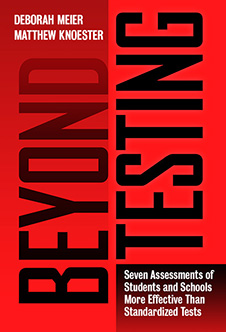
Beyond Testing

beyond_testing-332px


Dear Friends and Family,
I want to let you know that my new book, Beyond Testing: Seven Assessments of Students and Schools More Effective Than Standardized Tests is out and is currently being offered at a discount by TC Press!
 Below is a description of the book :

Beyond Testing describes seven forms of assessment that are more effective than standardized test results: (1) student self-assessments, (2) direct teacher observations of students and their work, (3) descriptive reviews of the child, (4) reading and math interviews with children, (5) portfolios and public defense of student work, (6) school reviews and observations by outside professionals, and (7) school boards and town meetings. These assessments are more honest about what we can and cannot know about children’s knowledge, skills, and dispositions, and are more adaptable to varying educational missions. Readers can compare and contrast each approach and make informed decisions about what is most appropriate for their school.
Click here to visit the online book page. Please note that there is a 20% discount when using the code “TCP2017.” Exam copies for text adoption are available by clicking here.

H-E-B's Butt pledges $50 million more to education efforts | The Texas Tribune

H-E-B's Butt pledges $50 million more to education efforts | The Texas Tribune:

H-E-B's Butt pledges $50 million more to education efforts

One of Texas’ most prominent philanthropists made another splash Monday, pledging $50 million to a program that will train public school teachers.

Student teacher Antonio Salmeron teaches a class as part of the UTeach Program at UT-Austin on July 10, 2017.
 Austin Price / The Texas Tribune


Charles Butt, the chairman and CEO of H-E-B and one of Texas’ most prominent philanthropists, made another splash Monday, pledging $50 million to a program that will train public school teachers.
The donation comes in the form of a new scholarship program, Raising Texas Teachers, which will be run by the Butt-founded Raise Your Hand Texas Foundation. Ten schools, including the University of Texas at Austin and the University of North Texas at Dallas, will receive funding this year for student scholarships. Eventually, the program will give 500 college students $8,000 per year to help them pursue teaching certifications.
“To improve academic achievement, it is critical that Texas elevate the status of the teaching profession, strengthen the existing pool of aspiring teachers, and inspire our most talented high school graduates to consider a career in teaching,” Butt said in a news release.
Earlier this year, Butt, the billionaire leader of the Texas-based grocery chain, pledged an additional $100 million to the creation of the Holdsworth Center, a nonprofit that works with state school districts to strengthen their leadership programs. H-E-B's Butt pledges $50 million more to education efforts | The Texas Tribune:

Sacramento Then and Now

Sacramento Then and Now:

Sacramento Then and Now

Image result for Sacramento Then and Now
Sacramento Historic Photos: K Street Then and Now https://shar.es/1BVZMI

It was a hot summer day in Sacramento, California’s capital city, in 1965. The cool water of a local public pool beckoned, three blocks away. Alone, I strolled there, ambling past manicured lawns in a suburban burg next to the American River. This pool, part of the city of Sacramento Parks and Recreation, opened on Memorial Day and closed on Labor Day. My male friends and I, dressed in swim trunks, t-shirts and rubber flip flops, gathered outside the pool entrance. We traded insults. In no time, we paid the pool entrance fee, ambled through the mall dressing room and arrived outside on the brown cement deck. Jump in the cool water. Feel refreshed. We spent the day there, minus sun block, munching on Payday bars. This was the daily routine until the neighborhood public school opened in early September.
At that point, the pool’s dressing room became a city-run teen center, open every day but Sunday. Movable walls dividing the gender-separated dressing rooms shifted. The extra space made room for a pool table and ping pong table. My male friends and I enjoyed spending time in the teen center, criticizing each other, but also chatting with the city staff, a few years older. They were the legal adults in charge. We looked up to them. It was a learning experience with role models to emulate and imitate.
City parks and rec staff also opened and closed the playground at the local neighborhood school. They checked out sports equipment to my male friends and me after school ended. Want a basketball, football or tetherball? We knew who to see. We did that, day after day. For us, play was the thing. Adequately funded public parks made it happen. I took this policy to be a natural thing, a little like the sun rising in the morning, or clean water flowing from a faucet.
Little did I know that my experience of growing up in Sacramento as the postwar economy of shared prosperity was exceptional. It came to an end. A weatherman, as Bob Dylan sang, is not the only soul to see changed climate. The changed winds of public policy did not arrive via what author Naomi Klein terms “disaster capitalism1,” a shock such as Hurricane Katrina that devastated the Gulf Coast and led to the firing of all public school K-12 teachers in New Orleans.
Back in Sacramento, a gradual decline of tax funding for the public services such as parks and schools which undergirded my youth of year-round play unfolded. For example, my neighborhood’s city-run teen center at the public pool closed its doors years ago. The city parks and recreation playground at the local school has been gone Sacramento Then and Now:

ABOUT THE AUTHOR

Seth Sandronsky lives and works in Sacramento. He is a journalist and member of the Pacific Media Workers Guild. Email sethsandronsky@gmail.com
Image result for sacramento arena
Sacramento Can't Afford Poor Kids But Has The Best Arena In The NBA 

Why Democrats Should Follow the NEA, NAACP and Black Lives Matter and Unite On A Charter School Moratorium | Alternet

Why Democrats Should Follow the NEA, NAACP and Black Lives Matter and Unite On A Charter School Moratorium | Alternet:

Why Democrats Should Follow the NEA, NAACP and Black Lives Matter and Unite On A Charter School Moratorium

Another rallying point labor and civil rights agree on.

Democrats know that success for their party relies on bringing labor and civil rights advocates together on key issues.
Faced with disastrous Donald Trump, labor and civil rights advocates are rallying in common cause behind health care for all, a living wage for every worker, a tax system where the wealthy pay their fair share, tuition-free college, and an end to senseless, never-ending wars.
Here’s another rallying point labor and civil rights agree on: A moratorium on charter schools.
This week, the nation’s largest labor union, the National Education Association, broke from its cautious regard of charter schools to pass a new policy statementthat declares charter schools are a “failed experiment” that has led to a “separate and unequal” sector of schools that are not subject to the same “safeguards and standards” of public schools.
To limit the further expansion of these schools, the NEA wants a moratorium on new charters that aren’t subject to democratic governance and aren’t supportive of the common good in local communities.
The NEA’s action echoes a resolution passed earlier this year by the national NAACP calling for a moratorium on the expansion of charters and for stronger oversight of these schools. These declarations also align with a policy statement issued last year by the Movement for Black Lives, a network Black Lives Matter organizers, calling for a moratorium on charter schools.
Now that labor and civil rights groups have come together in a unified call for a moratorium on these unregulated, privately-operated schools, prominent Why Democrats Should Follow the NEA, NAACP and Black Lives Matter and Unite On A Charter School Moratorium | Alternet:

CURMUDGUCATION: Meet the New Boss

CURMUDGUCATION: Meet the New Boss:
Meet the New Boss


If there was one thing that was going to be a hallmark of the Betsy DeVos Depatrment of Education, it was going to be their studious hands-off approach. Previous departments may have used all manner of extra-legislative legerdemain to impose their will on the states (Common Core arm-twisting, Race to the Top bribery, waiver-based extortion). ESSA was born out of bipartisan grumpiness over USED's long, grabby arms, and yet, one of John King's final actions as secretary wasto get himself spanked by Lamar Alexander for STILL trying to write laws from the USED offices.


"I will never do that kind of baloney," Betsy DeVos said.

"Easy to say until you have the wheel of power gripped tight in your own hand," said I. Here's a woman who has spent her whole adult life trying to impose her will on the education system. Now that she actually has the power, can she forgo actually using it?

Well, meet the new boss, same as the old boss.

And I don't mean actually meet her, because DeVos rarely does press, and when she does, it's a big nothing sandwich.  

As reported by Erica Green in the New York Times, DeVos's department has decided they will be the arbiter of adjectives, the setters of standards, the commandants of state capitals. Folks have submitted their ESSA plans, and USED is feeling its oats:

...the Education Department’s feedback to states about their plans to put the new law into effect, 
CURMUDGUCATION: Meet the New Boss:

Take it from a New Orleans charter school teacher: Parents don't always get school choice right - LA Times

Take it from a New Orleans charter school teacher: Parents don't always get school choice right - LA Times:

Take it from a New Orleans charter school teacher: Parents don't always get school choice right


Cohen — isn’t that a ghetto school?” the mom filling out her son’s application to a New Orleans high school asked me.
It was July of 2015, and we were sitting across from each other at an open enrollment fair at Dillard University, where it seemed as if the whole city had shown up to choose charter schools for their children. I was there as a volunteer to help parents sift through their options and fill out school applications. I struggled to figure out how to answer this woman’s question.
As a teacher at Cohen College Prep, I knew it to be one of her son’s best options, boasting the highest college acceptance rate of any open-enrollment high school in the city. But in my duties as a volunteer that day, I was prohibited from giving any opinion that could influence her decision.
“Cohen earned a B last year, according to the state,” I finally responded weakly.


“Hmm,” she said, turning to her son whose future we were trying to determine. “What do you think?”
“I want to go to Lake Area,” he said. “They say it’s fun there.”
My stomach sank. I had taught at Lake Area too. Despite the Herculean efforts of many of my old colleagues, Lake Area traditionally bounced between a C and a D. I knew firsthand that this child would not receive the same quality of education there as he would at Cohen.
Saying nothing, I checked to see how many seats Lake Area had left. It was full.


“Sorry,” I said. “Lake Area was a popular choice this year.”
It had been that way for the past few years. Despite its poor rankings, Lake Area consistently remained one of parents’ top choices. Cohen, meanwhile, struggled each year to persuade parents to send their students there. When I signed on as a civics teacher in 2015, 71% of the graduating class had enrolled in a four-year college, compared with 55% of Lake Area’s. But while class sizes ballooned at Lake Area, Cohen was under-enrolled by was under-enrolled by several hundred students.
 How could a D school be a top-five pick with parents while a B school ranked near the bottom of the barrel? Here was the free-market theory of parent choice played out like Milton Friedman and Los Angeles’ new school board member, Nick Melvoin, imagined — except parents weren’t always choosing the best schools.

Why?
The answer is a cautionary tale for Los Angeles, where the new school board, sworn in on Friday, has made it clear that it will make parent choice a priority.
During my three years teaching in New Orleans, I heard hundreds of reasons why parents chose the schools they did. Some, at Lake Area, liked the brand-new building. In a city where Hurricane Katrina had pulverized the majority of the city, appearances mattered. The sleek glass angles of Lake Area were a source of pride, whereas the bleak concrete of Cohen suggested a history of hardship many preferred to forget.
Other parents cared about safety, and rightly so. Whereas Cohen had existed as a neighborhood school for years (a conversion, as we would call it in L.A.), Lake Area was a start-up. That meant that Cohen had decades to acquire a reputation for being a rough school, while Lake Area began with a spotless record. Although I witnessed far more fights at Lake Area than I ever did at Cohen — where new leadership had created a much calmer, better-run school —parents’ institutional memories were slow to change.
Other families cared deeply about sports, choosing schools based on athletics rather than academics. For some students and their parents, getting a sports scholarship was the best ticket to college they felt they had. Considering the fact that, prior to Katrina, 62% of New Take it from a New Orleans charter school teacher: Parents don't always get school choice right - LA Times:

Charter Schools: Who Is Working Together to Improve Them? – Cloaking Inequity

Charter Schools: Who Is Working Together to Improve Them? – Cloaking Inequity:

Charter Schools: Who Is Working Together to Improve Them?

Image result for Charter Schools

During the past decade the number of students in charter schools has nearly tripled, with approximately 3.1 million students enrolled in 2016-17. In fact, one in eight black students now attends a charter in the United States. But while the popularity of charters is growing, so is concernabout charter schools, particularly in the civil rights community and among grassroots educators in teachers unions.
Last summer the NAACP made national news when it called for a charter moratorium until various civil rights concerns were addressed. Other civil rights organizations—including the Journey for Justice Alliance and the Movement for Black Lives—also called for a moratorium on charter schools.
These calls are leading the way for a shift in the national conversation about school choice, and help distinguish privatization and market-based education from real efforts to improve public education.
Last summer the leadership of the National Education Association faced an uprising of sorts from grassroots educators demanding that more critical questions be asked about transparency and accountability for charter schools. In response, NEA President Lily Eskelsen García convened a twenty-one member taskforce on Charter Schools last September, charging members to “fundamentally rethink what NEA policy should be on charter schools.”
This past week, the taskforce delivered their policy statement to a representative assembly at the NEA, and it was overwhelmingly voted into policy by educators from across the United States.
The new policy lays out three criteria charter schools must meet to provide students with the support and learning environments they deserve.
The first is that charter schools should only be authorized by a local and democratically accountable authorizing entity— i.e. a local school district—so that local school officials can closely monitor charter performance, and spread any potential innovations to local public schools.
The statement also calls for an empirical assessment of how a new charter school will serve to improve the local public system before any charter enters a community.
Finally, the statement requires that charter schools comply with the same safeguards and standards that apply to neighborhood public schools such as “open meetings and public records laws, prohibitions against for-profit operations or profiteering, and the same civil rights, employment, labor, health and safety laws and staff qualification and certification requirements.”
Educators at the assembly went further to pass an amendment calling for state and local moratoriums if charter schools do not meet these basic standards. Other amendments included stronger language on protections for special education students and limits on the state-level role in the approval of charter schools.
Market-based school choice supporters have often insisted that teachers’ unions have always been against charter schools.
In fact, Albert Shanker, former President of the American Federation of Teachers union, is credited with popularizing the charter idea as an alternative community-based, teacher-driven approach for the governance of schools in the early 1990s.
As a token academic on the NEA Charter School Taskforce, and in conversations with union leaders and educators, I know that this simplification is far from the truth. In fact, teacher unions have organized tens of thousands of charter school teachers over the years. As a result, the conversations about charter schools inside teachers’ unions are much more nuanced and balanced than market-based school choice supporters would have the public believe.
Market-based education reformers would also have us believe that education reform has been a “mainstream” movement over the past twenty years. Mike Petrilli argued just that in USA Today in response to the NEA’s new policy statement. During the Senate confirmation hearing for Secretary of Education Betsy DeVos, Senator Lamar Alexander essentially made the same argument on behalf of charters.
But goals for charters are far from mainstream; they have been strongly influenced by neoliberal ideals for privatization and private control of education in the United States.
Over the past year, civil rights organizations, grassroots educators, and citizen supporters of public schools organized to push back against this direction of charter schools, and to demand a reassessment.
The NEA’s new statement on charters is hopefully a turning point in our national discourse. The public is becoming more and more aware that the common sloganeering that underlies the various private-control and privatization school choice approaches are red herrings, and that educators and the communities that civil rights organizations represent are the experts when it comes to public education.
This article was first published by The Progressive Magazine here.
Please Facebook Like, Tweet, etc below and/or reblog to share this discussion with others.
Check out and follow my YouTube channel here.
Want to know about Cloaking Inequity’s freshly pressed conversations about educational policy? Click the “Follow blog by email” button in the upper left hand corner of this page.
Twitter: @ProfessorJVH
Click here for Vitae.
Charter Schools: Who Is Working Together to Improve Them? – Cloaking Inequity:

DeVos and Defrauding | By Christopher Brauchli | Common Dreams

DeVos and Defrauding | By Christopher Brauchli | Common Dreams:

DeVos and Defrauding

"Not surprisingly, in this administration, if a choice has to be made between taking steps to help the needy, in this case students, or the taxpayer, the taxpayer wins."

Education Secretary Betsy DeVos has moved quickly to dismantle Obama-era regulations aimed at protecting students from predatory for-profit schools. (Photo: Ted Eytan/Flickr/cc)
D’ye think th’ colledges has much to do with th’ progress iv th’ wurruld?” Asked Mr. Hennessey.
“D’ ye think ,” said Mr. Dooley, “tis the mill that makes th’ wather run?”
— Finley Peter Dunne [Mr. Dooley], Colleges and Degrees
The good news is that the DJT administration has finally come up with a plan to help businesses that does not benefit one of DJT’s enterprises and, therefore, does not represent a conflict of interest for DJT. That comes as a welcome surprise for those who have marveled at how DJT has transformed the White House from a policy center to a profit center. This was most recently demonstrated when the Republican National Committee selected the Trump International Hotel in Washington, to host a $10 million re-election fund raiser in that venue. According to the hotel, the Republican National Committee that put on the event paid “regular prices” for all the services and space provided by the hotel. That blatant conflict of interest made it all the more important to alert the public to the fact that, appearances notwithstanding, the most recent political decision made by the administration does not benefit DJT in any way. That is because, as far as can be determined, DJT no longer has any financial interest in making money by defrauding students. That was not always the case.

A while back, DJT was the poster child for an unethical enterprise that purported to offer training to its victims in get rich schemes. His fraud was called Trump University. It was a complete scam. It had no campus or classrooms. Although it touted the qualifications of its faculty when recruiting students, its faculty lacked academic credentials, the university granted no degrees, and most of its students discovered that promises of lucrative careers in the real estate world following completion of the program were illusory. Because of its palpable fraudulent conduct, it was subject to a class action lawsuit from those who had DeVos and Defrauding | By Christopher Brauchli | Common Dreams:


Seattle Schools Community Forum: HALA and Public Schools

Seattle Schools Community Forum: HALA and Public Schools:

HALA and Public Schools

Image result for What is HALA? The Housing Affordability and Livability Agenda (HALA) is a multi-pronged strategy for addressing housing affordability in Seattle.


You may recall that when the Mayor's HALA plan for our city came out, the plan consistently referred to schools as "amenities."  That's just wrong because no city is great without great schools which are part of the infrastructure of a city.  (They also had it in the plan that if the City built housing that could support a school at the street level, that school would go to a charter group.  When I challenged that idea, the word "charter" mysteriously disappeared.  No one at any HALA meeting will explain how it got in there and why it went away.)

You may have recently received an e-mail about the EIS for the HALA planwith a link for public comments.  I have to smile because while I think it important that citizens have access to the entire plan, it's a huge document.  I think if you really wanted input, a detailed synopsis would have been helpful. That's if you really wanted public input.

A reader did alert me to a section I had missed in the plan, called Public Services and Utilities (with public schools being part of that).   (And thank you to this reader; I depend on readers to send me this kind of information.)

What this reader noted:


In addition to my dismay that the Comprehensive Plan seemingly did not include Crown Hill in its study of schools by sector (not listed on page 4), and omitting Whitman Middle School from the list of schools lacking full sidewalk infrastructure (page 5 and 15), the DEIS does not offer sufficient mitigations on the impact of Seattle Schools Community Forum: HALA and Public Schools:

Fear and Longing: Life for Students with Undocumented Parents

Fear and Longing: Life for Students with Undocumented Parents:

Fear and Longing: Life for Students with Undocumented Parents
With parents targeted for deportation, students are traumatized, often unable to learn - and increasingly turn to educators for solace and advice.


AUSTIN, Texas—”Would you go?”
This is the question that silences 16-year-old Jacqui, tightens her wide smile into a thin line, and provokes a low sigh.
Her mother sits next to her—motionless—her gaze transfixed on a crack in the sidewalk.
The answer is no. Simply, reluctantly, painfully, no. If push comes to shove, and federal immigration agents deport Jacqui’s parents to Mexico, a country they left 18 years ago to find work, she would not go.
Jacqui would stay in the U.S., alone, to finish high school, go to college, and make good on her considered plans to earn a law degree. She is a citizen. They are not.
It’s a no-win situation that promises nothing but agony for millions of undocumented U.S. immigrant parents and their children.
“It is not something I like to think about,” says Jacqui quietly, closing the topic of conversation. Her mother still does not speak.
We are not criminals. We are mothers, and we are fathers. We are people who work, and who take care of our children. That’s it! Not criminals. Not criminals.” – Jacqui’s mother
About one in 14 students, or 6.9 percent from kindergarten through twelfth grade, have at least one undocumented immigrant parent, according to a 2014 Pew Research Center report. Most are U.S.-born, American citizens, like Jacqui, while a much smaller number (1.4 percent) are undocumented themselves.
Their numbers vary widely across the U.S., from nearly 18 percent, or about one in five students, in Nevada, to 0.1 percent in West Virginia.
For the most part, their parents are like Jacqui’s. They crossed the border to find work at least a decade ago, statistics show, and then put down roots as their Fear and Longing: Life for Students with Undocumented Parents:

CURMUDGUCATION: What About Flat Earthers?

CURMUDGUCATION: What About Flat Earthers?:

What About Flat Earthers?


This week the Denver Post ran an.... intriguing? unexpected? gob-smacking? piece about the Flat Earther community in the US, which is, for some reason, centered in Colorado. And these folks are committed.


You might think that this is some sort of hipster irony thing, like the Church of the Flying Spaghetti Monster. But take a stroll through just one flat earther youtube channel-- Globebusters-- and you'll realize that nobody means to be funny here. The international space station? A huge fake.The edge of the world? A barrier of ice. Why don't we feel the alleged speed at which we're supposed spinning with the earth's surface? And is NASA, as another flat earth-- well, I'd call it a group but it appears to be just one guy-- asserts, a secret arm of the Freemasons? And why do conspiracy theorists always have such bad spelling skills?

The Post piece offers a hint at the appeal:

“They want you to think you’re insignificant, a speck on the earth, a cosmic mistake,” Sargent says. “The flat earth says you are special, we are special, there is a creator, this isn’t some accident.”...

He and other Flat Earthers can only speculate why the global conspiracy has had such staying power for more than 500 years, or why “the top” — the uber-elite heads of governments, universities and major corporations that allegedly know “the truth” — would continue to uphold a scheme that offers little in the way of riches or strategic power.

But I'm not here to discuss the merits of Flat Earth Theory which is, after all, well-destroyed bunk. 

My question is-- what do we do with these folks?

Sure, it's a free country and you can believe whatever dumb thing you want to believe. You can
CURMUDGUCATION: What About Flat Earthers?: 

Big Education Ape: CURMUDGUCATION: ICYMI: Stuff To Read Edition + Catch up with CURMUDGUCATION - http://bigeducationape.blogspot.com/2017/07/curmudgucation-icymi-stuff-to-read.html

Nancy Willard: Deliberate Indifference to a Hostile Environment: A Call for Attorneys to Protect Vulnerable Students

Education Law Prof Blog:

Deliberate Indifference to a Hostile Environment: A Call for Attorneys to Protect Vulnerable Students
 By Nancy Willard


Public school districts violate federal civil rights laws when discriminatory harassment of students based on race, color, national origin, sex, or disability is sufficiently serious to create a hostile environment that is interfering with the students’ rights to receive an education, and school staff encourage, tolerate, do not adequately address, or ignore such harassment.
An unacceptably high number of students in public schools in the U.S. are suffering from daily bullying and harassment by their peers--and sometimes school staff. This emotional, and sometimes physical, abuse is known to have a life long harmful impact and to significantly interfere with the targeted students’ ability to receive an education.
While bullying and harassment of students has received a higher degree of focus in recent years, there is no evidence of any significant decrease in the number of students reporting being bullied and harassed. In fact, in some states, it appears that the approach promoted by the state’s anti-bullying statute is having an opposite effect.
For example, in the state of New York, the much-touted Dignity Act for All Students (DASA) was enacted in 2010. On the Youth Risk Behavior Survey in 2011, 18% of New York students reported being bullied. By 2015, this rate had increased to 21%. Under DASA, schools are required to make annual public reports of the number of bullying incidents--a black-mark on the school. In the 2015-16 school year, 71% of New York City schools reported zero bullying incidents.
The approach incorporated into state statutes has created the misperception that all educators must do is have Education Law Prof Blog:

Emily Talmage; Is Wall Street About To Take Over Public Education Once And For All? | PopularResistance.Org

Is Wall Street About To Take Over Public Education Once And For All? | PopularResistance.Org:

Is Wall Street About To Take Over Public Education Once And For All?

Image result for wall street hostile takeover of public schools


Across the country, teachers are being asked to collect, record, and slog through mountains of data that “experts” insist is meant to improve their practice.
There are pre-assessments and post-assessments, habits of work rubrics, writing prompts, social and emotional screeners, standards-based grading systems, RTI data, student learning objectives, professional growth goals, student surveys, self evaluations, administrator evaluations, office discipline referrals, results from progress monitoring programs  …the data demands go on and on, and all of it must be entered and stored in learning management systems.
Recently, a few brave teachers have begun to publicly state the obvious: that we don’t need all of this data to do our jobs well.
Unfortunately, no one seems to be listening, as there is a far more powerful entity that does need all this data:
Wall Street.
As Pay for Success schemes – also known as Social Impact Bonds – sweep the country, data collection in schools is reaching new heights.
“[It’s] an approach that has come of age,” Andy Sieg, Managing Director and Head of Global Wealth and Retirement Solutions at Bank of America Merrill Lynch said of Pay for Success contracts. “We see the confluence of investor demand, government innovation and access to data leading to the dawn of this new market.”
Here’s how they work: private investors provide upfront capital to start a program (a pre-K, for example). If the program meets a set of agreed-upon metrics of “success” (reducing the number of children receiving special education services, for example), investors get repaid with interest.
Despite ethical concerns and doubts about the actual public benefit of these contracts, they are rapidly advancing nationwide due to promises of big payouts for lenders. Goldman Sachs, for example, put up $16.6 million to fund an early childhood education program in Chicago, yet it is getting more than $30 million from the city.  According to The Rockefeller Foundation and Merrill Lynch, the impact investing market will reach between $400 billion to $1 trillion by 2020.
And they don’t intend for the profits to stop there. Investors also have plans to package these bonds up and turn them into a derivatives market. Using performance-based data to inform risk, investors will be able to gamble on these bond-backed securities just as they Is Wall Street About To Take Over Public Education Once And For All? | PopularResistance.Org:
 Image result for wall street hostile takeover of public schools