Friday, March 17, 2017

Betsy DeVos’s Hiring of For-Profit College Official Raises Ethical Issues - The New York Times

Betsy DeVos’s Hiring of For-Profit College Official Raises Ethical Issues - The New York Times:

Betsy DeVos’s Hiring of For-Profit College Official Raises Ethical Issues


As chief compliance officer for a corporate owner of for-profit colleges, Robert S. Eitel spent the past 18 months as a legal point man for a company facing multiple government investigations, including one that ended with a settlement of more than $30 million over deceptive student lending.
Today, Mr. Eitel — on an unpaid leave of absence — is working as a special assistant to the new secretary of education, Betsy DeVos, whose department is setting out to roll back regulations governing the scandal-walloped for-profit college sector.
His new role, which has not been announced publicly, could bump up against federal rules involving conflicts of interest and impartiality, ethics experts said, particularly given his position as a vice president for regulatory legal services at Bridgepoint Education Inc., an operator of for-profit colleges, during federal investigations into the company.
“It raises considerable red flags, especially due to the fact that this company was under investigation,” said Scott H. Amey, general counsel at the Project on Government Oversight, a nonpartisan, nonprofit investigative group.
Mr. Eitel, an Education Department lawyer under President George W. Bush, has been a stalwart critic of federal regulation of both for-profit colleges and K-12 education under the Obama administration.
A department spokesman, who requested anonymity, said Mr. Eitel is part of a “beachhead” team, paid staff members who are temporarily helping to lead federal agencies as the Trump administration gets up and running but do not require Senate confirmation.
Mr. Eitel has conferred several times with the agency’s ethics officer, the spokesman said, and will recuse himself from any policy decisions or discussions related to Bridgepoint and another former employer, Career Education Corporation. While on unpaid leave from Bridgepoint, the spokesman said, Mr. Eitel has also volunteered to recuse himself from weighing in on the department’s “gainful employment” regulation, which is intended to hold career schools accountable for their job placement records and is particularly despised by the industry.
Mr. Eitel does have a voice on other issues and regulations that affect the for-profit college sector, however.
The spokesman would not comment on the prospects for a longer-term role for Mr. Eitel, who served as deputy general counsel from 2006 to 2009. Some jobs he could potentially be a candidate for — such as general counsel — would require Senate confirmation.
Mr. Eitel did not respond to repeated requests for an interview, and Betsy DeVos’s Hiring of For-Profit College Official Raises Ethical Issues - The New York Times:


Cuts Meals on Wheels and subsidized school lunches after bragging about paying no taxes. | Reclaim Reform

Cuts Meals on Wheels and subsidized school lunches after bragging about paying no taxes. | Reclaim Reform:

Cuts Meals on Wheels and subsidized school lunches after bragging about paying no taxes.


Don’t feed kids in Head Start or subsidized school lunch programs. Cut Meals on Wheels for the elderly and handicapped.
Why?
The White House’s budget director, Mick Mulvaney, states. ““I think it’s probably one of the most compassionate things we can do.”
“They’re supposed to be educational programs, right? I mean, that’s what they’re supposed to do. They’re supposed to help kids who don’t get fed at home get fed so they do better in school. Guess what? There’s no demonstrable evidence they’re actually doing that. There’s no demonstrable evidence they’re actually helping results, helping kids do better in school.”
– Mick Mulvaney
To prove this as propaganda and a lie, google “benefits of subsidized school lunches.
Donald Trump brags about not paying taxes. (Watch and listen.) Why doesn’t he pay taxes according to his own words? “That makes me smart.” 
For decades I taught high school students a short unit on propaganda to show the power of language. Fifteen year olds learned how to recognize several forms of propaganda and to recognize the dangers of propaganda.
This particular propaganda produces suffering and pain.
Alternative facts are not facts. Alternative facts are lies.
Trump brags about not paying taxes, and then he and his spokesmen say there isn’t Cuts Meals on Wheels and subsidized school lunches after bragging about paying no taxes. | Reclaim Reform:

Hitting Left with the Klonsky Brothers Podcast #7. | Fred Klonsky

Hitting Left with the Klonsky Brothers Podcast #7. | Fred Klonsky:

Hitting Left with the Klonsky Brothers Podcast #7

Listen and download the podcast: Hitting Left with the Klonsky Brothers #7
IMG_0900IMG_0901
Top: Bill Iacullo, President of Local 143 of the International Union of Operating Engineers.
Next: Joanna Klonsky Brian Sleet with the Klonsky Brothers.
HITTING LEFT #3


Badass Teachers Association: Education IS Power by Bryan Sanguinito

Badass Teachers Association: Education IS Power by Bryan Sanguinito:

Education IS Power

by Bryan Sanguinito


Posted on www.facebook.com/EasternPSEA from a speech I gave as regional president at a recent leadership conference)

Over two hundred years ago, visionary leaders - names that will live on throughout history - advocated for a system of public education for ALL citizens because they recognized its power.
Today, small-minded politicians - names that will be forgotten within a generation - are trying to dismantle that system of public education because they, too, recognize its power.
The power of possibility, for our students and teachers alike. The power that a fairly-funded and properly provided education can have in the life of a child. The power to not only excel, but to exceed one’s own expectations. The power to achieve the American Dream, regardless of our race, religion, gender identity, ZIP code, or socioeconomic status.
There is a reason that Nelson Mandela said, “Education is the most powerful weapon which you can use to change the world.

You see, Education IS power.

And that is why so many politicians who are in the pockets of privateers and profiteers are trying to legislate us out of a job and legislate our students out of a high-quality public education.
Education is the movement from darkness into light. As educators and education support professionals, we enlighten. We empower. We embolden.
We speak the truth. We ask questions. We refuse to be obsequious. We persist. We resist.
Politicians have vilified our noble profession --- taking care of our neighbors’ children --- and have tried to turn those very neighbors against us. They have force-fed our citizens the outrageous myth that they alone know what is best.
But we know better… and so do our supporters. When it comes to doing what is right for our profession, our schools, our students, and their families, WE ABSOLUTELY KNOW BETTER than agenda-driven legislators who want to deny our schoolchildren a thorough and efficient system of public education. How ironic that a concept established by our forefathers – an education system in which EVERY CHILD is afforded an equal opportunity at success – now serves as the last bastion for social justice throughout this nation.
The fact that grand American ideals such as fairness and equality are woven into the fabric of public education is something that inspires us, but infuriates our opponents! Therefore, their vitriolic attacks keep coming: against our benefits, against our pensions, against our ability to collect dues, and against our ability to advocate for ourselves. The same hypocritical Badass Teachers Association: Education IS Power by Bryan Sanguinito:


Trump Budgets More Money to Kill Kids in Yemen Than Educate Kids in USA | gadflyonthewallblog

Trump Budgets More Money to Kill Kids in Yemen Than Educate Kids in USA | gadflyonthewallblog:

Trump Budgets More Money to Kill Kids in Yemen Than Educate Kids in USA

Image result for small hands trump animated gif
Donald Trump apparently would rather kill children in other countries than educate them in ours.
When you make a budget, you betray your priorities.
As Paul Begala said, “The budget is a profoundly moral document. For where your treasure is, there will your heart be.”
So where exactly are Donald Trump’s priorities?
While boosting the military by $54 billion in his 2018 budget, he slashes spending at the U.S. Department of Education by $9.2 billion – the largest cut in the department’s history.
This sad excuse for a man actually proposes that guns and tanks are more important than school children. Perhaps his motto should be “Save the guns! Fuck the children!”
No wonder he obsesses about the size of his hands and literally brags about the size of his genitals on the campaign trial. Can you imagine the infinitesimal pecker you would have to possess to need to brandish phallic pistols instead of taking care of the children in your fucking care!?
What a disgrace!
And moreover, he doesn’t even know how to effectively use the armed forces at his disposal.
Against advice from the military, this pustule with a fake weave authorized a Trump Budgets More Money to Kill Kids in Yemen Than Educate Kids in USA | gadflyonthewallblog: 
Image result for Kill Kids in Yemen

El dรญa de San Patricio y los inmigrantes de hoy - Lily's Blackboard

El dรญa de San Patricio y los inmigrantes de hoy - Lily's Blackboard:

El dรญa de San Patricio y los inmigrantes de hoy


El Dรญa de San Patricio comenzรณ como un dรญa de fiesta religioso para el santo patrรณn de Irlanda. Hoy en dรญa, se trata de celebrar la Verde Irlanda y su gente: la cultura, la historia, la cocina.
Dado el debate actual sobre los inmigrantes indocumentados y la hostilidad y el temor que estรกn instando algunas personas poderosas, he estado pensando tambiรฉn de los irlandeses como inmigrantes a Estados Unidos que nos han hecho mรกs ricos por todas las cosas que hacen que su cultura sea รบnica.
¿Pero hemos siempre apreciado cuรกnta profundidad aรฑaden a la historia americana? No. Cuando la Gran Hambruna Irlandesa causรณ que cientos de miles de irlandeses catรณlicos pobres y sin educaciรณn llegaran a estas costas empezando en el 1845, no los recibieron con brazos abiertos. Fueron despreciados.
Aunque ha habido cierto debate sobre quรฉ tan comรบn era ver letreros como “Que ningรบn irlandรฉs solicite” en las vitrinas de las tiendas y en otros negocios, sรญ es un hecho que el irlandรฉs fue discriminado en la contrataciรณn de trabajo y en la vivienda. (Sรณlo escucha la canciรณn del cuarteto de mรบsica folclรณrica, The Weavers.) “Los estadounidenses”, muchos de ellos inmigrantes reciรฉn llegados tambiรฉn, usaron su nuevo estatus y poder para hostigar a los que no hablaban como ellos o tenรญan costumbres desconocidas, cuya religiรณn no era la misma que los “verdaderos americanos”. Necesitaban sentirse superiores a alguien, y los irlandeses El dรญa de San Patricio y los inmigrantes de hoy - Lily's Blackboard:


Trump’s Budget Cuts: Make America Hungry Again

Trump’s Budget Cuts: Make America Hungry Again:

Trump’s Budget Cuts: Make America Hungry Again

If you have ever spoken to a relative or friend who lived through the Great Depression, you will learn how the little things in life, that most of us take for granted, meant so much during that time. If we are lucky, we will never know the want those who lived through that period experienced. Unfortunately, 1 in 6 of us might.
It is difficult to understand the many programs Donald Trump is destroying—programs his base depends upon. It is especially tough to comprehend what will be destroyed in education. But I thought I would delve today specifically into hunger.
Two of the programs in danger described by Thomas Philpott in Mother Jones are the Child and Adult Care Program, which provides meals and snacks to about 3.7 million children everyday in day care, and Meals on Wheels which assists senior citizens and helps them live at home and not in senior living. When my own grandmother was dying, Meals on Wheels assisted my family, helping her to live as independently as possible in her home.
Hunger, for many, is difficult to grasp. We run down the grocery aisle, upset we have to food shop when we’d rather be doing something else, wondering whether it’s worth it to Trump’s Budget Cuts: Make America Hungry Again:


Torlakson Vows to Fight for Cuts to Education - Year 2017 (CA Dept of Education)

Torlakson Vows to Fight for Cuts to Education - Year 2017 (CA Dept of Education):

State Schools Chief Vows to Fight President Trump's Proposed Federal Budget Cuts to Education

SACRAMENTO — State Superintendent of Public Instruction Tom Torlakson said President Donald Trump’s proposed budget is very disappointing and goes in the wrong direction with funding cuts that would hurt disadvantaged children, after school programs, teacher training, and other important services.
Torlakson said these cuts hurt programs that help prepare California students for jobs in the fiercely competitive, 21st century global economy.
Trump’s planned budget would take hundreds of millions of dollars from California by eliminating federal funds for programs that have proven successful in educating at-risk students, especially those from low-income backgrounds. It also reduces financial assistance to low-income college students.
“These devastating cuts shortchange our schools. By failing to invest in our students, we fail our society, our economy, and our nation,” he said. “This proposal takes us backward, jeopardizing California’s progress in improving our schools and preparing students for college and the 21st century economy.”
The President’s proposal would take away up to $132 million from California’s award-winning after school programs, which provide academic support, fitness, nutrition, and other engaging programs that help keep students in school. California has the nation’s largest after school network with more than 4,500 before and after school programs serving about 825,000 students.
The budget proposal would also wipe out $241 million to train principals and teachers with the latest education techniques and information.
Trump’s budget proposal also sets aside $250 million for a nationwide voucher program that would give public money to private schools. California voters have twice voted by large margins against voucher ballot measures.
“Voucher programs take taxpayer dollars away from public schools, starving them of the resources they need to provide a first-class education to students who remain in public schools,” he said. “Californians have said loudly and clearly that they do not want vouchers.”
Torlakson said he will urge Congress to reject these proposals when he travels to Washington, D.C. next week to meet with legislators from both parties.
Torlakson said he was pleased that the Trump budget proposal retains support for special education programs, but called for the federal government to make good on its commitment to fund 40 percent of its mandates, a pledge that has never been fulfilled.
# # # #
Tom Torlakson — State Superintendent of Public Instruction
Communications Division, Room 5602, 916-319-0818, Fax 916-319-0100
Torlakson Vows to Fight for Cuts to Education - Year 2017 (CA Dept of Education):

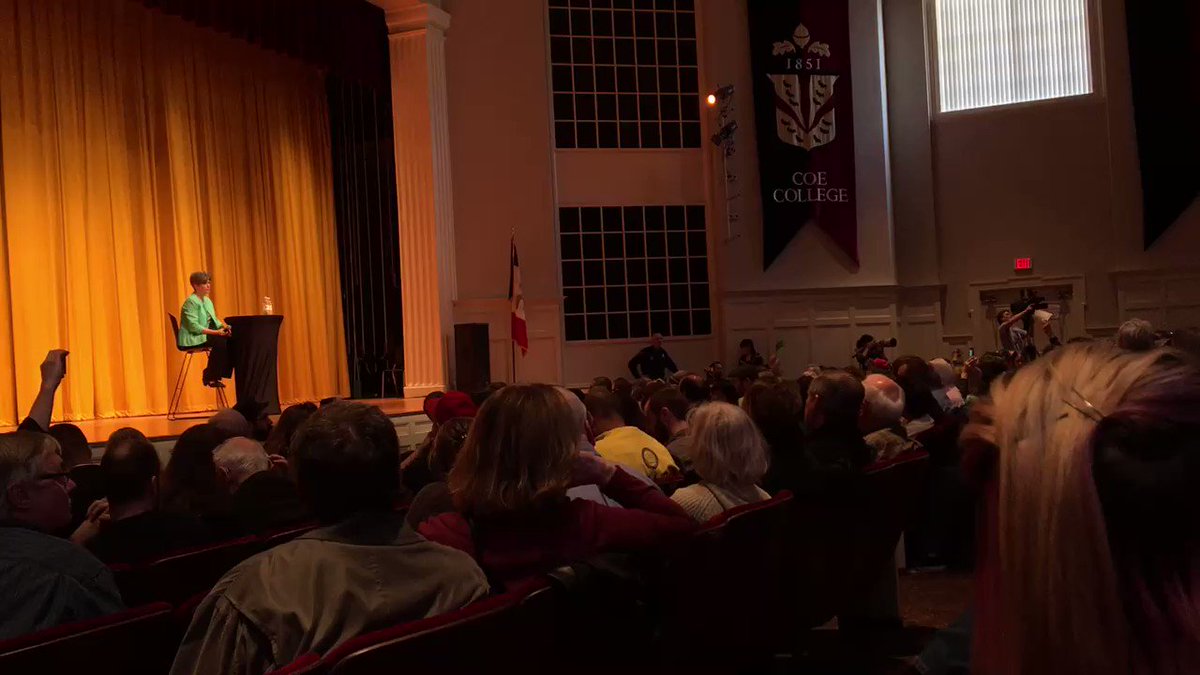
WATCH: Town hall erupts in boos when Republican senator says she ‘carefully vetted’ Betsy DeVos

WATCH: Town hall erupts in boos when Republican senator says she ‘carefully vetted’ Betsy DeVos:

WATCH: Town hall erupts in boos when Republican senator says she ‘carefully vetted’ Betsy DeVos


A town hall meeting with constituents quickly grew contentious for Sen. Joni Ernst (R-IA) on Friday.
Several of Ernst’s responses to Iowans’ questions earned loud rebukes from the crowd, but none more so than her defense of voting in favor of Education Secretary Betsy DeVos.
“Why did you not listen to your constituents?” one audience member asked Ernst about the thousands of calls that flooded into her office urging her to oppose DeVos.
Ernst replied that DeVos had been “carefully vetted” by the Senate — at which point the audience exploded in boos.
Elsewhere during the meeting, Ernst earned some cheers for saying that President Donald Trump should release his tax returns, and for saying she’d push back hard on the president’s proposed cuts to the State Department.
Overall, though, she faced mostly confrontational questioning, as the audience expressed displeasure for her answers about cutting funding for Planned Parenthood and on her views on her own party’s proposed replacement for the Affordable Care Act.
Watch Ernst get booed below.


@joniernst defends DeVos appointment to crowd with many public school teachers.


 WATCH: Town hall erupts in boos when Republican senator says she ‘carefully vetted’ Betsy DeVos:

Guest Post: John Thompson Responds to My Chalkbeat Article — Justin C. Cohen

Guest Post: John Thompson Responds to My Chalkbeat Article — Justin C. Cohen - Linkis.com:

Guest Post: John Thompson Responds to My Chalkbeat Article

John Thompson is a retired teacher, historian, author, and regular contributor at The Huffington Post. He writes about public schooling and has been an outspoken critic of "education reform," as it is practiced in this country today. Thompson and I have had regular, spirited, and cordial disagreements about education policy over the years. One time, we even got on the phone to talk about de-escalating the rhetoric between "education reformers" and "education traditionalists." (How delightfully old-fashioned of us!) When Thompson sent me this guest post, as a direct response to something I wrote in January, I couldn't resist posting it in its entirety.
Justin Cohen is “a technocratic public school graduate” who has been contemplating the ways that Betsy DeVos and Donald Trump could “kill the bipartisan education reform coalition.”  If that happens, Cohen will be disappointed, though not surprised, to see the movement dissolve.
Cohen fears that left-leaning reformers will then be “subsumed by the traditionalist agenda” which “still hews to the positions of management interests and labor leaders, and not closely enough to the needs of vulnerable families.”
Of course, I reject the implication that we in the traditional public schools - who accept challenges far more daunting than those faced by charter schools – are not closely attuned to the needs of the most vulnerable Guest Post: John Thompson Responds to My Chalkbeat Article — Justin C. Cohen - Linkis.com:

Where is the U.S. in School Reform in 2017? | Larry Cuban on School Reform and Classroom Practice

Where is the U.S. in School Reform in 2017? | Larry Cuban on School Reform and Classroom Practice:
Where is the U.S. in School Reform in 2017?


Where is the U.S. in school reform now?
To answer this question, I will do what lawyers often do when arguing a case. I will stipulate certain statements as facts. These statements may not sound like facts but as an historian and practitioner of school reform I claim they are.  Should readers quarrel with these statements, I do have supporting references and we can discuss those in dispute later. I stipulate the following:
FACT 1
Historically, school reformers have overstated defects in the existing system and made gloomy predictions of disaster. Then they have understated difficulties of changing the system by proposing rose-colored solutions.
Exhibit A is what has occurred over the past three decades in the U.S.
Market-inspired school reformers, endorsed by policy elites, media and parents, using low U.S. scores on international tests time and again, have blamed chronically low-performing public schools for hampering national economic growth, innovation, and productivity by  producing graduates mismatched to the job skills employers needed to compete in a constantly changing global marketplace.
To solve this serious problem of low academic performance and inadequately prepared graduates, state and federal officials have–between the early 1980s until 2015–created and legislated a federal and state reform agenda containing the following items:
*Common (and high) K-12 academic standards,
*State and national tests to determine if all students meet those standards,
*Student test scores as the primary metric to determine success of policies,
*Accountability regulations that hold districts, schools, students, and teachers responsible for results,
*Expanded parental choice, mainly through publicly financed charter schools,
*Deploy and use new technologies to get students to learn more, faster, and better.
*Teacher and administrator evaluation and compensation on the basis of student test scores.
Business and civic leaders, public polls, and  bipartisan policymakers endorsed Where is the U.S. in School Reform in 2017? | Larry Cuban on School Reform and Classroom Practice:

Charter School Gravy Train Runs Express To Fat City

Charter School Gravy Train Runs Express To Fat City:
Charter School Gravy Train Runs Express To Fat City

On Thursday, July 25, dozens of bankers, hedge fund types and private equity investors gathered in New York to hear about the latest and greatest opportunities to collect a cut of your property taxes. Of course, the promotional material for the Capital Roundtable’s conference on “private equity investing in for-profit education companies” didn’t put it in such crass terms, but that’s what’s going on.

Charter schools are booming. "There are now more than 6,000 in the United States, up from 2,500 a decade ago, educating a record 2.3 million children," according to Reuters.
Charters have a limited admissions policy, and the applications can be as complex as those at private schools. But the parents don’t pay tuition; support comes directly from the school district in which the charter is located.   They're also lucrative, attracting players like the specialty real estate investment trust EPR Properties EPR +0.47% (EPR). Charter schools are in the firm’s $3 billion portfolio along with retail space and movie megaplexes.
Charter schools are frequently a way for politicians to reward their cronies. In Ohio, two firms operate 9% of the state’s charter schools and are collecting 38% of the state’s charter school funding increase this year. The operators of both firms donate generously to elected Republicans
 The Arizona Republic found that charters “bought a variety of goods and services from the companies of board members or administrators, including textbooks, air conditioning repairs and transportation services.” Most charters were exempt from a requirement to seek competitive bids on contracts over $5,000

In Florida, the for-profit school industry flooded legislative candidates with $1.8 million in donations last year. “Most of the money,” reports The Miami Herald, “went to Republicans, whose support of charter schools, vouchers, online education and private colleges has put public education dollars in private-sector pockets.”
Among the big donors: the private equity firm Apollo Group APOL +%, the outfit behind the for-profit University of Phoenix, which has experimented with online high schools. Apollo dropped $95,000 on Charter School Gravy Train Runs Express To Fat City:

A local school board election in Park Ridge. Conflicts and convergences. | Fred Klonsky

A local school board election in Park Ridge. Conflicts and convergences. | Fred Klonsky:

A local school board election in Park Ridge. Conflicts and convergences.

8t3isqa5eweo4nl8bks5

Disgraced Park Ridge school board member, Dr. Dathan Paterno.
Park Ridge, where I taught for three decades, is having a school board election.
They can. Although the Illinois House is debating the issue as we speak, we Chicagoans still can’t elect our school board.
Why can’t we? I suspect it has something to do with the color of most of our citizens. As a loyal troll of this blog constantly reminds me, I tend to think race is a constant issue in Chicago.
Anyway, back to Park Ridge’s school board election. There are four open seats to be filled by the voters in April.
Park Ridge school board elections have small turnouts.  That is why a white racist and misogynist like Dr. Dathan Paterno can get elected. Remember the good doctor? He was forced to resign from the Park Ridge board a few months ago after he tweeted that the millions of women who marched against Trump a day after the inauguration were 300 pound screeching vaginas.
The little town of Park Ridge, Illinois made it to the national press when the story broke.
The story about Paterno’s screeching vagina tweets broke in January. But A local school board election in Park Ridge. Conflicts and convergences. | Fred Klonsky:


Rethinking Grading as Instruction: Rejecting the Error Hunt and Deficit Practices | radical eyes for equity

Rethinking Grading as Instruction: Rejecting the Error Hunt and Deficit Practices | radical eyes for equity:

Rethinking Grading as Instruction: Rejecting the Error Hunt and Deficit Practices

Image result for Rethinking Grading


As a first-year English teacher, I joined the department of the high school where I had graduated only five years earlier, becoming a colleague with teachers who had taught me. That introduction to the field allowed me behind the curtain, and one of those secrets was being handed a sheet that detailed every grammar and mechanics error students were likely to make in their writing and the amount of points to be deducted from their grade (writing was assigned the traditional content/grammar grade then).
One fragment, by the way, was an immediate deduction that resulted in an F in grammar.
This was department policy, and my efforts to navigate that system were akin to Sisyphus, his rock, and that damned mountain.
Since then, well over thirty years ago, I have become a non-grader, but I also have investigated and adopted concepts about grading (since we all at some point must grade) that I believe are incredibly important in the context of seeing grading (and feedback) as a part of instruction—and not something we do to students and their work after we teach.
A  teacher recently asked on NCTE’s Connected Community about subtracting points for grammar in student writing, and this is an ideal entry point to rethink how grading (especially of writing) sends instructional messages to our students.
My first caution is about a serious flaw with traditional grading that is grounded in viewing assessment situations in a deficit model whereby we have students start with an unearned 100 points from which we subtract credit by identifying errors. This fosters an atmosphere of risk aversion—which is not a healthy environment for developing literacy.
Specifically when teaching writing, we must abandon the “error hunt” (see Weaver, et al., and Lois Matz Rosen).
Therefore, we can send a much healthier message about student performances of learning if we acknowledge that students begin Rethinking Grading as Instruction: Rejecting the Error Hunt and Deficit Practices | radical eyes for equity: