Latest News and Comment from Education

Tuesday, February 28, 2017

Seattle Schools Community Forum: Coming Up on Testing Season

Seattle Schools Community Forum: Coming Up on Testing Season:
Coming Up on Testing Season


From a friend's Facebook page:

Parents, educators: Please read and share:

"I am a third grade teacher. Today I had to give the interim SBA ELA performance task.

 I couldn't believe how hard the test was. I was a fourth-grade teacher for many years and this seemed equally as difficult as the fourth grade test. The directions were confusing, very long, and the tasks expected of the kids demanded organizing and processing parts and pieces in their head. 

Another third grade teacher typed a part of the directions into two readability programs. The directions came out between 6.9 and 8.4 GLE readability. ðŸ˜£" - Anonymous Third Grade Teacher 


 Seattle Schools Community Forum: Coming Up on Testing Season:

Betsy DeVos Isn't Going to Stop Charter Schools From Promoting Religion | Knowledge Bank | US News

Betsy DeVos Isn't Going to Stop Charter Schools From Promoting Religion | Knowledge Bank | US News:
When Charters Go to Church
Betsy DeVos could further embolden charter schools to violate the Constitution and endorse religion.


Our religious groups are a creative bunch. They have invaded our school boards and forced religion into our textbooks in states like Texas, and they have been finding numerous ways to fight for things like school prayer for decades. However, one way in which religious groups have been able to push their ideology on our children that often goes unnoticed is currently happening inside our charter schools.
In 2013, The New York Times ran a story about a Texas woman named Latisha Andrews. She had attempted to run a private school out of a church for some time but eventually lacked the funding necessary to continue. What did she do? She did what so many Americans have done in recent years; she asked Uncle Sam to foot the bill. As the story notes, there are many charter schools in Texas that operate inside churches. So much for the separation of church and state.
In 2008, the Minneapolis Star Tribune found that a school run by Muslim-Americans was having students participate in daily prayer, despite saying they did no such thing, and the school was eventually shut down. In 2014, it was found two charter schools in Arkansas were teaching creationism.
The nonprofit educational organization Americans United for Separation of Church and State is currently involved in a lawsuit against a charter school group called Heritage Academy, which is operating in three Arizona cities. The charter schools run by Heritage teach that people who are not religious have mental health issues, that religious ideology is necessary in government and more religious nonsense. "Without religion the government of a free people cannot be maintained," the coursework reads.
Eric Rothschild, senior litigation counsel at Americans United for Separation of Church and State, told me charter schools inserting religion into teaching is quite common. He said many private religious schools that are struggling with funding will become charter schools to receive government aid but won't adequately change the curriculum to teach more secular lessons. He said instead of schools like those in the Heritage system simply teaching about religion, they regularly appear to be promoting religion.
This kind of teaching, paid for by our taxes, would appear to be a clear violation of the First Amendment. Our government is not to get involved in the promoting of religious ideals, despite what those who claim this is a Christian nation might try to tell you. However, due to poor state oversight in places like Arizona, schools like these are allowed to operate as they please with little intervention.
"The reason you see it happening relatively often is, I think, due in large part to the fact that there is insufficient oversight over charter schools," Rothschild told me.
What makes this all more concerning is that we now have a very religious secretary of education who thinks charter schools are the greatest invention since Christian rock. Betsy DeVos and her family have spent millions trying to get politicians to push for charter schools, and they have been loud supporters of somewhat extreme religious Betsy DeVos Isn't Going to Stop Charter Schools From Promoting Religion | Knowledge Bank | US News:


Has community-based accountability been impactful for English Learners? – Cloaking Inequity

Has community-based accountability been impactful for English Learners? – Cloaking Inequity:

Has community-based accountability been impactful for English Learners?


What is community-based accountability? In 2012, I first conceptualized community-based accountability in the post Accountability: Are you ready for a new idea? Over the past several years, California has undertaken this new approach for its more than 4 million students (See all posts on community-based accountability).
Local control has been a bedrock principle of public schooling in America since inception. In 2013, the California Legislature codified a new local accountability approach for school finance. An important component of the new California Local Control Funding Formula (LCFF) approach is a focus on English learners (ELs). The law mandates that every school district produce a Local Control Accountability Plan (LCAP) to engage the local community in defining outcomes and determining funding for ELs.
This week Education Policy Analysis Archives (EPAA) just published a special issue, Education Finance and English Language Learners: Examining Challenges and Opportunities to Improve Education Policy and Practice, guest edited by Oscar Jiménez-Castellanos. EPAA/AAPE is a peer-reviewed, open-access, international, multilingual, and multidisciplinary journal designed for researchers, practitioners, policy makers, and development analysts concerned with education policies.
In this issue I published a new study seeking understand the impact of the new local accountability approach on English Learners with Lisa Romero (California State Sacramento) and Megan Hopkins (University of California San Diego). Based on an exploratory analysis of a representative sample of LCAPs, we show that, although California’s new approach offered an opportunity to support locally-defined priorities and alternatives to top-down accountability, few if any districts had yet took full advantage of the opportunity. That is, the school districts in our sample had not yet engaged with the local community to facilitate significant changes to accountability or redistribution of funding and resources to support educational equity for ELs.
You can read our entire article online here: Vasquez Heilig, J., Romero, L. & Hopkins, M. (2017). Coign of vantage and action: Considering California’ local accountability and school finance plans for English learners, Education Policy Analysis Archives25(15), 1-24.*
Please also check out the other articles in the EPAA issue Education Finance and English Language Learners: Examining Challenges and Opportunities to Improve Education Policy and Practice below…
Check out and follow my YouTube channel here.
Please Facebook Like, Tweet, etc below and/or reblog to share this discussion with others.
Want to know about Cloaking Inequity’s freshly pressed conversations about educational policy? Click the “Follow blog by email” button on the home page.
Twitter: @ProfessorJVH
Click here for Vitae.
Thank you for reading Cloaking Inequity.
Has community-based accountability been impactful for English Learners? – Cloaking Inequity:

Charter School Regulations In Louisiana : VICE News HBO

Charter School Regulations In Louisiana : VICE News Tonight on HBO - YouTube:

Charter School Regulations In Louisiana


Betsey De Vos’s confirmation as Secretary of Education comes with the expectation that she will be a strong ally for charter schools. Charter schools are publicly funded but are run like small businesses – it’s the state’s responsibility to regulate which are succeeding and which are falling short. But judging the efficacy of charters isn’t always easy.

In Louisiana, where the number of charters has grown significantly since Hurricane Katrina, the state is still figuring out how to manage the system. Roberto Ferdman visited to explore how the original promise of charters – creating the opportunity for more diverse and specialized schools – hasn’t come to be.

Subscribe to VICE News here: http://bit.ly/Subscribe-to-VICE-News

Check out VICE News for more: http://vicenews.com

Follow VICE News here:
Facebook: https://www.facebook.com/vicenews
Twitter: https://twitter.com/vicenews
Tumblr: http://vicenews.tumblr.com/
Instagram: http://instagram.com/vicenews
More videos from the VICE network: https://www.fb.com/vicevideo


CURMUDGUCATION: Dangerous Amateurs + TX: Senator Ambushed by Students

CURMUDGUCATION: Dangerous Amateurs:

Dangerous Amateurs

Not all amateurs are a problem.

I live in a small town  world, and much of the community's important work is done by amateurs. Most of our major local organizations are run by amateurs, and our elected officials are all folks with a real day job-- there's no real money in being a professional politician on the local level.

I have been one kind of amateur or another most of my adult life. My actual training is to be a high school English teachers, but I have been a radio dj, church choir director, technical stage manager, band director, graphic artist, photographer, musician, all-around theater guy, and writer/fake journalist. I always knew I would be a generalist, so I grabbed some coursework here and there to back some of these jobs up, but mostly in these pursuits I am an untrained amateur.


My saving(ish) grace is that I know what I don't know, and I know there are professionals out there from whom I can learn. Before I take on a responsibility, I do my homework, read up, study up, talk to people who are pros, watch them work and learn from them. And in a community like mine, there are plenty of people like me around. We backstop each other as well.

But there are other types of amateurs in the world. More problematic. More dangerous.

It is one thing to know you lack the professional expertise, the trained knowledge for a particular field. It is another thing to believe that no such body of knowledge exists, or that any such knowledge and expertise is unimportant as long you are, you know, really interested in whatever field we're talking about.

These are the folks who figure that since they occasionally eat at a restaurant, and they like food, well, they're qualified to open a restaurant. These are the folks who figure that public speaking is just standing up and flapping your gums for a while (usually a really long while). These are the 
CURMUDGUCATION: Dangerous Amateurs:


TX: Senator Ambushed by Students
Texas GOP Senator Don Huffines is a huge fan of choice systems, and does his best to shill for them. But he ran into a rough time trying to pitch them to 7-12 grade students at Richardson ISD on, of all things, Texas PTA Day. While the 

Schools receive guidance on interactions with ICE agents :: SI&A Cabinet Report

Schools receive guidance on interactions with ICE agents :: SI&A Cabinet Report :: The Essential Resource for Superintendents and the Cabinet:

Schools receive guidance on interactions with ICE agents


(Calif.) Following weeks of high profile arrests and deportations of undocumented immigrants, the California School Boards Association is reminding districts of their rights in dealing with immigration enforcement agents–notably, that school officials are not required to do so.
The guidance released Sunday uses an interpretation of a Supreme Court ruling to explain why schools do not need to question children about citizenship status or share records with U.S. Immigration and Customs Enforcement agents.
“California’s public schools have a unique mission to help all students succeed in college, career and civic life,” Keith Bray, general counsel for CSBA and director of the Education Legal Alliance. “This responsibility is reinforced, in a legal context, by the landmark Supreme Court decision in Plyler v. Doe. In that ruling, the Court held that school districts must not discriminate on the basis of race, color, or national origin, and that students not be barred from enrolling in schools on the basis of their immigration status or that of their parents.”
Renewed attention to the rights and responsibilities of school districts that educate undocumented students stems from recent immigration sweeps prompted by the Trump administration’s call to crack down on illegal immigration.
Although there are no reports of immigration agents stepping on to school grounds, some aggressive actions have been chronicled elsewhere. In Seattle earlier this month, a 23-year-old with no criminal record was taken into custody by ICE officers at his father’s home despite being granted temporary permission to live and work legally in the country under a program called the Deferred Action for Childhood Arrivals. The program, established in 2012 by the Obama administration, protects those who were brought to the U.S. illegally as children from deportation.
The following week in California, a 44-year-old father of three who had worked as a gardener leaped off a bridge near the Tijuana-San Diego border crossing and killed himself hours after being deported–an act which spurred further calls for action from various immigrant advocacy groups.
In order to avoid deportation arrests on school grounds and to create a safe learning environment for all kids, the CSBA guidance contends that education officials are within their legal rights to deny student records to ICE agents without parental consent under the federal Family Educational Rights and Privacy Act.
Additionally, it is recommended that school officials not inquire about a student’s immigration status, or require a social security number, or other documentation that discourages undocumented students from enrolling in school in the first place.
Authors note that currently, under a policy implemented by Obama in 2011, ICE and border patrol agents are urged to “generally avoid” enforcement actions at “sensitive locations,” such as schools, health care facilities, places of worship, weddings or funerals–a policy that may not continue under the current administration.
Until that policy changes, if it does, districts are still allowed to notify parents, students and the public of the limitation of federal enforcement activities on school sites. The guidance also points out that the California Education Code provides that schools can turn away ICE or border patrol agents during school hours in order to limit disruptions on campus.
The CSBA’s guidance echoes messaging sent to districts by State Superintendent of Public Instruction Tom Torlakson in December, which urged school leaders to declare their campuses a “safe haven” for students and their parents.Schools receive guidance on interactions with ICE agents :: SI&A Cabinet Report :: The Essential Resource for Superintendents and the Cabinet:
 
Image result for U.S. Immigration and Customs Enforcement (ICE) and Schools

Traditional public schools educate 90 percent of America’s kids — let’s not make our educational system more unequal than it is already - The Hechinger Report

Traditional public schools educate 90 percent of America’s kids — let’s not make our educational system more unequal than it is already - The Hechinger Report:

Traditional public schools educate 90 percent of America’s kids — let’s not make our educational system more unequal than it is already
An argument against competition via private school choice and vouchers


Betsy DeVos and Donald Trump say that the solution to persistent inequality in educational opportunity is to provide parents with more choices.
They support vouchers that would allow public funds to be spent on private schools – even those with religious orientations – and charter schools, which are frequently run by private corporations.
Charter schools are public schools because they are funded through tax revenues. But these schools are often not answerable to local taxpayers and lack public accountability.
Vouchers use tax revenues to provide students and their families with funds that can be used at private and in some cases parochial schools. They have even less accountability.
Experience with voucher programs suggests that students with middle and upper class backgrounds are more likely to benefit from these programs than those who live in poverty.
Such outcomes remind us that we need to keep the needs of all children in mind when we craft educational policy. Traditional public schools educate 90 percent of the kids in America. Does it really make sense to pursue policies that will make our educational system more unequal than it already is?
Given the controversy over DeVos’ appointment as Secretary of Education, and the relatively small amount (typically around 8 percent) of educational funding coming from the federal government, some have wondered whether we might be better off without a federal Department of Education.
While doing away with such a controversial department might seem prudent, the truth is, educational opportunity for poor children would be even more limited without it.
The department oversees programs that provide much-needed funding for schools serving our poorest kids, such as Title I, which was first established in 1965 as part of the Elementary and Secondary Education Act (ESEA) and was a key component in President Johnson’s War on Poverty, as well as special education programs through the Individuals with Disabilities Education Act (IDEA), and English language instructional support.
In addition, the Department of Education provides funding for postsecondary education, in the form of Pell grants for the poorest students, funds for work-study and student loans. Given the size and Traditional public schools educate 90 percent of America’s kids — let’s not make our educational system more unequal than it is already - The Hechinger Report:


When it comes to struggling schools, school choice is no substitute for systemic change
Students at Lovett Elementary in Clinton, Miss. work on laptops during class. Photo: Jackie Mader The school choice option favored by Education Secretary Betsy DeVos and President Donald Trump isn’t enough to turn around chronically struggling schools. In addition, America’s educators need to redesign state and district systems so that every child has better choices. The Obama administration favo

YESTERDAY

Throw me some beads, mister!
Andre Perry and his son Robeson enjoying the parades on Jan. 31, 2016. One of the riders on a Krewe of Carrollton float threw Confederate flag beads that Robeson caught. Photo: Amanda Aiken You can’t take my black boy joy , but I can show you how to get some of your own. Everywhere else in the country, February 28 is just another Tuesday, but in New Orleans it’s Fat Tuesday — Mardi Gras Day. Scho


Those who wanted federal power over schools now fear Betsy DeVos might use it to foster choice and voucher plans
To those on the left, Betsy DeVos’ endorsement of school choice is a hazard that looms large, a point proven in the contentious debates before her confirmation. But to those on the other side of the political spectrum, this platform might be 

BEWARE - Governor Dannel Malloy’s devastating cuts to public education - Wait What?

BEWARE - Governor Dannel Malloy’s devastating cuts to public education - Wait What?:

BEWARE – Governor Dannel Malloy’s devastating cuts to public education


At a time when Connecticut’s students, parents and educators need and deserve adequate funding for the state’s public schools,  Governor Dannel Malloy has proposed the most drastic cuts to public education in Connecticut history.
In testimony last week before the Connecticut General Assembly, the Connecticut Coalition for Justice in Education Funding [CCJEF] identified the most serious problems with Malloy’s plan to slash funding for public schools in Connecticut.
As CCJEF explain, Malloy’s outrageous proposal,
Reduces overall state support for K-12 public education by at least $364 million
Zeroes out or reduces ECS funding to 131 municipalities/school districts.
The $428 million cut in ECS is justified by a fictional special education proxy that has no basis in per district special education student counts or expenses.
Lowers the ECS foundation amount from $11,525 to $8,999 for FY 18 and thereafter, but increases per pupil funding for 
BEWARE - Governor Dannel Malloy’s devastating cuts to public education - Wait What?:


Mike Klonsky's SmallTalk Blog: Chicago schools facing triple trauma from Trump, Rauner, Rahm

Mike Klonsky's SmallTalk Blog: Chicago schools facing triple trauma from Trump, Rauner, Rahm:

Chicago schools facing triple trauma from Trump, Rauner, Rahm


The real question now is whether or not CPS can withstand the latest three-pronged assault it faces from Operation TRAUMPMA That's the acronym I put together for Trump, Rauner and Rahm who are each playing their role in the trauma and erosion of public education and ultimately all public space and decision-making in this city.

Pres. Trump and the Republicans, representing the center prong of the trident, have made the cities their target. Trumponomics, the shift of billions of federal dollars into military spending and away from education, social services and infrastructure repair projects will have a devastating effect on city schools and neighborhoods.

His appointment of Betsy DeVos as education secretary represents nothing less than a declaration of war against urban education. Like her Democratic predecessor at the DOE, DeVos seems bent on using the very federal authority and resources she decries to push school re-segregation, privatization and aggressive implementation of so-called "choice" policies of vouchers and privately-run charters.

Gov. Rauner continues to hold the state budget hostage as a way of forcing austerity, unconstitutional pension "reform" (theft) and an end to collective bargaining for teachers and Mike Klonsky's SmallTalk Blog: Chicago schools facing triple trauma from Trump, Rauner, Rahm:

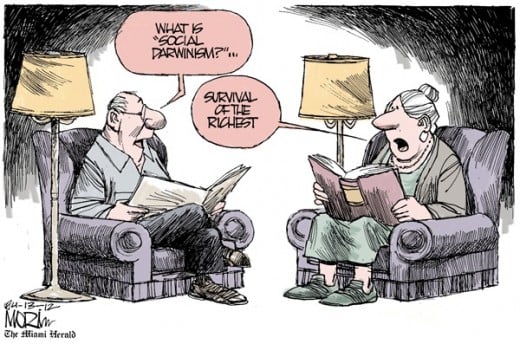
School Choice and the Inequitable Meat Grinder of Social Darwinism | radical eyes for equity

School Choice and the Inequitable Meat Grinder of Social Darwinism | radical eyes for equity:

School Choice and the Inequitable Meat Grinder of Social Darwinism

A close second to Trump himself as the poster child for the tragic consequences of being rich, white, and blindingly ignorant is Betsy DeVos, billionaire from a pyramid scheme and smiling shill for school choice.
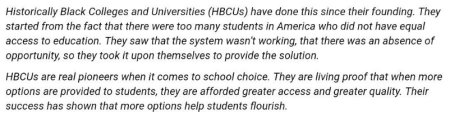
In the ugliest of ironies, DeVos has possibly achieved the single greatest moment of racial appropriation for political gain with her nonsensical twisting of HBCUs:
hbcu-devos
To understand the racism and privilege driving how and why the Right and Republicans chant “choice” and reach awkwardly out to blacks, consider Poet Claudia Rankine on studying whiteness, and the age of protest:
Why is it important to deconstruct whiteness? Rankine, whose most recent poetry is dominated by short paragraphs surrounded by expanses of white space, explains: “White people don’t see that their own positioning is a created position. They think it’s a meritocratic situation . . . rather than that the entire culture is set up to help them,” she says. “And so then they begin to believe that they are what is normal. That means everybody else is other to their position and, until you interrogate that, they will feel that individually they’re being attacked any time race comes up rather than understanding they are part of a community that includes all of us that put this hierarchical structure in place.”
DeVos, like Trump, believes she has earned her stature, believes she knows more than anyone else, and believes everyone else simply isn’t trying, isn’t deserving.
Blinded by her wealth and whiteness, she cannot see that choice is tossing School Choice and the Inequitable Meat Grinder of Social Darwinism | radical eyes for equity:
Image result for Inequitable Meat Grinder of Social Darwinism