Latest News and Comment from Education

Tuesday, September 13, 2016

The violent legacy of Chicago’s mass school closings | Parents Across America

The violent legacy of Chicago’s mass school closings | Parents Across America:

The violent legacy of Chicago’s mass school closings

Why PAA Opposes Mass School Closings: Our position paper

By Julie Woestehoff, PAA interim executive director
It has been more than 10 years since I and many of my former colleagues began warning Chicago that massive school closings would not improve education and would most likely lead to increased violence. It gives me no pleasure to see that this prediction has come true, and to such a tragic extent.
We began to sound the alarm about school closures in 2004, as Mayor Daley and Arne Duncan touted their Renaissance 2010 program, an attempt to satisfy the business community’s call to create 100 charter schools. Some of us slept on the sidewalk outside of the Board of Education headquarters the night before the August 2004 board meeting so that we could present a steady stream of testimony the next morning against the plan’s proposed 60 closures. 
While Arne Duncan dismissed parent and community concerns, affected schools and neighborhoods became increasingly dangerous. In 2006, the media reported that violence had soared at five of the nine high schools that accepted most of the students transferred out of the high schools closed under Renaissance 2010. West side activists rose in anger in 2007 when 27 children were killed within a few months of the closure of the only open enrollment high school in Austin, the city’s largest neighborhood, forcing their children to travel across several gang lines to get to school. The nation was gripped The violent legacy of Chicago’s mass school closings | Parents Across America:


Recess four times a day? Why some schools are now letting kids play an hour a day. - The Washington Post

Recess four times a day? Why some schools are now letting kids play an hour a day. - The Washington Post:

Recess four times a day? Why some schools are now letting kids play an hour a day.

(Photo of kids playing at recess supplied by LiiNK Project and used with permission)

For years we’ve been hearing that many schools have cut back — or eliminated — recess for young children because academics are seen as more important than giving kids a chance to move during the school day. But now some schools are bucking the trend — big time, sending kids outside four separate times a day for unstructured play.
It’s part of a new program, called the LiiNK Project, which connects play and character development and is designed to bridge academics with the social, emotional and physical well-being of children. The program started in the 2015-2016 school year with four schools in Texas that used the program and four other schools that served as controls. Although it’s too early for definitive results, the short-term ones look promising. Kids in the program schools focused better than those in the control groups during the year, and reports of bullying were down. This year it is being used in 14 public schools in six school districts in Texas and Oklahoma.
Allowing young kids in school a chance to go outside for recess is not just a good idea — it’s a “crucial” one. That’s what the American Academy of Pediatrics’ Council on School Health declared in a 2013 statement on the subject:
Recess serves as a necessary break from the rigors of concentrated, academic challenges in the classroom. But equally important is the fact that safe and well-supervised recess offers cognitive, social, emotional, and physical benefits that may not be fully appreciated when a decision is made to diminish it. Recess is unique from, and a complement to, physical education — not a substitute for it. The American Academy of Pediatrics believes that recess is a crucial and necessary component of a child’s development and, as such, it should not be withheld for punitive or academic reasons.
But, of course, in the standardized-test-based era of school “accountability,” recess has been drastically reduced — and in some cases eliminated — for children for precisely those reasons. Even kids in kindergarten are being asked to focus for long periods of time on math and reading — even if they are not developmentally able. The result, according to Angela Hanscom, a Recess four times a day? Why some schools are now letting kids play an hour a day. - The Washington Post:

Breaking News – CT Senate Republican Leader Fasano calls for appeal in CCJEF V. RELL Case - Wait What?

Breaking News – CT Senate Republican Leader Fasano calls for appeal in CCJEF V. RELL Case - Wait What?:

Breaking News – CT Senate Republican Leader Fasano calls for appeal in CCJEF V. RELL Case

Image result for CT Senate Republican Leader Fasano

In response to Governor Dannel Malloy’s unprecedented assault on public school students, parents, teachers and schools, Senate Republican Leader Len Fasano (R-North Haven) has been one of the most outspoken advocates for public education in Connecticut,
Now, calling the judge’s ruling in the CCJEF V. Rell case, “Breathtaking in its Hubris” and noting that, “the decision is flawed in many ways,” State Senator Fasano is urging Connecticut’s Attorney General to pursue an appeal of Superior Court Judge Thomas Moukawsher’s September 7, 2016 decision in Connecticut Coalition for Justice in Education Funding, Inc. v. Jodi Rell.
Fasano’s press release explains;
 “Judge Moukawsher’s decision can only be characterized as overreaching by an activist judge. His decision reads more like a legislative agenda or white paper on education policy than a judicial finding.”
“Interestingly, the court never ruled that the statutory Education Cost Sharing (ECS) formula itself is unconstitutional or that the state’s overall education funding levels are constitutionally insufficient,” Fasano observed.  “Rather, the court found that the Democrat controlled general assembly, over the last few years, has ignored the state ECS formula and manipulated education funding for political purposes” to create an “irrational, arbitrary, and fundamentally unfair system.”
Fasano noted how the court used “recent unjustifiable and arbitrary actions by the majority party to then reach into areas well outside its jurisdiction including but not limited to student testing, teacher evaluations, teacher contracts and teacher compensation.”  He said that “for a judge to opine on the
Breaking News – CT Senate Republican Leader Fasano calls for appeal in CCJEF V. RELL Case - Wait What?:

The "Big Bet" of a Funder That Hasn't Forgotten Traditional Public Schools - Inside Philanthropy - Inside Philanthropy

The "Big Bet" of a Funder That Hasn't Forgotten Traditional Public Schools - Inside Philanthropy - Inside Philanthropy:

The "Big Bet" of a Funder That Hasn't Forgotten Traditional Public Schools

Image result for i love real public schools

If you're only half tuned in to the education philanthropy space, you might think that most funders could care less about traditional public schools as they rush to pump money into charters and education nonprofits. Of course, that wouldn't make much sense, given that 95 percent of U.S. K-12 students still go to regular district schools. And sure enough, as we so often report, there's tons of philanthropic action around these schools involving both local and national funders. 
One funder that's deeply involved in working with district schools in its own community is Salesforce.org, the philanthropic arm of Salesforce.com, the Bay Area technology company. Its commitment, which involves much more than money, has been growing, and it's interesting to examine more closely. 
Last year, the company's chief philanthropy officer, Suzanne DiBianca, filled us in on the backstory. She said that Salesforce's commitment to the San Francisco Unified School District (SFUSD) emerged after a meeting with the mayor and superintendent. “We decided this was a place to make a big bet,” DiBianca said.
Salesforce saw an opportunity in helping the SFUSD because not many funders were getting behind the city's traditional schools. “Nobody is doing it,” DiBianca said, calling the state of public education “abominable.”
Salesforce started with a $2.7 million gift to SFUSD in 2013. Then, in 2014, it gave $5 million. In 2015, it raised the amount to $6 million. Much of this grant support went to fund infrastructure and technology improvements, an area where the school district is particularly weak. But Salesforce also made $100,000 available to each middle school principal through an innovation fund to spend as they see fit. 
Now, Salesforce has increased its commitment further, putting another $8.5 million behind its successful partnership with San Francisco Unified School District, and adding their neighbor across the Bay, Oakland Unified Schools. The primary focus of the new funding will be supporting computer science education, with Salesforce sticking to an area it knows well.
Outsiders should be paying attention to what's happening here. 
Many observers have commented on the dismal state of computer science instruction across the country (roughly only 25 percent of schools offer The "Big Bet" of a Funder That Hasn't Forgotten Traditional Public Schools - Inside Philanthropy - Inside Philanthropy:


 Image result for i love real public schools

AFT’s Weingarten on GAO ‘School Choice’ Report and Trump’s Voucher Scheme | American Federation of Teachers

AFT’s Weingarten on GAO ‘School Choice’ Report and Trump’s Voucher Scheme | American Federation of Teachers:

AFT’s Weingarten on GAO ‘School Choice’ Report and Trump’s Voucher Scheme 

Image result for donald trump vouchers
WASHINGTON—In response to the U.S. Government Accountability Office’s release of “School Choice: Private School Choice Programs Are Growing and Can Complicate Providing Certain Federally Funded Services to Eligible Students(link is external),” AFT President Randi Weingarten issued the following statement:
"With this report, the GAO confirms basic facts we have long known: While public schools have the responsibility for educating all students, many voucher schools take public funding while picking and choosing students based on their academic and behavioral characteristics. Voucher schools don’t abide by the same academic quality standards as public schools. They blur the lines separating church and state. Finally, vouchers exacerbate inequity by directly draining critical funding away from public schools—often the schools that need that funding most.
“This report was in the making long before Donald Trump announced his half-baked, ideology-driven plan to redirect $20 billion in federal education funding to a voucher scheme. But the GAO’s findings cast a harsh light on that plan and show why Trump’s education plan should terrify anyone who cares about leveling the playing field for all students.
“Analysis of Trump’s plan shows it could devastate up to 56,000 schools and leave as many as 21 million children worse off, while only providing vouchers to a tiny fraction of the students he claims he’ll help.
“Trump’s reckless voucher scheme could wreak real-world havoc. For schools with the highest concentration of high-needs students, Trump’s plan would likely mean:
  • Losing tens of thousands of highly qualified teachers and classroom aides, increasing class sizes and decreasing access to one-on-one attention for students.
  • Cutting curriculum improvement programs and professional development for educators.
  • Slashing resources for extended learning time and tutoring for kids who need extra help.
  • Firing counselors and ending counseling programs that help at-risk kids stay in school.
  • Cutting programs that increase parent participation and involvement.
  • Firing school nurses and ending in-school medical and dental care for students.
  • Cutting funding for classroom technology, school supplies and other critical materials for high-needs students.
“Trump’s proposal dwarfs any voucher scheme reviewed by the GAO and would cause tremendous damage. Let’s end the drive to privatize education and, instead, invest resources in public schools so that every student has access to a high-quality neighborhood school.”
# # # #
The AFT represents 1.6 million pre-K through 12th-grade teachers; paraprofessionals and other school-related personnel; higher education faculty and professional staff; federal, state and local government employees; nurses and healthcare workers; and early childhood educators.
- See more at: http://www.aft.org/press-release/afts-weingarten-gao-school-choice-report-and-trumps-voucher-scheme#sthash.NwLKHsbK.dpuf


John Thompson The Oklahoman's criticism of school funding is unfair - NonDoc

The Oklahoman's criticism of school funding is unfair - NonDoc:

The Oklahoman’s criticism of school funding is unfair

school funding

School finance is complicated enough without The Oklahoman muddying the waters in an attempt to shift much of the blame for chronic underfunding of schools to the school systems themselves.
That criticism of traditional public schools and other school reformers is like comparing the per-patient costs of a clinic serving young, mostly healthy drop-ins with the costs of an emergency room.
Two points jump out from the newspaper’s recent editorials:
First, The Oklahoman blames educators — who have their hands full keeping their underfinanced schools open — for not fixing the historic problems that plague Oklahoma’s budgeting and taxation systems. Presumably, in their spare time, education leaders should take charge of the state’s problems with auditing its property taxes. To do that, I guess, educators should wave a magic wand and reform tax-incentive finance districts so that money diverted to Oklahoma City’s downtown could be redirected back to the classroom. (And if educators would also solve the state’s problem with earthquakes, we’d be respected more, and our political stock would rise.)
Second, none of the charges cited by The Oklahoman have been directed toward the Oklahoma City Public School System. For instance, the newspaper’s editorials have long-criticized supposedly excessive spending on overhead. In a future post, I hope to address the reasons why the federal government — not the local schools — deserves the blame for The Oklahoman's criticism of school funding is unfair - NonDoc:


Charter Schools: Student population Video | NewsOK.com - Linkis.com

Charter Schools: Student population Video | NewsOK.com - Linkis.com:

Charter Schools: Student population

Published: September 9, 2016
John Thompson, a former teacher, talks about how charters take high poverty children, but don't have the kids experiencing trauma and generational poverty.


Charter Schools: Student population Video | NewsOK.com - Linkis.com:

ECOT online school funding fight reaches court: ECOT says state rules are "unenforceable," state says ECOT is "absurd" | cleveland.com

ECOT online school funding fight reaches court: ECOT says state rules are "unenforceable," state says ECOT is "absurd" | cleveland.com:

ECOT online school funding fight reaches court: ECOT says state rules are "unenforceable," state says ECOT is "absurd"

Image result for big education ape ECOT


 COLUMBUS, Ohio - The state's fight overwhether the giant ECOT online school deserves the $106 million in state money it receives hit the courtroom today, with ECOT lawyers saying the state is using rules that are "unenforceable" and the state saying the school's objections are "absurd."

The school and Ohio Department of Education are expected to be before Franklin County Common Pleas Judge Jennifer French for the next three days to present their differing views on a crucial issue: Whether online schools have to show that students actually participate in their online classes, or just that the schools provide classes.
In opening arguments this morning, lawyer Marion Little said state rules and a 2003 contract with ODE only require the Electronic Classroom of Tomorrow to prove that students are enrolled, not that they are engaged in their lessons.
Little said that e-school funding is set by enrollment but the state this year has tried to "merge" the "distinct" and separate ideas of participation with enrollment to audit the school and put its funding at risk.
"They tried to rewrite the law," Little said.
He said that having to prove that students are participating is a much higher standard than traditional schools have to follow. Those schools receive state aid, he noted, even if students skip class.
He also told the court of a 2003 agreement between the state and ECOT outlining what documentation the state would look at to determine funding for the school. It does not list any required documents showing time logged on to the school's system or other records of participation.
Little said that contract did not have a time limit and was never officially changed, so expecting more documentation now is unfair.
"We have an enforceable agreement that has not been complied with," he said.
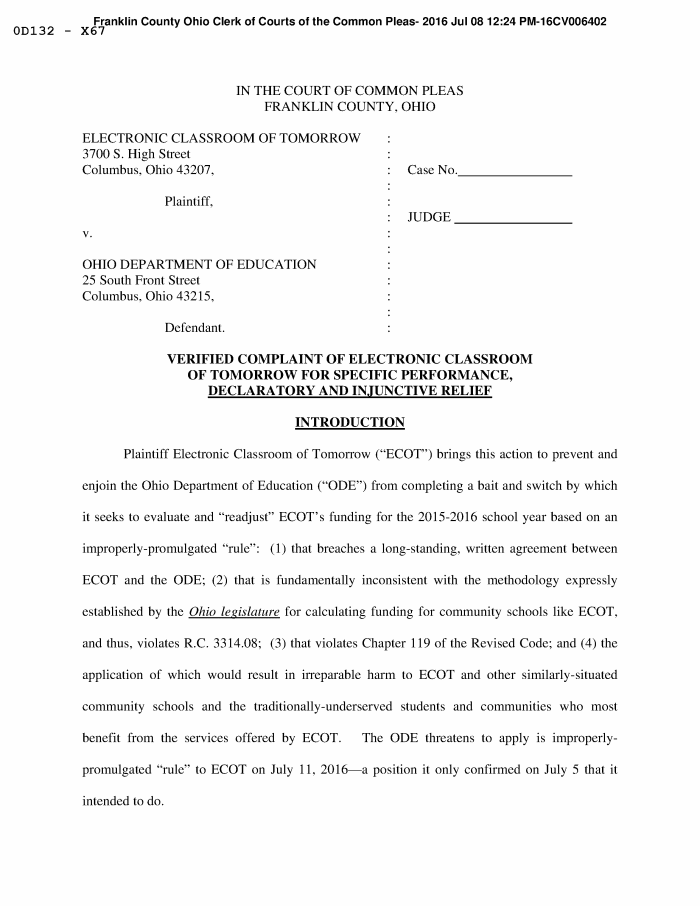
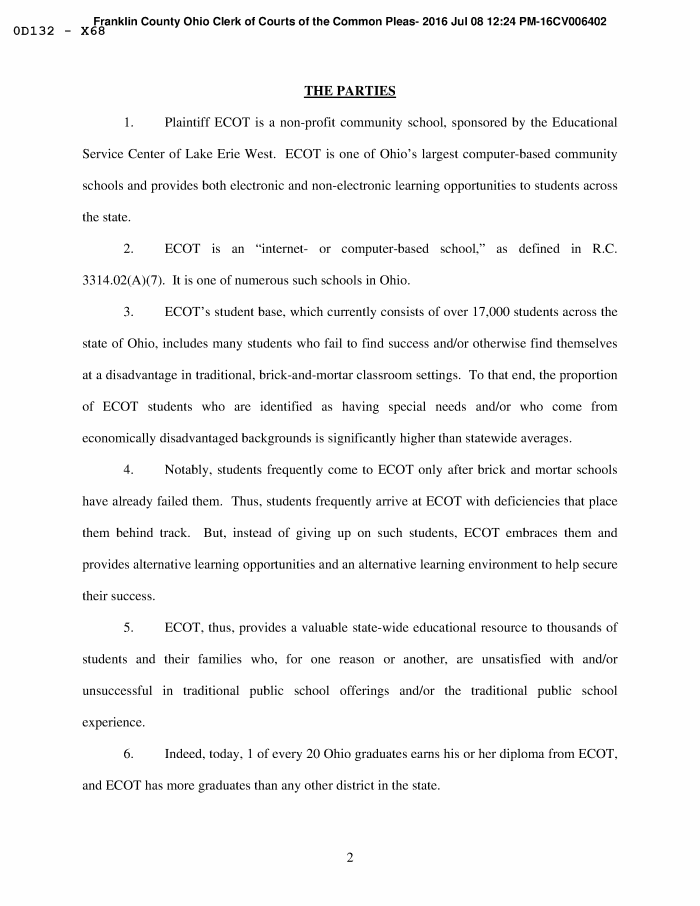
See below for a copy of that contract, attached to an earlier filing by ECOT in the case.
Douglas Cole, the lawyer representing ODE, countered by saying ECOT's position that "participation is irrelevant to receiving $106 million dollars" is absurd.
"Taxpayers deserve to know that their hard-earned dollars are actually going toward an education," Cole said. "Students actually deserve to an education, not merely offered the possibility of one."
Cole also argued that the "contract" with ECOT resolved a dispute at that time but is not binding now. 
We'll have more here soon.
As we have reported previously, the state is seeking proof that students are spending more than one hour a day online, as early reviews showed,
Because the school in the past has not had to provide documentation of the work that its students do, school leaders have said it's unfair to expect the documentation retroactively for the just-finished 2015-16 school year.
If the state makes ECOT show evidence of how much time its students spend learning or else lose some of its state funding, ECOT Superintendent Rich Teeters told supporters this summer that the school's future is in danger.
In the 2014-15 school year, 38,500 students took their classes on computers from home through an online school. Ohio, along with California and Pennsylvania, is one of the top states in the country for the number of kids in online schools, according to the National Alliance for Public Charter Schools (NAPCS).
For the 2015-16 school year, Ohio paid online schools $267 million to educate those students -– more than a quarter of what it paid all charter schools in the state.
ECOT and Ohio Virtual Academy, with 15,000 and 11,000 students, are the largest online schools in Ohio.
The contract in question makes up pages 18-20 of the file below. ECOT online school funding fight reaches court: ECOT says state rules are "unenforceable," state says ECOT is "absurd" | cleveland.com:

THE DEBATE OVER CHARTER SCHOOLS


DOCUMENT
PAGES
TEXT
Zoom


The U.S. Has Started Tracking Religious Discrimination In Schools | Huffington Post

The U.S. Has Started Tracking Religious Discrimination In Schools | Huffington Post:

The U.S. Has Started Tracking Religious Discrimination In Schools

It’s high time.

Image result for Religious Discrimination In Schools

The United States government is taking a big step to curb religious discrimination in schools.
The U.S. Department of Education announced a series of initiatives this summer to address religious discrimination in public schools, including a new website with legal information regarding students’ religious rights.
For the first time ever, the agency’s Office for Civil Rights will require schools to report the number of incidents involving religious-based bullying and harassment using an online data collection platform. The office also updated its online complaint form to clarify to schools the kinds of incidents that will fall into this category.
The department’s move comes at a crucial time, as the country grapples with disconcerting levels of anti-Muslim sentiment. 
There have been roughly 100 hate crimes committed against Muslims in the U.S. since the Paris terror attacks in November 2015, according to the group Muslim Advocates. Georgetown University’s Bridge Initiative found that there were more acts of anti-Muslim violence and vandalism in 2015 than in any year since Sept. 11.
The Huffington Post has also recorded more than 260 acts of anti-Muslim violence, discrimination and political speech in the United States this year. 
In the wake of terror attacks carried out by self-declared Muslims in Paris and San Bernardino, California last year, U.S.-based nonprofit group Crisis Text Line saw amajor uptick in Muslims reaching out for help. The number of users ― many of them teenagers ― who referenced being Muslim and experiencing bullying and harassment increased by 6.6 times shortly after the Paris attacks in November 2015, the group’s director of communications told CNN.
Muslim students and those of other targeted faiths and ethnicities aren’t protected from such harassment at school. In a 2014 survey, the California chapter of the Council on American-Islamic Relationships found that 55 percent of Muslim students surveyed reported experiencing bullying based on their religious identity while at school.
One in five students said they had experienced discrimination by a school staff member.
Many advocates and educators blame political rhetoric in part for what they see as The U.S. Has Started Tracking Religious Discrimination In Schools | Huffington Post:
 Image result for religion in schools

In Perplexing Decision, Connecticut Judge Fails to Raise the Bar for Adequate School Funding | janresseger

In Perplexing Decision, Connecticut Judge Fails to Raise the Bar for Adequate School Funding | janresseger:

In Perplexing Decision, Connecticut Judge Fails to Raise the Bar for Adequate School Funding

Image result for Connecticut Judge Fails Adequate School Funding

Last week, Connecticut Judge Thomas G. Moukawsher found Connecticut’s system of education unconstitutional.  Here is how Elizabeth Harris of the NY Times describes the decision in the eleven year old case, Connecticut Coalition for Justice in Education Funding v. Rell: “Reading his ruling from the bench for more than two hours, Judge Thomas Moukawsher of State Superior Court in Hartford said that ‘Connecticut is defaulting on its constitutional duty’ to give all children an adequate education.  Judge Moukawsher’s decision was a response to a lawsuit filed more than a decade ago that claimed the state was shortchanging the poorest districts when it came to school funding. What separates the decision from those in dozens of similar suits around the country is that rather than addressing money only, it requires the state to rethink nearly every major aspect of its system.”  It is expected that Judge Moukawsher’s decision will be appealed.
In a wishful and foolishly simplistic front-page analysis for the NY Times—an analysis that muses on national issues of education policy and misunderstands the legal implications of the Connecticut decision, Kate Zernike compliments Judge Moukawsher’s wide-ranging condemnation of Connecticut’s entire system of education: “(H)is unsparing 90-page ruling read and resonated like a cry from the heart on the failings of American public education… He criticized ‘uselessly perfect teacher evaluations’ that found ‘virtually every teacher in the state’ proficient or exemplary, while a third of students in many of the poorest communities cannot read even at basic levels… Though his ruling was about Connecticut, he spoke to a larger nationwide truth: After decades of lawsuits about equity and adequacy in education financing, after federal efforts like No Child Left Behind and Race to the Top, after fights over the Common Core standards and high-stakes testing and the tug of war between charter schools and community schools, the stubborn achievement gaps between rich and poor, minority and white students persist.”
While anyone who has been paying attention to decades’ of so-called efforts to reform American public education can certainly sympathize with Zernike’s frustration, Harris quotes William S. Koski, a school finance expert at Stanford University, who notes that Judge Moukawsher did not decide the issue the court was charged to address—inadequate school funding in Connecticut’s poorest school districts: “Most of these school finance lawsuits are In Perplexing Decision, Connecticut Judge Fails to Raise the Bar for Adequate School Funding | janresseger:


Massachusetts Ballot Question 2: The Union Money, and More | deutsch29

Massachusetts Ballot Question 2: The Union Money, and More | deutsch29:

Massachusetts Ballot Question 2: The Union Money, and More


Save Our Public Schools - https://saveourpublicschoolsma.com/


On November 08, 2016, Massachusetts voters will be deciding whether or not to lift the cap on the number of charter schools in the state. The ballot measure, known as Question 2, would open the door for “up to 12 new charter schools or enrollment expansions in existing charter schools each year.”
As of September 09, 2016, several ballot committees have filed funding reports with the Massachusetts Office of campaign and Political Finance (OCPF).
To date, there are five ballot committees associated with Question 2.
Four ballot committees are in support of raising the charter cap. As of September 09, 2016, together they have raised roughly $11 million (accounting for the fact that Yes on 2 turned around and gave its money to Campaign for Fair Access, and Expanding Educational Opportunities gave most of its money to Great Schools Massachusetts):
One committee opposes Question 2:
In sum, the five ballot committees have raised roughly $17.8 million on Massachusetts’ Question 2 as of September 09, 2016. (Note: I accounted for money sent from one committee to another. Had I not accounted for such overlap, the totalwould look like $18.8 million.)
Money Opposing Question 2
Save Our Public Schools, the lone committee opposing Question 2, has received 83 contributions. The largest contributors include the following (with some making multiple contributions):
In-state:
  • Massachusetts Teachers Association: $4,169,622
  • American Federation of Teachers (Boston): $251,823
Out-of-state:
  • National Education Association (Washington, DC): $1,900,000
  • American Federation of Teachers (Washington, DC): $450,000
Also noteworthy in this era of the billionaire purchasing of elections:
  • Largest out-of-state contribution from an individual: $50
  • Most of the money funding Save Our Public Schools (62 percent, or $4,169,622 /$6,777,696) comes from a Massachusetts-based organization
Thus, there are no out-of-state billionaires providing substantial funds to Save Our Massachusetts Ballot Question 2: The Union Money, and More | deutsch29:

California Charter School Scandals Shows the Movement Is a Vehicle for Fraud & Corruption

California Charter School Scandals Shows the Movement Is a Vehicle for Fraud & Corruption:

The Charter School Movement Is a Vehicle for Fraud and Corruption As it is presently constituted.

Image result for big education ape california charter school accountability


  I may have mentioned, we have a red-hot ballot initiative up here in the Commonwealth (God Save It!) in which we are asked whether or not we want to lift the cap on the number of charter schools in the state. The usual suspects and the usual out-of-state money are weighing in heavily on the YES side of things; their ads continually portray charters as merely an extension of the existing public school system even though experience everywhere tells us that the people who are making big bank of education "reform" generally, and on charters in specific, insist that they be allowed to run their businesse…er…schools independently of the school boards that manage the rest of the public system. In other words, all they want from the public school system is money and suckers.

The latest example of this comes to us from California where, as The Washington Post informs us, the charter system is a complete and utter dog's breakfast.
There is a never-ending stream of charter scandals coming from California. For example, a report released recently (by the ACLU SoCal and Public Advocates, a nonprofit law firm and advocacy group) found that more than 20 percent of all California charter schools have enrollment policies that violate state and federal law. A Mercury News investigation published in April revealed how the state's online charter schools run by Virginia-based K12 Inc., the largest for-profit charter operator in the country, have "a dismal record of academic achievement" but has won more than $310 million in state funding over the past dozen years.
Roll that number around in your head, especially if your kids go to a public school where they have to pass the hat for art supplies. That's $310 million in public money for lousy results. If the corporations and oligarchs financing education "reform" want to spend $310 million to run schools, they should spend their own damn money to do so.
California has been the Wild West on this frontier for quite some time now, California Charter School Scandals Shows the Movement Is a Vehicle for Fraud & Corruption:
Image result for big education ape california charter school accountability