Latest News and Comment from Education

Sunday, July 10, 2016

Focus on fresh start for public education in Detroit, not blame for past

Focus on fresh start for public education in Detroit, not blame for past:

Focus on fresh start for public education in Detroit, not blame for past


On July 1, 2016, a new school district was born in the City of Detroit. Sixty-eight days later, on Sept. 6, 2016, our new school district will begin its first semester of responsibility to educate its students. We will be ready.
As a community, we can choose to focus our time and energy on questions such as who bears the responsibility for the problems of the old Detroit Public Schools, whether it was necessary for the Michigan Legislature to launch a new school district to solve those problems, or whether the Legislature should have done more.
As leaders of the new school system, however, we choose to focus on the task of creating the best school system that we can for the city of Detroit. We make that choice because it is in the best interests of the students. All other questions are merely distractions from the goal of excellence in academics to which we aspire. We ask the community to join us in that choice.
In a larger sense, this new beginning for education in Detroit is a part of the larger fresh start that the city and the community are working so hard to achieve following the City of Detroit's bankruptcy. School leadership and staff, the city and the community will work equally hard to achieve a fresh start for the new school district.
Our goal is excellence in academics. That is why we are creating a new academic plan for the district. This spring, we launched the Academic Advisory Council. We requested anyone interested in assisting with the creation of our new Academic Plan to respond. We have more than 160 participants. The council utilizes research and best practices models to make recommendations for improvement in 15 categories.
The council’s work is not complete, and the door to participate remains open. The council will continue to meet quarterly to provide a forum for dialogue and critique of the district’s academic plans moving forward.
At the same time, we recognize our logistical challenges in creating excellence in academics. Our budget must be balanced. Our school buildings must be fixed. Our students must have the necessary books and supplies and must feel safe and secure. We are working hard on these challenges. But they are only the means to the end.
We also recognize the opportunities that community involvement creates for excellence in academics. To the great credit of our community, many have volunteered. Beyond that, everyone we ask wants to help. The sense of responsibility for the education of our children that so many in Detroit are willing to actively support is growing. We are working on new and innovative ways to harness that energy.
Our definition of “community” extends beyond Detroit’s geographic boundaries. In our view, everyone in the state of Michigan has a stake in the success of education in Detroit, just as everyone has a stake in the success of the city itself. This means that we must bring an end to the “us vs. them” view that some hold, both within the city and elsewhere in Michigan.
Ultimately, excellence in academics comes down to two interactions. The first is what happens in the classroom between the teacher and the students. We take full responsibility for the quality of our students’ classroom experiences. The new academic plan addresses the multi-faceted issues of teaching and learning in our schools.
The second is the support that the adults in our students’ lives create for their education. We are committed to facilitating that support and to providing innovative tools to assist with that support. The new academic plan also addresses this key challenge.
The birth of our new school system is a fresh start for public education in Detroit. It is to be cherished for the gift that it is. We look forward to its future with great hope and expectation.
Steven Rhodes is transition manager and Alycia Meriweather is the interim superintendent of the Detroit Public Schools Community District. To volunteer, for the district's Academic Advisory Council contact academic.excellence@detroitk12.orgFocus on fresh start for public education in Detroit, not blame for past:


Can the Save Our Schools Movement Fix Public Education? | TakePart

Can the Save Our Schools Movement Fix Public Education? | TakePart:
Can the Save Our Schools Movement Fix Public Education?
Activists such as Jonathan Kozol headed to Washington, D.C., to protest inequalities in the K-12 system.


In a week dominated by headlines about bloodshed, protests, and inequality in the era of the nation’s first black president, one tweet on Friday got to the heart of the matter: "For black lives to matter, black #education has to matter," wrote the Twitter user UndercoverBAT, a pseudonym for a public school teacher.
To that end, this weekend dozens of public education activists and advocates are convening in Washington, D.C., to push for a national agenda they argue can keep poor and minority children out of prison, level the economic playing field with whites, and help the nation compete in the global, tech-based economy. 
The participants in the annual Save Our Schools conference are intent, however, on pushing back against what they see as the privatization of the nation’s schools—including the promotion of charter schools in places like Detroit and New York City,unequal school funding among white and minority districts, and the scant attention presidential candidates Hillary Clinton and Donald Trump have paid to the K–12 public education issue on the campaign trail. 
“We just thought it was time to come back to D.C. and raise these issues again,” Anthony Cody, one of the event’s organizers, told TakePart. Education, he said, “is one of the most important issues that affects hundreds of millions of people” but typically isn’t taken seriously by most politicians. 
“They give us a pat on the back when they want our vote,” but neither Democrats nor Republicans are willing to tackle the core issues head-on, Cody said. Trump, the presumptive Republican nominee, has barely mentioned an education agenda, Cody said, and “from Hillary Clinton we’ve gotten mixed messages.” 
Education “is sort of a third rail,” he said. 
But for Jonathan Kozol, the education activist and author who is participating in the education sessions and a march on the White House, education is no less than a fundamental civil rights issue. 
“Nationally, the issues that are being raised at the SOS rally are very close to my heart,” said Kozol, who taught in underserved schools and participated in the civil rights movement to break what he calls the apartheid of segregation in 1960s. “I still happen to believe that Dr. Martin Luther King Jr. was right—I believe his actual dream” of true equality was built on education. 
Though the Save Our Schools conference agenda is broad and leans to the left—full, equitable funding for all public schools, community leadership in public school policies, child-centered, culturally appropriate curricula for everyone—the primary goal is to raise awareness of disparity in public education and what Cody calls a corporate takeover of public education. 
That includes the recent proliferation of high-stakes testing, which critics say is driven by education giants such as McGraw-Hill, Harcourt, and NCS Pearson. Cody sees the same motives driving the push for charter schools in Detroit, which recently announced it would depend on the taxpayer-funded, committee-run schools to rebuild Motown’s moribund districts. 
While education reform activists argue that the evaluations are crucial to teacher accountability and ensuring students in underserved districts have high-performing educators, critics say they’re being used to punish teachers and manipulate school Can the Save Our Schools Movement Fix Public Education? | TakePart:


As Common Core standards kick in, debate rages on - San Jose Mercury News

As Common Core standards kick in, debate rages on - San Jose Mercury News:

As Common Core standards kick in, debate rages on

Bud Harrington, a retired English teacher from the East Side Union High School District, was known for unique classroom activities such as ghost storytelling in a darkened theater, analyzing songs from his Simon & Garfunkel playlist and putting together a personal magazine.
While other teachers focused on getting their students to meet standards, Harrington said he made an effort to enhance students' creativity, cultural appreciation and enthusiasm for learning. His classroom relied on a relaxed, bean bag-filled atmosphere with "assignments that allowed for low-achieving, high-risk students to enjoy learning and to stay in school," he said.
"School should never be about making mindless working robots out of human beings," Harrington said. "While students need the technology and the ability to adapt, they should never be deprived of learning sweeping lines from Shakespeare or admiring the subtle colors that Michelangelo used when painting the Sistine Chapel."
California schools have slowly been implementing Common Core standards, which are meant to ensure that students are ready for life beyond high school. The standards focus on collaboration and the development of verbal communication skills to prepare students for college and career.
But while most educators have embraced the standards, Harrington does not believe these standards are beneficial to students. He is in the minority among teachers and administrators recently surveyed by WestEd, a nonprofit organization working with education.
The study, conducted earlier in the year, reported that "56 to 92 percent of teachers and administrators believe that the new standards are more rigorous than previous standards, that the standards make learning more relevant to students' everyday lives, and that the standards will positively impact the degree to which students are prepared for college and careers."
Bernadette Marcias, a sixth-grade teacher at San Jose's Carolyn Clark Elementary School, numbers among the majority of teachers who support the shifts in language arts, explaining that "it comes down to making sure your students have the skills to be in the real world. I want to make sure when a student leaves my classroom, they can express their ideas without being afraid, that they can be a leader."
However, she acknowledged potential drawbacks to the focus on collaboration and discussion that comes with the new standards.
"Students without the vocabulary and verbal and writing skills can be seen as not being a team player because they don't have the basics and cannot participate in higher-level discussion groups," Marcias said.
Concern for students who struggle with the basics of reading and writing is common among As Common Core standards kick in, debate rages on - San Jose Mercury News:

Replacement of No Child Left Behind Act causing problems in Washington | Times Record

Replacement of No Child Left Behind Act causing problems in Washington | Times Record:

Replacement of No Child Left Behind Act causing problems in Washington


WASHINGTON — A new education law applauded for replacing the much-maligned No Child Left Behind Act has become embroiled in criticism that it could wreak havoc on local school funding and teacher contracts.
Six months after President Barack Obama signed the Every Student Succeeds Act — declaring it a Christmas miracle — the dispute over his administration's effort to enforce it has created unusual battle lines. Key Republican lawmakers, state governors, and the teacher unions are on one side and recently confirmed U.S. Education Secretary John King Jr., Democratic lawmakers and leaders of the civil rights community on the other.
Like its predecessor, the Every Student Succeeds Act is scheduled to be passed every few years to reauthorize the Elementary and Secondary Act, signed into law originally in 1965 by Lyndon B. Johnson as part of his War on Poverty.
The latest act aims to reduce the emphasis on testing while preparing high school graduates for college and a career, targeting resources toward schools with high drop-out rates, empowering local officials to develop their own programs for school improvement and providing more access to high-quality preschool.
But critics worry implementation and regulations of it will violate the law.
What King is pushing for
At the center of the dispute is Title 1, a major provision in the original 1965 law that provides lower-income students with additional federal funding, and the "Supplement Not Supplant" provision, which ensures local schools do not use federal funds to replace local and state money.
Title 1 remains the largest of the law's grant programs with $14.9 billion for the current fiscal year.
Despite progress leading to record graduation rates, significant reductions in drop-out rates for African-American and Latino students and increased college enrollment, King said too many schools offer disadvantaged students less access to the best teachers, most challenging courses and services more affluent students take for granted.
"This is critically important because despite the end of separate but equal, 70 percent of all African-American or Latino students and 70 percent of low-income students attend Title 1 schools," he said.
King's effort has drawn the support of Democratic senators such as Elizabeth Warren of Massachusetts, whose positions on such issues have made her a star among her party's liberal wing, Bernie Sanders of Vermont, who energized those same people with his run for the White House, and Richard Durbin of Illinois, who currently holds his party's No. 2 leadership post in the Senate.
"It is critical that the Department ensures that states are not circumventing Congressional intent by using this funding to backfill shortfalls in state and local funding due to irresponsible, inequitable, or unfair budgeting decisions," they stated in a letter to King, citing the past record of some to use Title 1 dollars to actually subsidize inequitable funding practices on the local level.
Leading members of the civil rights community including the American Civil Liberties Union, the Children's Defense Fund, the NAACP, the National Council of La Raza and the National Urban League also spoke up.
"Without robust clarity in regulations for the oversight of this provision of the law, the integrity of federal Title 1 dollars will be undermined and low-income students will be deprived of the supports and services they need and deserve," stated a letter from more then two dozen groups.
But there are critics
Opposition to the Education Department's approach has been strong, and perhaps the most vocal critic has been Republican Sen. Lamar Alexander of Tennessee.
Currently Alexander is chairman of the Senate Health, Education, Labor & Pensions Committee and served as Replacement of No Child Left Behind Act causing problems in Washington | Times Record:

Saturday, July 9, 2016

The Gree(n)ding of American Education | BustED Pencils

The Greening of American Education | BustED Pencils:

The Greending of American Education


By Todd Lilly


As I have been traveling this summer talking to K12 and college faculty about the total transformation of American schools that is taking place right under our noses, people get this confused look on their faces: “What are you talking about?” That’s understandable; hard-working educators don’t have time to be watching their backs to make sure they are not about to be stabbed (metaphorically speaking). This, my first blog and the other blogs here on Busted Pencils are our way of looking out for you… but only if you read them…
——————————————-
650 billion dollars… That’s about how much America spends each year to educate our children. That’s not nearly as much as we spend on health care (about 250 TRILLIONdollars), and less than we spend on our military operations (about 750 billion), but still, it is a prodigious sum. If you had that kind of money at birth and spent a million dollars each and every day of your life until your timely demise, you would still have hundreds of BILLIONS to leave to your surviving spouse, your surviving children, your surviving grandchildren, and your favorite animal shelter. Wow!
I know what you’re thinking: That’s a lot of money to spend on kids. How can I get a chunk of that change? Well, maybe you can. There are many who are making big bucks at the education trough. If you’re an entrepreneur who is thinking about getting your share of the 650 billion or if you’ve been sleeping for the last 30 years and just woke up, I’ve put together a short chronicle of events to bring you up to speed. Read on.
You’ll be happy to know you won’t need to start from scratch. The first and most important step towards setting the stage to rake in tax dollars was to convince the public that there was “trouble in River City.” (Meredith Willson’s Music Man isn’t a bad analogy if you take out the Madam Librarian bit.) You can thank the Reagan administration for putting a big one in the win column (another one for the Gipper). In 1981 his Secretary of Education (think: Robert Preston, a guy who can’t sing but plays the lead in a musical) put together a committee comprised overwhelmingly of school administrators and one token teacher (and no educational scholars) who looked at some student test scores and concluded that The Greening of American Education | BustED Pencils:


CURMUDGUCATION: ALEC's Resolution for Big Brother

CURMUDGUCATION: ALEC's Resolution for Big Brother:

ALEC's Resolution for Big Brother


ALEC, you may recall, is the fun club for conservative elected officials and conservative corporate folks. They get together, cook up some "sample" legislation, and send those out as templates for various state legislatures to turn into laws. Not only are they not open to ordinary citizens, butthey're pretty adamant about keeping away reporters.

ALEC is interested in many, many aspects of government, but they occasionally take a whack at education, and they have a fun new "resolution" apparently on deck for later this month. If you think that some folks are just a little too paranoid about the whole data mining thing, just have a seat as I walk you through this. Those of you who actually are fully paranoid about data mining may want to strap yourselves in.

It's called the "Resolution in Support of Student-Centered Accountability Systems." Remember when you were a child and some adult would threaten you with how a bit of misbehavior would stay on your permanent record and follow you for the rest of your life? Well, as it turns out, they had no idea how right they were.

Every good resolution starts with some "whereas" business, a list of premises that are supposed to lead us to the "resolved" part. ALEC has a full thirteen piece of wherassing for us. So let's see what our premises are here:


Whereas 

1) ESSA put states back in the driver's seat for public ed accountability. Okay, there are some folks still arguing about that one, but you're technically correct.

2) ALEC supports federalism and likes having states in the driver's seat for accountability. I'm wondering what ALEC means, exactly, by "federalism," but okay again.

3) The purpose of education accountability is to insure "the best possible education for every 
CURMUDGUCATION: ALEC's Resolution for Big Brother:


Parent Coalition for Student Privacy opposes dangerous “model” employee & student privacy legislation | Parent Coalition for Student Privacy

Parent Coalition for Student Privacy opposes dangerous “model” employee & student privacy legislation | Parent Coalition for Student Privacy:

PARENT COALITION FOR STUDENT PRIVACY OPPOSES DANGEROUS “MODEL” EMPLOYEE & STUDENT PRIVACY LEGISLATION

big-brother foto


Adapted from the EFF website.
The Parent Coalition for Student Privacy joined the Electronic Frontier Foundation,  ACLU, and a coalition of nearly two-dozen civil liberties and advocacy organizations  to urge the Uniform Law Commission (ULC) to vote down dangerous model employee and student privacy legislation.
The bill, the Employee and Student Online Privacy Protection Act (ESOPPA), is ostensibly aimed at protecting employee and student privacy. But its broad and vaguely worded exceptions and limitations overshadow any protections the bill attempts to provide. As the letter below explains, ESOPPA will result in only further invasions of student and employee privacy.
The ULC is a nonpartisan organization dedicated to researching, drafting, and promoting the enactment of uniform state laws, which it drafts and circulates as “models.” The ULC will vote on ESOPPA on July 11 at its annual meeting, and if it passes, the ULC will circulate the bill to legislators across the country in the hope of uniform adoption in all fifty states. But ESOPPA falls far short of its goal and does not live up to the prevailing standard for protecting social media privacy currently being enacted by the states and as required by the U.S. Constitution.
Social media accounts include vast quantities of sensitive personal information. As the U.S. Supreme Court made clear in Riley v. California, searches of digital devices are grave invasions of personal privacy in ways that physical searches could never be. Yet ESOPPA does next to nothing to prevent school administrators and employers—including public school employees and state officials—from coercing or requiring students and employees to turn over private, non-publicly available information from such accounts. The bill not only fails to comport with protections afforded to such sensitive personal communication under the Constitution, but the few protections it purports to provide are ripe for abuse and without measures to ensure accountability.
Furthermore, ESOPPA applies only to students at the college level and beyond, leaving the privacy of K12 students completely exposed.
That’s why we’re asking the ULC to either address ESOPPA’s deficiencies or reject the bill outright at its upcoming meeting. Other organizations, including the Foundation for Individual Rights in Education (FIRE), have also sent their own letter to the ULC opposing the current draft of ESOPPA.
You can read the full text of the letter below.
July 6, 2016
Members of the Uniform Law Commission
111 N. Wabash Avenue, Suite 1010
Chicago, Illinois 60602
Oppose Unless Amended: Employment and Student Online Privacy Protection Act
Dear Commissioner:
As civil liberties groups, advocacy organizations, student and parent rights coalitions, and a union representative, we write to you today to express deep concern over the Employee and Student Online Privacy Protection Act (“ESOPPA”). We appreciate the ULC’s interest in protecting the privacy of employees and students alike, but the version of the bill submitted to the full ULC committee for approval at the upcoming annual meeting fails to accomplish that goal in light of its significant deficiencies. While it purports to Parent Coalition for Student Privacy opposes dangerous “model” employee & student privacy legislation | Parent Coalition for Student Privacy:

Children are more than test scores: I could have been anywhere today

Children are more than test scores: I could have been anywhere today:

I could have been anywhere today


Today I could hear James Weldon Johnson in my head
"Lift every voice and sing
Till earth and heaven ring,
Ring with the harmonies of Liberty;
Let our rejoicing rise
High as the listening skies,
Let it resound loud as the rolling sea.
Sing a song full of the faith that the dark past has taught us,
Sing a song full of the hope that the present has brought us,
Facing the rising sun of our new day begun
Let us march on till victory is won."

I could have been anywhere today.

"Stony the road we trod,
Bitter the chastening rod,
Felt in the days when hope unborn had died;
Yet with a steady beat,
Have not our weary feet"

James, you warned me the road would be stony,
the chastening rod would be bitter, 
our feet would be weary.

I came 500 miles today James.
I stood under the 100 degree Washington DC sun,
I marched under that hot sun,
I sang under that hot sun,
I dance in the afternoon rain...

I could have been anywhere today, 
But, they're closing down our schools today,
But, they're putting For Sale signs on our public schools today,
But, America's Senators and Members of Congress are dinning with Hedge Fund Managers today, 
But, Governor and Mayors are slashing schools budgets today, 
Charter School Pirates are buying our local schools today,
Secretary John King and his Alphabet Boys and Girls at the United States Department of Education are cooking new soups NCLB, RTTT, ESSA, and CBE today,

I could have been anywhere today,
But, they're pushing Rigor to children today,
But, 
Children are more than test scores: I could have been anywhere today:


John Thompson: Chronic absenteeism fundamental to schools' failures - NonDoc

Chronic absenteeism fundamental to schools' failures - NonDoc:

Chronic absenteeism fundamental to schools’ failures

Chronic absenteeism

On the eve of the No Child Left Behind Act of 2001, the John Marshall High School I taught at had an attendance rate of 80 percent. We knew we had a serious problem; students can’t learn if they are not in class. So, we made a major effort to address absenteeism, but it was simply impossible for our overburdened staff to make the systematic extra efforts necessary to get truancy under control.
Our problems grew much worse, however, when NCLB mandated that we dramatically raise attendance rates or face repercussions. As data-driven reformers should have known, high-challenge schools had to choose between a focus on the complex challenge of getting more students to come to school more often or the more doable task of just “juking the stats” and making sure absences disappeared from the district’s computer system.
Let me quickly get the following issue out of the way: The OKCPS responded to this maddeningly complicated dilemma like virtually every urban school system. While the district deserves criticism for playing statistical games to comply with test-driven reform, it didn’t create the output-driven policies that took low-performing inner-city schools and made them worse.
As a result, who knows how much of the subsequent reductions of absenteeism rates were Chronic absenteeism fundamental to schools' failures - NonDoc:

Will you answer the call for democracy and education? – Cloaking Inequity

Will you answer the call for democracy and education? – Cloaking Inequity:

Will you answer the call for democracy and education?


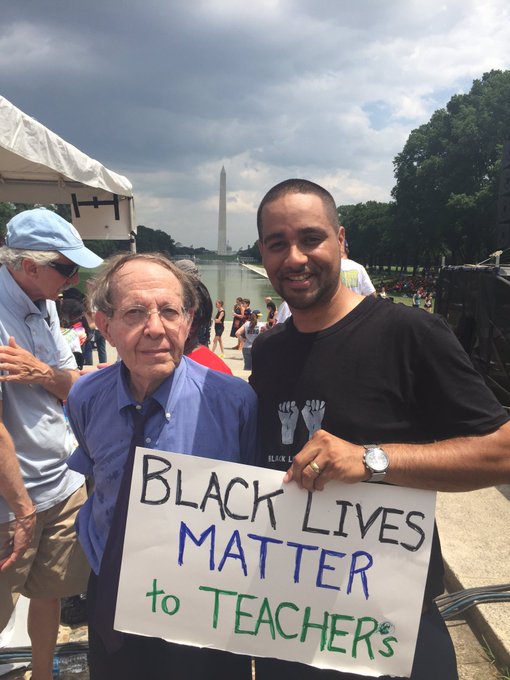
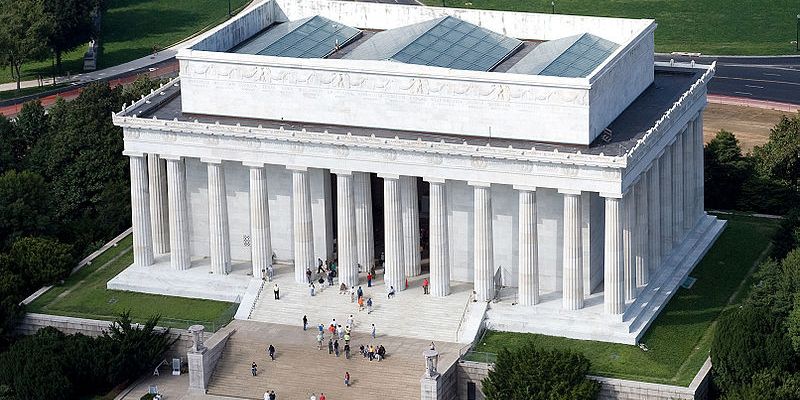
My entire life I have been inspired by the 1963 March on Washington. If I close my eyes, I can see and hear Martin Luther King Jr. delivering the I Have a Dream speech. Our generation must, we MUST continue the social change that this nation requires. The 2016 SOS Coalition People’s March for Public Education & Social Justice occurred on the step of the Lincoln Memorial on July 8.
coalition of grassroots groups, union organizations, and activists gathered to organize and march for:
Full, equitable funding for all public schools; safe, racially just schools and communities; community leadership in public school policies; professional, diverse educators for all students; child-centered, culturally appropriate curriculum for all; and no high-stakes standardized testing!  
It was incredible to be a part of the mass gathering of children and adults who rallyied and marched in support of education and social justice this summer!
In my speech at the Lincoln Memorial I implored those listening to answer the call for democracy and education. I also asked attendees to press for community-based solutions in education policy.
My Great Grandmother Z. Louise Scott was at the 1963 March on Washington. In fact, she also heard the I Have a Dream Speech when it was given first in Detroit by Dr. King. So, I was very emotional when I started the speech, you can probably hear my voice cracking.
But her memory, and her remembering her  on the mall more than 50 years ago gave me the strength to give the most important speech of my life to date.