Latest News and Comment from Education

Monday, December 21, 2015

CURMUDGUCATION: Free Market Bad for Students with Disabilities

CURMUDGUCATION: Free Market Bad for Students with Disabilities:

Free Market Bad for Students with Disabilities


 Disabilities Studies Quarterly, a peer-reviewed quarterly journal, published a paper back in 2012 that makes some sobering points about how a free market approach to schools works out (or not) for students with disabilities. In fact, it has a few sobering things about how free market schools treat all students.


"The Effects of Market-based School Reform on Students with Disabilities" was authored by Curt Dudley-Marling and Diana Baker at Boston College.

It begins with a history of the intersections between neo-liberalism, free market theory, and education. It's a handy primer, all fully sourced and pretty interesting. But the meat of the paper is the question of how various free market approaches work (or don't ) for students with disabilities. It's worth remembering that we're back in 2012-- but the conclusions here are still worth noticing.

Vouchers

There's not a lot of data available about the effects of vouchers on students with disabilities, but the available data is not exactly encouraging. The authors cite a study from 2011 that shows while Milwaukee has a SWD population of about 20%. However, SWD were only 1.6% of the voucher population. That seems to have been typical.

Charter Schools

The charter school system creates a new dynamic between students and schools-- specifically, it create a new role for students, and the writers of this paper explain it as well as anyone I've ever read.

...however they are structured, charter schools must produce acceptable test scores or risk the revocation of their charters (Swanson, 2004). In this context, students are transformed into "commodities" (Apple, 2000; Hursh, 2007a; Wills, 2006) who bring more or less value to charter schools. Students with high test scores enhance the reputation and, hence, the marketability of 
CURMUDGUCATION: Free Market Bad for Students with Disabilities:


Doug Harris on the “Every Student Succeeds Act” and Reasons to Continue with VAMs Regardless | VAMboozled!

Doug Harris on the “Every Student Succeeds Act” and Reasons to Continue with VAMs Regardless | VAMboozled!:

Doug Harris on the “Every Student Succeeds Act” and Reasons to Continue with VAMs Regardless


Two weeks ago I wrote a post about the passage of the “Every Student Succeeds Act” (ESSA), and its primary purpose to reduce “the federal footprint and restore local control, while empowering parents and education leaders to hold schools accountable for effectively teaching students” within their states. More specific to VAMs, I wrote about how ESSA will allow states to decide how to weight their standardized test scores and decide whether and how to evaluate teachers with or without said scores.
Doug Harris, an Associate Professor of Economics at Tulane in Louisiana and, as I’ve written prior, “a ‘cautious’ but quite active proponent of VAMs” (see another two posts about Harris here and here) recently took to an Education Week blog to respond to ESSA, as well. His post titled, “NCLB 3.0 Could Improve the Use of Value-Added and Other Measures” can be read with a subscription. For those of you without a subscription, however, I’ve highlighted some of his key arguments below, along with my responses to those I felt were most pertinent here.
In his post, Harris argues that one element of ESSA “clearly reinforces value-added–the continuation of annual testing.” He equates these (i.e., value-added and testing) as synonyms, with which I would certainly disagree. The latter precedes the former, and without the latter the former would not exist. In other words, it’s what one does with the test scores, whereby test scores do not just mean by default the same thing as VAMs.
In addition, while the continuation of annual testing is written into ESSA, the use of VAMs is not, and their use for teacher evaluations, or not, is now left to all state’s to decide. Hence, it is true that ESSA “means the states will no longer have to abide by Doug Harris on the “Every Student Succeeds Act” and Reasons to Continue with VAMs Regardless | VAMboozled!:


Mike Klonsky's SmallTalk Blog: WEEKEND QUOTABLES

Mike Klonsky's SmallTalk Blog: WEEKEND QUOTABLES:

WEEKEND QUOTABLES

 
Quentin Tarantino

Quentin Tarantino
“I completely and utterly reject the ‘bad apples’ argument,” Tarantino said. “Chicago just got caught with their pants down in a way that can’t be denied… and the chief of police, is he a bad apple? I think he is. Is [Chicago Mayor] Rahm Emanuel a bad apple? I think he is. They’re all bad apples. That just shows that that’s a bullshit argument. It’s about institutional racism. It’s about institutional cover-ups that are about protecting the force as opposed to the citizens.” -- The Wrap
Mark Konkol
In our town, everybody knows all roads lead to the mayor's office, no matter who’s in power. -- DNAInfo
Arne Duncan
“It’s hard to educate a kid that’s dead.” — Washington Post
Civil Engineering Prof Marc Edwards
 "They discovered scientifically conclusive evidence of an anomalous Mike Klonsky's SmallTalk Blog: WEEKEND QUOTABLES:

Seattle Schools Community Forum: Charter school proponents, a thread for you

Seattle Schools Community Forum: Charter school proponents, a thread for you:

Charter school proponents, a thread for you

I am very glad to see that a number of charter school proponents have been active on this blog.

That's wonderful. We all benefit from an open discussion that includes a variety of perspectives.

It's true that Melissa and I both find charter schools an unnecessary distraction that detracts from public education, and it is also true that a large proportion of those who read this blog share that view.

It is also true that we welcome - sincerely - opposing views. I like to think that I could be convinced to change my mind on a large number of topics and charter schools are certainly among those. I have had a number of very lively, civil conversations with well-informed and well-intentioned charter school proponents and I have benefited from those conversations. I am grateful for an understanding of their views and concerns and I am equally grateful for the opportunity to examine my own views more critically and deeply.

I don't particularly despise charter schools. Honestly, I like any school that's a good school, whether it is public, private, or charter. There isn't anything about the public school format that precludes the creation of a good school, so I figure that the best path to follow is to create good public schools instead of creating new formats. I find them unnecessary. Tell us why charter schools are necessary.

So let's have a space for this. Let's have a space for charter school proponents to make their case.


But first, some provisos:


  1. This isn't about disputing the Supreme Court decision or finding fault with it. That's simply not germane. This is not the place to say that Running Start or Skills Centers or anything else is unconstitutional if charters are and for the same reason. Attacking the Court decision or Seattle Schools Community Forum: Charter school proponents, a thread for you:


Most New York City Elementary Schools Are Violating Disabilities Act, Investigation Finds - The New York Times

Most New York City Elementary Schools Are Violating Disabilities Act, Investigation Finds - The New York Times:

Most New York City Elementary Schools Are Violating Disabilities Act, Investigation Finds

A two-year federal investigation has concluded that 83 percent of New York City’s public elementary schools are not “fully accessible” to children with disabilities, in violation of the Americans With Disabilities Act.
In a blistering letter to the Education Department’s top lawyer on Monday, the office of Preet Bharara, the United States attorney for the Southern District of New York, said that the investigation also showed that six school districts, which serve more than 50,000 elementary students, did not have a single school that is fully accessible.
“Nowhere is it more important to tear down the barriers to equal access than with respect to the education of our children,” Mr. Bharara’s office said. “But today, in New York City, 25 years after passage of the A.D.A., children with physical disabilities still do not have equal access to this most fundamental of rights.”
Mr. Bharara, in a brief statement, said his office had asked the city for a response to the findings, “including an outline and timeline of corrective actions that will remedy this unacceptable state of affairs.”
The 14-page letter gives the city 30 days to provide a response. The investigation had not been previously disclosed publicly.
Harry Hartfield, a spokesman for the Education Department, said the department was reviewing the letter and remained “committed to increasing the accessibility of our school buildings.”
Mr. Hartfield said that the department had been cooperating with the Most New York City Elementary Schools Are Violating Disabilities Act, Investigation Finds - The New York Times:

PEDRO NOGUERA: ‘Beyond Measure: Rescuing an Overscheduled, Overtested, Underestimated Generation’ - The New York Times

‘Beyond Measure: Rescuing an Overscheduled, Overtested, Underestimated Generation’ - The New York Times:

‘Beyond Measure: Rescuing an Overscheduled, Overtested, Underestimated Generation’

Kids and their parents collect flyers before a rally against teacher evaluations in front of P.S. 321 in Park Slope, Brooklyn, last March. Credit Jake Naughton for The New York Times


In the thought-provoking “Beyond Measure,” Vicki Abeles offers a compelling set of arguments for reconsidering how we define success in American education and for radically altering the approach we’ve taken to get there. High grades, high test scores and admission to one of the nation’s elite colleges have long been embraced as symbols of excellence and, by extension, successful parenting. Abeles suggests that pursuit of this narrow form of success is actually harming children and families, and distorting our educational institutions. Her book is bound to be controversial, particularly to the education establishment — university presidents, the testing industry and the policy makers who support them. For many of them, “Beyond Measure” is likely to be regarded as a threat, if not downright subversive.

Unlike others who have written on this topic, Abeles is not primarily focused on the politics driving America’s approach to education. Instead, she writes as a parent who questions the value of the ­sacrifices made by her own daughters when her family became “enslaved to achievement.” She is a keen observer who has spoken to researchers, educators and parents throughout the country about the toll that such competition has taken on our children. She documents rising rates of depression and anxiety disorders, and excessive use of performance-enhancing drugs, and concludes that if the trade-off for success is a decline in health, a growing number of people may decide it’s not worth it.

Following up on her highly regarded film “Race to Nowhere,” Abeles calls for an end to what she describes as the “application arms race.” She also reminds us that it wasn’t always this way. Not too long ago, those who didn’t gain admission to elite private colleges could be educated at strong, affordable public alternatives that were readily available. She points out that homework has been around for centuries, but since when did it become normal for children as young as 6 and 7 to be burdened with hours of it each night? Standardized tests have been a regular part of education, but in the past the stakes weren’t so high, and relatively little time was devoted to preparation.

Her critics are likely to contend that her concerns are limited to a privileged segment of the population: overachieving, affluent parents and their children. They will suggest that her arguments have no relevance to ‘Beyond Measure: Rescuing an Overscheduled, Overtested, Underestimated Generation’ - The New York Times:

Charter school network raises concerns | SanDiegoUnionTribune.com

Charter school network raises concerns | SanDiegoUnionTribune.com:

SD Unified renews Audeo Charter, raises concerns


 — The San Diego school board has awarded the Audeo Charter School a five-year charter renewal for seven storefront campuses despite concerns about the way the organization is managed and public funds are spent.
The independent-study program is one of a network of nonprofit groups governed largely by one person, Mary Bixby, who retains near-virtual control over all decision-making and spending.
“Audeo’s governance structure allows for a single individual, Bixby, to be delegated full authority to make any and all real estate transactions, personnel decisions, etc. without any agendized items to have these actions presented, reviewed, and approved by the Audeo board,” district officials wrote in its Dec. 1 report.
“The district’s concern is that a single individual, rather than a board that meets and reports its actions in open public meetings, has decision-making authority over a public charter school’s operations,” the staff report said.
Nonetheless, trustees approved the charter extension through June 2021.
The California Charter School Association supports Audeo’s charter renewals. But Miles Durfee, the association’s managing regional director for Southern California, said “the partnership between the charter and the district needs to be enhanced.”
“The governance structure has evolved. The school district should be looking at it to make sure it is designed to be legal and effective in supporting the students they serve,” Durfee said. “I don’t think anyone argues that students are not being served well. Isn’t that the point?”
The campuses are designed to educate students seeking an alternative to the traditional classroom under independent study programs. Thousands of students transfer to the charters from San Diego Unified campuses each year and eventually return to district-run schools on track to graduate.
The Audeo charter operates as one of at least four nonprofits owned by another nonprofit called the Altus Institute, a growing corporation that legally is the sole owner of the other tax-exempt organizations.
The best-known school operated by Bixby and Altus Institute is the Charter School of San Diego, which opened 22 years ago under the first charter ever issued by the San Diego Unified School District.
“I am the founder of all of the organizations,” Bixby said. “I have been delegated as the keeper of the dreams, the keeper of the visions.”
Since she first opened the Charter School of San Diego, Bixby has created an educational empire that stretches across five counties and collects tens of millions of dollars a year in state and federal education dollars. Altus and its four schools — each with multiple storefront centers — take in a combined $26.5 million in annual revenue, according to its most recent nonprofit tax filings.
The organization also has begun setting up a charter political action committee, and a professional Charter school network raises concerns | SanDiegoUnionTribune.com:

Charter School Approval Flea Flicker: Three charter schools closed by CPS file appeals with state | Chicago Sun-Times

Three charter schools closed by CPS file appeals with state | Chicago Sun-Times:

Three charter schools closed by CPS file appeals with state


The Charter School Approval Flea Flicker
flea flicker is an unorthodox play, often called a "trick play", in American football which is designed to fool the defensive team into thinking that a play is a run instead of a pass.
Three South Side charter schools that were ordered closed by Chicago Public Schools at the end of the academic year have asked the state to give them another shot at educating children.
And if the Illinois State Charter Commission grants any of their wishes, Amandla Charter High School, Betty Shabazz Charter School’s Sizemore elementary campus and Bronzeville Lighthouse Charter Elementary School would become the first schools reopened by the commission.

Any of the schools who win on appeal also essentially become mini-districts separate from CPS. As such, the schools would receive a full share of money from the state — including the cut that normally would go to CPS. The commission now has 75 days to review the applications, interview the schools and CPS and hold a public hearing. In the past, the Commission has only ever been asked to review new charter applications that have been denied.Three charter schools closed by CPS file appeals with state | Chicago Sun-Times:

Big Education Ape: Glendale Unified board denies charter school plans; petitioners say they will appeal to county -... http://bit.ly/1P9tvbD

Big Education Ape: Flea Flicker: Rocketship appeals to state board to build school in Concord - ContraCostaTimes http://bit.ly/1RVCrnq

Big Education Ape: Flea Flicker: Should state be able to approve charter schools in Virginia? - Daily Press http://bit.ly/1QPtgEg
Big Education Ape: Washington Charter Schools Find Another Source Of Public Money | KUOW News and Informationhttp://bit.ly/1QPtknC

AP Builds New Multi-Format Team for Education News Coverage - ABC News

AP Builds New Multi-Format Team for Education News Coverage - ABC News:

AP Builds New Multi-Format Team for Education News Coverage


A new national beat team has been established at The Associated Press to elevate coverage of issues in education, the news cooperative announced Monday.
The team will aim to generate more coverage off the news and explore trends affecting students of all ages, using text, video, photos and interactive multi-format storytelling about how trends in education are affecting children and families across America and around the world.
The team is comprised of experienced journalists who consistently break news and produce well-received enterprise on education trends and issues, including recent stories on racial tensions at college campuses after the University of Missouri protests and changes in high school and middle school sex education to address consent and sexual assault, not just pregnancy and disease.
"The creation of this team signifies the AP's commitment to this critically important topic," said Sarah Nordgren, director of U.S. news operations. "We are putting some of our top talent in a position to tell the stories of education for the entire suite of AP customers."
The team includes reporters, editors and visual journalists around the United States. They will work with AP bureaus around the globe to develop ambitious stories told in innovative ways for digital and traditional media platforms. The work will include projects with customizable datasets, enabling customers to localize strong national enterprise stories for their audiences.
Members of the team include reporters Lisa Leff in San Francisco and Collin Binkley in Boston, who will focus primarily on higher education. Reporters Christine Armario in Los Angeles and Carolyn Thompson in Buffalo, New York, are dedicated primarily to K-12 issues. Jennifer C. Kerr, a Washington-based reporter, will focus on federal education policy and its impact on schools, teachers and students.
Photo editor Marta Lavandier in Miami and video-first journalist Gillian Flaccus in Orange County, California, will work closely with the team to help incorporate video and photos into its storytelling.
The co-leaders of the team are Michael Melia, an administrative correspondent in Hartford,Connecticut, and Carole Feldman, a news editor in Washington.AP Builds New Multi-Format Team for Education News Coverage - ABC News:


CURMUDGUCATION: Coleman to Catholics: Never Mind Common Core

CURMUDGUCATION: Coleman to Catholics: Never Mind Common Core:

Coleman to Catholics: Never Mind Common Core

In an exclusive interview with Catholic Education Daily, David Colman, architect of Common Core and head honcho at the College Board, offered some of the same old same old. But he also told Catholic schools that they could just nevermind the Common Core.

Do Catholics not love the Core? 

Writer Adam Cassandra has put together a good overview of the odd and sometimes-difficult relationship between the Catholic school system and the Common Core-- or at least the Core's co-creator.

The Catholic system has been fairly direct about its resistance to the core, including a wholeCatholic Is Our Core campaign. Their objections are familiar to the umpty-gazillion educators, parents and people on the street who have objections to the Common Core. For instance, Dr. Dan Guernsey and Dr. Denise Donohue of the Newman Society wrote a report last May called “Disconnect between Common Core’s Literary Approach and Catholic Education’s Pursuit of Truth.” That included this Fairly Excellent Quote:

In Catholic schools, we know we are not just producing workers and scholars, we are producing living, breathing, complex, contradictory, eternally destined, unrepeatable and immensely valuable 
CURMUDGUCATION: Coleman to Catholics: Never Mind Common Core:


The Greatest Gift of 2015 - Lily's Blackboard

The Greatest Gift of 2015 - Lily's Blackboard:

The Greatest Gift of 2015

In this season of giving, educators, students and parents just received one of the best presents we’ve had in a while: the Every Student Succeeds Act (ESSA). The new law places student learning – instead of student testing – at the center of everything educators do.
When I count my blessings as 2015 ends, the ESSA will go straight to the top of my list. But as a teacher, I have to admit that my cup runneth over in the gift department.
Not too long ago, we posted a query on NEA Today’s Facebook page asking educators to tell us about some of their most cherished gifts from students. These ranged from the heartfelt to the hilarious.
I taught at Orchard Elementary School in the suburbs of Salt Lake City, and at homeless shelters. I taught students who struggled to succeed in harsh circumstances and those who were lucky enough to grow up well-off in the right ZIP code. No matter what their differences, they had something in common. Each of them taught me, and each of them enriched my life. Whether you’re a teacher, a guidance counselor, school secretary, college professor, coach, principal, or an education support professional, I know you can relate to that.
Many of the educators who responded on Facebook said that simply hearing a student say “Now I get it” was the best gift ever. I know the pure joy of that moment. Suddenly something clicks, and we get to watch it happen. The eyes get wider. The brow unfurrows. The grimace becomes a grin. And before you know it, that Pharrell song, “Happy,” is on repeat in your head.
.gift
A chemistry teacher said her best gift was hearing a student say, “I never liked science, but I liked this class.” Others had similar answers: “When a former student tells me about the positive impact I had on their life,” and “It’s the notes and letters! I keep them in a file and read them when I feel the need.”
For some educators, the most cherished presents are handmade. A kindergartener’s handprint Christmas tree. A bookmark. A detailed picture of a student’s favorite classroom activities. A book of poems, pictures, stories, and “what-nots” from one teacher’s entire class. An orange named Oscar with yarn for hair and eyes. Sometimes the best gifts are practical, like the plastic spoons a teacher received, labeled as “scientific stirrers.”
Often it’s the presents from students and families that are least able to give that touch the heart. A teacher in a high-poverty school will never forget the mom who gave her a $5 gift card to a fast-food restaurant. The mom cried and told her what a difference she’d made in her daughter’s life. Another mentioned the student who handed him a shoebox that held a few treasured items, including a book and a teddy bear.
Some gifts tell the heart-wrenching story of trauma. One teacher said a first grader who initially wouldn’t allow any adult even to hold his hand asked if he could give her a hug.
There is the constant gift of our students’ giggles – and then, there are the gifts that make us giggle. Consider: the bikini one teacher received (by the way, it was the correct size), and the two favorite snakes presented to another. (Were these gifts or gags?)
Whatever you’re giving or getting this holiday season, remember that as educators, we have the greatest gift of all: the privilege of inspiring our students’ curiosity, imagination, and desire to learn, and the opportunity to provide them with the caring, committed, and qualified educators they deserve.The Greatest Gift of 2015 - Lily's Blackboard:


John White Tells the Truth! Charter Schools are Not About Children or Choice, They are About Cashflow | Crazy Crawfish

John White Tells the Truth! Charter Schools are Not About Children or Choice, They are About Cashflow | Crazy Crawfish:

John White Tells the Truth! Charter Schools are Not About Children or Choice, They are About Cashflow


In the past I would write posts about John White’s lies.  However his lies have become so commonplace (and obvious) that eventually the public stopped paying attention.  It was generally accepted that if John White’s lips were moving, he was lying.  (“White Lies” is how they are frequently referred to online.) However John White is living proof that it’s difficult to lie all the time. Invariably you are going to let some truth out to someone, somewhere. Because this happens so infrequently the times he tells the truth are perhaps the most interesting now.
Take for instance this clip I made from the December 1st 2015 BESE meeting where John White explains to the public why he has chosen to authorize charter schools in public school districts that don’t want them, with plenty of options, choices and under financial strain, but is refusing to authorize them in New Orleans, which is 100% charter controlled.
Louisiana State Superintendent John White:
“If you were running a traditional school system you would never open a new school when you have an enrollment deficit.  And here we have a charter system.  So on one hand you’re called to authorize charter schools.  On the other hand [RSD] superintendent Dobard and I must determine what the right enrollment balance is, just like a traditional system.
I will tell you this type 2 charter school system, and I have told this to Dr. Triplett, cannot open this year.  It cannot open this year.
It may open in a year when the enrollment re-stabilizes and we have another need, but I have been very clear to them for this year, as a type 2 charter school because it would add to the number of seats when our kindergarten enrollment is down.
Now I think she has also applied for a type 5 charter school.  That type 5 charter school could take over for schools that are struggling. Uh. We are recommending its for approval as well.  And she could, uh, provide services within a currently existing school.  But a standalone new additional set of however many new kindergarten kids, 50 or 100 or so, I just do see how we can do that and be fair to the school system.”
This is very interesting because it goes against every idea the charter industry pushes as the need for new charter schools.  This decision limits choice at a time where only about 30% of the kids get their first choice by the OneAp system that John White Tells the Truth! Charter Schools are Not About Children or Choice, They are About Cashflow | Crazy Crawfish:


Fisher Letter Boston Globe Refused to Print | Cloaking Inequity

Fisher Letter Boston Globe Refused to Print | Cloaking Inequity:

Fisher Letter Boston Globe Refused to Print


The Boston Globe recently printed an opinion column entitled ‘Mismatched’ black students pay the price of affirmative action. Jeff Jacoby was either grossly ignorant of the facts or simply racially prejudiced.
Here is the letter I wrote responding to Jacoby:
The columnist neglected to mention important data that would better inform Globe readers in his column ‘Mismatched’ black students pay the price of affirmative action. Jacoby continues the insecurity and insidiousness of racial prejudice that has unfortunately permeated our society for centuries. Jacoby assumed that African Americans and Latina/os gained admission to UT-Austin at the expense of Abigail Fisher. He is wrong. Jacoby neglected to mention that Abigail Fisher was a very average student (See Entitlement by “race”: What Abigail Fisher didn’t tell you…). The facts are that Abigail Fisher did not finish in the top ten percent of her high school class, which would have automatically qualified her for admission to any public university in the state. Second there were five black students who were denied admission that had better scores and grades than Abigail. Third, there were 42 white students who gained admission that had worse test scores and grades.
Jacoby’s second failure was to follow Justice Scalia’s most recent judicial missteps by citing mismatch theory— which is racism parading as scholarship. In the latest Fisher arguments, Scalia sweepingly suggested that Blacks should just go to “slower track” universities. The social science world has extensively discredited the racialized ideas underlying mismatch theory. The data from Texas also discredits Scalia and Jacoby’s assertions.
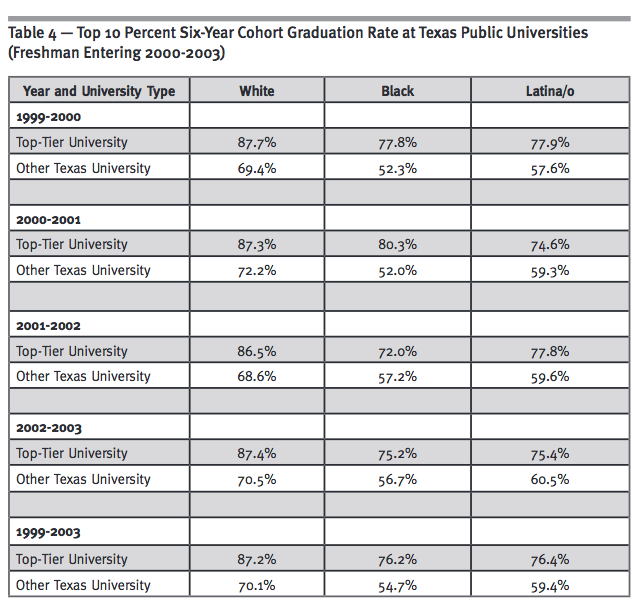
When I was a professor at the University of Texas at Austin we published a paper in the Harvard Journal of African American Public Policy that showed that, controlling for ability, students who attended the Texas’ flagship institutions actually graduated at much higher rates. So, in essence, Black students of the same ability, if they attend lower tiered institutions had much lower graduation rates.
Screen Shot 2015-12-21 at 10.42.12 AM
In sum, the actual data from Texas is mismatched with Scalia, Jacoby and Fisher’s highly racialized and wrong assertions.
Why is this even an issue? I wrote in the post Fisher v. Texas: Another civil rights movement on the way? that it’s because African American and Latino students continue to be severely underrepresented in our nation’s selective institutions— including UT-Austin.


Diversity in these institutions is again under attack in the Fisher v. Texas case currently being re-decided in the US Supreme Court. For past attacks see BakkeHopwoodGrutter and Gratz. Considering that Grutter upheld race as one of many factors under a decade ago, conservatives Fisher Letter Boston Globe Refused to Print | Cloaking Inequity:

Strike Rochdale from the record books. The Co-op began in Scotland | Business | The Guardian

Strike Rochdale from the record books. The Co-op began in Scotland | Business | The Guardian:

Strike Rochdale from the record books. The Co-op began in Scotland

Amateur historians uncover record of weavers who were discount store pioneers


Its famous four-letter logo and revolutionary system of profit-sharing - the "divi" - made the Co-op a high street institution, and generations of schoolchildren have been taught that it began in a humble store on Toad Lane in Rochdale.
Now two amateur historians claim the history books are wrong: the cooperative movement was born nearly 240 years ago in a barely-furnished cottage in Fenwick, East Ayrshire, when local weavers manhandled a sack of oatmeal into John Walker's whitewashed front room and began selling the contents at a discount. It is here, according to a document they unearthed, that the world's first co-op was founded, 230 miles north of the accepted home of the Co-op.
Fenwick's pre-eminence has been overlooked, locals say, in favour of the English town where the Rochdale Pioneers opened their store 83 years later.
The metropolitan borough in north-west England has long boasted of its association with the 28 mill workers who opened their store in 1844, devising the "principles" which became the model for cooperatives worldwide.
A sign on the railway bridge above the A664 leading into the town from the M62 states: "Rochdale: birthplace of cooperation", while the council's website describes the town as the "home of the worldwide cooperative movement".
Yet it seems that movement actually began on March 14 1761, when a group of self-employed weavers gathered secretly in the village of Fenwick, a straggling line of cottages, small shops and old coaching hotels near Kilmarnock which has changed little.
Written in a firm, precise hand, the yellowing document the 15 men signed bound members to be "honest and faithfull to one another ... and to make good & sufficient work and exact neither higher nor lower prices than are accustomed".
It was a revolutionary move. Fenwick survived on tweed and muslin weaving, shoemaking and farming; its tradesmen dependent on patronage by the local elite.
"Cooperation has been around since the year dot, but making it official was different," said John McFadzean, who researched the weavers' history with fellow amateur historian John Smith. "Getting the very much lower working class to fend for themselves, and having the ability to set up the infrastructure to run a documented cooperative was quite a feat ... no one has anything like it predating this."
'Being in need'
Records show the society quickly began lending money to needy members and their families - making it, argue both men, the first recorded credit union. Original records, now in the National Library of Scotland, record short-term loans of 10 and 12 shillings to members, at a flat rate of 5%. One accounts sheet from 1764 records: "Given to Margaret Mitchel at Finnick being in need ... 1s."
The weavers' society began by buying and sharing materials and looms, but in 1769 branched out into food and "victuals", first buying a sack of oatmeal wholesale to sell in smaller quantities at cut price. Savings were divided among the members - a measure Mr Smith insists was a prototype "divi" or dividend.
Those innovations spawned other initiatives; a cooperative subscription library was founded in 1808, and an "emigration society" to help villagers make new lives in the New World. In the early 1800s, the villagers established what became known as the "Fenwick parliament", open meetings to debate local affairs held at Strike Rochdale from the record books. The Co-op began in Scotland | Business | The Guardian:

NYC Public School Parents: 2015 year in review: Please give to Class Size Matters to keep us going strong!

NYC Public School Parents: 2015 year in review: Please give to Class Size Matters to keep us going strong!:

2015 year in review: Please give to Class Size Matters to keep us going strong!


Dear friend:

Please consider giving to Class Size Matters, as we rely on your donation to keep our organization going.  We had a very busy year and need your support.  Please click here to give a tax-deductible donation now. 

In February, we blew the whistle when we noticed a two billion dollar internet contract that was going to be awarded to a contractor who had been involved in a corrupt kickback scheme just a few years ago.  After I alerted the media, the NYC Department of Education hurriedly renegotiated the contract down to $1 billion.  The Panel for Educational Policy then voted to approve the contract 8-1, but luckily, the Mayor’s office took notice of the controversy and cancelled the contract – the first time this has happened in the history of the DOE.

In March, we helped organize “Protect our schools” rallies throughout the city, where thousands of teachers, parents, and students formed human chains around their schools,  to protest the Governor’s threatened budget cuts and damaging charter takeover proposals.

In April, we won a lawsuit we had filed against the DOE to ensure that School Leadership Team meetings remain open to the public.  Justice Peter Moulton agreed with us and the Public Advocate that DOE was violating the law by closing these meetings, and that SLTs, half of whose members are parents at every NYC public school, have more than “advisory” powers.  Though the DOE is unfortunately appealing his decision, we are confident we will eventually prevail on appeal. 

Our analysis of school overcrowding has been widely cited by other groups and officials, showing that there is a need for at least 100,000 seats in the school capital plan to alleviate overcrowding and address expected enrollment growth.  We are spearheading a campaign to convince the Mayor to double the number of school seats to be built, and to create a taskforce or commission to improve the accuracy and efficiency of school planning, which lags far behind residential development.  In June, the Public Advocate, twenty-two Council Members and many parent leaders sent a letter to the Mayor and Chancellor, urging them to do take these important steps.  

Along with NYC Kids PAC, we released an Education report card for the Mayor in the spring, in which he received mixed grades in several categories because he has failed to fulfill his promises in many critical areas, including on class size. This fall, we co-hosted a Parent Action Conference in Brooklyn, with workshops on many topics ranging from the Common Core, testing and Mayoral control to School Leadership Teams and overcrowding. 

When the DOE’s class size data was released last month, we reported that the number of students in extremely large class sizes in the early grades has nearly doubled since 2011, with more than 48,000 children in classes of 30 or more.   Our findings were cited in the Daily News and in an editorial in AMNY.   

Our City Council testimony on Renewal schools was also widely covered in the media,  revealing that despite repeated DOE promises,  class sizes have not be reduced in nearly half of all the Renewal schools, and the vast majority continue to have classes of thirty students or more.

The Parent Coalition for Student Privacy, the national organization we co-founded in 2014 following our defeat of inBloom Inc., continues to make waves.   Our members wrote op-eds and were quoted widely in the media, most recently about Google’s data-mining of students and Mark Zuckerberg’s intention to spend billions to expand risky and unproven online learning.  At the same time, we are working to inform parents about what they should demand in terms of privacy and security protections of their children’s data from their schools, districts and state. 

As part of our work with our state-wide coalition, NY State Allies for Education, we urged parents to opt out of the defective Common Core exams, leading to an unprecedented 240,000 students refusing to take the state tests last spring.  The opt out movement and nationwide rebellion against the flawed Common Core standards has led to significant revisions in the federal education law, and has  caused a  growing recognition among policymakers that it is wrong to use badly designed tests and inappropriate standards to label kids, teachers, and schools as failing.  

But many challenges remain. The need for student privacy protections is more critical than ever, especially as the use of digital learning and data-mining software is being promoted by the ed tech industry and government officials. Meanwhile, in NYC, excessive class sizes and school overcrowding continues to worsen, without any plan or commitment on the part of the Chancellor or the Mayor to seriously address the problem.

Please help us fight for students to be provided with a quality well-rounded education, including smaller classes and real personalized learning, rather than instruction delivered via computers.  We need your help to advocate for every student’s right to privacy, and for parents to have a voice in how their children’s schools are run.

Thank you immensely if you’ve given to Class Size Matters before and please give again as generously as you can.   Just donate online at byclicking here.  If you’d prefer to send a check, address the envelope to Class Size Matters, 124 Waverly Pl., New York, NY 10011.

Have a happy holiday and wonderful New Year,