Latest News and Comment from Education

Saturday, September 19, 2015

Seattle Black Lives Matter Organizers: “We are in full support” of the Seattle educator strike! | I AM AN EDUCATOR


Seattle Black Lives Matter Organizers: “We are in full support” of the Seattle educator strike! | I AM AN EDUCATOR:

Seattle Black Lives Matter Organizers: “We are in full support” of the Seattle educator strike!
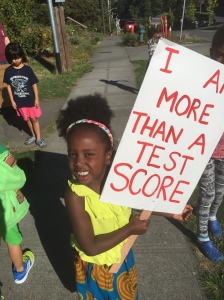

IMG_3560
Students joined the picket line to make their voices heard
The 5,000 members of the Seattle Education Association led a five-day strike that was nothing short of transformative of our education system and our city.  Thousands of parents joined in solidarity with the teachers, including the celebrated “Soup for Teachers” group that formed to bring sustenance and solidarity to picket lines at just about every school in the district.  The Coalition for the Schools Seattle Deserves united community organizations and joined Kimya Dawson to host abenefit concert to raise funds for the striking teachers.  The Seattle City Council, led by councilmember Kshama Sawant, passed a unanimous resolution in support of the strike.  Marching band students used their pep-band anthems to root on striking educators.  There can be no doubt that this strike was overwhelming supported by the people in the Seattle area–except, perhaps, for the regions’ wealthiest resident, Bill Gates, who has invested his fortune in schemes to privatize education and reduce our schools to test prep centers.
So many of the union’s social justice demands were advanced in the current strike and negotiations–creating a compelling model for educators around the country who believe in social movement unionism.  This is why so many were greatly frustrated that the union ended the strike before a fair workload and pay agreement could be reached between the union and the school district.
Still, the union’s demand for “race and equity” teams was groundbreaking.  The Seattle Education Association advocated for every one of the Seattle Public Schools to have such a team to tackle issues of institutional racism.  The Seattle school district originally said they would only agree to having these teams in six schools.  However, the power of the strike pushed the district to agree to allow 30 schools to have these anti-racist committees in the tentative agreement that was reached between the union and the Seattle Public Schools.  Given that the Seattle schools have been found to suspend African American students at four times the rate of white students, it is clear that every school in the city needs to take to organize actively against inequality and racism.
Tomorrow, Seattle educators will vote on the tentative agreement.  Many of us will ask the Seattle Black Lives Matter Organizers: “We are in full support” of the Seattle educator strike! | I AM AN EDUCATOR:

Fourteen Year-Old School Children, Rosa Parks, Donald Trump, Marco Rubio, Ted Cruz and Planned Parenthood | Reclaim Reform

Fourteen Year-Old School Children, Rosa Parks, Donald Trump, Marco Rubio, Ted Cruz and Planned Parenthood | Reclaim Reform:

Fourteen Year-Old School Children, Rosa Parks, Donald Trump, Marco Rubio, Ted Cruz and Planned Parenthood


When presidential candidates train for debates, each of their teams does research for months; the candidates are then coached, rehearsed and prepared for weeks on end. This is basic homework for their debate preparation.
Parks Trump Rubio Cruz.001
Republican presidential candidates Donald Trump, Marco Rubio and Ted Cruz all chose Rosa Parks to be on the ten dollar bill as a sign of honor and respect.
After a full night of demonizing Planned Parenthood, this choice showed little if any preparation on the part of all of the candidates. Their statements were bizarre. Rosa Parks was a board member of Planned Parenthood. A simple Google search is sufficient to discover this not-so-secret historical fact. Simple homework.
As a retired language arts teacher with over three decades of teaching experience, I never encountered a single fourteen year-old who gave a presentation so inept. Because I taught all ability levels and listened to thousands of presentations prepared with all degrees of homework (or lack of it), this is saying a great deal. I never encountered a student who Fourteen Year-Old School Children, Rosa Parks, Donald Trump, Marco Rubio, Ted Cruz and Planned Parenthood | Reclaim Reform:

Report from Chicago: Dyett Hunger Strike Ends Today - Living in Dialogue

Report from Chicago: Dyett Hunger Strike Ends Today - Living in Dialogue:

Report from Chicago: Dyett Hunger Strike Ends Today


By Michelle Gunderson.
The hunger strike for Dyett High School ended this morning on day 34.
Once again I headed to the south side to be with my friends and fellow education fighters known as the Dyett Twelve. Education activists had been told that the hunger strikers would have an announcement this morning, and many of us converged at the Rainbow Push Coalition broadcast to be there in support.
I sit in the pews behind Cathy Dale and Jeanette Taylor-Ramann – two women who I have come to love and respect through this struggle. After 34 days of fasting the hunger strikers have an other-worldly presence. They seem so strong and focused, yet vulnerable at the same time.
The Dyett hunger strikers make their decisions collectively, and I have seen this process first-hand. There is always a careful and respectful debate, an analysis of strategical plan, and a strong focus on the mission: A neighborhood high school open to all children governed by the community and focused on a curriculum that the community wants.
It was difficult to bring this strike to a righteous close and a real win.
Here are the remarkable accomplishments made through this struggle. First, we know of no closed neighborhood school in the country that has be re-opened as a neighborhood school. Second, the school will not be opened as a charter or a contract school.
The planning for curriculum and governance of the school has not yet been decided, and this is where national allies and supporters need to take notice. To continue this fight, we cannot turn away and let the appointed school board of the Chicago Public Schools think we are no longer watching. Our continued insistence on a school FOR the community, FROM the community will bring the hunger strike to its full resolution.
A hunger strike is an action of last resort, a stance taken by those who no longer agree to be victims of a Report from Chicago: Dyett Hunger Strike Ends Today - Living in Dialogue:


The Global Search for Education: Teaching in a Global World | C. M. Rubin

The Global Search for Education: Teaching in a Global World | C. M. Rubin:

The Global Search for Education: Teaching in a Global World

2015-09-08-1441724671-6467625-cmrubinworldRandiWeingartenphoto4500.jpg


"In Finland, Singapore and Japan, the approach is much different than the top-down, my-way-or-the-highway sanction and blame approach to accountability we see in too many schools in the U.S. If we are going to achieve our goal of a high-quality public education for every child, we need to lean into preparation, practice, and collaboration--not high stakes testing and narrow accountability."
-- Randi Weingarten
Let's talk about teaching. Randi Weingarten is the President of the American Federation of Teachers (AFT), which represents educators and healthcare professionals to make sure that fairness and democracy prevails. Her long career as President of the United Federation of Teachers earned her the accolade of being one of the most influential New Yorkers in the New York Observer. Her commitment to education reform and her support for local unions is an inspirational example of what is needed to secure sustainable community solutions for the future of education. In this interview, I talk to Randi about what we can learn from successful education models abroad, the increasing importance of teachers having robust global and cultural competence, and how the US can do a better job supporting its teachers. Her globally informed insights are what we have come to expect from Weingarten, who also writes a monthly column, "What Matters Most," for the New York Times' Sunday Review.
2015-09-08-1441724748-3605961-cmrubinworldRandiWeingartenphoto5500.jpg
"Achieving global competence also requires educators to be culturally competent. Effective teachers know how children learn and grow, they know the academic content they are teaching, AND they know how to teach that content to diverse groups of students using culturally responsive practices." -- Randi Weingarten
Randi, all countries share a common desire to create a high-quality education system that prepares children for success in their lives. You've attended the International Summits on the Teaching Profession and done study visits to other nations - what impressed you most from around the The Global Search for Education: Teaching in a Global World | C. M. Rubin:

Drones increasingly becoming common part of education | Technology

OMAHA, Neb.: Drones increasingly becoming common part of education | Technology | SanLuisObispo.com:

Drones increasingly becoming common part of education


 — More than footballs were flying at a recent Westside Warriors practice.
Jeff Ingraham pushed a lever on a radio controller, and a white DJI Phantom drone whined and lifted off the running track.
A few more pushes and pulls, and the drone sailed to a spot high above the turf, hovering still as a rock, its high-definition camera recording the action below.
The Omaha World-Herald reports (http://bit.ly/1YhBTuL ) that one day soon, drones like this will probably swoop into your kids' school. If they aren't there already.
The compact, remote-controlled aircraft are providing marching band directors and football coaches with a bird's-eye view of formations.
In science class, students write programs to steer miniature drones through obstacle courses.
School officials capture dramatic, Hollywood-style videos to show off their facilities and promote their districts.
Ingraham is a technology specialist with Educational Service Unit 3, a political subdivision that provides technology support to 18 eastern Nebraska school districts.
The organization bought 25 drones, including the Phantom, as part of its mission to seek out emerging technologies that might be important to schools in the future, he said.
"It just seemed to be an incredibly compelling way of engaging students, specifically in STEM concepts — science, technology, engineering, math — that is so important for the future of our nation," Ingraham said.
The drones cost about $3,500 in all. They vary in size and capabilities. But they all reflect the convergence of whiz-bang technologies: powerful, miniature motors; long-lasting, lightweight batteries; global positioning and infrared guidance systems; digital cameras; and easy programming.
Ingraham takes them, upon request, to schools in the member districts, including Bellevue, Elkhorn, Douglas County West, Millard, Gretna, Papillion-La Vista, Ralston, Springfield Platteview and Westside.
The ESU serves 77,000 students, making it the largest in Nebraska.
The DJI Phantom, costing about $1,000, is the biggest and most expensive aircraft in Ingraham's squadron. It's 14 inches across, weighs over 2 pounds and carries on its belly a GoPro camera. Its four blades emit a loud whine and look like they could chop a salad, or a finger, in nothing flat.
With global positioning capability, the drone can sit magically in the air like it's on a string. When the battery runs low, it automatically returns to the spot where it took off. Its videos, shot in high definition, are clear and smooth.
Ingraham can aim the camera remotely, but he can't see what the camera sees. With this model, there's no screen on the controller to view through the drone's lens. So it's a guess as to what isOMAHA, Neb.: Drones increasingly becoming common part of education | Technology | SanLuisObispo.com:


Read more here: http://www.sanluisobispo.com/2015/09/19/3815152_drones-increasingly-becoming-common.html?rh=1#storylink=cpy

Teacher: The ‘layers of absurdity’ in Florida’s education agenda - The Washington Post

Teacher: The ‘layers of absurdity’ in Florida’s education agenda - The Washington Post:

Teacher: The ‘layers of absurdity’ in Florida’s education agenda


Over the summer, the Florida Legislature agreed to spend $44 million to fund a scholarship program that will award big bonuses to teachers who got high SAT and ACT scores before entering college — even if they took the test decades ago and can somehow locate their scores.  The proposal was so, well, kooky, that it didn’t make it through the Republican-led Senate during the legislature’s spring session, but it rose from the dead in a June special session and turned up in the 2015-16 Florida education spending budget.
In this post, Florida teacher Melissa Halpern writes about what this program reveals about the state’s education agenda in general, a critical view that is far different from anything you will hear from Jeb Bush, the former Florida governor who is running for the 2016 Republican presidential nomination and who touts his education reform credentials.
Halpern is a long-time Palm Beach County teacher and founder of the Florida Professional Teaching Force, an organization that advocates for restored dignity and efficacy in the teaching profession. She recently graduated from the Harvard Graduate School of Education.
By Melissa Halpern
The layers of absurdity that make up Florida’s new “Best and Brightest” teacher incentive program may seem impenetrable, but if  dissect them, we’ll Teacher: The ‘layers of absurdity’ in Florida’s education agenda - The Washington Post:

Louisiana Educator: Breaking News! The PARCC Cut Scores Have Been Set but Still No Results Released by LDOE

Louisiana Educator: Breaking News! The PARCC Cut Scores Have Been Set but Still No Results Released by LDOE:

Breaking News! The PARCC Cut Scores Have Been Set but Still No Results Released by LDOE


The PARCC cut scores for each level of performance have now been released by the PARCC consortium and other states are already starting the process of informing parents about how their children scored on the PARCC tests. The lowest passing score for Louisiana students is suppored to be level 3 performance which the PARCC consortium has decided will be represented by a score of 725 out of a possile 850 points.

Please click on this link to see how the Illinois Department of Education plans to inform each parent about the performance of his/her child the new PARCC tests similar to the PARCC tests given in Louisiana this Spring.

Notice that on this particular 5th grade math test the possible scale scores range from 650 to 850. In many cases these scale scores bear little relationship to the percentage of questions the student answered correctly. For example, suppose a student got frustrated or ill and did not answer any of the questions. He just gave his name or ID on his test form and could not answer any of the questions. My understanding is that this student would still get a score of 650. Suppose that another student answered 25 questions correctly out of 75 questions on the test. If the raw cut score for level 2 performance is 26 out of 75, then that student would be awarded a score between 650 and 700 and still be rated at level #1. That's the same as the student who answered none of the questions correctly. Does this make any sense to you?

This is just one example of how obscure and non-sensical the grading on these PARCC tests can be.
Most parents and teachers understand the concept of a raw score.The raw score for a particular child is the percentage of questions that the student got right. For example, a raw score of 33.3% on the test above means that the student got 25 out of 
Louisiana Educator: Breaking News! The PARCC Cut Scores Have Been Set but Still No Results Released by LDOE:

Seattle Schools Community Forum: Duncan's Former Chief of State Says States "Forced" to Take on Common Core

Seattle Schools Community Forum: Duncan's Former Chief of State Says States "Forced" to Take on Common Core:

Duncan's Former Chief of State Says States "Forced" to Take on Common Core


Must be the month for "I knew it" moments (the first being the Washington State charter school law.)

Common Core may be toast now.  Except that states and districts, like ours, have invested millions on following and using it.  And invested millions in testing those standards.

Guinea pigs - your children were nothing but guinea pigs to these people.  Shame on them.  

From Breitbart:

In a remarkable admission, the former director of the Race to the Top (RttT) competitive grant program and chief of staff to U.S. Education Secretary Arne Duncan says the federal government “forced” full support for adoption of the Common Core standards from each state by requiring its governor, chief state school officer, and head of the state board of education to sign off on the grant application.

Weiss, who led RttT from its start, explains the federal government took advantage of the fact that states were strapped for cash due to the recession.

“[S]o the large pot of funding that we had to offer was a significant inducement for states to compete,” she writes, adding the surprise number of 46 states willing to sign onto the Common Core standards initiative was due 
Seattle Schools Community Forum: Duncan's Former Chief of State Says States "Forced" to Take on Common Core:


The Wall Street Journal consults experts on teacher quality | @ THE CHALKFACE

The Wall Street Journal consults experts on teacher quality | @ THE CHALKFACE:

The Wall Street Journal consults experts on teacher quality


IMG_5896


The WSJ discusses improving teacher quality with three experts, one of whom is actually a teacher. It is with great interest that I read the comments of educators on their profession. The educator in this piece, Mr. Vilson, who is a frequent commentator, once again disappoints me. It always seems as if his comments, and those of many others, are sanitized for public consumption.
It is a rare thing to find many education commentators, Mr. Vilson among them, propose any real, concrete, specific, and insightful propositions. Instead, they tend to come out like this:
Continuous, constructive feedback, strong professional development, and chances to determine one’s own path while still in the classroom are just some of the recommendations I’d make.
Or this:
Teachers should have a set of researched best practices, but we would do well to help educators learn how to be nimble as well.
It sounds too careful and sterile.
Without spending all day thinking about it, I can take a quick imaginary walk through my school and my own classroom and come up with my own very specific ways we could improve “teacher quality,” which is a The Wall Street Journal consults experts on teacher quality | @ THE CHALKFACE:

TEACHERS PROTEST BILLIONAIRE ELI BROAD - Schoolhouse Live

Schoolhouse Live:


COMING SUNDAY, SEPTEMBER 20, AT 9:00 AM PDT:
TEACHERS PROTEST BILLIONAIRE ELI BROAD
On September 20, join educators, parents, students, and community members to tell the billionaires: “Hands Off Our Schools!”

Public education is facing an escalating attack led by billionaires like Eli Broad. Broad is willing to give millions to the arts but fights against more funding for schools. He publicly supported the recent Prop. 30 school funding measure but secretly funded political groups in an attempt to defeat it. The last time Broad meddled in LAUSD, we got former superintendent John Deasy’s failed leadership, millions lost during the MiSiS Crisis, and the iPad scandal that led to an FBI investigation.

Now Broad is planning to dismantle public education by taking 50% of our students out of LAUSD and putting them in unregulated, non-union charters that don’t play by the same rules as other schools. Losing 50% of our enrollment would trigger a severe loss in funding for crucial resources and programs for our students.

Broad funded similar plans in New Orleans after Hurricane Katrina, and his “reform” there has resulted in massive inequities and civil rights violations for students, as segregation has been reinforced and special education students have been left behind. Schoolhouse Live:


Schools Matter: Houston Chronicle Exemplifies Media Coverage of KIPP

Schools Matter: Houston Chronicle Exemplifies Media Coverage of KIPP:

Houston Chronicle Exemplifies Media Coverage of KIPP

Please do go the Houston Chronicle for a clear example of how corporate media covers research on KIPP. 


Admittedly, the research firm, Mathematica (which collected millions from KIPP sponsors to conduct the study) had its part to play in emphasizing the sunny side for KIPP, Inc., but it remains the journalist's job to tell the whole story, rather than the parts that billionaires want to hear. 

My comments on the Houston Chronicle story at their site:


This article is a great example of how the media treats the billionaire philanthropist school choice for urban children. It is written to spin the Mathematica study to suit the billionaires at Atlantic Philanthropies who paid for the research in 2008.  

Here are a few core findings that you might have presented if reporters chose to report the whole story, rather than the parts that support the agenda of corporate education reformers:

--KIPP's impact, or effect size, on student learning has declined steadily since 2007 as the charter chain has almost tripled in the number of KIPP schools.

--One in four KIPP middle schools had no impact or negative impact on student learning over the 8 years of data collection by Mathematica.

--Of the elementary schools in the study, more than half the schools had marginal impact or no impact at all on achievement.  From the study:

"The impact of KIPP at the elementary school level varies by school. Among the eight KIPP elementary schools we examine, three have positive and statistically significant impacts on at least one measure of academic achievement (Figure III.1). Two additional schools have 
Schools Matter: Houston Chronicle Exemplifies Media Coverage of KIPP:


In one chart, the rules in all 50 states about opting kids out of standardized tests - The Washington Post

In one chart, the rules in all 50 states about opting kids out of standardized tests - The Washington Post:

In one chart, the rules in all 50 states about opting kids out of standardized tests


The growing “opt-out movement” — when parents don’t allow their children to take state standardized tests — has grown significantly in various states around the country this past year, leading education officials to review their testing programs and see where they can cut back. The question for many parents is whether their state allows them to opt-out their children, and if not, what the actual consequences are if they do it anyway.
In New York state, some 20 percent of students opted out of tests this past spring, far more than the year before. With so much interest, one group of teachers within the United Federation of Teachers has set up a Web site for parents explaining how they can easily opt-out with their cell phone. In Washington state, up to 53 percent of 11th-graders opted-out of the spring Common Core exams.
The National Association of State Boards of Education has collected the rules in each state and assembled them in one chart, which you can see below.
Here is the chart:


The Art of Machiavellian Education Reform | Creative by Nature

The Art of Machiavellian Education Reform | Creative by Nature:

The Art of Machiavellian Education Reform


“Machiavellianism is “the employment of cunning and duplicity in statecraft or in general conduct”. The word comes from the Italian Renaissance diplomat and writer Niccolò Machiavelli, who wrote Il Principe (The Prince), among other works.” ~ Wikipedia
Portrai Machiavelli
What so called “education reformers” have done in the United States is soMachiavellian its hard to believe, and so many people don’t. As the Italian author of the Prince put it himself, “Never attempt to win by force what can be won by deception.”
First, former president George Bush put in place NCLB laws, so that the number of charter schools grew in the U.S. and high-stakes testing expanded.
When Barack Obama ran for president he promised to change things, but was secretly used as a “cover” by DFER (Democrats for Education Reform), Bill Gates, Eli Broad, the Walton Family and their charter school Wall Street investor friends.
Billionaires Broad & Gates “agents of change” Arne Duncan & Joanne Weiss (former executive of New Schools Venture Fund, supporting charter school investments) were placed in high level positions at the U.S. Department of Education, to support charter school allied governors, mayors and Broad “Academy” trainees who had been sent to take over and “disrupt” public school districts around the nation, as superintendents.
With financing from Bill Gates (and billions acquired from The American Recovery & Reinvestment Act) charter school “affiliated” agents at the Dept of Education were able to “leverage” change by creating the Race to the Top competition, doling out money to gain The Art of Machiavellian Education Reform | Creative by Nature:

You Can’t Win a Rigged Game – Standardized Tests as “Proof” of Failure | gadflyonthewallblog

You Can’t Win a Rigged Game – Standardized Tests as “Proof” of Failure | gadflyonthewallblog:

You Can’t Win a Rigged Game – Standardized Tests as “Proof” of Failure

Kids_playing_video_games
One of my dearest high school friends was a bit of a doofus.
Who am I kidding? So was I!
One of our favorite things to do after school was plop on the coach and play shoot ‘em up video games. “Smash TV” was a particular favorite.
We’d bob and weave while clutching controllers and rapidly jamming our thumbs on the buttons.
And at such times, we‘d talk.
No great philosophical problems were solved during these mid-afternoon gaming sessions. We’d talk trash, dissing each other’s gaming skills, bragging about our own, and occasionally quizzing each other with trivia on a shared topic of interest.
We both loved movies, so my buddy used to shout out cinematic quotations and ask me to name where they came from.
“Frankly, my dear, I don’t give a damn.”
“Luke, I am your father!”
“Go ahead, punk. Make my day!”
None of these famous quotes made my buddy’s list. He preferred lines like these:You Can’t Win a Rigged Game – Standardized Tests as “Proof” of Failure | gadflyonthewallblog:

CURMUDGUCATION: Dyett: How the Hell Can This Still Be Happening #FightForDyett

CURMUDGUCATION: Dyett: How the Hell Can This Still Be Happening:
Dyett: How the Hell Can This Still Be Happening


You know, I don't really have anything new to add to a discussion of the Dyett High School hunger strike, because after thirty four days, very little has changed.

It has been almost two weeks since CPS tried to shut the strikers up by announcing a bogus "compromise" in which the city got everything that it wanted and the activitists got to sit outside the press conference, carefully locked away from any possible voice in the future of Dyett High. That was not a compromise or a capitulation-- it was officials' attempt to put out a brushfire by depriving it of oxygen.

It has been a month. A month without solid food. A month of getting the word out, of standing up to the city as it tries to deprive one more not-white not-wealthy neighborhood of the stabilizing influence of a democratically, locally controlled school.

Dyett is the worst of the reformster movement in a microcosm-- residents will be stripped of their local school, given no voice in what will replace it, because their Betters have decided what they need, what they deserve. And because small politicos want to make sure that local voices are shut out, that power is not allowed into the hands of ordinary citizens.

Dyett is all of us, sooner or later (and in some places, already)-- privatizers and profiteers shutting down democracy so that they can get their hands on those sweet sweet piles of tax money and keep their hands on the wheels of power.

I say it every time-- people who want to concern troll and tone police need to notice that the 
CURMUDGUCATION: Dyett: How the Hell Can This Still Be Happening:


Two Million

At some point this week, the hit count on this blog passed two million.
It's very gratifying, and I'd be lying if I didn't say that, as a hack writer, it's cool to have an audience.
But I don't for a moment imagine that those two million hits are about me, about two million times that people said, "That Pete Greene's a helluva guy-- let's just click on over and see what he's saying." It's about something else entirely.
That's two million times that somebody said, "This stupid thing that's happening in public education pisses me off."
That's two million times that somebody said, "Public education is foundational to our country, our democracy, our way of life, and for some reason, it seems to be under attack."
That's two million times that somebody said, "Public education matters to me, and we have got to do something about the attacks on it, even if it's only to share information, understanding and awareness."
That's two million times that somebody said, "Public education is one of the most important issues in http://curmudgucation.blogspot.com/2015/09/two-million.html

Leadership Is Overrated

Boy, I hadn't thought about this in a while, but then Mark Zuckerberg personally recommended the clip to me (well, the facebook link algorithm tossed it up on my feed) .


Go ahead and watch it. It's quick and simple and powerful.
The main point here is that leaders, while celebrated and honored, are not nearly as important to a movement as first and second followers, who make the difference between a single nut and a growing movement. Seeing that point made again sparked two separate thoughts.

Teacher Leaders

The vast majority of "teacher leader" programs are not about leadership at all-- they're about conning teachers into being first and second followers. Caspar McGrubmoney provides whatever program is being promoted (the leader) and now, so that the program doesn't look like a lonely nut http://curmudgucation.blogspot.com/2015/09/leadership-is-overrated.html

Rubin: We Need Fewer Teachers?

Jennifer Rubin tried to offer her two cents on teaching this week, but as it turns out, all she had was a plugged nickel.
Rubin's brilliant insight in the Washington Post is that we just need fewer teachers, and then schools will get better.
For the time being, we'll skip past her assumption that schools are in desperate need of fixing. That's its own argument. Instead, let's just focus on her unsupported dumb thesis.
Calling small class sizes a "fad," Rubin cites PISA honcho Andreas Schleicher who cites PISA research that found no correlation between class size and score. This is a fun factoid, but it proves nothing about the effect of class size. Look-- if I give a bunch of three foot tall people three foot tall stools to stand on and let six foot tall people stand on the ground, I will find no correlation between stool size and the ability to see over a five foot test.
If Rubin wants real research about the impact of class size, she can take her pick from this website. If she just wants to dismiss small class sizes because she doesn't want to pay for them, she should stick with the non-research she just cited.
From there, she pivots to the old Atlantic article that asks the dumb question "Is it better to have a great teacher or a small class," which is right up there with, "Would you rather marry a hideous evil person who loves you, or a beautiful person who doesn't care about you at all?" In both cases, other, better choices are readily available. The question as asked tells us nothing.
But Rubin argues that everybody wants more teachers. And by "everybody" she means "everybody who http://curmudgucation.blogspot.com/2015/09/rubin-we-need-fewer-teachers.html

Homework: A New User's Guide : NPR Ed : NPR

Homework: A New User's Guide : NPR Ed : NPR:
Homework: A New User's Guide


It's Homework Time!


If you made it past the headline, you're likely a student, concerned parent, teacher or, like me, a nerd nostalgist who enjoys basking in the distant glow of Homework Triumphs Past (second-grade report on Custer's Last Stand, nailed it!).
Whoever you are, you're surely hoping for some clarity in the loud, perennial debate over whether U.S. students are justifiably exhausted and nervous from too much homework — even though some international comparisons suggest they're sitting comfortably at the average.
Well, here goes. I've mapped out six, research-based polestars that should help guide you to some reasonable conclusions about homework.
How much homework do U.S. students get?
The best answer comes from something called the National Assessment of Educational Progress or NAEP. In 2012, students in three different age groups — 9, 13 and 17 — were asked, "How much time did you spend on homework yesterday?" The vast majority of 9-year-olds (79 percent) and 13-year-olds (65 percent) and still a majority of 17-year-olds (53 percent) all reported doing an hour or less of homework the day before.
Another study from the National Center for Education Statistics found that high school students who reported doing homework outside of school did, on average, about seven hours a week.
If you're hungry for more data on this — and some perspective — check out this exhaustive report put together last year by researcher Tom Loveless at the Brookings Institution.
An hour or less a day? But we hear so many horror stories! Why?
The fact is, some students do have a ton of homework. In high school we see a kind of student divergence — between those who choose or find themselves tracked into less-rigorous coursework and those who enroll in honors classes or multiple Advanced Placement courses. And the latter students are getting a lot of homework. In that 2012 NAEP survey, 13 percent of 17-year-olds reported doing more than two hours of homework the previous night. That's not a lot of students, but they're clearly doing a lot of work.
That also tracks with a famous survey from 2007 — from MetLife — that asked parents what they think of their kids' homework load. Sixty percent said it was just right. Twenty-five percent said their kids are getting too little. Just 15 percent of parents said their kids have too much homework.
Research also suggests that the students doing the most work have something else in common: income. "I think that the debate over homework in some ways is a social class issue," says Janine Bempechat, professor of human development at Wheelock College. "There's no question that in affluent communities, children are really over-taxed, over-burdened with homework."
But the vast majority of students do not seem to have inordinate workloads. And the ones who do are generally volunteering for the tough stuff. That doesn't make it easier, but it does make it a choice.
Do we know how much homework students in other countries are doing?
Sort of. Caveats abound here. Education systems and perceptions of what is and isn't Homework: A New User's Guide : NPR Ed : NPR: