Latest News and Comment from Education

Thursday, August 13, 2015

Do I Understand ESEA? - The Crucial VoiceThe Crucial Voice

Do I Understand ESEA? - The Crucial VoiceThe Crucial Voice:

Do I Understand ESEA?

This question — do I understand ESEA — should have been a starting point for President Obama and all 535 members of Congress as they approached the reauthorization of ESEA (Elementary and Secondary Education Act). I’m only attempting to answer the question today because a citizen on Facebook asked it and I happened to see it. It’s an excellent question with answers that have varied according to who is speaking and the depth of their understanding or political motivation.right-question-quotes-8
It is confusing.
ESEA —the original 1965 law— and NCLB (No Child Left Behind) aretechnically the same law but the similarities in their purposes and methods are few.
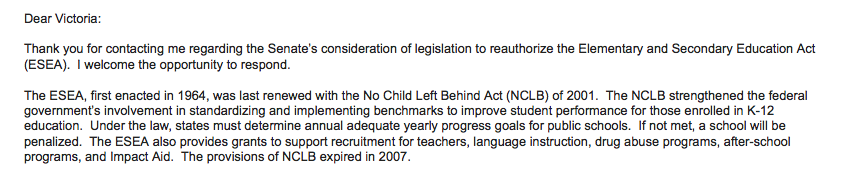
Here is an explanation directly from Senator Crapo of Idaho.
Screen Shot 2015-08-12 at 5.16.24 PMESEA was actually enacted in 1965 and its focus was on funding to children disadvantaged by poverty. The funds were to meet under-privileged children’s educational needs through improved teacher, counselor, and state leadership training, community support services, and increasing support for libraries and learning materials.
We stopped questioning authority?

The provisions ended in 2007? That’s confusing. It makes it sound as if NCLB ended; it did not! Congress just FAILED at that point to do their jobs and the detrimental effects of the law continued unchecked for eight more years.
Here’s how it once worked.
To implement the original ESEA required low-income communities to identify the needs of impoverished children and develop plans to address those needs. This is because the Do I Understand ESEA? - The Crucial VoiceThe Crucial Voice:

CURMUDGUCATION: Go Home, CAP

CURMUDGUCATION: Go Home, CAP:

Go Home, CAP


On the heels of a recent tweet in which the Center for American Progress tried to pretend that politics had nothing to do with Common Core (at least, not until big meanies dragged politics in), CAP is now here to assert that CCSS math standards are both necessary and research based.

"How the Common Core Will Help the United States Bring Up Its Grade on Mathematics Education"comes perilously close to being the sort of thing certain bloggers might write if they wanted to make fun of folks like CAP. This is like a small museum of bad and discredited arguments for the CCSS.

First, it's "OMGZ!! Our test scorers are worserer than everybody elses!!"

American high school students also perform far below the international average in math. Currently, they rank 27th in mathematics, while Korean and Japanese students lead the world. Between 2003 and 2012, the average math score in the United States actually decreased 2 points, while Korea’s shot up 12 points. 

Education historian Diane Ravitch has addressed this point roughly a gazillion times. 


In 1964, when the first international test was offered in two grades to twelve nations, we came in last and next to last in the two grades but went on to have a stronger economy in the next half 
CURMUDGUCATION: Go Home, CAP:


Education, Inc. Premiere

Brian Malone has written and directed a new documentary that belongs with your collection of films that make the current assault on public education clear and vivid. And the film's official release is tomorrow.

Education Inc is in the fine tradition of Food, Inc. It provides both a specific and important story and a clear and comprehensible overview of the larger forces shaping the small battles in education. The small picture is of events in Colorado, where Jefferson and Douglass counties find their school boards being bought up by outsider interests and their schools hammered by the folks who want to see public education run by private corporations.

The larger picture shows how this local battle is just one manifestation of forces that are dismantling public education across the entire country. Here's the trailer:


Tomorrow is the official launch of the film, though copies have been available for a while now. Many "official" screenings are scheduled across the country (you can find a partial listing here), but you can also go ahead and buy a copy ($15 plus s/h), then screen the film in the comfort of your own home.

This is one more opportunity to bring clarity and real information to the education debates. Check out Malone's film-- if not tomorrow, then as soon as you're able.

Education, Inc. Premiere

Opt-Out Movement Grows as parents fight back against unfair Common Core tests - Wait What?

Opt-Out Movement Grows as parents fight back against unfair Common Core tests - Wait What?:

Opt-Out Movement Grows as parents fight back against unfair Common Core tests


New York’s Common Core testing madness is one year ahead of Connecticut’s, which means parents know more and are taking action to protect their children.
Last summer, the majority of parents in New York State were told their children were failures as a result of that state’s version of the unfair, inappropriate and discriminatory Common Core testing scheme.
As a result, parents were prepared for this year’s testing scam and record numbers of public schools students were opted out of the opted-out of the testing fiasco.
Yesterday, the New York State Education Department (NYSED) finally released their test results, admitting that nearly a quarter of a million New York students did not take the test as a result of parental action.
The New York State Allies for Public Education (NYSAPE), an anti-common core testing advocacy group which is made up of more than 50 parent and educator groups across New York released a major statement calling on parents to step up the opt out movement by handing in their test refusal letters on the first day of school.
The NYSAPE statement;
Opt Out to Sharply Rise as NYS Continues to Sacrifice Children With Flawed Tests & Policies
Yesterday, released the results of the 2015 3-8th grade English Language Arts (ELA) & Math exams. ELA scores were essentially flat, and the small increase in Math scores (less than 2 percentage points) was smaller than last year’s modest jump. There was also an increase in the percentage of Level 1 students in ELA, and an unchanged percentage of Level 1 students in Math, suggesting that the ratcheting up of high-stakes is leaving our most struggling students behind.
Test refusals, also known as opt outs, rose to a record number of 222,500, surpassing advocates’ estimates. More New York parents across the state are informed and have said no to the high-stakes testing regime that is disrupting quality education and harming their children. With no relief in sight, opt out figures are expected to grow significantly again this year until damaging education laws and policies are reversed.
Jeanette Deutermann, Nassau County public school parent and founder of Long Island Opt Out said, “How many more children will we sacrifice to a narrow education, excessive testing, and failure, before New York calls a timeout? How many veteran, master teachers will we watch flee the profession before we untie testing from evaluations? How many schools will close before New York State recognizes that public schools are the foundations of every community? Instead of dreaming up sanctions, SED should be working with educators and parents to change course and right this wrong.”
“Governor Cuomo, the Regents and SED have been quick to judge teachers through a sham accountability system that wrongfully reduces highly 
Opt-Out Movement Grows as parents fight back against unfair Common Core tests - Wait What?:

Update on state tests, opt outs, meeting with Commissioner and last chance to sign our petition! NYC Public School Parents:

NYC Public School Parents: Update on state tests, opt outs, meeting with Commissioner and last chance to sign our petition!:

NYC Public School Parents: Update on state tests, opt outs, meeting with Commissioner and last chance to sign our petition!


The state test scores were released yesterday and they were nothing to brag about.  As before, the vast majority of students scored at Level 1 or 2, and there was only a very small uptick in those scoring Level 3 or 4 (supposedly proficient.)  The big story was the number of opt outs, which statewide reached 20%, meaning  there were about 225,000 students who refused to take the tests.   In NYC, the percent of opt outs were far fewer – between 1.4-1.8%, but even there the number tripled compared to the year before.  
  

There are real questions as to whether the results have any validity, given the large number of opt outs and the flawed nature of these exams.  If those students who opted out were included, there might have been no improvement at all in the overall proficiency rate, as the state admitted that the opt-outs were more likely to have scored Level 1 or 2 in 2014.   In any case, the percent of Level 1 students in ELA increased and stayed the same in math, giving little support to the claim that our high-stakes testing regime is helping our neediest students succeed.     

Even if the numbers and scoring methodology were reliable, which is doubtful, we know these exams are designed to confuse students.  See my blog about a passage on the 3rdgrade exam involving a talking snake, with questions that even the author of the story could not answer.  Also, you can check out Carol Burris’ analysis showing that the achievement gap between racial and ethnic groups increased, theNYSED website for the test score and opt out data by district and school, and NY Times maps of the amazing opt out numbers across the state.


Also, on August 4, we met with the new State Education Commissioner MaryEllen Elia, along with other members of the steering committee ofNYS Allies for Education.  Though most of the discussion revolved around the defective state exams and Common Core standards and their damaging impact on our schools, I briefed her on three areas in which the state has failed to comply with the law:  Ensuring that charter schools enroll and retain equal numbers of high-needs students, as required by the 2010 amendments to the charter law;  that student data is protected, according to the 2014 student privacy law; and that NYC is lowering class size according to the 2007 Contracts for Excellence law. The Commissioner seemed interested and took notes; only time will tell if she improves the poor record of our previous Commissioner in fulfilling the state’s legal obligations to our children.

Speaking of class size, please sign our petition, also posted to the right, urging the NYC Chancellor to comply with  the C4E law and reduce class size.  The legal deadline for submitting our comments is Saturday, August 15, which is the day after tomorrow – so this is your last chance!NYC Public School Parents: Update on state tests, opt outs, meeting with Commissioner and last chance to sign our petition!:


Thompson: Why Teachers (& Bees) Are Disappearing - This Week In Education:

This Week In Education: Thompson: Why Teachers (& Bees) Are Disappearing:

Thompson: Why Teachers (& Bees) Are Disappearing


The explanation of why bees are disappearing is complex. The question why teachers are leaving the profession is not. 
Teaching is a tough job, especially in the inner city. But, especially in high-challenge classrooms, it would be hard to find a more wonderful career. If teaching in urban schools is the calling for you, only a fiasco as bad as the contemporary school reform movement could drive the joy out the job.
The latest discussion about the disappearance of teachers was prompted by the New York Times Motoko Rich. Rich, in Teacher Shortages Spur a Nationwide Hiring Scramble (Credentials Optional), explains that California has to fill 21,500 teaching slots, and the state is issuing fewer than 15,000 new teaching credentials a year. She also reported on efforts in Charlotte-Mecklenburg, Louisville, Ky.; Nashville; Oklahoma City; and Providence, R.I. to staff their classrooms. NPR's Diane Rehm adds that enrollment in teacher preparation programs across the U.S. fell by around 30% between 2010 and 2014.
I can't imagine what teachers in Charlotte-Mecklenburg feel when recalling their district's past integration efforts, and the loss of the opportunity to be on the cutting edge of a real civil rights movement - where school desegregation promised kids and adults such rewarding and life-changing opportunities. Seeing their system move from a pioneer in social justice to being a showcase for "reform" must have been devastating.
But, I can comment on Oklahoma City where recruiters have traveled to Puerto Rico and Spain to fill classrooms. When I entered the inner city neighborhood school classroom in 1993, my John Marshall High School had more great teachers than I could have imagined. I had never encountered such teaching excellence. The faculty had stuck out the violence of 1970's bussing and the 1980's crack and gangs epidemic. But, soon, the reform mantra would be that these awesome educators' "low expectations" and their "excuses" were to blame for the low performance of high-challenge students.  So, teachers were told to all "get on the same page" in teaching the same tested material at the same rate, or get out of the inner city.  
Our school went through bouts of dysfunction when violence and disruptive behavior spun out of control, and we had funerals for far too many students, but we also produced an astounding amount of academic, artistic, musical, and athletic excellence.  It was test-driven, competition-driven reform, not the failures of our school's educators and students, that eventually transformed us into the lowest-performing high school in the state.   
It was not just NCLB and Arne Duncan's accountability-driven reforms that sucked the oxygen out of our school improvement efforts and drove out our best teachers. Top-down reform robbed us of our professional autonomy. Eventually, those of us who stood and fought for our kids' right to engaging instruction found ourselves losing battle after battle and most tearfully left for easier schools where they had more freedom to teach in a holistic manner. 


As these national stories bring the exodus of teachers into the political consciousness of nonThis Week In Education: Thompson: Why Teachers (& Bees) Are Disappearing:-

Arne Duncan Stressed About Preparing For Standardized Secretary Of Education Exam - The Onion

Arne Duncan Stressed About Preparing For Standardized Secretary Of Education Exam - The Onion - America's Finest News Source:

Arne Duncan Stressed About Preparing For Standardized Secretary Of Education Exam


WASHINGTON—Saying the long nights of cramming from the study guide and the constant drilling from flashcards had really worn on his nerves, Arne Duncan told reporters Tuesday that preparing for the upcoming standardized Secretary of Education Test was completely stressing him out. “I know I’ve got the stuff on FSA loans down, but it’s super unrealistic for them to think I’ll memorize every little thing about federal lunch voucher requirements—what if I’m wrong, though?” Duncan said of the yearly four-hour exam, adding that he wasn’t a very good test-taker to begin with and that even thinking about how he would get through the essay portion in just 50 minutes was making him anxious. “Half the multiple-choice questions on the SETs are on things like the Office of Migrant Education that hardly ever come up in everyday life, and the other half seem like they’re designed to trick you. Ugh, why can’t this be over?” Duncan went on to say that he’d probably do far better on the test if he could afford a high-priced tutor like former Education Secretary Margaret Spellings.Arne Duncan Stressed About Preparing For Standardized Secretary Of Education Exam - The Onion - America's Finest News Source:

The complicated politics of national standards: The many sources of opposition (part 1 of 3) | Brookings Institution

The complicated politics of national standards: The many sources of opposition (part 1 of 3) | Brookings Institution:

The complicated politics of national standards: The many sources of opposition (part 1 of 3)


Advocates of the Common Core State Standards say that high, uniform academic standards are essential to improving American students’ academic performance—to prepare them better for college or career and to enhance our nation’s ability to compete in the global marketplace. However, surveys of teachers and the general public reveal growing opposition to the Common Core as it entered its first year of full implementation nationwide in 2014-15. These same surveys also show that most people do not know much about the Common Core, and that much of what they think they know is incorrect.
Opposition to the Core does not stem from a single source and is not confined to members of one political party. People dislike the Common Core for different reasons. In this post, I will identify various sources of opposition to the Common Core as well as assess (and in some instances dispel) the stated reasons for opposition. It is also important to understand the unusual political alliances that have emerged in opposition to the Common Core implementation, and how they may play out longer term. In a future post, I will analyze their likely effects on the future of the Common Core.

Federal (and presidential) overreach

Some, particularly Tea Party adherents and others on the right, view the Common Core as a dangerous—even unconstitutional—expansion of federal control into education and a violation of states’ rights. The word “education” does not appear in the U.S. Constitution, and our country has a strong tradition of local control of schools. Beginning with the passage of No Child Left Behind (NCLB) in 2002, the federal role in education has grown tremendously and, like the law itself, has become more controversial. Yet the Common Core originated as a state venture. It was and continues to be led by the National Governors Association and the Council of Chief State School Officers — not the federal government. But the Obama administration’s use of the Race to the Top grant competition and NCLB waiver application process to encourage states to adopt the standards, and its funding of the two consortia that developed the Common Core-aligned assessments, have fed concerns that Uncle Sam is becoming the national schoolmarm. This involvement, along with the Obama administration’s vocal support for the Core, has made it easy for opponents to cast it as a federal initiative. It is an erroneous claim taken as fact by many who oppose the Common Core. The 2014 PDK/Gallup Poll of the Public’s Attitudes Toward the Public Schools revealed that 40 percent of those who opposed the Common Core said it was “very important” to their opinion that “the federal government initiated the Common Core State Standards.” An additional 22 percent who opposed the Core said the federal genesis was “somewhat important.”
As a result, the Common Core has become a powerful and threatening symbol of big government to conservatives. Dislike of a Democratic president and the Affordable Care Act (“Obamacare”) has been transferred to the Common Core and tagged by some with the moniker “Obamacore.” Once championed by conservatives, national standards have come to be identified as “liberal” and linked to President Obama. Some Republicans contemplating a 2016 presidential bid—including Louisiana Gov. Bobby Jindal and New Jersey Gov. Chris Christie, both former Core supporters—are highlighting their opposition to the Common Core to appeal to conservative voters who dominate GOP primaries.

Data privacy

The Common Core had the misfortune of emerging around the time of revelations about the National Security Agency’s invasive data collection. The centralized collection of student information and test scores at the heart of the Common Core thus collided with heightened fears of data mining. For example, a 2014 survey by Education Next found that 85 percent of Americans who have heard of the Common Core erroneously believe the federal government will receive detailed data on individual students’ test performance. While the federal government has funded the development of longitudinal state databases of student performance, it will not have access to any individual student information.

Backlash to corporate concerns


The business community has been one of the most vocal supporters of the Common Core, arguing that higher academic standards are imperative to ensuring that the American economy has the high-quality workforce necessary to compete in the global marketplace. The Business Roundtable and the U.S. Chamber of Commerce, and major corporations such as The complicated politics of national standards: The many sources of opposition (part 1 of 3) | Brookings Institution:

From New Orleans: Washing Machine-Style Education Reform | The Progressive

From New Orleans: Washing Machine-Style Education Reform | The Progressive:

From New Orleans: Washing Machine-Style Education Reform


As a New Orleans parent and an active member of my community, I think of myself as an expert on the experiment in education reform that tranformed my city into the nation's first all-charter school district. So when I attended a recent community-centered conference on “The New Orleans Model of Urban School Reform: A Guide or a Warning for Cities Across the Nation?” I wasn’t sure there’d be much for me to learn.
In fact, given the focus on academic urban education research, I feared the event would speak only to people who have Ph.D.s or are working on getting one, neither of which describes me.
But the research on what has happened to New Orleans over the last ten years shocked me. The story of what happened here is important not just to those of us who live here, but to people who live in any of the cities where New Orleans-style education reform is headed next, possibly including yours.
Parent activist Anthony Parker described what he called “washing machine” approach to education reform: “Wash, rinse, repeat. Wash, rinse, repeat.” He was talking about what happens to children. Children wait at bus stops as early as 4:30 in the morning and don't get home until 7:30 or 8:00 at night. Then it’s time to do homework, go to sleep, get back up and repeat the cycle all over again. Children are badly sleep deprived. Despite the long school days, children often get no time for social development because of the strict and rigorous atmosphere of the charter schools here. Nor are they learning from a curriculum that feels relevant, respectful, and accessible to a child of color growing up in this community. This is a painful and unnecessary waste of most of these children's time.
Parker, whose grandparents taught in the New Orleans Public Schools for a combined sixty years, described how hard it was to explain to his son why he can’t attend their neighborhood school after his charter school was closed. For Parker’s own son, who is just seven years old, “washing machine” reform means he’ll be attending his fourth school this fall. “Wash, rinse, repeat.”
The lives of adults have been disrupted, too. Charmaine Neville talked about her relationship to the schools in the New Orleans neighborhood of Bywater. Before the storm, she was deeply involved in schools across the city, volunteering, tutoring, and giving lessons of all kinds. She described her heartbreak when she tried to help children with special needs who attend the
- See more at: http://www.progressive.org/news/2015/08/188260/new-orleans-washing-machine-style-education-reform#sthash.yTCQJM1C.dpuf

Experts: Keep 'Grit' Away From Teacher Evaluations - NEA Today

Experts: Keep 'Grit' Away From Teacher Evaluations - NEA Today:

Experts: Keep ‘Grit’ Away From Teacher Evaluations


The latest sign that “grit” has graduated from mere buzzword to the big time emerged a few weeks ago when the National Assessment of Educational Progress (NAEP) announced that it will soon be collecting data on student perseverance and desire to learn. Every two years, NAEP measures the academic progress of 4th and 8th graders and compiles the results in the so-called “Nation’s Report Card.” Beginning in 2017, students will be asked to evaluate their level of grit as part of the assessment’s background survey.
The purpose is to help determine how non-cognitive factors like grit (shorthand for resilience, motivation, resourcefulness, etc.) contribute to student achievement. It’s a question that has fascinated a growing number of experts and education leaders in recent years. While some see it as an intriguing but marginally important discussion, others believe that studying grit is a key to improving academic performance.
So it’s hardly a surprise that some have latched onto the idea that if resilience and stamina can be taught in schools, then it can also be linked to testing. Therefore, it only follows that districts start evaluating teachers based on their students’ motivation and other non-academic skills.
But the scholar most often credited with popularizing grit in schools is now urging a little restraint. Angela Lee Duckworth of the University of Pennsylvania believes that it is too early to use measures of non-cognitive skills to evaluate teacher performance.
“Given the intense visibility and enthusiasm around growth mindset, grit, and other personal skills, it is important for school leaders and policymakers to realize that while there is great benefit to studying and assessing these attributes, the measures should not, currently, be used for broader accountability purposes,” said Duckworth.
In other words, everyone please take a step back.
Duckworth and David Scott Yeager of the University of Texas recently released a paper that explains how self-reporting on non-cognitive qualities can produce unreliable data, if used improperly.
“There really is no perfect measure for any aspect of personal skills,” Duckworth adds. “What we have are measures that have their distinct advantages and limitations.”
Much of Duckworth’s research relies on self-reporting. At the University of Pennsylvania, she devised a “Grit Scale,” consisting of statements such as “I am a hard worker” and “Setbacks don’t discourage me.” Duckworth and her colleagues used the scale in various educational environments (focused on military academy students and spelling bee finalists, for example) and found grit level to be a fairly reliable predictor of achievement.
Unfortunately, as she is now finding out, her research is in danger of being appropriated by policymakers who have bad ideas but no grasp of nuance.
“I’m hearing about school district superintendents getting very interested in things like character and grit, and wanting to evaluate teachers based on them,” Duckworth recently told National Public Radio. “I feel like the enthusiasm is getting ahead of the science.”
But critics say that the grit discussion is troublesome on a much broader scale. Some experts believe, for example, that a focus on building student resilience and tenacity provides another excuse for education leaders to ignore more fundamental Experts: Keep 'Grit' Away From Teacher Evaluations - NEA Today:

LAUSD board president Steve Zimmer talks about getting back to basics | Education | Jewish Journal

LAUSD board president Steve Zimmer talks about getting back to basics | Education | Jewish Journal:

LAUSD board president Steve Zimmer talks about getting back to basics


<em>Steve Zimmer. Photo by Carla Acevedo-Blumenkrantz</em>


Steve Zimmer was first elected to the Los Angeles Unified School District (LAUSD) board in 2009 after coming to town as a Teach for America trainee and then teaching for 17 years. Now he helps guide the nation’s second-largest public school system, serving nearly 700,000 students as the newly elected board president and representative for District 4, which encompasses a vast and varied swath of the city that includes Tarzana, Encino and other portions of the San Fernando Valley, as well as Venice, Mar Vista and Hollywood.
The 45-year-old Hollywood resident and New York native, who davens at Temple Beth Am on La Cienega Boulevard and spends the High Holy Days at B’nai David-Judea Congregation in Pico-Robertson, recently took time in his 24th-floor downtown office to talk about the recent school board election, the new technology plan and what it’s going to take to bring families back to LAUSD. Here is an edited version of that conversation.
Jewish Journal: Do you miss the classroom? 
STEVE ZIMMER: Every day. That’s why I was just out. Stephen Wise Temple does some of our Freedom Schools, a program with the Children’s Defense Fund. We were able to connect them with some very high-poverty schools in the Valley. I was just there this morning. So I do try to be in a classroom or school or around kids or families in some way every day, because this building can be very far removed from the children and families we impact. I think of myself as a teacher, a counselor, on special assignment.
JJ: You represent a huge area of Los Angeles. How did this come to be?
SZ: The district was created through obscene political gerrymandering. No more obscene than any other district; mine just happens to be a piece of bizarre art.
JJ: And how do you represent these various areas fairly?
SZ: You have to be balanced. I represent all. But there is no question in my mind who needs the school district more. Equity questions are not personally difficult for me. I’m not interested in fairness, so to speak, because this system has not been fair to poor children at all. But … there is a challenge to balance how much time and effort we spend addressing the needs of families living in severe poverty every day.
JJAre there particular issues unique to your San Fernando Valley constituents and schools? 
SZ: I think that there are. Diversity in the Valley, especially in the portion of the Valley that I serve, is one of the most unique opportunities in this generation to embrace authentically diverse schools. Woodland Hills in particular is a community that has a vast diversity — I think of Taft High School. I have two high schools that are literally the United Nations: Fairfax and Taft.
In the West Valley, we have the advantage of a certain level of stability, a baseline of stability both in our schools and in our economy and housing. That is not true in other areas of Los Angeles. Because we have a stability baseline, we can take public education and authentically diverse public education to a whole new level, really a kaleidoscope celebration of different cultures.
JJ: In recent years, LAUSD’s enrollment numbers have consistently been going down. What can be done to reverse this trend? 
SZ: Unless families believe that their neighborhood LAUSD school is going to be the conduit through which their family can achieve the American dream, they aren’t going to choose LAUSD. We have to offer instructional pathways that have the quality and the attraction value that will lead families to choose us. So: magnet programs for across the district, instructional designs that are specialized that are very attractive, dual-immersion programs, STEM [science, technology, engineering and math] programs. …
I believe in choice, but I am very, very wary. I am very cognizant of the damage that competition has done to our schools. And we became obsessed with data instead of being data-informed. When a system becomes so obsessed with competition that they view children through their potential to score versus their overall humanity, the dehumanization of that public school system is not something that is attractive to parents, is not something that is warm and inviting. And our public schools, to my great regret, have become test score-obsessed. A lot of charter schools have, too.
JJ: How do we change that? 
SZ: It’s about balance, about returning us to the purpose and objective of public education as it relates to families — to meet and fulfill the American dream. That is not a test-driven process. So I believe we reverse that by returning to our roots.
JJ: Is that view shared by your colleagues on the board?
SZ: Right now, we share an understanding that the cost of cutthroat competition in the public education system is greater than the real gains for some children.
JJ: You’re a big proponent of universal preschool. But Superintendent Ramon C. Cortines wants to get rid of the district’s half-day preschools and instead offer full-day preschool, significantly reducing the overall number of preschool spots.
SZ: Vexing question. Very deep. We’re going to do everything we can to use money the state has allocated to replace seats that this plan adjusts. There is actually a gain in hours but a loss in seats. Children coming to our kindergarten classes where there are severe school readiness gaps, these equity needs are going to be addressed. The problem is, from a facilities perspective and literally a numbers perspective, if we are going to address the equity issue, there is going to be some temporary seat loss, especially in communities where people can afford private options.
JJ: The recent school board election felt very much like a vote that was  either pro- or anti-charter school. Is that how it feels on the board?
SZ: I think there is a difference between support for existing charter schools that parents have chosen [and new charter schools]. I respect and support those choices as long as the charter is doing very well, and I mean very well.
JJ: Why a different bar for charter schools?
SZ: Because that’s why charters are supposed to exist: either to provide something better, or unique and innovative. Otherwise there’s no compelling reason to authorize them.
JJ: Do you think there’s any chance to roll back the charter trend? 
SZ: We have the most charters of any school district in the nation. We have incredibly high levels of saturation. If choice is so important, the California Charter Schools Association agenda and the Walton Family Foundation and other foundations’ agendas to situate more and more charter schools within the LAUSD boundary is not about children. It’s not about choice. It’s not about innovation. It’s about a very different agenda of bringing down the school district, an agenda to dramatically change what is public education. It’s about altering the influence of public sector unions. I just happen to disagree with that agenda. But folks should be explicit about what their agenda is. 
I’m actually very proud we have some of the highest-performing LAUSD board president Steve Zimmer talks about getting back to basics | Education | Jewish Journal:


Poor teachers: Who is to blame? | My Island View

Poor teachers: Who is to blame? | My Island View:

Poor teachers: Who is to blame?


I posed an #Edchat Topic recently based on a number of studies I have been reading about that are claiming millions of dollars are being spent, or wasted, on professional development, while very few teachers are benefitting from it. Again the age-old story of doing things the same old way but expecting different results defeats us as a profession. The method of doing professional development for educators has largely not changed over the decades. It may be time to re-examine a few things.

Pedagogy vs. Andragogy
I have addressed this in several earlier posts, but it needs to be re-stated until people finally begin to understand that there are differences in how adults effectively learn, andragogy, compared to the motivations in learning by children, which is pedagogy. Pedagogy is what most educators are familiar with because it was taught to them to enable them to teach kids. It is how kids learn best. The natural thing for an educator to do when he or she is teaching a professional development course however is to go with what he or she knows. The result is that professional development is taught to adults as if they were children learners. How effective is that result going to be?

Collaboration vs. Lecture
Key factors in adult learning, or the intrinsic motivations for adults to learn are ownership of the learning to meet personal needs and being able to use tomorrow what’s learned today. As a whole adults are better with collaborative learning since it gives them control to direct the learning to what they need to know. It also exposes them to things they may not be aware of through the experiences of Poor teachers: Who is to blame? | My Island View:

Supreme Court holds state in contempt over school funding | Breaking News | KOMO News

Supreme Court holds state in contempt over school funding | Local & Regional | Seattle News, Weather, Sports, Breaking News | KOMO News:

Supreme Court holds state in contempt over school funding


SEATTLE (AP) - The Washington Supreme Court is holding the Legislature in contempt for its lack of progress on fixing the way the state pays for public education, but it is holding off on punishments until after the 2015 legislative session, according to an order issued Thursday.

If lawmakers do not complete their plan for fixing the way the state pays for public schools by the end of that legislative session, the court promised to reconvene and impose sanctions and other remedial measures.

Possible sanctions include fines for the Legislature or individual lawmakers, or having the court rewrite the state budget.

In a statement signed by Chief Justice Barbara Madsen, the court said the justices were not impressed by the state's presentation at a hearing in Olympia, explaining the Legislature's lack of progress toward paying all the costs of basic education.

"The court has no doubt that it already has the Legislature's 'attention,'" she wrote, echoing comments from the state's lawyer from last week's hearing. "But that is not the purpose of a contempt order. Rather, contempt is the means by which a court enforces compliance with its lawful orders when they are not followed."

The Supreme Court ruled in January 2012 in what is known as the McCleary decision that Washington's system of education funding is unconstitutional. They gave the Legislature until the 2017-18 school year to fix the problem.

A coalition of teachers, parents, students and community groups sued the state. The Washington Education Association paid most of the cost of the lawsuit.

The coalition's attorney, Thomas Ahearne, said Thursday's order was as good as he could hope for since the 2014-15 school year already has begun and a special legislative session probably wouldn't help kids this year.

"It wipes out all the excuses that legislators tell themselves why they don't have to do anything," Ahearne said.

The order says that if the Legislature does not finish its work, the court and attorneys will talk after the session about what kind of punishment to impose. Sanctions suggested by Ahearne and the Supreme Court holds state in contempt over school funding | Local & Regional | Seattle News, Weather, Sports, Breaking News | KOMO News:

Got Art? How Much Art Do Students Get in School?

Got Art? How Much Art Do Students Get in School?:

Got Art? How Much Art Do Students Get in School?


Vivid playful strokes and paintbrushes
I found I could say things with color and shapes that I couldn’t say any other way – things I had no words for.
Georgia O’Keeffe
The new school year is starting and I’d like to hear how much art students get? Do children in preschool do art? Kindergartners—how much art will they find between Response to Intervention and reading rigor? Is art scheduled once a day? Once a week? Rarely? How much art do elementary students receive—really?
Does your child’s school have a room dedicated to the arts and a fully qualified art teacher? How much access have teachers to art equipment and resources? Does the art room have a kiln? A potter’s wheel?
It’s nice to have local art museums send artisans to schools to show their craft, or discuss with children the beauty of the arts. But they should not be seen as qualified art teachers in public school.
Also, blended art is not really enough art. Some art involved with other subjects is fine, of course. But it makes the arts an afterthought. The arts should also stand alone as a Got Art? How Much Art Do Students Get in School?:

WNYT.com - Common Core protesters hit goal of 200,000 test refusals

WNYT.com - Common Core protesters hit goal of 200,000 test refusals:
Common Core protesters hit goal of 200,000 test refusals


ALBANY – Parents and teachers fighting the Common Core hit their goal to get 200,000 students across the state to opt out of this year’s controversial exams.
The state released the official numbers Wednesday along with test results.
While opt out numbers skyrocketed across the state, test scores didn't look a whole lot different compared to the last two years and parents are feeling frustrated.
“I was surprised. I was hoping they had done a lot better,” said Andy O’Toole, whose kids are in grades six and eight.
Statewide results show slight improvements in English with 31.3 percent of students grades three through eight scoring proficient, compared to 30.6 percent in 2014 and 31.1 percent in 2013.
Students made bigger leaps in math with 38.1 percent of students grades three through eight scoring proficient, compared to 36.2 percent in 2014 and 31.1 percent in 2013.
“It is frustrating because I’ve seen that the teachers are very dedicated, I see the students trying very hard on the tests and yet they don’t seem to do well,” said O’Toole.
But, new state education commissioner MaryEllen Elia is remaining optimistic.
“Certainly the transition to new learning standards is not easy and success isn’t instantaneous,” she said in a conference call with reporters after the scores were released.
“I would like to see gains faster, but again it wasn’t beyond my expectations at this point,” said Albany Superintendent Marguerite Vanden Wyngaard.
The Albany School District is lagging behind the state. Only 14 percent of students scored proficient in math, up from 12 percent last year. Fifteen percent scored proficient in English Language Arts, compared to 14 percent a year ago.
“I’m optimistic they went up, but they are still much lower then I’d like to see them, less than half of the state which is disappointing for Albany,” said Mary Beth Farr, a mother in the district.
The ‘opt out’ movement gained steam this year with 20 percent of eligible students sitting out across the state. That's four times more than last year.
Wyngaard is echoing the commissioner's call to stop the movement next year.
“You can’t hold yourself accountable to a standard without measuring results,” she said.