Latest News and Comment from Education

Monday, May 18, 2015

Chair of the Education Committee of the Milwaukee Branch of the NAACP Statement on the Attack Public Education in Milwaukee | Larry Miller's Blog: Educate All Students!

Chair of the Education Committee of the Milwaukee Branch of the NAACP Statement on the Attack Public Education in Milwaukee | Larry Miller's Blog: Educate All Students!:

Chair of the Education Committee of the Milwaukee Branch of the NAACP Statement on the Attack Public Education in Milwaukee


Attack on public education
May 18, 2015 by Jamaal Smith
Jamaal E. Smith, a community activist and chair of the education committee at the Milwaukee branch of the NAACP, questions the motives of Gov. Scott Walker and others seeking to undermine Milwaukee Public Schools.
“Education is not a way to escape poverty – It is a way of fighting it!” said Julius Nyerere, former president of the United Republic of Tanzania.
Given the current economic position of the City of Milwaukee (being the second poorest city in the United States), you would think Nyerere’s statement would carry a hefty amount of weight in the city’s revitalization. However, surveying the educational landscape statewide, this just doesn’t seem to be the case. There is an intentional attack on public education taking place in the state legislature that is completely sickening.
It’s bad enough that Gov. Scott Walker, in his state budget, decided it would be a great idea to cut $127 million in funding for K-12 public schools along with $300 million for the University of Wisconsin system. Now we see two Republican legislators — Sen. Alberta Darling and Rep. Dale Kooyenga — presenting a new piece of legislation entitled the “Opportunity Schools and Partnership Program,” which would, in essence, place the MPS schools labeled as “failing” in the hands of public charter or private voucher schools with “better records of success.”
Additionally, Milwaukee County Executive Chris Abele will name a “commissioner” who will have parallel authority to the democratically elected MPS School Board but would be free from rules, save for laws regarding health, non-discrimination and special education services, according to the proposal. Tell me again what experience Chris Abele has in education? I must have missed that part during his campaign. What about Darling?? Kooyenga?? But they do know business very well, and that is where the problem lies.
The more legislation of this type that is created and presented, the more I can see why the state of Wisconsin was voted “the worst state to raise African-American children.” This type of action simply glorifies privatization and capitalism. Keeping a specific group uneducated in order to establish a system that amasses wealth for others at that group’s expense sounds eerily familiar to me. Privatizing education spells doom for democracy and further pushes the initiatives of plutocracy, thus contributing to the problem of the “haves vs. have nots”.
Coincidentally, Walker stated that education is his top legislative priority. I would assume so, since education in Wisconsin has been turned into a “get rich quick” scheme. The Republican agenda has drained MPS of its funding and resources for years, but then Republican politicians expect the parents and supporters of MPS to believe they have MPS’s best interest at heart? If that were the case, Republican legislators would consider the poor socioeconomic conditions over 80 percent of the students live in and begin creating programs that fit the needs of both the students and the parents. But that would represent a level of socialistic proclivity that we all know they would never be able to support.
This same type of proposal has been a proven failure across the nation, most notably in New Orleans, where the “Recovery District” created to help restore failing public schools resulted in permanent school closures and students being forced to attend the overcrowded schools that remain. Why would that be the path to follow here in Wisconsin??
In addition, there is an expectation that teachers — who have been attacked and vilified under this same agenda, yet are only required to have a bachelor’s degree and work experience to receive a teacher’s license — will properly educate nearly 40 students per class with limited resources and little to no support. And let us not forget the perils and misconceptions of culturally biased standardized testing that takes away more time for teachers to educate our children.
You would have to be a master of the art of naivetƩ to not understand the difficulties these proposals present to educators, students and parents.
Bob Petersen, president of the Milwaukee Teachers’ Education Association, in learning about the new proposal from Darling and Kooyenga, stated that “for two white suburban legislators to propose that the white county executive appoint a ‘commissioner’ who will have parallel authority to the school board is a racist attack on the democratic rights of the citizens of Milwaukee, the majority of whom are black and brown,” and he was spot on! Frederick Douglass said, “Once you learn how to read, you will forever be free,” yet this deplorable attack on public education seems to be consistent with oppression and subjugation.
To add insult to injury, Walker’s budget eliminates public oversight and makes Wisconsin the only state without student protections at for-profit colleges. Ironically, what demographic is most represented in these predatory colleges? Low-income African-American students. This is nothing but an expedited infusion of black and brown youth into the school-to-prison pipeline.
Test scores used as a “key indicator” of whether more prison cells should be created, overcrowding of classrooms, an influx of inexperienced teachers in high-risk schools, cuts of programs such as home economics, art and music that contribute to the creativity of our children — I find none of this to be merely circumstantial. The reports of the failing schools and subsequent legislation have been used as the red herring to mask the chicaneries within the true purpose: Our children are the cash crop of the plutocratic corporation we call the state of Wisconsin!
You can view this statement at Milwaukee Neighborhood News Service at:
http://milwaukeenns.org/2015/05/18/attack-on-public-education/

Seattle Educators Set To Strike For The School Our Children Deserve: Video Jesse Hagopian I AM AN EDUCATOR

Seattle Educators Set To Strike For The School Our Children Deserve: Video interview with Jesse Hagopian on the rolling strike wave in Washington State | I AM AN EDUCATOR:

Seattle Educators Set To Strike For The School Our Children Deserve: Video interview with Jesse Hagopian on the rolling strike wave in Washington State

ft-teachers-washington


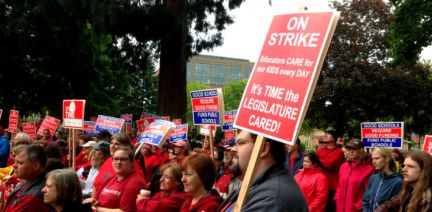
Educators are walking out of the public schools in Seattle on Tuesday, May 18th, joining a one day rolling strike wave of educators unions around the state, with a powerful message for the State Legislature: Fully fund education. These educators will be joined by many parents and students who are asking that the Washington State Legislature do what is not only right, but what is lawful.  The Washington State Supreme Court has ruled the that State Legislature is in violation of state law and has mandated that they add billions of extra dollars to fund education.

Moreover, Washington State voters have approved I-1351 which would reduce class size around the state, yet the legislature is preparing to ignore that law.  To make matters worse, theWashington State Legislature is getting ready to take an 11% raise, even while educators have had their voter approved cost of living adjustment revoked for the past six years, and now only offer educators a 1.8% increase.
RNNimage
DHARNA NOOR, PRODUCER, TRNN: Welcome to The Real News Network. I’m Dharna Noor joining you from Baltimore.Thousands of public school teachers went on strikes across nine Washington State school districts on Wednesday. These single-day strikes are part of a protest against the new state budget proposal. The teachers, who are members of a union called the Washington Education Association, are demanding smaller class sizes, better compensation, and less testing. Teachers of other districts are set to strike this Friday.Joining us from Seattle to discuss these strikes is Jesse Hagopian. Jesse teaches history and is also the black student union advisor at Garfield High School, where teachers just voted to join the strike. Jesse is an associate editor of the acclaimed magazine Rethinking Schools. He’s also a founding member of Social Equality Educators. He blogs at I’mAnEducator.com and is the editor of More than a Score: The New Uprising Against High-Stakes Testing.

Lily Eskelsen GarcĆ­a - Improving education is a cooperative process

Improving education is a cooperative process:

Caveat Emptor


I’ve talked a lot about testing, because the testing monster eats through everything in education these days: third graders don’t get to be fourth graders; seniors don’t get to graduate; teachers are labeled ineffective; schools are labeled failing to make adequate progress… all based on hitting a number on a standardized test.
But just as pernicious is another pillar of the corporate school model: privatization, the commercial concept of market “choice”. You know how this one goes. Our schools should be in the “business” of competing for their market share of “customers”. Economic theory (in theory) says competition forces services and products to improve at a more efficient price to attract more customers. So, say the corporate school reformers, “why shouldn’t it work in education?” Good schools will attract more kids and money will follow the kids. Bad schools will lose customers, lose money, and eventually go out of business. Standardized tests come into the picture here because just as companies are measured by market share, profitability and stock value, “in theory”, schools should be graded based on standardized test scores and their ability to compete for customersI mean students.
Those enthralled by the myth that competition in and of itself will magically improve education quality, while simultaneously reducing cost should be aware of another principle that is more accurate: caveat emptor.
Let the buyer beware.
16429635132_5903184560_k
Vouchers, franchise charters, and even public school choice have been around decades now. Competition has not produced the vast improvements that the mystical invisible hand of the market place promised. In his review of a voucher study purporting to show that competition leads to better public school outcomes, Professor Christopher Lubienski found that existing research provides “little reliable information about the competitive impact of vouchers.” Well, competition zealots may defend themselves saying there isn’t true competition here because we don’t have universal choice and public schools are protected from the fiscal impact of the limited choice we do have.
But Chile has universal vouchers, and a study of that system found “no evidence that choice improved average educational outcomes as measured by test scores, repetition rates, and years of schooling.”
As part of its analysis of the 2012 PISA results, the OECD looked at the impact of competition, and found that “within school systems, there is no performance difference between schools that compete with other schools for students and those that do not, after taking into account students’ socio-economic status.”
It’s bad enough that we upend a system for something that doesn’t deliver anything better, but the evidence now shows it actually makes things worse. The unintended consequences of turning public schools into businesses that fight for the “best” customers can harm students. In Chile, competition has produced a stratified and segregated educational system. In their study of education reform in New Zealand (-When Schools Compete), Professors Helen Ladd and Edward Fiske found that competition concentrated the best teachers in the schools that attracted the most advantaged students, and schools became increasingly segregated by class and ethnicity. The PISA study I previously mentioned affirmed that when affluent families opt out of the neighborhood school, competition increases socio-economic segregation. That’s not good for kids, and it’s even worse for social stability.
Closer to home, a recent study of competition in New Orleans found that when schools compete for students, those schools might work to improve instructional strategies, but they are just as likely to seek niche markets that attract high-achieving students (and simultaneously discourage enrollment of low-achieving students), or even to actively exclude students who might cost more to educate than their enrollment would generate, or who might reduce Improving education is a cooperative process:

Zimmer 'damns' Rodriguez and his supporters for attacks on Kayser - LA School Report

Zimmer 'damns' Rodriguez and his supporters for attacks on Kayser - LA School Report:

Zimmer 'damns' Rodriguez and his supporters for attacks on Kayser 


LA Unified board member Steve Zimmer


If Ref Rodriguezwins election tomorrow, he’s got no friend in Steve Zimmer.
Rodriguez is the challenger in the race for LA Unified school board District 5 against Bennett Kayser, easily themost heated of the three board elections. A loss by Kayser could shift the ideological balance of the seven member board from pro-union to pro-charter.
While Zimmer, a former teacher and teachers union advocate who represents board District 4, has been a reliable and long-time Kayser supporter, he recently railedagainst Rodriguez’s “reformer” agenda and campaign tactics, as well as his most powerful and generous supporter, the California Charter Schools Associationpolitical action committee.
“Damn them! Damn them!” Zimmer exclaimed during a fire-and-brimstone speech at a Kayser fundraiser last month, about 7 minutes of which is on YouTube.
The remarks came in response to a series of campaign attack ads against Kayser that Zimmer said portrays the incumbent as a racist slumlord whose Parkinson’s disease makes him unfit to serve a second term.
In an interview with LA school Report today, Zimmer doubled down on his scathing criticism of Rodriguez and CCSA.
“They have crossed new frontiers of depravity in this campaign,” Zimmer said. “This is the most amoral type of campaigning, using a type of lies and distortion, that lowered the entire moral climate of political discourse.”
In an email from his campaign, Rodriguez said,“I agree with Mr. Zimmer that there’s far too much polarization in the discussion around our schools, and I look forward to working closely with him on the serious challenges that face our schools, students, and teachers.”
Over six years on the board Zimmer has strived to take on the role of peacemaker/conciliator/mediator on a number of divisive issues — even under former Superintendent John Deasy who embraced charter schools, fought to tie teacher evaluations to test scores and put record numbers of teachers in “teacher jails.”
But, Zimmer says, those days are over.
“I come to them with olive branches, they respond with napalm,” he said in the interview referring to the interests that would align with Rodriguez.
CCSA has spent several million dollars in mailers, radio and television advertisements boosting Rodriguez’s qualifications and assaulting Kayser’s character. One mailer calls Kayser a “slumlord millionaire” who “forces tenants to live in filth.” The flyer provided no citation to support the accusation.
Another flyer featured a group of brown-skinned children below Spanish that translates to: “Bennett Kayser tried to stop Latino children from attending schools in white neighborhoods.” On the other side, it says, “He’s not for us.” An LA Times editorial following the release of the ad accused CCSA of engaging in “slimy tactics on behalf of children.”
And, a commercial equating Kayser to a 90s movie villain — Kayser Soze — ended with the shattering of a coffee cup. Kayser allies argue it is a thinly veiled allusion to his Parkinson’s disease.
“Where is the middle ground when people are trying to destroy a human being?” Zimmer asked.
Although most of the anti-Kayser campaigning has been paid for by CCSA and, therefore, is technically not part of the official campaign, Zimmer says Rodriguez, as a charter school founder, bears ultimate responsibility for the tone of his campaign.
Like Kayser, Zimmer was in a contentious re-election race just two years ago and his opponent, Kate Anderson, was heavily financed by CCSA and other reformers with deep pockets, including Michael Bloomberg, who contributed $1 million to Anderson and candidates in two other races.
“I’ve been a candidate, and candidates make decisions about the parameters that they will allow and associate with their campaign,” Zimmer said. “Ref is absolutely responsible.”
Should Rodriguez defeat Kayser, as he did in the March primary, relations on the board will become even more strained, at least for Zimmer.
“If there ever was a relationship there with Rodriguez, it has been seriously damaged,” Zimmer said with an air of finality.
Zimmer, an educator for more than 20 years, said the attacks against Kayser amounted to attacks against him. “They’re against everything I stand and everything I’ve tried to do,” he said. “They’re saying I hate you. I hate you. I hate you.”
Board meetings are already pretty testy, a result of multiple personal and political beefs between members. Tamar Galatzan and Monica Ratliff, for example, rarely see eye to eye. Galatzan and Monica Garcia are often on the opposite side of an issue with George McKenna. And board president Richard Vladovic is a bit of a wild card, especially recently while he’s been running for re-election.
But neither Galatzan’s race tomorrow against Scott Schmerelson in District 3 nor Vladovic’s against Lydia Gutierrez in District 7 has played out with the same degree of vitriol.
“I talk about re-humanizing teachers and the district and that includes board members,” Zimmer said. “We are human… how can we not take these attacks personally?” Zimmer 'damns' Rodriguez and his supporters for attacks on Kayser - LA School Report:

61 Years After Brown v. Board Of Education, Many Schools Remain Separate And Unequal

61 Years After Brown v. Board Of Education, Many Schools Remain Separate And Unequal:

61 Years After Brown v. Board Of Education, Many Schools Remain Separate And Unequal


BROWN V BOARD OF EDUCATION


 Decades after the U.S. Supreme Court's Brown v. Board of Education ruling declared segregated schooling of black students unconstitutional, many American schools with high minority populations continue to receive fewer resources and provide an education that's inferior to schools with large white populations.

For Sunday's 61st anniversary of the Brown v. Board of Education ruling, which proclaimed "separate educational facilities are inherently unequal," The Huffington Post takes a look at the state of education for black students in 2015.
In many states, there continues to be stark disparities in resources provided to black students and white students. In Nevada, for example, high-minority school districts receive significantly less state and local funding per pupil than low-minority districts.
These six graphs show the disparities.
1.
High-minority districts typically received less funding per pupil from states and localities than low-minority districts during the 2011-2012 school year, according to the latest data from the National Center for Education Statistics.
2. 
Black students are significantly more likely to attend high-poverty schools than white students, according to the Urban Institute.
"In some metropolitan areas, the racial concentration of school poverty is so severe that black and white students effectively attend two different school systems: one for middle- and upper-middle-income white students, and the other for poor students and students of color," says an Urban Institute feature on the subject.
3. 
Students who attend high-minority schools often receive instruction from the least-qualified teachers. The Obama administration is trying to change this. In 2014, the White House announced the Excellent Educators for All initiative, which calls on states to develop plans that would more equitably distribute the best teachers.
4. 
White students and black students graduate high school at different rates. In 2013, 71 percent of African-American students graduated. Eighty-seven percent of white students did.
5. 
American classrooms are getting more diverse. But the teaching force remains overwhelmingly white. Data from the National Center for Education Information reveals that in 2011, about 84 percent of America's teachers identified as white. Department of Education research shows a similar trend. In a 2011-2012 Department of Education survey of teachers, more than 80 percent identified as white.
"Teachers of color can serve as role models for students of color," says a 2014 report from the Center for American Progress on the subject. "When students see teachers who share their racial or ethnic backgrounds, they often view schools as more welcoming places."
6. 
Black students are expelled or suspended from school nearly three times more than their white counterparts, according to the U.S. Department of Education's Office for Civil Rights. Unfortunately, these disparities start as early as preschool. Data from 2011-2012 shows that black toddlers are more likely to be suspended from preschool than their white peers.61 Years After Brown v. Board Of Education, Many Schools Remain Separate And Unequal:

Anti-union groups target California teachers » peoplesworld

Anti-union groups target California teachers » peoplesworld:

Anti-union groups target California teachers


SAN FRANCISCO - Pro-corporate education anti-union groups have taken aim at California teachers unions with two separate lawsuits - one of which would strip away the right for unions to collect "fair pay" or "agency fees" from non-members; and another which  argues the right of workers to be represented by the union, and to vote in union elections, but to not have to join the union or pay agency fees.
The first of these suits, Friedrichs vs California Teachers Association - currently on appeal at the United States Supreme Court, would strip away the right upheld in Abood vs Detroit Board of Education for unions to collect "fair pay" or "agency fee" funds from non-members of the workplace union, which are fees deducted automatically from the paycheck that match the amount of the union dues. 
The plaintiffs in the case argue that union dues, fees, and the process of collective bargaining itself constitute political activity that potentially violates their freedom of speech, if they disagree with the decisions of the union and how funds are deployed by the union. 
The Center for Individual Rights, a conservative law firm representing the plaintiffs in Friedrichs, gives an optimistic assessment of their success in the case, based on the recent past decisions on labor by the USSC:
"In 2010, a majority of the Court signaled that the time may have come to revisit this approach. In Knox v. SEIU567 US ___ (2012) Justice Alito wrote for the majority that:
"Because a public-sector union takes many positions during collective bargaining that have powerful political and civic consequences," these sorts of "compulsory fees constitute a form of compelled speech and association that imposes a significant impingement on First Amendment rights."
Conservative success in the ruling of Harris vs Quinn also signaled a willingness by the USSC to weaken labor on "First Amendment" grounds. 
Bain vs CTA also bases its attack on the unions using "First Amendment" arguments.  In Bain, the plaintiffs argue their right to be represented by the union and be permitted to vote in union elections, but to not have to join the union or pay agency fee payments, on the grounds that the union might decide to do something in a democratic process that the minority objects to.  The lawsuit, if successful, could lay groundwork for the success of Friedrichs
Bain vs CTA is being funded by anti-teachers' unions Michelle Rhee's former organization, StudentsFirst, in their first salvo against California teachers.
Both lawsuits employ logic used in previously successful anti-labor lawsuits, however, it is clear that the real goal is stripping away the ability of public sector unions to collect fees from non-members, thereby hamstringing the unions' strength and political influence. 
Michael Hiltzik of the Los Angeles Times said, "Bain vs. CTA should be viewed in the context of a long war against public employee unions. Among its landmarks were Gov. Arnold Schwarzenegger's 2005 ballot initiatives to reduce teacher tenure rights and hamstring public employee unions' authority to spend member dues on political activity. Both failed."
California has the highest number of unionized workers in the country.  If plaintiffs in both cases win, both the California Federation of Teachers and the California Teachers Association will lose the ability to automatically Anti-union groups target California teachers » peoplesworld:

This Week In Education: Thompson: Robert Putnam and Ending the Education Civil War

This Week In Education: Thompson: Robert Putnam and Ending the Education Civil War:

Thompson: Robert Putnam and Ending the Education Civil War


The conservative Fordham Institute's A Conversation with Robert Putnam foreshadows the way that our education civil war could end. Fresh from his conversation with President Barack Obama, Arthur Brooks of the American Enterprise Institute, and E.J. Dionne, Robert Putnam last week discussed his new book, Our Kids, which could be read, in part, as a call for deescalating a full range of political fratricides. 
Surprisingly, Putnam had only recently learned of the bitter battle of output-driven, market-driven school reformers versus teachers and our unions.  Putnam wants to tackle the "Opportunity Gap," but apparently he was unaware of the baggage attached to those words. We teachers who oppose corporate school reform seek a campaign to close the Opportunity Gap.  Data-driven reformers dismiss such a goal as an "Excuse."
I doubt that either Putnam or President Obama fully realize that the goal of equal opportunity has been derided by reformers as "Low Expectations," meaning that those who embrace it supposedly aren't committed to meeting measurable outputs, or test score growth targets. Under the President's School Improvement Grant, a teacher can be dismissed for merely expressing support for Putnam's goal and recommendations, thus being labeled a "culture killer" who doesn't focus solely on "outcomes" i.e. test scores.
Fordham's Mike Petrilli kept a straight face when telling Putnam that he would provide research by CREDO and others that would document the better outcomes produced by charters over the last seven years. Putnam graciously agreed to look at Petrilli's information but he said that his reading of the evidence says that sorting is the problem, and choice is not the answer.
Moreover, Putnam replied that none of the poor kids profiled in Our Kids would have been better off if they just had better information about school options. Putnam concludes that socio-economic segregation, not schools, is the cause of our growing Opportunity Gap.  
In contrast to Petrilli, a liberal or neo-liberal reformer like Arne Duncan would likely have stayed on message, ignored reality, and tried to deny that charters "cream" or accept only as many of the most challenging students as they can handle. After all, a liberal reformer couldn't admit to leaving the poorest kids behind or stop pretending that test-driven accountability is not unfair to teachers and students in the schools where it is harder to meet growth targets.
But, guess what Petrilli did?


Petrilli asked what is wrong with focusing on working class and less poor kids. Why, he asked, do (liberal?) reformers say that the poorest students deserve all of the attention.  The conservative reformer thus implicitly acknowledges the obvious - that high-performing charters don't serve the "same" kids as neighborhood schools. 
Even better, Petrilli didn't challenge Putnam's explanation of why he rejects the blame game. The baggage brought to school by children who have endured trauma causes the disorder and violence that undermines  instruction. Of course, if reformers had done what Petrilli did when he basically admitted that we in inner city neighborhood schools face greater challenges - and when he did not challenge Putnam's failure to indict teachers - we would not be bogged down in this education civil war.  
So, after he passed up the chance to argue with rightwing and/or leftwing opponents, what were Putnam's solutions?  First, he rejects "triage." He won't leave behind the kids who are suffering the most. Putnam calls for high-quality early education. He tells the truth that too many under-the-gun educators are afraid to utter. High-quality early education is hard, and it is not cheap. But, creating high schools wasn't cheap either. We need to make the investments necessary to tackle the Opportunity Gap when children are young and most malleable.
Putnam voices support for socio-economic integration, while also acknowledging its difficulties. He recommends the simpler, but not inexpensive Teacher Transfer Initiative. Putnam endorses incentives to attract the best teachers to the toughest schools. He doesn't mention the high-stakes testing stick as a shortcut to equity.  Putnam also calls for the restoration of extracurricular activities.
Petrilli pushed back a little, citing reformers who argue that American schools should narrow their focus to intellectual content, follow the European and Asian examples, and get rid of sports. But, that softball counter-argument goes to Putnam's wheelhouse, and he knocks it out of This Week In Education: Thompson: Robert Putnam and Ending the Education Civil War:

Video: How PACs are impacting school board elections in LA | 89.3 KPCC

Video: How PACs are impacting school board elections in LA | 89.3 KPCC:

Video: How PACs are impacting school board elections in LA 


 Political action committees are spending 15 times the cash they did six years ago ahead of the Los Angeles Unified school board election on Tuesday.

Just this spring, more than $4.5 million flowed to PACs for glossy mail fliers, robocalls and ads on Spanish language radio in support or against school board candidates.
With runoffs set in west San Fernando Valley, east Los Angeles and South Bay board districts, PAC organizers hope to swing the ideological composition of the seven-member school board to their side, potentially altering the direction of the 650,00-student district and its $7.3 billion budget.
The stakes in this year's election are especially high because the new board will select the district's next superintendent. His or her leadership of the country's second largest school district will be closely watched both statewide and nationally.
Donors looking to influence education policy may be migrating from national to local elections where their dollars can have a greater impact, said Raphael Sonenshein, director of the Pat Brown Institute of Public Affairs at Cal State L.A.
PACs allow donors to contribute to causes and candidates often with a degree of anonymity. Sonenshein said the veiling of contributions creates a barrier to an informed electorate.
"One of the great protections of voters is if you know whose money it is," Sonenshein said.


The biggest spender in the LAUSD school board election is the California Charter Schools Association Advocates' PACs, which so far has spent $2.2 million. Their funds primarily support charter school executive Ref Rodriguez in the east Los Angeles' District 5 race and against incumbent Bennett Kayser, a charter school opponent.
"We are supportive of candidates who have got a vision of great public schools in Los Angeles, and we would like charters to be part of that solutions," said Gary Borden, executive director of CCSA Advocates.
Last year, the charter school PAC received donations from local philanthropist Eli Broad, Netflix CEO Reed Hastings and former New York City Mayor Michael Bloomberg.
The names of more recent donors aren't required to be disclosed just yet: California requires these types of PACs to publish contributors on a semi-annual  basis, often falling after Election Day.
Some donors may prefer it that way. 
Last year, Sony executives discussed waiting until after the election to donate $25,000 to the African American Voter Registration and Education Project, a PAC supporting school board candidate Alex Johnson.
Jamie Lynton, the publisher of LA School Report, a blog reporting on Los Angeles schools and LAUSD school board races, is married to Sony CEO Michael Lynton.
In an email posted by WikiLeaks in the wake of a cyberattack against Sony Pictures Entertainment, a company executive suggested a way for Sony to avoid any potential issues with a donation to the African American voter PAC.
"Here's an option to make a direct contribution in a way that helps the effort but avoids perception/conflict issues," wrote Keith Weaver, Sony's vice president of global policy and external affairs, to Michael Lynton in a July 2014 email published by WikiLeaks. 
Contribution records show Sony made a $25,000 donation on Sept. 10, 2014, one month after the runoff election.
Weaver later clarified Sony Pictures Entertainment does not support school board candidates. 
"SPE is proud of its years-long history of supporting the African American Voter Registration and Education Project and its work to empower the community is consistent with the company’s corporate giving philosophy and practices," he said in a statement.
United Teachers Los Angeles, the teachers union, has spent $1.3 million so far on its favored candidates. They include Kayser; Scott Schmerelson, who is working to unseat Tamar Galatzan in the west San Fernando Valley's District 3; and board president Richard Vladovic, who is being challenged by Lydia Gutierrez in the South Bay's District 7.
While outspent by the groups advocating for charter schools, many of them nonunion, UTLA can call on its more than 31,000 members and labor supporters to campaign on behalf of its favored candidates. 
"It's rare we are going to be able to outspend opponents," said UTLA President Alex Caputo-Pearl. "But we do put money behind candidates who support the values of the schools L.A. students deserve campaign, [including] fighting for things like class size, arts and music in schools, more counselors and social and emotional supports."
Aaron Mendelson, KPCC associate digital producer, data, contributed to this report.
To read up on the LAUSD school board candidates running in Tuesday's election, visit KPCC'selection guide.


WE DIDN’T NEED A SURVEY TO TELL US THIS!! OH YES WE DID!! Badass Teachers Association

Badass Teachers Association:

WE DIDN’T NEED A SURVEY TO TELL US THIS!! OH YES WE DID!!


So many have responded to the surveys findings that they are not surprised!  Well of course not we are teachers!! We are living this everyday! It is obvious to anyone who has lobbied politicians that many are out of touch with the reality of what is happening in public education today. When is the last time a school board member was able or perhaps even willing to spend a day shadowing a teacher in their school district? Have you ever had a politician shadow a teacher for a day? I am not speaking of a dog and pony show I mean get in the trenches with us!


Our Data will speak volumes to those that judge from afar! The single problem the BAT SURVEY team sees on current research in education is (1) they are writing as researchers (outsiders) rather than survivors (insiders).  And they don't see that they don't see.


These statistics in our survey are directly from the trenches! They do not use VAM and are not based upon a test written to produce failure with a convoluted cut score that is so secret no one can speak of it. This data represents real human beings who have been made into collateral damage for the express purpose of profit and corporate greed. Our children and generations to come will be the human casualties of a war on public education to merely profit the chosen few. WE KNOW THE END GAME.


Our data and survey results will reveal the true human cost.


At no time in our history has the education work environment ever been scientifically studied by NIOSH or the USDOE. WHY IS THIS?? WE NEED TO DEMAND AN ANSWER!


A teacher’s work environment is a students learning environment! Why has USDOE neglected this important fact? WE NEED TO DEMAND AN ANSWER!


WHEN 77% of the teachers and school staff say there is not enough staff to get all the necessary work done. WE NEED TO DEMAND AN ANSWER!


When 79% of the teachers  and school staff say they are not treated with respect by elected officials, WE NEED TO DEMAND AN ANSWER!


When 52% of the teachers and school staff say they are not respected by their school board and 69% say they are not respected by their community. WE NEED TO DEMAND AN ANSWER!


When 86% of teachers and school staff say their feeling about their profession has changed over the past two to three years WE NEED TO DEMAND AN ANSWER!


When 73% find their work stressful OFTEN and 78% are physically and emotionally exhausted at the end of their day. WE NEED TO DEMAND AN ANSWER!


When over 59% are working through weekends and summer vacations to meet the demands of our profession and 65% say these time demands have increased. WE NEED TO DEMAND AN ANSWER!


When 51% characterize their schools facility as poor to fair WE NEED TO DEMAND AN ANSWER!


THIS FOLKS IS THE TIP OF THE ICEBERG!
WE NEED TO DEMAND USDOE AND NIOSH CONDUCT A SCIENTIFIC STUDY THAT IS PEER REVIEWED!


WE NEED CONGRESSIONAL HEARINGS!


IT IS TIME TO HUMANIZE THE TEACHING PROFESSION!