Latest News and Comment from Education

Friday, May 1, 2015

Newark HS students protest district turnaround program in front of Bridgegate reporters | NJ.com

Newark HS students protest district turnaround program in front of Bridgegate reporters | NJ.com:

Newark HS students protest district turnaround program in front of Bridgegate reporters


NEWARK — While a gaggle of reporters waited on Friday outside the federal court building in Newark for further developments in the George Washington Bridge scandal, hundreds of East Side High School students arrived to the courthouse hoping to call attention to another issue:
Newark Public Schools' plan to steer the school into its turnaround program.
"We have a duty to fight. We have a duty to win," the students chanted in unison in front of the federal court building in Newark. "We have nothing to lose but our chains."
The district has named eight schools to becometurnarounds next school year, which means that teachers will be asked to sign agreements that may require them to work for a longer school day, go through two additional weeks of professional development in the summer and work on multiple Saturdays.
Under the teacher's contract, which expires in June of 2015, the district is permitted to name up to ten schools as turnarounds each year. In exchange, teachers are paid an additional stipend of $3,000 a year for the extra time.
At least 23 schools have been designated as turnaround schools since the program began, according to the district.
"We know that many of the schools designated as a "Turnaround" school have outstanding leadership and terrific teachers that lead Newark's students every day," Newark Public Schools spokeswoman Brittany Chord Parmley said in a statement.
"As negotiated with the Newark Teachers Union in 2012, the extra time and resources provided under this model allow our school leaders and teachers to continue raising the bar even higher for our students."
But Sarrah Violet, 17, said that a longer school day was not necessary and might cause more students to drop out.
"We're fine the way we are," she said in front of the courthouse.
Charlene Anderson, 17, echoed similar sentiments.
"She is trying to turn it around when it has already been turned around," she said.
East Side High School has become lightening rod in the debate over the school district's turnaround program. Last month, dozens of students were reported to leave the school in the middle of the day to protest the program.
Last Saturday, the school held a rally to highlight what they say is the school's progress. Meanwhile, activists have waged a social media campaign with the hashtag#WeAreEastSide to fight the designation.
On Friday, the students marched from the courthouse toward Newark Public Schools' headquarters, located at 2 Cedar Street, and back toward their school. While police officers on motorcycles trailed them, the students at time snarled traffic along Broad Street and Raymond Boulevard.
Critics from NJ Communities United, the Newark Students Union and the Newark Teachers Union say test scores of the school are improving and the school. Additionally, they argue teachers are not being paid enough for the extra time.
"A turnaround school is a failing school that needs to be improved," East Side High School principal Mario Santos said in an interview last Saturday.
"East Side has been on a road to greatness and the results have shown it."
At East Side High School, the share of students considered proficient in language arts increased from 67 percent during the 2010-2011 school year to 79 percent during the 2013-2014 school year. While the number of students considered proficient in math has increased from 63 percent during the 2010-2011 school year to 75 percent during the 2013-2014, according to New Jersey Department of Education state report card.


East Side High School students rally against turnaround program
Students of East Side High School rally outside of Federal Court in Newark, as state appointed superintendent Cami Anderson and Gov. Chis Christie plan on defunding extra-curricular activities on eight Newark Schools NJ 5/1/15 (Amanda Marzullo | NJ Advance Media for NJ.com)
But overall, 93.3 percent and 84.8 percent of high school students in New Jersey were considered proficient in language arts and math in 2014 respectively, data shows.
Students also argued on Friday that the longer school day might make it harder to participate in extra curricular activities.
"Let's be real. We live in Newark," said sophomore Vitor Dos Anjos. "It's hard to get home sometimes."
But Chord Parmley said the district is taking steps to improve local schools and extra curricular activities will not be affected by the turnaround program.
"We will continue to engage in collaborative conversations that will help improve our schools and close the achievement gap in Newark," she said.
Still, the controversy surrounding the turnaround program is not likely to go awayanytime soon.
Later on Friday, Newark Mayor Ras Baraka is expected to appear at a press conference with Journey for Justice, a coalition of community organizations who have advocated Newark HS students protest district turnaround program in front of Bridgegate reporters | NJ.com:

Watch New Video From the NETWORK FOR PUBLIC EDUCATION NATIONAL CONFERENCE Schoolhouse Live

Schoolhouse Live:
THE NETWORK FOR PUBLIC EDUCATION NATIONAL CONFERENCE
April 25-26 educators and advocates gathered in the Windy City to discuss crucial issues facing children in our public schools. From the infiltration of big business into public education to high stakes testing and the Common Core, dangers to America's proud tradition of public education were exposed and efforts to neutralize them examined. Click below to relive this lively weekend, and watch for new video links in the days to come!


From Vincent Precht and SCHOOLHOUSE LIVE

California Father


I am a teacher, writer, filmmaker and live streamer. I have produced live stream events for United Opt Out featuring addresses by Diane Ravitch and Karen Lewis and am making a documentary, which includes interviews with Noam Chomsky, Jesse Hagopian and many others. Published in the New York Times, Seattle Review, TriQuarterly and elsewhere, I have written award winning short stories. I have been a public school teacher for 29 years. The biggest moments of my life were having a son and 40 years earlier meeting the Beatles.

Vincent Precht http://bit.ly/1GwPEPv


School reform in post-Katrina New Orleans harmful to black community, scholars say

School reform in post-Katrina New Orleans harmful to black community, scholars say:

School reform in post-Katrina New Orleans harmful to black community, scholars say


 By most media accounts, education reform in post-Katrina New Orleans is a success. Test scores and graduation rates are up, and students once trapped in failing schools have their choice of charter schools throughout the city.

But that's only what education reform looks like from the perspective of New Orleans' white minority - the policymakers, school administrators and venture philanthropists orchestrating and profiting from these changes, say three education scholars in a new paper, published in the journal Qualitative Inquiry.
From the perspectives of black students, parents and educators—who have had no voice in the decision-making, and who have lost beloved neighborhood schools and jobs—education reform in New Orleans has exacerbated economic and cultural inequities.
Researchers Adrienne D. Dixson, of the University of Illinois, and Kristen L. Buras and Elizabeth K. Jeffers, both of Georgia State University, are the co-authors of a new study that examines the racial implications of education reform in New Orleans after Hurricane Katrina.
Each of the scholars has an insider's perspective on events in New Orleans' schools: Dixson and Buras as longtime researchers, and Jeffers as a former teacher at John McDonogh Senior High School.
McDonogh is one of three public high schools presented as case studies in the paper to illustrate the methods of dispossession that the reformers engaged in and the resistance mounted by community members.
"Parents, teachers and, importantly, students have fought back against the reforms in New Orleans schools," said Dixson, who is conducting a multiyear ethnography of African-Americans' experiences with education reform in New Orleans. "This resistance is important to document and share with a wider audience. We also wanted to speak back to the success narrative portrayed in the media, and the promotion of educational improvement for racially marginalized youth under the guise of civil rights. Genuine educational justice in urban public schools will be born only from substantive, ongoing community-based decision-making, rather than the accumulative interests of white elites."
After the 2005 hurricane, the state of Louisiana took control of 102 of Orleans Parish School Board's 117 schools—those deemed its worst performers—and appointed the Recovery School District to oversee them.
When McDonogh reopened in 2006, students had no textbooks, computers, bathrooms or water fountains, and only one certified English teacher for about 1,200 students. Yet, the newly installed school district administrators were receiving inflated salaries that were paid through hurricane relief funds, the researchers wrote.
Nonetheless, students were eager to learn, and teachers were highly engaged with their pupils—despite reports from reform advocates "that public education in New Orleans was of such low quality, the displacement of local veteran teachers and administrators was warranted and necessary," according to Jeffers.
When outside interests and local officials began pushing for McDonogh to become a charter school, constituents fought to preserve the school, its legacy and its teachers. Students, families and teachers protested the unequal distribution of resources and demanded evidence of the charter operators' effectiveness, since none of them had track records of successfully operating schools, the researchers wrote.
Many community members believe their resistance to McDonogh becoming a charter school is why a program that offered advanced placement courses was shifted abruptly from McDonogh to a charter school, the study said.
The school board eventually handed McDonogh over to the charter operator Future is Now, beginning with the 2012-13 academic year. All of the 's black veteran teachers were replaced. Two years later, Future is Now closed McDonogh, citing poor student performance and heavy financial losses.
Similar battles were fought over the chartering of New Orleans' Frederick Douglass and Walter Cohen high schools, the two other case studies explored in the paper.
While education reformers both within and outside of Louisiana tout the chartering of all the traditional schools taken over by the Recovery School District as a success, the researchers conclude that the results have been devastating for the black community—jeopardizing the future of public education, the black middle class and the historic city's long-term survival.
Some constituents view the education reform movement in New Orleans as the colonization of the city's public schools, rather than the model of equity and success portrayed in the media. From many black New Orleanians' School reform in post-Katrina New Orleans harmful to black community, scholars say:

Parent: What I Saw, Learned and Enjoyed at #NPEChicago | Cloaking Inequity

Parent: What I Saw, Learned and Enjoyed at #NPEChicago | Cloaking Inequity:

Parent: What I Saw, Learned and Enjoyed at #NPEChicago

Flag_of_Chicago,_Illinois
Like most public school parents, I try to discern how to simultaneously support our schools and teachers while also figuring out ways to make sure that the educational experience our kids receive is constantly improving and moving in the right direction. That’s one reason I serve on the board of the Network for Public Education (NPE), the group that brings together like-minded public school advocates around the country since, really, it’s the same fight everywhere.
Budget cuts, disconnected from reality legislators disconnected from reality, lack of equity in financing of our schools, a pliable and passive media, easy-sounding false solutions, teachers frustrated to the point of leaving the profession . . . all of these things are at once local and national phenomena, and they aren’t accidental. This past weekend, once again the NPE annual conference in Chicago, like the inaugural meeting in Austin last spring, had the sensation of drinking water from a proverbial firehose, but in a good way. There was lots of stimulating, thought-provoking, assumption-shaking information and conversation, and the chance to engage in small groups and one-on-ones with real heroes of the movement fighting for real, effective and educator-based improvements that will strenghthen our nation’s public schools for all students. Featured conversations between Diane Ravitch and union leaders, a funny and
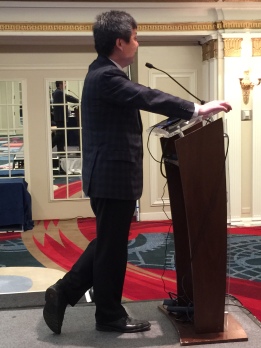
Yong Zhao keynote at #NPEChicago 2015
serious keynote by Yong Zhao, an opening conversation between high school junior Tanaisa Brown of the Newark Students Union and Journey for Justice veteran Jitu Brown, and a lunchtime conversation netween three notable bloggers Jennifer Berkshire of http://edushyster.com/, Peter Greene of http://curmudgucation.blogspot.com/ and Jose Vilson of http://thejosevilson.com/— all of those plenary sessions were enlightening and entertaining.
I will break down some of the personal highlights for me— although by its nature with six or seven panels happening at the same time, no one person can take it all in, so this is not in any way meant to be comprehensive— it just reflects the people and sessions I was lucky enough to see and that I found especially compelling.
To me, the Debunking Myths panel, featuring skilled messaging craftsman Jeff Bryant of the Education Opportunity Network and Salon.com, as well as rising stars Hilary Tone ofMedia Matters and Diallo Brooks, from People for the American Way, was indeed a real highlight, as was the one on Effective Messaging Around Assessment (basically, Too Much Damned Testing, and it works with Ds and Rs!), led by Bob Shaeffer from FAIRTEST.org and some parent/teacher advocates form NJ and NY. I also loved the time I spent with the creators and directors of Go Public: A Day in the Life of an American School District, Dawn and Jim O’Keeffe, along with their colleague in film Shannon Puckett, whose new film Defies Measurement (See post Film Review: Defies Measurement weaves together problematic purposes of ed reform) about a middle school in California, is truly a tour de force. Other panels I attended at least parts of were one on Community Schools, led by former Tennessee legislator and Knoxville teacher Gloria Johnson and educators from Pennsylvania and Oklahoma and the Southern Education Foundation’s Katherine Dunn on the New Diverse Majority, featuring educators from South Carolina and Mississippi about some distinct ways of fighting for equity in education.
Screen Shot 2015-05-01 at 10.52.32 AMAnd finally, I was very happy that the College Access panel led by Nicole Hurd of the College Advising Corps  went so well and was attended by so many key people learning about this brilliant program. The panel also featured others from her group and Claire Dennison of the peer organization and collaboratorParent: What I Saw, Learned and Enjoyed at #NPEChicago | Cloaking Inequity:

Holy State Takeover! | EduShyster

Holy State Takeover! | EduShyster:

Holy State Takeover!


Nine state takeover takeaways (because I ran out of time before I could come up with #10)

Well that certainly didn’t take long. The official state takeover time piece barely registered two hours and the Holyoke Public Schools had officially entered a new state:taken over. If you are keeping count at home, that’s about half as long as the public hearing that preceded the vote, during which some 1,000 + Holyokesters, including some who stood for four hours, packed a hall to register their objections to the state’s takeover plans. In other words, nothing to see or hear here folks, especially, it seems, if you were one of the ten members of the state’s 12 member Board of Education who didn’t actually visit a single Holyoke school prior to casting your vote…
One Holyoke
First, can we just acknowledge the extraordinary display on state takeover eve, when residents of a city so divided that whites live up in the Heights while Latinos live in the Flats, came together to oppose the state’s plans? But where you and I saw a standing-room-only crowd and overwhelming opposition, members of the state Board of Education seemed to see something different. Board chair Paul Sagan saw a *data point,* as well as the many theoretical community members who silently supported the state’s takeover but declined to join the two actual community members who spoke in favor of the state takeover at the hearing. Note: if you are watching from the comfort of your own state-run district, you will recognize a familiar turnaround trope. As for this guy, Dennis Birks, who raised the roof with his impassioned defense of his city and its schools, I don’t think we’ve seen, or heard, the last of Holy State Takeover! | EduShyster:

Charters to save 'failing' public schools? but who's saving the failing charters?

Superintendent's Blog: Charters to save 'failing' public schools, but who's saving the failing charters?:

Charters to save 'failing' public schools, but who's saving the failing charters?


Under proposed Senate Bills 669 and 895 and House Bill 1536, the Texas Opportunity School District would swoop in to properly educate and save the students attending “failing” public schools.

These bills are proposed to help heal those public schools with a 10-year minimum contract with a charter school Band-Aid, but with no guarantee for solving the student performance problem. The bills also provide a method for increasing the number of charter schools without having to follow the authorization process established in Senate Bill 2. As a matter of fact, SB 895 validates the quality of a charter school by asking the charter operator, “Is your charter a good one?” Talk about rigor!

I have an even better prescription that Texas should try. In my solution, Cypress-Fairbanks ISD will create “The Cypress-Fairbanks ISD Opportunity School District” to take over and manage failing charter schools.

Around 8.2 percent of public school campuses are classified as failing, but nearly 17 percent of charter schools are designated as failing. In fact, within three years of being included on the low-performing list, only seven out of approximately 8,500 traditional public schools are still designated as failing. If you are mathematically inclined, less than one-tenth of 1 percent of all Texas public school campuses are rated IR or AU for more than three years.

It seems that public schools are doing a great job of addressing low-performing schools without the added bureaucracy of another state agency. But there does appear to be a need to help charter schools, when nearly 1 in 5 are considered failing.

CFISD is recognized as one of the most effective school districts in the state when considering academic achievement and financial efficiency. We don’t pick and choose our students; we educate all students within our borders. The principles we practice should be quite useful in assisting the great number of failing charter schools. We feel that with more funding, less regulation and our processes, we can give thousands of students trapped in failing charter schools hope for a better tomorrow.

The proliferation of failing charter schools is the “civil rights issue of the 21st Century.” CFISD sees an opportunity to rescue these students and generate additional dollars to help offset the current underfunding (less operation funding than charters) that we receive. It is a win-win! Students at the failing charter school will benefit by receiving a quality education and CFISD students will benefit with more funding.

We are excited about the opportunity to teach so many charter school operators how to run an efficient and effective public school—our prescription meets every child’s needs!


Although this article is satirical, hundreds of public school districts have proven they are capable of rehabilitating low-performing campuses—a much more effective solution than an entirely unnecessary new state bureaucracy.

~ Mark Henry, Ed.D.

National Association of Charter School Authorizers (NACSA) Group: 1 in 5 charter schools not doing well enough to stay open
A group that oversees more than half of the nation's 5,600 charter schools said as many as one in five U.S. charter schools should be shut down because of poor academic performance. 

http://seattletimes.com/html/nationworld/2019784379_charterschools29.html


Mike Klonsky's SmallTalk Blog: UNO charter debacle hurts parents. Shows charters aren't 'public' after all.

Mike Klonsky's SmallTalk Blog: UNO charter debacle hurts parents. Shows charters aren't 'public' after all.:

UNO charter debacle hurts parents. Shows charters aren't 'public' after all.

A single picture tells the story
The latest UNO scandal represents a potential disaster for the thousands of mainly Latino students and parents enrolled in Chicago charter schools. It should also put an end to claims that privately-run charters are truly "public schools"

For those who haven't been following, there's been a split between the scandal-plagued United Neighborhood Organization (UNO) and the charter school chain it founded. Now UNO is threatening to force closure of six of those charters, potentially leaving parents and teachers scrambling to find a new school for thousands of children come next fall.

UNO claims that the separately incorporated UNO Charter School Network owes them $3 million in management fees. The schools are said to be withholding payments to UNO because of lack of transparency about how the millions are being spent and also because UNO is currently the target of ongoing federal investigations.

Mike Madigan
UNO is threatening to sell all four school buildings it owns-- buildings that are home to six schools-- unless the charter network pays up. UNO CEO Rick Cerda says that conflicts between his group and the charter chain “raise a question as to whether the UCSN schools will continue to operate as they do today.”

It's hard to know how much of this is bluff or what UNO would be able to do with those empty buildings. But CPS has plenty of space to house those six schools now that it is sitting on dozens of empty school buildings of its own.

Imagine the power this clout-heavy, private group has over neighborhood parents, teachers, and Mike Klonsky's SmallTalk Blog: UNO charter debacle hurts parents. Shows charters aren't 'public' after all.:


'Failing schools' robocall confuses Sumner residents

'Failing schools' robocall confuses Sumner residents:

'Failing schools' robocall confuses Sumner residents


A recent pro-school voucher robocall that has offended some Sumner residents has been misinterpreted, its source says.
The robocall received April 15 specifically targeted GOP voters in the 2012 and 2014 primaries inRepublican Rep. Courtney Rogers' legislative district that partially covers Goodlettsville, Hendersonville, Millersville and White House. Its voice is former Tea Party U.S. Senate candidate and state Rep. Joe Carr of Murfreesboro's District 48, speaking on behalf of the Tennessee Federation for Children, encouraging residents to support Rogers as she backs the pro-school voucher bill.
The Tennessee or American Federation for Children is a Washington, D.C.-based pro-school voucher nonprofit advocating to provide parents with a private school choice. For supporting the proposal, the message says, Rogers has been attacked by "union-funded front groups" that "take their direction from the National Education Association, the largest labor union to support Barack Obama and the largest labor union in Tennessee."
"They want to impose their values on our schools, and are working to oppose parental choice scholarships that allow parents to escape failing government-run schools," the message says.
Numerous parents and teachers contacted Director of Schools Del Phillips upset with the call that they felt suggested Sumner County has failing schools, spokesman Jeremy Johnson said. Some also thought Rogers approved the message.
"Prove that. Where do we have failing schools," school board member and parent Ted Wise asked. "Don't just say it. Prove it to me. If a message was sent about her and she didn't approve it, I'd have a huge problem if I were her. I think she absolutely knew about it, and if she didn't, she's got a bigger problem than she realizes."
The Hendersonville home of school board member Beth Cox, also a parent, received the call twice.
"Everyone was perplexed to have a political call in a non-election year," Cox said. "I thought it was a confusing message because we have incredible schools. That's why people move here. If it were me, I would do everything I could to correct it and separate myself from the situation, and I am not sure that was done effectively. I would have done more."
The federation confirmed neither the call nor the message came from Rogers, who was not informed of it ahead of time. The robocall's script also specifies that it was, "Paid for by the Tennessee Federation for Children and not authorized by any candidate or candidate's committee."
"It's not a political ad; it's a policy ad," said Steve Gill, a communications strategist and a political analyst, one of whose clients is the Tennessee Federation for Children. "It's not unusual for policy ads to be run in a non-election year to encourage legislators to either vote for or against a particular issue."
Purpose: to generate support
The targeted issue here, Gill said, is House Bill 1049, a pro-voucher proposal that aims to provide low-income students with a state-funded scholarship so they can attend a private school. The bill, which the Senate passed March 30, affects five counties — Davidson, Knox, Hamilton, Shelby and Madison.
"The message was not referring to failing schools in Sumner County," Gill said. "The purpose of the robocall was to generate support for Courtney Rogers on the school choice bill that gives children the option to escape horribly failing government schools."
The call is "pretty odd," said Sumner County Commissioner Paul Goode pointing that Rogers is not on committees voting on the bill.
"Why would this group single her out out of 99 representatives when she isn't on any committee that would debate this bill?" asked Goode, who also received calls from upset constituents.
There are two reasons, Gill said, to encourage support for and defend Rogers.
"Courtney Rogers was being targeted by advocacy groups opposing the school choice bill," Gill said. "I also think there are people, including Republicans, who still have a political vendetta against Courtney Rogers because she won an election against Debra Maggart. It was to support someone under fire, and unfairly so, as demonstrated by the response to the call, which proves the point of the robocall. People are creating a false hysteria over a message about a proposed legislation that does not even apply to Sumner County."
Rogers replies
Carr, a radio talk show host, was picked for the call, Gill said, because of his recognizable, conservative voice and advocacy for school choices.
"The robocall is in no way directed toward Sumner County Schools," said Carr, who has experience in public, private and home-schooling. "We called in Sumner County because Rep. Rogers has shown leadership on the issue. I oppose excluding any method that would help raise the educational standards of our children. I'm for parental choice and competition. The massage basically said, 'Hey, parents of Sumner County, we have failing schools in Tennessee and vouchers are a tool in the toolbox that we should consider to improve the opportunities for children to excel. Support Rep. Rogers on this bill.' "
Rogers, one of 30 representatives co-sponsoring the bill, said she appreciates individuals and groups that give up time and resources to support her, but confirmed she neither initiated nor approved the message.
"One of the tough things about being in politics is that you never know when or from whom (support) will come," Rogers said. "I support parental choice especially in areas where there are failing schools. I believe that parents are the final authority in the education of their children. The message did rightfully address the fact that there are failing schools in Tennessee. I believe that public schools will continue to be the primary mechanism for education in our state and therefore should be supported for the task at hand, but if specific schools repeatedly fail to serve their purpose, we have an obligation to take action to restore excellence within the schools in question and to allow the use of different options in the meantime."
The verbiage of the call, however, concerned Rogers, who felt that it "could be misinterpreted as a complaint against Sumner County Schools" and asked that it be withdrawn. She also added her family moved to Sumner because of the good schools and feels happy with that decision.
After receiving numerous concerned inquiries, Phillips felt it was necessary to reach out to Rogers.
"They were upset by the content that stated Sumner County had failing schools," Phillips said. "I reached out to Rep. Rogers to ensure that she understands that we do not have nor have we had a school classified as a failing school under any metric used by the Tennessee Department of Education here in Sumner County. I wanted to make sure Rep. Rogers had the correct information in regards to the performance of our school district."
The federation has not sent similar robocalls in other districts. The nonprofit has, however, used radio ads and paid social media to encourage support for the bill. House Finance, Ways and Means Subcommittee members deferred the proposal Tuesday after lead sponsor Rep. Bill Dunn, R-Knoxville, took it off notice. The bill won't come back up until next year.
Reach Dessislava Yankova at 575-7170 and on Twitter @desspor.
Robocall script
This is Joe Carr with an important message from the Tennessee Federation for Children about Sumner County Schools.
Right now, union-funded front groups are attacking conservative leader Courtney Rogers, simply for her decision to fight to give parents more power to choose where their child goes to school.
The groups attacking Courtney take their direction from the National Education Association, the largest labor union to support Barack Obama and the largest labor union in Tennessee.
They want to impose their values on our schools, and are working to oppose parental choice scholarships that allow parents to escape failing government-run schools.
We're in the midst of a fight for the future of our education system. Our choice is whether to give bureaucrats and unions even more control or try something new, and give each family a direct say in how their tax dollars should be spent.
Call Courtney Rogers today or text STOPNEA to 41411, that's STOPNEA to 41411, to support Rep. Rogers in her fight to keep government unions and their political agenda out of our schools.
Paid for by the Tennessee Federation for Children and not authorized by any candidate or candidate's committee.'Failing schools' robocall confuses Sumner residents:

Questions, answers about plan for Detroit school district - Yahoo News

Questions, answers about plan for Detroit school district - Yahoo News:

Questions, answers about plan for Detroit school district 


 LANSING, Mich. (AP) — Michigan Gov. Rick Snyder wants to overhaul Detroit's troubled state-run school district and divide its operations to address the "crushing" debt he says is hurting education in the city.

Some questions and answers about the wide-ranging plan, which needs approval from the Michigan Legislature:
___

WHAT ARE THE MAIN POINTS OF THE PROPOSAL?
Under the plan unveiled Thursday, an entirely new Detroit school district would be created to handle the academic operations of the city's public schools. The existing district would be kept intact to collect existing taxes and pay off $483 million in debt. The Legislature would direct $72 million more annually over seven years to the new district. The new district would have a universal enrollment system in which parents would rank their top three school choices for their children. An education manager would be hired to determine if failing schools should be closed.
____
WHAT IMPACT WOULD IT HAVE ON SCHOOLCHILDREN?
Those attending traditional schools could have more options, while those attending charters might have less, depending on whether they can attend their top pick. A lottery system would be used if a school is in too much demand. Students at traditional schools now attend based on proximity to their home or by applying to specialty schools. Many students attend charter schools, some of which are authorized by the district and others by universities or others.
___
HAS THIS BEEN DONE ANYWHERE ELSE?
To a certain extent, yes. Since 2012, four other Michigan school districts have received additional aid to address their operating deficits. Two were dissolved. Two others — in Muskegon Heights and Highland Park — were under state management and converted to charter school districts. The original districts remained in existence only to levy taxes.
___
HOW DID DETROIT SCHOOLS GET IN SUCH A MESS?
Since 2000, more than a quarter-million people have left the city. Its population now is about 690,000. Fewer children mean less from the state in funding. The district also has lost thousands of students to city charter and suburban schools. More than 177,000 students were enrolled in 263 schools in 1997. Unofficial numbers from last fall showed 47,238 full-time students in 97 schools. More than 40 schools closed in 2010 alone.
___
WILL THE GOP-CONTROLLED MICHIGAN LEGISLATURE AGREE TO THE FUNDING?
Snyder, a Republican, faces an uphill climb. Some lawmakers are "bailout"-weary after committing $195 million last year to prevent steeper cuts to city retiree pensions as part of the city's bankruptcy exit.
However, Snyder has some leverage with lawmakers. He says much of the Detroit school district's debt is backed with state credit, so Michigan ultimately is on the hook. He can make a similar argument to the one he made to rescue bankrupt Detroit: The cost of not acting now would make things worse later. Legislators also largely agree that something must be done to turn around a district ranked as the worst urban district in the country in terms of academic performance.
___
WHAT DO TEACHERS THINK?
Teachers were unhappy about the plan even before Snyder unveiled it. Classes in 18 Detroit schools were canceled Thursday after 500 of 2,800 teachers took personal days to protest the proposal. They say lawmakers need to address issues in the classroom, including class sizes and supplies.
___
WHAT ARE THE PROSPECTS FOR DETROIT PUBLIC SCHOOLS TO GET PAST THEIR WOES?
It has made some headway in education with improved scores on standardized tests and higher graduation rates. The district has saved millions of dollars by closing obsolete and half-empty school buildings. But even if its debt is wiped out, the district has done little to attract more students.
___
Corey Williams contributed from Detroit.