Latest News and Comment from Education

Saturday, April 25, 2015

Dylan Sepulveda presents his original piece, “Academia” #NPECHICAGO

Patriot Press : See the Spit Fire 2015 Performances Here!:


The student news site of Freehold Township High School


Dylan Sepulveda presents his original piece, “Academia”


The Invented History of 'The Factory Model of Education'

The Invented History of 'The Factory Model of Education':

The Invented History of 'The Factory Model of Education'


And so too we’ve invented a history of “the factory model of education” in order to justify an “upgrade” – to new software and hardware that will do much of the same thing schools have done for generations now, just (supposedly) more efficiently, with control moved out of the hands of labor (teachers) and into the hands of a new class of engineers, out of the realm of the government and into the realm of the market.  Audrey Watters


“What do I mean when I talk about transformational productivity reforms that can also boost student outcomes? Our K–12 system largely still adheres to the century-old, industrial-age factory model of education. A century ago, maybe it made sense to adopt seat-time requirements for graduation and pay teachers based on their educational credentials and seniority. Educators were right to fear the large class sizes that prevailed in many schools. But the factory model of education is the wrong model for the 21st century.” – US Secretary of Education Arne Duncan (2010)
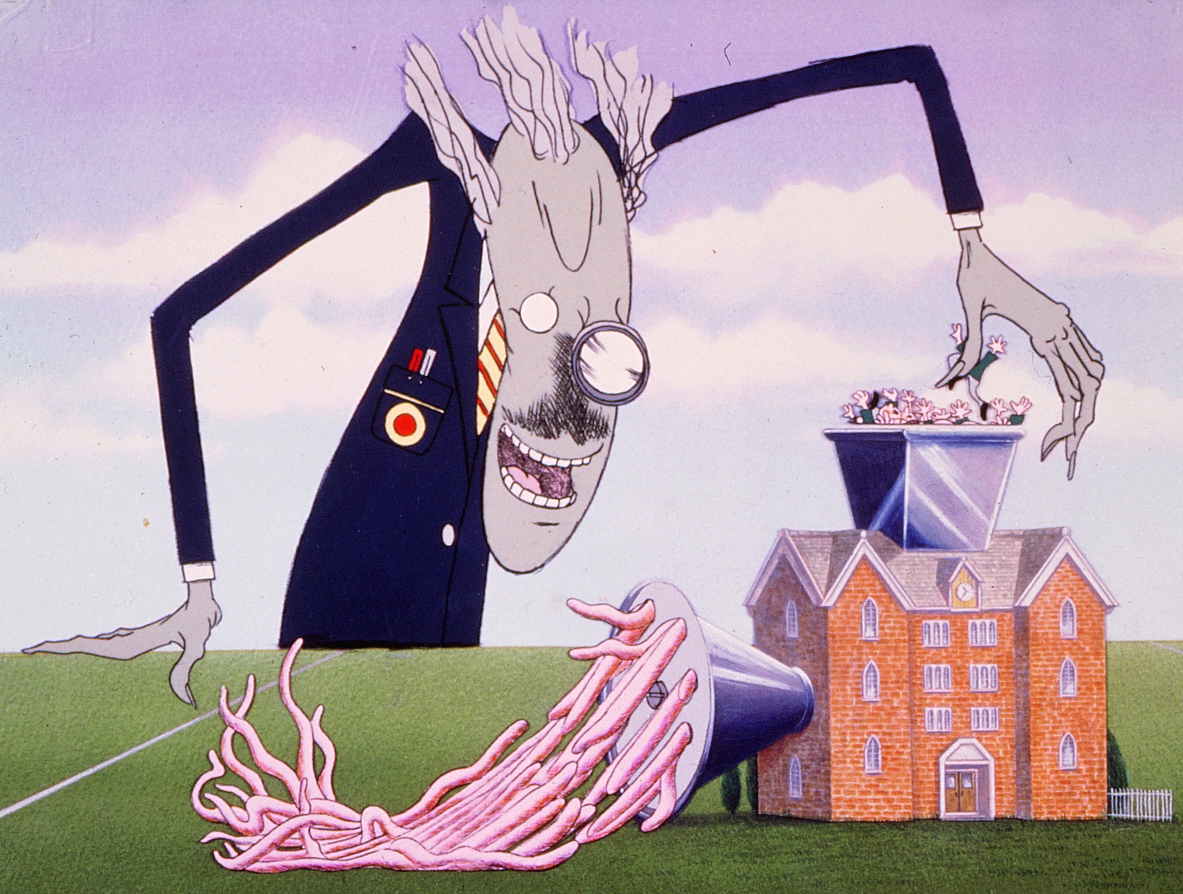
One of the most common ways to criticize our current system of education is to suggest that it’s based on a “factory model.” An alternative condemnation: “industrial era.” The implication is the same: schools are woefully outmoded.
As edX CEO Anant Agarwal puts it, “It is pathetic that the education system has not changed in hundreds of years.” The Clayton Christensen Institute’s Michael Horn and Meg Evan argue something similar: “a factory model for schools no longer works.” “How to Break Free of Our 19th-Century Factory-Model Education System,” advises Joel Rose, the co-founder of the New Classrooms Innovation Partners. Education Next’s Joanne Jacobs points us “Beyond the Factory Model.” “The single best idea for reforming K–12 education,” writes Forbescontributor Steve Denning, ending the “factory model of management.” “There’s Nothing Especially Educational About Factory-Style Management,” according to the American Enterprise Institute’s Rick Hess.
I’d like to add: there’s nothing especially historical about these diagnoses either.

Blame the Prussians


The “factory model of education” is invoked as shorthand for the flaws in today’s schools – flaws that can be addressed by new technologies or by new policies, depending on who’s telling the story. The “factory model” is also shorthand for the history of public education itself – the development of and change in the school system (or – purportedly – the lack thereof).
Here’s one version of events offered by Khan Academy’s Sal Khan along with Forbes’ writer Michael Noer – “the history of education”:


Khan’s story bears many of the markers of the invented history of the “factory model of education” – buckets, assembly lines, age-based cohorts, whole class instruction, standardization, Prussia, Horace Mann, and a system that has not changed in 120 years.
There are several errors and omissions in Khan’s history. (In his defense, it’s only eleven and a half minutes long.) There were laws on the books in Colonial America, for example, demanding children be educated (although not that schools be established). There was free public education in the US too prior to Horace Mann’s introduction of the “Prussian model” – the so-called “charity schools.” There were other, competing models for arranging classrooms and instruction as well, notably the “monitorial system” (more on that below). Textbook companies were already thriving before Horace Mann or the Committee of Ten came along to decide what should be part of the curriculum. One of the side-effects of the efforts of Mann and others to create a public education system, unmentioned by Khan, was the establishment of “normal schools” where teachers were trained. Another was the requirement that, in order to demonstrate accountability, schools maintain records on attendance, salaries, and other expenditures. Despite Khan’s assertions about the triumph of standardization, control of public schools in the US have, unlike in Prussia, remained largely decentralized – in the hands of states and local districts rather than the federal government.
The standardization of public education into a “factory model” – hell, the whole history of education itself – was nowhere as smooth or coherent as Khan’s simple timeline would suggest. There were vast differences between public education in Mann’s home state of Massachusetts and in the rest of the country – in the South before and after the Civil War no doubt, as in the expanding West. And there have always been objections from multiple quarters, particularly from religious groups, to the shape that schooling has taken.
Arguments over what public education should look like and what purpose public education should serve – God, country, community, the economy, the self – are not new. These battles have persisted – frequently with handwringing about education’s ongoing failures – and as such, they have shaped and yes changed, what happens in schools.

The Industrial Era School


Sal Khan is hardly the only one who tells a story of “the factory of model of education” that posits the United States adopted Prussia’s school system in order to create a compliant populace. It’s a story cited by homeschoolers and by libertarians. It’s a story told by John Taylor Gatto in his 2009 book Weapons of Mass Instruction. It’s a story echoed by The New York Times’ David Brooks. Here he is in 2012: “The American education model…was actually copied from the 18th-century Prussian model designed to create docile subjects and factory workers.”
For what it’s worth, Prussia was not highly industrialized when Frederick the Great formalized its education system in the late 1700s. (Very few places in the world were back then.) Training future factory workers, docile or not, was not really the point.
Nevertheless industrialization is often touted as both the model and the rationale for the public education system past and present. And by extension, it’s part of a narrative that now contends that schools are no longer equipped to address the needs of a post-industrial world.
Perhaps the best known and most influential example of this argument comes from Alvin Toffler who decried the “Industrial Era School” in his 1970 book Future Shock:
Mass education was the ingenious machine constructed by industrialism to produce the kind of adults it needed. The problem was inordinately complex. How to pre-adapt children for a new world – a world of repetitive indoor toil, smoke, noise, machines, crowded living conditions, collective discipline, a world in which time was to be regulated not by the cycle of sun and moon, but by the factory whistle and the clock.

The solution was an educational system that, in its very structure, simulated this new world. This system did not emerge instantly. Even today it retains throw-back elements from pre-industrial society. Yet the whole idea of assembling masses of students (raw material) to be processed by teachers (workers) in a centrally located school (factory) was a stroke of industrial genius. The whole administrative hierarchy of education, as it grew up, followed the model of industrial bureaucracy. The very organization of knowledge into permanent disciplines was grounded on industrial assumptions. Children marched from place to place and sat in assigned stations. Bells rang to announce changes of time.

The inner life of the school thus became an anticipatory mirror, a perfect introduction to industrial society. The most criticized features of education today – the regimentation, lack of individualization, the rigid systems of seating, grouping, grading and marking, the authoritarian role of the teacher – are precisely those that made mass public education so effective an instrument of adaptation for its place and time.
Despite these accounts offered by Toffler, Brooks, Khan, Gatto, and others, the history of schools doesn’t map so neatly onto the history of factories (and visa versa). As education historian Sherman Dorn has argued, “it makes no sense to talk about either ‘the industrial era’ or the development of public school systems as a single, coherent phase of national history.”
If you think industrialization is the shift of large portions of working people to wage-labor, or the division of labor (away from master-craft production), then the early nineteenth century is your era of early industrialization, associated closely with extensive urbanization (in both towns and large cities) and such high-expectations transportation projects as the Erie Canal or the Cumberland Road project (as well as other more mundane and local transportation improvements). That is the era of tremendous experimentation in the forms of schools, from legacy one-room village schools in the hinterlands to giant monitorial schools in cities to academies and normal schools and colleges and the earliest high schools in various places. It is the era of charity schools in cities and the earliest (and incomplete) state subsidies to education, a period when many states had subsidies to what we would call private or parochial schools. It is also the start of the common-school reform era, the era when both workers and common-school reformers began to talk about schooling as a right attached to citizenship, and the era when primary schooling in the North became coeducational almost everywhere. It was an era of mass-produced textbooks. It was an era when rote learning was highly valued in school, despite arguments against the same. And, yes, the first compulsory-school law was passed before the Civil War… but it was not enforced.

Maybe you think industrialization is the development of railroads, monopolies, national general strikes, metastasizing metropolises, and mechanized production. Then you mean the second half of the nineteenth century, and that is the era where the structural dreams of common-school reformers largely came to pass with tuition-free 
The Invented History of 'The Factory Model of Education':

Recess and Behavior Problems Part I: Attitude Adjustment

Recess and Behavior Problems Part I: Attitude Adjustment:


Toys

Recess and Behavior Problems Part I: Attitude Adjustment

My recent post “If You’re a Teacher Who Denies Recess…” raised some questions about what a teacher could do if they couldn’t use recess as a bargaining chip to get students to complete their work and/or behave. I thought it was important for me to address these problems.
My attempt here is to show that all children deserve recess, and to look for other ways to deal with troublesome behavior so teachers don’t punish children by withholding recess.
I will provide suggestions for teachers (and parents), but please know that I am no know-it-all. Behavioral difficulties with students in ever increasing class sizes can be most challenging. But I will give some suggestions in three short posts. And if any teacher wants to join in and give their own solutions, please feel welcome.
First, I would never keep a student from recess for not completing work at school or homework.
The testing craze has made teachers push students to work faster. But faster doesn’t always mean better. Some students just work slowly. Students who try but don’t finish their assignments might also have a learning problem. Some parents and teachers might say, they know their kids and they are just lazy, but I would argue it is difficult to know that for sure.
I have never met a child, and I have known a lot of students with behavioral and learning disabilities, who didn’t want to do a good job in school. If they bubble Christmas trees in on test forms, or procrastinate doing their work, or even act out, it isn’t because they are saying, “I love to get into trouble.” It is because they have a Recess and Behavior Problems Part I: Attitude Adjustment:

SUNDAY, APRIL 26 NPE 2015 Annual Conference Schedule, Panels & Keynotes #‎NPEChicago


SUNDAY, APRIL 26TH

Morning Keynote
Diane Ravitch in Conversation with AFT’s Randi Weingarten and NEA’s Lily Eskelsen García
image (1)
Closing Keynote and Call to Action
Chicago’s Very Own, Karen Lewis

image (3)


Sunday, April 26th Schedule


7:00 – 9:00                        Breakfast
Paid as part of the meal plan (purchase through our website)

9:00am-10:15                   Sunday Session 5

Schools of Opportunity: Carol Burris and Dr. Kevin Welner
A Trip To The Jersey C.O.A.S.T; Community Organizing Around Standardized Test: Michael Kaminski, Jim Boice, Alex DeVicaris, Patrick Manahan, and Susan Cauldwell
The Impact of Race and Poverty on Education; What Parents Need To Know: Nathan Harris, Dora Taylor, and Julie Woestehoff
Social Justice Unionism; The What, Who and Why: Michelle Gunderson, Xian Franzinger Barrett, and UCORE activists
More Than a Score; Black Student Lives Matter: Jesse Hagopian
Knocking Down Barriers Together; College Access for All: Nicole Hurd moderating, Veniese Bradley-Mitchell, Claire Dennison, and Julie Pagliuco
How to Have Conversations with Teach for America Supporters: Dr. Julian Vasquez Heilig, Katie Osgood, Jameson Brewer, Annie Tan, Chad Sommer, and Dr. Terica Butler

10:25 – 11:30                    Morning Keynote
Diane Ravitch in Conversation with AFT’s Randi Weingarten and NEA’s Lily Eskelsen García

11:40 – 12:55                    Sunday Session 6

Designing and Delivering Persuasive Assessment Reform Messages: Bob Schaeffer, Bianca Tanis, and Steve Baker
Imagineering Our Edu-Nation: Katie Lapham
BATS Pushing Back Against the Dismantling Of Special Education: Marla Kilfoyle, Terry Kalb, Melissa Tomlinson, and Lorri Gumanow
Teacher Education; Doing What Is Right When Everything Is Wrong: Tim Slekar, Jed Hopkins, Sheila Hopkins, Donna Vukelich-Selva, and Alexandra Miletta
Teach Writing Like A Writer: Peter Greene
Getting Your Book Published: Anthony Cody, John Kuhn, Jose Vilson, and Denny Taylor 
The Battle for Adult Education in California; “Workforce Preparation” vs. Community is Immunity: Kristen Pursley, Cynthia Eagleton, and Bruce Neuberger

1:05 – 1:45                    Sunday Closing Keynote and Call to Action
Chicago’s Very Own, Karen Lewis

Not everyone can make it to Chicago this weekend -- but you can still be part of the action via the Livestream that will broadcast on as many as three channels. All the keynotes and many of the workshops will be available live, starting Saturday at 8:30 am central time at   www.schoolhouselive.org

 Please tweet with the hashtag ‪#‎NPEChicago‬ and help us trend #1 again like we did twice last year.

LIVE FROM CHICAGO, APRIL 25-26
CHECK OUT ALL THREE CHANNELS!

NPE Lessons LIVE and the Raw Truth: What do we need to do? | Reclaim Reform

NPE Lessons LIVE and the Raw Truth: What do we need to do? | Reclaim Reform:


NPE Lessons LIVE and the Raw Truth: What do we need to do?

Viewing the LIVE coverage of the Network for Public Education Conference is an enlightening experience to say the least. The vast differences of experiences from teacher to teacher, age category to age category and location to location exposes an overview of the corporate education reform plan to treat teachers and teaching as mechanisms to be cheaply reproduced.
The end product has nothing to do with helping children to grow and become well educated, fulfilled adults. It’s all about corporate (Foundation) power, control and money.
Coincidentally, one letter from a teacher in Massachusetts in this month’s issue of Harper’s Magazine lays bare a slice of raw truth.
Sisyphus2a
Letter of response to the Esther Kaplan article “The Spy Who Fired Me” [Report, March issue of Harper’s Magazine].
As a teacher in Massachusetts, I have witnessed a trend toward “accountability” prompted by Race to the Top, No Child Left Behind, and the Common Core. Like UPS or Starbucks workers, teachers are now being electronically tracked by state education departments. Through PowerSchool, a program used for planning and grading, teachers are required to show that every lesson pertains to the assigned strand of the Common Core. If grades don’t meet expectations, NPE Lessons LIVE and the Raw Truth: What do we need to do? | Reclaim Reform:

Public boarding school _ the way to solve educational ills? - Yahoo News

Public boarding school _ the way to solve educational ills? - Yahoo News:

Public boarding school _ the way to solve educational ills?


The SEED Public Charter School of Washington, a public boarding school for poor and academically at-risk students is shown, Friday, April 24, 2015, in...


 BUFFALO, N.Y. (AP) — Buffalo's chronically struggling school system is considering an idea gaining momentum in other cities: public boarding schools that put round-the-clock attention on students and away from such daunting problems as poverty, troubled homes and truancy.

Supporters say such a dramatic step is necessary to get some students into an atmosphere that promotes learning, and worth the costs, estimated at $20,000 to $25,000 per student per year.
"We have teachers and union leaders telling us, 'The problem is with the homes; these kids are in dysfunctional homes,'" said Buffalo school board member Carl Paladino.
He envisions a charter boarding school in Buffalo where students as young as first or second grade would be assured proper meals, uniforms, after-school tutoring and activities.
It's one of a pair of boarding school proposals that have been floated in the city, where only 53 percent of students graduate in four years, English and math proficiency hover 20 points below the state average, and a majority of public schools are considered by the state to be failing. Around 80 percent of students meet federal guidelines for free and reduced lunch.
"We are not hitting various measures set by the state or ourselves," said Tanika Shedrick, a former charter school dean who is trying to open the state's first public boarding high school in Buffalo. "Our students are leaving school not prepared for college."
Her charter Buffalo Institute of Growth would supplement a college-style academic schedule with life skills and social activities that would keep students on campus seven days a week, with the goal of sending 100 percent of graduates to college or a vocational program.
"We want to make sure we're there every step of the way," said Shedrick, who plans to submit a charter school application to the state this year. She estimates the per-student cost at $20,000 to $25,000 per year, to be paid for with public funding and fundraising. New York's traditional charter school allocation is about $12,000 per student.
Both proposals in Buffalo would be subject to state approval.
About 115,000 students board at private schools in the United States, federal statistics show, in a tradition that predates the Revolutionary War, but the idea of public boarding schools is relatively new.
The Washington, D.C.-based SEED Foundation opened its first public boarding school for poor and academically at-risk students in 1998 and followed up with a school in Baltimore in 2008 and Miami in 2014. A fourth school is in the works in Ohio at the request of the state's Department of Education. The model, in which students in grades six through 12 return home for weekends, required changes in state laws.
The idea has been discussed in cities including Detroit and Niagara Falls, as well. Advocates say the high price is the biggest obstacle.
"Even I have to admit, in the short run it's expensive," SEED Foundation co-founder Eric Adler said. "That's an argument for not doing it. I don't think it's a good argument, but it's a valid argument."
Adler continued: "Not every child needs this, but there are many who do, and without it, they wouldn't have much of a shot."
Tasha Poulson found SEED and its 90-plus percent graduation rate while researching schools after seeing her daughter, who had excelled in elementary school, begin to lose ground upon entering one of Washington's public middle schools.
"It was horrible," Poulson said. "I knew that I had to get her out of that school, and there wasn't another school that I saw as a fit for my daughter." But she hesitated at the thought of her sixth-grader living away from home.
In the end, Poulson decided it would give her daughter the independence and confidence she would need to go to college. She visits frequently and also attends events such as poetry nights that welcome parents. Her daughter is headed for North Carolina Central University next year, and a niece and son now attend the SEED school as well.
A Buffalo Board of Education committee is looking at Paladino's proposal to explore a SEED school.
While SEED's Adler acknowledged the annual per-pupil cost is high in the short term, he said it pays off with successful, taxpaying citizens down the line.
A study of SEED published in the Journal of Labor Economics last year found that changing both a student's social and educational environment through boarding significantly raised student achievement in math and English.
Paladino has proposed asking the state to fund a Buffalo boarding school as a kind of pilot project.
"Next year, we'll take in another 6,000 kids to our traditional public schools," Paladino said. "Eighty percent of those kids are condemned to a school opportunity that will not teach them. It will just put them on the streets at some point."Public boarding school _ the way to solve educational ills? - Yahoo News:

Officials to review state exams after errors found: Fariña - NY Daily News

Officials to review state exams after errors found: Fariña - NY Daily News:

Education officials to review state exams after error discovery: Fariña


City Schools Chancellor Carmen Fariña (seen with Deputy Mayor Richard Buery at a Pre-K enrollment center on Thursday) has promised that officials will review state math and reading exams after the discovery of two major errors.


 City schools boss Carmen Fariña said Thursday Education Department officials will review state math and reading exams after two glaring errors were found in tests in the past two weeks.

State education officials have admitted the problems with the 2015 exams, which are used in decisions to promote students, evaluate schools and rate teachers.
And passages from the fourth-grade reading test were posted on Facebook Wednesday, adding to the fuss over the optional exams, which are supposed to remain secret.
Fariña altered the school system’s policy for promoting students to reduce the importance of the exams last year, but still says she supports the tests.
“We always review and we always respond, and in some cases we make recommendations, as to what should happen next year,” Fariña said when asked about the quality of the tests.
One of the reading exams administered last week misstated the name of a character in a text students were asked about, state Education Department officials said.
And a Russian-language version of the state math exam administered this week incorrectly contained passages in Korean.
About 200 students who were affected by the translation mistake will be given an error-free, makeup version of the test.
Critics of the exams object to their prominent place in school lesson plans, their level of difficulty and their use in decisions to promote students and evaluate teachers.
A statewide opt-out count for the standardized reading exams administered last week exceeded 190,000, according to the anti-testing group United to Counter the Core.
The group says 62,173 students have skipped out on state math tests given this week. Its unofficial tally is based on media reports and information provided by educators and parents.
And more than 3,100 city students at 93 public schools skipped their state reading exams last week, according to a tally by the anti-testing group Change the Stakes.
Education Department officials say it could be weeks before a complete tally of who took the tests is compiled.Officials to review state exams after errors found: Fariña - NY Daily News:

Teacher: What I wish everyone knew about working in a high-needs school - The Washington Post

Teacher: What I wish everyone knew about working in a high-needs school - The Washington Post:

Teacher: What I wish everyone knew about working in a high-needs school


 The following post was written by a fifth-year English teacher in a Title 1 middle school who blogs anonymously at the loveteachblog. It captures both the joys and overwhelming burdens of working in an under-resourced school with a large population of high-risk students  and in a system that makes it difficult for teachers and students to succeed. Though these are the experiences of one teacher, they reflect those of many others across the country.

The author insists on anonymity out of concern of retaliation by administrators, and to protect the identities of students. I rarely publish anonymous pieces, but do so when I know who the author is, believe their reasons for choosing not to be identified are valid, and think that they are relating a truth about public education that will have resonance beyond a single classroom.

Here’s the post by “Teach”, the teacher who blogs anonymously:
I’m in my fifth year of teaching English at a Title I middle school. Title I schools are public schools that receive special grants because of their high number of students who have been identified as at-risk. I adore my students and my teaching team. I love teaching. I’m really good at it. I respect my administration and feel valued by them.
But at the end of this year, I’m leaving. I’m not sure if I’ll continue teaching elsewhere or start a new career. If I do leave, I’ll be one of the 40-50 percent of teachers who leave during their first five years. A drop in the bucket.
To other teachers, I’m sure this isn’t surprising. Without knowing me or where I teach, they can probably easily guess why someone who loves her job and is good at it would be leaving.
But it’s not teachers who need to know what it’s like. It’s everyone else. People who have no idea what it’s like teaching in a Title I school. Some of these people are even making important decisions about education.
There are so many things I would tell them.
I would tell them about the bright bulletin boards, posters, and student work that are either taken down or covered with white butcher paper for most of the spring semester, because the state mandates that there can be no words of any kind on the walls during one of the 14 standardized tests.
I would tell them about the 35 desks I have in my classroom, and how in two of my classes, all the desks are filled.
I would tell them about the hours I’ve spent outside of class time writing grants to get novels because my school doesn’t have the money for them.
I would tell them that I get to school about two hours before the first bell every day, but I still spend less time at school than most of my colleagues.
I would tell them about how I’m not allowed to fail a student without turning in a form to the front office that specifies all instances of parent contact, describing in detail the exact accommodations and extra instruction that the child was given. I would tell them about how impossible this form is to complete, when leaving a voicemail doesn’t count as contact and many parents’ numbers change or are disconnected during the school year. I would tell them how unrealistic it is to document every time you help a child when you have a hundred of them, and how this results in so many teachers passing students who should be failing.
I would tell them how systems that have been put in place to not leave children behind are allowing them to fall even further behind.
I would tell them that even though I love my job and work harder at it than I’ve ever worked for anything, the loudest voice in my head is the one that is constantly saying you’re not doing enough. I hear it all the time.
I would tell them about the student in one of my classes who in August of last year, flat-out refused to do any work because of how much he hated reading. I would tell them that today, when he found out we weren’t going to be doing book groups, I heard him mutter, “Oh, man. I wanted to keep reading,” and I said, “WHAT DID YOU SAY?” really loud and shook his Teacher: What I wish everyone knew about working in a high-needs school - The Washington Post:

Troy LaRaviere: Corrupt public servants. SUPES and Barbara Byrd-Bennett. | Fred Klonsky

Troy LaRaviere: Corrupt public servants. SUPES and Barbara Byrd-Bennett. | Fred Klonsky:


Troy LaRaviere: Corrupt public servants. SUPES and Barbara Byrd-Bennett.


screenshot-2015-04-20-15-58-01
– From Troy LaRaviere’s blog. Troy is a principal at Blaine elementary school in Chicago.
An Invitation
In July of 2013–along with hundreds of principals across Chicago–I received an email with the subject, “Leadership Launch with Dr. Barbara Byrd-Bennett.”  The email implored principals to join Byrd-Bennett “for the comprehensive launch of the Chicago Executive Leadership Academy (CELA).” CELA was the title given to the series of professional development workshops organized by SUPES Academy under their $20+ million no-bid contract with Chicago Public Schools (CPS); a contract that is now under federal investigation. The launch was a huge event, staged at the UIC Forum. It was advertised as an “invite only” affair for which we had to reserve a ticketed seat (see mine above).
The Boiling Point
As expected, the event did not open up with any discussion of the SUPES training. Instead we got what we had come to expect at the start of every principals meeting: talk of an impending budget apocalypse that can only be solved by CPS defaulting on its obligation to provide a secure retirement for its teachers.
The meeting opened up with CPS board member and former school principal, Dr. Mahalia Hines.  I’d heard her twice before; her primary function seems to be to tell stories that convince her listeners that Rahm Emanuel actually cares about south and west side children from low-income households.  However, during the CELA launch, her comments were aimed at preparing principals for budget austerity.  During her talk, she mentioned a couple principals who had written grants and gotten external funding.  She praised these principals efforts because, in her words,“You can’t rely on the board to get funding for your schools.”  Yes. She actually said those exact words. Having succeeded in convincing many of the best principals in the room to consider looking for more secure employment in the suburbs, she then introduced Barbara Byrd-Bennett who continued the austerity theme with empty corporate speak about principals “leveraging partnerships” to get free or low-cost services for our students.
“Did she really just say that?” I thought.


Louisiana Educator: The War Against Public Schools and Teachers Resumes Next Week!

Louisiana Educator: The War Against Public Schools and Teachers Resumes Next Week!:


The War Against Public Schools and Teachers Resumes Next Week!


Two Committees of the Louisiana House of Representatives next week will go back to work attempting to further dismantle public education and do more damage to the teaching profession.

House Education Committee: 9:00 AM, Wednesday, April 29

So after all the dismal academic results of most of the voucher schools and the audits showing misuse of our tax dollars by greedy voucher school directors, and the terrible academic track record of vouchers nationwide, you may have thought that voucher fever in Louisiana had died down. . .  Wrong! Voucher proponents have a bill to be heard the House Education Committee, Wednesday, April 29 that would allow new voucher schools to enroll more than the present statutory limit of 20% voucher students.

HB 330 by Badon would allow the LDOE to waive the 20% limit of voucher students in some of the voucher schools that have been in operation for less than two years. You see, the problem is that some new private schools have trouble getting off the ground with mostly private paying students, so this would let entrepreneurs start their schools with more publicly funded voucher students if they can convince the LDOE that they have a viable school even before they start! That has not been hard to do with John White's voucher loving LDOE. This is just another scheme to let the privatieers profit using our public school students and our tax money.

Many of these new voucher schools fit my definition of Predatory Schools. That is, private schools and charter schools that get public school funding and attempt to attract only the higher performing students so that their performance will look better than the real public schools. Even though these predatory schools are supposed to be non-discriminatory (The Brumfield Dodd requirement), no one really checks to see that they attract a fair ratio of black or at-risk students. In addition, they have the freedom to reject students with disabilities if they say that they are not equipped to instruct such students, (This exemption greatly boosts their scores on state tests), and they can easily use their discipline policies to remove disruptive and low performing students (further boosting their scores).

So next time you hear the proponents of privatization reciting their slogans and talking points like: "Its time to break up the public school monopoly", or "competition will force all schools to perform better for our students" be aware that these are false claims just to help justify ways of diverting our tax dollars to non-accountable predatory schools. They do not play by the same rules. If this process is allowed to continue, public schools will become the dumping grounds for underprivileged and low performing at-risk students while the managers who run these privatized schools get rich on our tax dollars. As my friend, former School Board Association President, Noel Hammatt often says: "Follow the money."

Please contact your State Representative and ask him/her to vote against HB 330! 


Representative Ivey wants to remove all job security for teachers

HB 505 by Representative Ivey of the Central area in Baton Rouge would prevent new teachers from ever attaining tenure under any conditions, but more importantly, this bill would allow teachers to be fired at the end of each school year without legitimate reasons. Even new teachers without tenure now get some due process because of  a provision in state law that requires that any disciplinary action against them (including termination) must be supported by valid reasons. The teacher is allowed to have a court review of their termination to determine if it was arbitrary or capricious.

HB 505 would not only eliminate the possibility of a new teacher ever gaining tenure, it would allow all such teachers to be terminated at the end of each school year without the need to provide a valid reason because this new law would give teachers only one year contracts! We need to keep the present law because LAE won several lawsuits last year in cases where teachers were being denied due process.

Governor Jindal and big business groups like LABI like this legislation because their goal is to make every teacher subject to dismissal at any time, for any reason.  Right now it would not apply to experienced teachers, but I predict that if this is successful, they will go after experienced teachers next. Part of their rationale is that if teachers have no job protection, they Louisiana Educator: The War Against Public Schools and Teachers Resumes Next Week!: