Thursday, May 1, 2014

UPDATE: NYC Educator: Mr. Mulgrew Writes Me a Letter About the Contract

NYC Educator: Mr. Mulgrew Writes Me a Letter About the Contract:


UFT Contract Committee Votes Up MOA Without Even Looking at It
James Eterno reports that the contract committee held a vote, and that there was only one official abstention announced. James reports he abstained, and that he doesn't vote for anything until he sees it.  Go figure.Though there was no memorandum of agreement, the committee, consisting overwhelmingly of oath-obeying Unity members, voted in favor of recommending it to the Municipal Labor Committee,


Mr. Mulgrew Writes Me a Letter About the Contract

There is an agreement on a new teacher contract between the city and the UFT, one that gets us the 8% that's eluded us all these years, and establishes some crap pattern for the following years. Having gone so very long without a raise, it's hard to imagine UFT voting against it. There are, as always, concerns. There is the slippery slope of saving money on health care, and it appears our uniformed brothers and sisters have concerns about that they may be funding teacher raises with health givebacks.

Then there's the problem of ATR teachers, which, if this is to be believed, have something less than a rosy future:

The deal also includes reforms to various rules, including changes to the “Absent Teacher Reserve pool,” where teachers are sent if they can’t find work in city classrooms. The new contract will include rules that allow the city to permanently fire teachers if, for instance, they are twice returning to the pool for poor performance by principals. 

The fact is, we are all ATRs, or on the verge of becoming ATRs. Though Bill de Blasio does not appear to be insane, that doesn't mean he will be mayor forever, and who's to say another Bloomberg won't buy his way in? Firing people for no good reason has not worked well in Chicago, and will not likely work well anywhere. If this proves to be true I will not support this contract.

And there's a hat tip to legal expert Campbell Brown.


The rules also expand the definition of sexual misconduct, which will make it easier for the city to fire teachers for actions like inappropriate touching or texting, officials said.

Once again we are solving a non-existent emergency.  Every time we concede to reformy types for no reason it lends credence to their causes and degrades our profession.

There are other things, right from Mulgrew's email, that have me shaking my head.


The union won major changes, including a focus on eight instead of 22 Danielson components and a better system for rating teachers in non-tested subjects.

I have heard directly from union sources that they'd insisted on focusing on all of Danielson, and that making them focus on all aspects was a great victory. Apparently making them focus on fewer factors is also a victory. We shall see what happens with non-tested subjects. And I'm NYC Educator: Mr. Mulgrew Writes Me a Letter About the Contract:

Getting Kindergarteners “College and Career Ready" | Truth in American Education

Getting Kindergarteners “College and Career Ready" | Truth in American Education:


Getting Kindergarteners “College and Career Ready”

Filed in Common Core State Standards by  on May 1, 2014 • 0 Comments
Yvonne Gasperino from Stop Common Core in New York State shared this picture with me last week.  Harley Avenue Primary School (part of the Elwood Union Free School District) in Elwood, NY cancelled their Kindergarten Show in order to “prepare children for college and career.”  Oh brother.
10295740_226620464202797_8376463130260840335_n
The “Kindergarten Show” was a play that this school would do on an annual basis with their kindergarten students.
Gasperino pointed out:
What goes into a production like this? Children learning to work among their peers, learning and reading new material, memorizing this new material for their lines which probably includes new vocabulary words for them, artwork to go along with the production which includes tapping into the creativity of the children, learning to listen to the “director” to make the production successful, learning accountability for one’s role that they will play in this production are just few of the life’s lessons they will develop with the “hands-on learning” that comes from this play. Last but not least the memories that they will have for the remainder of their life because of this play… Shame on the school!!!
If I were a parent of Elwood Kindergartner I would seek out a venue, get a group of parents together from the classroom and put on our OWN KINDERGARTEN PLAY and invite all the children from all of the grades to support the kindergartners…along with the community… THIS IS COMPLETE NONSENSE!!!
I agree it is complete nonsense.  Kindergarteners don’t need to worry about college and careers Getting Kindergarteners “College and Career Ready" | Truth in American Education:

Scathing Report Finds Rocketship, School Privatization Hurt Poor Kids | The Progressive

Scathing Report Finds Rocketship, School Privatization Hurt Poor Kids | The Progressive:


Gordon Lafer, a political economist and University of Oregon professor who has advised Congress, state legislatures, and the New York City mayor's office, landed at the airport in Milwaukee, Wisconsin, late last night bringing with him a briefing paper on school privatization and how it hurts poor kids.
Lafer's report, "Do Poor Kids Deserve Lower-Quality Education Than Rich Kids? Evaluating School Privatization Proposals in Milwaukee, Wisconsin," released today by the Economic Policy Institute, documents the effects of both for-profit and non-profit charter schools that are taking over struggling public schools in Milwaukee.
"I hope people connect the dots," Lafer said by phone from the Milwaukee airport.
Lafer's research, commissioned by the Economic Policy Institute to evaluate the school-privatization push in Milwaukee, is a sweeping indictment of the growing private charter school industry -- and other schemes backed by rightwing groups and big business -- that siphon public funds out of public schools and enrich corporate investors at the expense of quality education for poor children.
Milwaukee is ground zero for school privatization, having pioneered the use of publicly funded private school vouchers in 1990.
In its last session, Wisconsin legislators pushed forward bills to close low-performing public schools and replace them with less accountable, privately run enterprises. The Economic Policy Institute asked Lafer to analyze the effects of privatization on the children these schools serve.
The results are not pretty.
A popular chain of charter schools called Rocketship, which originated in California and has spread to Wisconsin, with the enthusiastic support of state legislators and the local chamber of commerce in Milwaukee, is "a low-Scathing Report Finds Rocketship, School Privatization Hurt Poor Kids | The Progressive:

The New Conscientious Test Objectors at International High School in NYC! | I AM AN EDUCATOR

The New Conscientious Test Objectors at International High School in NYC! | I AM AN EDUCATOR:


The New Conscientious Test Objectors at International High School in NYC!

A couple of days ago a New York area code popped up on my cell phone. I didn’t recognize the number—but when a teacher on the other end of line said that she was organizing a testing boycott at her high school, I certainly recognized the situation.
Emily Giles, a teacher at International High School at Prospect Heights, told me about a standardized test that was disrespecting the schools English Language Learner (ELL) students’ cultural and linguistic diversity. She told me about ELL students who were brought to tears during the fall pre-test administration of the exam because of the level of English used was far above the level of beginner ELLs—and thus provided very little useful feedback for the teachers. Emily told me about a test that some 50% of the parents were already set to opt out of. And she told me of the dedicated educators who were no longer willing to see their students humiliated or their profession degraded by the abuses of the NYC ELA Performance Assessment Test.
Similar conditions arose in Seattle last year when my colleagues at Garfield High School refused to administer the MAP test—and succeed in making the test optional for high schools. When I spoke to Emily, it was clear that she and her coworkers had already set in motion all the key components to a successful direct action campaign against the tests. We discussed how there are no guarantees about the outcome when you engage in civil disobedience, but that because her colleagues had built such a strong base of support among teachers and parents, if the staff truly felt that they could not administer this test in good conscience, I thought it was worth taking this stand for her students.
I checked in with her last night as she was preparing for the press conference today to see how she was holding up. I remember the fear vividly—the cold sweats and sleepless nights—I had when we prepared to announce that Garfield would refuse to administer the MAP test, and I figured she could use some support. What she told me let me know that these teachers are ready to take a bite out of the The New Conscientious Test Objectors at International High School in NYC! | I AM AN EDUCATOR:

My Forthcoming Speaking Engagement in AZ about VAMs |

My Forthcoming Speaking Engagement in AZ about VAMs |:


My Forthcoming Speaking Engagement in AZ about VAMs


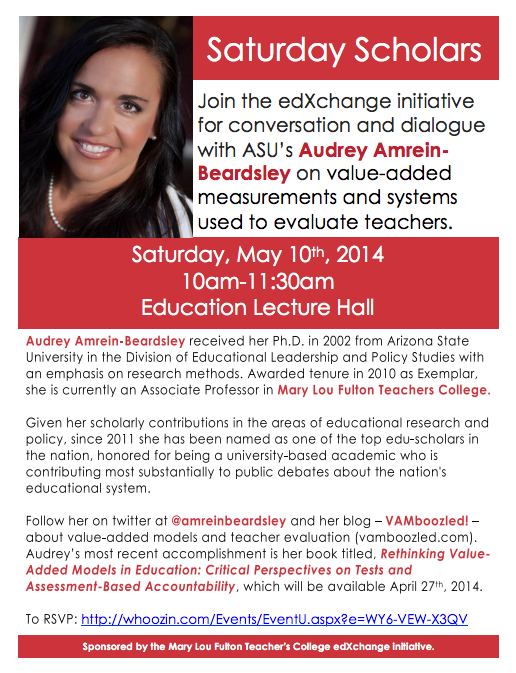
 If you reside in Arizona or plan to travel here soon, I invite you to join me as I discuss my new book, Rethinking Value-Added Models in Education: Critical Perspectives on Tests and Assessment-Based Accountability (available this Sunday, May 4th). To read more about this book, please click here re: a prior post with more of the book’s details.

AZPresentation
This event is free and open to the public, and many representing many constituencies across the state have been invited. It will be held one week from this Saturday, on Saturday, May 10th, 2014 from 10:00am-11:30am in the Education Lecture Hall at Arizona State University (ASU’s main campus).
For more details and to RSVP, please use this link:http://whoozin.com/Events/EventU.aspx?e=WY6-VEW-X3QV
Coffee, tea, and light refreshments will be provided.
Hope to see you all there. If you cannot make it, I will also post the materials-post presentation, for all of you who follow this blog who do not reside in Arizona and feel not so inclined to fly in ;)

Mike Klonsky's SmallTalk Blog: May Day Warning: 'We're rapidly returning to the conditions of Ludlow days.'

Mike Klonsky's SmallTalk Blog: May Day Warning: 'We're rapidly returning to the conditions of Ludlow days.':


May Day Warning: 'We're rapidly returning to the conditions of Ludlow days.'

Ludlow: The striking miners and their families, 1914
BILL MOYERS' blog has an excellent piece on the 100th anniversary of the Ludlow strike and massacre, by Erik Loomis, "US Workers Were Once Massacred Fighting for the Protections Being Rolled Back Today." The headline says it all.
A century later, the bloody incident might seem a relic of the distant past, but the Ludlow Massacre retains a powerful, disturbing and growing relevance to the present. After a century of struggling against powerful interests to make American workplaces safer and corporations responsive to their employees, the US is rapidly returning to the conditions of rampant exploitation that contributed to Ludlow.
The same theme is picked up by Thai Joneswriting in The Nation. He writes, "One hundred years on, the Ludlow Massacre is a starkly contemporary tragedy." Thai's book, "More Powerful Than Dynamite" is the best thing written yet on that period. Here's Rick Ayers' review at Huffington.

BROOKLYN TEACHERS aren't going for it -- Common Core that is. Prospect Heights International HS teachers in Brooklyn are refusing to administer an English Language Arts test Thursday because they believe it is useless to their non-native-English-speaking students. Twenty-six of the school’s 30 teachers sent a letter to Schools Chancellor Carmen Fariรฑa Mike Klonsky's SmallTalk Blog: May Day Warning: 'We're rapidly returning to the conditions of Ludlow days.':

Paul Horton: A Teacher Writes to Arne Duncan - Living in Dialogue - Education Week Teacher

Paul Horton: A Teacher Writes to Arne Duncan - Living in Dialogue - Education Week Teacher:


Paul Horton: A Teacher Writes to Arne Duncan

Guest post by Paul Horton.


Dear Mr. Duncan,
I just wanted to drop you a note to let you know what sane teachers are doing these days.
I attended a rally last night at Union Square Fieldhouse that brought together concerned teachers, parents, and students to discuss standardized testing in Illinois.
We went over sample PARCC reading questions from their website, and most of us guessed wrong on most of the questions. All 80 of us would have failed the test. My guess is that we had a normal curve in the audience, but statistical norms did not seem to measure the results in our somewhat random sample: we had people of all ages, colors, social classes, and grit levels.
My guess is that CPS kids will do much better than us adults, but I doubt that they will do any better than what our state superintendent of education proclaims is our "cut score."
I also shared some secrets I have learned as a teacher with thirty-two years experience: 
1)   Standardized tests do not measure anything important. In one of the questions we took last night, those kids who knew the arcane English use of "cross" would have answered the question correctly. In other words, the kids most likely to answer this question correctly were those who played with Thomas the Tank Engine and companion readers.
2)   Many of my students who score the highest on standardized tests simply have the ability to solve puzzles. Many lack other essential forms of intelligence, and, more importantly, never learn to work hard. Extremely high-test scores might correlate more closely to lack of success, except perhaps in your typical financial or legal grifting.
3)   Huge numbers of kids with huge potential simply do not test well. because standardized tests Paul Horton: A Teacher Writes to Arne Duncan - Living in Dialogue - Education Week Teacher:

NSBA issues guide for schools on data privacy :: SI&A Cabinet Report :: The Essential Resource for Superintendents and the Cabinet

NSBA issues guide for schools on data privacy :: SI&A Cabinet Report :: The Essential Resource for Superintendents and the Cabinet:


NSBA issues guide for schools on data privacy

NSBA issues guide for schools on data privacy

(Va.) Making consistent strides toward bringing modern technology to the classroom isn’t a simple task, and neither is adjusting to obstacles that come with it, such as protecting students’ online privacy.
But school districts considering data protection policies can look to guidance recently released by the National School Boards Association for a brief overview of existing laws, as well as information about online technologies and suggestions for merging student access with security.
“The advantages of Cloud-based platforms and learning tools are obvious – ease, convenience, 24/7 accessibility, less staff time maintaining on-site servers, individualized learning, and compliance with testing requirements,” reads the 10-page report, Data in the Cloud: A Legal and Policy Guide for School Boards on Student Data Privacy in the Cloud Computing Era.”
“But along with these benefits come serious challenges, particularly the potential for loss of privacy that accompanies the transfer of personal student information to the Cloud,” authors note. “Concerns about data privacy are real and must be addressed by public school districts, which reflect the values and norms of their communities.”
This guidance comes as both federal and state officials seek regulations that allow districts to maintain control of private student information even as they expand the use of multi-media and open-source technologies in their classrooms.
School leaders, says the NSBA, must be proactive in efforts to guard the personal information of their pupils and able to articulate their district’s policies, practices and commitment to protecting student privacy.
“Teachers and administrators must understand the necessity of taking steps to ensure that cloud services deployed throughout a district’s offices and classrooms comply with all applicable laws and district policies,” the association’s white paper says. “And the school district community – including parents – should be consulted and educated about the district’s use of the Cloud.”
From districtwide email systems to educational applications accessed via classroom computer, every connection to the Internet is a potential source of student data, report writers said.
“More difficult student data privacy issues arise with the universe of applications available to individual staff and students through a simple Internet connection, often to a device that can fit in a pocket,” reads Data in the Cloud. “These applications create separate ‘doors’ to district data that it may not be able to control in every case.”
Despite all the concerns about student data privacy, however, the NSBA report urges districts not to avoid taking advantage of modern technology to educate students and makes recommendations for doing so safely.
Among the suggestions:
• Identify an individual district-wide Chief Privacy Officer (CPO), or a group of individuals with district-wide responsibility for privacy.
• Conduct a district-wide privacy assessment and online services audit, preferably by an independent third party. By determining what services are currently in use, and to what extent student data is used and protected within those services, your district will have the basis for determining what policy or practice changes are necessary.
• Establish a safety committee or data governance team that includes the school or district’s Chief Privacy Officer. This team engages with the school community regarding proposed and existing use of Internet-based educational services that may use student information, recommends policies and best practices, and serves as the liaison between the school district and the community on privacy issues. This team also could serve as the review board to approve adoption of specific apps and services.
• Regularly review and update relevant district policies and incident response plans, in consultation with your state school boards association and school attorney. Consider including the following in your district’s policy:
  1. Clear guidelines or procedures for evaluation and adoption of Cloud services, which include requiring a written contract; and
  2. Statements regarding whether or when the district may allow the use of student data for service-provider uses outside of the contracted service.
• Consistently, clearly, and regularly communicate with students, parents, and the community about privacy rights and district policies and practices with respect to student data privacy. Include in an annual notice to parents the types of information transferred to Cloud service providers.
There are a number of additional resources mentioned in the guidance to help local educational agencies identify best practices for protecting student privacy.


Senate panel moves bill to restore multilingual K-12 classrooms
(Calif.) A bill that would repeal the core tenets of a 15-year-old ban on the use of bilingual education in the state’s K-12 school system cleared its first legislative hurdle Wednesday – passing out of the Senate Education Committee, where it was lauded as being both necessary and overdue.

5-1-14 The Answer Sheet

The Answer Sheet:


What if we approached testing this way?
Arthur H. Camins writes about the unintended consequences of many education reform policies. Camins is the director of the Center for Innovation in Engineering and Science Education at the Stevens Institute of Technology in Hoboken, N.J. The ideas expressed in this article are his alone and do not represent Stevens Institute. His other writing can be found at www.arthurcamins.com. A version […]

Is the $1 trillion student loan debt really a crisis?
When you read about the more than $1 trillion student loan debt in the United States, the word “crisis” invariably appears. But is it? Donald E. Heller, dean of the College of Education at Michigan State University, offers a different view of the common media portrayal of the issue. By Donald Heller For the last […]


4-30-14 The Answer Sheet
The Answer Sheet: America’s best teachers got a B on this quizThe 62-year-old National Teacher of the Year Program is the oldest national honors program that focuses on teaching excellence, and this week, the 2014 winners from each state, the District and U.S. territories are in the nation’s capital’s for the annual celebration. The teachers have been touring the capital and meeting with various d

Becoming a 'Badass' Teacher - Education Week Teacher

Becoming a 'Badass' Teacher - Education Week Teacher:


Becoming a 'Badass' Teacher


“You are the only one in your school to speak up at faculty meetings (although many people who remained silent come up to you afterward to tell you how happy they are you did).”
“You tell administrators at your school what you really think, not what they want to hear.”
“Your colleagues come to you constantly with problems with the administration that they are afraid to raise themselves.”
Mark Nason, founder of the Badass Teachers Association, wrote these words to describe the teacher many of us want to teach with, want to be, want our children to have. They describe a teacher who is courageous, connected, creative … and so much more. I’m not personally a member of the BTA, and in fact I disagree with many of the group’s initiatives. But I appreciate Nason’s description of an outspoken, driven educator. As I read it, I remember admired colleagues, friends, and teachers of my own that perfectly fit the bill.
But is ‘badass’ something one just is as a teacher? Is it an inherent quality that one either has or doesn’t have, like being tall, musically talented, or athletic? Is badass a binary proposition—on or off, no in-between? Can one become badass, learn to be what Nason describes, and build conditions in which these qualities can develop naturally?
Personally, I think so. I think badass isn’t something one is by virtue of membership in a group or by ascribing to a certain set of specific beliefs or behaviors. I think it’s something one becomes. I think that teachers and educational allies who are described by their peers as badass tend to develop, both through personal initiative and experience, the following qualities:
1. Creativity: Badass teachers know that the best way to solve a problem is often the unexpected path. They cultivate a creative spirit both personally and professionally. They also have a sense of humor and they apply it liberally in all kinds of situations because they know that we can take the work seriously without taking ourselves too seriously.
2. Courage: Badass teachers know that being brave and being stupid aren’t the same thing. They know when and how to take action in ways that will help students—and teachers—to be successful. They’re brave enough to connect, to be vulnerable, to take instructional and professional risks. They know that courage is doing what needs to be done because the action that needs to be taken is more important than the fear—but sometimes the bravest thing one can do is wait, watch, and go back to school each day.
3. Personal Identity: Badass teachers know who they are when they aren’t being Becoming a 'Badass' Teacher - Education Week Teacher:

Teachers Union President Paid Less than Most Charter School Bosses

Teachers Union Boss Randi Weingarten: My Salary's Only $360K:


American Federation of Teachers (AFT) President Randi Weingarten, who was paid $543,150 last year, defended her compensation by claiming her pay is $360,000 and other reported expenses simply prove the union’s “transparency.”
As part of a series of April 28 Twitter posts demanding Congress hike the federal minimum wage to $10.10, Service Employees International Union (SEIU) District 1199 quoted from a January column Weingarten wrote for The Huffington Post.
“Justice means that hardworking people must have access to a living wage,” Weingarten wrote. AFT paid Weingarten $556,981 in 2012 and $543,150 in 2013.
When her 2013 pay was pointed out on Twitter, Weingarten made an awkward attempt to defend the gold-plated compensation she takes from AFT members and forced “fair share” fee payers in districts represented by AFT:
rweingarten-pay-tweet-2014-04-28

Note that SEIU District 1199, far from reacting with shock that a leading spokeswoman for government redistribution of wealth took over $360,000 from workers last year, replied to Weingarten, “you do amazing work for working people, children and their families.”
For the fiscal year ending June 30, 2013, AFT reported Weingarten’s gross salary as $401,578. In addition to her salary, the union reported disbursing $51,440 in “allowances,” $62,632 “for official business,” and $27,500 in “other disbursements” to Weingarten.
An excerpt from AFT’s fiscal year 2013 LM-2 report to the U.S. Department of Labor (DOL) follows. Click the image for more information.
weingarten-pay-AFT-2013-LM2-DOL-thumb

Generously calculating from Weingarten’s gross salary reported by AFT and assuming 52 work weeks of 50 hours each, Weingarten’s 2013 pay would equate to an hourly wage of $154.45.
By AFT’s own estimation, Weingarten spent less than one third of her time on “representational activities” from July 1, 2012 to June 30, 2013.
Weingarten further attempted to justify the more than half a million dollars the union disbursed to Teachers Union Boss Randi Weingarten: My Salary's Only $360K:


5-1-14 LA School Report - What's Really Going on Inside LAUSD

LA School Report - What's Really Going on Inside LAUSD (Los Angeles Unified School District):


Candidates for board seat, CA education chief at USC forum
Yet another education-related candidate forum has been scheduled for Los Angeles, this one on Saturday at USC, and it’s unusual in that it will include back-to-back conversations with candidates for the open board seat for LA Unified’s District 1, then another with those running for State Superintendent of Public Instruction. The co-sponsors — Parent Revolution, the Los Angeles Urban League and St


De Blasio announces contract deal with teachers’ union
Via The New York Times | By Michael M. Grynbaum and Nikita Stewart Mayor Bill de Blasio, confronting a key challenge of his first year in office, announced what he called a “landmark” labor deal on Thursday with New York City’s largest teachers’ union that officials said would provide a framework for dozens of other outstanding contracts with the municipal work force. The deal, hammered out in mar

USC ‘masters’ to hear grad speech from LAUSD’s Melendez
Thelma Melendez Commencement season is upon us and with it, the rush to find moving speakers to lead graduating students through the expensive right of passage. Sometimes schools get lucky, such as UC Irvine, which this year reeled in President Barak Obama by sending 10,000 postcards from students, staff and alumni, inviting him to be the guest of honor. Other times, schools look to their own past
JUST IN: Plan to use ‘Need Index’ to go before LAUSD board
In a surprise move, LA Unified school board will consider a resolution that supports the use of an alternative formula, known as the “Student Need Index,” in deciding how to distribute school funds throughout the district. LA School Report has learned that Monica Garcia and Board President Richard Vladovic have agreed to co-sponsor a resolution to put before the board at its next meeting, on May 1

Kayser sniffing out problems with scented soap in LAUSD schools
LA Unified Board member Bennett Kayser is not only thinking about the LCAP, arts education, and transitioning to Common Core standards, he’s also thinking about soap. Specifically, unscented soap. According to Kayser, who has championed a variety of health issues since joining the board, the almond-scented, goopy, pink soap found in nearly every restroom, classroom or kitchen on an LA Unified camp


Morning Read: LAUSD budget aims at helping foster children
LAUSD foster kids to get more help from school social workers Los Angeles Unified’s plan to help some of its most troubled students — foster kids — calls for creating a corps of social workers and manning 17 centers in poverty-stricken neighborhoods. If approved, the $32.7 million effort would hire 95 social workers to manage California’s largest classroom population of foster children, 11,604. LA


4-30-14 LA School Report - What's Really Going on Inside LAUSD
LA School Report - What's Really Going on Inside LAUSD (Los Angeles Unified School District): Decathlon title in hand, El Camino Real gets ready to celebrateThe winning teamPhoto: LA Daily News And now for the celebration. In honor of its seventh national Academic Decathlon championship, El Camino Real Charter High School in Woodland Hills is holding a rally tomorrow morning for a team that won th