Latest News and Comment from Education

Wednesday, January 29, 2020

NewBlackMan (in Exile) TODAY

NewBlackMan (in Exile)

NewBlackMan (in Exile) TODAY


Looking Back On A 'Decade Of Fire'

'In the 1970s, a string of devastating fires would help make the South Bronx a symbol of urban decay. In her documentary Decade of Fire , co-director Vivian Vázquez Irizarry , who grew up in the South Bronx, tries to dissect and counter that negative image through a personal lens. The documentary analyzes how the city, state, and federal governments abandoned the Bronx in the 1970s, and how despi
On The Frontlines Of Autism Research: North Carolina Professors Study Early Detection, Treatment

'Researchers at the University of North Carolina at Chapel Hill say they can detect autism spectrum disorder before it manifests in some young children, and they’re even developing treatments for some of the conditions that go hand-in-hand with autism. Professors Mark Zylka and Joe Piven work among more than two dozen scientists at UNC focused on autism spectrum disorder, and the National Institu
'Franchise' Tracks The Rise And Role Of Fast Food In Black America

'History professor Marcia Chatelain 's new book, Franchise: The Golden Arches in Black America, tracks what she calls the hidden history of the relationships between the struggle for civil rights and the expansion of the fast food industry.' -- All Things Considered
Finding Strength In Fragility: Meet Maya Freelon

'Durham artist Maya Freelon ’s large tissue paper installations have hung in the halls of the Smithsonian Arts and Industries Building and the North Carolina Museum of Art. She has received commissions from Google and Cadillac and was recently named one of five young artists to watch during Miami Art Week 2019. Her techniques transform tissue paper from schoolhouse craft to fine art and create co
The Barriers to Finding Mental Healthcare While Black

'There are many barriers to mental health care in the United States, including insurance, cost, and availability of therapists or psychiatrists. For people of color, these barriers can be much higher. Only around 4% of therapists are Black, and Black Americans are less likely to seek out mental health care. Dr. Joy Harden Bradford is the host of the podcast Therapy for Black Girls , and she recen
Carrie Mae Weems: 'How Do You Measure a Life'

'Artist and MacArthur fellow Carrie Mae Weems recites a piece called, “How Do You Measure a Life.” An excerpt from the MLK celebration hosted by Jami Floyd, Alison Stewart and WQXR’s Terrance McKnight at the Apollo. This year’s theme was “The Strategic King: MLK's Visionary Leadership' -- All Of It
How a Lost Recording Became a Philadelphia Soul Classic

'Philadelphia's Sigma Sound Studios recorded more than 200 gold and platinum records before closing its doors in 2003, eventually donating 7,000 tapes to Drexel University, including recordings by Stevie Wonder , David Bowie , Gladys Knight and hundreds of other unknown artists. Christoper Booker reports on the search for hidden gems in one of the city's most comprehensive musical archives.' -- P


Imran Mohammad on Genocide, Detention, and Refugeehood

'Taking advantage of his visit in Chicago, Léopold Lambert talked with our past contributor Imran Mohammad . In November 2017, he wrote a text for us about the Rohingya genocide that he fled while he was living his fourth year of detention in an Australian camp detaining hundreds of exiled people on Manus Island, Papua New Guinea. A few weeks later and while many detainees organized forms of revo
NewBlackMan (in Exile)

Another attempted cash grab by the corporate ed crowd in Washington State: House Bill 2788 – Seattle Education

Another attempted cash grab by the corporate ed crowd in Washington State: House Bill 2788 – Seattle Education

Another attempted cash grab by the corporate ed crowd in Washington State: House Bill 2788


The League has opposed charter schools because they don’t have boards elected by the voters but instead the corporation running the schools appoints the board.
cashEven though charter schools have been a big fail in Seattle, as we said they were in other states ten years ago, the corporate education advocates still want money for what has shown to be simply one big cash grab by taking away money from PUBLIC schools.
There is a bill, HB (House Bill) 2788, if approved,  would allow charter schools to receive levy funding raised by the City of Seattle. This funding has been used previously for PUBLIC schools to supplement state funding.
pettigrewState House Representative Eric Pettigrew, who has no problem selling his own people down the river, is the lead sponsor of this bill. For examples of his untiring bidding for the moneyed few, see Rainier Beach High Schools responds to the League of Education VOters Attack on its Shool and CommunityApartheid House Bill 1860: No one wants to split Seattle in two except for Reps. Santos, Pettigrew and oh yeah… Magendanz. Remember him?, and House Rep. Eric Pettigrew, House Bill 1497, mayoral control and the money.       
Testimony will be heard in the House Appropriations Committee today at 3:30 PM.
Catherine Ahl, the Education Chair for the League of Women Voters of Washington, CONTINUE READING: Another attempted cash grab by the corporate ed crowd in Washington State: House Bill 2788 – Seattle Education

2020 Medley #3: Are we planning for the future? | Live Long and Prosper

2020 Medley #3: Are we planning for the future? | Live Long and Prosper

2020 Medley #3: Are we planning for the future?


WHAT MESSAGE ARE WE SENDING THE FUTURE?
I won’t be here to see the next century when today’s infants will be “the elderly.” It’s my responsibility, however, to do what I can to help keep the Earth habitable for my children, and for their children.
…and for their children…and for their children.
Currently, the world’s adults have been unable to let go of fossil fuels and the political and social control that billions of dollars of oil and gas money provide.
Some of our children have become aware of this, so they are trying to take control of the fight against fossil fuels in a quest to save the Earth’s life-friendly climate. It was disappointing, then, to read the ruling that children — who will live on the Earth long after the Koch brothers and the current administration are gone — could not show “standing” to sue to protect their own future.
The term, “standing,” in its legal sense, is “the ability of a party to demonstrate to the court sufficient connection to and harm from the law or action challenged to CONTINUE READING: 2020 Medley #3: Are we planning for the future? | Live Long and Prosper

School Choice Plus Student Based Budgeting: Destroys Public Schools in Poor Neighborhoods | janresseger

School Choice Plus Student Based Budgeting: Destroys Public Schools in Poor Neighborhoods | janresseger

School Choice Plus Student Based Budgeting: Destroys Public Schools in Poor Neighborhoods


Those who favor school privatization and school choice through the expansion of charter schools and school voucher programs frame their advocacy by privileging individual choosers.  They assume that the mass of individual families’ choices in an educational marketplace will improve services for and protect the rights of a city’s children.  These assumptions are wrong.
In a major 2016 report for the Economic Policy Institute, Bruce Baker, the education finance expert at Rutgers University, rejected the contention that the expansion of school choice will improve educational opportunities overall. Baker argued that what matters is the balance of educational opportunity across the school district: “If we consider a specific geographic space, like a major urban center, operating under the reality of finite available resources (local, state, and federal revenues), the goal is to provide the best possible system for all children citywide… Chartering, school choice, or market competition are not policy objectives in-and-of-themselves. They are merely policy alternatives—courses of policy action—toward achieving these broader goals and must be evaluated in this light. To the extent that charter expansion or any policy alternative increases inequity, introduces inefficiencies and redundancies, compromises financial stability, or introduces other objectionable distortions to the system, those costs must be weighed against expected benefits.”
Washington, D.C. is the latest example of a place where it is becoming clear that school choice for some children is damaging the overall operation of public education. This is the conclusion of new research conducted by Johns Hopkins University for the Office of the D.C. Auditor.
The Washington Post’s Perry Stein explains: “When D.C. families choose a school that is not their assigned neighborhood campus, they tend to select schools that educate fewer students CONTINUE READING: School Choice Plus Student Based Budgeting: Destroys Public Schools in Poor Neighborhoods | janresseger

NYC Educator: No NY Teacher Should Have More than Two Co-teachers

NYC Educator: No NY Teacher Should Have More than Two Co-teachers

No NY Teacher Should Have More than Two Co-teachers


It's tough keeping up with the geniuses in Albany. They have so many ideas, and they are so smart that each one must be followed to the letter. They are not to be criticized because they are the Regents, the closest thing NY State has to popes, or saints, or statues so sacred birds won't poop on them.

In their infinite wisdom, they rewrote CR Part 154 so that students who don't know English would get less English instruction. Though they gave them no more time, they decreed that if some ESL teacher sat his or her posterior in a subject class full of ELLs, the students would magically learn not only the subject, but also all the English and culture associated with it. If it takes 45 minutes for a native English speaker to learn about chapter one of To Kill a Mockinbird, an ELL can learn not only that, but also all the vocabulary, idioms, background info, and everything else a native American English speaker can learn.

How does that happen? No one knows, but since the Regents say so, that should be good enough for anyone. So people scream at me that I'm not kind enough to the geniuses in Albany, that they are experts, and that they know.

Here's the thing, though. On this astral plane, there are consequences. Yesterday I spoke to a high school teacher who had five co-teachers. I'm acquainted with an elementary teacher who has nine. Now how do you co-plan with five teachers? How do you co-plan with nine teachers. The short answer is you don't. You walk in those classrooms and hope for the best. You can't possibly anticipate what the teachers will do.

Even if you could, you're a third wheel. Teachers may think you don't belong in the classroom. After all, they're there each and every day and CONTINUE READING: 
NYC Educator: No NY Teacher Should Have More than Two Co-teachers

Lessons Learned from Technology-powered School Reform | Larry Cuban on School Reform and Classroom Practice

Lessons Learned from Technology-powered School Reform | Larry Cuban on School Reform and Classroom Practice

Lessons Learned from Technology-powered School Reform


On June 13, 2018. I was a member of a panel held at Mission High School during San Francisco Design Week. Software developers, and others who see themselves as designers of ed-tech products that will improve schools attended this panel discussion. The moderator asked each of us to state in 7-8 minutes “what hard lessons have you learned about education that you’d like to share with the ed-tech design community?” My fellow panelists were two math teachers–one from Mission High School and the other a former teacher at Oakland High School, three product designers (one for the Chan/Zuckerberg Initiative, another for Desmos, and the lead designer for Khan Academy) who have been working in the ed-tech industry for years. In attendance were nearly 60 young (in their 20s and 30s) product designers, teachers, and ed-tech advocates .
Elizabeth Lin, a designer for Khan Academy, organized and moderated the panel. She began with a Kahoot quiz on Pokemon and Harry Potter. Audience members had the Kahoot app on their devices and entered the pin number to register for the quiz. For the record, I knew none of the answers having never played Pokemon or, as yet, cracked a Harry Potter book. 
When my turn came to speak, I looked around the room and saw that I was the oldest person in the room. Here is what I said.
Many designers and school reformers believe that in old age, pessimism and cynicism go together. Not true.
As someone who has taught high school history, led a school district, and CONTINUE READING: Lessons Learned from Technology-powered School Reform | Larry Cuban on School Reform and Classroom Practice

Letter to Seattle Public Schools Leadership Demands Accountability for Abuse in its Schools — & the District’s Silence – Seattle Education

Letter to Seattle Public Schools Leadership Demands Accountability for Abuse in its Schools — & the District’s Silence – Seattle Education

Letter to Seattle Public Schools Leadership Demands Accountability for Abuse in its Schools — & the District’s Silence


It seems very quiet at the offices of the Seattle School District’s John Stanford headquarters, in spite of a bombshell story about the district’s tolerance of student abuse in the classroom by the adults in charge.
The mismanagement of the district was on display and in the news recently with the School Board’s Jan. 22 vote to begin the process of dismantling its Highly Capable education program (see herehere, and here). This action ignored opposition from families, students and the recommendations of its own Advanced Learning Task Force.
And now a new outrage has emerged. The next day, on Jan. 23, Ann Dornfeld, a reporter for KUOW (94.9 FM), broke a lengthy story about rampant abuse in the classroom at Washington Middle School and in other places:
“A KUOW investigation found that Seattle Public Schools often allows teachers who harm students to stay in the classroom. Some are allowed to keep teaching even after multiple offenses. 
The district has also, on at least one occasion, removed evidence of misconduct from a teacher’s personnel file after forcing them out of the district.  Through a public records request, KUOW obtained records for 10 cases in which teachers CONTINUE READING: Letter to Seattle Public Schools Leadership Demands Accountability for Abuse in its Schools — & the District’s Silence – Seattle Education

On Data Privacy Day, please contact your state Attorney Generals and urge them to investigate the selling of student data by the College Board | Parent Coalition for Student Privacy

On Data Privacy Day, please contact your state Attorney Generals and urge them to investigate the selling of student data by the College Board | Parent Coalition for Student Privacy

ON DATA PRIVACY DAY, PLEASE CONTACT YOUR STATE ATTORNEY GENERALS AND URGE THEM TO INVESTIGATE THE SELLING OF STUDENT DATA BY THE COLLEGE BOARD


Today, January 28th is Data Privacy Day, the international annual day of action and awareness to promote the privacy of our personal data.
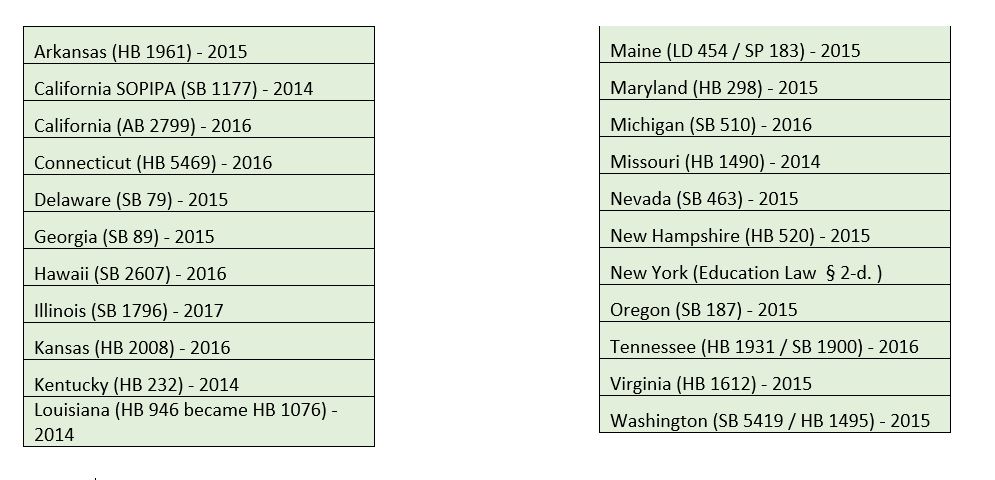
The College Board and ACT sell personal student data at a profit.  Yet twenty one states prohibit this practice by school vendors, operators or service providers,  under any  conditions; see list   below.  Most every district or state contracts with one of these organizations to administer the PSAT, SAT, AP or ACT exams to students in school.
The College Board sells student data for 47 cents per student  to colleges and other organizations, including some for-profit companies, but have refused to make the list public. They offer them student test scores within a range, and other  personal information deceptively gathered from students via surveys administered before their exams.  As the Wall Street Journal explained, one reason colleges buy the data is to lower their acceptance rates and selectivity, by luring far more students to apply than they have any intention to accept. Most outrageously, the College Board falsely claims they don’t sell student data on their privacy policy, instead saying they “license” the data, a difference without a distinction.
This needs to stop.  Please contact your state Attorneys General today, and ask them to investigate these illegal practices, which violate state student privacy laws and the laws that most every state has that bar deceptive practices.  Thanks!
On Data Privacy Day, please contact your state Attorney Generals and urge them to investigate the selling of student data by the College Board | Parent Coalition for Student Privacy

First of a Series on Project-Based Learning | The Merrow Report

First of a Series on Project-Based Learning | The Merrow Report

First of a Series on Project-Based Learning


In hopes that your children or grandchildren will be doing school projects later this year, for the next few weeks I will devote this space to project-based learning and some ideas for projects.  
Project-based learning has significant benefits.  First of all, students become producers of knowledge, not mere consumers of information that others decree they must know.  They own what they learn, and they reap the satisfaction of possessing expertise.  Moreover, they develop (or sharpen) a skill the adult workplace values: the ability to work with others. 
The best projects meet these five criteria: 
     1) The topic is of interest to whoever’s adopting it;
     2) The issue is significant, not trivial
     3) The project follows ‘The Goldilocks Rule.’  Neither huge and grandiose (“Solving the Middle East crisis”) nor tiny and trivial (“Comparing the rate of growth of avocado pits under different conditions“).  Instead, it’s “Just Right” so that students can get their CONTINUE READING: First of a Series on Project-Based Learning | The Merrow Report

Tuesday, January 28, 2020

Leading While Woman: Challenges, Mazes, Labyrinths, and Glass Ceilings | Cloaking Inequity

Leading While Woman: Challenges, Mazes, Labyrinths, and Glass Ceilings | Cloaking Inequity

LEADING WHILE WOMAN: CHALLENGES, MAZES, LABYRINTHS, AND GLASS CEILINGS


Today I’d like to relay a call for proposals for a special issue of The SoJo Journal: Educational Foundations and Social Justice Education entitled Leading While Woman: Challenges, Mazes, Labyrinths, and Glass Ceilings edited by Azadeh F. Osanloo, New Mexico State University,
Azadeh writes,

The SoJo Journal: Educational Foundations and Social Justice is interested in research studies which include conceptual, theoretical, philosophical and policy analysis essays challenging the existing state of affairs in society, schools and (in)formal education.

From a historical perspective, in terms of foundations and social justice in education; leading as a woman is complex. Several factors contribute to the inequity women face in educational leadership such as societal and social variables, including but not limited to: systemic oppression, gender bias, family structure, personal and professional development; and academic culture. All potentially affect the process of progressive leadership (change) in educational settings. Albeit a social construct, gender often adds to the complexity of women in leadership as a result of several social assumptions regarding leadership styles of women (i.e. femininity, aesthetic, emotion, and behavior). In terms of “leading while woman,” few of the same characteristics are typically representative of men, often creating a barrier of social constructs between men and women in educational leadership roles (Waylen, Celis, Kantola & Weldon, 2013). For women, the search for regularity and equity in higher educational leadership is real. This call specifically considers women in educational leadership, lending from perspectives of both scholars and practitioners committed to social change and promotion of equity inside and outside of the PK-20 educational pipeline.
 
From a social justice perspective, gender diversity is critical. For women to obtain equitable access to opportunities in educational systems like – social mobility, economic parity, and fair ascension to leadership positions – transparent discourse regarding social justice practices and clear requirements regarding institution policy are imperative. Leading while being a woman is challenging; not from a perspective of deficit, but in recognition of the responsibility and barriers women face historically, socially, and institutionally.
 
The proverbial “glass ceiling” has been disrupted, since women are both capable and able to obtain the same executive-level leadership roles as men. However, the idea implies women and men have equitable access to entry and mid-level positions, which is inaccurate (Eagly & Carli, 2009). Historically, women have a more difficult time obtaining traditionally non-female dominated positions regardless of the level. It remains a challenge for women to achieve goals past one particular obstacle, and the “glass ceiling” metaphor implies women are unable to conceptualize a complex, evolving professional life (Eagly & Carli, 2009).
 
A more thorough, forward-thinking explanation regarding the maze of challenges and complicated trajectory most women in leadership roles face, is the Labyrinth Metaphor. The suggestion details the broader picture of the complexity of work-life balance, and addresses barriers such as sex discrimination while also addressing societal expectations such as a women’s domestic and home-life responsibilities (Martin, 2007). The Labyrinth Metaphor is based on leadership from perspectives of educational psychology, economic factors, communication practices, management styles and sociology methods (Martin, 2007). The motivation for the metaphor was to increase gender equality in the workplace, which authors suggest change on a number of levels including “the culture, the organization, the family and the individual” (Martin, 2007, p. 90).
 
Based on the suggestion of the labyrinth metaphor and refuting the “glass ceiling” phenomena, educational researchers are emboldened to acknowledge other aspects of inequity. Educational environments, which theoretically provide safe spaces for learning and personal growth, can exacerbate negative contexts in relationships thus hindering positivity in many learning environments (Yoon, Barton & Taiariol, 2004). For example, the societal representations of bullying and the “mean girl” culture are historical illustrations of women protecting their status and cultivating their power in cruel ways (Ryalls, 2011). The term is used to describe women using indirect, passive-aggressive behavior destroying other relationships, including efforts causing their victims to feel attacked and marginalized (Ryalls, 2011). The aggression displayed in the context of “mean girl behavior” is often associated with adolescence, however the behavior, in terms of a historical standpoint and expectations of society, tends to carry on through the lives of adult women as well (Driscoll, 2008), often creating a pattern of behavior with negative consequences for other women.
 
For higher education specifically, representation of the academic bullying culture, and/or the academic “mean girl” is evident when identifying factors such as “faculty incivility” which describes perceived harassment, passive-aggressive behavior and bullying from a colleague without clear intent or reason (Twale & De Luca, 2008). The term is used to identify several variables which contribute to academic bullying behavior (Twale & De Luca, 2008).
 
Talking points include the following:

  • • Faculty Incivility
  • • Societal expectations
  • • Gender bias
  • • Institutional sexism
  • • Marginalization
  • • Work-life balance
  • • Maze of Challenges
  • • The “mean girl” phenomenon

Timeline

An early expression of interest and a 500-word abstract is required by March 1, 2020. Manuscripts (20-30 pages double-spaced) are due June 20, 2020. An expectation for the publication is November 1, 2020 Please address correspondence and submissions to azadeh@nmsu.edu and include “SoJo Special Issue” in the subject line.
 
Dates at a Glance

  • March 1, 2020 – 500-word abstract due to azadeh@nmsu (include “SoJo Special Issue” in the subject line)
  • March 15, 2020 – Authors receive notification that their abstract was accepted and are invited to submit a full manuscript.
  • June 20, 2020 – Manuscripts due
  • July Review Process
  • September 1, 2020– Revised drafts due to Special Issue Editor
  • November 1, 2020 – Publication Date (Tentative)

Style Guidelines

All manuscripts must adhere to APA sixth addition format, include an abstract with 100-150 words, 3-4 keywords, and range between 20-30 pages in length (including tables, charts, figures and references). Two copies of the manuscript should be attached: 1) a master copy including a title page and 2) a blind copy with the title page and all other author-identifying information removed (including citations and references pertaining to any of the contributing authors’ works).
 
Submission Guidelines
 
1. Papers should not exceed 20-30-page limit without consulting editors.
 
2. APA citation, 12 point, Times New Roman
 
3. Papers should be saved as “author last name-title of paper” and saved as a doc or docx, (For example, Jackson-Women leaders in higher education.docx)
 
4. Papers should be submitted to the following email with the name of the file (as above) in the subject heading.
 
5. Completed papers should be emailed by June 20, 2020 to azadeh@nmsu.edu
 
6. All questions should be submitted to azadeh@nmsu.edu
 
Journal Contact
 
Azadeh F. Osanloo
 
Co-Editor-In-Chief
 
The SoJo Journal: Educational Foundations and Social Justice Education
 
New Mexico State University
 
1220 Stewart St., Las Cruces, NM 88003
 
Phone: 575-646-5976
 
Email: azadeh@nmsu.edu
Also, we will be hosting a symposium at the University of Kentucky College of Education in February 11 entitled: Continuing the Diversity, Equity, and Inclusion Conversation: Gender and Equity. Stay tuned to Cloaking Inequity for details.
Please Facebook Like, Tweet, etc below and/or reblog to share this discussion with others.
Check out and follow my YouTube channel here.
Twitter: @ProfessorJVH
Click here for Vitae.

Book Tour Diary: Early Days | Diane Ravitch's blog

Book Tour Diary: Early Days | Diane Ravitch's blog

Book Tour Diary: Early Days

My new book SLAYING GOLIATH was launched in Park Slope, Brooklyn, on January 21. It was a delightful event, with Carol Burris and I discussing the book, talking about the national picture, and explaining the role of the Network for Public Education in pushing back against the Billionaire Combine. It was a lively and engaged crowd, including Lisa Rudley of New York State Allies for Public Education, one of the heroes of my book.
On Friday, Mary and I flew to Fort Lauderdale, where one of my nephews was getting married. It was a good time to catch up with family whom I don’t see often and to eat vast quantities of food (blowing away one of my New Year’s resolutions).
After the wedding festivities concluded, we moved to the apartment of New York friends who spend every winter in Fort Lauderdale.
Monday night was an event at one of America’s best independent bookstores: Books and Books in Coral Gables. And what a bookstore it is! I’m glad I got there early, with time to browse the shelves of this beautiful store, which has a vast supply of unusual books of CONTINUE READING: Book Tour Diary: Early Days | Diane Ravitch's blog

Big Education Ape: My Book Tour Dates for SLAYING GOLIATH | Diane Ravitch's blog - https://bigeducationape.blogspot.com/2020/01/my-book-tour-dates-for-slaying-goliath.html

Pennsylvania: Superintendents Form Coalition to Fight Privatization | Diane Ravitch's blog

Pennsylvania: Superintendents Form Coalition to Fight Privatization | Diane Ravitch's blog

Pennsylvania: Superintendents Form Coalition to Fight Privatization


The Resistance grows!
Press Advisory: Thirty Regional School Superintendents To Come Together to Defend Public Education, Joining Public District Leaders from Across the State to Urge Reform of Pennsylvania’s Charter School Law
When: Monday, January 27, 2020 10 a.m.
Where: Whitehall Elementary, 399 North Whitehall Road Norristown, PA 19403
Leaders Form Coalition and Support a Moratorium on New Charter Enrollment Until Laws Can be Reformed

Leaders from public school districts in the five-county Greater Philadelphia region are joining with others from across the state in calling for meaningful, substantive reform of Pennsylvania’s charter school laws. They also support a moratorium on new charter school applications and a freeze on additional seats for students at existing charters until reform is enacted. Public school superintendents and other top school administrators recently formed LEARN, Leaders for Educational Accountability and Reform Network, as a way to coalesce around urgent issues impacting public schools, such as charter reform. They are calling for reform to the way charters are funded, as well as an improvement in accountability and oversight. Citing an extremely CONTINUE READING: Pennsylvania: Superintendents Form Coalition to Fight Privatization | Diane Ravitch's blog