Latest News and Comment from Education

Thursday, January 16, 2020

AstroTurf Alert: National Parents Union is Thinly Veiled Union Busting Backed by Billionaire Cash | gadflyonthewallblog

AstroTurf Alert: National Parents Union is Thinly Veiled Union Busting Backed by Billionaire Cash | gadflyonthewallblog

AstroTurf Alert: National Parents Union is Thinly Veiled Union Busting Backed by Billionaire Cash
How do you do something disgusting without hurting your image?
If you’re the Walton Family, you hide behind a mask.
That’s what their latest AstroTurf front group is – the so-called National Parents Union (NPU).
It’s a way to bust teachers unions, destroy public schools and profit off of students behind the guise of a friendly parents organization.
Oh, it’s all funded with oodles of cash from the Walton family and other billionaires but they get to pretend to be nothing but supporters on the sidelines.
The people who bust unions before most of us have even had breakfast yet claim they have nothing to do with this anti-union movement. It is all the parents doing. The Walmart heirs just put up the money to let these parents live their dream of union free schools – as if schools where educators have no rights or intellectual CONTINUE READING: AstroTurf Alert: National Parents Union is Thinly Veiled Union Busting Backed by Billionaire Cash | gadflyonthewallblog

NYC Educator: UFT Delegate Assembly January 15, 2020--The Census, the UFT Legal Plan, and the Chapter Leader Network

NYC Educator: UFT Delegate Assembly January 15, 2020--The Census, the UFT Legal Plan, and the Chapter Leader Network

UFT Delegate Assembly January 15, 2020--The Census, the UFT Legal Plan, and the Chapter Leader Network


UFT President Michael Mulgrew welcomes us. 4:34

Speaks of support for chapter leaders and delegates. Says chapter leader most important union position, as members identify with CL. Says work from focus group will go live February 3rd to several districts. Will roll out over week. There will be a chapter leader community on internet and CLs can ask questions. There is a knowledge base that UFT phone support uses, and from February on CLs will have access to it. This knowledge base evolves as new questions are asked.

There are issues with incorrect answers to questions and knowledge base can help cut down on that. Will be a CL chat room. There will be rules, and legalities, not for political use inside and outside of the union. Urges against bad language.

There will be a my school section with basic info. There will be a repository of school info so new CLs can see it, including SBOs and grievances. Union looking for other ways to use it, new applications, and urges constant back and forth. CL handbooks may be put online.

Looking to have a high percentage of registration for this. Tying this to a project. Everyone will get a letter signed my Mulgrew, Carranza and president of CSA saying that math and ELA must have a plan tied to new standards. Test scores aren’t everything, but we don’t want a dramatic drop either. UFT will do inventory, and CLs will have to log on and provide info on what materials school uses. Union will provide support.

Majority of existing materials are not aligned to new standards. Materials can be modified to do so. Will have to be evaluated by committees, which will approve or not.

Phase two will be lists of approved materials. Schools can choose from these materials and curriculum and programs will be provided by DOE. Each school district in NYC, and each CONTINUE READING: 
NYC Educator: UFT Delegate Assembly January 15, 2020--The Census, the UFT Legal Plan, and the Chapter Leader Network


Choosing Democracy: Help Qualify Schools Initiative

Choosing Democracy: Help Qualify Schools Initiative

Help Qualify Schools Initiative
Collect Signatures Now.  
mlares1972@gmail.com


‘Are You Thinking About Suicide?’ - NEA Today

‘Are You Thinking About Suicide?’ - NEA Today

‘Are You Thinking About Suicide?’

By Mary Ellen Flannery


“In the last nine days, in just this area, we’ve lost another three students to suicide,” said Tim Warnock, a physical education teacher in the suburbs of Phoenix, after a series of student deaths in October 2019.

The numbers are scary and sad, but not shocking to Warnock or his wife Lorie, a high school English teacher of 28 years. The couple knows all too well that Arizona’s teen suicide rate has increased 25 percent over the past three years. “There is a suicide epidemic,” says Lorie Warnock flatly.

An incredible one in six high school students reported “seriously considering suicide” in 2017, including nearly one in four girls and almost half of gay, lesbian, and bisexual students, according to the U.S. Centers for Disease Control and Prevention (CDC) data. At this rate, every high school teacher—and many educators of younger students—knows a student considering suicide. But these young people can be kept safe, experts say.

This topic can be really overwhelming. It can feel like, ‘Oh my gosh, is there nothing we can do as a society?’” says psychologist Lindsey Giller of the Child Mind Institute. “There are things we can do. Suicides can be prevented.”

Recognizing risk factors is one thing. What’s more important is knowing to pull up a chair and ask, “Are you thinking of suicide?”—and when you hear yes, knowing where to take CONTINUE READING: ‘Are You Thinking About Suicide?’ - NEA Today

Paul Horton: Technology and Unemployment: A Lesson - Living in Dialogue

Technology and Unemployment: A Lesson - Living in Dialogue

Technology and Unemployment: A Lesson


By Paul Horton.
It is clear to most critics and economic commentators that digital technology is displacing work and cheapening much of the work that remains.  Amazon is likely to replace many warehouse jobs with robots once robots are created that can grasp packages. The consulting firm McKinsey predicts that many retail jobs will be replaced by the digital market and home delivery in the next fifteen years.
Defenders of the new tech economy counter this commentary with the idea that when robots replace people, more programmers and technicians will be needed to create more robots. But many doubt that enough jobs will be created, and Marc Zuckerberg, for example, has begun to support the idea of a minimum earned income for those who are unemployed or underemployed as a result of technological unemployment.
Jaron Lanier and Jonathan Taplin are two of the critics of the tech sector’s assault on the middle man and the middle class.  Both Lanier and Taplin are especially critical of the squeezing of what might be called the “creative class” of knowledge workers and artists who had been heretofore seen as the harbingers of innovation within a postindustrial society. For both, economies of scale created by digital platforms controlled by the likes of Amazon, Facebook, and YouTube are driving down the value of the work produced by artists, musicians, and writers.
Not only is all work threatened by robotics, but creative work that is produced outside of the corporate technosphere, work that is associated with creative innovation, is cheapened or bought and coopted at lower value.
As you read the following, think about whether you agree or disagree with Lanier and Taplin. Do they exaggerate in your opinion?
From Jaron Lanier: Who Owns the Future? (2003):
As the information economy arises, the old specter of a thousand science fiction CONTINUE READING: Technology and Unemployment: A Lesson - Living in Dialogue

News about arguments in our class size lawsuit & WEDNESDAY’s radio show | Class Size Matters

News about arguments in our class size lawsuit & tomorrow’s radio show | Class Size Matters | A clearinghouse for information on class size & the proven benefits of smaller classes

News about arguments in our class size lawsuit & WEDNESDAY’s radio show


Dear friend,
1.Yesterday, the class size lawsuit against the city and the state that we filed more than a year ago, along with nine NYC parents from every borough and the Alliance for Quality Education, was heard in the Appellate court in Albany. Our pro bono attorney, Wendy Lecker of the Education Law Center, did a fabulous job, those of us in the courtroom agreed, which included two of the parent plaintiffs in the lawsuit, Litza Stark of Queens and Johanna Garcia of Manhattan, along with Johanna’s daughter Hailey, back from her first semester in college. NY Senator Robert Jackson, who spearheaded the Campaign for Fiscal Equity case, was also there to support us, as well as retired teacher Norm Scott.  A photo of all of us after the arguments were heard is on our blog, taken by Norm outside the courtroom in Albany.
A panel of five judges listened intently as Wendy related how the NYC Department of Education had violated the state Contracts for Excellence law passed in 2007, which specifically mandates that the city lower average class sizes in all grades over five years – but instead, class sizes had sharply increased so that they are now far larger than they were when the law was first passed. In response, the attorneys for the city and state tried to argue that since the five years outlined in the original law had lapsed, there was no longer any requirement for the DOE to lower class size.
Yet as Wendy pointed out, the state legislature renews and reauthorizes the C4E law every year, including its class size mandate, with no specific end point for when the city’s obligations would cease; thus there is indeed a continuing legal requirement on the part of the DOE.

The attorneys for the city and state also claimed that the court had no jurisdiction over this matter, but that the Commissioner of Education had the sole power to determine whether the city had adequately complied with the law. Yet as Wendy counter-argued, the court indeed has the authority to decide whether the Commissioner has accurately interpreted the language of the statute, and the court’s authority to do so as regards this specific law was re-confirmed by the Appellate court in 2011. By essentially nullifying the city’s class size obligation under the law, she said, the Commissioner had essentially usurped the legislature’s role.
Though no one can predict how the court will rule, those of us in the room felt that Wendy’s arguments were far stronger than those of the city or state attorneys, who did not even try to dispute the facts in the case: that class sizes had increased sharply since 2007, and this had unfairly deprived NYC students of an quality education.
In any event, the Appellate Court will likely not issue any decision until this summer at least, and we are not content to sit back and wait for this to occur. Instead, we are urging the Mayor and the Council to put a down payment on the quality of our children’s education by allocating $100 million for class size reduction, starting next year, first in the early grades and in struggling schools. More on how you can help with this soon.
2. Also yesterday, the Board of Regents approved the final regulations for our NY state student privacy law, originally passed in 2014. We have won the battle to ensure that as the law proscribes, NO school vendors can sell personal student data.
Tomorrow on our WBAI radio show, “Talk out of School”, which airs every Wed. at 10 AM, we will interview Cassie Creswell, a privacy advocate in Chicago and Scott Drury, an attorney, about their federal class action lawsuit against the College Board for its continued practice of selling student data. The College Board makes an estimated $100 million per year from this practice, despite the fact that it violates the law in more than half of all states, including Illinois and NY. Then we will talk to Sen. Robert Jackson , about what we should expect from the NY Legislature this year in terms of education funding and accountability for charter schools.
You can also download the show afterwards here; or subscribe to it as a podcast on iTunes, Spotify or Google Play.
Thanks as always for your support,
Leonie Haimson
Executive Director
Class Size Matters
124 Waverly Pl.
New York, NY 10011
212-529-3539

News about arguments in our class size lawsuit & tomorrow’s radio show | Class Size Matters | A clearinghouse for information on class size & the proven benefits of smaller classes


CURMUDGUCATION: DeVos on Fox: Six Minute Baloney Digest (With Homelessness)

CURMUDGUCATION: DeVos on Fox: Six Minute Baloney Digest (With Homelessness)

DeVos on Fox: Six Minute Baloney Digest (With Homelessness)


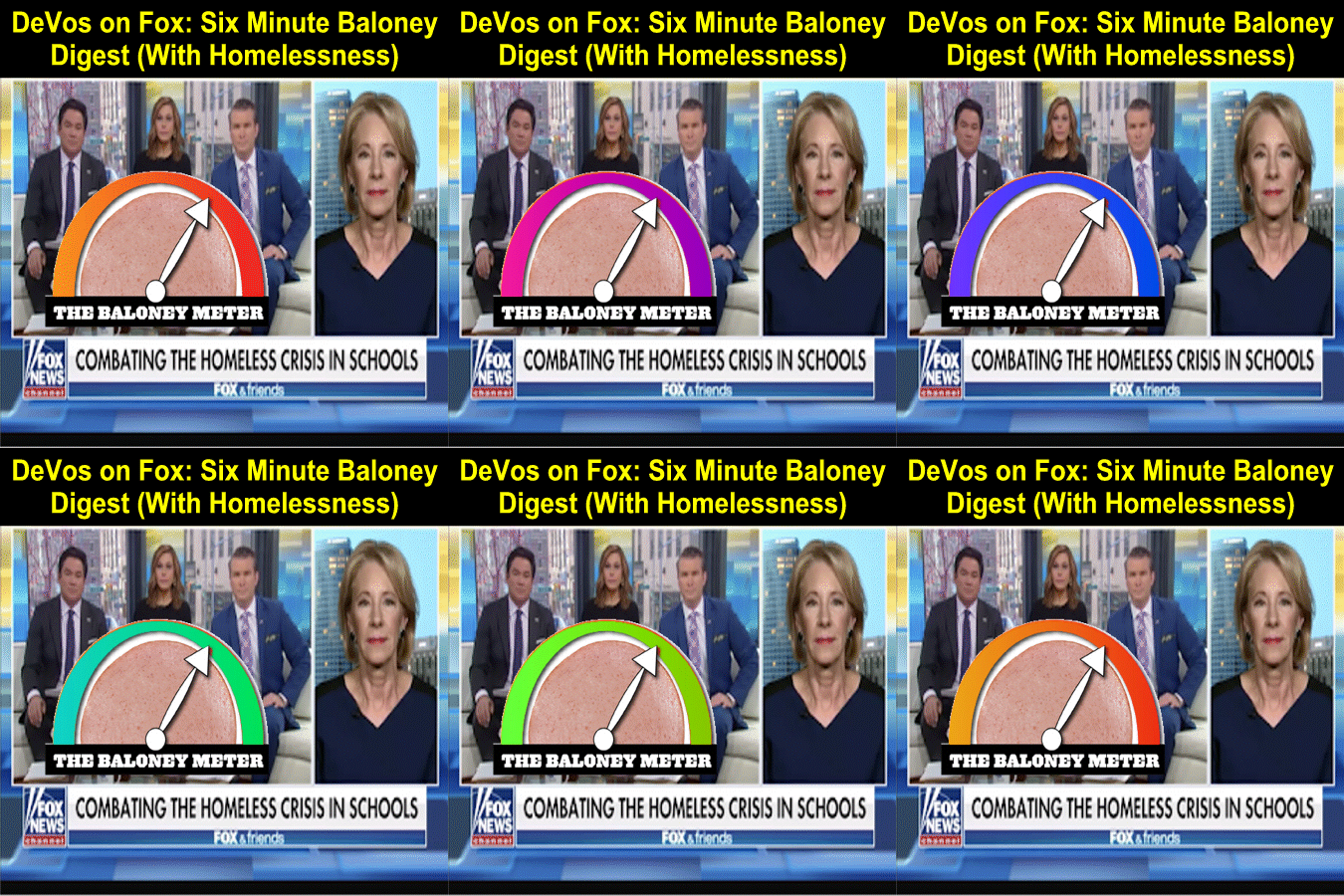
Betsy DeVos went on Fox and Friends this week, the softest of soft interview destinations form members of this administration. If you want a quick six-minute sampler of her current talking points, you could do worse, but it you don't think you can take looking at the patented smile d'smarm, here are the highlights- and there are a couple of revealing moments here.

The segment is nominally titled "Combating the Homeless Crisis In Schools," and it starts with some b roll of homeless folks while noting that over 114,000 students in NYC were homeless last school year, which works out to about one in ten. "So what can be done to make sure disadvantaged kids have access to top quality education?"


Well, from "homeless" to "disadvantaged" is a bit of a leap, but it really doesn't matter, because we're never going to talk ab out this issue for the rest of the segment. It's time to introduce DeVos, whose smile is having even more trouble than usual making it all the way up to her eyes. After the intro, we re-present the question as "what more can be done to make sure that everyone gets access to quality educations" (yes, that's how he said it). The homeless have now vanished from the conversation.

deVos opens by invoking NAEP and citing made-up statistics. Two out of three eighth graders "can't read or do math at the level they should be able to" which is a meaningless statement-- "should be" according to whom-- but shows her CONTINUE READING: 
CURMUDGUCATION: DeVos on Fox: Six Minute Baloney Digest (With Homelessness)


“Insect-Based Teacher Training, Part 2” | The Merrow Report

“Insect-Based Teacher Training, Part 2” | The Merrow Report

“Insect-Based Teacher Training, Part 2”

Last week in this space I took a poke or two at what I called “Insect-Based Teacher Training,” specifically the practice of wiring teachers so that remote observers can hear and see what they do in their classrooms.  What they call “Bug in the Ear training” enables experts to interrupt teachers and tell them what they are doing wrong. In theory, that allows teachers to improve on the spot.  You may remember that the expert I observed in action wasn’t particularly effective.
(Full disclosure: In last week’s essay I took a small liberty with the two veteran teachers whose opinions I cited: neither of them actually referenced ‘ants in underpants’ or ‘ticks on dicks.’   I owe my readers an apology because the teachers did not say that.  I made that up, just for the fun of it. 
Why would I do that?  Well, after so many years of reporting for public broadcasting, where the emphasis is on truth, making stuff up gives me a huge adrenalin rush.
However, everything else in that essay  is 100% accurate.  You can take that to the bank.)
But I digress. What I want you to know is the morning after “Insect-Based Teacher Training” was published, I received a call from the School Superintendent whose district I had visited.   He was upset about my portrayal of the process, saying that the observer had a bad day.  Moreover, he said, I had failed to grasp the subtle, CONTINUE READING: “Insect-Based Teacher Training, Part 2” | The Merrow Report

Wednesday, January 15, 2020

CURMUDGUCATION: Should Tax Dollars Pay For This Discrimination

CURMUDGUCATION: Should Tax Dollars Pay For This Discrimination

Should Tax Dollars Pay For This Discrimination


From Kentucky comes the story of a fifteen-year old student expelled for wearing a rainbow t-shirt. Seriously.

Kayla Kenney used to be a student at Whitefield Academy, where the mission is "to serve Christian families by providing a Christ-centered, Biblically-based education marked by academic excellence and spiritual vitality." Part of their vision is "to produce powerful and effective student leaders." The name, incidentally, is from George Whitefield, an 18th century preacher credited with helping to found Methodism and evangelism-- so not a subtle whiteness thing, just a subtle "refusing to be dragged into the 21st Century" thing.

The school's language suggests that this is part of an ongoing issue with Kenney, because, I guess, she often wears rainbows? Who knows. It doesn't really matter; Whitefield is a private school and they can eject any student they wish for any reason they wish. This story is spreading rapidly, but I'm not sure there's much to see here.

Except.

Except that this is Kentucky, where the fans of school choice have been pushing oh-so-hard for charters and vouchers in all their various forms. Like this old op-ed in which the head of EdChoice Kentucy tries to argue that scholarship tax credits don't cost the taxpayers a cent because they CONTINUE READING: 
CURMUDGUCATION: Should Tax Dollars Pay For This Discrimination

Does Your School Affirm Institutional Racism During Black History Month? - Philly's 7th Ward #BlackLivesMatterAtSchool #BlackLivesMatter

Does Your School Affirm Institutional Racism During Black History Month? - Philly's 7th Ward

DOES YOUR SCHOOL AFFIRM INSTITUTIONAL RACISM DURING BLACK HISTORY MONTH?


Have you ever sat in a staff meeting where the tension was so thick you can cut it with a knife, where you were not sure if a comment would spark an all-out race riot amongst teachers?  
Well, three years ago I sat in that type of meeting, where Black, White, Latino and Asian staff had to have a face to face discussion about Black Culture, White privilege, cultural appropriation and what it really means to celebrate Black History Month.
As we approach Black History Month, this is a discussion I believe all schools with predominately Black students should be willing to have, no matter how uncomfortable people are with talking about race.
The “history” behind Black History Month
Black History Month initially started off as Negro History week. The week was created by noted historian Carter G. Woodson and other prominent black leaders in 1926.  The goal of the week was to educate students on the achievements and accomplishments of Black people in America. Eventually, the week evolved to a month-long celebration that not only focused on CONTINUE READING: Does Your School Affirm Institutional Racism During Black History Month? - Philly's 7th Ward
Image result for history of institutional racism in u.s. public schools
Amazon.com: The History of Institutional Racism in U.S. Public Schools (9781942146728): Susan DuFresne: Books - https://www.amazon.com/History-Institutional-Racism-Public-Schools/dp/1942146728


Big Education Ape: PUT YOUR COMMUNITY ON THE 2020 BLACK LIVES MATTER AT SCHOOL MAP! – Black Lives Matter At School #BlackLivesMatterAtSchool #BlackLivesMatter - http://bigeducationape.blogspot.com/2020/01/put-your-community-on-2020-black-lives.html

RCSD supporters fight for more aid; teachers union wants more district oversight by state | WXXI News

RCSD supporters fight for more aid; teachers union wants more district oversight by state | WXXI News

RCSD supporters fight for more aid; teachers union wants more district oversight by state


Three busloads of people headed from Rochester to Albany on Tuesday to demand an increase in education funding.
Rochester City School student Maya Adams led a chant,“Whose money! Our Money! Our Schools! Our Schools!” from the well of the state Capitol. She’s part of a group including students, teachers, and Rochester residents hoping to prevent further layoffs in the district. The district laid off about 100 teachers mid-year because of an estimated $65 million budget shortfall.
Randi Weingarten, President of the American Association of Teachers, spoke at the rally and said it’s the state’s duty to help.
“We need to make sure that a place like Rochester is not abandoned,” said Weingarten. “If the market abandons it, the public good must come in to save it for the families that want to live there and want to thrive there.”
School officials including Superintendent Terry Dade and Board of Education Commissioners Natalie Sheppard, Ricardo Adams and Amy Maloy were also at the Capitol, meeting with lawmakers, and the state education department in hopes of closing the gap. To do that, Dade said more cuts and at least $20 million in state aid CONTINUE READING: RCSD supporters fight for more aid; teachers union wants more district oversight by state | WXXI News

Maurice Cunningham: Why the Waltons Fund the “National Parents Union” | Diane Ravitch's blog

Maurice Cunningham: Why the Waltons Fund the “National Parents Union” | Diane Ravitch's blog

Maurice Cunningham: Why the Waltons Fund the “National Parents Union”


Maurice Cunningham is a professor of political science at the University of Massachusetts who specializes in shining a bright light on Dark Money, the money insidiously inserted into political campaigns under false pretenses, where the donors try to hide their identity. In the instance described below, the identities of the donors are mostly known, so technically it is not Dark Money, but the purposes of the donors are hidden. The Waltons are part of the hard rightwing. They  oppose higher taxes, unions, or anything that might diminish their fortune of $150 billion. They advocate for vouchers and charters, never public schools. They employ one million low-wage workers. They have launched lawsuits to lower the property taxes of their Walmarts, which reduce state and local funding for public services. Their entry into Democratic politics is intended to boost conservative candidates who support their preference for low taxes on the richest. It’s actually a brilliant strategy, like DFER: the billionaires already own the Republican Party and benefit from its tax cuts and deregulation, time to use their money to gain influence in the Democratic Party too.
Cunningham writes:

Waltons Dive into Democratic Primaries Behind National Parents United

The Walton family, heirs to the Wal-Mart fortune, are trying to deal themselves in CONTINUE READING: Maurice Cunningham: Why the Waltons Fund the “National Parents Union” | Diane Ravitch's blog

Andre Perry: Education financing has to change for education to be the 'great equalizer' #BlackLivesMatterAtSchool #BlackLivesMatter

Education financing has to change for education to be the 'great equalizer'

Education can be the great equalizer, but it isn’t yet
A level playing field for children will only come about if we pay for it


When it comes to education spending, middle-income Americans typically don’t put their money where their mouth is. How often do we hear politicians and parents wax poetic about education being the great equalizer? Yet they do nothing about lopsided budgets that favor wealthier districts. It’s impossible for education to be an equalizer if budgets don’t meet every kid’s needs.

In a noble attempt to level the education playing field, in October a Maryland state panel, known as the Kirwan Commission, voted to recommend a new funding formula that calls for spending to increase by $4 billion per year by 2030. About a third of that increase, $1.2 billion, would come from local municipalities, with the state picking up the remaining $2.8 billion per year — 37 percent more than it currently spends. The increases would be phased in over the course of this decade. How to pay for this plan, which would certainly benefit low-income districts, will ultimately be determined by lawmakers during the 2020 legislative session.
There are many states that have passed new laws that mitigate large funding disparities between rich and poor districts, but, if fully funded, Maryland would become “the first in the country to prioritize equitable distribution of funds among school systems,” according to reporting from the radio station WAMU 88.5 FM.
The Kerwin Commission’s vote is a rare victory in the ongoing battle to disrupt an education financing system most of us accept as status quo. It’s a long time coming. There have been other efforts to create more equitable funding formulas, but resistance from local districts has largely resulted in small incremental changes that take years to kick in. Change at the state level could happen more quickly, if local school CONTINUE READING: Education financing has to change for education to be the 'great equalizer'


Big Education Ape: PUT YOUR COMMUNITY ON THE 2020 BLACK LIVES MATTER AT SCHOOL MAP! – Black Lives Matter At School #BlackLivesMatterAtSchool #BlackLivesMatter - https://bigeducationape.blogspot.com/2020/01/put-your-community-on-2020-black-lives.html

NYC Public School Parents: Our "Talk out of School" Podcast about suing the College Board and NY State Education funding

NYC Public School Parents: "Talk out of School" Ourtomorrow about suing the College Board and NY State Education funding

Our "Talk out of School" Podcast about suing the College Board and NY State Education funding


Join us tomorrow Wed. Jan. 14 at 10 AM on WBAI 99.5 or wbai.org when I interview Cassie Creswell of IL Families for Public Schools and attorney Scott Drury about the federal class action lawsuit vs. the College Board for selling student data.  
Then we will also speak to NY State Senator Robert Jackson about the Legislature’s battle over state education funding and charter schools.
NYC Public School Parents: "Talk out of School" Ourtomorrow about suing the College Board and NY State Education funding

CURMUDGUCATION: DeVos: Remote Work Bad, Remote School Good

CURMUDGUCATION: DeVos: Remote Work Bad, Remote School Good

DeVos: Remote Work Bad, Remote School Good


Betsy DeVos has long been a fan of cyber-schooling. Her husband was an investor in K-12, the cyber-charter behemoth, way back at beginning of the millennium (we can start saying that now, right?) Back when she was still running the American Federation for Children, she had this to say

Families want and deserve access to all educational options, including charter schools, private schools and virtual schools. States are well ahead of Congress on this and their efforts should be encouraged and supported. Twenty-three states plus DC have 48 publicly funded private school choice programs; 43 states have charter school laws; and virtual schools are growing across the country. Greater innovation and choice will contribute to better K-12 educational outcomes for our children.

AFC often spoke out in favor of cyber charters, and DeVos has continued to advocate as Secretary, even as the dismal results rolled in.

DeVos has been an unwavering supporter of remote schooling. But her support for remote work stops CONTINUE READING: 
CURMUDGUCATION: DeVos: Remote Work Bad, Remote School Good


Charter Schools: All the Ways They Are Not In the Public Interest | janresseger

Charter Schools: All the Ways They Are Not In the Public Interest | janresseger

Charter Schools: All the Ways They Are Not In the Public Interest


Donald Cohen is the executive director of In the Public Interest. In a powerful statement about his organization’s mission for 2020, Cohen proclaims:
“So much is under attack: public education, water, transit, public parks, public health, libraries, the postal service, air traffic control, and much more.  Where there’s money to be made, there are corporations positioning to take over… What worries us most is when private interests get too much control and influence over fundamental democratic decisions and our ability to provide public goods… We often hear that government is needed when markets fail. We disagree. There are market things and public things. They’re different things, like apples and oranges.  Here’s what we mean by ‘public’ (or, what’s in the public interest):
  • The things we can only do if we do them together…
  • The things we all benefit from regardless of whether we use the specific service or asset…
  • The things that protect and support us all…
  • The things that make us a better, fairer, more compassionate, and more democratic nation.
“We are pro-government because it is the only institution capable of ensuring that public things remain public.”
During the past quarter century, charter schools have come to threaten the public interest as Cohen defines it.  While their sponsors call them “public charter schools,” they are public only in the funding stream of public tax dollars. Their boards are private, and the management CONTINUE READING: Charter Schools: All the Ways They Are Not In the Public Interest | janresseger

The Tennessee ASD: Booted or Re-Booted? | Gary Rubinstein's Blog

The Tennessee ASD: Booted or Re-Booted? | Gary Rubinstein's Blog

The Tennessee ASD: Booted or Re-Booted?


Since 2011 I have been following the biggest, and most predictable, disasters of the education reform movement — the Tennessee Achievement School District (ASD).  It was formed in a perfect storm of reform theory.  First, Tennessee won Race To The Top money.  Then they hired a TFA-alum and the ex-husband of Michelle Rhee, Kevin Huffman to be their state commissioner.  Then he hired TFA-alum and charter school founder Chris Barbic to design and run the ASD.  The initial promise of the ASD was that they would take schools in the bottom 5% and convert them into charter schools in order to ‘catapult’ them into the top 25% in five years.  They started with 6 schools in 2012 and grew to over 30 schools within a few years.
They completely failed at this mission.  Chris Barbic resigned, Kevin Huffman resigned, Barbic’s replacement resigned, Barbic’s replacement’s replacement resigned.  Of the 30 schools they nearly all stayed in the bottom 5% except a few that catapulted into the bottom 10%.
The new education commissioner of Tennessee is also a TFA alum with ideas similar to Huffman.  She promised, however, to get a handle on the ASD and what to do about its CONTINUE READING: The Tennessee ASD: Booted or Re-Booted? | Gary Rubinstein's Blog