

Friday, December 20, 2019
Just Try to Catch Diane Ravitch's blog | A site to discuss better education for all
Diane Ravitch's blog | A site to discuss better education for all


ProPublica: Donald Trump Jr. Visits Mongolia, Gets Special Treatment, Kills an Endangered Sheep | Diane Ravitch's blog
ProPublica: Donald Trump Jr. Visits Mongolia, Gets Special Treatment, Kills an Endangered Sheep | Diane Ravitch's blog
ProPublica: Donald Trump Jr. Visits Mongolia, Gets Special Treatment, Kills an Endangered Sheep

ProPublica: Donald Trump Jr. Visits Mongolia, Gets Special Treatment, Kills an Endangered Sheep
Someday we won’t have to think about the Trump family and their misadventures. I look forward to that day.
Donald Trump Jr. went to Mongolia in the summer of 2019, and ProPublica explains what he did there.
What did you do on your vacation? Did you slaughter a creature who is part of an endangered species?
The rocky highlands of Central Asia, in a remote region of Western Mongolia, are home to a plummeting population of the largest sheep in the world, the argali. The endangered species is beloved for its giant curving horns, which can run over 6 feet in length.
On a hunting trip this August, Donald Trump Jr. shot and killed one.
His adventure was supported by government resources from both the U.S. and Mongolia, which each sent security services to accompany the president’s eldest son and grandson on the multiday trip. It also thrust Trump Jr. directly into the controversial world of Mongolian trophy hunting — a polarizing practice in a country that views CONTINUE READING: ProPublica: Donald Trump Jr. Visits Mongolia, Gets Special Treatment, Kills an Endangered Sheep | Diane Ravitch's blog
Eli Broad Spends $100 Million to Buy a Yale Home and the Yale Name for His Education Leadership Center | janresseger
Eli Broad Spends $100 Million to Buy a Yale Home and the Yale Name for His Education Leadership Center | janresseger
Eli Broad Spends $100 Million to Buy a Yale Home and the Yale Name for His Education Leadership Center

 Eli Broad just donated $100 million to Yale University’s School of Management. The gift came with a quid pro quo: Yale University’s School of Management will now house the Broad Superintendents’ Academy and Broad Residency in Urban Education. What this means is that mega philanthropist, Eli Broad is buying a prestigious institutional home for a training program he alone devised. Eli Broad’s personal philosophy of education management will receive the imprimatur of Yale University even though there is no academic, peer-reviewed research endorsing Eli Broad’s theories of education management.


Eli Broad Spends $100 Million to Buy a Yale Home and the Yale Name for His Education Leadership Center
This blog will take a two week holiday break. Good wishes to you for Christmas and the New Year. Look for a new post on Monday, January 6, 2020.
 Eli Broad just donated $100 million to Yale University’s School of Management. The gift came with a quid pro quo: Yale University’s School of Management will now house the Broad Superintendents’ Academy and Broad Residency in Urban Education. What this means is that mega philanthropist, Eli Broad is buying a prestigious institutional home for a training program he alone devised. Eli Broad’s personal philosophy of education management will receive the imprimatur of Yale University even though there is no academic, peer-reviewed research endorsing Eli Broad’s theories of education management.
Who is Eli Broad and what are the Broad Academy and Residency in Urban Education?
In her 2010 book, The Death and Life of the Great American School System, Diane Ravitch describes Eli Broad and his background: “Eli and Edythe Broad attended Detroit public schools. He received a degree in accounting from Michigan State University. With his wife’s cousin, Broad entered the home-building business and later bought a life insurance company that eventually became a successful retirement savings business called SunAmerica. That business was sold to AIG in 1999 for $18 billion, and Eli Broad became one of the richest men in the nation. He promptly created the Eli and Edythe Broad Foundation, which invests in education, the arts, and medical research… Having been trained as an accountant and having made his fortune as an entrepreneur, Broad believes in measurement, data, and results. He created training programs for urban superintendents, high level managers, principals, and school board members, so as to change the culture and personnel in the nation’s urban districts… In 2006, Broad invited me to meet with him…. He explained his philosophy of education management. He believes that school systems should run as efficiently as private sector enterprises. He believes in competition, choice, deregulation, and tight management. He believes that people perform better if incentives and sanctions are tied to their CONTINUE READING: Eli Broad Spends $100 Million to Buy a Yale Home and the Yale Name for His Education Leadership Center | janresseger
Betsy DeVos’ “Backpack Full of Cash” Portable Funding Flop | deutsch29
Betsy DeVos’ “Backpack Full of Cash” Portable Funding Flop | deutsch29
Betsy DeVos’ “Backpack Full of Cash” Portable Funding Flop
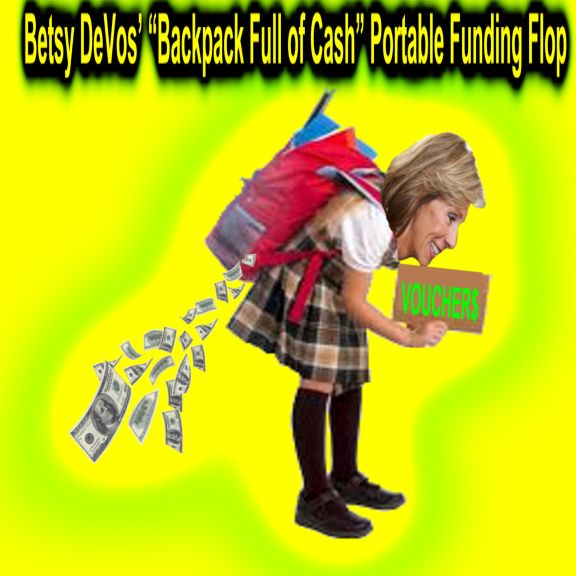
Even so, Allen’s image of each student toting “a backpack full of cash” conjures the image of market-based ed reform seeing children not as human beings but as a means of income and profit.
Betsy DeVos’ “Backpack Full of Cash” Portable Funding Flop
In 2016, Stone Lantern Films released “a film exploring the real cost of privatizating America’s public schools,” Backpack Full of Cash.
The movie’s title derives from a comment made by Center for Education Reform (CER) founder Jeanne Allen as Allen was being interviewed for the film:
Our children have a backpack full of cash, and the school should vie for the privilege of having that backpack turned over to them.
Allen was not pleased to have her quote transformed into a pro-public-school film title, responding in part,
“This movie is all about smearing us as anti-public education,” Allen said. “It’s a backpack full of hypocrisy.
 |
| Center for Education Reform (CER) founder Jeanne Allen |
Perhaps US ed sec Betsy DeVos is unaware of the Backpack film and the Allen-angering origin of its title, for DeVos herself invoked the very same image in her December 12, 2019, remarks to the American Legislative Exchange Council (ALEC):
ESSA (Every Student Succeeds Act) represents an important step in respecting the role of education in this country. For the first time in modern history, politicians on both sides of the aisle realized federal overreach in education had failed.ESSA affords your states and your communities more flexibility to CONTINUE READING: Betsy DeVos’ “Backpack Full of Cash” Portable Funding Flop | deutsch29
CURMUDGUCATION: Would Medicare-For-All Come With An Education Bonus?
CURMUDGUCATION: Would Medicare-For-All Come With An Education Bonus?
Would Medicare-For-All Come With An Education Bonus?
This is the least-read thing I've ever written for Forbes, but I still wonder about the issue. So let me put it out there again.
The expansion of Medicare coverage as a path to universal healthcare for the U.S. has unleashed a great deal of debate from think tanks to water coolers. One of the biggest questions remain—how much would it actually cost, and what would the average citizen pay?
The answer to the first question is “a whole lot (but remember--we currently pay a large number of whole lots. The second part-- well, there are many possible plans floating around at the moment. Some argue that the overall cost of healthcare in the U.S. would come down, meaning savings for some folks and fewer profits for others. The government costs would go way up, necessitating increased taxes for everyone. But, argue supporters, the increased tax burden would be offset by the end of deductibles and co-pays; there’s also the hope, under some versions, that employers would save on healthcare costs and some of those savings could be passed on as wage increases. Plus, the extra wrinkle that businesses would no longer be able to use health care as leverage against striking workers.
There is one other wrinkle that seems to draw little or no discussion.
Public school employees, like other citizens, get their healthcare from their employers. But unlike CONTINUE READING: CURMUDGUCATION: Would Medicare-For-All Come With An Education Bonus?
Would Medicare-For-All Come With An Education Bonus?

This is the least-read thing I've ever written for Forbes, but I still wonder about the issue. So let me put it out there again.
The expansion of Medicare coverage as a path to universal healthcare for the U.S. has unleashed a great deal of debate from think tanks to water coolers. One of the biggest questions remain—how much would it actually cost, and what would the average citizen pay?
The answer to the first question is “a whole lot (but remember--we currently pay a large number of whole lots. The second part-- well, there are many possible plans floating around at the moment. Some argue that the overall cost of healthcare in the U.S. would come down, meaning savings for some folks and fewer profits for others. The government costs would go way up, necessitating increased taxes for everyone. But, argue supporters, the increased tax burden would be offset by the end of deductibles and co-pays; there’s also the hope, under some versions, that employers would save on healthcare costs and some of those savings could be passed on as wage increases. Plus, the extra wrinkle that businesses would no longer be able to use health care as leverage against striking workers.
There is one other wrinkle that seems to draw little or no discussion.
Public school employees, like other citizens, get their healthcare from their employers. But unlike CONTINUE READING: CURMUDGUCATION: Would Medicare-For-All Come With An Education Bonus?
Would Parents Win a NYC School Board Election? or, a Billionaire? or, Charter School Supporters? | Ed In The Apple
Would Parents Win a NYC School Board Election? or, a Billionaire? or, Charter School Supporters? | Ed In The Apple
Would Parents Win a NYC School Board Election? or, a Billionaire? or, Charter School Supporters?

Would Parents Win a NYC School Board Election? or, a Billionaire? or, Charter School Supporters?
In my last blog post I included my testimony to the Education Committee of the NYS Assembly and showed up bright and early on Monday to wait turn to testify.
The mayoral control law is not scheduled to sunset until 6/30/22; however, as Committee Chair Benedetto explained the members wanted to explore how the law is working, and, intends to hold further hearings and perhaps appoint a commission to explore in depth.
I suggested in my oral testimony that additional hearings are held in the poorest neighborhoods of the city; on Monday the testimony came from the most active communities in the city, i. e., the Upper West Side (District 3) of Manhattan, the Lower East Side (District 1) and Brownstone Brooklyn (District 15), the poorest districts were not represented.
Chancellor Carranza lauded mayoral control and listed achievements and had a “professional” back and forth with the committee members. Mark Treyger, the Chair of the City Council Education Committee mirrored my testimony: change the law to give the board (Panel for Education Policy) fixed terms and can only be removed for cause, add a seat for the City Council and increase the powers (unspecified) of the local boards (Community Education Councils).
A number of the speakers were Asian and were sharply critical of the mayor’s policy to end G & T classes as well as the specialized high school admittance CONTINUE READING: Would Parents Win a NYC School Board Election? or, a Billionaire? or, Charter School Supporters? | Ed In The Apple
Thursday, December 19, 2019
Mitchell Robinson: "How will we know how our kids are doing if we don't test them?" Here's how… | Eclectablog
"How will we know how our kids are doing if we don't test them?" Here's how… | Eclectablog
“How will we know how our kids are doing if we don’t test them?” Here’s how…

“How will we know how our kids are doing if we don’t test them?” Here’s how…
Attending the recent Public Education Forum in Pittsburgh last weekend was a wonderful experience in many ways…getting a chance to hear what many of the presidential candidates had to say about public education; meeting some of my favorite education reporters bloggers, and activists; and finally seeing public education receive the attention it deserves as one of the most important issues facing our nation. All in all, it was a terrific weekend…except for one nagging question, left largely unanswered by any of the candidates, and now lingering and looming over the next several months of debates, analyses, and discussions.
This question was asked many times, and in a variety of ways, but in its most essential form it looks pretty much like this:
“How will we know how our kids are doing if we don’t test them?”
On its face this looks like a perfectly legitimate question. After all, isn’t that what “tests” are for? To determine what and how much students know? Didn’t all of us have to take tests when we were in school? We turned out ok, so what’s the big deal? Why do so many teachers have such strong feelings about testing all of the sudden? What’s going on???
Well, first–a little context.
That was then, this is now…
A lot has changed when it comes to testing, and how it’s done in our schools today as compared to CONTINUE READING: "How will we know how our kids are doing if we don't test them?" Here's how… | Eclectablog
Subscribe to:
Posts (Atom)