Latest News and Comment from Education

Wednesday, October 2, 2019

It's Larry Ferlazzo's Websites of the Day... A VERY BUSY DAY | The latest news and resources in education since 2007

Larry Ferlazzo's Websites of the Day... | The latest news and resources in education since 2007

It's Larry Ferlazzo's Websites of the Day... A VERY BUSY DAY | The latest news and resources in education since 2007


Media Literacy Week Is October 21st – 25th – Here Are Related Teaching & Learning Resources
OpenClipart-Vectors / Pixabay Media Literacy Week is From October 21st to the 25th. You might be interested in: The Best Tools & Lessons For Teaching Information Literacy – Help Me Find More The Best Tools To Help Develop Global Media Literacy
The Best Resources For Learning About Dunning Kruger Effect
TeroVesalainen / Pixabay I’ve applied The Dunning Kruger Effect in my classroom (see New Metacognition Study & How I’m Thinking Of Applying It In My Classes – Feedback Welcome! ). And I’ve previously posted about a good TED-Ed video on the topic that, however, I don’t think is usable in the classroom because of its title (see Useful New TED Video & Lesson On The Dunning-Kruger Effect ). You might
The National Day Of Writing Is On Oct. 20th – Here Are 37 Related Teaching & Learning “Best” Lists
Free-Photos / Pixabay From The National Council Of Teachers Of English: The National Day on Writing® (October 20), an initiative of the National Council of Teachers of English, is built on the premise that writing is critical to literacy but needs greater attention and celebration. Every year NCTE and enthusiastic participants around the world continue to grow this event. Since 2009 we’ve seen hu
Most Popular Posts Of The Week
I’m making a change in the content of the regular feature. In addition to sharing the top five posts that have received the most “hits” in the preceding seven days (though they may have originally been published on an earlier date), I will also include the top five posts that have actually appeared in the past week. Often, these are different posts. You might also be interested in IT’S THE TWELFT
‘Indigenous People’s Day’ (Columbus Day) Is Coming Up – Here Are Related Teaching & Learning Resources
OpenClipart-Vectors / Pixabay Columbus Day, also know as Indigenous People’s Day, is coming up. You might be interested in The Best Online Resources About Christopher Columbus (& ‘Indigenous Peoples’ Day’).
New TED-Ed Video & Lesson Is On Japanese American Internment
ErikaWittlieb / Pixabay The latest TED-Ed lesson and video is on Japanese American Internment during World War II. I’m adding it to The Best Resources On Japanese-American Internment In World War II.
“Author Interview: ‘Be Excellent on Purpose'”
Author Interview: ‘Be Excellent on Purpose’ is the headline of my latest Education Week Teacher column. In it, Sanée Bell agreed to answer a few questions about her new book, “Be Excellent On Purpose: Intentional Strategies for Impactful Leadership.” Here are some excerpts:
Diwali Takes Place Later This Month – Here Are Related Teaching & Learning Resources
bhuwanpurohit / Pixabay Diwali, the Hindu Festival of Lights, will start on October 25 this year. It concludes on October 29th. You might be interested in The Best Sites For Learning About Diwali.
Larry Ferlazzo's Websites of the Day... | The latest news and resources in education since 2007


Betsy DeVos calls federal school vouchers ‘the conservative answer to what ails American education’ -- and says, incorrectly, that they won’t cost the government any money - The Washington Post

Betsy DeVos calls federal school vouchers ‘the conservative answer to what ails American education’ -- and says, incorrectly, that they won’t cost the government any money - The Washington Post

Betsy DeVos calls $5 billion school tax credit plan ‘the conservative answer to what ails American education’ -- and says, incorrectly, that it won’t cost the government money
Trump adviser Kellyanne Conway participated in same event.


Education Secretary Betsy DeVos, appearing Tuesday at a D.C. think tank with presidential adviser Kellyanne Conway, called her $5 billion federal tax credit plan that would fund scholarships to private and religious schools “the conservative answer to what ails American education.” And she said, incorrectly, that it won’t cost the government any money to implement.

DeVos and Conway appeared at the conservative American Enterprise Institute (see video below) for a discussion about the Trump administration’s Education Freedom Scholarships proposal. The scholarships would be funded by individuals and businesses who want to privately donate but who would then receive a federal tax credit for doing so.
President Trump’s 2020 budget plan includes $5 billion to pay for those tax credits, on a dollar-for-dollar basis: A dollar for a scholarship gets you a $1 tax credit. (The president’s budget proposal also would cut Education Department spending by nearly $9 billion. Congress is not expected to approve the tax credit program or the budget cuts.)
DeVos has been clear since becoming education secretary in 2017 that her chief priority was expanding alternatives to traditional public schools, which she once called “a dead end.” As she has in the past, DeVos on Tuesday hailed the proposal as one that would not take money away from public schools, and this time she said it wouldn’t use any “government money” — even though the $5 billion used to cover tax credits means government money would be involved.
She said:
Our Education Freedom Scholarships proposal . . . doesn’t grow the government bureaucracy one tiny bit. . . . It doesn’t impose any new requirements on states or on families. It doesn’t take a single dollar from public school students, and it doesn’t spend a single dollar of government money. And it doesn’t entangle schools with federal strings or stifling red tape. In fact, it can’t. And that’s by design.
The Education Department did not respond to a request for comment.

DeVos' security detail cost $6.24M during the past year - POLITICO

DeVos' security detail cost $6.24M during the past year - POLITICO

DeVos' security detail cost $6.24M during the past year

Education Secretary Betsy DeVos’ security detail is projected to cost $7.87 million from now through the end of September 2020, a spokesperson for the U.S. Marshals Service told POLITICO today.

The Marshals Service said the final cost of protecting DeVos in fiscal 2019, which ended Monday, was $6.24 million. That’s down from $6.79 million in fiscal 2018 and less than the service’s projection last year — $7.74 million — for fiscal 2019.
The service did not disclose why the secretary's protection is expected to cost more in the upcoming year.

The U.S. Marshals Service, which began providing a protection detail for DeVos in February 2017, “regularly conducts threat assessments on Ms. DeVos to determine threats to the secretary’s safety,” according to an official statement.

DeVos’ security detail is highly unusual — the past four Education secretaries have been protected by the Education Department’s own small security force. Her security detail was initially ordered by former Attorney General Jeff Sessions.

An agreement between the department and the Marshals Service establishes roles, responsibilities and terms between the agencies “to monitor and mitigate threats against the secretary.”

The Marshals Service said the number of personnel assigned to the detail is “commensurate with the existing threat and based on USMS protective service requirements, experience and methodology.

“For reasons of operational security, we will not disclose the number of CONTINUE READING: DeVos' security detail cost $6.24M during the past year - POLITICO

Navigating Racist Triggers: The Unsettling Impact of Current Events on the Immigrant Experience | Schott Foundation for Public Education

Navigating Racist Triggers: The Unsettling Impact of Current Events on the Immigrant Experience | Schott Foundation for Public Education

Navigating Racist Triggers: The Unsettling Impact of Current Events on the Immigrant Experience

As Donald Trump continues to fuel white nationalism with his recent tirade against four members of Congress who are all women of color, the essence of what it means to be American is in a seismic shift. The values of the constitution, the leadership elected to uphold it, and the American people are in direct conflict and the threat to already vulnerable communities like mine is real. The question that keeps getting louder in my ears is: Am I safe?
As much as we are a nation of immigrants, nativism [born from the original immigrants], is inextricably part of our history. So while there’s nothing new about Trump’s sentiments of an ‘Us versus Them’ dynamic, what is different is the overt speech he’s using to incite racist, anti-immigrant, and mob-like rallying. Using the presidency as a platform to gaslight tensions that have been intensifying in recent years is not only irresponsible but it’s dangerous. Hearing the president’s steady drumbeat of comments validating hate is stirring a deeply seeded reminder that I – like many others - have to be prepared to defend my nationality, my culture, and even my humanity. And before I hear another suggestion that we challenge these threats at the ballot box in 2020, I want to know what we can do now.
The growing crisis at the border and the threats of raids in target cities have triggered the paralyzing fears of my childhood. The panic of growing up in a home of mostly immigrants is a defining part of my identity and the imminent threats we faced still haunt me today. Hearing the clamoring for a wall and the denials of what is happening the in the detention centers on one side and watching the trauma-filled family reunions and testimonials of immigrants at the border on the other, pinches a nerve that immediately flashes me back in time. Throughout the ‘90s – in the shadow of our nation’s capital – I grew up in a house where nearly a dozen immigrants could have been targeted on any given day.
Born to Latin American immigrants, and raised among refugees, I was U.S. citizen and should’ve felt safe. Instead I lived in fear of the same threats I see children and families facing today. Most of my relatives came through networks of coyotes who CONTINUE READING: Navigating Racist Triggers: The Unsettling Impact of Current Events on the Immigrant Experience | Schott Foundation for Public Education

LAUSD earmarks $5.5 million to ease sharing between charter and public schools - Los Angeles Times

LAUSD earmarks $5.5 million to ease sharing between charter and public schools - Los Angeles Times

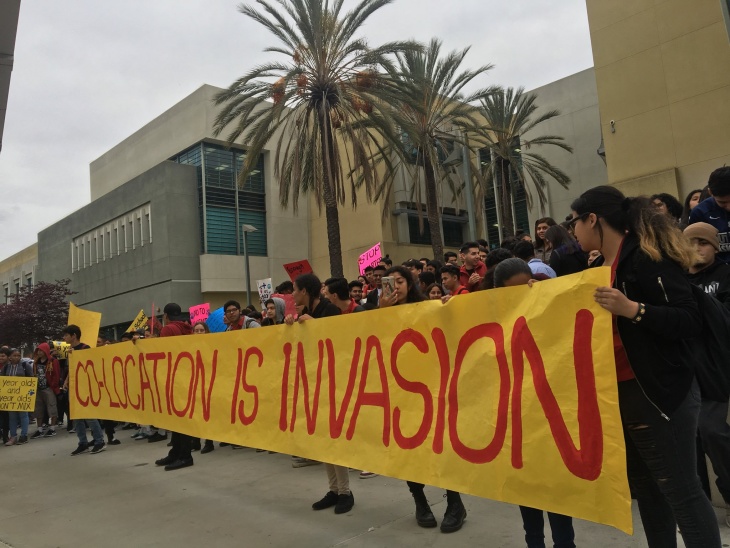
Can charter and public schools share space without fights? LAUSD’s $5.5-million solution

charter school co-location
Five schools, including three charters, share the Westchester High School campus, making for a potential headache when it comes to drop-off and pick-up, serving food and using the library and athletic fields.
A plan unanimously approved Tuesday by the Los Angeles Board of Education won’t fix all the logistics at schools like Westchester, but it offers $5.5 million to make sharing campuses more manageable and collegial. The funding works out to about $100,000 for each of the 55 campuses that host one or more charters in the nation’s second-largest school system.
The funding represents a notable collaboration between board members Nick Melvoin, a charter ally, and Jackie Goldberg, a charter critic. It comes just one week after an unrelated but key compromise between the same two camps over controversial fees that senior district officials want to collect from charters.
These recent actions show that board members can work together on divisive issues. They also underscore the importance of upcoming school board elections, especially with new rules that give school boards more authority to reject new charters.
No one likes this sharing between charters and district schools, said Melvoin, “but we can do more to provide support to our district schools by easing the burden of sharing a campus. We can help the day-to-day operations run a little smoother, and maybe even promote a new spirit of collaboration.”
“I made substantial changes to Nick’s original motion and he accepted all of them,” said Goldberg, who added that the end result should be smoother lunch lines, easier student drop-offs and better play spaces.
The complications around sharing campuses are not all logistical. In some cases, a new charter school, which is run by a nonprofit board of directors, has recruited CONTINUE READING: LAUSD earmarks $5.5 million to ease sharing between charter and public schools - Los Angeles Times
Image result for charter school co-location

CURMUDGUCATION: The 14,752nd Real Promise Of School Choice

CURMUDGUCATION: The 14,752nd Real Promise Of School Choice

The 14,752nd Real Promise Of School Choice


AEI hosted a pep rally for the DeVos $5 million scholarship tax credit, and afterwards, Rick Hess put up the latest entry in AEI's 60 second that "reminds" us of the "real promise" of charters and choice:

Thank you to @BetsyDeVosED, @KellyannePolls, and state decision makers for a great conversation about Education Freedom Scholarships today! In any discussion about school choice, it's important to remember its *real* promise. @rickhess99 explains


Embedded video

Yes, apparently the real promise of choice is that it will empower educators to start up schools where they can do their thing. This has to be the six gazillionth tweaking of the charter argument, and one of the least convincing to date.

After all, the argument for the longest time was that choice was necessary to rescue students from failing public schools and the failing teachers who failed there. Hess says that the real promise of choice is not higher math and reading scores, but  of course that was exactly the promise of school choice; if it was not a real promise it was certainly a marketing promise. These score-raising  charters would be staffed by Teach For America folks, or other alternative path folks, because CONTINUE READING: 
CURMUDGUCATION: The 14,752nd Real Promise Of School Choice


Rahm’s and Arne’s Legacies Continue to Damage Chicago Public Schools, Especially in Black Neighborhoods | janresseger

Rahm’s and Arne’s Legacies Continue to Damage Chicago Public Schools, Especially in Black Neighborhoods | janresseger

Rahm’s and Arne’s Legacies Continue to Damage Chicago Public Schools, Especially in Black Neighborhoods

Corporate school reform was launched in Chicago back in 2004 in the form of a glittery new promise named Renaissance 2010.  By 2010, the school district said, it would close so-called “failing” public schools and replace them with one hundred new schools. Many of the new schools would be charter schools. There was a corporate flavor to every detail beginning with the formal announcement of the new scheme—at the Commercial Club of Chicago.
In Chicago, however, corporate school reform did not end in 2010. It continues to this day.
In Ghosts in the Schoolyard, her profound (2018) history of Chicago school reform, University of Chicago sociologist Eve Ewing contrasts the widespread community grief that has followed school closures—as parents, children, and teachers understood and loved their schools as community and even family institutions, while schools CEO, Barbara Byrd Bennett and her staff brought a technocratic corporate mentality.  Ewing quotes the Chicago Public Schools portfolio planner, Brittany Meadows, justifying (at a formal 2013 hearing) the reason for closing Mayo Elementary School: “(T)he enrollment efficiency range of the Mayo facility is between 552 and 828 students. As I stated, the enrollment of Mayo as of the 20th day of attendance for the 2012-2013 school year is 408. The number is below the enrollment efficiency range, and thus the school is underutilized.” (Ghosts in the Schoolyard, p. 100)
Ewing dissects the technocratic logic of the school reform imposed on Chicago by Arne Duncan, who ran the district before he became U.S. Secretary of Education and later Rahm Emanuel and a succession of mayoral-appointed school district CEOs: “Meadows closes with the language of logic: ‘This number is below the enrollment efficiency range, and thus the school is underutilized.’ Meadows presents this data using an ‘if… then’ statement, explaining the calculation of the metrics without explaining the validity of the constructs involved. In this manner the school closure proposal appears natural and inevitable. Well, of course, since this CONTINUE READING: Rahm’s and Arne’s Legacies Continue to Damage Chicago Public Schools, Especially in Black Neighborhoods | janresseger

Seattle Schools Community Forum: Things That Make You Go, Hmmm

Seattle Schools Community Forum: Things That Make You Go, Hmmm

Things That Make You Go, Hmmm

  • How come Superintendent Juneau demoted Principal Emily Butler Ginolfi out of Washington Middle School and made it clear that EGB would be an assistant principal at lower pay and then reversed that by appointing EGB to Licton Springs K-8? 
How principals get so much grace and autonomy in their jobs is Reason #501 to wonder about this district.  The next person to complain about how "hard it is to get rid of bad teachers" needs to remember that about principals.  (Also, note to the district - everything that EGB did at Washington Middle School is now public record so if she messes up again, that will be quite the lawsuit on your hands.)

  • I'm hearing that some/all SPS schools are checking visitors' IDs? And scanning them? The district needs to have the driver's license number of every visitor to SPS? I'm going to JSCEE this week so I'll be really interested to see if they ask for anything there.
  • Want to hear some really good wordsmithing? Check out the back and forth from Superintendent in Tahoma as he and his Board decide to part ways. From the Covington Reporter:
The Tahoma School District Board of Directors made an unexpected vote during a special board meeting on Monday, Sept. 30, when it accepted the district superintendent’s resignation.  

District Spokesperson Kevin Patterson said the district came to an agreement regarding the statement with Giurado and his legal team. The resignation was a surprise for staff and parents alike. 

“The Tahoma School District Board of Directors and CONTINUE READING: Seattle Schools Community Forum: Things That Make You Go, Hmmm

Trump administration sides with Catholic school that fired gay teacher - The Washington Post

Trump administration sides with Catholic school that fired gay teacher - The Washington Post

Trump administration sides with Catholic school that fired gay teacher


The Trump administration is backing a Roman Catholic archbishop in Indiana who pushed a Catholic school to fire a gay teacher, saying in a legal document that the First Amendment protects the church’s right to make such decisions.
The Justice Department submitted a “statement of interest” on the side of the Archdiocese of Indianapolis in a lawsuit filed by the teacher, Joshua Payne-Elliott, who was fired in June from Cathedral High School, where he had taught social studies and world language.

In 2017, Payne-Elliott married a male teacher at Brebeuf Jesuit Preparatory School in Indianapolis. The archdiocese told both schools they no longer would be considered Catholic if they did not fire the teachers. Brebeuf refused to dismiss Payne-Elliott’s husband, who was not named, and Archbishop Charles C. Thompson issued a decree in June saying the school would no longer be recognized as Catholic. Cathedral, apparently to avoid the same fate, fired Payne-Elliott after trying to protect him for nearly two years.
Last month, the Vatican suspended Thompson’s decree against Brebeuf while the school appeals the archbishop’s decision.
Payne-Elliott then sued the archdiocese in Marion Superior Court in Indianapolis, saying it had discriminated against him and illegally interfered with the contract he had with Cathedral to teach. He is seeking compensation for lost earnings and benefits, as well as emotional distress.
The Archdiocese of Indianapolis makes clear on its website that the “Catholic Church believes marriage to be between a man and a woman,” and that teachers in its schools are “ministers” who “must uphold the teachings of the Church in their daily lives, both in and out of school.”
The Justice Department’s statement of interest says the First Amendment gives the church the right to CONTINUE READING: Trump administration sides with Catholic school that fired gay teacher - The Washington Post


IS TEACHING A CALLING OR A JOB? CAN IT BE A TEAM SPORT? | The Merrow Report

IS TEACHING A CALLING OR A JOB? CAN IT BE A TEAM SPORT? | The Merrow Report

IS TEACHING A CALLING OR A JOB? CAN IT BE A TEAM SPORT?

I begin with the negative, but I promise that–if you stick it out–you will encounter a vision of what teaching could be.
The first question: is teaching a calling, a profession, or just another job?  
“So, are they quitting because they’re fed up with their heavy-handed union bosses?” The hostility of the question took me by surprise. I was explaining to my dinner companion, a veteran lawyer, that 40% of teachers leave the field within five years, and right away he jumped to his anti-union conclusion disguised as a question.
No, I explained. Unions don’t seem to have anything to do with it; it’s most often related to working conditions: class size, discipline policies, and how much control and influence they have over their daily activities.
“It’s not money?” he asked, aggressively suspicious. Not according to surveys, I explained.
I described what I’d seen of a teacher’s daily work life. He interrupted, “How can it be a profession if you can’t take a leak when you need to?”
While that’s not a criterion that social scientists use to define a profession, my cut-to-the-chase acquaintance might be on to something.
Can teaching be a true profession if you can’t take a bathroom break when nature CONTINUE READING: IS TEACHING A CALLING OR A JOB? CAN IT BE A TEAM SPORT? | The Merrow Report

Tuesday, October 1, 2019

Unsweet Tea: On Tokenism, Whiteness, and the Promise of Culturally Relevant Teaching | radical eyes for equity

Unsweet Tea: On Tokenism, Whiteness, and the Promise of Culturally Relevant Teaching | radical eyes for equity

Unsweet Tea: On Tokenism, Whiteness, and the Promise of Culturally Relevant Teaching

I stood as I have many times in front of the two tea dispensers at a chain sub sandwich shop. But this time, I was suddenly struck with the choice I always make—the “unsweet tea.”
Medium Freshly-Brewed Iced Tea Unsweetened
I was born, raised, and have lived my entire life in the Deep South. My mother made tea that would rival pancake syrup and trained my sister and me in the meticulous ritual of steeping tea bags and then pouring the hot tea over a huge mound of processed sugar.
The tea pot was dedicated only to steeping tea, and the tea jar and the giant plastic sugar spoon were sacred as well.
Once I left home, my mother flirted with sun tea, but the syrup-sweet tea of my childhood later became my defining feature of what could rightfully call itself The South. When ordering tea, The South hands you sweetened ice tea; hot tea or tea without sugar are not even mentioned, or considered.
So with a great deal of shame, I must admit that only a week or so ago I was truck with the absurdity that is “unsweet tea,” which of course is just CONTINUE READING: Unsweet Tea: On Tokenism, Whiteness, and the Promise of Culturally Relevant Teaching | radical eyes for equity

4 Great Visual Teaching Tools for Science Teachers - Teacher Habits

4 Great Visual Teaching Tools for Science Teachers - Teacher Habits

4 Great Visual Teaching Tools for Science Teachers


By Anica Oaks
Employing just the right visual teaching tools can make a critical difference between science teachers bringing their material brilliantly to life before their students’ eyes and watching them grow frustrated and overwhelmed by the difficult concepts. Reluctant or struggling learnings may need to process information through a different channel for the lessons to stick. After all, around 65 percent of the population is comprised of visual learners. When you consider that humans visually process about 90 percent of all information in any given environment visually, that makes sense. The knowledge you present may not always inherently electrify the classroom all by itself, but recognizing and playing to your students’ strengths can keep them engaged.

Memes

Chuckle and roll your eyes if you want, but these ubiquitous visual gags are naturally sticky ideas ideal for making any notion easy to instantly recall. Try setting up a moderated classroom subreddit. Encourage students to use any of the countless online meme generators available now to creatively repurpose existing templates toward what you teach. Next, let them comment, upvote and reply with their own memes to each thread. It may sound ridiculous and even shallow to elder generations, but this is a downright devious way to sneak learning into the same motif kids choose to riff on sports, anime, video games, and life’s generally ridiculous minutiae.

Infographics

Depending on your school’s scheduling philosophy, you likely have CONTINUE READING: 4 Great Visual Teaching Tools for Science Teachers - Teacher Habits