Latest News and Comment from Education

Wednesday, August 28, 2019

CURMUDGUCATION: PA: Poorer Districts Worst Hit By Cyber Schools

CURMUDGUCATION: PA: Poorer Districts Worst Hit By Cyber Schools

PA: Poorer Districts Worst Hit By Cyber Schools

A study released in February shows that poorer school districts are bearing the brunt of funding Pennsylvania's cyber schools. The study was published in the American Journal of Education, and you can tell it's serious because its title is painfully dull: Cyber Charter Schools and Growing Resource Inequality among Public Districts: Geospatial Patterns and Consequences of a Statewide Choice Policy in Pennsylvania, 2002–2014.

Bryan Mann (University of Alabama) is a professor of education policy and foundations, and co-author David Baker (Penn State) is a professor of sociology, education and demographics. As the title suggests, they looked at the changes in cyber enrollment and the patterns and financial costs of that enrollment from 2002 to 2014. And because it's behind an academic paywall, we'll have to depend on second-hand reporting of the results, as well as their own writing about it..

The abstract of the study, translated from heavy academese, boils down to this:


When cyberschools started, everyone said, "Cool! Computers! I bet that'll make kids damned smart!" But then it turned out that cyber schools don't actually school well at all, and as word got out in the media, upscale communities ditched it, while enrollment in poorer areas kept up. So now districts with low tax bases are losing "significant revenue" to the cybers, despite the "dubious academic benefits."

From the anecdotal perspective of someone who taught in a less-wealthy rural-ish district, that sounds about right.

There are several other takeaways from the CONTINUE READING: 
CURMUDGUCATION: PA: Poorer Districts Worst Hit By Cyber Schools


John Thompson Reviews an Important New Book About Privatization of Public Services | Diane Ravitch's blog

John Thompson Reviews an Important New Book About Privatization of Public Services | Diane Ravitch's blog

John Thompson Reviews an Important New Book About Privatization of Public Services

John Thompson, historian and retired teacher, reviews an important new book.
Lawrence Baines’ Privatization of America’s Public Institutions: The Story of the American Sellout combines analyses of assaults on four public sectors, the military, corrections departments, public schools, and higher education, to reveal the immense scale of privatization and its dangers. Dr. Baines, the Associate Dean of Education at the University of Oklahoma, shows that “Privatization is no longer an occasional strategy to help improve efficiency of a particular public service.” It “has become an automatic response to any perceived governmental inefficiency.” Baines carefully documents the ways that “Privatization is changing the nature of America’s public institutions and consequently, the character of the country.”


The first chapter, “Privatizing the Military: Profiting from the Carnage of War,” foreshadows a frightening pattern that explains why I, for one, was slow to see the full nature of the threat. It starts in 2007 with the killing of 17 persons in Baghdad by mercenaries employed by Erik Prince’s Blackwater. The people I know were horrified by that and other behavior of contract fighters when Dick Chaney, formerly of Halliburton, was Vice President. I had no idea, however, that by 2015, private contractors in the CONTINUE READING: John Thompson Reviews an Important New Book About Privatization of Public Services | Diane Ravitch's blog

U.S. to states: School lunch changes none of your business - Reuters

U.S. to states: School lunch changes none of your business - Reuters

U.S. to states: School lunch changes none of your business


NEW YORK (Reuters) - As schools begin reopening their doors to children nationwide, the U.S. government has told a federal judge that states have no power to sue over new rules they say make school meals less healthy.


In a Monday night court filing, the government said New York, five other states and Washington, D.C., could not sue based on speculation that changes to the federally funded National School Lunch Program could cause health problems for children and require more spending on treatment.
The government also said the states lacked power to sue under a doctrine known as “parens patriae,” Latin for “parent of the nation,” because it allegedly would not protect children from harm.
“This rule recognizes that a state has no legal interest in protecting its citizens from the federal government, and that only the United States, not the states, may represent its citizens and ensure their protection under federal law in federal matters,” U.S. Attorney Geoffrey Berman in Manhattan said in a filing in the federal court there.
The office of New York Attorney General Letitia James, who led the state coalition, did not immediately respond on Tuesday to requests for comment.
New York, California, Illinois, Minnesota, New Mexico, Vermont and the District of Columbia sued Agriculture Secretary Sonny Perdue on April 3 over changes in the school lunch program, which feeds more than 30 million, mostly lower-income CONTINUE READING: U.S. to states: School lunch changes none of your business - Reuters

Chartered: Florida's First Private Takeover Of A Public School System

Chartered: Florida's First Private Takeover Of A Public School System

Chartered: Florida's First Private Takeover Of A Public School System

Florida’s first all-charter school district was engineered by unelected state bureaucrats at then-Gov. Rick Scott’s Department of Education, funded by the state Legislature and carried out by a charter school network based in South Florida, nearly 500 miles away.
This “experiment” in rural Jefferson County has been transformational for many students but disastrous for a few. And it’s already changing education in Florida forever.

Listen to the documentary


Parents' Concern About School Safety Remains Elevated

Parents' Concern About School Safety Remains Elevated

Parents' Concern About School Safety Remains Elevated

STORY HIGHLIGHTS

  • Parental fear same now as after Newtown and Parkland school shootings
  • 12% of parents say child has expressed worry about safety at school
WASHINGTON, D.C. -- As summer winds down and children from kindergarten through high school head back to school, 34% of parents remain fearful for their safety. At the same time, fewer (12%) report that their school-aged children have expressed concern about feeling unsafe at school.
The current level of parental worry is similar to last August's 35% reading, which was taken about six months after 17 students and staff members were killed at Marjory Stoneman Douglas High School in Parkland, Florida. It is also on par with the 33% of parents who were concerned about their children's safety at school in August 2013, roughly eight months after 26 students and staff members were killed at Sandy Hook Elementary School in Newtown, Connecticut.
The latest readings are from an Aug. 1-14 Gallup poll, with interviewing spanning two non-school-related mass shootings in El Paso, Texas, and Dayton, Ohio, which together claimed the lives of 31 people in one weekend. Although Gallup's question about school safety does not refer specifically to gun violence, parents' fear has spiked in the past after high-profile mass shootings, indicating they do have these kinds of threats in mind when answering the question.
The highest level of parental fear, 55%, was recorded in April 1999, one day after 13 people were killed at Columbine High School in Littleton, Colorado. By the time parents were sending their children back to school that year, fear had dipped, but only slightly, to 47%, the highest August figure in Gallup's trend. By August 2000, it had dropped to 26%.
Parental fear for their children's safety in school fluctuated over the next two decades but rose in the immediate aftermath of the school shootings at Santana High School in Santee, California, in 2001 and at an Amish schoolhouse in Nickel Mines, Pennsylvania, in 2006. The lowest August reading is 15% in 2008.
This pattern of heightened levels of concern after such an event occurs, followed by a gradual decline as it fades from memory, is common in Gallup trends. Thus, it is not clear if the stability between the 2018 and 2019 readings reflects sustained concern from the CONTINUE READING: Parents' Concern About School Safety Remains Elevated

Is NCLB’s Reading First Making a Comeback?

Is NCLB’s Reading First Making a Comeback?

Is NCLB’s Reading First Making a Comeback?

Reading First was President George W. Bush’s signature reading program, the cornerstone of No Child Left Behind. With a $6 billion price tag (a billion per year for six years), it promised “scientific proof” it would have every child reading by third grade. States had to apply for federal grants. Reading First centered around phonics.
When the President spoke at a Leadership Forum in Jacksonville, Florida on September 10, 2001, a day before the worst attack on America’s soil, he said, One of the unfortunate aspects that we find in many States is that there are great teachers who have got wonderful hearts who don’t know how to teach reading, that don’t know the science of reading. He was introducing Reading First.
That was almost twenty years ago. Several reporters are once again criticizing teachers and their education schools for not teaching teachers to teach reading the “right” way, with scientific proof. Their arguments are eerily reminiscent of Reading First.
That’s not to say education schools shouldn’t reexamine their programs. But it’s disconcerting to repeatedly read criticism focusing solely on teachers and how they teach reading. There’s a teacher shortage and parents also complain that more students face screens with unproven reading programs like iReady.
Natalie Wexler, a writer who reports in Forbes and has an education book out, just CONTINUE READING: Is NCLB’s Reading First Making a Comeback?

Celebrating the first day of school with community traditions

Celebrating the first day of school with community traditions

Grooming traditions for back to school
Getting your kid's hair cut? Pay it forward
Earlier this month, New Orleans barber Brandus Mercadel, who goes by Fatt da Barber, set out to break the Guinness World Record for “Most free back-to-school haircuts.” Mercadel aimed for 200 cuts over the course of two days, starting August 3. Not surprisingly, families showed up en masse for a planned 8 a.m. start in Culture Park, in nearby Gentilly, and the cuts continued the next day at his shop, in adjacent Treme.
Thank goodness for people like Mercadel, who refuse to allow conformity, practicality and efficiency to suck away the enthusiasm for the first day of school. Because many public-school leaders have control issues, dull uniforms have proliferated in the school landscape, taking away opportunities for students to express themselves through their appearance. Parents acquiesce, saying uniforms are more affordable and it gives parents one less thing to juggle in their busy schedules. But utilitarian tennis shoes, starched khakis, clip-on ties and pleated skirts don’t represent new beginnings so much as they signify compliance. Consequently, the first day of school is becoming just another day we have to work to get through — far from the sacred day it represents to many.


Notwithstanding those restrictive schools that immorally criminalize black hairstyles, hair is one of the few remaining frontiers for personal expression.
“In New Orleans, you have to have a fresh haircut,” Mercadel told the Times-Picayune. “Even if your clothes or sneakers are bummy, people can be blinded by a fresh haircut. All they will see is the fresh cut.”
If there is ever a day that students should look fresh, it’s the first day of school. That’s not a call for clean-shaven, pull-your-pants-up respectability. It is a call for us to continue the tradition of treating CONTINUE READING: Celebrating the first day of school with community traditions

Who Should Get Priority Enrollment in Oakland Schools? OUSD Weighs Details of Policy Shift | KQED News

Who Should Get Priority Enrollment in Oakland Schools? OUSD Weighs Details of Policy Shift | KQED News

Who Should Get Priority Enrollment in Oakland Schools? OUSD Weighs Details of Policy Shift

The Oakland Unified School District's radical plan to downsize by closing and merging schools includes a key component to making sure displaced students end up in better schools. It's a policy change that could result in diversifying some of the city's most in-demand schools. But details of the so-called opportunity ticket have yet to be hammered out.
The opportunity ticket is the brainchild of The Oakland REACH, a parent group committed to getting underserved communities into high-quality schools, and was approved by the OUSD Board of Education last March.
District enrollment currently gives priority to siblings entering a school and then to children of families that live in the school's neighborhood. The opportunity ticket would change that, allowing displaced students from schools that are geographically relocated to get priority enrollment.
An advisory group, including parents, met with OUSD Superintendent Kyla Johnson-Trammell last week to recommend a fair way to implement the policy.
"The data’s very clear. Kids do better after a closure only if they go to a better school," said Katherine Lee, parent of a first-grader at Henry J. Kaiser Jr. Elementary School and a parent in the advisory group.
"We’ve heard the district say a lot, ‘We need to start doing things differently.’ Well closures and mergers aren’t different, but this opportunity ticket is different. It’s the one different thing that they are doing when it comes to how they are implementing these."
Historically, school closures have hit schools harder that have a majority of black and brown students. That's why The Oakland REACH came up with the opportunity ticket idea, along with Dirk Tillotson of the State of Black Education Oakland, said group co-founder and executive director Lakisha Young.
"The intent behind the policy has always been clear," Young said. "It’s to provide a new chance for folks who have been disadvantaged in the system."
The new enrollment policy has the potential to integrate some of the city's top schools by race CONTINUE READING: Who Should Get Priority Enrollment in Oakland Schools? OUSD Weighs Details of Policy Shift | KQED News

Racist Image Of Doctored Rio Americano High School Website Sparks FBI, Sacramento Sheriff Investigation - capradio.org

Racist Image Of Doctored Rio Americano High School Website Sparks FBI, Sacramento Sheriff Investigation - capradio.org

Racist Image Of Doctored Rio Americano High School Website Sparks FBI, Sacramento Sheriff Investigation

The FBI and the Sacramento County Sheriff’s Department are investigating a fake image of a racist post on the Rio American High School website, which was sent via phone to some students last week.
A screenshot of the altered Rio Americano web page was shared last Wednesday and included a post that with the headline “District-Wide High School No Black People Policy.” It also claimed members of the Klu Klux Klan would be patrolling the school.

Levias Taylor's son is a student at Rio Americano. He brought the fake post to her attention after it was forwarded to him by a friend.
"Completely infuriating, upsetting, hurtful,” she said of the post. “A lot of emotions just kind of ran through my mind at that particular point being that I have two black students that attend the school.”
Taylor says her son has been called the N-word at the school in the past and that racism at the school needs to be addressed.
“They need to hear their students. They need to hear their stories,” she said. “Everybody is not comfortable talking about these issues. But they’re real. It’s not something we can keep sweeping under the rug.”
On Monday, students were greeted by school staff, including the principal, and were invited to CONTINUE READING: Racist Image Of Doctored Rio Americano High School Website Sparks FBI, Sacramento Sheriff Investigation - capradio.org

How Much of Your Formal Education Still Lives in You? | Teacher in a strange land

How Much of Your Formal Education Still Lives in You? | Teacher in a strange land

How Much of Your Formal Education Still Lives in You?


It was a Facebook post that started the conversation—a photo, taken at the Chicago Institute of the Arts by my good friend Kirk Taylor.  Kirk and I taught together for 25+ years, and he was my children’s 8th grade English teacher. The photograph features pointillist painter Georges-Pierre Seurat’s ‘A Sunday on La Grande Jatte,’ surrounded by viewers.
The post had been up less than a day, and already more than 30 of Taylor’s students—and a handful of parents and teaching colleagues– had commented, mostly things like: I love that painting! Sunday in the Park with George! Dot dot dot!
There were also heartfelt messages of thanks from these former students, now adults, for Mr. Taylor’s role in shaping their appreciation of art and music, opening doors to worlds they never considered, the impact he’s had on their lives and career choices. Taylor’s inspired, hand-crafted curriculum changed continuously over the years and included visits to the Detroit Institute of the Arts and the Holocaust Memorial Center as well as student publications, dramatic productions and media analysis.
Midway down the thread, Taylor wrote this: CONTINUE READING: How Much of Your Formal Education Still Lives in You? | Teacher in a strange land

Lou Dobbs' Guest Blames 'Black Culture' For Academic Achievement Gap | HuffPost

Lou Dobbs' Guest Blames 'Black Culture' For Academic Achievement Gap | HuffPost

Lou Dobbs’ Guest Blames ‘Black Culture’ For Academic Achievement Gap
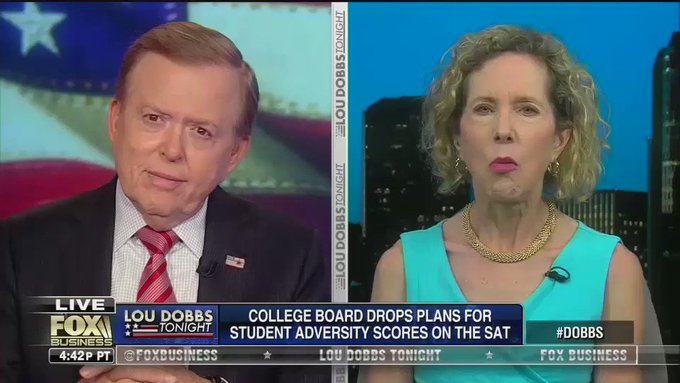
Heather Mac Donald said it was up to “Black culture and the rest of culture” to close the academic achievement gap.

Conservative commentator Heather Mac Donald blames “Black culture” for the academic achievement gap, and says race and gender diversity goals are blunting the nation’s “competitive edge.”
The College Board announced on Tuesday that it was withdrawing plans to introduce an “adversity score” on test results, a measure intended to address inequality in college admissions for those from varying socioeconomic backgrounds.
“All of this tinkering with meritocratic admissions in colleges and throughout the economy, frankly, is all driven by one fact, which is the persistent academic achievement gap,” Mac Donald said during an appearance on “Lou Dobbs Tonight” Tuesday. 
“If Black culture or the rest of culture could close that gap, we would be back to a colorblind meritocratic system, but the College Board is trying to give colleges an excuse to continue to give preferences to under-prepared Black students, to catapult them into academic environments for which they are not prepared,” she added.
Watch Mac Donald’s segment on Fox Business below.
Lou Dobbs guest blames "black culture" for an academic achievement gap and says that colleges are giving preferential treatment to "underprepared black students"


Embedded video


CURMUDGUCATION: "Tired Of Being Treated Like Dirt" Teacher Morale In The 2019 PDK Poll

CURMUDGUCATION: "Tired Of Being Treated Like Dirt" Teacher Morale In The 2019 PDK Poll

"Tired Of Being Treated Like Dirt" Teacher Morale In The 2019 PDK Poll
Image result for Tired Of Being Treated Like Dirt
The title of the 2019 Phi Delta Kappa Poll of the Public's Attitudes Toward the Public Schools of "Frustration in the Schools," and the focus in much of the coverage has been on the results about teacher morale.


75% of teachers say schools in their community are underfunded.
50% of teachers have considered leaving the profession.
48% of teachers feel less valued by the community. (10% say they are valued "a great deal.")
55% of teachers would not want their child to follow them into the profession.
The breakdown of the teachers who have seriously considered getting out cite reasons that are all inter-related.
Inadequate pay is the marquee reason, and notably regional. Public school teachers are far less likely to feel fairly paid in the South and Midwest. That reason is followed closely by stress and pressure, which is followed by a lack of respect. Lack of support. Teaching no longer enjoyable. Testing requirements. Workload.
These are tied together with the single thread of distrust and disrespect for teachers. This has been evident on the national stage with issues like installing a Secretary of Education who had previously dismissed public education as a "dead end" or a Secretary of Education who asserts that student failure is because of low teacher expectations. Education has also carried the modern burden of the thesis that poor education is the cause of poverty, or even CONTINUE READING: CURMUDGUCATION: "Tired Of Being Treated Like Dirt" Teacher Morale In The 2019 PDK Poll
Image result for Tired Of Being Treated Like Dirt

NYC Public School Parents: The NYC School Survey: Changes over time leading to possibly skewed results and how the survey could be improved

NYC Public School Parents: The NYC School Survey: Changes over time leading to possibly skewed results and how the survey could be improved

The NYC School Survey: Changes over time leading to possibly skewed results and how the survey could be improved

The following was written by the new research associate for Class Size Matters, Emily Carrazana. Take a look!

Since 2007, the NYC Department of Education has issued something called the “Learning Environment Survey,” administered to students, parents, and teachers to collect their views about each school's quality and the system as a whole. Every year between 2007 and 2014, when parents were presented with ten choices, class size came out as the top priority of 21% to 24% of parents when they were asked “Which of the following improvements would you most like your school to make (Choose ONE)?”  

In 2015, this question related to parents’ top priority was completely left out of the survey, possibly because then-Chancellor Farina seemed uninterested in listening to parents in general and especially on the need to lower class size. In fact, her peculiarly unique view was that class sizes in NYC schools were too small 

 After significant pushback from Class Size Matters and others, this question was resurrected the following year, but with a few other "tweaks". While class size was still offered as one of the choices, options relating to more or less state test preparation were removed, and “a safer school environment” option was added. The phrasing on the choice of more enrichment programs was expanded from “Stronger enrichment programs” to “Stronger enrichment programs (e.g. afterschool programs, clubs, teams)”. 

This choice now became the only one that provided any additional descriptive information, including specific examples of what might qualify as an enrichment program. Before that point, the percent of parents choosing “enrichment programs” as their top priority had significantly fallen, from 19% in 2007 to 12% in 2014.  Unsurprisingly, in 2016 for the first time, the number of parents who chose enrichment exceeded those who chose class size –with enrichment the top choices of 23% to 27% of parents from that year onward, compared to class size at 20% to 21%.
Which of the following improvements would you MOST like your school to make?


(Take note of the sharp uptick in enrichment programs in year 2016, the same year that the wording changed)

This is not to downplay the importance that schools should place on improving their students’ access to extracurricular and afterschool programs, especially to parents, many CONTINUE READING: NYC Public School Parents: The NYC School Survey: Changes over time leading to possibly skewed results and how the survey could be improved