Latest News and Comment from Education

Monday, June 24, 2019

Dehesa School District profited by cultivating charter schools - The San Diego Union-Tribune

Dehesa School District profited by cultivating charter schools - The San Diego Union-Tribune

Dehesa School District profited by cultivating charter schools 
The 138-student school district is in charge of watchdogging nine charter schools with 11,500 students.

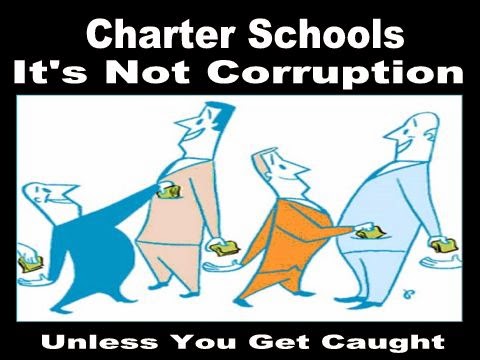
The duty to watchdog multiple charter schools involved in a recent alleged charter school scam lay on the shoulders of Dehesa School District, a tiny district that consists of a single elementary school with 138 students in the hills of east San Diego County.
In May 11 people were indicted in connection with a statewide charter school scheme that prosecutors said funneled $50 million into the pockets of two executives of A3 Education. Three of the A3 charter schools were authorized and overseen by Dehesa.
In a statement, the district defended its authorization of its several charter schools.
“The Dehesa School District approved the charter schools believing we were making educational options available to students who could benefit from instruction in non-traditional settings,” the district said in a statement. “We recognize that several charter school reforms have been initiated at the state level, and our District is committed to ensuring legal compliance with all applicable laws and regulations concerning charter schools.”
Neither Dehesa Superintendent Nancy Hauer, who has been placed on paid leave and was one of the 11 people indicted, nor board members responded to requests for comment.
How could such alleged charter school fraud be allowed to happen? Some have argued that California’s charter school laws are too lax in what they require of charter authorizers. Others say that argument gives charter authorizers like Dehesa too much benefit of the doubt.
“You know, the [district attorney] made a statement about A3 and how they prey on small, naive districts, and there is no such thing as naive anymore,” said Terri CONTINUE READING:  Dehesa School District profited by cultivating charter schools - The San Diego Union-Tribune

Sacramento City School District Passes Budget Plan, Eliminating Nearly 400 Jobs - capradio.org

Sacramento City School District Passes Budget Plan, Eliminating Nearly 400 Jobs - capradio.org

Sacramento City School District Passes Budget Plan, Eliminating Nearly 400 Jobs

Sacramento City school board members were up late Thursday night passing a budget plan for next year, but the district still has major financial hurdles ahead of it.
The good news? The new fiscal plan avoids a state takeover for now. The bad news? The district cut nearly 400 teachers and school positions, and teachers and administrators are still deadlocked over labor negotiations.
“This budget is tolerable for now, but we really need to move forward so that we’re not having this fight every year, and we can start investing in the kids,” said Tara Thronson, founder of the group Parents United to Restore our Schools.
The school district still faces a state takeover in a couple of years if it doesn’t realize more long-term structural savings.
Thursday’s meeting ran late as parents pleaded that teachers and the district do anything they can to fix the district’s long term budget deficit.
“Everywhere where we have reduced costs or made cuts has been on the employee side of the equation, not on the student side,” said district spokesperson Alex Barrios. “And that has been 100% intentional. We want to say loud and clear to the community, our programs are staying in place.”
The district faces many more months of financial problem-solving. The county is expected to reject the city schools funding plan.
Sacramento City School District Passes Budget Plan, Eliminating Nearly 400 Jobs - capradio.org

Will Mississippi Supreme Court Allow Privately-Operated Charter Schools to Keep Seizing Public Funds from Public Schools? | Dissident Voice

Will Mississippi Supreme Court Allow Privately-Operated Charter Schools to Keep Seizing Public Funds from Public Schools? | Dissident Voice

Will Mississippi Supreme Court Allow Privately-Operated Charter Schools to Keep Seizing Public Funds from Public Schools?

A high-level court case is currently underway in Mississippi to decide if privately-operated charter schools can keep siphoning local property taxes from public schools.
Presently, Mississippi’s charter school law unconstitutionally diverts millions of dollars in local property tax money (ad valorem taxes) away from local public school districts to privately-operated charter schools.
Defenders of public schools and the public interest rightly note that privately-operated charter schools are harming public schools by draining money away from them and that opening more charter schools will only make things worse. They say that if privately-run charter schools are going to operate in Mississippi, they should find another source of funding.
Charter schools are not public schools in the proper sense of the word, therefore they have no valid or legitimate claim to public funds. Privately-operated charter schools differ legally, philosophically, organizationally, and operationally from public schools. To treat both types of schools as public and entitled to public funds is erroneous, misleading, and dishonest.
In Mississippi and other states, only public schools under local control by CONTINUE READING: Will Mississippi Supreme Court Allow Privately-Operated Charter Schools to Keep Seizing Public Funds from Public Schools? | Dissident Voice


See Where Teachers Got Pay Raises This Year - Education Week

See Where Teachers Got Pay Raises This Year - Education Week

See Where Teachers Got Pay Raises This Year
Protests across the country swayed governors to push for salary bumps

More than a year after teachers across the country began walking out of their classrooms en masse to demand higher salaries, at least 15 states have given their teachers a raise.
And lawmakers in several more states are putting the final touches on plans to raise teacher salaries, according to an Education Week analysis.
Earlier this year, Education Week counted 22 governors who proposed raising teacher pay in their State of the State addresses. The proposals ranged from Arizona Gov. Doug Ducey’s ambitious plan to give teachers a 20 percent raise by 2020 to Delaware Gov. John Carney’s proposal of a 2 percent raise. Other governors, such as in Idaho and Pennsylvania, have proposed increasing their state’s minimum pay for teachers.
Now that the legislative sessions are largely over, most governors have seen their plans fully or partially realized. But there have been some snafus: For instance, because of a computer glitch, Mississippi Republican Gov. Phil Bryant signed into law a budget that didn’t include enough money for the $1,500 raises the state promised its teachers this fall.
And the new money approved by governors in many cases now is negotiable with local unions. Already, teachers in Fargo, N.D., and Brevard, Fla., are at an impasse with their administrators over who will get raises this year and how much those raises will be.
For their part, teachers have mostly welcomed the raises, but some have said the increases don’t go far enough, especially after what they see as years of legislative inaction.
“It’s a great start, but they’re going to have to continue to come up with more in the next several years,” Lisa Ellis, a high school journalism teacher in Blythewood, S.C., and the founder of the grassroots teachers’ group, SCforED, said of the state’s plan to raise teacher pay. “Teachers are now awake and watching.”
Here’s what you need to know about each state’s plan (as of June 17) to raise teacher pay. (The average teacher salary for each state reflects the National Education Association’s estimate for the 2018-19 school year, which would not include these raises.)
Click a state in the dropdown to jump to that section:  


John Thompson: Challenges to watch as OKCPS 'pathway' is implemented

Challenges to watch as OKCPS 'pathway' is implemented

Challenges to watch as OKCPS ‘pathway’ is implemented

The battle over Classen SAS High School and Northeast Academy grabbed most of the attention during the June 10 Oklahoma City Public Schools board meeting, but new, complex challenges were also revealed. The Board heard a Planning Department report on the number of OKCPS graduates who require remediation in college.
These sad outcomes, as well as new disclosures on the need for the district to take over Seeworth Academy, an alternative school, should prompt an open, evidence-based discussion of complex education policy dilemmas. If we needed more proof, the reorganization of the OKCPS administration was announced only a week later.
OKCPS has plenty on its plate, but I believe the district won’t improve without engaging in transparent, research-based discussions on what it will actually take to provide our kids with the education they deserve. Below is my advice.

Good news, bad news

First, the good news is that the OKCPS dropout rate has fallen, down to less than 2 percent in 2017. (See the PDF embedded below.) The bad news is that the use of “credit recovery” programs, across the nation, means we can’t tell how much of the decline is due to real improvements and how much is due to “passing kids on,” regardless of what they haven’t learned. The worst news in the recent OKCPS report is that nearly two-thirds of OKCPS graduates who attend college need remediation.
Since 2002-03, the college-going rates, with or without remediation, have improved for CONTINUE READING: Challenges to watch as OKCPS 'pathway' is implemented

EdSource: Why California Charter Schools Have Little or No Oversight | Diane Ravitch's blog

EdSource: Why California Charter Schools Have Little or No Oversight | Diane Ravitch's blog

EdSource: Why California Charter Schools Have Little or No Oversight

Louis Freedberg of EdSource explains here why California charter schools are largely unsupervised, leading to a drumbeat of scandals like the recent indictment of 11 people charged with a theft of $80 million.
He writes:
As charter school conflicts intensify in California, increasing attention is being focused not only on the schools themselves but on the school boards and other entities that grant them permission to operate in the first place.
They’re called charter authorizers, and unlike many states, California has hundreds of them: 294 local school districts, 41 county offices of education, along with the State Board of Education.
In fact, California, with over 1300 charters schools, has more authorizers than any other state. That’s not only because of California’s size but also because it has an extremely decentralized approach to charter school authorization.
Someone wishing to start a charter school, or to renew a charter, must apply to a local school district to get the CONTINUE READING: EdSource: Why California Charter Schools Have Little or No Oversight | Diane Ravitch's blog

Jersey Jazzman: Things Education "Reformers" Still Don't Understand About Testing

Jersey Jazzman: Things Education "Reformers" Still Don't Understand About Testing

Things Education "Reformers" Still Don't Understand About Testing

There was a new report out last week from the education "reform" group JerseyCAN, the local affiliate of 50CAN. In an op-ed at NJ Spotlight, Executive Director Patricia Morgan makes an ambitious claim:

New Jersey students have shown significant improvements in English Language Arts (ELA) and math across the grade levels since we adopted higher expectations for student learning and implemented a more challenging exam. And these figures are more than just percentages. The numbers represent tens of thousands more students reading and doing math on grade level in just four years.
None of this has happened by accident. For several decades, our education and business community leaders have come together with teachers and administrators, parents and students, and other stakeholders to collaborate on a shared vision for the future. Together, we’ve agreed that our students and educators are among the best in the nation and are capable of achieving to the highest expectations. We’ve made some positive changes to the standards and tests in recent years in response to feedback from educators, students, and families, but we’ve kept the bar high and our commitment strong to measuring student progress toward meeting that bar.
A New Jersey high school diploma is indeed becoming more meaningful, as evidenced by the academic gains we’ve see year over year and the increase in students meeting proficiency in subjects like ELA 10 and Algebra I. Our state is leading the nation in closing ELA achievement gaps for African American and Hispanic students since 2015. [emphasis mine]
This is a causal claim: according to Morgan, academic achievement in New Jersey is rising because the state implemented a tougher test based on tougher standards. If there's any doubt that this is JerseyCAN's contention, look at the report itself:

The name of the new exam, the Partnership for Assessment of Readiness for College and CONTINUE READING: Jersey Jazzman: Things Education "Reformers" Still Don't Understand About Testing

Skepticism Grows About High-Stakes, Test Based School Accountability and Privatization | janresseger

Skepticism Grows About High-Stakes, Test Based School Accountability and Privatization | janresseger

Skepticism Grows About High-Stakes, Test Based School Accountability and Privatization

Nick Hanauer’s confession that neoliberal, “corporate accountability” school reform doesn’t work is not entirely surprising to me.  After all, No Child Left Behind was left behind several years ago.
And Daniel Koretz, the Harvard University expert on our 25 year experiment with high stakes, test-based accountability, says: “It’s no exaggeration to say that the costs of test-based accountability have been huge. Instruction has been corrupted on a broad scale. Large amounts of instructional time are now siphoned off into test-prep activities that at best waste time and at worst defraud students and their parents… The primary benefit we received in return for all of this was substantial gains in elementary school math that don’t persist until graduation.”(The Testing Charade, p 191)
Nick Hanauer is a smart venture capitalist who has been paying attention, so it isn’t so surprising he has noticed that we still have enormous gaps in school achievement between the children raised in pockets of extreme privilege and the children raised in the nation’s very poorest and most segregated communities. Because he is an influential guy, however, I am delighted that Hanauer published his confession in The Atlantic:
“Long ago, I was captivated by a seductively intuitive idea, one many of my wealthy friends still subscribe to: that both poverty and rising inequality are largely consequences of America’s failing education system… This belief system, which I have come to think of as ‘educationism,’ is grounded in a familiar story about cause and effect: Once upon a time, America created a public-education system that was the envy of the modern world…  But then, sometime around the 1970s, America lost its way.  We allowed our schools to crumble, and our test scores and graduation rates to fall.  School systems that once churned out well-paid factory workers failed to keep pace with the rising educational demands of the new knowledge economy.  As America’s public-school systems foundered, so did the earning power of the American middle class… Taken with this story line, I embraced education as both a CONTINUE READING: Skepticism Grows About High-Stakes, Test Based School Accountability and Privatization | janresseger

How Pennies Trickling Down To School Sites Get Amplified – redqueeninla

How Pennies Trickling Down To School Sites Get Amplified – redqueeninla

How Pennies Trickling Down To School Sites Get Amplified

Among the misconceptions that persist in the wake of Proposition 13’s ruinous toll on our public school system, is the notion that a school’s stakeholders will just personally make-up, or supplement the state’s funding liability.
The fallacy belies the fantasy that really, there is sufficient money available, it’s just (pick one) {improperly distributed/siphoned/spent/budgeted}. This is the caricature conveyed at a recent West Hollywood City Council meeting discussing a pernicious district maneuver that would flatten socioeconomic diversity by displacing Laurel’s regular K8 school with a specialized magnet school, gratuitously restrictive in both enrollment age and curricular focus. A city councilmember (@4:49.10) suggested then that “more affluent” parents could “do an event and … raise several hundred thousand dollars” while less affluent schools “might be able to raise $70-$80K.”
Indeed there is a disparity in fundraising capacity between schools, but as it happens neither of these extremes accurately reflects modern fundraising or backfilling of missing services. A few schools raise funds prodigiously and exclusively for their pupils to be sure, but most schools raise nothing at all. The entire practice is tremendously inequitable and inefficient; the expectation is socially and perhaps academically destructive.
To better understand the actual extent and capacity of “extracurricular” fundraising at schools, each of the 615 elementary schools, 182 middle schools and 168 high schools in LAUSD’s footprint – including regular district and charters whether managed independently from or “affiliated” with their chartering agency – was randomized. This data set is described here. SPAN schools including grades from one or more school type {elementary-middle-high}, are defined by the CONTINUE READING: How Pennies Trickling Down To School Sites Get Amplified – redqueeninla


The Downside of Mayoral Control: Can Political Agendas Drive Education Policy? | Ed In The Apple

The Downside of Mayoral Control: Can Political Agendas Drive Education Policy? | Ed In The Apple

The Downside of Mayoral Control: Can Political Agendas Drive Education Policy?

For a millennium superintendents, selected by elected lay school boards managed schools. Educational policy was set by the neighbor down the block and his/her neighbors who had the political smarts to get elected in non-partisan elections commonly held in May, with low voter turnouts. Superintendents walked a thin line, satisfying a school board, negotiating a labor agreement, and making  educational decisions that result in “progress.”
In the nineties a few urban school districts began to move to mayoral control; the mayor appoints the superintendent and the superintendent, in effect, serves as a deputy mayor for education.
Some scholars have assessed mayoral control positively (See here and here),
Kenneth Wong in The Education Mayor wrote,
 …  although mayoral control of schools may not be appropriate for every district, it can successfully emphasize accountability across the education system, providing more leverage for each school district to strengthen its educational infrastructure and improve student performance.
Diane Ravitch, on the other hand, is sharply critical of the Bloomberg iteration of mayoral control and suggests a mayoral control model with strong checks and CONTINUE READING: The Downside of Mayoral Control: Can Political Agendas Drive Education Policy? | Ed In The Apple


Sunday, June 23, 2019

JOHN THOMPSON: School Reform Lesson: Ravitch Was Right - The Oklahoma Observer

School Reform Lesson: Ravitch Was Right - The Oklahoma Observer

School Reform Lesson: Ravitch Was Right

Next January, Diane Ravitch’s long-anticipated book on education reform, Slaying Goliath, will be published but it is being preceded by an anthology, The Wisdom and Wit of Diane Ravitch. I contribute to Ravitch’s blog, and we have only had two types of disagreements. One is addressed in the new book.
The first disagreement was illustrated last fall when we were sitting with some of America’s top education experts. I said that Ravitch is the most important education writer of the last century. Only she dissented.
The second was included in The Wisdom and Wit, where she wrote:
John Thompson contemplates the urgent issue of whether I hurt reformers’ feelings. …To be precise, the question posed by his review is, “Should Diane Ravitch Be More Careful to Not Hurt Reformers’ Feelings?”
Ravitch acknowledged that “reformers say I am ‘mean’ or ‘harsh’ when I say that some ‘reformers’ have a profit motive or that their grand plans actually hurt poor minority children instead of helping them.” She had been told, “Bill Gates was very hurt by my comments about his effort to remake American education. He frankly could not understand how anyone could question his good intentions.” But Ravitch had never questioned his intentions, even though she “certainly question[s] his judgment and his certainty that he can ‘fix’ education by creating metrics to judge teachers.”
Ravitch confessed to being less worried about the Billionaires Boys Club’s feelings than their “constant repetition of the blatant lie that American public CONTINUE READING: School Reform Lesson: Ravitch Was Right - The Oklahoma Observer

North Carolina: State Superintendent Ignores Professionals and Chooses Tech Tool to Assess Youngest Children | Diane Ravitch's blog

North Carolina: State Superintendent Ignores Professionals and Chooses Tech Tool to Assess Youngest Children | Diane Ravitch's blog

North Carolina: State Superintendent Ignores Professionals and Chooses Tech Tool to Assess Youngest Children

Justin Parmenter, NBCT in North Carolina, writes here about the educational malpractice inflicted on the state’s youngest readers by order of State Superintendent Mark Johnson. A TFA alum, Johnson overruled the recommendations of expert professionals in the state and decided to assess and diagnose children’s reading skill with technology instead of a teacher.
As the 2019-20 school year wound down and teachers began their well-earned summer breaks, Superintendent Mark Johnson dropped an unexpected bombshell: North Carolina schools would be scrapping the mClass reading assessment system and replacing it with the computer-based Istation program.
North Carolina schools have used mClass as the diagnostic reading assessment tool in grades K-3 since the Read to Achieve legislative initiative was implemented in 2013.
Johnson’s announcement of the change referred with no apparent irony to “an unprecedented level of external stakeholder engagement and input” which had gone into making the decision.  He neglected to mention that he had completely ignored the recommendations of those stakeholders.
When the Request for Purchase (RFP) for a Read to Achieve diagnostic reading assessment first went out in CONTINUE READING: North Carolina: State Superintendent Ignores Professionals and Chooses Tech Tool to Assess Youngest Children | Diane Ravitch's blog

The 5 Options Exhausted Teachers Have + You Might Be a Petty Tyrant If... - Teacher Habits

The 5 Options Exhausted Teachers Have - Teacher Habits

The 5 Options Exhausted Teachers Have


For most teachers, another school year is in the books. If you’ve been off for a couple of weeks, you have probably already started to forget the suffocating exhaustion you felt over the past ten months. If you’ve just begun your break, then you’re probably still catching up on sleep, relaxation, and your favorite Netflix shows. But one thing is for sure: if nothing changes, you’ll be just as tired next year as you were this past year.
If this is you, then you really only have five options.

1. You can persist.

My suspicion is that most teachers choose this option. They put their heads down and keep going. They accept that they’re going to spend much of the school year stressed out, beaten down, and just plain physically whipped. Some may have made peace with it, while others grudgingly accept it as part of the job; after all, they know plenty of teachers in the same boat. These teachers will return in the fall, and the fall after that, and the one after that, and they’ll keep on keeping on, plugging away and doing their best, all the while wishing things could be different but not taking any steps to make them different.

2. You can neglect.

Those who don’t persist may neglect their responsibilities. These are the teachers who hang on to their jobs but have allowed the spark they CONTINUE READING: The 5 Options Exhausted Teachers Have - Teacher Habits

You Might Be a Petty Tyrant If


A couple of years ago I was written up for wearing a red shirt to school. It was one of those national “Wear Red for Ed” days and the union had sent an email telling everyone to wear shirts that had been designed during a previous round of negotiations. They bore the words “Support Charlotte Teachers As We Support Your Students.” Administration caught wind of it and issued a memo telling teachers that such an act would be considered political and could result in discipline (because I guess suggesting that the public support teachers and students is political now – nice time we live in). Some teachers switched to other red shirts. I altered mine a bit:

The Superintendent directed the principals to go around and record the names of all the teachers who wore red shirts. I guess it’s in my CONTINUE READING: You Might Be a Petty Tyrant If

The Last Day of School | gadflyonthewallblog

The Last Day of School | gadflyonthewallblog

The Last Day of School
On the last day of school this year, my 8th grade students gave me one of the greatest salutes a teacher can get.
They reenacted the closing scene of “The Dead Poets Society.”
You know. The one where Robin Williams’ Mr. Keating has been fired from a boarding school for teaching his students to embrace life, and as he collects his things and leaves, the students get up on their desks as a testament to his impact and as a protest to the current administration’s reductive standardization.
That’s what my students did for me. And I almost didn’t even notice it at first.
The whole thing went down like this.
The bell rang and an announcement was made telling us that the day was done.
I was immediately rushed by a crowd of children turning in final projects, shaking my hand, saying goodbye.
In fact, I was so occupied with the students right in front of me that I didn’t notice CONTINUE READING: The Last Day of School | gadflyonthewallblog

Another OOPS! Philanthropist Sees The Light… Finally | Larry Cuban on School Reform and Classroom Practice

Another OOPS! Philanthropist Sees The Light… Finally | Larry Cuban on School Reform and Classroom Practice

Another OOPS! Philanthropist Sees The Light… Finally

Here is a “mea culpa” from Nick Hanauer, an entrepreneur and venture capitalist who made his fortune in technology companies. Hanauer gave much money to transform schools so that they could become engines of equity erasing economic and social inequalities (and poverty as well) that bedevil American society.
Long ago, I was captivated by a seductively intuitive idea, one many of my wealthy friends still subscribe to: that both poverty and rising inequality are largely consequences of America’s failing education system. Fix that, I believed, and we could cure much of what ails America.
This belief system, which I have come to think of as “educationism,” is grounded in a familiar story about cause and effect: Once upon a time, America created a public-education system that was the envy of the modern world. No nation produced more or better-educated high-school and college graduates, and thus the great American middle class was built. But then, sometime around the 1970s, America lost its way. We allowed our schools to crumble, and our test scores and graduation rates to fall. School systems that once churned out well-paid factory workers failed to keep pace with the rising educational demands of the new knowledge economy. As America’s public-school systems foundered, so did the earning power of the American middle class. And as inequality increased, so did political polarization, cynicism, and anger, threatening to undermine American democracy itself.
Taken with this story line, I embraced education as both a philanthropic cause and a civic mission. I co-founded the League of Education Voters, a nonprofit CONTINUE READING: Another OOPS! Philanthropist Sees The Light… Finally | Larry Cuban on School Reform and Classroom Practice

New Orleans Charter School Fradulently Tried to Graduate 49% of Its Class of 2019. | deutsch29

New Orleans Charter School Fradulently Tried to Graduate 49% of Its Class of 2019. | deutsch29

New Orleans Charter School Fradulently Tried to Graduate 49% of Its Class of 2019.

Just shy of half of the Class of 2019 at John F. Kennedy High School at Lake Areadid not meet graduation requirements and are therefore not eligible to receive the diplomas that they may have expected to receive when they participated in a graduation ceremony on May 17, 2019. (I write “may have expected” because at the time of the ceremony, both students and the general public knew the school was under investigation for grade fixing.)
That’s 87 out of 177 graduates, or 49 percent (which, by the way, indicates a four-year graduation rate that is at best 51 percent.)
Scandals like this do not begin and end in a single year. And this scandal was not uncovered by state or district oversight. Like too many charter school scandals nationwide, revelation of what you will see described by the board president of the charter organization (New Beginnings Schools Foundation) as “malfeasance and negligence that had for years gone undetected” depended for its detection upon a whisleblower.
The June 21, 2019, Advocate details the fiasco, including backstory. Some excerpts:
Nearly half of the senior class at John F. Kennedy High School was not eligible to graduate this year, even though dozens of those students walked across the stage at a commencement ceremony held in May, officials with the New Beginnings Schools Foundation said Friday.
The charter network’s review of student transcripts, ignited by grade-fixing allegations, revealed that 87 members of the 177-student senior class at Kennedy were ineligible to graduate for a number of reasons  CONTINUE READING: New Orleans Charter School Fradulently Tried to Graduate 49% of Its Class of 2019. | deutsch29

Michigan: Governor Whitmer Lacks Authority to Take Control of Benton Harbor, Says Tom Pedroni | Diane Ravitch's blog

Michigan: Governor Whitmer Lacks Authority to Take Control of Benton Harbor, Says Tom Pedroni | Diane Ravitch's blog

Michigan: Governor Whitmer Lacks Authority to Take Control of Benton Harbor, Says Tom Pedroni

She doesn’t even have legal authority to take charge of the district, he writes.
He writes:
Gov. Gretchen Whitmer is in over her head in Benton Harbor Area Schools. Suddenly, though, our fledgling governor is waking up to the reality that she is alienating the very demographic — black and progressive voters — who just seven months ago propelled her to the state’s highest office.
Earlier this month community educational advocates from predominately black districts across the state gathered in Benton Harbor to express support for the district’s families, encouraging the BHAS elected board to remain steadfast in its refusal to endorse the governor’s “proposal.” They highlighted the harm inflicted by previous state strong-arming in Inkster, Buena Vista, Highland Park, Muskegon Heights, Saginaw, Detroit and Albion. Many reserved special animus for a governor who had campaigned on a promise to buoy education and protect local communities from the type of state meddling engaged in by her gubernatorial predecessors.
Lost in all this, and apparently lost even on the governor CONTINUE READINGMichigan: Governor Whitmer Lacks Authority to Take Control of Benton Harbor, Says Tom Pedroni | Diane Ravitch's blog