Latest News and Comment from Education

Friday, May 10, 2019

Thanking #RedforEd In Teacher Appreciation Week | janresseger

Thanking #RedforEd In Teacher Appreciation Week | janresseger

Thanking #RedforEd In Teacher Appreciation Week


Today at the end of Teacher Appreciation Week, we owe special thanks to school teachers this year, thanks that goes beyond our gratitude for teachers’ primary contribution—their daily work to support and inspire our children. In their strikes and walkouts this year, teachers have taught all of us about the the meaning for their students of years of tax cuts and the accompanying drop in state funding for public schools.  And they have taught us to be increasingly skeptical of the diversion of paltry school budgets to an expanding charter school sector.
In #RedforEd walkouts and strikes from West Virginia to Oklahoma to Arizona to Kentucky to North Carolina to Virginia to Los Angeles to Oakland to Denver, teachers showed us how far teachers’ salaries have fallen relative to what people earn in comparable professions. In cities with a high cost of living, we have learned about 35-year-old teachers doubled up in tiny apartments because they can no longer afford the rent for a one bedroom apartment.  This means that school districts are finding it harder and harder to recruit new teachers and retain experienced teachers. Not only do teachers themselves struggle during budget shortfalls, but this year they have also exposed what it means for their students when there are more than 40 students in a class in schools without enough counselors, social workers, nurses, and librarians.

The education budget crisis is widespread and deep.  But teachers have been willing to keep up the fight even when the gains are modest or slow to come.
CNN reported this week that on Wednesday, teachers walked out in at least 25 school districts across Oregon including Portland, the state’s largest school district, which closed schools. Governor Kate Brown has expressed support for teachers and pledged to sign the Student Success Act, which will increase the state’s K-12 education by 18 percent if the legislature passes it. Here are the teachers’ demands in addition to enough money for much smaller classes: “More school counselors. Oregon has half the school counselors that national experts suggest… More school librarians. Currently, there are only 158 school librarians in Oregon—less than one librarian per district.  More school nurses.  There’s only one nurse for every CONTINUE READING: Thanking #RedforEd In Teacher Appreciation Week | janresseger

ANC Commissioners on DC Public Schools – Education Town Hall Forum

ANC Commissioners on DC Public Schools – Education Town Hall Forum

ANC COMMISSIONERS ON DC PUBLIC SCHOOLS


On our show on Thursday May 9, we had a wide-ranging discussion about the role of advisory neighborhood commissions (ANCs) in our publicly funded schools, including in school openings, closings, and resourcing. ANCs represent the most local level of elected government in the District of Columbia, with each ANC commissioner elected to represent about 2,000 people, all on a voluntary basis.
For our show, we were joined by the following ANC commissioners from wards 4, 6, 7 & 8:
Sheila Carson Carr, ANC commissioner for Ward 7F and DCPS mom (and grandmother) and community activist
Darrell Gaston, ANC commissioner for Ward 8B, in his 4th term and is a Ward 8 native and resident who has been active in advocating for DCPS’s Stanton, Turner, and Moten elementaries
Sondra Phillips-Gilbert, ANC commissioner for Ward 6A and DC social services representative and community activist
Evan Yeats, ANC commissioner for Ward 4B and DCPS parent and co-plaintiff on the lawsuit to ensure the mayor followed the law regarding the chancellor selection panel


The first three guests above were in studio, with Evan Yeats joining us by phone.
We discussed how city leaders are to give “great weight” to the decisions and deliberations of CONTINUE READING: ANC Commissioners on DC Public Schools – Education Town Hall Forum

Thurmond Praises Newsom's K–12 Education Budget - Year 2019 (CA Dept of Education)

Thurmond Praises Newsom's K–12 Education Budget - Year 2019 (CA Dept of Education)

State Superintendent Tony Thurmond Praises Largest-Ever Support of K–12 Education in Governor Newsom’s Budget Update

SACRAMENTO—State Superintendent of Public Instruction Tony Thurmond today praised Governor Gavin Newsom’s revised budget for fiscal year 2019–20. “Our Governor just announced the largest-ever investment in K–12 schools, with 45 percent of all proposed increased spending to benefit our schools. We applaud this commitment to public education, especially by adding funding to assist students with the greatest needs. The revision also makes significant investments in the recruitment and retention of qualified teachers, and supporting the financial burdens they face,” he said.
Governor Newsom proposed increasing K–12 education by $4.4 billion in non-Proposition 98 spending for the benefit of our schools, while Prop 98 funding is at $81.1 billion, the most it has been in years.
“I am pleased that Governor Newsom is placing a top priority on education and look forward to a strong, productive partnership with him, the Legislature, and all stakeholders in the next few years that will lift up all of our students by improving our education system and increasing the resources that go to our schools—today’s announcements prove his commitment to increasing funding for public education,” he said.
Other highlights include:
  • $696.2 million ongoing money for special education. This is $119.2 million more than was proposed in the Governor’s Budget, and is a 21 percent year-over-year increase.
  • $150 million in one-time non-Proposition 98 General Funds.
  • $89.8 million one-time non-Proposition 98 General Fund money to help recruit and retain qualified teachers, especially in rural communities, and/or in the areas of special education, STEM, and bilingual assignments.
  • $44.8 million one-time non-Proposition 98 General Fund to provide training and resources for classroom educators, including teachers and paraprofessionals, to build capacity around inclusive practices, social emotional learning, computer science, and restorative practices.
  • $15 million in broadband infrastructure and updates to ensure all students have access with the growing bandwidth needs of digital learning.
  • Several new investments to increase access to subsidized child care for low-income families.
  • Specific charter school proposals to prevent families from being wrongfully turned away from the public school of their choice based on academic performance, student characteristic, or special education status.
  • Reduction to employer contributions to CalSTRS to provide some immediate fiscal relief to school districts for the rising cost of teacher pensions.
# # # #
Tony Thurmond — State Superintendent of Public Instruction
Communications Division, Room 5602, 916-319-0818, Fax 916-319-0100
Thurmond Praises Newsom's K–12 Education Budget - Year 2019 (CA Dept of Education)

Thursday, May 9, 2019

Guard at Colorado school shooting may have shot at deputies, wounded student amid chaos: Source - ABC News

Guard at Colorado school shooting may have shot at deputies, wounded student amid chaos: Source - ABC News

Guard at Colorado school shooting may have shot at deputies, wounded student amid chaos: Source


An armed security guard at a Colorado school may have mistakenly fired on sheriff's deputies and wounded a student amid a highly chaotic shooting rampage at the campus this week, authorities told ABC News on Thursday.
Investigators are probing the security guard's actions during the chaos that broke out Tuesday afternoon at the Highlands Ranch STEM School when two students allegedly opened fire on classmates, killing one student and injuring others, a law enforcement official with knowledge of the investigation told ABC News.
Detectives are trying to determine if gunshots directed at Douglas County Sheriff's deputies responding to the scene were mistakenly fired by the security guard, whose name has not been released, and whether the guard shot and wounded a student during the episode, a law enforcement official said.

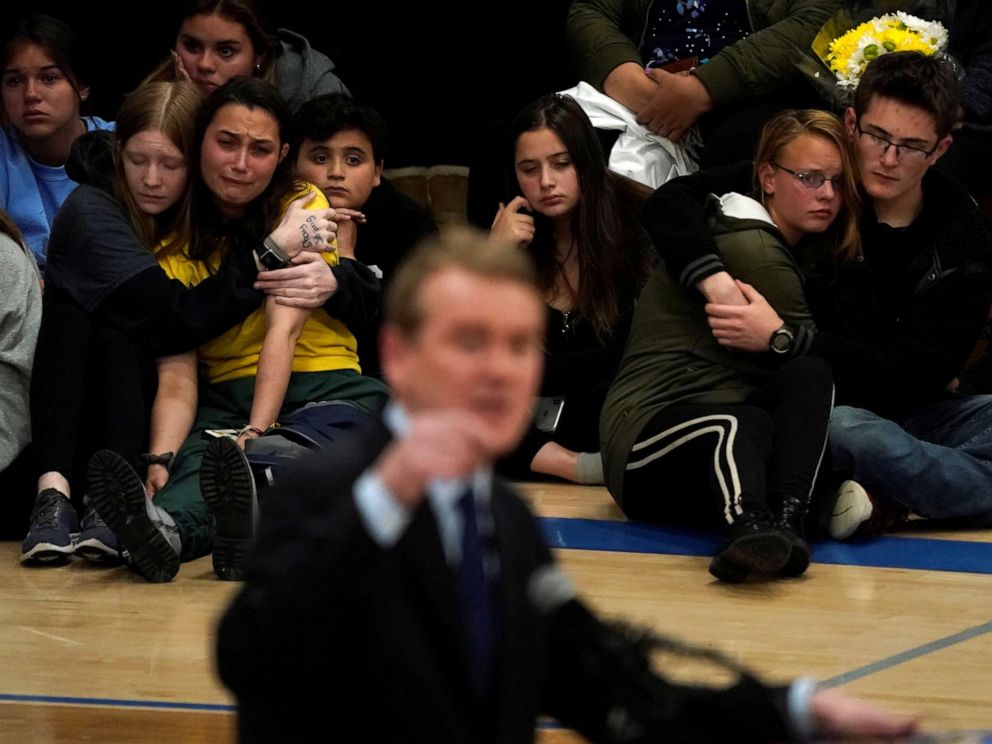
PHOTO: Students hug at a vigil for the victims of the shooting at the STEM School in Highlands Ranch, Colo., May 8, 2019, as Sen. Michael Bennett speaks.Rick Wilking/Reuters
Students hug at a vigil for the victims of the shooting at the STEM School in Highlands Ranch, Colo., May 8, 2019, as Sen. Michael Bennett speaks.more +

The source cautioned that the investigation is in the early stages and investigators are speaking with the security guard to determine all the facts.
A Douglas County Sheriff’s Department spokeswoman would not comment, citing the ongoing investigation.
At a news conference on Wednesday, Douglas County Sheriff Tony Spurlock said the security guard restrained one of the shooting suspects until deputies arrived.
The school’s security officer is employed by BOSS High Level Protection.

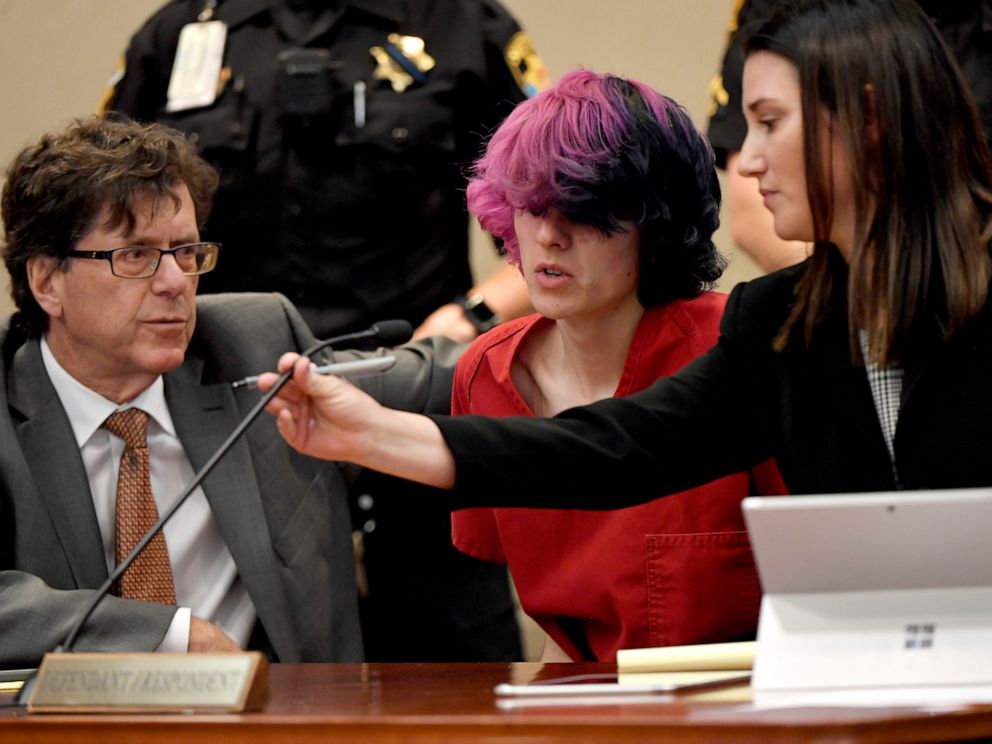
PHOTO: Devon Erickson, an accused STEM school shooter, answers the judge during his advisement at the Douglas County Courthouse in Castle Rock, Colo., May 8, 2019.Joe Amon/Denver Post via AP
Devon Erickson, an accused STEM school shooter, answers the judge during his advisement at the Douglas County Courthouse in Castle Rock, Colo., May 8, 2019.more +

The twist in the investigation was first reported by NBC affiliate station KUSA-TV in Denver.
Grant Whitus, chief executive officer of Boss High Level Protection, told ABC News on Thursday that the guard was interviewed by investigators for about an hour following the CONTINUE READING: Guard at Colorado school shooting may have shot at deputies, wounded student amid chaos: Source - ABC News

Nearly 200 Sacramento school teachers getting laid off as district attempts to avoid state takeover | abc10.com

Nearly 200 Sacramento school teachers getting laid off as district attempts to avoid state takeover | abc10.com

Nearly 200 Sacramento school teachers getting laid off as district attempts to avoid state takeover
Sacramento City Unified School District will approve the layoffs at a special board meeting scheduled on Thursday at 7 p.m.


SACRAMENTO, Calif. — Nearly 200 Sacramento City Unified School District teachers will soon be fired as the district continues to try avoiding a state takeover, announced late Tuesday night.
The layoffs had been announced earlier this year but were challenged by the teachers’ union. However, an administrative judge upheld the layoffs and ABC10 has confirmed that 178 teachers will laid off on July 1, 2019.
SCUSD blamed a decline in enrollment and budget issues for the layoffs as they continue to make cuts to try and avoid a state takeover. The district has until June to fill a $35-million budget hole.
No word yet on what schools and teachers will be impacted by this decision.
RELATED:
SCUSD officials told ABC10 that the board will approve the layoffs at a special board meeting scheduled on Thursday at 7 p.m.
Superintendent Jorge Aguilar issued the following statement following the decision:
“Decisions that result in our district losing dedicated staff members are not easy. Unfortunately, we do not have the resources to maintain our current staffing levels due to our fiscal crisis and declining enrollment. We are committed to helping our staff during this challenging transition.”
Board President Jessie Ryan had this to say:
“Each cut to our dedicated, certificated, classified and administrative staff looms heavy on our hearts but is unfortunately necessary given our grave fiscal challenges. We remain committed to doing the difficult work necessary to avoid a state takeover but recognize how deeply these actions impact our school communities.”
This is a developing story.
Nearly 200 Sacramento school teachers getting laid off as district attempts to avoid state takeover | abc10.com

The Lockdown-Drill Generation - The Atlantic

The Lockdown-Drill Generation - The Atlantic

When Was the Last Time American Children Were So Afraid?
Students used to duck and cover. Now they have lockdown drills.


This week, America got another reminder of the fear that its schoolchildren must make sense of every day. On Tuesday afternoon, nine students were shot—one of them fatally—at STEM School Highlands Ranch, near Denver.
Though the two suspects are teenagers, STEM School Highlands Ranch is K-12, meaning that some young children were exposed to the violence. Among them was a second grader who told a New York Times reporter that he’d gone through lockdowns and active-shooter drills since kindergarten. That’s close to half of his eight years of life.
His familiarity with potential crisis scenarios makes him part of an enormous group: In the 2017-2018 school year, over 4.1 million students participated in a lockdown or lockdown drill, according to an analysis by The Washington Post.
These lockdowns can be scarring, causing some kids to cry and wet themselves. Others have written letters bidding their family goodbye or drafted wills that specify what to do with their belongings. And 57 percent of teens worry that a shooting will happen at their school, according to a Pew Research Center survey from last year. Though many children are no strangers to violence in their homes and communities, the pervasiveness of lockdowns and school-shooting drills in the U.S. has created a culture of fear that touches nearly every child across the country. In postwar America, have kids ever been so afraid and so regularly prompted to imagine their own suffering?When I asked that question to Paula Fass, a historian at UC Berkeley and the author of The End of American Childhood: A History of Parenting from Life on the Frontier to the Managed Child, she brought up two eras as analogues. The first was the early stages of the Cold War—the ‘50s in particular—when fears of nuclear bombs had schoolchildren across the country doing duck-and-cover drills underneath their desks.

Governments should step up their efforts to give people skills to seize opportunities in a digital world - OECD

Governments should step up their efforts to give people skills to seize opportunities in a digital world - OECD

Governments should step up their efforts to give people skills to seize opportunities in a digital world


09/05/2019 - Governments must urgently step up their efforts to improve their education and training policies to help more people reap the benefits of the digital transformation and to reduce the risk of automation widening inequalities and driving unemployment, according to a new OECD report.
The OECD Skills Outlook 2019, which is part of the Organisation’s “I am the Future of Work” campaign, shows that as job markets evolve in response to technological change, some countries are better prepared than others as a result of the skill levels of their populations.
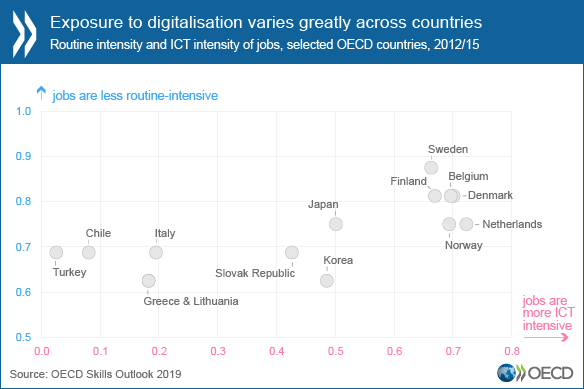
A new scoreboard in the Outlook finds that only a few countries, including Belgium, Denmark, Finland, the Netherlands, Norway and Sweden, are ahead in terms of the skills and effective lifelong learning systems needed to thrive in the digital world.
However, many other countries are lagging behind. Japan and Korea, for example, have the potential to perform well but must make greater efforts to ensure older workers and adults are not left behind. People in Chile, Greece, Italy, Lithuania, the Slovak Republic and Turkey often lack the skills needed to flourish in the digital world and current training systems are not developed enough to enable them to upskill.
“In our rapidly digitalising world, skills make the difference between staying ahead of the wave and falling behind,” said OECD Secretary-General Angel Gurría, launching the report in Paris. “To help people, governments will need to find the right balance between policies fostering flexibility, labour mobility and job stability. Businesses have also a key role to play in ensuring that employees upskill and reskill, adapting to the changing demands of the labour market. By improving our skills systems, we can ensure that today’s technological revolution will improve lives for all.” Read the full speech.
Traditional education systems need to evolve into lifelong learning systems, says the OECD. Adults will need to reskill and upskill throughout their careers to keep up with changes in the labour market. Yet, participation in training by low-skilled adults – those most likely to be affected by the changes ahead – is 40 percentage points below that of high-skilled adults on average across the OECD. Countries should create flexible and shorter types of learning opportunities, and technology can help through the development of online resources.
The Outlook says it is also key to improve the labour market relevance of adult learning and design new ways to recognise the level of skills of people who will follow complex learning pathways. It is vital to overcome the lack of motivation, which seems to prevent many low-skilled adults from engaging in training opportunities.
The Outlook estimates the level of training required for workers to change occupation and calculates how much training effort is required to facilitate these transitions. The findings show that more than half of occupations (54%) at high risk of automation will need either a moderate (less than one year) or severe (more than one year) training effort for workers to transition to better-quality and safer jobs.
The magnitude of the challenge is substantial since lifelong learning systems need to provide training for adults throughout their careers, so that they can move to other jobs as automation progresses or avoid being displaced from jobs that will be profoundly transformed. Governments need to put the right incentives and mechanisms in place to engage employers, social partners and other stakeholders to share the costs.
Countries can foster lifelong learning by addressing inequalities in learning opportunities throughout life, adapting the school curriculum to changing skills requirements and providing more effective training to teachers. Technology can play a large role in making education and training systems more efficient, flexible and adaptable to individual needs. To achieve this goal, it is important that teachers receive the support they need to use technology in order to improve student outcomes.
Technology can also help lagging regions catch up, by connecting people with teachers and learning opportunities that may not be available locally.
The OECD Skills Outlook 2019, together with country notes for Canada, France, Germany, Italy, Korea, Mexico, Spain, the United Kingdom and the United States, are available at http://www.oecd.org/publications/oecd-skills-outlook-2019-df80bc12-en.htm
For more information, journalists should contact Spencer Wilson (tel. + 33 1 45 24 81 18) in the OECD Media Office (tel. + 33 1 45 24 97 00).

Working with over 100 countries, the OECD is a global policy forum that promotes policies to improve the economic and social well-being of people around the world.

Governments should step up their efforts to give people skills to seize opportunities in a digital world - OECD

OKCPS will try ‘transformation school’ experiment again

OKCPS will try ‘transformation school’ experiment again

OKCPS will try ‘transformation school’ experiment again


Given the excellence of Classen SAS, Southeast H.S., and Belle Isle Enterprise School, expanding access to these magnet schools makes sense for OKCPS in its new Pathway to Greatness realignment.
But what will be the education values that drive the district’s effort to turn around high-challenge schools using the transformation school model? And if the district invests in BrittonMartin Luther KingThelma Parks and Rockwood elementaries to become “innovative transformation schools,” will the instruction be similar to that of previous transformation schools?
“Our goal is to help prepare middle-schoolers to be able to be successful,” Southeast Middle School’s new principal, Rhonda Schroeder, explained to The Oklahoman’s Tim Willert. “Our academics will be enriched with science and technology and engineering.”
Similarly, Belle Isle’s students take Spanish, math exploration classes that connect concepts with real-world applications and elective topics like gardening and STEM projects.
“The school produces exceptionally well-rounded students thanks to great teachers, great leaders and so many opportunities for students to become engaged through academics, fine arts, athletics and other extracurricular activities,” said Christy Watson, a Belle Isle CONTINUE READING: OKCPS will try ‘transformation school’ experiment again

Teacher's Union Says ‘Elitist’ Betsy DeVos Is Making Teaching ‘Impossible’: ‘Strikes Are Never a First Resort’

Teacher's Union Says ‘Elitist’ Betsy DeVos Is Making Teaching ‘Impossible’: ‘Strikes Are Never a First Resort’

TEACHER'S UNION SAYS ‘ELITIST’ BETSY DEVOS IS MAKING TEACHING ‘IMPOSSIBLE’: ‘STRIKES ARE NEVER A FIRST RESORT’

Image result for ELITIST̢۪ BETSY DEVOS

One of America’s largest teacher’s unions has hit out at Education Secretary Betsy DeVos, accusing her of hypocrisy and failing to listen to the needs of both teachers and students.
The reaction came after DeVos criticized educators for taking industrial action and suggested such measures were unfairly undermining students’ education.
Statewide work stoppages have taken place in Arizona, Oklahoma, West Virginia, Kentucky, Colorado and North Carolina during the 2018–2019 school year. Smaller actions have been launched across the country. The graph from Statista below shows the number of teaching strikes in the U.S. in recent years.
20190507_TeacherSTATISTA
But the Department of Education has refused to cave to the industrial action. Speaking at a conference in Baltimore on Monday, DeVos said teachers should air their grievances outside of classroom hours.
“I think it's important that adults have adult disagreements on adult time, and that they not ultimately hurt kids in the process,” DeVos said. “I think too often they're doing so by walking out of classrooms and having arguments in the way that they are.”
But American Federation of Teachers President Randi Weingarten dismissed DeVos' comments. She told Newsweek, “It's so rich when people cut budgets and make it impossible to teach until they take action at the last resort to try to actually get kids what they need. Those same people who have made it impossible then say, ‘Oh, well they shouldn't disrupt kids.’”
The AFT—the second largest teachers’ union in the country representing some 1.7 million people—has been involved in strikes across the country. The union and its members have rallied against low wages, large class sizes and other issues.
Weingarten suggested it was “the height of hypocrisy” for DeVos to “make it impossible for teachers to teach” and then blame the teachers for drastic action. After all, she added, strikes “are never a first resort, they are always a last resort.” This is something Weingarten believes the general public already knows. “The public understood…that teachers want what children need,” she explained. “Teachers went on strike for kids, not on kids.”
DeVos did agree that “great” teachers should be “well paid,” but did not elaborate on how much CONTINUE READING: Teacher's Union Says ‘Elitist’ Betsy DeVos Is Making Teaching ‘Impossible’: ‘Strikes Are Never a First Resort’

The Most Important Article You Will Read This Year: “Stop the Bleed” | Diane Ravitch's blog

The Most Important Article You Will Read This Year: “Stop the Bleed” | Diane Ravitch's blog

The Most Important Article You Will Read This Year: “Stop the Bleed”


Bystanders can and must be first responders, and they can learn the techniques to stop bleeding. These are crucial as a person can bleed to death in five to eight minutes.
It is a sad commentary on our society but it is reality: none of us knows when we will be the bystander whose fast thinking and action are required to save the life of a friend or a stranger.
The number of shootings and acts of terrorism has escalated and is now called an “Intentional Mass Casualty Event.”
Williams begins with a dramatic account of one of these events at a high school in Murrysville, Pennsylvania.
“One April morning in 2014, a sixteen-year-old sophomore at Franklin Regional Senior High, in Murrysville, Pennsylvania, stole two butcher knives from his parents’ kitchen, hid them in his backpack, and took them to school. He was wearing all black and, according to witnesses, had a “blank expression.” Just before first period, in the hall of the science wing, he stabbed several classmates. Then he pulled the fire alarm. As the corridor filled with people, the boy moved down the hallway, a knife in each hand, stabbing more students. He turned and raced back up the hall—an administrator CONTINUE READING: The Most Important Article You Will Read This Year: “Stop the Bleed” | Diane Ravitch's blog


Can Choice Save Public Education revised | Deborah Meier on Education

Can Choice Save Public Education revised | Deborah Meier on Education

Can Choice Save Public Education revised

I recently ran across an article I wrote for The Nation in 1991 entitled “Choice Can Save Public Education.” It surprised me for two reasons, (1) Was I already worried that public education might disappear? And (2) when did I stop being such an enthusiast for choice?


At the time I wrote the Nation piece my slogan was “Small schools, choice and self-governance” was my mantra.

I even thought school size could be mandated without doing any harm—and probably doing a lot of good. My enthusiasm for choice began when in 1973 Tony Alvarado, the superintendent in East Harlem offered me a chance to start “my own” school of choice. District 4 was a densely packed district, about a square mile in size. 1973 was the beginning of a too short period in New York City when elected local school boards and their superintendents had unprecedented autonomy. Alvarado’s proposed that parents could choose to send their children to this new small school and I could choose the staff, and together we were promised a lot of freedom. Within a few years there were almost as many small schools of choice as zoned neighborhood schools. In a way it made the neighborhood schools a choice as well.

District 4 quickly went from being the poorest and lowest scoring school district to be having schools with some social class integration (more based on class than race) and higher test scores. Small schools and choice seemed to have won a victory. Self-governing schools not so much—alas—as few of the new or old school leaders liked the idea of sharing power.

Self-governing democratically operating school became my central focus from then on. As I was approaching retirement, I was attracted to Boston, which was starting something they called Pilot Schools. It seemed an exciting opportunity to explore all CONTINUE READING: Can Choice Save Public Education revised | Deborah Meier on Education


CURMUDGUCATION: What She Taught Me

CURMUDGUCATION: What She Taught Me

What She Taught Me


I've written about Miss Gause before. She was my elementary school vocal music teacher, and she had a critical effect on me in two major ways.

First, she was fairly relentless in confronting the Monotone Boys I'm-Too-Cool-To-Sing Chorus in the back of the room. She harangued us into listening to pitches and more or less matching them. Now, in my school students took a listening aptitude test in fourth and fifth grade to determine if we were eligible to study an instrument. I flunked in fourth grade and passed in fifth; the difference was Miss Gause. It is not humanly possible to imagine what my life would have been like if I hadn't played an instrument.


Second, she paddled me (it was the sixties). I was in the back of the room performing what I was certain was a hilarious imitation of her conducting technique. She failed to grasp my comic genius, and I received a fairly fierce paddling, there, in front of the class, so that it was painful, and embarrassing, plus I had to keep from showing how much it hurt.

The paddling itself was not terribly influential. But what stuck with me was what came next, which was nothing. She didn't treat me any worse because i had screwed up. I was not forever after branded a Bad Kid. I misbehaved, I received a consequence, and then the incident was over and done. For me, it was the beginning of understanding that "I disagree with you" or "I think you've done wrong" were not synonymous with "I hate you" or "You are a terrible human being."

I carried that into my classroom, and always tried to keep "No, that's wrong" and "I need you to knock that off right now" separate from "You suck" or "I want you to get off the planet." I was pretty explicit about it, too, because I wanted students to be able to hear the difference between CONTINUE READING: 
CURMUDGUCATION: What She Taught Me