Latest News and Comment from Education

Thursday, April 18, 2019

Destroying Public Education in St. Louis | tultican

Destroying Public Education in St. Louis | tultican

Destroying Public Education in St. Louis


By T. Ultican 4/18/2019
On April 2nd, St. Louis city voters picked Adam Layne and Tracee Miller to serve on their seven-member Public School Board. They appear to be the two least likely candidates out of seven to protect public schools. With the state poised to end twelve years of control over the city’s schools, this is not a happy result for public education advocates.

The Seven Board Candidates

  1. Adam Layne is a former Teach for America (TFA) corps member assigned to a St. Louis charter school and is currently a board member of the Kairos Academy charter school.
  2. Tracee Miller was a TFA corps member and is currently running a math tutoring program in St. Louis for the Gates Foundation supported Khan Academy.
  3. Louis Cross boasts a long career with St. Louis Public Schools. He served as principal and interim superintendent of the now defunct Ethel Hedgemen charter school.
  4. Bill Haas served on the school board from 1997 to 2005, and again from 2010 to 2018. He was one of two board members that stood in opposition to contracting with Alvarez and Marsal to run St. Louis schools in 2003.
  5. David Merideth served on a special committee in 2017 that studied the school board’s role in future governance of the district when state control is relinquished.
  6. Barbara Anderson is a graduate of St. Louis Public Schools who taught on the elementary, middle and university levels throughout her career.
  7. Dan McCready is from Cincinnati, where he taught third and fifth grade math at a Cincinnati public school. He currently works at KIPP Victory Academy, a St. Louis charter school.
Dark Money Keys Election Results

Layne and Miller
Adam Layne and Tracee Miller
New board member Adam Layne appears to be a talented and idealistic young man. In 2011, he graduated with a bachelor’s degree in finance from George Washington University. Unfortunately, that youthful idealism was corrupted  CONTINUE READING: Destroying Public Education in St. Louis | tultican

An open letter to Betsy DeVos, from two leading public education advocates - The Washington Post

An open letter to Betsy DeVos, from two leading public education advocates - The Washington Post

An open letter to Betsy DeVos, from two leading public education advocates

At a recent hearing on Capitol Hill, Education Secretary Betsy DeVos testified before the House Education Committee and had a brief discussion with Rep. Haley Stevens (D-Mich.) about charter schools.
Here's how some of it went:
STEVENS: So your budget proposes to eliminate billions of dollars in K-12 programs, from professional development for teachers and principals, to after school programming, to mental health services, and one of my personal favorites: STEM education. And obviously, we’ve heard you talk about some of the hard decisions that you’ve had to make. Yet, somehow, you found $60 million for an increase in the federal charter school program. I just really wonder if charter schools are the answer here, whereas it really should be the Title I funding. A recent report by the Network for Public Education found that more than $1 billion in charter school program funds have been given to support charter schools that never opened or they’ve closed -- they kind of abandoned the children and families. Since 2010, 25 schools in Michigan that have received $1.7 million in charter school funding just never even opened. And the Inspector General found waste, fraud, and abuse due to the frequency of school closures in the charter school program. Can you just explain for me the mark of effective programs here, and can you justify the proposed increase for the charter school program, and on what measures or studies you have been using?
DeVOS: Let me first comment on the study you’re referring to. I’m not sure you can even call it a study. We’re looking more closely at it of course, and anything that is truly waste, fraud, or abuse we will certainly address. But the reality is that the study was really funded by and promoted by those who have a political agenda against charter schools. And the other reality is that there are currently over one million students on wait lists for charter schools in the country. So, we want to see more charter schools, not fewer. More students that can access options that are right for them, not fewer.
The report to which they refer is “Asleep at the Wheel,” published in March by the Network for Public Education, a group that advocates for policies supporting publicly funded school districts. It says the U.S. government has wasted up to $1 billion on charter schools that never opened, or opened and then were closed because of mismanagement and other reasons. The report said the U.S. Education Department has not adequately monitored how its grant money has been spent by Republican and Democratic administrations.
I wrote about the report, which was slammed by many supporters of charter schools who do not want restrictions on how charters operate. Those supporters include DeVos, who has made clear in speeches and testimony that she believes the market, and not the government, should decide the fate of schools.
Charter schools are publicly funded but privately operated — some by for-profit companies. About 6 percent of America’s schoolchildren attend charter schools, with 44 states plus the District of Columbia, Guam and CONTINUE READING: An open letter to Betsy DeVos, from two leading public education advocates - The Washington Post

CURMUDGUCATION: The Charter Effect On Teachers

CURMUDGUCATION: The Charter Effect On Teachers

The Charter Effect On Teachers


Unions, we have been told, have a deleterious effect on  teachers, forcing them to accept lousier deals than they could get in a free market where they each negotiated their own deals. In such a market, schools would compete for teachers, bidding up the salary offers. Teachers could negotiate from a place of strength. No teacher would ever want a union ever gain.

I confess that there was a time when I thought this might be true. Long ago, I thought that whatever their flaws, charter and choice systems would turn popular and successful teachers into sports stars, with schools throwing money and cars and lord-knows-what-else at them.


There were several factors I didn't reckon with, the chief one being the degree to which the charter industry would view teachers less like LeBron James and more like Pat the fry cook. I didn't foresee that charterpreneurs would imagine a system where the teacher was just a fleshy bot, a particularly lifelike animatronic content delivery device with a shelf life of only a few years. I failed to realize that a teacher's ability to walk away would be overshadowed by a school's ability to fire teachers for any reason at all.

Over the years the anecdotes kept rolling in to show me how wrong I was. But there was also some actual research, like this report from Public Source in Allegheny County PA (the county that surrounds Pittsburgh). I missed this report when it came out two years ago, but it's worth looking at now.

Public Source did a separate report about charter staff turnover. The turnover is high, and that's CONTINUE READING: 
CURMUDGUCATION: The Charter Effect On Teachers


2019 Medley #8 | Live Long and Prosper

2019 Medley #8 | Live Long and Prosper

2019 Medley #8 


Grade Level, Student Achievement,
Society’s Mirror, Teacher Shortages,
Charter Accountability,
Disenfranchising the Voters
CHILDREN DON’T EAT ON GRADE LEVEL
This post isn’t about reading, but Mitchell Robinson brings up important information we should remember.
Last month, third graders in Indiana took the IREAD-3, a reading achievement test. Those who fail to achieve the arbitrarily designated cut score must take the test again during the summer. Those who fail it again must repeat third grade.
The concept of grade level should be flexible, not based on an arbitrary cut score. It should reflect the average reading level of a child in a particular grade instead of a goal for every child to achieve on a given test day. We should teach children at their zone of proximal development — the level just beyond the child’s independent level, not at the level the test insists upon.
Would we like all children to be above average? Of course, but we can’t ignore the math which renders that impossible. Additionally, we can’t ignore the detrimental impact of poverty on school achievement. Our job, as teachers, is to analyze a child’s achievement and make our plans based on what will help him progress as quickly as possible. That means starting where the child is…not at some vague “grade-level” determined by an outside source.
By setting a cut score on a test, and using the test to determine grade placement, the state is ignoring this basic concept of academic achievement and development, usurping the professional judgment of the classroom teacher, and ignoring the best interests of children in a misguided quest to get a number with which to label teachers, schools and school districts.
I agree with Robinson when he says that we can set “goals as teachers for when we introduce various literacy concepts to our students.” We do that by understanding the reading process and observing our students. [emphasis in original]
Children don’t “read on grade level” anymore than they “eat on grade level” or “care about their friends on grade level.” Anyone who has actually helped  CONTINUE READING: 2019 Medley #8 | Live Long and Prosper


MetWest Internships (Part 7) | Larry Cuban on School Reform and Classroom Practice

MetWest Internships (Part 7) | Larry Cuban on School Reform and Classroom Practice

MetWest Internships (Part 7)


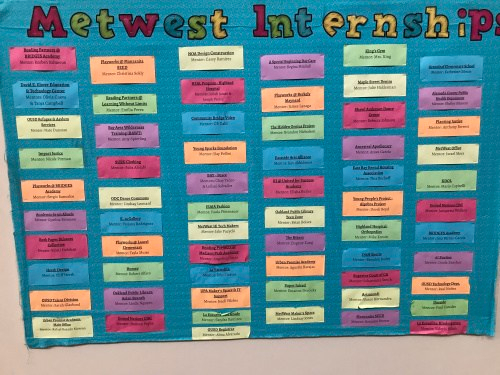
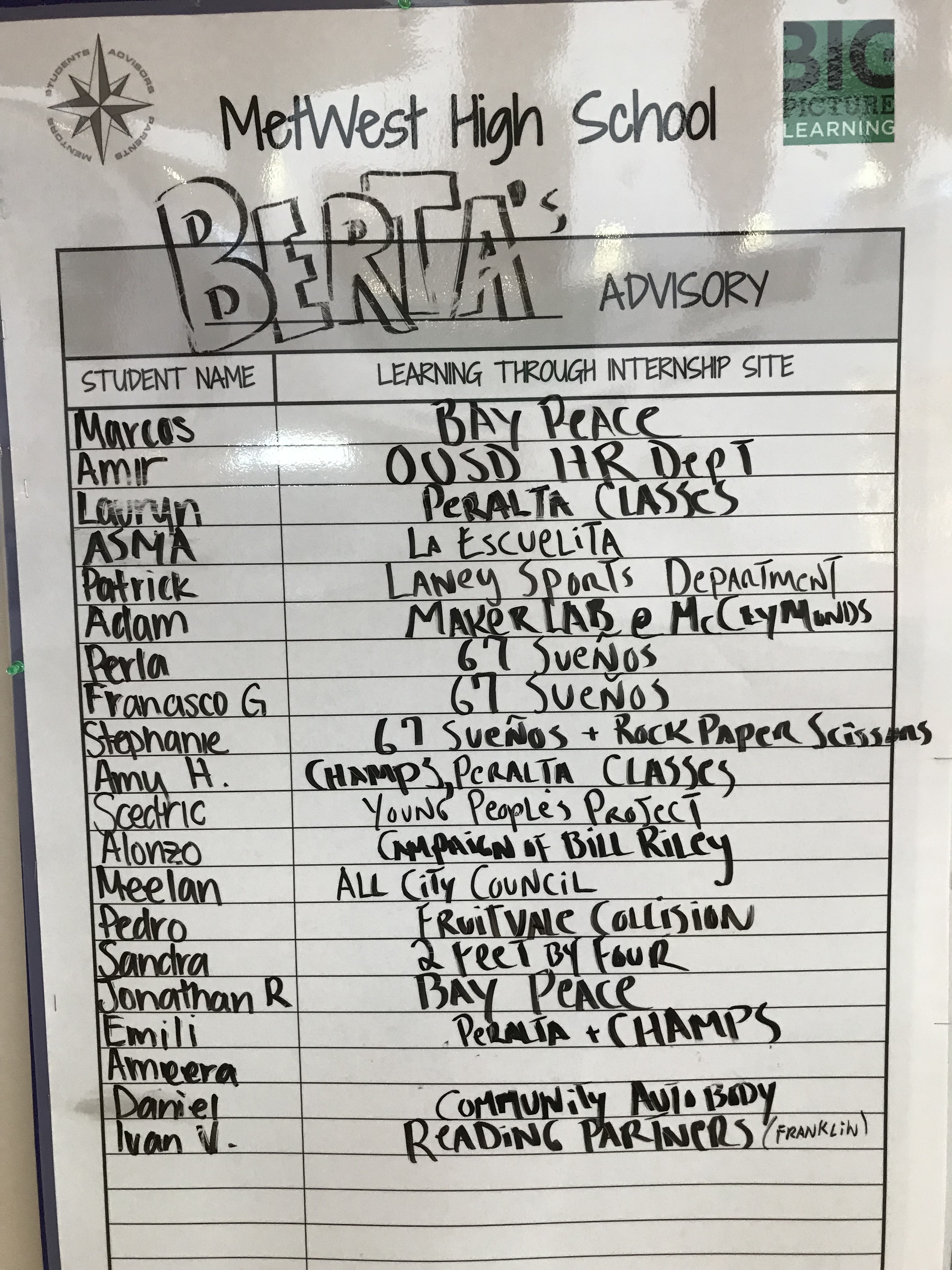
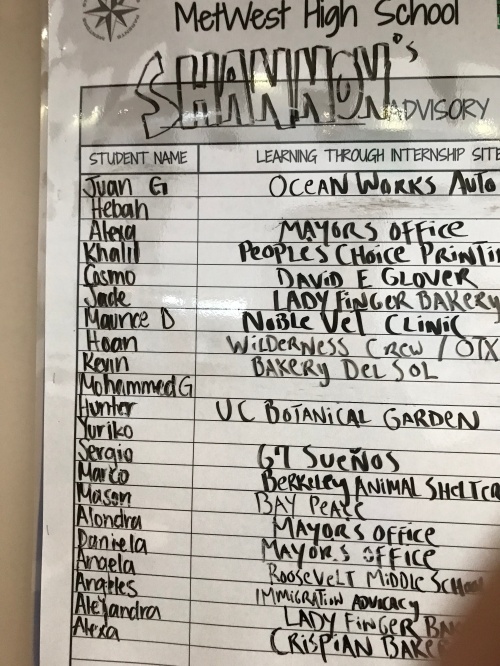
The last post described student and teacher participation in twice-weekly internships in Oakland businesses, government agencies including schools, health facilities, and social services.
img_2382.jpg

Advisor/Teachers work closely with students in their sites and are responsible for connecting what they learn with the academics they teach–English, history, math, science, foreign language.
IMG_2479.jpg
img_2375.jpg
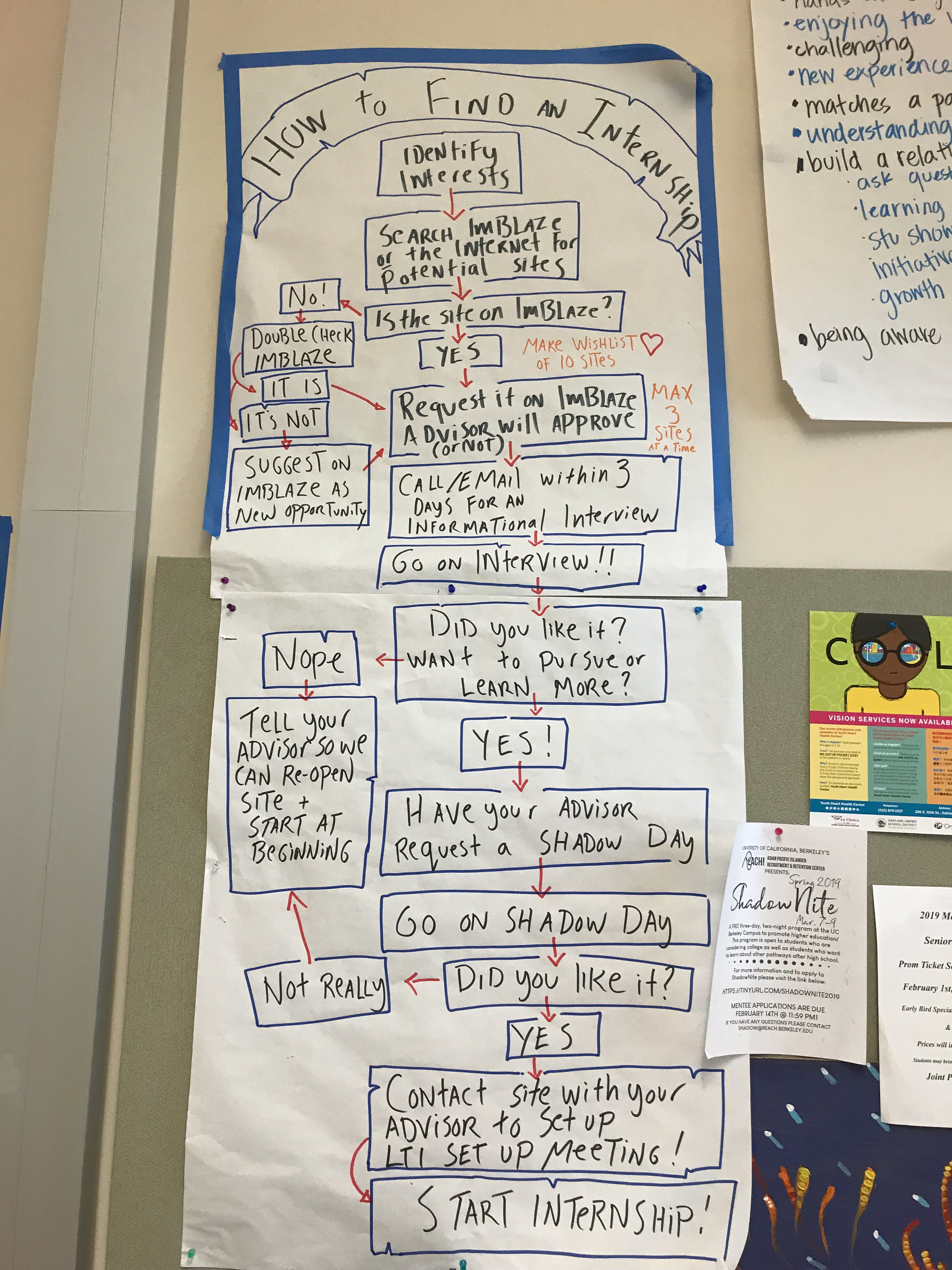
Mike Cellemme is Learning Through Internship (LTI) coordinator. He finds a site and locates a mentor willing to take and supervise a MetWest student. He talks to students about what they are interested in and want to learn more about and then finds a match between site, mentor, and student. He supervises the overall program. The process looks like this:
IMG_2438.jpg
*ImBlaze is a website that Big Picture schools use to identify possible internships for students

A former teacher at The Met in Providence (RI), he is experienced, savvy,and committed to making the program work for students, teachers, and work site mentors. What follows describes an afternoon I spent with Mike working with students and then going to an internship work site.
Like any high school program with many moving parts involving 160 students, a dozen or so teachers, and over a hundred mentors in their workplace, some things go smoothly, some less so.
On March 21, 2019, I went to room 136 in MetWest to see Mike and Mayra Acosta (a graduate of program and now Resource Program Specialist) work with various students searching for and working in varied internships. Students came in, asked questions about their mentors and sites and left; others stayed and sat with Mike and Mayra to talk about issues that came up in their classes, Senior Thesis Project, and internships.
Here is what I observed over the next hour. Alonzo who had worked as an intern on an Oakland political campaign during the fall semester is now searching for a new internship. On her laptop screen, Mayra pulls up some possibilities for him to consider. She asks questions about what he learned during the last internship, his current interests, and what he has heard from other students about their  CONTINUE READING: MetWest Internships (Part 7) | Larry Cuban on School Reform and Classroom Practice


Wednesday, April 17, 2019

We’re Having the Wrong Conversation About the Future Of Schools

We’re Having the Wrong Conversation About the Future Of Schools

We’re Having the Wrong Conversation About the Future Of Schools
Despite the rhetoric, modern movements to reform schools have had a devastating effect on education


As a full-time teacher, I don’t have a lot of time to look up from the dailiness of the job to consider something as nebulous as the “future” of education. When I do, I feel a vague unease that too many non-teachers seem to have a lot of time to do this kind of thinking.
One thing in my favor is that education reform seems to take the same basic forms, year after year. There’s the standards and accountability movement and the ongoing attempts to give it “teeth.” Then there are the tech giants peddling autonomy and self-direction in lieu of soul-crushing activities like reading The Outsiders and using protractors. And though the latter reformers are often critics of the former, the two have a lot in common.
Both represent billion-dollar industries. Both frequently co-opt a rhetoric of liberation, autonomy, and empowerment. Both can barely disguise a deep disdain for teachers and schools, especially of the “sage on the stage” variety. And both are almost exclusively headed up by white men.
These are the kind of people setting a bold agenda for the future of education.
Admittedly, us unruly American educators would have a hard time coming up with anything coherent enough to compete with the brave visions set forth by the leaders of these two industries. The very fact that such an all-encompassing solution is needed testifies to their dominance in framing the narrative around American schools. Mired in the day-to-day challenges and complexities of actually caring for and educating children, many teachers exhibit a complete failure of imagination when it comes to sweeping monolithic initiatives with pithy acronyms, eye-catching logos, and font pairings that are straight fire.
But we do need to change. Beyond the usual Alice Cooper-type critiques, we teachers have been especially complicit in the widespread marginalizing, neuroticizing, and criminalizing of our most vulnerable students. Yes, we need to stop boring future white rockstars and Silicon Valley entrepreneurs. This is already well known. But, CONTINUE READING: We’re Having the Wrong Conversation About the Future Of Schools

We've Got Issues: How can you find out more about the issues you care about? | Eclectablog

We've Got Issues: How can you find out more about the issues you care about? | Eclectablog

We’ve Got Issues: How can you find out more about the issues you care about?


I’ve got issues. We all do.
For me, it’s all about public education. It’s what I’ve dedicated my professional life to, and I have pretty strong feelings about supporting public schools, teachers, and students, and protecting the institution of public education from attacks by persons like Michigan’s own Betsy DeVos.
Your issue may be affordable health care. Or making sure we all have clean drinking water. Or defending the rights of our friends in the LGBTQ community. Or making our government more transparent and responsive to the needs of our citizens, instead of bowing to pressures from special interest groups.
If you’re like me you’re always on the lookout for information about the things you care about–and may become frustrated at times with the lack of any sort of coverage on your issue from the mainstream media. Especially if you’re a Progressive.
And that’s where Eclectablog comes in!
Because we care about Progressive issues–and so do you! And Progressive issues tend to be the stuff that most of us actually care about. The things that impact our kids, our families, our friends, and our communities. Like well-supported schools, and health care, and clean water, and civil rights…for everyone.
But we need your help. To keep the lights on we come to you, our readers, four times a year–hat in hand, asking for your help in the form of a donation.
Here’s the good news! We make it as easy as possible for you to be a supporter by using the handy PayPal form at the top of the right sidebar to make a one-time donation in the amount of your choice. You can also go “old school” and send a check (which avoids PayPal taking out a percentage of your donation) to Chris Savage, P.O. Box 32, Dexter, MI 48130. Just make the check payable to “Eclectablog”.
And if you really want to make a statement about your support for your issue, you can do so by making a monthly donation–just enter the amount below:
Want to make a  monthly donation?
We've Got Issues: How can you find out more about the issues you care about? | Eclectablog
Even if you can’t make a financial contribution, there’s another way to support the work we do in shining a light on your issues: keep sharing our posts on your social media networks! The more eyes we get on these posts means more potential support for all of the issues we care about–including your’s!
And, as always, thank you for your ongoing support. It means a lot.
Tags 
We've Got Issues: How can you find out more about the issues you care about? | Eclectablog

The Los Angeles Times’ History of Putting Kids Last

The Los Angeles Times’ History of Putting Kids Last

The Los Angeles Times’ History of Putting Kids Last
– Los Angeles Times Editorial Board
During my first run for the LAUSD School Board, I was interviewed by the Los Angeles Times (LAT) Editorial Board as they considered who they would endorse. Unfortunately, this discussion devolved into an argument over my support of the opt-out movement for standardized testing. I had explained that one of the reasons that my wife and I had decided to exercise our rights under the state education code and exempt our children from taking these tests was the unnecessary stress it imposed on students. A member of the Editorial Board accused me of hypocrisy as I had also allowed my children to choose to take AP tests. She was unswayed by my argument that since the payoff for undergoing the stress of taking an AP test was possibly receiving college credits, the stress of taking that test was an acceptable cost. To her, stress was a necessary part of life and she did not see a reason why children should  be protected from it.
To no one’s surprise, the LAT endorsed Tamar Galatzan, who was supported by the charter industry, in that election. Fresh on the heels of multiple scandals that wasted taxpayer money and exposed Superintendent John Deasy’s incompetence, the Times pushed for this incumbent who, in their own words, was “such a reflexively pro-Deasy vote that she neglected to ask key questions about problematic proposals. That includes the proposal to spend half a billion dollars on iPads for every student, which she continued to support for far too long.” Contradicting this statement, they lauded her as “the board member most likely to take independent positions”. As an example, they cited her opposition to parent centers.
In that same cycle, the LAT endorsed Ref Rodriguez, even afterquestions had arisen over fundraising that had occurred during the early stages of his campaign. Rodriguez had been one of the founders of the PUC chain of charter schools and was also a candidate CONTINUE READING: The Los Angeles Times’ History of Putting Kids Last


Varnett charter school parents eligible for restitution after founders’ convictions - Houston Chronicle

Varnett charter school parents eligible for restitution after founders’ convictions - Houston Chronicle

Varnett charter school parents eligible for restitution after founders’ convictions


More than 4,000 parents whose children attended the Houston-based Varnett charter school network between 2007 and 2014 could receive restitution payments totaling more than $600,000 nearly a year after the district’s founders were convicted of siphoning millions from the schools, federal officials announced Tuesday.
Parents could be eligible for $110.02 per child for every year they attended one of the district’s three campuses. For example, if a family sent three children to the school for three years, it could be eligible for $990.06.
The money came from selling assets once owned by Marian Annette Cluff and her husband, Alsie Cluff Jr., who also have been ordered to pay $1.89 million to the charter school district, $1.83 million to the Internal Revenue Service, $100,000 to a Philadelphia-based insurance company and nearly $14,800 to two employees. Both Cluffs were sentenced in June 2018 and are in federal custody. Marian Cluff is serving 10 years for conspiracy to commit tax evasion and mail fraud; Alsie Cluff was sentenced to three years on a conspiracy to commit tax evasion conviction.
Ryan Patrick, U.S. Attorney of the Southern District of Texas, said Tuesday that the Cluffs billed parents for routine expenses — such as field trips and fundraisers — even though those functions already had been funded by the school. Instead of spending the money on students, the two used the extra funds to pay for lavish vacations aboard a private jet, furnish a 7,000-square-foot home in South Houston, purchase designer jewelry and fund upkeep on a ranch.
“What the Cluffs did was use this set of charter schools as pass-throughs for their own financial gain,” Patrick said.
The Cluffs founded the Varnett school network, which has grown to serve about 1,600 elementary students across three campuses, in 1984. They paid themselves exorbitant salaries, Marian Cluff for working as the schools’ superintendent and Alsie Cluff for managing business operations. Alsie Cluff also made millions from contracts and other deals with the schools. The couple reported about $12 million in income from Varnett during an eight-year period.
In addition to giving themselves higher-than average salaries, the Cluffs skimmed money parents paid under the guise of CONTINUE READING: Varnett charter school parents eligible for restitution after founders’ convictions - Houston Chronicle

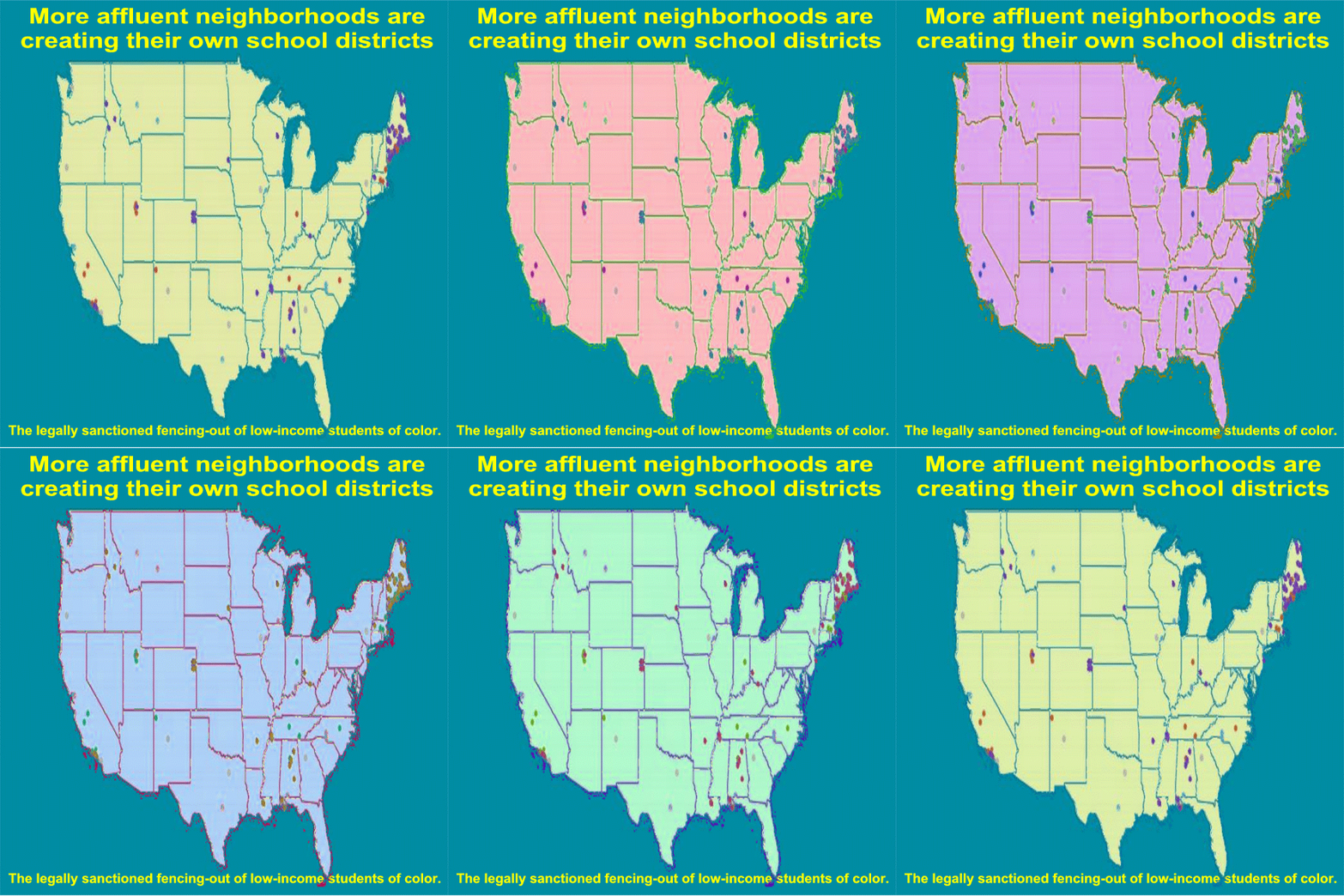
More affluent neighborhoods are creating their own school districts - Vox

More affluent neighborhoods are creating their own school districts - Vox

More affluent neighborhoods are creating their own school districts
The legally sanctioned fencing-out of low-income students of color.


In the past two decades, 128 communities have had a simple idea: to make their own school district.
For many of them, the underlying purpose was to draw a legal fence between their community and a poorer one. Because a large chunk of public education is funded using local property taxes, making your own district with your affluent neighbors means that you’re able to hoard resources — and not share tax dollars with poorer communities of color.
In 2017, I wrote about how a surprising number of these efforts have succeeded.
Since then, 11 more communities have seceded from their districts, according to a report from EdBuild. Another 16 communities are currently in the process of trying to secede. And two states — Indiana and North Carolina — have made it easier for these communities to form their own districts.
“It’s a disturbing trend. We’re seeing legislators making this overtly permissible,” said EdBuild CEO Rebecca Sibilia.


To be clear, school secession isn’t a viral trend yet. Most of the new divisions are in Maine, where Republican Gov. Paul LePage successfully pushed the legislature to lift penalties on communities that left regionalized districts. And some of the seceding districts are doing so for legitimate reasons such as “shifting enrollments and geography,” as EdBuild notes.
But school secession is one of the more brazen examples of affluent communities using their political clout to fence out everyone else. And as leading school segregation writer Nikole Hannah-Jones wrote in 2017, “School secessions, at least in the South, trace their roots to the arsenal of tools that white communities deployed to resist the desegregation mandate of the Brown ruling.”

One high-profile secession case was blocked last year, but many others went through

Advocates who oppose this behavior got a big win in 2018 when a federal court blocked an Alabama community from leaving its district.
In 2017, I wrote about a community called Gardendale, which took initial steps to leave the CONTINUE READING: More affluent neighborhoods are creating their own school districts - Vox