Latest News and Comment from Education

Monday, March 25, 2019

Report: U.S. government wasted up to $1 billion on charter schools and still fails to adequately monitor grants - The Washington Post

Report: U.S. government wasted up to $1 billion on charter schools and still fails to adequately monitor grants - The Washington Post

Report: U.S. government wasted up to $1 billion on charter schools and still fails to adequately monitor grants


The U.S. government has wasted up to $1 billion on charter schools that never opened, or opened and then closed because of mismanagement and other reasons, according to a report from an education advocacy group. The study also says the U.S. Education Department does not adequately monitor how its grant money is spent.
The report, titled “Asleep at the Wheel” and issued by the nonprofit advocacy group Network for Public Education, says:
  • More than 1,000 grants were given to schools that never opened, or later closed because of mismanagement, poor performance, lack of enrollment or fraud. “Of the schools awarded grants directlyfrom the department between 2009 and 2016, nearly one in four either never opened or shut its doors,” it says.
  • Some grants in the 25-year-old federal Charter School Program (CSP) have been awarded to charters that set barriers to enrollment of certain students. Thirty-four California charter schools that received grants appear on an American Civil Liberties Union list of charters “that discriminate — in some cases illegally — in admissions.”
  • The department’s grant approval process for charters has been sorely lacking, with “no attempt to verify the information presented” by applicants.
  • The Education Department in Republican and Democratic administrations has “largely ignored or not sufficiently addressed” recommendations to improve the program made by its own inspector general.
“Our investigation finds the U.S. Department of Education has not been a responsible steward of taxpayer dollars in its management of the CSP,” it says.
The Education Department did not respond to questions about the study’s findings. The report has been given to members of Congress with education oversight authority.
Charter schools are publicly financed but privately operated, sometimes by for-profit companies, and they have become a controversial part of the “school choice” movement that has gained ground throughout the country over the past few decades.
Today, about 6 percent of U.S. schoolchildren attend charter schools, with 44 states plus the District of Columbia, Guam and Puerto Rico having laws permitting them. Some states have only a few charters while others have many. California has the most charter schools and the most charter students; in Los Angeles, 20 percent of children attend such schools. In the District, almost half of the city’s schoolchildren go to charter schools.
Supporters first described charters as competitive vehicles to push traditional public schools toward reform. Over time, that narrative changed, and charters were touted by supporters as offering choices for families who CONTINUE READING: Report: U.S. government wasted up to $1 billion on charter schools and still fails to adequately monitor grants - The Washington Post

Why School Psychologists Are Worried About the Mental Health of America’s Students | American Civil Liberties Union

Why School Psychologists Are Worried About the Mental Health of America’s Students | American Civil Liberties Union

Why School Psychologists Are Worried About the Mental Health of America’s Students
Distressed student sitting with a counselor


Earlier this month, thousands of school psychologists met in Atlanta at the annual convention of the National Association of School Psychologists. One of the hottest topics among attendees was exhaustion — a consequence of having to serve more students who are experiencing more trauma and other mental health problems without more help in carrying the load.
It’s not just school psychologists who are concerned about being short-staffed. I know of far too many school counselors, social workers, and nurses who are serving more students than any practitioner can reasonably handle. Their impossible caseloads result in not only work overload and the risk of burnout but also an alarming number of young people not getting the help they need.
For the past several years, members of the school psychologist community have been raising concerns about the detrimental under-investments in school-employed mental health staff — and a new report from the ACLU adds further data to the extent of the problem. “Cops and No Counselors,” co-authored by me and six other experts, analyzed data that the U.S. Department of Education collected from every school district in the nation. We found that the majority of K-12 schools are ill-equipped to address the mental health needs of children who are experiencing record levels of anxiety and depression during their formative years.

Children today are reporting just as much stress as adults, with 1 in 3 reporting that they are feeling depressed. Suicide, once on the decline as a risk for young people, is now one of the leading causes of death among youth, second only to accidents. Many of the kids I personally work with have one thing in common: significant trauma histories.
Take the student who accidentally shot his friend when the gun they were playing with discharged. Or the boy whose parents have both been incarcerated since he was young and who has bounced from foster home to foster home, separated from his siblings during these transitions.  
These students are in pain. They’re acting out. And they’re often in schools that can’t address their needs because of the lack of mental health support on site.  
The National Association of School Psychologists recommends a school psychologist serve no more than 500-700 students. But the ACLU report reveals that school psychologists across the country  CONTINUE READING: Why School Psychologists Are Worried About the Mental Health of America’s Students | American Civil Liberties Union

Asleep at the Wheel: How the Federal Charter Schools Program Recklessly Takes Taxpayers and Students for a Ride - Network For Public Education

Asleep at the Wheel: How the Federal Charter Schools Program Recklessly Takes Taxpayers and Students for a Ride - Network For Public Education

Asleep at the Wheel: How the Federal Charter Schools Program Recklessly Takes Taxpayers and Students for a Ride


This report details the Network for Public Education’s two month examination of the U.S. Department of Education’s Charter Schools Program (CSP). Our investigation found a troubling pattern of insufficient applicant review, contradictions between information provided by applicants and available public data, the gifting of funds to schools with inadequate financial and governance plans, a push-out of large grants to the states with little supervision by the department, and the waste of hundreds of millions of taxpayer dollars.
By comparing claims made by charter grant applicants to information on state databases and school websites, we found numerous examples of federal tax dollars being misspent due to an inattentive process that routinely accepts applicants’ claims without scrutiny.
We found that it is likely that as many as one third of all charter schools receiving CSP grants never opened, or opened and shut down. In fact, the failure rates for grant-awarded charter schools in California has reached nearly four in ten.
American taxpayers have a right to demand that their tax dollars not be wasted. Tax dollars that flow to charter schools that never opened or quickly close should not be considered the cost of doing business. And a program with a stated commitment to spread “high-quality” schools should not be a major funding source for schools that leave families in the lurch and promote discriminatory enrollment practices that increase segregation and unequal opportunity for students with disabilities, behavioral challenges or English language learner status. We cannot afford to continue to pump hundreds of millions of dollars into a program whose stewards are clearly asleep at the wheel.

If the LAUSD’s Goal is “Parent Engagement”, What is the Plan of Action?

If the LAUSD’s Goal is “Parent Engagement”, What is the Plan of Action?

If the LAUSD’s Goal is “Parent Engagement”, What is the Plan of Action?


Complaints about the many obstacles that the public faces when they attempt to participate in meetings of the Los Angeles Unified School District Board are close to universal.  Parents of children enrolled in charter schools and those in District schools all seem to recognize that there is a problem with a system that requires them to line up hours in advance because the Board Room is not large enough to hold the number of people who show up, particularly when there are contentious issues on the agenda. While other local districts hold their meetings in the evening, the LAUSD hold theirs during the school day which means that working parents, students and teachers are usually not able to attend.  Since the Board limits the number of people who can speak on a subject, frustrations mount when opposing sides are not given equal opportunity to present their arguments before a vote is taken.
For years, Board members from both sides of the aisle have promised to fix these problems. Former LAUSD President Steve Zimmer, who was supported by the District’s teachers, promised that he was “actively trying to get better on this.” Charter backed Board member Nick Melvoin has agreed that the “time of meetings…are valid concerns” and would be “looking at our Board rules soon to make sure that we can hear all voices.” While minor adjustments have been made, none have ended the need for parents to spend hours in line before sitting through marathon Board meetings.
In an attempt to force the LAUSD Board to finally discuss this issue, I used Article 3, Section 35145.5. of the California Education Code to submit the “Board Meeting Accessibility to the Public” resolution as an agenda item. As a result, it will be heard at the March 26, Committee of the Whole meeting at 1:00 PM.  If adopted by the Board, this resolution would make several changes, including a requirement that meetings could not be held  while school is in session, that at least half of meetings would occur after 6:00 PM, that meetings be planned to last no longer than four hours and that speakers for both sides of any issue be given an opportunity to speak. The full text of the CONTINUE READING: If the LAUSD’s Goal is “Parent Engagement”, What is the Plan of Action?

The Wisdom and Wit of Diane Ravitch — Garn Press Coming Soon April 2, 2019

The Wisdom and Wit of Diane Ravitch — Garn Press

The Wisdom and Wit of Diane Ravitch
“DIANE’S RECORD OF SCHOLARSHIP AND ACTIVISM SETS A POWERFUL EXAMPLE FOR US TO GET INVOLVED AND STAY INVOLVED UNTIL THE FIGHT IS WON” – YOHURU R. WILLIAMS, PROFESSOR OF HISTORY, DEAN OF THE COLLEGE OF ARTS AND SCIENCES AT THE UNIVERSITY OF ST. THOMAS, MINNESOTA
Diane’s unwavering support of public education has made her a national treasure. Public school teachers love her. In The Wisdom and Wit of Diane Ravitch she shines a light on their courage and endurance. Available for purchase April 2, 2019.

The Wisdom and Wit of Diane Ravitch


Diane Ravitch is a lightning rod in American Society. She is a fearless defender of public education as the foundation stone of democracy. In this unique collection of her most important writings, Diane Ravitch provides remarkable insights into her seminal thinking on public education, and on the dangers to democracy of treating parents as consumers, students as products, and teachers as compliant followers of commercial scripts.
Diane’s unwavering support of public education has made her a national treasure. Public school teachers love her. In The Wisdom and Wit of Diane Ravitch she shines a light on their courage and endurance. She inspires them. But through her writing she also strikes fear into the hearts of all those – oligarchs, politicians, hedge fund financiers, and corporate reformers – who are intent on dismantling public schools and turning them into corporate money makers.
Similarly, through her pen, Diane confronts the detractors of public education and exposes the nefarious purposes of the Common Core, high stakes testing, and corporate reform. She names names – Bill Gates, Eva Moskowitz, Mark Zuckerberg, David Coleman, Charles and David Koch, and the Waltons.
Essentially, Diane has a most extraordinary talent for encouraging readers to inhabit what’s happening in the texts that she is writing. We stand beside her and take up the challenge of resisting, persisting, and pushing down the risks to children whose public schools are in jeopardy and who are growing up in a democracy that is in peril. Her goal is to bring hope to all those educators who have been disrespected by plutocrats. In these writings, she does exactly that.

Buy (Coming Soon April 2, 2019)


The Wisdom and Wit of Diane Ravitch
ISBN: 9781942146742
6 x 9 | 466 pages
Print: Available April 2, 2019

About Diane Ravitch

THE NEW YORK TIMES STATES “MS. RAVITCH…WRITES WITH ENORMOUS AUTHORITY AND COMMON SENSE.” THE NATION WRITES THAT “IN AN AGE WHEN ALMOST EVERYBODY HAS AN OPINION ABOUT SCHOOLS, RAVITCH’S NAME MUST BE SOMEWHERE NEAR THE TOP OF THE ROLODEX OF EVERY SERIOUS EDUCATION JOURNALIST IN THIS COUNTRY.” WHILE THE WALL STREET JOURNAL WRITES THAT “MS. RAVITCH [IS] THE COUNTRY’S SOBEREST, MOST HISTORY-MINDED EDUCATION EXPERT.”
Diane Ravitch is Research Professor of Education at New York University and a historian of education. She is also president and co-founder of the Network for Public Education, with 350,000 followers. She blogs at dianeravitch.net, which has had more than 32 million page views since she started it April 26, 2012.
From 1991 to 1993, she was Assistant Secretary of Education to Lamar Alexander in the administration of President George H.W. Bush. She was responsible for the Office of Educational Research and Improvement, where she led the federal effort to promote the creation of voluntary state and national academic standards. From 1997 to 2004, she was a member of the National Assessment Governing Board, which oversees the National Assessment of Educational Progress. She was appointed by the Clinton administration’s Secretary of Education Richard Riley in 1997 and reappointed by him in 2001. From 1995 until 2005, she held the Brown Chair in Education Studies at the Brookings Institution. Before entering government service, she was Adjunct Professor of History and Education at Teachers College, Columbia University.
In 2011, she was honored to receive the Daniel Patrick Moynihan award from the American Academy of Political and Social Science. Her last two books were national bestsellers, and she received the Grawemeyer Prize in 2014 for The Death and Life of the Great American School System. She has received 12 honorary degrees.
The Wisdom and Wit of Diane Ravitch — Garn Press


The UTLA Victory in Context - International Viewpoint - online socialist magazine

The UTLA Victory in Context - International Viewpoint - online socialist magazine

The UTLA Victory in Context


The United Teachers of Los Angeles (UTLA) have won a big, although limited victory, as detailed in Peter Olson’s on-the-ground account in this issue of Against the Current. [1] The strike is part of a nationwide teachers’ upsurge that began with, and was largely made possible by, the 2012 strike of the Chicago Teachers Union (CTU).
Before that pivotal strike, teachers and their unions, the American Federation of Teachers (AFT) and the National Education Association (NEA), had become stuck in a spiral of concessions, as corporate privatizers — supported by both Democrats like Barack Obama and Republicans — expanded the growth of charter schools in major cities across the country.

Cities have the following percentages of students in charter schools: post-Katrina New Orleans 92%, Detroit 53%, the District of Columbia 43%, Philadelphia 32% and Los Angeles has 20%. As the number of charter school students increased, resources devoted to public schools declined and loss of students led to loss of programs — and in the worst case a closure of public schools like the 48 schools closed in Chicago a year after the 2012 strike.

In the two years between the Caucus of Rank-and-File Educators (CORE) winning control of the CTU and going on strike in 2012, the union worked relentlessly to change the CTU’s culture from a service model union into an organizing model under the slogan “The Schools Chicago Students Deserve.” This led to the stunning CTU strike victory, much to the surprise of Mayor Rahm Emanuel and union leaders like Randi Weingarten of the AFT.

Teachers throughout the country then realized it was possible to fight the privatizers and gain public support. The St. Paul Federation of Teachers published their own version of “The Schools St. Paul Students Deserve.” Caucuses in major cities, like Los Angeles, won control of their union and began the preparation to unite their members and build ties with the community needed to win a struggle against formidable foes.

Fruits of Organizing

As one of a dozen or so members of the “UTLA Solidarity Squad,” organized by Labor Notes and the United Caucuses of Rank-and-File Educators (UCORE), I was able to compare the level of organization in Los Angeles compared to that of the 2012 Chicago strike.

While in both cities the union members were united and energized by the strike, the level of internal organizing appeared better in LA. Despite its geographical sprawl, there was the eye-popping 80% level of support of LA teachers compared to “only” 67% during the Chicago strike. UTLA clearly did their homework!

UCLA education professor John Rogers commented to the Los Angeles Times that what surprised him was not just how strongly the union message came across, but how ineffective the school district management was in trying to persuade the public that it just didn’t have the money to fix the schools. He noted that “It’s breathtaking how different this conversation is than a decade ago during the recession, when the conversations were so focused on bad teachers.”

The Union Power leadership of UTLA is the result of a decade-long effort of rank and file UTLA members. In 2006 the Progressive Educators for Action (PEAC), a social justice caucus originally founded in the 1990s, formed an alliance with A. J. Duffy; the unified slate won office. But as a leadership it wasn’t unified and four years later it was defeated by a slate focused on “bread and butter” issues.

Led by Warren Fletcher, that slate hired a “professional” bargainer and organized a single-focused “Rally for a Raise.” Meanwhile PEAC organized a contingent calling for programs that would facilitate a system of quality schools.

The current Union Power leadership, which comes out of the PEAC current, won office in 2014. Its president, Alex Caputo-Pearl, has worked to develop a team committed to internal organizing and linking it to a social justice orientation with strong parent and community alliances.

This, in turn, has transformed the union from bottom to top. The caucus built a union infrastructure in each of 900 CONTINUE READING: The UTLA Victory in Context - International Viewpoint - online socialist magazine

CURMUDGUCATION: OK: Bogus School Efficiency Report

CURMUDGUCATION: OK: Bogus School Efficiency Report

OK: Bogus School Efficiency Report


PIC charter schools are boasting about the results of a new efficiency study of Oklahoma schools, and there are so many layers of deep-fried baloney here it takes a minute or two to dig through them. But when charter boosters start talking about "accountability" and "transparency," this is the kind of bullshit that makes their claims less than believable.

The very top layer is the least important, but it's worth noting because this is exactly the kind of foolishness that gives journalism a bad name. The Oklahoman is a legitimate news organization out of Oklahoma City; they run a website which also powers another site called newsOK. That site includes BrandInsight which connects "local experts and business leaders with the NewsOK audience" which means that it runs puffy marketing dressed up to look like a news item. It's there that we finda piece ostensibly about the Oklahoma schools efficiency report, with a note at the very bottom that this was sponsored by EPIC.


Sommers takes a rest.
Why care? Because the charter free marketeer stated dream is that parents will sit down with clear, useful data to drive their decisions about where to send their children. But what we keep finding in reality is that parents have to sort through a lot of marketing foofery masquerading as facts. We keep getting rhetoric about empowering families when what happens is that charter businesses are hoping that they can drive families into their arms.

Unfortunately, some news outlets have picked up the story and run it as if it's legit news. It's not. If you're in Oklahoma, here's why you can safely ignore the findings.

A copy of the report is living on the Oklahoma Public [sic] Charter School Association website; we'll just skip to the executive summary.

The entire measure efficiency rests on a thing called the Kalmus Ratio, which never appears without 
CURMUDGUCATION: OK: Bogus School Efficiency Report


Amy O’Rourke’s Charter School Dropped Two Grade Levels That It Still Advertises | deutsch29

Amy O’Rourke’s Charter School Dropped Two Grade Levels That It Still Advertises | deutsch29

Amy O’Rourke’s Charter School Dropped Two Grade Levels That It Still Advertises


In listening to a news report on presidential candidate Beto O’Rourke’s wife, Amy Sanders O’Rourke, I caught a quick mention of her having started a charter school in El Paso, Texas.
La Fe Preparatory School is the name. O’Rourke drafted the application in December 2006.
According to the La Fe Prep website, the school serves grades K-8. However, it seems that the site is not up-to date; the downloadable application is for the 2017-18 school year, and the latest news on the school, this KFOX14 news report dated July 24, 2018, indicates that La Fe Prep dropped grades 7 and 8 “according to parents”:
La Fe Preparatory School is downsizing, according to parents. They tell us they had been hearing rumors and finally got it confirmed.
“We were hearing rumors they weren’t sure there was going to be middle school. But we weren’t 100% sure yet,” Katherine Juarez, a parent at the school, said. “So just in case I went ahead and I put her in a different middle school.”
Juarez already enrolled her daughter into public school to be prepared for the changes.
KFOX14 reached out multiple times to the school’s public information officer to find out why the school was downsizing but never heard back.
The La Fe Prep website includes no mention of Amy O’Rourke as principal, though she is listed as principal in this Texas Tribune school search engine. CONTINUE READING: Amy O’Rourke’s Charter School Dropped Two Grade Levels That It Still Advertises | deutsch29

Badass Teachers Association Blog: Educator's Touch More Lives Than We Realize by Vickie Lynn Harmon

Badass Teachers Association Blog: Educator's Touch More Lives Than We Realize by Vickie Lynn Harmon

Educator's Touch More Lives Than We Realize by Vickie Lynn Harmon


This day during another recent surgery has to be the most profound for me as a teacher. When my assigned nurse anesthetist came to my room to discuss my previous history of anesthesia, (his badge was not on at the time), I looked into his eyes and immediately knew him. 

He continued to talk and was very polite, professional, and had a great personality. He did not recognize me. Well, you see, I taught this young man 27 years ago in Mississippi. My surgery was in Tennessee. As he continued to talk, I said, "Do you remember me"? He said, "No ma'am". I said, "Since your badge is missing, is your name Ryan -------"? He said, "Yes, how did you know"?. 

I said, "Ryan, I was your 5th grade science and social studies teacher 27 years ago in Mississippi. You always said, Ms. Harmon, I am going to be a doctor and an anesthesiologist". He burst out crying and I did too. He remembered me at that very moment, and pulled me up from my bed. He ran out of the room screaming, crying, and yelling to everyone to come to surgical waiting area #7 to see his 5th grade teacher, Ms. Harmon. 

I had no idea where he was--thinking that he was still in Mississippi, and he had no idea where I was--in Tennnessee. Well, after a few minutes, with Ryan now in the bed with me, doctors, nurses, etc..tried to all attempted to fit in tiny surgical waiting area #7. Everybody was crying by that time. The time was nearing for me to be taken to the operating room, and Ryan asked me, "Ms. Harmon, do you still want me to put you to sleep in surgery since we now have reunited"? 

I told him, yes, and that I would not have it any other way. Well, after a 3-hour surgery, Ryan, did put me to sleep, and later returned to my room to see me in recovery. 

He found his badge too! We exchanged numbers, and have gone out to dinner with his fiancee' and my fiancee' He has been to my home several times and vice-versa. He said, "Ms. Harmon, I loved the way that you CONTINUE READING: Badass Teachers Association Blog: Educator's Touch More Lives Than We Realize by Vickie Lynn Harmon


What You're Not Gonna Do [Vox] | The Jose Vilson

What You're Not Gonna Do [Vox] | The Jose Vilson

WHAT YOU’RE NOT GONNA DO [VOX]


This weekend, I’ve spent the majority of my Internet time swatting detractors of my latest piece on Vox about the Specialized High School Admissions Test (SHSAT). Here, an excerpt:
Essentially, these schools enshrined into law the right to ignore school performance, grades, interviews, standardized state exams, or any other qualification in favor of a test that rarely aligns with the standards they learn in school, tacitly keeping these schools out of reach for under-resourced students and schools. The specialized high schools continue to exemplify why New York City has the most segregated school system in the country.
As I sifted through the books in my collection and the articles I had laid out in my browser, I stopped and asked if it was all worth it. The last time I stated my opinion on the SHSAT, eugenists plowed through my pieces with conjecture and made-up statistics. It’s been years. The voters voted for sweeping change. The same issues persist.
Except now there’s people who decided to look up my school and point out that our schools has “no 4s” and don’t generate the type of kids that would necessarily apply for the SHSAT. Said another way, this SHSAT-passing private-public school graduate went to teach at a school in need.
Right.
None of these qualifiers undermine my argument as a “winner” of these tests but it’s worth restating the dedication it takes to do the classroom work in a neighborhood with less resources in a school CONTINUE READING: What You're Not Gonna Do [Vox] | The Jose Vilson

Sunday, March 24, 2019

California: An Alert for Supporters of Public Schools! | Diane Ravitch's blog

California: An Alert for Supporters of Public Schools! | Diane Ravitch's blog

California: An Alert for Supporters of Public Schools!


A reader in California asks for help to fix one of the charter reform bill that has a big loophole.
He writes:
“Thank you for all you do for public education. In California right now are 4 assembly Bills – AB-1505 – AB-1508.

“AB-1508 in particular is intended to enable local school districts to consider the financial, program and facilities impacts when approving/denying new charter petitions. This leaves a huge gap for districts to have a say in renewing charters that were imposed on the districts by the California State Board of Education despite denial at the local and county levels.
“Would you be able to alert your readers in California to contact the bill’s authors before it goes to the floor for a vote to add language to AB-1508 to apply to charter renewals as well as new petitions?
“If enough Californians can respond, we may be able to make this proposed law even stronger to bring back local control over the 1323 charter schools in operation in the state.
“AB-1508 sponsors are CA Assembly Members Kalra (author), Bonta, McCarty, O’Donnell, Smith and CA Senators Beall and Skinner.”
California: An Alert for Supporters of Public Schools! | Diane Ravitch's blog


Find Your Legislator

Map Search

Legislators' Websites and Contact Information

Legislative Rosters
(Mailing Addresses and Office Phone Numbers)


Assemblymembers O’Donnell, McCarty, Smith, Bonta, Joined by Educators, Administrators, School Boards and Labor Partners, Intro Bills to Fix Broken Laws Governing Charter Schools, Hurting Students


Four Bills address local control over authorizing new charter; clarifying site and location of new charters; facilities, academic and fiscal impact on students; and a cap on growth of charters

Contact: Claudia Briggs at 916-325-1550
SACRAMENTO – A concerned group of lawmakers, educators, administrators, civil right organizations and classified personnel have come together to address many of the issues surrounding California charter schools by fixing the laws governing charter schools that have negatively impacted students attending neighborhood public schools. Assemblymembers  Patrick O’Donnell, Kevin McCarty, Christy Smith and Rob Bonta and introduced AB 1505AB 1506AB 1507 and AB 1508.

AB 1505 by Assemblymember O’Donnell ensures all matters related to charter schools’ authorization, renewal and other key decisions be made by the local governing board—those who actually know and manage the school district.

AB 1506 by Assemblymember McCarty establishes a cap on growth of charter schools. The removal of the cap that was included in the original charter school law has led to destabilizing school districts and the law has not kept pace with the growth of unregulated corporate charter schools and the groups behind them.  AB 1507 by Assemblymember Smith closes a loophole in current law which allows a charter school to operate outside of its authorizing district. AB 1508 by Assemblymember Bonta would allow authorizers to consider facilities, fiscal and academic impact on the district when considering new charter school petitions.

SB 126 by Senator Connie Leyva and Assemblymember O’Donnell which cleared the Senate last week is making its way through the Assembly this week. SB 126 ensure all corporate charter schools are held to the same transparency and accountability as neighborhood public schools.

“Charter school reform is long overdue. These bills will provide school districts the ability to make responsible and informed decisions regarding authorization and renewal of charter schools, which are critical for student success and taxpayer accountability,” said Assemblymember O’Donnell, Chair of the Assembly Education Committee. 

“AB 1506 will put a cap on the number of charter schools in California yet allow some capacity for charter schools to expand when schools are phased out or shut down,” said Assemblymember Kevin McCarty. “This will give some much needed financial stability to California school districts — many of which are challenged with declining enrollment and other cost pressures.”

“I am proud to author AB 1507 which restores the right of individual districts to have oversight of schools located within their boundaries,” said Assemblymember Smith. “I am pleased that AB 1507 is a part of a broader package of measures creating greater transparency and accountability for our taxpayer dollars, while improving public schools for every student.”

“School board members have a fiduciary duty to ensure the fiscal health of their district,” said Assemblymember Bonta. “They know the needs of their schools the best and should be able to consider the fiscal impact on their students and district when considering whether to approve a new charter school."

Additional lawmakers are considering legislation to impose a moratorium on charter school growth similarly to what the NAACP recently called for and also agreed upon between the Los Angeles Unified School District and United Teachers Los Angeles in its strike resolution agreement earlier in February.

“It is clear that Californians want significant changes in the decades-old laws governing charter schools that have allowed corporate charter schools to divert millions away from our neighborhood public schools, allowed for waste, fraud and abuse of taxpayer dollars at the expense of our students,” said California Teachers Association President Eric Heins. “We need the Assembly to support SB 126 this week to ensure transparency and accountability at corporate charter schools. Fixing these laws will put us on the right path to making sure all schools are held to the same standards for the sake of our students.”

California Federation of Teachers President Josh Pechthalt said:
“These common-sense measures will empower local communities to decide whether charter schools are the right choice for their students. Placing decision-making powers back in the hands of local communities will mean more accountability and better outcomes for all of our students.”

California School Employees Association President Ben Valdepeña said:
“Public schools are designed to lift all students. Nobody, including charter schools, should be exempt from laws that protect local control and a fair playing field for all students. These bills are good public policy and are a positive step towards education equity.”

Max Arias, Executive Director, SEIU Local 99 said
“SEIU members share a commitment to strengthening public education as a foundation of the California Dream for the next generation.  We believe every child in California should have access to a quality education within walking distance of their home and that we must have a strong system of accountability to protect our investment in their future.”

Dr. Julian Vasquez Heilig, California NAACP Education Chair said:
“In 2016, the national NAACP called for a moratorium on the rapid expansion of charter schools. Charter schools, as currently operating under law in California, are lacking public transparency and financial accountability. As a result, the California NAACP stands in solidarity with legislative efforts that call for a charter moratorium.”

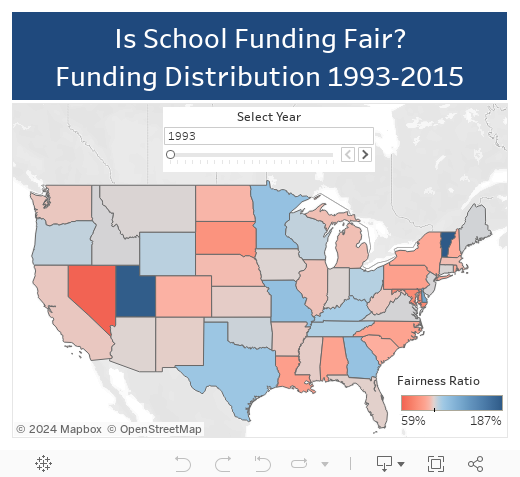
Is School Funding Fair? A National Report Card

School Funding Fairness
Is School Funding Fair?  A National Report Card


The ability of state school finance systems to fairly deliver resources to students is an essential precondition for the delivery of high quality education. States must provide a sufficient level of funding that is fairly distributed to address the additional needs generated by poverty, English language learner status, student disabilities, and other special needs. Schools educating students with these needs require additional funding to support the programs and services that will provide all students with the opportunity to succeed. 
Rigorous school finance research is needed to provide convincing evidence that fair school funding is the central building block of an effective school system. Such research needs to clearly establish the relationship between state funding systems, the equitable distribution of school resources, and student outcomes.
In recognition of this need, researchers at Rutgers Graduate School of Education and Education Law Center created the “Is School Funding Fair?” project to:
      • provide tools for advocates and policymakers to effectively communicate rigorous research to
        influence positive changes in state school finance policy;
      • provide researchers with open access to the datasets that are the foundation of the school finance research on this site and encourage further exploration;
      • build consensus on the methods for evaluating and comparing state school finance systems and the resulting inequalities in resources and outcomes


On this website you can find: the award-winning report, “Is School Funding Fair? A National Report Card” and all related materials, such as interactive reports, press releases, and media mentions; related publications on school finance equity; and open access to compiled data sets and code for further analysis.


7th edition of "Is School Funding Fair? A National Report Card" available now.


New report "The Real Shame of the Nation" available now.


School Funding Fairness