Latest News and Comment from Education

Saturday, February 9, 2019

CURMUDGUCATION: Field Guide To Strike Objectors

CURMUDGUCATION: Field Guide To Strike Objectors

Field Guide To Strike Objectors

In my four decades of teaching, I went through a strike twice--once as a first year teacher, and once as the president of the local union. Writing about education, I have followed dozens more. No matter what kind of public support a strike is getting, there are always some familiar tunes you can expect to hear played in opposition to a teacher walkout. Here's your guide to all the classics.
Don't they understand the district can't afford their demands?
When we were strike, a member of the board's negotiating team said publicly, "Yes, we have the money. We just don't want to give it to them." That's not usually how it goes. Folks all the way up to former US Secretary of Education Arne Duncan have been chicken littling the impending financial doom of Los Angeles schools, and that's a fairly typical stance. Here's the thing to remember. When we were on strike, our state association sent us a trained education accountant to dig through the district's records (which, as a public school system, are completely public). By the time he was done, we knew as well as they did exactly what they could and could not afford. We kept that information in mind when negotiating because it would have been stupid to make demands that the district couldn't fund. When it comes to the financial side of negotiations, no union is flying blind, and no union is making demands that can't possibly be met.
It's those damned union leaders.
The teachers are fine, but those damned leaders are forcing them to strike. This tune appears in the coverage citing union president Alex Caputo-Pearl's "blind ambition." While people taking this approach often claim to love teachers, just not the union, this framing of a strike assumes that CONTINUE READING: CURMUDGUCATION: Field Guide To Strike Objectors

Peter Greene: Teacher Merit Pay Is A Bad Idea

Teacher Merit Pay Is A Bad Idea

Teacher Merit Pay Is A Bad Idea

Florida's governor is planning to boost the state bonus program for teachers, even as Denver teachers are ready to strike over their district's version of an incentive program. So it's worth taking a moment to step back and remember why teacher merit pay and bonus systems are just a bad idea.
First, they can't work like a private sector bonus system. In the business world, bonuses and incentives are based on a clear idea of success. Whether the definition of success at Widgetcorps this year is "We made a bunch more money" or "We increased the value of Widgetcorps stock this year" or even "We managed to strip a pile of dollars out of Widgetcorps this year," the end result is a pile of "extra" money (the end result, depending on the definition of success, may be a less healthy company, but let's set that aside for now). The bonus deal between Widgetcorps and its bonus-eligible employees is simple--if there's a pile of extra money here at the end of the year, you get to have some of it.
Public schools, on the other hand, don't make money, and school district success is hugely hard to define. More high school graduates? The football team won a championship? The school musical was really good this year? More students really got into Shakespeare? Larger number of students earned welding certification? The school's culture and atmosphere was so healthy that students really love attending? All of these might count as success, but none of them CONTINUE READING: Teacher Merit Pay Is A Bad Idea


Mitchell Robinson: Want to Make Teaching Great Again? Here's How… | Eclectablog

Want to Make Teaching Great Again? Here's How… | Eclectablog

Want to Make Teaching Great Again? Here’s How…


A recent story in the Washington Post’s “Answer Sheet” focused on the fates of the 4 finalists for 2016 National Teacher of the Year…
Nate Bowling was the 2016 Washington state Teacher of the Year and one of four finalists for the National Teacher of the Year. There were three other finalists who were the winners in their states that year: Jahana Hayes of Connecticut, Shawn Sheehan of Oklahoma and Daniel Jocz of California. Hayes won the national title that year.
So what happened to the four in an era in which teachers are striking and speaking out about low pay, unfair evaluation methods, disrespect from policymakers and insufficient funding of their schools?
Are they all still teaching? The answer is no.
Given the current dishonest and deeply cynical narrative around “failing schools,” “poor scores by US students on international assessments,” and “the evils of the powerful teachers unions” that’s been promoted by none other than Secretary of Education Betsy DeVos–who is allegedly responsible for supporting and encouraging these schools and teachers–this really shouldn’t come as any surprise.
But the question remains: what can we do to keep more great teachers in the classroom? Here are a few suggestions for strengthening public education, and making teaching great again…
  • Create more space and room for growth for teachers: Give teachers more responsibility for creating curriculum, designing assessment tools, and determining school, district, and state policies.
  • Lower class sizes and make teaching assignments reasonable and manageable: An elementary music teacher with 600 students is educational malpractice just as much as a Kindergarten teacher with 40 students is.
  • Open up the curriculum, making sure kids have more choice in the courses they can take, and the opportunity to study music, art, drama, literature, history…not just math and science.
  • Get rid of standardized testing–there’s nothing “standard” about children, or teaching.
  • Pay teachers more, and ensure their benefits are fair and guaranteed.
  • Pay for teachers to attend professional development conferences–it’s the “R&D” of education, and teachers shouldn’t have to pay out of pocket to spend their weekends and CONTINUE READING: Want to Make Teaching Great Again? Here's How… | Eclectablog


Coverage of the LAUSD by the L.A. Daily News: News or Propaganda?

Coverage of the LAUSD by the L.A. Daily News: News or Propaganda?

Coverage of the LAUSD by the L.A. Daily News: News or Propaganda?

– Los Angeles Daily News
Three weeks after Candi Clark, chief financial officer of the Los Angeles County Office of Education (LACOE), spoke at a Los Angeles Unified School District (LAUSD) Board meeting, the Los Angeles Daily News was still describing her appearance as “unannounced”.  However, the facts tell a different story. Documents obtained in a Public Records Act request by United Teachers Los Angeles show that the text of a speech was created on a District computer registered to Cheryl Simpson, an “LAUSD budget official” and shared with Clark. Her appearance was definitely not “unannounced” as it is clear that there was some coordination with officials at the LAUSD.


The failure to do any research into the events that lead to Clark’s appearance before the LAUSD Board is journalistic malpractice. However, this is not surprising given that the byline for the article is “Laura Greanias, LA School Report (LASR)”. The LASR was created by Jamie Alter Lynton, a supporter of education privatization, to provide coverage of the LAUSD. Alexander Russo, who “edited LA School Report during its first year of operation”, says that she does not adhere “to the balanced/objective model of journalism”. Lynton’s friendship with former Superintendent John Deasy gave her exclusive access to breaking stories, at least the ones he wanted covered. CONTINUE READING: Coverage of the LAUSD by the L.A. Daily News: News or Propaganda? 

Third Grade Flunk Laws–and (Un)intended Consequences | Teacher in a strange land

Third Grade Flunk Laws–and (Un)intended Consequences | Teacher in a strange land

Third Grade Flunk Laws–and (Un)intended Consequences


Like many states, Michigan has a Third Grade Mandatory Retention law for students who are not reading at grade level in the statewide assessments. And like most states, the law is riddled with exceptions, loopholes and what you might call pre-existing conditions. In other words, well-connected parents who don’t want their child who struggles with reading to fail the third grade will be able to wiggle out of it. If you’re poor or attending a ‘failing’ school, you’re pretty much toast if your reading skills (or test-taking skills) are subpar–when you’re eight years old.
Much of the critique around ‘3rd grade flunk’ legislation centers on the damage done to kids by being forced to repeat a grade, the financial burden on schools as they are compelled to provide an additional year of instruction to large segments of their elementary population, and the complete lack of proof that these laws work. If our goal is higher rates of genuine literacy, rather than punishing schools and vulnerable students, there are better ways to get there.
We could begin by noting that Finland, a perennial head-of-list country when it comes to international comparisons of literacy accomplishment, does not begin formal reading instruction until students are seven years of age—roughly second grade—because they believe that’s when a majority of students are developmentally ready to handle the complex intellectual tasks of phonemic awareness, decoding and making meaning of the symbols on the page. By age nine—4th grade—Finnish students are ahead of ours, even though our 4th graders have been subjected to formal reading instruction for five years at that point.
Now we are witnessing the other consequences of the Third Grade Threat—pushing inappropriate instruction down to kindergarten, as anxious districts fear that students CONTINUE READING: Third Grade Flunk Laws–and (Un)intended Consequences | Teacher in a strange land

JEFF BRYANT: Charter schools are pushing public education to the breaking point | Salon.com

Charter schools are pushing public education to the breaking point | Salon.com

Charter schools are pushing public education to the breaking point
Charters are driving Boston’s public education system to the financial brink

hen striking Los Angeles teachers won their demand to call for a halt to charter school expansions in California, they set off a domino effect, and now teachers in other large urban districts are making the same demand.
Unchecked charter school growth is also bleeding into 2020 election campaigns. Recently, New York magazine columnist Jonathan Chait berated Democratic Massachusetts Senator and presidential candidate Elizabeth Warren for having opposed a ballot initiative in her home state in 2016 that would have raised a cap on the number of charter schools. “There may be no state in America that can more clearly showcase the clear success of charter schools than [Massachusetts],” declared Chait.
But while Chait and other charter school fans claim Massachusetts as a charter school model, the deeper reality is that charters are driving Boston’s public education system to the financial brink.
As the Boston Globe recently reported, the city is experiencing an economic boom, but its schools resemble “an economically depressed industrial center.” The state’s unfair funding formula is part of the problem, but an ever-expanding charter school industry also imposes a huge financial drain.

The Trouble with Test-Obsessed Principals | gadflyonthewallblog

The Trouble with Test-Obsessed Principals | gadflyonthewallblog

The Trouble with Test-Obsessed Principals

When I was a child, I couldn’t spell the word “principal.”
I kept getting confused with its homonym “principle.”
I remember Mr. Vay, the friendly head of our middle school, set me straight. He said, “You want to end the word with P-A-L because I’m not just your principal, I’m your pal!”
And somehow that corny little mnemonic device did the trick.
Today’s principals have come a long way since Mr. Vay.
Many of them have little interest in becoming anyone’s pal. They’re too obsessed with standardized test scores.
I’m serious.
They’re not concerned with student culture, creativity, citizenship, empathy, health, justice – they only care about ways to maximize that little number the state wants to transform our children into.
And there’s a reason for that. It’s how the school system is designed to operate.


New Orleans Charter Schools Must Include Parents/Alumni as Board Members | deutsch29

New Orleans Charter Schools Must Include Parents/Alumni as Board Members | deutsch29

New Orleans Charter Schools Must Include Parents/Alumni as Board Members


If school choice is about empowering parents (also see here and here and here), it seems that charter school boards would necessarily– automatically– definitely– include among their memberships the very parents who have been supposedly empowered.
New Orleans schools have been a showcase (albeit a controversial one) for charterization since the fall of 2005 when Hurricane Katrina devastated the area. By 2022— 17 years post-Katrina– the last local-board-run public school in New Orleans will be completely phased out, making New Orleans a 100-percent charter school district.
What is surprising, however, is how long it has taken lawmakers to require New Orleans’ charter schools to include parents and alumni– locals invested in the community– on the charter school boards.
It’s a shame that charter school boards must be forced to include locals in the actual roles of empowered decision-making. But so it goes.
The 2018-19 school year was the first in which New Orleans charter schools were required to include at least one parent or school alumnus on their boards. In 2019-20, all New Orleans charter schools (except those drawing from the entire state) must be comprised of boards in which both gender and racial makeup of the board must reflect that of the locality of the school– with at least 60 percent of board members being locals.
From legislation in Louisiana passed in 2018, regarding  the boards of charter schools located in major cities (i.e., New Orleans):
Beginning October 1, 2018, the membership of the governing or management board of each charter school located in a parish with a population of between three hundred twenty-five thousand and three hundred seventy-five thousand persons, based on the most recent federal decennial census, shall include at least one member who is a parent, legal  CONTINUE READING: New Orleans Charter Schools Must Include Parents/Alumni as Board Members | deutsch29

Teaching at MetWest: A Big Picture School (Part 1) | Larry Cuban on School Reform and Classroom Practice

Teaching at MetWest: A Big Picture School (Part 1) | Larry Cuban on School Reform and Classroom Practice

Teaching at MetWest: A Big Picture School (Part 1)
Image result for Oakland MetWest


It is a Monday and the schedule at Oakland’s MetWest calls for an 8:30-10AM session with an Advisor/Teacher. I enter a spacious, well-lit room where 18 ninth graders are sitting in a circle with Nick Palmquist. He is wearing black jeans, a button-down grey shirt over the jeans and dark tennis shoes. The assignment for these students had been to write down their goals for high school. I noted that more than half had a sheet of paper in hand.
Nick–students call him by his first name–began by holding a multi-colored cloth volleyball and stating what his goals have been for life and teaching. He then passed the ball to his left. Student didn’t say anything and passed the ball to another student who read off his goals. As the ball went from student to student, their goals fell into a familiar pattern of ninth graders: get good grades, graduate, and go to college. Two students said they wanted to get “good” jobs. After the ball traveled around the circle and returned to Nick, he summarizes what most students had said were their goals and says: “we are about to close the circle. Does anyone have “any appreciation to share.” He waits at least five seconds, no response. Nick then say” please return to you tables.”
Students pick up their chairs and put them at tables where two students sit. The tables and chairs are arranged in a horseshoe facing a front whiteboard with the open center space holding a small table upon which Nick’s laptop and erasable markers rest. Students sitting at tables see classmates across the open space. On one side of the whiteboard is marked “Homework.” Listed are the following:
*Semester goals + vision board/road map–due Tuesday AM
*Observation notes on my learning this week–due Monday AM
*Binder check Tuesday
Nick passes out a two-page worksheet from which the rest of the lesson unfolds. The worksheet lists “Lesson Targets”: “I can explain and creatively portray my CONTINUE READING: Teaching at MetWest: A Big Picture School (Part 1) | Larry Cuban on School Reform and Classroom Practice

CURMUDGUCATION: IA: Choice Is Taxation Without Representation

CURMUDGUCATION: IA: Choice Is Taxation Without Representation

IA: Choice Is Taxation Without Representation


An Iowa state senator has caught on to one of the problematic side effects of many choice programs-- disenfranchised taxpayers. Or, as somebody put it a while ago, taxation without representation.

Iowa has long allowed open enrollment; an Iowa family can enroll their student in any public school district, whether they live there or not. Currently the full per-pupil expenditure follows the student-- including the part of the expenditure that is collected by the taxpayer in the student's home district.


In other words, if I live in East Spamwich and pay taxes on my home there to fund the school. Only a large number of students from the area may attend school in West Spamwich. I'm able to vote for the school board members in the East Spamwich school board, but in West Spamwich, where much of my money goes to be spent, I have no say at all.

Republican State Senator Tom Greene (no relation, as far as I know) was newly elected in an upset contest in 2016. In real life, he's a pharmacist, but he was also the board president of Burlington School Board, andthat gives him some perspective (from Radio Iowa).

“The Burlington School District totally surrounds the West Burlington School District. The West Burlington School District has 800 and 900 students; 53 percent of those students reside outside the CONTINUE READING: 
CURMUDGUCATION: IA: Choice Is Taxation Without Representation


Friday, February 8, 2019

The myth of de facto segregation  - kappanonlineorg #BlackLivesMatterAtSchool #CounselorsNotCops #blackhistorymonth

The myth of de facto segregation  - kappanonline.org

The myth of de facto segregation 

Today’s high levels of school segregation can be traced to specific government policies that created distinct White and Black neighborhoods. 
 PDK_100_5_Rothstein_Art_554x350px
For nearly 30 years, the nation’s education policy makers have proceeded from the assumption that disadvantaged children would have much greater success in school if not for educators’ low expectations of them.  In theory, more regular achievement testing and tougher accountability practices would force teachers to pursue higher academic standards for all children, resulting in improved instruction and greater student proficiency. 
However, there never was any evidence to support this theory, and even its most eager proponents have come to realize that it was flawed all along. In fact, there are a host of reasons why disadvantaged children often struggle to succeed academically. Undeniably, one is that some schools in low-income neighborhoods fall short in their traditional instructional roles. Another is that many schools have failed to embrace effective out-of-classroom programs — such as health clinics or early childhood centers — that might enable students to be more successful in the classroom. Perhaps most important, however, is the influence of children’s out-of-school social and economic conditions, which predict academic outcomes to a far greater extent than what goes on in the classroom. Researchers have long known that only about one-third of the Black-White academic achievement gap results from variations in school quality. The rest stems from social and economic factors that render some children unable to take full advantage of what even the highest-quality schools can offer.   
Racial segregation exacerbates achievement gaps between Black and White children because it concentrates students with the most serious social and economic challenges in the same classrooms and schools. Consider childhood asthma, for example: Largely because of poorly maintained housing and environmental pollution, urban African-American children have asthma at as much as four times the rate of White middle-class children. Asthmatic children often come to school drowsy and inattentive from sleeplessness, or they don’t come to school at all. Indeed, asthma is the single most important cause of chronic absenteeism. No matter how good the teacher, or their instruction, children who are frequently absent will see less benefit than children who come to school well rested and regularly. Certainly, some asthmatic children will excel — there is a distribution of outcomes for every human condition — but on average, children in poorer health will fall short. 
Children from disadvantaged families suffer disproportionately from a number of other such problems, including lead poisoning that diminishes cognitive and behavioral capacity; toxic stress, from experiencing or witnessing violence; irregular sleep or meal times, related to their parents’ working multiple jobs with contingent work schedules; housing instability or homelessness; parental incarceration, and many others. A teacher can give special attention to a few who come to school with challenges that impede learning, but if an entire class has such problems, average achievement inevitably declines.  
We cannot expect to address our most serious educational issues if the most disadvantaged of the nation’s children are concentrated in separate neighborhoods and schools. Today though, racial segregation characterizes every metropolitan area in the United States and bears responsibility for our most serious social and economic problems: Not only does it produce achievement gaps but it predicts CONTINUE READING: The myth of de facto segregation  - kappanonline.org


Behind The Lens episode 18: A preview of reporter Marta Jewson’s work on the tricky question of when to close failing schools in New Orleans. | The Lens

Behind The Lens episode 18: ‘A very difficult and unpleasant decision that is part of the landscape in New Orleans’ | The Lens

Behind The Lens episode 18: ‘A very difficult and unpleasant decision that is part of the landscape in New Orleans’


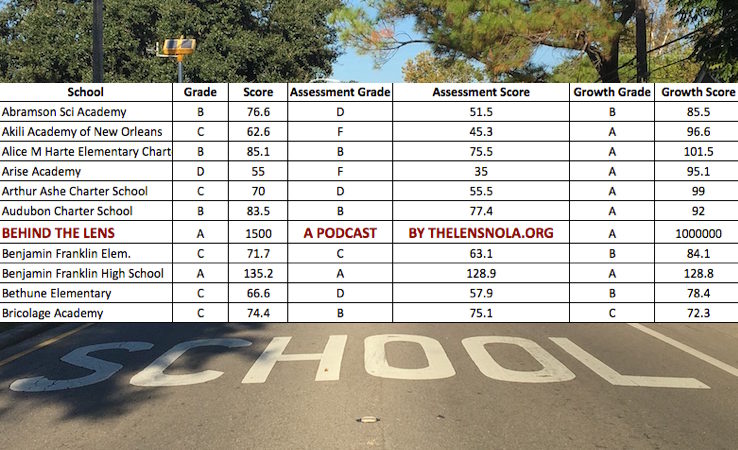
This week on Behind The Lens, New Orleans’ approach to education has resulted in a revolving door of education providers — charter schools — for the city’s students. Sometimes, changes at poorly performing schools don’t seem to come soon enough.
We have a preview of reporter Marta Jewson’s work on the tricky question of when to close failing schools in New Orleans.
Also, Louisiana’s Coastal Protection and Restoration Authority has a complex plan for reconnecting the Mississippi River with disappearing coastal regions. The agency has a plan for the effort and, right now, a lot of money to work with.
But they still have to win over a skeptical part of the public in South Louisiana. Part of that is a series of “Coastal Connections” meetings throughout the region. The latest one was in Braithwaite. Host and producer Tom Wright went there and spoke to the CPRA’s project manager for the Mid-Barataria and Mid-Breton diversions.
Behind The Lens is available on Apple PodcastsSpotifyGoogle Play and Stitcher.
Behind The Lens episode 18: ‘A very difficult and unpleasant decision that is part of the landscape in New Orleans’ | The Lens


Hundreds of OUSD Students Walked Out of Class Today: Student Organizers tell us what’s next for their movement. | East Bay Majority #Unite4OaklandKids #WeAreOEA #WeAreCTA #strikeready

Hundreds of OUSD students walked out of class today. Two student organizers tell us what they’re protesting and what’s next for their movement. | East Bay Majority

Hundreds of OUSD students walked out of class today. 
Two student organizers tell us what they’re protesting and what’s next for their movement.

Students participate in a sickout and march in support of Oakland teachers, Feb. 8

Hundreds of Oakland students walked out of their schools this morning to protest low teacher pay, school closures that target working-class families of color, and overcrowded, under-resourced classrooms.
Although the student organizers of today’s student walkout are young, today’s success shows they’ve already worked through political complications that dog organizers twice their age: how to nurture a multiracial movement that draws power and legitimacy from popular material demands.
Majority interviewed two of the organizers behind today’s action, Lauren K. and Theo Z., both seventeen-year-old students at Oakland Tech. They began their work as student organizers in the wake of the Parkland shooting, when thousands of Oakland students walked out off class to join the March for Our Lives.
However, the broad popularity of that walkout didn’t translate into a diverse membership for their core organizing club at Oakland Tech, which dwindled to a handful of white students in the months after the march.

Majority: What’s different about this week’s walkout?

Theo: What the district is doing is disproportionately targeting minorities and low-income families, and the schools that are closing, none of them are in the hills, they’re in East and West Oakland. It’s a more relatable issue for more students [than school shootings]. The interesting thing about school shootings is they’re the only type of gun violence based in the suburbs.
Lauren: A problem we had was [the original members of the organizing club] basically just reached out to their friends to join, and the school is segregated into small schools that break down by race. Everyone is reaching out to their friends within this segregated school, so the club wasn’t diverse. But with this event, we’ve joined students from all over the school, people who’d never been part of the club. This time around, we have a very diverse group of leaders.

Why did you call a sickout?

Lauren: I’m sure you heard about the teachers’ sickout they had a couple weeks ago. So a few problems we noted with that: a) all the teachers lost money because they were not teaching, they were not in class, and that’s the same problem they will have with the strike, so while teachers will put pressure on the district they’ll also be losing money, and b), when the teachers did their sickout all the students who were absent were marked present which is…
Theo: Super illegal.
Lauren: Very, very wrong. And the district didn’t lose any money from that because according to them we were all present. … The difference in the student-only sickout is that the teachers will be in class so they will be making money which I think sends a powerful message that we support them, they can keep making money, and work is being done.

Why are you organizing in support of the teachers?

Lauren: As students, we see better than anyone how hard our teachers work, and we know that they’re not getting paid enough to live in  Oakland which is ridiculous. They should be able to afford to live here. And on top of that, we see our counselors who CONTINUE READING: Hundreds of OUSD students walked out of class today. Two student organizers tell us what they’re protesting and what’s next for their movement. | East Bay Majority

The Privatization of Teaching Teachers How to Teach Reading: Cashing In on Kids!

The Privatization of Teaching Teachers How to Teach Reading: Cashing In on Kids!

The Privatization of Teaching Teachers How to Teach Reading: Cashing In on Kids!


Wondering about all the recent articles claiming teachers don’t know how to teach reading, and their education schools are failing them?
It appears to be about nonprofits! These groups are competing with universities. They promise to better prepare teachers to teach reading, for a fee, of course!
But there’s no proof they will do teacher preparation better. It’s unclear why nonprofits are considered experts.
The goal along with making money appears to be to place children on digital devices for most of their learning.
Here are some examples. Click the titles for the links.
The Wall Street Journal recently promoted a group called Early Reading Matters “Nonprofit Trains Teachers on the ABCs of Reading in the Classroom.”
Early Reading Matters is a part of Teachers Matter which promotes itself as an organization to teach teachers a variety of skills. Here’s the link. 
Why is this group untrustworthy?

Hire More Black Teachers Now!: A research statement from BLM@School & J4J – Black Lives Matter At School

Hire More Black Teachers Now!: A research statement from BLM@School & J4J – Black Lives Matter At School

Hire More Black Teachers Now!: A research statement from BLM@School & J4J


What Does Public Education Have Against Black Teachers

You may think this is an exaggeration, but an analysis of the data from Journey 4 Justice Alliance and the #WeChoose Coalition, shows that in at least six major cities, Black teachers are becoming extinct. The same data shows us that each of these cities has a growing population of students of color, but many of them will not see a teacher who looks likes them. Instead, they will face discriminatory discipline and gaps in opportunities and attainment that negatively impact their future. From a 3% gap in Oakland to a 30% gap in Pittsburgh, Black students are attending schools increasingly taught by white educators (The Purge of Black Teachers Cities, 2019).
This gap is even larger in charter schools that tend to serve more black students and hire fewer black teachers. Both New York City and Chicago have seen gaps of 38% and 39% respectively, between the population of black students and the number of black teachers within the charter school system (The Purge of Black Teachers Cities, 2019).

To understand how the decline in black teachers began, we must first look at New Orleans. After hurricane Katrina, privatizers were able to push out Black teachers and turn the school district over to charter operators.  In 2004, 71% of teachers in New Orleans were Black. In 2005, all New Orleans teachers were summarily fired, a mass dismissal of 8% of Louisiana’s teachers and 24% of the state’s Black teachers. (The Purge of Black Teachers, 2019). By 2013, only 35% of new hire teachers were Black, and only 22% of dismissed teachers were rehired, down from 33% in 2007 (The Purge of Black Teachers, 2019).  Nationally, we have seen a decline of Black teachers to 6%, while Black students make up 15 % of the student population, and students of color account for more than half of the student population (The Purge of Black Teachers, 2019).
Often the removal of Black teachers is part of a broad effort to privatize public education by turning the public schools into charter schools. With an influx of charter schools comes an increase in mostly white teachers who have less experience and are likely trained in alternative teacher certification programs.  New Orleans went from CONTINUE READING: Hire More Black Teachers Now!: A research statement from BLM@School & J4J – Black Lives Matter At School

Time to get real about ‘open’ enrollment: what works, what’s a workaround? | The Lens

Time to get real about ‘open’ enrollment: what works, what’s a workaround? | The Lens

Time to get real about ‘open’ enrollment: what works, what’s a workaround?

I was proud that, as the most recent school performance scores were released,  the state honored Harriet Tubman Charter School for both “equity” in its admissions practices and for achieving “top gains” in its academic performance.
The twin designations mean that Tubman students of all ethnicities, economic backgrounds, and special-need status are making strong academic gains at the same rate. The designations were especially meaningful to me, as principal, because Tubman, alone among this year’s crop of honorees, is both a formerly failing school and one with an open-enrollment or come-one-come-all admissions policy.
And yet, newspaper columnist Jarvis DeBerry saw fit to criticize Tubman as one of the equity honorees “being rewarded for gatekeeping.” DeBerry’s columns are often worth reading, but on this occasion his criticism reveals a misunderstanding of a much larger issue that should be the focus of district-wide discussion and debate, a debate rooted in hard facts.
I agree that exclusionary enrollment practices in any school that is designated open-enrollment blunt the meaning of the “equity” honor and become a source of confusion to parents. These exclusionary practices make the term “open-enrollment” meaningless, and they aren’t fair because they give preference to the middle class. In our district, “open-enrollment” should be easily defined, but it’s not.

I believe there are exclusionary practices in the district, but DeBerry’s placement of Harriet Tubman in that category is wrong.  First, let’s take a closer look at Tubman: To characterize the school as seeking to exclude kids whose backgrounds make them harder to educate is simply not true.

At Tubman, 97 percent of our kids are economically disadvantaged, 95 percent are non-white, and 20 percent qualify for special education services. We were an early adopter of the OneApp enrollment process, and, without exception, we embrace open-enrollment both conceptually and in practice.

Where DeBerry goes wrong is in his conclusion that our practice of giving  preference to our pre-k students seeking admission to our kindergarten is exclusionary.
Three facts are worth bearing in mind:
One is that every New Orleans public school that offers pre-k gives preference to those students when it comes to kindergarten CONTINUE READING: Time to get real about ‘open’ enrollment: what works, what’s a workaround? | The Lens