Latest News and Comment from Education

Saturday, December 1, 2018

Hakeem Jeffries, a DFER Democrat, Joins the Party Leadership | Diane Ravitch's blog

Hakeem Jeffries, a DFER Democrat, Joins the Party Leadership | Diane Ravitch's blog

Hakeem Jeffries, a DFER Democrat, Joins the Party Leadership


Rachel Cohen writes that the elevation of Hakeem Jeffries to chair of the Democratic House Caucus is a huge victory for the pro-charter school group Democrats for Education Reform (DFER), the hedge fund managers who control large campaign contributions. The purpose of DFER, she writes, was “to break the teacher unions’ stranglehold over the Democratic Party.” The state conventions of the Democratic Party in both California and Colorado adopted resolutions demanding that DFER remove the D from its name and stop co-opting their brand as Democrats, when they were in fact a corporate front.
She writes:
While DFER really began to flex its financial muscles in 2008 — when it raised about $2 million to help elect pro-charter candidates — its earlier work focused primarily on New York. There, the group helped elect Hakeem Jeffries to the New York State Assembly in 2006. (He served in the state Legislature from 2007 to 2012.) In 2007, DFER also helped lobby New York legislators to lift the state’s charter school cap, increasing it from 150 schools to 250. In 2010, Jeffries co-sponsored legislation to raise the state’s charter cap even further, to 460 — where it stands today.

Over the years, Jeffries has become one of DFER’s top candidates. In 2012, when Jeffries announced that he would run for Congress, the group rallied behind him, elevating him to its so-called DFER Hot List. No other Democrat received more in direct DFER contributions that cycle, according to the Center for Responsive Politics…
While in Congress, Jeffries has stayed close to the charter movement. He’s spoken at fundraisers for Success Academy, the prominent New York City charter network, and in 2016 was the keynote speaker for a large pro-charter rally, organized to pressure Mayor Bill de Blasio to expand charters in New York City.
Cohen says that Hakeem Jeffries is a cousin of Shavar Jeffries, the executive director of DFER.
This story in The Intercept describes how Hakeem Jeffries was elected to a leadership party in the Democratic Party in the House of Representatives.
Ryan Grim writes:
THE ELECTION OF Rep. Hakeem Jeffries as House Democratic Caucus chair on Wednesday represented a symbolic and substantive comeback for the wing of the party that had suffered a stunning defeat last June, Continue reading: Hakeem Jeffries, a DFER Democrat, Joins the Party Leadership | Diane Ravitch's blog


The Persistence Of Segregated Schools - 1A

The Persistence Of Segregated Schools - 1A

The Persistence Of Segregated Schools


Thousands of students, parents and educators rally in Brooklyn demanding an end to what they describe as separate and unequal education in New York City schools on October 7, 2015 in New York City.
Thousands of students, parents and educators rally in Brooklyn demanding an end to what they describe as separate and unequal education in New York City schools on October 7, 2015 in New York City. 
Over the weekend, The Jackson Free Press reported that Senator Cindy Hyde-Smith attended and graduated from a segregation academy — a school established to avoid court-ordered integration.
A group photo in the 1975 edition of The Rebel—the Lawrence County Academy Yearbook—illustrates the point. High-school cheerleaders smile at the camera as they lie on the ground in front of their pom-poms, fists supporting their heads. In the center, the mascot, dressed in what appears to be an outfit designed to mimic that of a Confederate general, offers a salute as she holds up a large Confederate flag.
Third from the right on the ground is a sophomore girl with short hair, identified in the caption as Cindy Hyde.
The photo, and the recently appointed Republican senator’s attendance at one of the many private schools that was set up to bypass integration, adds historic context to comments she made in recent weeks about a “public hanging” that drew condemnations from across the political spectrum.
Though this was in the 1970s, school segregation is still an issue today.
NBC reports that “across the country about a third of all black and Latino students attend what the Civil Rights Project classifies as hyper-segregated schools. Those are schools where 90 percent or more of all students are non-white.”
New York Times reporter and MacArthur “Genius” award winner Nikole Hannah-Jones has been covering the issue of segregated schools for years. And she wrote about her own experience choosing a school for her child in Brooklyn, New York. Her daughter’s name is Najya, and her husband’s name is Faraji.
When the New York City Public Schools catalog arrived in the mail one day that spring, with information about Mayor Bill de Blasio’s new universal prekindergarten program, I told Faraji that I wanted to enroll Najya in a segregated, low-income school. Faraji’s eyes widened as I explained that if we removed Najya, whose name we chose because it means Continue reading: 
The Persistence Of Segregated Schools - 1A
Image result for Segregated Schools


Time’s 2018 Person of the Year? How about the American teacher? - The Washington Post

Time’s 2018 Person of the Year? How about the American teacher? - The Washington Post

Time’s 2018 Person of the Year? How about the American teacher?


President Trump has said he can’t imagine anyone but himself as Time magazine’s Person of the Year.
I can.
In the past, Time has made entire groups of people the winner.
In 2003, it was “The American Soldier,” honoring U.S. troops around the world, especially those fighting in Iraq.
In 2006, it was “You," representing the millions of people around the world who create things on the Internet.
In 2011, it was “The Protester,” representing the many protest movements around the world.
In 2017, it was “The Silence Breakers,” representing both women who spoke out against sexual harassment and leaders of the #MeToo movement.
In American education, 2018 has been the year of the teacher.
It was this year that long-timid American teachers stood up by the tens of thousands in a handful of states to strike for better pay and for more funding for sorely under-resourced schools. The strikes were largely in Republican-led states, and led by teachers rather than their unions.
They followed years of plummeting morale among teachers because of what they saw as oppressive federal Continue reading: Time’s 2018 Person of the Year? How about the American teacher? - The Washington Post
Image result for trump time magazine


Paul Pastorek Is Positioned to Charterize Puerto Rico. Who Is This Guy, Anyway? | deutsch29

Paul Pastorek Is Positioned to Charterize Puerto Rico. Who Is This Guy, Anyway? | deutsch29

Paul Pastorek Is Positioned to Charterize Puerto Rico. Who Is This Guy, Anyway?


The Puerto Rican Department of Education has decided to contract with former Louisiana state ed superintendent, Paul Pastorek, at $250 an hour ($155,000 max) for assistance that includes soliciting the US Department of Education for hurricane recovery aid.


The dog whistle in that news is a charterized Puerto Rico.


In this post, I offer a slice of Pastorek history and involvements. Even though I cut it short, this is a long post.


Get some coffee and sit in your comfy chair.


Here goes:


Like many ed reformers, Pastorek has no teaching background. A lawyer by trade, Pastorek was appointed to the Louisiana Board of Elementary and Secondary Education (BESE) in 1996 by then-governor, Mike Foster, who was impressed by (wait for it) Pastorek’s *passion* about education. From an old Pastorek bio:


Mr. Pastorek served on the Board of Elementary and Secondary Education (BESE)

from 1996-2004, including the last three years as president. …


At first, he was a passionate volunteer in a New Orleans public junior high school.

Appalled at some of the things he saw in that inner-city school, he began to read

literature and work with the New Orleans Chamber of Commerce to improve the

education of children in New Orleans. His work came to the attention of Governor

Mike Foster, who appointed him to serve on the Board of Elementary and Secondary Education.


Pastorek’s time as a governor’s appointee to BESE ended with Foster’s 2004 Continue reading: Paul Pastorek Is Positioned to Charterize Puerto Rico. Who Is This Guy, Anyway? | deutsch29


Review and Preview Thurmond v Tuck | tultican

Review and Preview Thurmond v Tuck | tultican

Review and Preview Thurmond v Tuck


This year’s biggest election win in California was for the down-ballot office, Superintendent of Public Instruction (SPI). Tony Thurmond defeated Marshall Tuck in a proxy battle between billionaires supporting public school privatization and teachers’ unions fighting for democratically run neighborhood schools. More than $61,000,000 was spent on the SPI office doubling the previous $30,000,000 spending record set in 2014 when Tuck lost to Tom Torlakson.
Director of research at California Target Book, Rob Pyers, reported this year’s total election spending in California realized a new level. Target Book publisher Darry Sragow commented, “If blowing through the billion-dollar campaign spending ceiling in California doesn’t give pause to everyone in politics, I don’t know what will.”

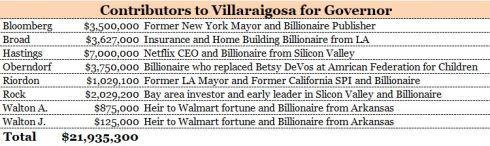
Of the eight state-wide constitutional offices on the ballot, the governor’s race topped spending at $108,221,028 and the SPI race came in second totaling $61,170,451. Spending in the governor’s race was also heavily impacted by billionaires supporting the charter school industry. California has an open primary in which the top two vote getters reach the general election ballot regardless of party. Before June’s voting, billionaires lavished Anthony Villaraigosa’s campaign unprecedented independent expenditure money trying to get him to the November ballot.
Billionaires for Villaraigosa
Spending By Eight Billionaires for Villaraigosa over Newsom in 2018 Primary Election
When Villaraigosa lost badly in the June 6 primary, many of the same Continue reading: Review and Preview Thurmond v Tuck | tultican


CURMUDGUCATION: Common Core Testing And The Fracturing Of Literature

CURMUDGUCATION: Common Core Testing And The Fracturing Of Literature

Common Core Testing And The Fracturing Of Literature


The Common Core Standards do not require reading complete long works of literature. Even by the time we arrive at the 11th and 12th grade set of standards for reading literature, the standards only refer to "stories, dramas, and poems."
There are, throughout the standards, references to Shakespeare and "foundational works" or literature. But the standards do not suggest that students should, at some point in their academic career, read an entire book. Appendix A provides highly technical explanations of how to consider text complexity and quality, but somehow avoids discussing the value of reading an entire novel. Appendix B provides "exemplars," of reading selections, but the exemplars from novels are all short passages.
This interest in passages and excerpts dovetails nicely with the standardized testing now associated with the Common Core Standards (or whatever name your state has given to them). The PARCC, the SBA, and other big standardized tests cannot, by their nature, ask students to read and reflect on entire complex works of literature. Instead, we find short poems, short articles, and passages excerpted from longer works.
Both the standards and the tests are focused on "skills," with the idea that the business of reading a play or a story or any piece of text is not for the value of that Continue reading: CURMUDGUCATION: Common Core Testing And The Fracturing Of Literature


Billionaire Heiress Lashes Out at Unions Because Her Fortune Didn’t Buy Election | gadflyonthewallblog

Billionaire Heiress Lashes Out at Unions Because Her Fortune Didn’t Buy Election | gadflyonthewallblog

Billionaire Heiress Lashes Out at Unions Because Her Fortune Didn’t Buy Election


Betsy DeVos is furious!
She and her family spent boatloads of money this election cycle and few of their candidates won.
Instead, lawmakers were largely selected by these things called… ew… voters.
She was so enraged that she used her platform as Secretary of Education – another prudent purchase by her family – to lash out at teachers unions for – get this – having too much influence!!!!!
“The teachers union has a stranglehold on many of the politicians in this country, both at the federal level and at the state-level.”
That’s rich coming from her, but one can see where she’s coming from.
In the midterms 23 states had double-digit percentage-point increases in turnout compared with 1982-2014. That resulted in a blue wave in the U.S. House – one of the largest and most diverse groups of freshman Congresspeople ever.
This is the third-highest turnover since 1974. We showed 104 incumbents the door.
DeVos didn’t pay for THAT!
How dare those Joe and Jane Sixpacks come out to the polls and upset the plans the billionaire class had plunked down their hard-inherited wealth to ensure!
How dare teachers and school employees pool their nickles and dimes to have a say about their own professions!
The only people who should have a voice in public policy are the… uh, public?
No.
Parents and students?
No!
Plutocrats like DeVos and family?
Yeah! That’s right!
We can’t let our schools be run by parents or students  or the people who Continue Reading: Billionaire Heiress Lashes Out at Unions Because Her Fortune Didn’t Buy Election | gadflyonthewallblog


Educator Discussions That Avoid “The Problem” | Larry Cuban on School Reform and Classroom Practice

Educator Discussions That Avoid “The Problem” | Larry Cuban on School Reform and Classroom Practice

Educator Discussions That Avoid “The Problem”


In 1942, Paul Diederich, senior research associate at Educational Testing Service, wrote “The Light Touch: 27 Ways to Run Away from an Educational Problem” for Progressive Education. He wrote this piece after being part of intense discussions with hundreds of teachers during summers when the Eight Year Study was being implemented in 30 high schools across the nation.*
Like Diederich, I have participated in thousands of discussions with teachers, principals, superintendents, board of education members, researchers, and policymakers over my half-century in public school work. I might be able to add one or two but Diederich does a fine job, in my opinion. When I think of (and listen to) current debates about problems like inequality, racism, and poverty as they influence what techers do, how schools operate, and effects on students, I recall many times when I heard and saw school baord members, superintendents, principals, teachers, and parents engage in what Diederich lists below. Here is what he wrote in 1942.

“Most educational problems become, sooner or later, a desperate attempt to escape from the problem. This is often done clumsily, causing unnecessary embarrassment and leaving the group without the comfortable feeling of having disposed of the problem.  Educational leaders long ago worked out adequate techniques for dodging the issue.
The following list, of course, is a tentative, partial, incomplete, a mere beginning, etc. but it should give group leaders a command of alternative modes of retreat and enable them.
1. Find a scapegoat. Teachers can blame administrators, administrators can blame teachers, both can blame parents, and everyone can blame the system.
2. Profess not to have the answer. That lets you out of having any answer.
3. Say that we must not move too rapidly. That avoids the necessity of getting started.
4. For every proposal set up an opposite and conclude that the “middle ground” (no motion whatever) represents the wisest course of action.
5. Point out that an attempt to reach a conclusion is only a futile “quest for certainty.” Doubt and indecision promote growth.
6. When in a tight place, say something that Continue reading: 
Educator Discussions That Avoid “The Problem” | Larry Cuban on School Reform and Classroom Practice


Friday, November 30, 2018

The Nation’s First Major Charter School Strike Is Brewing in Chicago – Mother Jones

The Nation’s First Major Charter School Strike Is Brewing in Chicago – Mother Jones

The Nation’s First Major Charter School Strike Is Brewing in Chicago
“We’ve had less rights, less pay, and less benefits. At the end of the day, these are our schools.”


For the last five years, Martha Baumgarten has taught fifth-graders at Carlos Fuentes Elementary School, a charter school on Chicago’s North Side. She started working at the school because of its commitment to helping Latino students, but every year her classes have been overcrowded, even by city standards. This year, she has 32 students.
“That a lot of fifth-graders in one room. It’s not what’s best for kids,” Baumgarten says, noting that some of her colleagues have left for traditional public schools in the city and surrounding suburbs, where wages are higher and class sizes lower. “It’s not an environment where I can do my job as a teacher.”
Protesters take to the street in Chicago during a one-day strike in April 2016. Chicago teachers demanded demanding that lawmakers provide the funding needed for proper education and other programs. Jim Vondruska/NurPhoto/ZUMA
Carlos Fuentes Elementary is one of the 15 campuses run by Acero Schools, one of Chicago’s largest charter networks. In their latest contract negotiations, Acero teachers like Baumgarten have pushed for smaller class sizes, higher pay, more teacher diversity, and more special-education resources. If their demands aren’t met, 500 teachers, counselors, and other staffers are threatening to walk out starting December 4 in what’s being touted as the country’s first major charter school teacher strike.
“We’re ready to fight,” Baumgarten says, “until the very end.”


The first-of-its-kind work stoppage would come on the heels of massive statewide teacher walkouts in West VirginiaOklahomaArizonaColoradoKentucky, and North Carolina earlier this year—protests that Baumgarten says served as a “rallying cry” for her Acero colleagues. And since the beginning of the school year, teachers in both Los Angeles and Oaklandhave threatened to strike over ongoing contract disputes.
But what makes the potential Acero strike different is that, unlike at traditional public schools, where 70 percent of teachers are in a union, just 11 percent of charter school teachers are unionized. Across the country, 781 of Continue Reading: The Nation’s First Major Charter School Strike Is Brewing in Chicago – Mother Jones


Louisiana: The “Miracle School” That Was a Fraud | Diane Ravitch's blog
Louisiana: The “Miracle School” That Was a Fraud | Diane Ravitch's blog

Louisiana: The “Miracle School” That Was a Fraud


About five weeks ago, I read a story online about a small private school in Louisiana whose students had a 100% college entry rate and were admitted to America’s most selective colleges and universities. It was truly a miraculous school, said the story, because its students were poor black children from adverse circumstances who were all too often struggling in public schools. What was their secret sauce? I sent the story to Gary Rubinstein, who has a knack for detecting fraud, but all he could determine from the state records was that the school was tiny (only 142 students), its graduating class was tiny (class of 2015 had 5 graduates, class of 2016 had 8 graduates, class of 2017 had 13 graduates). The school did not have to supply any data about attrition or anything else. Just enrollment, class size (tiny) and graduation rate. The story implied the superiority of private schools and vouchers. It claimed that poverty and adversity didn’t matter when you did whatever this school was doing, which was not clear from the reports.
But now we know that none of its claims were true.


The New York Times published an expose.
BREAUX BRIDGE, La. — Bryson Sassau’s application would inspire any college admissions officer.
A founder of T.M. Landry College Preparatory School described him as a “bright, energetic, compassionate and genuinely well-rounded” student whose alcoholic father had beaten him and his mother and had denied them money for food and shelter. His transcript “speaks for itself,” the founder, Tracey Landry, wrote, but Mr. Sassau should also be lauded for founding a community service program, the Dry House, to help the children of abusive and alcoholic parents. He took four years of honors English, the application said, was a baseball M.V.P. and earned high honors in the “Mathematics Olympiad.”
The narrative earned Mr. Sassau acceptance to St. John’s University in New York. There was one problem: None of it was true.
“I was just a small piece in a whole fathom of lies,” Mr. Sassau said.


T.M. Landry has become a viral Cinderella story, a small school run by Michael Landry, a teacher and former salesman, and his wife, Ms. Landry, a nurse, whose predominantly black, working-class students have escaped the rural South for the nation’s most elite colleges. A video of a 16-year-old student opening his Harvard acceptance letter last year has been viewed more than eight million times. Other Landry students went on Continue reading: Louisiana: The “Miracle School” That Was a Fraud | Diane Ravitch's blog

Big Picture Learning: Priming Workforce Development for Impact Profit-Taking – Wrench in the Gears

Big Picture Learning: Priming Workforce Development for Impact Profit-Taking – Wrench in the Gears

Big Picture Learning: Priming Workforce Development for Impact Profit-Taking


This post is the second in a Q&A exchange on social impact bonds and pay for success finance with UK blogger Privatising Schools. The focus of this post is Big Picture Learning. For additional background on Big Picture in Philadelphia check out my previous post here.

Privatising Schools: Question 8

Let’s look at a specific example of a social impact bond in education. Here in the UK, as you know, we’ve had eight years of austerity, which has done great damage to public services, especially those provided by local government. But central government regularly launches new funds, targeting particular areas of social need: youth unemployment, homelessness, mental health, and so on. We’ve had the Innovation Fund, the Social Outcomes Fund and, most recently, the Life Chances Fund.
Now, the purpose of these funds – and the government is very explicit about this – is to underwrite new public-private partnerships which will find ‘innovative’ ways of financing public services. In other words, social impact bonds (see here). The Innovation Fund, which was run by the Department for Work and Pensions, served to ‘incubate’ ten SIBs.

One of the projects supported by the new Life Chances Fund will see a US charter school chain, Big Picture Learning, set up a school in Doncaster, a town in north-east England, in order to ‘test new ways of learning through a social impact bond’ (see here). The target group is students who have been excluded from mainstream schools and who would normally be in what we call ‘alternative provision’. Doncaster Council is working with a company called the Innovation Unit, which was spun out of the Department of Education back in 2006, to set up the SIB.
According to a report given to the leaders of Doncaster council:
By introducing this educational model via a SIB, […] we have the opportunity to test innovation due to the use of an outcomes contract and making funding for the services conditional on achieving results. The Social Investors (still to be identified) will pay the provider at the start, and then receive payments from the Doncaster Metropolitan Borough Council (the commissioner) based on the results achieved by the project via a Special Purpose Vehicle (SPV) or other appropriate mechanism.
Can you unpack this for us?

My Response:

It is interesting that the first education social impact bond in the UK is with Big Picture Learning, because I’ve been following them for several years. Big Picture started in Rhode Island in the mid 1990s and was incubated in the Annenberg Institute at Brown University. Their 990 tax form from 2001 states that among their “program service accomplishments” is to Continue reading: Big Picture Learning: Priming Workforce Development for Impact Profit-Taking – Wrench in the Gears