Friday, August 26, 2016

10 Things to Know about the Charter School Debate – Cloaking Inequity

10 Things to Know about the Charter School Debate – Cloaking Inequity:

10 Things to Know about the Charter School Debate

At separate conventions this summer, the NAACP and the Black Lives Matter Movement—the nation’s oldest and the youngest civil rights organizations—passed resolutions critical of charter schools and the privatization of education. We may have reached a watershed moment for market-based school choice.
This article appeared here first at the Progressive Magazine.
Here are 10 things to consider about the market-based charter schools debate:
  • Where did market-based school choice come from? Writing in the 1950s, the libertarian economist Milton Friedman, followed by John Chubb and Terry Moe in the 1990s, argued for a profit-based education system where resources are controlled by private entities rather than by democratically elected governments. They recommended a system of public education built around parent-student choice, school competition, and school autonomy as a solution to what they saw as the problem of direct democratic control of public schools.
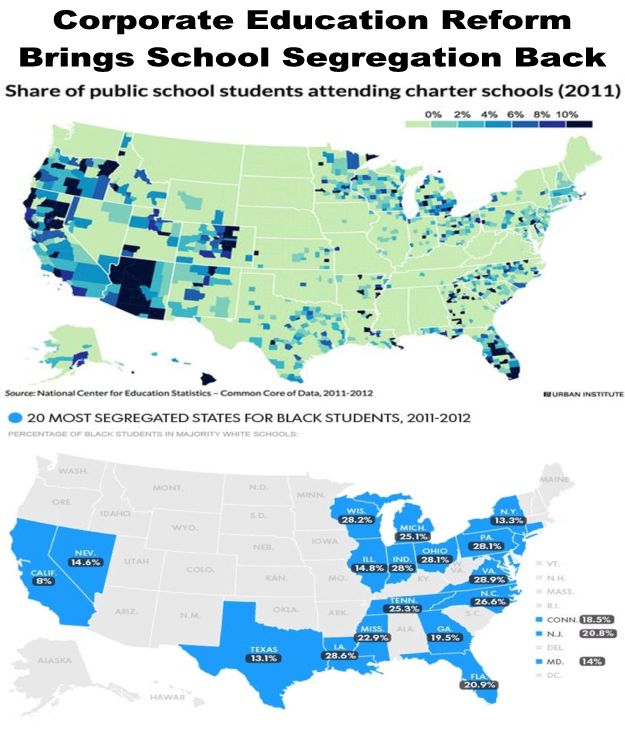
  • School “choice” does not cure the inequality created by markets. Not surprisingly, the academics neglected to mention that market-based mechanisms are the very system that created the inequities in American public schools today. Along with other public policies, including redlining, market forces created racial and economic segregation. Instead of making this situation better, school choice made this situation worse. A group of Chilean economists mentored by Friedman, the Chicago Boys, took Friedman’s theories about education back to their home country and to push an education system with universal choice and relaxed regulation and oversight. Over the past several decades, Chile simultaneously became one of the richest countries in South America and the most unequal developed country in the world.
  • The position of the NAACP and Black Lives Matter on privatization is consistent with the views of past civil rights leaders. NAACP co-founder W.E.B. Du Bois, in his essay Negroes and the Crisis of Capitalism in the U.S., extolled the virtues of collaborative social and government action. He railed against the role of businesses and capitalistic control that “usurp government” and made the “throttling of democracy and distortion of education and failure of justice widespread.” Malcolm X characterized market-based public policy  as “vulturistic” and “bloodsucking.” He advocated for collaborative social systems to solve problems. Martin Luther King Jr. argued that we often have socialism in public policy for the rich and rugged free market capitalism for the poor. King and Malcolm X would have recognized the current patterns we see of charters located primarily in urban and poor areas rather than wealthy suburban enclaves. White academics pressing for market-based school choice in the name of “civil rights” ignore this history of African American civil rights leaders advocating for collaborative systems of social support and distrusting “free market” policies.
  • Is the NAACP and Black Lives Matter position on schools out of touch with civil rights? A barrage of criticism has come from market-based school choice proponents and charter operators about the NAACP and Black Lives Matter resolutions. However, the NAACP has for years been consistent in its critique of charters schools. At the 2010 convention, the NAACP national board and members supported an anti-charter resolution saying that state charter schools create “separate and unequal conditions.” A review of ten years of research supports their statement. More recently, in 2014, the NAACP connected school choice with the private control of public education. While the recent 2016 resolution has not yet been ratified as policy by the NAACP National Board, more than 2,000 NAACP delegates from across the nation did vote for a charter school moratorium based on a variety of civil rights-based critiques such as a lack of accountability, increased segregation, and disparate punitive and exclusionary discipline for African Americans.
  • Do families actually choose charter schools? Probably the most prominent argument heard from market-based education proponents is that school choice means that families can choose their own schools. Proponents of market-based school choicehave argued that charter schools were designed to have both more freedom and more accountability. Critics of privately-managed schools point out that 10 Things to Know about the Charter School Debate – Cloaking Inequity:


2016 Delaware Charter School Inspection Shows Severe Lack Of Transparency – Exceptional Delaware

2016 Delaware Charter School Inspection Shows Severe Lack Of Transparency – Exceptional Delaware:

2016 Delaware Charter School Inspection Shows Severe Lack Of Transparency


Many Delaware charter schools failed a recent inspection on financial, organizational, and governance transparency.  No charter school received a perfect score on this inspection.  The ones who failed did so miserably.
Delaware law is very clear about what charter schools are required to do.  Other public meeting laws in Delaware, which have been supported through legal opinions on FOIA complaints, are very clear as well.  Last night, I went through every single charter school website to look for eight things: Their monthly financial information was up to date (July 2016), they posted their last annual audit (2015), they posted their IRS 990 Tax Form (as a non-profit), they posted their board agenda for their most recent meeting, they posted their board minutes (based on when they had their last meeting and were able to approve those minutes), they put an agenda up for their Citizens Budget Oversight Committee, they put up the minutes for their CBOC meetings, and a Delaware Department of Education representative was present at those CBOC meetings.
Most of the Delaware charter schools failed this inspection.  One of them (considered to be a very successful charter school) didn’t pass any category.  Some charter schools feel as though they don’t have to meet during the summer and prepare for the new school year.  There was no charter school that received a perfect score.  I understand things slow down in the summer, but not meeting is inexcusable in my book.  Some charters need to do a lot of work on their websites.  Hunting and pecking to find information is not in the vein of transparency.
The most disturbing aspect is the apparent lack of oversight coming from the Delaware Department of Education.  More specifically, the Charter School Office.  They may monitor the charters, and I’m glad a DOE representative is attending most of their CBOC meetings, but where is the public transparency of that monitoring?  Jennifer Nagourney worked very hard to get this aspect turned around with charters.  I would hate to see her hard work disappear.
The way CBOC laws are written, quarterly meetings are okay.  But some charters meet monthly.  I’m not going to dink you if you don’t meet every single month.  I think districts and charters should have monthly CBOC 2016 Delaware Charter School Inspection Shows Severe Lack Of Transparency – Exceptional Delaware:


How the charter school lobby is changing the Democratic Party - LA Times

How the charter school lobby is changing the Democratic Party - LA Times:

How the charter school lobby is changing the Democratic Party


 At a time when Democrats and their party are, by virtually every index, moving left, a powerful center-right pressure group within the liberal universe has nonetheless sprung up. Funded by billionaires and arrayed against unions, it is increasingly contesting for power in city halls and statehouses where Democrats already govern.
That’s not how the charter school lobby is customarily described, I’ll allow, but it’s most certainly what it’s become.
Next year, the progressive mayors of America’s two largest and overwhelmingly Democratic cities – New York’s Bill de Blasio and Los Angeles’ Eric Garcetti – will each stand for reelection. So far, the only visible challenger to Garcetti’s bid is Steve Barr, founder of the Green Dot charter schools. In New York, de Blasio’s critics have suggested that Success Academy Charter Chief Executive Eva Moskowitz would be the candidate most likely to depose the mayor, though Moskowitz has denied any interest in running.
This abrupt elevation (or self-elevation) of today’s charter school entrepreneurs into tomorrow’s civic leaders may seem surprising, but it’s part of a larger pattern.
In California, political action committees funded by charter school backers have become among the largest donors to centrist Democratic state legislators who not only favor expanding charters at the expense of school districts, but also have blocked some of Gov. Jerry Brown’s more liberal initiatives.
In New York’s upcoming primary, such longtime charter supporters as Wal-Mart heiress Alice Walton have given hundreds of thousands of dollars to a PAC seeking to unseat several Democratic legislators who’ve defended the role and budget of traditional public schools.
In future decades, historians will have to grapple with how charter schools became the cause celebre of centrist billionaires – from Walton to Bloomberg to Broad – in an age of plutocracy. The historians shouldn’t dismiss the good intentions behind the billionaires’ impulse: the desire to provide students growing up in poverty with the best education possible. But neither should they dismiss their self-exculpation in singling out the deficiencies, both real and exaggerated, of public education as the central reason for the evisceration of the middle class. 


If Wal-Mart, the corporation from which Walton derives her wealth, hadn’t compelled its suppliers to make their products abroad to reduce the price of their goods, more public school students’ parents might have the kind of stable employment and adequate incomes that foster learning-friendly upbringings. Despite the fact that our traditional ladders of mobility – decent blue-collar and service sector jobs, unions, cross-class marriages – have largely collapsed, seemingly sentient billionaires insist that teachers and their unions are the main obstacles blocking young people’s escape from poverty.
The poor, or their tribunes, don’t necessarily agree. In the past couple of weeks, both the Movement for Black Lives (50 organizations active in the Black Lives Matter movement) and the NAACP passed resolutions declaring that charter schools increase segregation and leave school districts with both fewer resources and a more challenging student body. While many in minority communities dispute these views, there’s clearly some real skepticism about the merits of charterizing education among the very people it purports to How the charter school lobby is changing the Democratic Party - LA Times:


Carl J. Petersen for LAUSD School Board 2017

Carl J. Petersen for LAUSD School Board 2017 (ID# 1384794):

Carl J. Petersen for LAUSD School Board 2017 


 “When we say $1.4 billion for special ed and we only have $700 million from the federal government and the other $700 million are coming from every child in this district, I’m not about defunding special ed. I just know that we have a serious issue to how can we serve our own kids?”

- Mรณnica Garcรญa
Carl J. Petersen for LAUSD School Board, District 2 because:
All Kids Are Our Kids!
The_Petersens.jpg
  • The LAUSD School Board needs a parent's perspective. None of the current Board members has a child enrolled in the district.
  • One size education does not fit all. The District must provide opportunities to all students, not just those who are college bound. We will fight to block the closure of special education centers and return funding to vocational education.Nicole_and_Carl.jpg
  • Eli Broad's plan to privatize education must be stopped. Unlike Mรณnica Garcรญa's campaign, this campaign will not be funded by the charter industry. I will answer to the parents and students of the district, not corporate donors.
 CHANGE IS COMING!
March 7, 2017

contribute-button-150px-b.gif
Paid for by Carl J. Petersen for LAUSD School Board 2017 (ID# 1384794)Carl J. Petersen for LAUSD School Board 2017 (ID# 1384794):

CURMUDGUCATION: Guest Post: Is Integration Too Much Bother?

CURMUDGUCATION: Guest Post: Is Integration Too Much Bother?:

Guest Post: Is Integration Too Much Bother?

Image result for big education ape resegregation of our schools


It's my pleasure to feature a guest post from Rita Rathbone, a teacher and blogger in NC. She writes regularly at Patiently Impatient.

The debate over charter schools has slowly spread into wider and wider circles of public discourse. In response to data supported concerns that charter schools are contributing to the resegregation of our schools, theNAACP and Black Lives Matter have expressed concerns. Some charter school advocates have taking an interesting stance in response. They propose that perhaps desegregating our schools is just too hard, too expensive, and too time consuming and simply shouldn’t be a goal or focus of education policy. A good example of this is a recent piece by Peter Cunningham. He leaves the reader with this question:

“So here's the question: Should America spend hundreds of billions more to reduce poverty and should we risk more bitter battles to reduce segregation, or should we just double down on our efforts to improve schools? The liberal in me says we should do both. The pragmatist in me wonders if we can.”


The shear absurdity of the question begs for a piece of satire along the lines of “A Modest Proposal.” This perplexing stance on desegregation, which seems to be held by a number of influential people in the world of education reform, isn’t really all that perplexing—it is the policy corner they have backed themselves into. This is exactly where the rabbit hole of uncritical support for school choice, accountability, and faith in “market forces” leads.

Contradictions

Lets start by addressing two important logical fallacies in this line of thinking. If desegregation is too complex and difficult of a problem for public schools to address, then so is the similarly vexing problem of poverty. If schools have no business solving segregation, then they have no business solving poverty. However, those who advocate education reform often espouse that very idea—that education is the solution poverty. So it is our job as educators to end poverty, but when it comes to segregation, we must throw our hands up in despair because there is nothing to be done. Or just focus on instruction as if poverty and segregation have no impact on CURMUDGUCATION: Guest Post: Is Integration Too Much Bother?:


 Image result for big education ape resegregation of our schools

Boston Globe: FOR Charters, AGAINST Teachers’ Union | Diane Ravitch's blog

Boston Globe: FOR Charters, AGAINST Teachers’ Union | Diane Ravitch's blog:

Boston Globe: FOR Charters, AGAINST Teachers’ Union


The Boston Globe used to be a liberal newspaper. But that was long ago. Now it opposes the teachers’ unions and it supports privatization of public education.
Massachusetts is the highest performing state in the nation, as judged by test scores; you would never know that if the Globe was your only source of information. Corporate reformers were audacious in choosing Massachusetts as their next big battleground to save poor kids from failing schools. Their ambition–to break public education–is outrageous in the nation’s top-performing state. Their promises ring hollow.
Our reader Christine Langhoff gives us an update on the escalation of hostilities as the air war for public opinion heats up.
She writes:
The Question 2 campaign continues to, as we say, “evolve”.
On Sunday, The Boston Globe published an advertorial scolding the Boston Teachers Union that it had better settle contract negotiations pretty quickly because “such changes are necessary to boost the quality of teaching and learning so the school system can compete more aggressively with independently run charter schools, a sector of public education that could grow dramatically in the coming years.”
The “research” comes from the Boston Municipal Research Bureau, whose President Sam Tyler, of course lives in the suburbs. Among the recommendations:
“Supporting and improving teacher quality and adding more time for learning in the BPS should be the mutual objectives of the City and BTU in these negotiations. To that end, the final three-year contract should include the following provisions:
*Teacher Compensation – Adopt a new fiscally responsible teacher compensation system that rewards teachers for performance and additional responsibilities rather than for academic credits and longevity.
* Mutual consent – Reinforce early hiring and mutual consent for teachers and extend mutual consent as the process for hiring paraprofessionals.
* SPC Teachers – Improve procedures for the assignment and evaluation of teachers in suitable professional capacity (SPC) positions in order to improve teacher quality and reduce the number of SPC teachers not hired after a year or who do not apply for positions.
* Teacher Evaluation – Improve the teacher evaluation process based on the BPS’ experience over the last three years.
* Excessing Procedures – Include language for excessing teachers that is consistent with retaining top quality teachers irrespective of seniority.
* Extended Time – Provide more time on learning for students in traditional Boston schools in a fiscally responsible and sustainable manner.”
In other words, credentialed, certified teachers, many with decades of Boston Globe: FOR Charters, AGAINST Teachers’ Union | Diane Ravitch's blog:

Let white leaders defend institutional racism; let black leaders defend black lives

Let white leaders defend institutional racism; let black leaders defend black lives:

Let white leaders defend institutional racism; let black leaders defend black lives

Black educators cannot best serve their communities by doubling as shields for white organizations and institutionalized racism

Image result for Let white leaders defend institutional racism; let black leaders defend black lives
  
If one looks and listens closely, black reform advocates and charter leaders are responding to the mythology that black people don’t want charter schools or reform in general.

For most black folk, however, not liking reform equates to not liking institutional racism, which impacts our communities no matter how many black and brown people an organization hires. When black people say they don’t like education reform, they mean the trade-offs of institutionalized oppression are patently unacceptable.
Some may call it an untruth that black people and charter critics resist positive change; I call it a lie. Black folk have never been in a position to accept the status quo, and most black people applaud black people in our communities who teach, open charter schools or lead district-run schools. In addition, black educators have always excelled in spite of systems. We are never surprised and are always encouraged by black educators who make systems work—including those in charters. Therefore, any idea that not liking reform is somehow a refutation of black educators in charter schools is a terrible interpretation in the face of history.
When black people say, “I don’t like education reform,” they don’t mean individual black charter leaders are bad. They aren’t saying change isn’t needed. For many people, not liking education reform is really not liking the perfunctory rolling out of black educators who speak on behalf of white organizations. Instead of intentionally dismantling systemic and institutional oppression, black faces are placed at the helm of a crooked ship to convince us it’s smooth sailing.
The weight must be distributed effectively and equitably. White charter proponents must carry the burden of disenfranchised voters, fired teachers, supplanted black businesses and expelled students. Black educators cannot best serve their communities by doubling as shields for white organizations and institutionalized racism.
Hillary Clinton’s silence on K-12 education seemingly corresponds with a new chorus of criticisms. News21 recently put out a report on how school takeovers disproportionately affect poor, black communities. The NAACP called for a moratorium on charter schools, and the Black Lives Matter Collective issued its own rebuke. All of which echoes concerns within black communities, and rightfully so.
Black folk know too well that no matter how well-meaning white establishments are, they are not black ones. The hiring of black Let white leaders defend institutional racism; let black leaders defend black lives:

Say a Big Thank You to John Oliver! - Network For Public Education

Say a Big Thank You to John Oliver! - Network For Public Education:

Say a Big Thank You to John Oliver!


 On Sunday night, John Oliver did a brilliant job exposing the abuses of the charter school industry and the problems associated with charter schools. If you have not seen it, you can watch it here.  Charter supporters are livid, and they are bombarding Oliver with emails.


Please take a moment and send John Oliver your thank you. We've created a sample letter you can quickly send. Share it with others to send as well. We also have "thank you" tweets that link to recent charter scandals for you to tweet to John. Your participation is important and Diane needs your help with this campaign. Please send your letter today.Say a Big Thank You to John Oliver! - Network For Public Education:

Tweet Your Thanks to John Oliver! - Network For Public Education - http://wp.me/p3bR9v-1Ox


Jersey Jazzman: The Sick Consequences of "Competition" in Education

Jersey Jazzman: The Sick Consequences of "Competition" in Education:

The Sick Consequences of "Competition" in Education

Image result for The Sick Consequences of "Competition" in Education

ADDING: Big props to @pippi longstocking for guiding me to this story.

 There are two ways to get you to buy my product:

  1. Convince you my product is good.
  2. Convince you the other guy's product sucks.
Sure, there are plenty of companies that base their marketing strategy around a positive message. But if my product isn't really that good to begin with, it's going to be hard to convince you to fork over some cash for my stuff. It's probably easier, and more effective, to just bad-mouth my rivals.

Now, we are currently living in the golden age of competition in public education. Milton Friedman's dream of pubic schools having to compete for students has finally come true. Which means charter schools have to go out and make their case for enrollment, either by extolling their virtues, or by denigrating the public schools with which they compete.

The problem is that when you're opening a brand new charter school, it's hard to prove to people you're better than the local public school district -- the same school system that has been at the heart of the community for generations. The same district that brings America Friday night football games and kindergarten Halloween parades and high school spring musicals and all the other traditions tightly tied to our nation's identity.

That pretty much leaves you only one choice:

This is an actual mailer sent to families in the Bethlehem, PA area, recruiting for the Innovative Arts Academy Charter School. Sara K. Satullo, reporting forlehighvalleylive.com, picks up the story:
A promotional mailer claiming to be from a new Catasauqua charter school paints Liberty High School students as drug users, sparking outrage among many Bethlehem residents. 
Innovative Arts Academy Charter School denies it had anything to do with 
Jersey Jazzman: The Sick Consequences of "Competition" in Education:


CURMUDGUCATION: Should We Close Schools for Low Performance?

CURMUDGUCATION: Should We Close Schools for Low Performance?:

Should We Close Schools for Low Performance?

Image result for big education ape Closing Schools


Over at Rick Hess's EdWeek blog, guest blogger Deven Carlson (Poli Sci, Oklahoma U) considers the question of whether or not schools that show low performance. In the process, he illuminates some of the deeply flawed premises under which reformsters operate.

He opens by noting that school closure has been a popular policy approach since the days of No Child Left Behind.

The logic of closing low-performing schools is clear: Shutting down bad schools will remove students from these contexts and facilitate their transition to a better school. Improved academic outcomes will follow. In addition, the resources that had been devoted to the closed schools can be reallocated to those that remain open, which may contribute to their improvement.


The path of that logic is clear. But clarity doesn't equal correctness. I can take nice clear pictures of a KKK rally; they're still wrongheaded dopes.

Skipping past, for a moment, the fact that we are currently using unreliable methods and bad data to identify bad schools, moving students to "a better school" is neither easy nor simple, nor does it necessarily follow that the student will do better in a new school. Carlson is also skipping over the issue of capacity-- if we close a 500-student school, where are the 500 new seats? What Carlson is not noting here is that eliminating low-performing schools has not been nearly as popular as replacing them-- but that usually means replacing the students as well.

What Carlson does clearly get is that while this conversation is easy for policy-makers to have in the abstract, it's a whole other thing to implement it on "specific districts and schools, affecting actual teachers, students, families, and neighborhoods." In fact, when the rubber meets the road, very few schools have actually been closed down under the modern era of school reform, and when the issue is raised, local pushback is strong. Well, yes. This is why reformsters need disasters to thrive-- you can't convince people to give up their schools unless something "great" like a hurricane comes and flattens them.

Carlson suggests there is some support for closures, citing some research (including his own) that suggests students from bad schools do better when their school is closed and they are relocated-- though he skips over the finding of one of those studies, which also says that students at the receiving school do worse (which makes me wonder how much the study depends on averages, but I'm not going to pay $36 to see). Carlson's own "research" is some data crunching for the Fordham Foundation showing that closing schools in Ohio and sending those students to charters makes 
CURMUDGUCATION: Should We Close Schools for Low Performance?:

Image result for big education ape Closing Schools

A southern city wants to secede from its school district, raising concerns about segregation - The Washington Post

A southern city wants to secede from its school district, raising concerns about segregation - The Washington Post:

A southern city wants to secede from its school district, raising concerns about segregation

A view of the large posters of last year’s football and cheerleading squads at Bragg Middle School in Gardendale, Ala., on Aug. 3, 2016. City voters have decided to break away from the surrounding county’s school district, saying they want more local control. Opponents have said that it’s a move by a largely white population to isolate itself from a county with a far higher proportion of black students. (Linda Davidson/The Washington Post)


 The school board in this small Birmingham suburb meets monthly, debates district policies and pays a superintendent’s salary. But the Gardendale Board of Education oversees no schools, employs no teachers and enrolls no students.
City officials in this predominantly white town appointed the board in 2014 as part of a years-long effort to secede from surrounding Jefferson County — where there are more African American than white students — and form their own independent school system.
Opponents argue that the secession effort is laced with racial overtones and amounts to a push for segregation. But supporters say that it has nothing to do with race and that they are motivated by a desire for local control of public education — and the tax money that pays for it.
“It’s keeping our tax dollars here with our kids, rather than sharing them with kids all over Jefferson County,” said Stan Hogeland, mayor of Gardendale, a town that no one would call rich but is better off than some of its neighbors. “My focus is on Gardendale, not the county as a whole.”
Five decades after black families first sued over segregation here, Jefferson County schools are still bound by a federal desegregation court order, which means a federal judge will have the final say over whether Gardendale will be allowed to secede.
It is a case that not only illustrates courts’ continued authority over dozens of the nation’s school systems still under desegregation orders, but also highlights an American reality: The lines drawn around school districts do not just determine who gets to vote in local school board elections; they also serve as walls that define communities and drive property values, separating black from white and poor from affluent.
“It’s important to be really critical anytime new boundary lines are drawn,” said Erica Frankenberg, a professor at Penn State University who has studied desegregation in Jefferson County and nationwide. “They’re in­cred­ibly powerful.”
Alabama state law allows cities of more than 5,000 residents to form their own school systems, replacing what was once legal segregation with a different kind of division that also effectively has separated children by race and class, Frankenberg said.A southern city wants to secede from its school district, raising concerns about segregation - The Washington Post: