Friday, August 26, 2016

Mexico’s Striking Teachers Stand Firm Against State Repression-Privatization | The Nation

Mexico’s Striking Teachers Stand Firm Against State Repression | The Nation:

Mexico’s Striking Teachers Stand Firm Against State Repression

The government refuses to negotiate, heightening the danger of further bloody confrontation.
dnb08mexicocity085_img
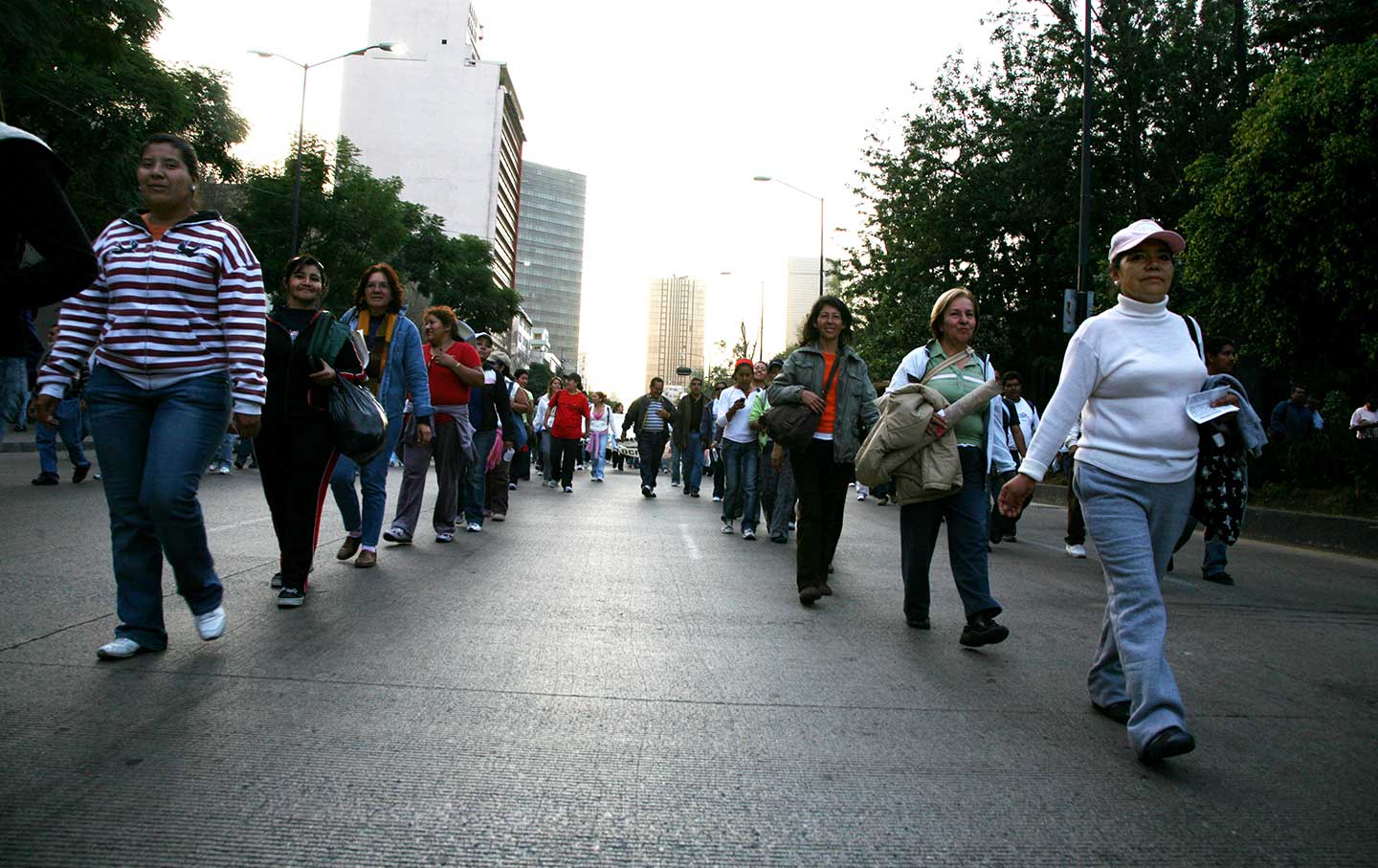
Teachers marching against education reform in Mexico City. (David Bacon)
Oaxaca—Since the killing of 11 demonstrators at a street blockade in the Oaxacan town of Nochixtlán on June 19, Mexico has been in an uproar over the use of force against teachers resisting corporate education reform. As the Mexican school year is starting, teachers and supporters in four states have refused to return to classes until there is a negotiated agreement to change the government’s program, and until the perpetrators of the Nochixtlán massacre are held responsible.
The government says it will not negotiate, and Mexico’s corporate leaders are demanding that the government use force to suppress the teachers and reopen the schools. The danger of further bloody confrontation is greater than ever.
The resisting teachers are concentrated in a highly organized network, the National Coordination of Education Workers (CNTE), within the National Union of Education Workers (SNTE), the largest union in Latin America. The CNTE now controls the union in four states: Oaxaca, Guerrero, Chiapas, and Michoacán. In other states, especially Mexico City, it has a large base of support. Teachers in assemblies in those four states voted on August 18 not to start classes on the 22. As of August 23, the government was claiming that over 90 percent of schools had opened. The CNTE says that over half of the schools in Oaxaca and Chiapas remain closed. Adelfo Gómez Alvarez, of the Chiapas teachers’ union, told the Mexico City daily La Jornada that “there were strikes and demonstrations in 28 states, including in Mexico City itself.”
Mexican President Enrique Peña Nieto declared: “There will be no more dialogue if we don’t guarantee beforehand that children can receive an education in their classrooms, which today are closed. First education, then dialogue.” Enrique Enriquez Ibarra, general secretary of Sección 9, Mexico City’s teachers union, responded that for a year teachers had tried negotiating with the government while continuing to stay in their classrooms, but the government didn’t budge. “Today we no longer believe in classes first and then dialogue. The teachers strike will continue,” he warned.
Mexican business interests began proposing changes to the country’s education system over a decade ago, as part of a series of economic reforms that have privatized much of the country’s economy and rolled back rights and protections that workers and farmers won decades ago. Supported by education reform groups in the United States and by the US Agency for International Development, these corporate reforms concentrate on standardized testing for students, and especially teachers. Testing is then used to eliminate educators’ job security and punish militant resistance.
“The real goal is privatizing education,” said Tranquilino Lavariega, a classroom teacher and general secretary of his union chapter in Santa Cruz Ocotlán, in Oaxaca. “These corporations see education as a business. And because our union has been part of the opposition to their growing power in Mexico’s Striking Teachers Stand Firm Against State Repression | The Nation:
 
Memorial to the disappeared students of Ayotzinapa in the teachers’ plantón in Oaxaca.(David Bacon)

FBI's Don't Be a Puppet game targets Muslim youth, teachers' union says | US news | The Guardian

FBI's Don't Be a Puppet game targets Muslim youth, teachers' union says | US news | The Guardian:

FBI's Don't Be a Puppet game targets Muslim youth, teachers' union says

Counter-terrorism program meant to dissuade teens from being radicalized leads to racial profiling and bullying, American Federation of Teachers argued

fbi dont be a puppet terrorism game
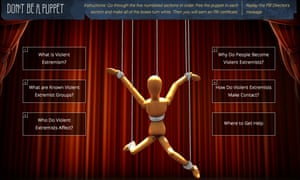
 The main screen of the FBI’s Don’t Be a Puppet online game on extremism, which was launched in February. Photograph: FBI


 A controversial FBI program targeting Muslim teenagers has drawn criticism from the American Federation of Teachers (AFT), claiming it leads to bullying and profiling.

The union, which represents 1.6 million teachers in the US, sent an open letter to FBI director James Comey earlier this month to call for an end to the agency’s Don’t Be a Puppet program which aims to prevent youth from being radicalized.
“What we saw with the Don’t be a Puppet program, was that it created this broad based suspicion of people based upon their heritage or ethnicity,” AFT president Randi Weingarten said.
Don’t Be a Puppet: Pull Back the Curtain on Violent Extremism is an online game the FBI launched in February. It is set in a dingy basement where students compete a series of tasks to liberate a puppet on strings.
“Increasing ideological policing and surveillance efforts like the Don’t be a Puppet campaign will have a chilling effect on our schools and immigrant communities,” the letter said.
Nineteen civil rights and community groups signed the letter including the National Immigration Law Center and the League of United Latin American Citizens.
Several Muslim community leaders previewed the game last year and were instantly incensed.
“It was pretty bad,” said Abed Ayoub, legal director of the American-Arab Anti-Discrimination Committee who was at the initial preview. “We felt that it really did target the Arab and Muslim community, and there was no room for it inside a classroom.”
ADC and other groups have actively spoken out against the game, which they say leads to bullying and profiling of Muslim students.
Following the meeting, the game’s release was pushed back but it was eventually rolled out in February, with some minor modifications.
It was met with ridicule and widely panned by gaming publications. In one game, users navigate a goat around virtual obstacles, and are rewarded with a sample text of the “distorted logic” foreign terrorists use to lure youth.
It remains unclear how many – if any – schools have adopted the program for use FBI's Don't Be a Puppet game targets Muslim youth, teachers' union says | US news | The Guardian:

In the eyes of the NLRB, charter schools are private, not public - Capitol Confidential

In the eyes of the NLRB, charter schools are private, not public - Capitol Confidential:

In the eyes of the NLRB, charter schools are private, not public 

Image result for In the eyes of the NLRB, charter schools are private, not public

Here’s an interesting item that touches on the semantics as well as labor issues surrounding New York’s charter school movement.
A recent ruling by the National Labor Relations Board (NLRB), concludes that charter schools are private and efforts to start teachers unions in them should fall under their purview, rather than the Public Employment Relations Board (PERB) which oversees the public sector.
The decision stemmed from efforts by the United Federation of Teachers (UFT) to unionize teachers at the Hyde Leadership charter school in Brooklyn.
PERB had asserted jurisdiction over the school, but the union ended up arguing that organizing efforts should be overseen by the NLRB which administers labor law in the private sector.
The NLRB in its decision, concluded that “Hyde was not established by a state or local government, and is not itself a public school.”
Being a federal agency, the NLRB would have precedence over the state PERB.
It wasn’t immediately clear if the charter operators would appeal to the courts.
But UFT’s affiliate, New York State United Teachers, on Thursday pointed out that the NLRB’s description of charters as private schools runs counter to the terminology that charter supporters often use in describing their institutions.
I don’t think anyone would bet that charter proponents will stop calling their establishments public charter schools. But this decision adds a new twist to this ongoing debate over the nature of charters.
NYSUT spokesman Carl Korn noted that charters tend to call themselves public schools when it’s convenient, such as arguing for more government funding.
But they see them as private when it comes to disclosure rules that apply to traditional public schools.
“The charter industry wants to have it both ways,” Korn said in an email.
“Charter management claims charters are public schools when they want taxpayers’ money, but use legal maneuvers to hide from public audits, seek to evade the rules that govern public pre-k programs and, in this case, claim they are private schools when it comes to union representational elections.”In the eyes of the NLRB, charter schools are private, not public - Capitol Confidential:
Here is the NLRB decision. The private/public discussion is on Page 8:

Diane Ravitch to Readers: Don't Let Charter Industry Silence John Oliver | Common Dreams

Diane Ravitch to Readers: Don't Let Charter Industry Silence John Oliver | Common Dreams | Breaking News & Views for the Progressive Community:

Diane Ravitch to Readers: Don't Let Charter Industry Silence John Oliver

Oliver was targeted by privatizers after criticizing charter schools in a segment of his HBO show


What do an education historian and a late-night comedian have in common?
Shared opposition to the fraud and abuse associated with charter schools and other privatization efforts, of course.
On Thursday, longtime educator and activist Diane Ravitch encouraged her readers to start a campaign of thanks to comedian John Oliver, who devoted a segment of his HBO showLast Week Tonight on Sunday to charter schools and fraud—and is now being targeted by privatizers and other corporate propagandists on Twitter.
Charter supporters are "saying that he 'hurt' children, he savaged children," she wrote, noting that this is "a familiar tactic" of intimidation that she faced after writing about dubious test-scoring methods in New York City school a decade ago.
Ravitch called on her readers to combat the hate by tweeting and emailing Oliver messages of support. "Don't let the charter industry intimidate him," she wrote.
Watch Oliver's segment below:

"Fraud is a feature of deregulation, not a bug," Ravitch added.
"When no one is looking, some people steal. Not everyone steals, but many do. That is why Ohio, Florida, Michigan, and California are scamming taxpayers. No one is demanding accountability. Politicians get paid off by charter friends, then cripple any effort to oversee them Ohio and Michigan spend $1 billion a year to subsidize charter schools, which are Diane Ravitch to Readers: Don't Let Charter Industry Silence John Oliver | Common Dreams | Breaking News & Views for the Progressive Community:

Thursday, August 25, 2016

A Brick In The Path (Promised Lands Are Never Promises Kept) | The Jose Vilson

A Brick In The Path (Promised Lands Are Never Promises Kept) | The Jose Vilson:

A Brick In The Path (Promised Lands Are Never Promises Kept)

Image result for A Brick In The Path (Promised Lands Are Never Promises Kept)


“Originally a biblical reference to the land of Canaan promised to the descendants of Jacob, The Promised Land represented a new physical space where the old social order would be dissolved and from which opportunity would spring. The Promised Land was geographic, political, and simultaneously corporeal and non-corporeal.”
From the beginning of the book Inequality In The Promised Land: Race, Resources, and Suburban Schooling, Professor R. L’Heureux Lewis-McCoy (Dumi Lewis, if you must) asks the reader to turn on their critical lenses and pick apart their assumptions about equity, specifically about the redeeming qualities of social class as a lever for anti-racism. He also asks us to suspend belief in a specific type of schooling and focus on the relationships between students and the various actors (and policies) that interact with the students. He asks us to use this suburban district case study as a model for any district where they ostensibly “have it figured out” but still show the same markers of inequity we see in more visible (i.e. urban) spaces.
He forgot to tell us to keep our feelings separate from the text. This book angered me, and I wish he told me sooner.
The book takes us through the inner workings of a district he dubs Rolling Acres Public Schools (RAPS), a suburban mixed-class school district where the population is mostly black and white racially. (NB: When I asked him which school district he was talking about, he said he hadn’t even told his wife. So, there’s that.) From the outset, he lays out the current research on school districts like these and disavows them at once. For example, he suggests that previous studies that just focus A Brick In The Path (Promised Lands Are Never Promises Kept) | The Jose Vilson:

Introducing NPE Grassroots Education Network - Network For Public Education

Introducing NPE Grassroots Education Network - Network For Public Education:

Introducing NPE Grassroots Education Network

State and Local Banner Grass and National

Dear friend and ally in the fight to save public education,
We would like to invite you to participate in an exciting Network for Public Education (NPE) service initiative, called the NPE Grassroots Education Network. We believe that it is our obligation to better serve allied groups in the struggle to preserve, promote, improve and strengthen our public schools. We are reaching out to leaders of local, state and national organizations across the country in order to foster communications and connections among groups that share common interests and concerns.
Your participation in the NPE Grassroots Education Network will not only help your organization reach more people who care about your issues, but we are confident that it will also serve to strengthen the national movement to save our schools.
What does participating in the NPE Grassroots Education Network mean for your organization? First and foremost, this is a service initiative on the part of the Network for Public Education. If you participate you are fully autonomous; your group is not a member or chapter of NPE. We will not charge you and we are not receiving a financial benefit for creating this initiative. We want to help you amplify your voice and forge alliances as we fight together to strengthen and preserve our public schools.
 Texas Grassroots Education Network - Network For Public Education - http://wp.me/p3bR9v-1O2

Virginia Grassroots Education Network - Network For Public Education - http://wp.me/s3bR9v-6951

Wisconsin Grassroots Education Network - Network For Public Education - http://wp.me/s3bR9v-6957

Tennessee Grassroots Education Network - Network For Public Education - http://wp.me/s3bR9v-6940

South Carolina Grassroots Education Network - Network For Public Education - http://wp.me/p3bR9v-1NQ

Rhode Island Grassroots Education Network - Network For Public Education - http://wp.me/s3bR9v-6928

Oregon Grassroots Education Network - Network For Public Education - http://wp.me/s3bR9v-6921

Ohio Grassroots Education Network - Network For Public Education - http://wp.me/p3bR9v-1Ns

North Carolina Grassroots Education Network - Network For Public Education - http://wp.me/s3bR9v-6905

New Hampshire Grassroots Education Network - Network For Public Education - http://wp.me/p3bR9v-1Ne

Introducing NPE Grassroots Education Network - Network For Public Education:


Introducing NPE Grassroots Education Network - Network For Public Education:

Eight new questions parents should ask at back-to-school night - The Washington Post

Eight new questions parents should ask at back-to-school night - The Washington Post:

Eight new questions parents should ask at back-to-school night


It’s the back-to-school-night season. That means ringing cellphones during the teacher’s presentation (because so many parents are too important to turn them off), attendees breaking the rules and asking specific questions about their own child, parents talking belligerently as if they know more than the teacher, and other such annoyances.
Despite all this, this is no time for parents to be quiet. They just have to ask the right questions — and insist on satisfactory answers.
Yes, parents can still ask teachers old-time questions such as, “How much homework do you give every night,” and “What are your goals for your students in this class?”
They can ask the teacher whether projects are assigned — and what happens if the teacher discovers that the parent, rather than the child, has actually put together 1,000 toothpicks in the shape of the Parthenon.
They can ask about useful education apps, whether their child can meet with the teacher after class, if there is differentiated instruction (assuming parents know what that is), whether students need to bring a computer to class and how to get in touch with the teacher.
And they can ask the following questions, courtesy of the Ohio BATS, a state affiliate of the national Badass Teachers Association, a group that started in 2013 to give voice to teachers tired of being made the scapegoats for problems in public education.
These questions reflect some of the main concerns that many teachers and parent activists have today, including standardized testing and student data privacy.Eight new questions parents should ask at back-to-school night - The Washington Post:

Shouldn’t Our Schools At Least be as Logical as Dental Floss? | gadflyonthewallblog

Shouldn’t Our Schools At Least be as Logical as Dental Floss? | gadflyonthewallblog:

Shouldn’t Our Schools At Least be as Logical as Dental Floss?

Girl-flossing1
All my life I assumed flossing was essential to dental health.
It was safe, it was sound, it was normal.
Every day after brushing, I would stand before the bathroom mirror and carefully thread a mint-flavored filament through my teeth – like a chump.
And when I got to the dentist, I’d comfort myself that I had done the best I could to prevent cavities.
The hygienist would remove plaque and germs while scraping and sawing at my teeth with a specialized hook, and all the while I’d think, “At least I flossed every day!”
Yet now the federal government tells us that flossing is ineffective at best!
What!? After all these years!?
It turns out, there just is no evidence that flossing actually helps – never has been. So this summer for the first time in decades the good folks who compile federal dietary guidelines decided not to recommend the practice.
A total of 25 studies have concluded that the evidence for flossing is “weak, very unreliable,” of “very low” quality, and carries “a moderate to large potential for Shouldn’t Our Schools At Least be as Logical as Dental Floss? | gadflyonthewallblog:


New book: Obama’s Education Department and Gates Foundation were closer than you thought - The Washington Post

New book: Obama’s Education Department and Gates Foundation were closer than you thought - The Washington Post:

New book: Obama’s Education Department and Gates Foundation were closer than you thought

Image result for big education ape will the real education secretary please stand
Megan E. Tompkins-Stange is an assistant professor of public policy at the Ford School of Public Policy at the University of Michigan who has written a highly revealing book about the power and influence of four major foundations in education-reform policy in recent years.
She researched “Policy Patrons: Philanthropy, Education Reform, and the Politics of Influence” over several years, in which she was given access to officials in four foundations — Bill and Melinda Gates, Eli and Edythe Broad, Ford, and W.K. Kellogg—  as well as permission to quote people without attribution.
It would, of course, be better to know exactly who said what, but Tompkins-Stange is able nonetheless to give enough context so that the power of the words she recorded from 60 interviews contributes to the overall narrative. “Policy Patrons” looks at the effect of the unprecedented philanthropic engagement in public education reform during the Obama administration and raises questions about whether democracy is usurped when private individuals use their fortunes to bend public policy to their own priorities.
Regular readers of this blog know that some wealthy foundations — especially the Bill and Melinda Gates Foundation, the world’s largest, but also the Eli and Edythe Broad Foundation — have in recent years taken unusually active roles in trying to align public policy with their education goals, such as the Common Core State Standards and charter schools.
Indeed, the involvement of foundations in corporate school reform — which, broadly, has been an attempt to change public education to operate like a private business rather than as a civic institution — has been unprecedented in the history of American public education. Tompkins-Stange wrote: “Arguably, no social sector in the United States is more heavily impacted by foundations than K-12 education.”
To understand just how influential the Gates Foundation has been with the Obama administration in terms of education policy, consider this passage from the book, which refers to Arne Duncan, Obama’s education secretary from 2009 to the end of last year:
Gates’s cultivation of relationships with elites extended beyond local and state contexts and into the federal government. Several interviewees cited the appointment of President Obama’s Secretary of Education, Arne Duncan, former superintendent of the Chicago Public Schools, as a turning point. The reason was that Duncan’s staff appointments were often either former Gates officials or former Gates grantees. One respondent noted, “Once Obama was elected, I mean, Gates literally had people sitting at the Department of Education both formally and informally.” These officials included Jim Shelton, Assistant Deputy Secretary for Innovation and Improvement and former Program Director for the Education program at Gates, and Joanne Weiss, director of the Race to the Top competition and a former partner at the NewSchools Venture Fund, a major Gates grantee that served as an intermediary funder for charter school management organizations. With President Obama in office, federal staff engaged current Gates officials in key discussion of importance regarding education priorities. As one respondent explained:
It gives you a notion of where the field is moving, because they have regular sessions or phone conversations between funds and the Department of 
New book: Obama’s Education Department and Gates Foundation were closer than you thought - The Washington Post:


Jersey Jazzman: Charter Schools: A Few Bad Apples, Or a Whole Barrel?

Jersey Jazzman: Charter Schools: A Few Bad Apples, Or a Whole Barrel?:

Charter Schools: A Few Bad Apples, Or a Whole Barrel?


Charter school advocates are not happy about John Oliver's last show, in which he documented the many problems with charter schools:


Profit-taking, corruption, lack of transparency, mediocre-to-poor performance... doesn't sound like "freedom from the education bureaucracy" is all that great after all.

Predictably, the professional charter cheerleaders rushed to disavow all that Oliver had uncovered. Here a statement from the National Alliance for Public Charter Schools, as reported by Valerie Strauss in The Washignton Post [all emphases in this post are mine]:


“The August 21 episode of Last Week Tonight with John Oliver examined the critical importance of strong charter school authorizers and laws. The program began by spotlighting one of the thousands of high-performing charter schools that are opening doors of opportunity for students – especially those living in low-income communities. High-quality charter schools like these are the norm, giving families access to local, public, and effective educational options in communities where traditional district schools aren’t meeting the needs of students.
“Most of the program focused on charter schools in three states that were engaged in practices that were either questionable or unethical. These practices are unacceptable, but are not representative of charter schools nationwide. Furthermore, many of the examples featured are years-to-decades old, and fail to reflect the significant progress that the charter school movement has made in the areas of oversight and accountability.
Nelson Smith, Senior Adviser to the National Association of Charter School Authorizers and former CEO of the National Alliance for Public Charter Schools, feels likewise:

If this stuff were actually typical of charter schools, I would have bailed out of the movement years ago. But it’s not, and I haven’t.
Now, the writers at Last Week Tonight probably aren’t statisticians, but this is known as an Unrepresentative Sample. Except for a brief nod to KIPP’s graduation rate, the entire segment was a parade of horror stories, including one dredged up from 2010. Not since Dick Cheney got hold of the Iraq briefings have we seen cherry-picking on this scale.
Why, it's just not fair for Oliver to focus on the "bad apples" -- look at KIPP! It's thereal representative of the charter sector! Sure, we need to get rid of those few bad actors, Jersey Jazzman: Charter Schools: A Few Bad Apples, Or a Whole Barrel?:

John Thompson: John Oliver highlights criminal charter school activities - NonDoc

John Oliver highlights criminal charter school activities - NonDoc:

John Oliver highlights criminal charter school activities

Image result for big education ape charter school crime watch


(Correction: This post has been updated as of 11:26 a.m. on Aug. 25 to properly cite Ohio’s State Auditor as David Yost.)


In his recent Last Week Tonight piece, John Oliver knew he might anger both sides of the charter school wars by saying he would not tackle the substance of whether charters, in principle, are a good idea.
Oliver limited his comedy routine to the question of overseeing these publicly funded, privately run institutions that have divided educators and patrons. He only had time to address the funnier scandals in four states, such as the Philadelphia elementary school which co-located with the unlicensed and illegal “Club Damani,” and collected $5 million in public money before the proprietor was busted for embezzlement.
Charters have application forms as long as 400 pages, but many don’t hold themselves as accountable as they do their patrons. Oliver cites mid-year closures without warning throughout the nation, the 14 (of the 119 closed Florida charters) that never made it through their first year, and a chain responsible for 32 of the lowest-performing schools in Ohio. Its leader affirmed, education is “first, last, and always, a business.”
Ohio GOP Gov. John Kasich echoed the party line on the cleansing power of competition, saying schools are “just like a pizza shop.” If you want more pepperoni per slice, you need a second pizza shop.
A convicted charter superintendent justified her crimes by quoting Proverbs, and the need for “vision.” She said her students were inspired by the travels and the trappings she purchased with ill-gotten gains.
Some states try harder to provide accountability, but it’s difficult to oversee schools that are parts of “nonprofit” charter management organizations that bill the specific schools in notoriously opaque ways. One school’s fees came to $1 million, as did its bill of $1 million to the taxpayers for serving 459 students. Only about thirty students actually attended class.
Cyber charters are even more impossible to regulate (as Oklahoma has seen) and they cost $1 billion a year. They might not take attendance but still be allowed to report a 100 percent attendance rate. Students in one cyber charter lost 180 days of math learning during a 180 day school year.
Oliver mocks the Ohio governor, concluding that charters need as much regulation as a pizza shop.
However, I’d leave the last word to Ohio’s State Auditor, David Yost. Yost is supposed to be “the independent, disinterested official who guards the public interest.”
But, he told the Charter School Summit: “We in the charter movement must John Oliver highlights criminal charter school activities - NonDoc:

What’s So Bad About Educational Technology? Beware The Poverty Pimps! – Exceptional Delaware

What’s So Bad About Educational Technology? Beware The Poverty Pimps! – Exceptional Delaware:

What’s So Bad About Educational Technology? Beware The Poverty Pimps!


Ed Tech.  It is everywhere.  Like the Vikings of yesteryear, it is invading every classroom in America.  It is pillaging the public education village.  For the Vikings, this was their way.  It was all they knew.  But for the Poverty Pimps, the companies who profit from students with the justification of fixing education for poor kids, it is disturbing on many levels.  If this technology is used in moderation and for the sole benefit of increasing the ability for students to learn, that would be one thing.  But companies are making billions of dollars off of our kids.  Even worse, the privacy of our children’s information is suspect at best.  One mom from Pennsylvania, Alison McDowell, has looked into all of this and she has found out a lot about what is going on with this aspect of the Ed Tech Boom.
A Skeptical Parent’s Thoughts on Evaluating Digital Learning Programs
With the school year beginning, questions about digital learning programs and computerized behavior management programs have started to pop up in my feed. Is X program ok? How about Y? Concerned parents are scanning privacy policies and trying to figure it all out. What does this mean for MY child?
As someone who took a symbolic stand and opted her child out of Google Apps for Education last year (and she didn’t seem to come out any the worse for wear for it BTW), I’d like to share my current thinking on this topic. I am not a Luddite, but I am concerned that rather than being taught to use and control technology, many children (especially children in turn-around or transformation schools) are increasingly being put into the position of being used BY technology to further the interests of for-profit cyber instruction and workforce development. I’m sharing my thoughts in the hope of opening up a discussion and to see where other folks are in this brave new world.
For me the bottom line is this: Does the technology under consideration empower students to be the creators of the content? Is the power with THEM?
If the answer is “yes,” then it shouldn’t depend on tracking personalized data to function properly. Sure kids should be able to work on a project, save it, and go back to it, but online monitors shouldn’t be tracking all their data. Students own What’s So Bad About Educational Technology? Beware The Poverty Pimps! – Exceptional Delaware:

Where Has All The Money For Our Schools Gone? | PopularResistance.Org

Where Has All The Money For Our Schools Gone? | PopularResistance.Org:

Where Has All The Money For Our Schools Gone?


New government spending data could reveal how tax breaks for big businesses leave K-12 school funding out to dry.

State and local governments give away at least $70 billion a year to business subsidies, most of it in foregone tax revenue. Local property taxes are the most significant tax most corporations pay. In most communities, they’re also the backbone of local school finance.
So when subsidies slash corporate property taxes, our schools often get hurt the most.
In Chicago, for example, we already have a glimpse into the unsavory relationship between tax subsidies and school finance. Last year, one subsidy program alone cost public services $461 million. Meanwhile, the city’s schools are facing a budget that is $140 million less than they had last year.
When cities line the pockets of powerful interests with subsidies while short-changing children, they harm everyone — including businesses that depend on a well-educated work force.
Unlike Chicago, in most cities it’s difficult to calculate exactly how much state and local tax subsidies drain from a given school district. But that’s about to change.
Starting next year, the Governmental Accounting Standards Board will require more than 50,000 government bodies to report how much tax revenue they’ve lost to economic development tax breaks given to developers and corporations.
Though school districts, library districts, and other special purpose districts seldom have a role in awarding these subsidies, they too will be required to report how much revenue they’ve lost lost—even as a result of tax breaks handed out by other governmental bodies.
This new data will also shine a light on inequities in education, allowing new critical examination of whether tax breaks that fill corporate coffers come disproportionately at the expense of the most disadvantaged school districts.
This way, we can say no to deals that pad the profits of the already wealthy at the cost of denying opportunity to those looking to get a foot on the first rung of the economic ladder.
Some states are already following the logic of this new common sense standard. In a 2011 budget deal, California decided to phase out an expensive subsidy granted by redevelopment agencies, and as a result, paved the way for local property tax revenues to rise by 10-15 percent in coming years. These added revenues will allow cities and towns throughout California to increase funding for local priorities—including schools.
Soon, we’ll all have a much better idea about where the funding for schools throughout the nation has gone. Parents and teachers clamoring for smaller class sizes and more support services will have the data to back their demands.
And taxpayers will be able to debate whether costly, long-term tax breaks that often go to the most prosperous businesses in town have been worth the cost of struggling schools.
As we look ahead to the new school year, it’s time to hold our governments and schools accountable to meet student needs. The data is coming soon that will help us get there.

 Where Has All The Money For Our Schools Gone? | PopularResistance.Org:

CURMUDGUCATION: PA: Open Letter To My Legislators

CURMUDGUCATION: PA: Open Letter To My Legislators:

PA: Open Letter To My Legislators


To Senator Scott Hutchinson and Rep. R. Lee James 

Dear Scott and R. Lee:

It is long past time to regulate the cyber charter school industry in Pennsylvania.

Perhaps you saw the news yesterday that Nicholas Trombetta finally pled guilty to federal tax conspiracy charges. Trombetta was the founder of the Pennsylvania Cyber Charter School in Beaver County, a business that he used to steal at least $8 million dollars of Pennsylvania taxpayer money and spend it on things like a condo and an airplane as well as finance various real estate deals.

This was done with money that came from taxpayers, but money that was intended for schools. As you both know from your own home districts, many school districts have been hard hit by cyber charter tuition payments, prompting lost programs and closed buildings to help deal with financial struggles. It is adding insult to injury to see that some of those dollars did not go to educate students in another school, but to finance some charter operator's condo.

You may well ask, "Well, isn't it worth some risk if the cyber charters do a good job?" But at this point, we know they don't. A study by the Center for Research on Education Outcomes at Stanford University (CREDO), a research group that is generally in favor of education reform, found that cyber charters have an "overwhelmingly negative impact" on student achievement, finding that a year in a cyber charter left math students 180 days-- a full year-- behind their peers.

You may hear from charter advocates and lobbyists (of which there are apparently many in Harrisburg) that any oversight of cyber charters will stifle creativity or business flexibility. But even the National Alliance for Public Charter Schools has released a report calling for tighter controls and more accountability for cyber charters. 

The time has long passed for cyber charter accountability. Governor Wolf's recent call for charter accountability is nothing more than a requirement that taxpayer dollars that flow to charters be given the same oversight than the taxpayer dollars that flow to public schools. As a taxpayer, I can walk into my local school district office and demand a look at the budget. What a public school district does with taxpayer dollars is public information. Why should cyber charters not have to similarly account for the use of tax dollars? Tax dollars used by a public school enter a transparent fishbowl, while tax dollars used by cyber charters enter a black box. Why?

The cyber industry has actively fought any kind of accountability. In Ohio, cyber charter operator ECOT is suing the state to keep from having its attendance audited. In Pennsylvania, cyber charters complained when their revenue stream was threatened, but have made no offers for greater transparency or accountability.

The cyber charter industry of Pennsylvania is a financial drag on public schools, and provides no value or accountability for the tax dollars it collects. Oversight is so lax that the industry is ripe for exactly the sort of corruption that we saw acknowledged yesterday-- and that was in a federal, not a state, court.

It is time for Pennsylvania to hold cyber charters at least as accountable as they hold traditional public schools-- and not as part of some bill that gives cyber charters more freedom to grow in exchange for the appearance of accountability. It is time for taxpayers to be able to see what cyber charters do with the money that is taken from local school districts. It is time.

Sincerely,

Peter Greene 

Note to any of my PA readers-- you can contact your legislator through this website. If you can't think of what to say, feel free to cut and paste from here.


 CURMUDGUCATION: PA: Open Letter To My Legislators:

State shifts policy to allow longer term substitutes :: SI&A Cabinet Report

State shifts policy to allow longer term substitutes :: SI&A Cabinet Report :: The Essential Resource for Superintendents and the Cabinet:

State shifts policy to allow longer term substitutes

State shifts policy to allow longer term substitutes


(Calif.) Although school administrators in many parts of the state continue to struggle with the ongoing teacher shortage, some relief is being offered with the relaxation of rules governing long-term substitutes.
As of this month, replacements will no longer be held to a maximum of 30 consecutive days when substituting for the same teacher in a general education classroom or 20 consecutive days for the same special education teacher.
Under new regulations approved by the Office of Administrative Law, school administrators will be able to assign a substitute to lead a classroom for the full duration of the teacher of record’s leave as long as the absence is one protected in statute.
The new regulations took effect on August 16.
Although the state does not collect data on the number of teachers that take long-term leave, recent reports from districts suggest that the numbers are significant and growing.
The option comes as the education community has seen a big drop-off in the number of new recruits entering the teaching profession and as scores of baby boomer veterans begin retiring.
Complicating the landscape are teachers that need to take long-term leaves, typically for health reasons. Under the prior rules, schools were forced to juggle substitute assignments for even the most routine absences.
A new mother, for instance, who takes the maximum four-month maternity leave allowed under state and federal law, required three different substitutes to be shuffled in to cover her class, according to the Commission on Teacher Credentialing.
A more complex problem, such as a work-related injury that can last 60 days, could require as many as eight different substitutes to cover, according to testimony before a legislative panel last fall.
The new regulations, detailed in a correspondence released this week by the CTC, provide for a substitute to serve for the entire length of a qualified leave taken by the teacher of record under certain conditions.
For one, substitutes must receive a new state permit that requires some training beyond what regular substitutes must have. Also, the type of leave taken by the teacher of record must be one already identified in state law as one that districts are required to approve.
Thus, differential sick leave gives the teacher of record five months leave under state law, the pregnancy disability leave provides four months, while family medical leave requires a teacher to be off at least 12 work weeks.
The new rules are the result of more than two years of study and debate. The CTC organized a stakeholders group in 2014 to take up the question, with representatives of both labor and management organizations, including the Association of California School Administrators, the California County Superintendents Educational Services Association, California Federation of Teachers, California School Boards Association and the California Teachers Association.
The commission also conducted a survey that drew almost 800 responses from a variety of county and local representatives. An overwhelming number, almost 83 percent, said they had experienced staffing issues related to statuary leave, according to a staff report.State shifts policy to allow longer term substitutes :: SI&A Cabinet Report :: The Essential Resource for Superintendents and the Cabinet:
 District boundaries help maintain cycles of poverty :: SI&A Cabinet Report - https://www.cabinetreport.com/human-resources/district-boundaries-help-maintain-cycles-of-poverty